IS the U.S. Taking Over the 5G Network?


A 5G network owned by the United States government? It’s not going to happen.

The U.S. government considering its own 5G network is nothing new, frightening, or likely to happen.

Could the Trump White House be pondering a nationalized 5G network? Yes, it’s distinctly possible. But it’s also highly unlikely to happen and the story is being blown dramatically out of proportion.

The latest Twitterverse kerfuffle was kicked up by an Axios report alleging consideration of “an unprecedented federal takeover of a portion of the nation’s mobile network to guard against China”. That’s an alarming claim, no matter what side of the political aisle you’re on. Axios is a relatively new publication, but they’ve made a name for themselves since their 2016 launch with a number high profile exclusives and well-sourced and researched pieces. This 5G report is well-sourced, but also takes a number of alarmist steps that ignore how the U.S. federal government actually functions.

Image result for 5g photo

Here’s what Axios is reporting:

We’ve got our hands on a PowerPoint deck and a memo — both produced by a senior National Security Council official — which were presented recently to senior officials at other agencies in the Trump administration. … The documents say America needs a centralized nationwide 5G network within three years.

Axios goes on to describe two options laid out in the report: that the government builds its own 5G network or that the various competing carriers in the US build their own. It’s worth noting that this is a proposal made by a single NSC member. This is how the government is supposed to work. The NSC is just one of many competing interests in the federal government, and its mandate is to advance strategies to maintain and enhance the security of the United States. It would indeed be in the national defense interests of the U.S. military to have a government-controlled high-speed low-latency nation-wide wireless network — rapid and clear communication is vital for successful military operations, and a 5G network would be enormously useful in that.

But… the NSC is still just one of many loud voices in the United States government. The Departments of State and Commerce and Justice would all have competing opinions on the proposal for a federal network, from international trade implications to pushback from the carriers that spend billions on lobbying. Not to mention the cost of such an endeavor.

Image result for 5gphoto

There is historical precedent for large investments that would support both military operations and civilian needs. The Interstate Highway System was funded by the federal government not just to dramatically improve inter-state travel and commerce — the primary impetus for its creation was the need to be able to quickly deploy military force throughout the United States in the event of a foreign invasion. The constellation of GPS satellites we rely on for navigating the world today is a U.S. Air Force project that was originally built for military purposes (and the government still has a switch to downgrade GPS accuracy for non-U.S. military users if deemed necessary).

Talk of a federally owned communications cellular network has been going on for decades, but it was kicked into high gear after the September 11, 2001 terrorist attacks. The strikes on New York City and the Pentagon didn’t just reveal the unpreparedness of the United States for such an unsophisticated attack — it also exposed weaknesses in the civilian-owned and operated cellular networks of the time. On that day the cellular networks in New York and DC were overwhelmed by the sheer number of users trying to access services — and that was well before today’s high-speed wireless internet services.

The biggest pushback would come from cellular network operators. Every U.S. carrier has already invested heavily in 5G, from research to live regional tests to making preparatory upgrades to their transmission infrastructure to handle the eventual roll-out of 5G-capable transceivers and consumer devices. Billions of dollars have already been laid out with the expectation that there will be much more invested in the networks and billions more reaped in profit. You can be certain that Verizon, AT&T, T-Mobile, and Sprint have already contacted their lobbying firms to communicate their displeasure.

Specialized equipment has long been a part of the military’s inventory. Just this weekend the story of expensive new refrigerators for Air Force One provoked outrage once the context of what the purchase actually consisted of (five bespoke flight-grade walk-in cooling units to store up to 3,000 meals on what is essentially a flying White House). Equipment like tanks and aircraft carriers and grenades is all exclusively manufactured for the military, to its specification. But the military has long also used off-the-shelf civilian hardware when it meets its needs and costs. Walk into the Pentagon and you’ll find government-issued HP and Dell laptops and officers walking around with issued iPhones running on Verizon and AT&T.

The United States has long had an interplay between the needs of the federal government and the civilian population. Sometimes there are things that only the government could effectively fund, organize, and operate, like the interstate system or GPS satellites. The costs behind those become easier to justify when they’re also available to civilian users. Conversely, there are things the civilian market is far better at — AT&T, Verizon, Sprint, and T-Mobile all have enormous expertise in cellular networks, they’ve already made huge investments in their network infrastructure that they’ll be able to leverage in building their 5G networks, and they’re already responsive to the needs of their customers — both civilian and government.

This proposal was dead in the water before it was ever presented. It’s almost amusing, following the Trump administration’s push against Net Neutrality being framed as unleashing the potential of web services and internet providers, to now see a proposal to create a national 5G network that the government would then lease to the carriers.

It’s worth repeating: this is just a proposal from one part of the government. Axios notes that it was already presented to other agencies, where I have no doubt it was met with significant resistance, if not outright derision. After all, the Trump government is supposed to be one that gets out of corporate business (for better or worse), and “we’re going to build a 5G network and you’ll just rent access from us because we’re the federal government” runs 100% counter to that.

There’s much the government could do to promote and accelerate the development and deployment of 5G networks in the United States, though it’d have to come with oversight than the billions of government subsidies paid to Verizon for a fiber network it never built. Grants to ensure deployment into rural areas, subsidies for low income access, regulation clean-up to ease the way for new installations, funding of university and corporate research projects in artificial intelligence and domestic development of these technologies — all of this is already within the wheelhouse of what the federal government can do, and sometimes already does.

Proposals like this are just how the government works. The military side of the equation is going to propose everything they can think of to ensure the most efficient and most effective military they can imagine, while the diplomats will propose their own missions and initiatives to promote their goals, and the economists are going to come with an entirely different set of proposals about trade and monetary policy and financial regulations. These will all be simultaneously complementary and contradictory. This is the nature of government — a dozen departments with competing goals in different arenas jockeying for limited resources. Their proposals are just part of what feeds into the decision-making process of the President and Congress, which are supposed to strike a balance between the needs of the military, business, international partners, civilians, and (of course) politics.

I would be utterly shocked if a government-owned 5G network ever comes to fruition. It’d be massively expensive and inefficient, not to mention well outside the government’s expertise and capability. It’d also see immediate and costly legal challenges, not to mention stand on legally tricky ground when the carriers have already paid billions to the government for the frequency licenses they need to deploy their own 5G networks.

The government would also have to pay for this somehow, and after a $1.5 trillion-dollar tax cut, there’s not a lot of spare cash laying around for GovCell.

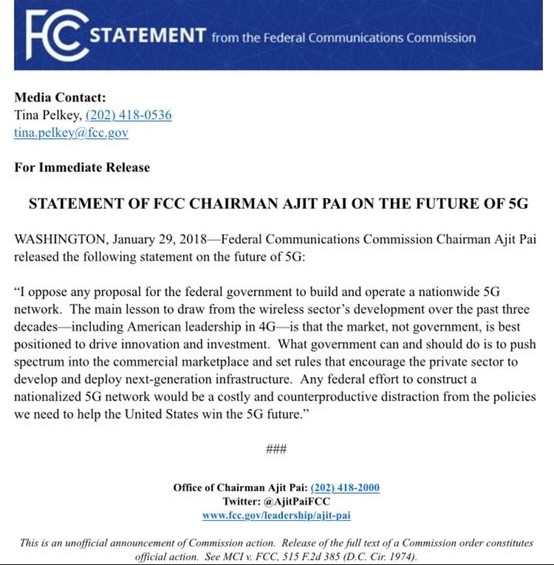
Updated 10:33 a.m. Jan. 29: Here’s a statement from FCC Commissioner Ajit Pai, who also says it ain’t gonna happen:

“I oppose any proposal for the federal government to build and operate a nationwide 5G network. The main lesson to draw from the wireless sector’s development over the past three decades—including American leadership in 4G—is that the market, not government, is best positioned to drive innovation and investment. What government can and should do is to push spectrum into the commercial marketplace and set rules that encourage the private sector to develop and deploy next-generation infrastructure. Any federal effort to construct a nationalized 5G network would be a costly and counterproductive distraction from the policies we need to help the United States win the 5G future.”

SECDEF Rumsfeld’s Thoughts on September 10, 2001

SecDef Said Biggest Threat on 9/10/2001: Pentagon Bureaucracy

Archive FOIA Lawsuit Wins Monthly Releases Thanks to Pro Bono Representation by Skadden Arps

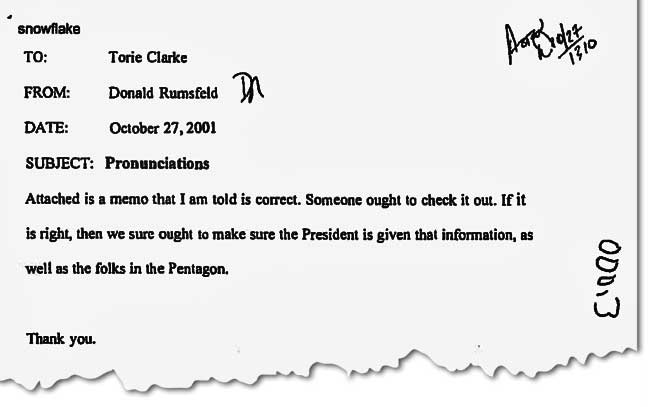
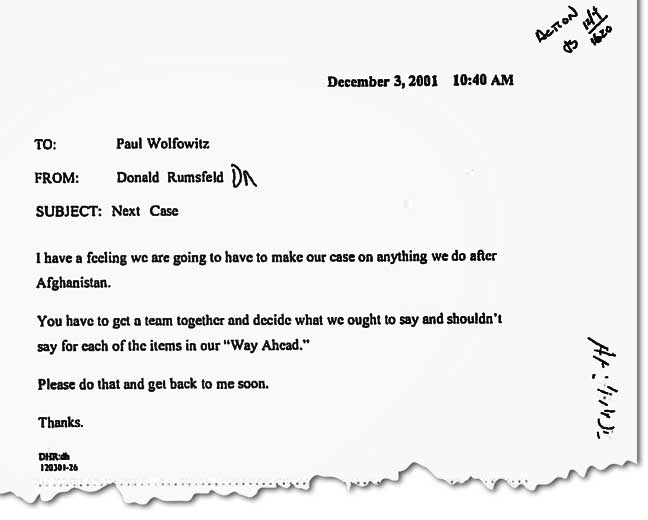
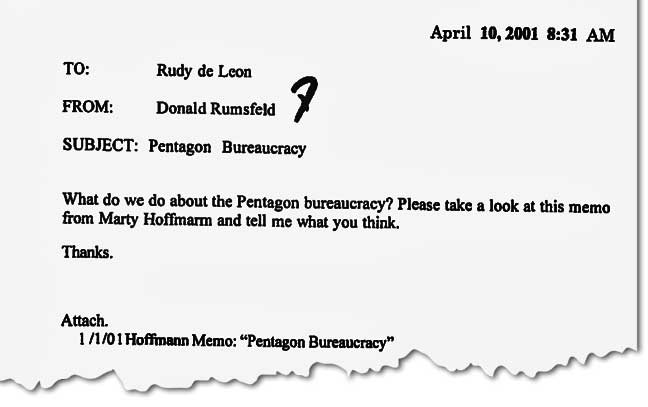
Washington D.C., January 24, 2018 – On the day before September 11, 2001, Secretary of Defense Donald Rumsfeld believed the gravest threat to American national security was Pentagon bureaucracy, according to “snowflakes” he wrote that were released by the Defense Department after a five-year Freedom of Information Act fight and lawsuit by the National Security Archive.

At 10:15 AM on September 10, Rumsfeld authored a snowflake – the term used to describe his usually one-page, often one-sentence, memos that he sent to his underlings to ask a question or issue an instruction – bemoaning the quantity of DOD agencies, surgeons general, inspectors general, judge advocates general, Congressional Relations functions, and Public Affairs functions.  He concluded the memo by asking, “Is this all really necessary?”  In a separate September 10 item, he pondered abolishing the Armed Forces Staff College.

The same day, Rumsfeld gave a speech warning, “This adversary is one of the world’s last bastions of central planning.  It governs by dictating five-year plans.  From a single capital, it attempts to impose its demands across time zones, continents, oceans, and beyond….You may think I’m describing one of the last decrepit dictators of the world [but] the adversary’s closer to home.  It’s the Pentagon Bureaucracy.”

The September 10 memo is one page out of an estimated 59,000 pages the Pentagon has begun to provide in segments to the Archive in response to its FOIA suit.

The next snowflake in the corpus is dated September 12, 2001.  In it, Rumsfeld instructs, “Someone ought to be thinking through what kind of an event we are going to have for the people who died here.”  In the aftermath of the September 11, 2001 attacks, the Pentagon budget expanded from 325 billion in FY 2001 to 447 billion in FY 2006 and military personnel estimates rose from 76,888 to 111,286 during the same period, ending Rumsfeld’s war on bureaucracy.

Rumsfeld eschewed modern email communication and used paper and ink instead, because he believed it was much easier to keep paper on file and track the progress of his dictums and queries.   Though quick for Rumsfeld to dictate or type, these memos requesting actions, position papers, or research were a significant burden on Pentagon employees, growing, in Rumsfeld’s own words, “from mere flurries to a veritable blizzard.” According to Washington Post reporter Robin Wright, one of the first to disclose Rumsfeld’s use of snowflakes, it was not uncommon for him to send up to 60 snowflakes on a given day.

Rumsfeld began publishing a relatively small subset of these snowflakes to publicize his 2011 memoir Known and Unknown.  The DOD release of these documents to Rumsfeld caused a stir among researchers and historians whose FOIA requests for the same material, made years earlier, continued to languish in the DOD queue.  In June of 2011, the Archive filed a FOIA request for the entire body of snowflakes.  Six years later, not having received a single snowflake from that request, the Archive filed a Freedom of Information Act lawsuit against the Department of Defense.

Represented pro bono by the firm Skadden, Arps, Slate, Meagher & Flom, the Archive filed its complaint on March 17, 2017.  Skadden attorneys Melissa Smith, Cliff Sloan, and Gregory Craig of Skadden Arps, had the pleasure of hearing the Department of Defense attorney Mark Harrington confess at an August 7, 2017, hearing, “As far as the delay in the initial response to the request, all I can do is fall on our sword; that was too long.”  Judge Tanya S. Chutkan agreed, calling the DOD six-year delay “unconscionably long.”

The Department of Defense is now releasing the snowflakes on a rolling monthly basis.  In addition to highlighting particular items, the Archive is posting them in their entirety online as they become available to us on a special section of our website named “Rumsfeld’s Snowflakes.”

The full corpus of snowflakes is a critical historical resource.  The snowflakes serve as a sort of ultimate Pentagon chronology, touching on such diverse DOD issues as staffing, Rumsfeld’s personal requests, advice from such notables as Frank Gaffney and Newt Gingrich, communications from Rumsfeld to President George W. Bush, relations with Russia, China, and other nations, and the DOD’s strategy and conduct in the wars in Afghanistan and Iraq.

On this page, peruse a selection of snowflakes the Archive found notable, then explore the first full release, with more to come!  Finally, tweet other notable releases using the hashtag #rummysnowflakes.


snowflakes-13.jpg
snowflakes-51.jpg
snowflakes-54.jpg


The U.S. has a Russian Problem, but it is Worse in the UK

Remember the polonium death in Britain? There was a chilling documentary about it. The case still rolls on.

Image result for Aleksandr Litvinenko photo

The United Kingdom has frozen the assets of two Russians accused of carrying out the 2006 killing in London of former Federal Security Service officer Aleksandr Litvinenko.

London on January 22 issued the order to freeze the assets of Andrei Lugovoi and Dmitry Kovtun under the terms of the Antiterrorism, Crime, and Security Act of 2001.

Dmitry Kovtun (left) and Andrei Lugovoi have denied any involvement in Aleksandr Litvinenko's death. (combo photo)

On January 21, Judge Robert Owen, who chaired the British government inquiry into the Litvinenko killing, said he was certain Lugovoi and Kovtun killed Litvinenko by placing a lethal dose of polonium 210 in his tea during a meeting on November 1, 2006.

Litvinenko, who was an outspoken critic of Russian President Vladimir Putin, died several days later.

Both men deny any involvement in Litvinenko’s death. However, British investigators found traces of polonium 210 in hotels, restaurants, and aircraft used by Lugovoi. Lugovoi was reportedly treated for radiation poisoning in Moscow in December 2006.

Lugovoi, a former Soviet KGB agent, was elected a member of the Russian State Duma in 2007. Putin awarded him a state medal “for services to the motherland” in 2015. Hat tip

Meanwhile, we have the case of Andrey Borodin that lives in Britain and he is a wanted man by none other than Vladimir Putin.

Mr Borodin, who is sought by Moscow on fraud and corruption charges, which he strongly denies, and who was granted asylum in February, told The Independent: “Given that my successful application for asylum in the UK included all details of the Russian criminal investigations and argued that they are politically motivated, I now believe that the Russian authorities are via the media trying to lend credibility to their claims by referring to the Swiss investigation.”

He added: “My lawyers are engaging with the Swiss authorities and I am confident that a satisfactory conclusion will be reached in the not too distant future.”

It emerged in April that Mr Borodin was the target of a potential assassination plot involving a hitman who claimed to have been approached by Chechen political figures and offered as much as £600,000 to kill him in Britain.

The banker, who is a close ally of the former mayor of Moscow Yury Luzhkov, arrived in Britain in March 2011 after a warning that, following years of lucrative success negotiating Moscow’s treacherous nexus of business and politics, his star was on the wane.

The details of the assassination plot, brought to the attention of MI5 after the hitman pulled out of the deal, were considered to be credible. More chilling details to the story here.

So why do should we care? Perhaps the pressure of nefarious Russian plots and history would explain much of the goings-on in the U.S. political architecture…right? Russia, Russia, Russia….everywhere.

Yes…it seems that Andrey Borodin has hired a U.S. lobby firm, BGR Government Affairs to represent him. The filing form is here. Apparently at issue is a visa problem and well the case is assigned to  Haley Barbour, former Mississippi governor and Republican National Committee chair, and Maya Seiden, a former State Department aide under Secretary Hillary Clinton.

Related reading: Russia posing most complex challenge since Cold War: UK army chief 

In another meanwhile, after the unchallenged Hillary Clinton scandal of Skolkovo and Silicon Valley, there is yet another operation underway.

(Reuters) – Masha Drokova, a 28-year-old Russian political activist turned venture capitalist, on Tuesday joined a small family of Russian nationals who have set up shop as Silicon Valley venture investors.

Drokova’s new firm, Day One Ventures, will make investments of $100,000 to $1 million from a fund that initially totals nearly $50 million, a person familiar with the matter said. Drokova hopes her experience as an angel investor and a prior career in public relations will give her edge.

“Masha knows a lot of people,” said Serguei Beloussov, a senior investing partner at venture firm Runa Capital and who worked with Drokova until 2014. “She is good in that she gets access to very good startups.”

Drokova’s new fund comes as relations between the United States and Russia remain fraught and foreign investments of all types into U.S. technology companies receive more scrutiny.

She is following the lead of several other Russian investors who say that being based in the United States – and raising money from wealthy individuals rather than institutions – helps them get better access to startups and curtails concerns about the source of their money, even if some of it still comes from Russia.

Close to 20 percent of Runa Capital’s $135 million fund comes from wealthy Russian individuals, said Beloussov, who is Russian-born but now a Singapore citizen. Silicon Valley firm GVA Capital, managed by Russian native Pavel Cherkashin, has raised money from individuals in Russia, Ukraine, Kazakhstan and Georgia.

“There is a growing number of funds like us – Russian-speaking fund managers in the U.S. but sourcing checks from Russia and the former Soviet Union,” said Cherkashin. “That trend is growing.”

Cherkashin estimates startup investments from U.S.-based fund managers who raise capital from Russia has more than tripled over the last three years. This would include a 2016 investment in Uber by FortRoss Ventures, which has an office in Silicon Valley and whose funds come mostly from Russian investors, including state-owned Sberbank.

Drokova said her fund comes from individual entrepreneurs in the United States and Europe.

Drokova spent five years as a leader of a Kremlin-backed youth political movement in Russia called Nashi before moving to the United States at age 23. She now describes her political views as “liberal” and says she is no longer involved in Russian politics.

Drokova said her nationality and political work have not yet posed any challenges in her new career. But other Russians who have venture firms in Silicon Valley say they still run into obstacles, including extra scrutiny when they try to open U.S. bank accounts.

Sergey Gribov of Flint Capital, a venture firm whose partners are Russian-born but does not raise money in Russia, said he discloses all the details of his funding sources to head off suspicions.

“From time to time it comes up,” he said. “I would say it helps to be transparent.”


12 Strong the Movie

Image result for task force dagger photo

DoD: Those of us who are old enough to remember the terrorist attacks of Sept. 11, 2001, have vivid memories of that day. But the military mission launched in retaliation isn’t one most of us heard anything about until years later. Now, it’s being depicted on the big screen.

“12 Strong” comes out this weekend and is based on what happened when a 12-man U.S. Special Forces team was inserted into Afghanistan just weeks after the attacks on 9/11. The team, which was one of the first boots on the ground, worked with feuding local warlords and resistance fighters to take down the Taliban regime that was harboring al-Qaida.

The operation, dubbed Task Force Dagger, is still considered one of the most successful unconventional warfare mission in U.S. history.

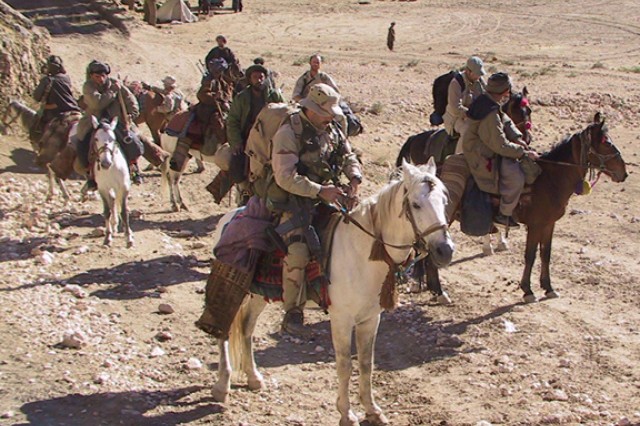
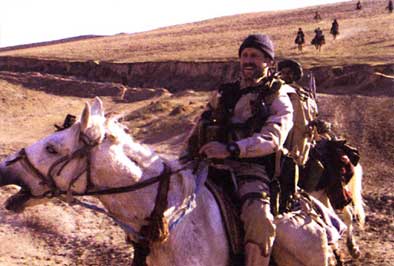
The soldiers depicted in the movie were Green Berets assigned to the 5th Special Forces Group. They became famous not just because of their success against the Taliban but also because many of them did so on horseback – the first to ride to war that way since World War II – and they did it with only small weapons, while the Taliban enemy had tanks armed with artillery, mortars and rocket-propelled grenades.

The Americans also had key air power from the Air Force backing them up … but still.

Forever after that, the Green Berets became known as the “horse soldiers.”

How the Movie Matches Up

“12 Strong” is based on the 2009 book “Horse Soldiers” by Doug Stanton. But how does it fare in telling the real-life story?

“We were impressed with what they did,” said Army Lt. Col. Tim Hyde, the deputy director of the Los Angeles Office of the Chief of Public Affairs, which provided advice on the project.  “What they did do very well is they got across the experiences that these soldiers went through.”

He said although producers did still take some “creative license” with it and added a few “obvious dramatizations,” they told an accurate story, in part, thanks to the Defense Department working with the crew on the production.

The DoD’s Contribution

The movie was shot from November 2016 to February 2017 in the Albuquerque, New Mexico, area, with a few weeks spent shooting at White Sands Missile Range, which provided a lot of the enemy vehicles you see in the movie.

“The U.S. Army aircraft that you see in that film are actual 160th [Special Operations Aviation Regiment] aircraft that they brought in from Joint Base Lewis-McChord [in Washington state],” Hyde said.

Active-duty personnel were used in the movie – but you don’t actually see them. They were the people flying those aircraft.

None of the men who were depicted in the film played a role, but two of them – including real-life Capt. Mark Nutsch (portrayed by actor Chris Hemsworth) and Chief Warrant Officer Bob Pennington (portrayed by Michael Shannon) – watched the filming for a few days to get a sense of how producers were portraying their story.

“This is a fictional portrayal – don’t lose sight of that,” Nutsch told the Tampa Bay Times in a recent interview.

A few more tidbits about their incredible real-life mission:

  • Each Green Beret carried about 100 pounds of equipment on his back, including GPS, food and U.S. currency.
  • The Afghan horses were feisty stallions who would fight each other, even when the soldiers were riding.
  • They hoofed it over some scary terrain, at times riding on foot-wide trails by cliffs at night anywhere from 6 to 18 miles a day.
  • The soldiers were operating so deep in Afghanistan that additional supplies often had to be air-dropped to them.
  • In two months, three 12-man teams like the troops in the movie, as well as more than a dozen support personnel and Afghan militia, accomplished more than any other force in Afghanistan at the time. The enemy was driven out of its safe havens in what al-Qaida still considers its largest, most destructive defeat.

Soldiers Magazine put together a great story about these horse soldiers. If you want to know more about their courageous journey, I suggest you read it!

***

Throughout the campaign, Army Special Forces, assisted by AFSOC Combat Controllers (CCTs) called in bombing runs from B-52, B-1 bombers as well as Navy F14 and F18 attack aircraft. AFSOC AC-130 Gunships, operating exclusively at night and coordinated by CCTs, provided close air support. On several occasions, MC-130E/H aircraft dropped 15,000lb BLU-28 ‘Daisy Cutter’ bombs on Taliban troop positions with devastating effect.

The combination of SOF-coordinated air power and indigenous anti-Taliban forces characterized the opening rounds of Operation Enduring Freedom.

ODA 595 & ODA 534 – Mazar-e-Sharif and Dari-a-Souf Valley

The 2nd TF-Dagger team to insert was ODA 595, which was flown across the Hindu Kush mountains by SOAR MH-47s on the 20th of October. The team was inserted in the Dari-a-Souf Valley, south of Mazar-e-Sharif, linking up with the CIA and General Dostum, commander of the largest and most powerful Northern Alliance Faction.

ODA 595 on horseback ODA 595, CIA SAD operatives and attached AFSOC CCTs found themselves required to ride on horseback alongside General Dostum’s troops. In scenes reminiscent of Lawrence Of Arabia, US SOF and Northern Alliance swept across the Afghanistan countryside towards Taliban positions in classic cavalry charges.

Few of the US SOF were accomplished riders and none were comfortable with the traditional wooden saddles common in Afghanistan. Following an urgent request, leather saddles was air dropped to the grateful men on the ground.

ODA 595 split into two units, Alpha and Bravo. Alpha accompanied Dostrum as his force pushed towards the city of Mazar-e-Sharif, calling in strikes from US warplanes against a series of Taliban positions, whilst Bravo called in strikes against Taliban positions across the Dari-a-Souf Valley.

A further Special Forces team, ODA 534, inserted by SOAR helos on the night of November 2nd were tasked with supported General Mohammad Atta, a Northern Alliance militia leader. ODA 534, along with CIA officers, eventually linked up with ODA 595 and Gen Dostrum outside Mazar-e-Sharif.

As the 2 SF ODAs and attached AFSOC personnel called down air strikes, Northern Alliance foot soldiers, cavalry and armored units took the city. More here.

WH wants more Nukes, Why? Kanyon

Yesterday, this website published an item regarding the Trump Executive Order requiring a total review and updated summary of the U.S. nuclear posture. Countless media outlets along with liberal think tanks wrote stinging critical articles on this review, mostly promoting the full elimination of nuclear weapons by the United States. This was the clear position of the Obama administration.

As this article is being published, the United Nations is holding a session on nuclear proliferation. Further, President Trump is at the Pentagon as this is being typed.

Trump and his national security team receives intelligence briefings and the summary below will likely explain why President Trump is right.

Image result for kanyon russia photo

Popular Mechanics explains: Pentagon Document Confirms Existence of Russian Doomsday Torpedo

Kanyon is designed to wipe out the enemy’s coastlines and make them unlivable for generations.

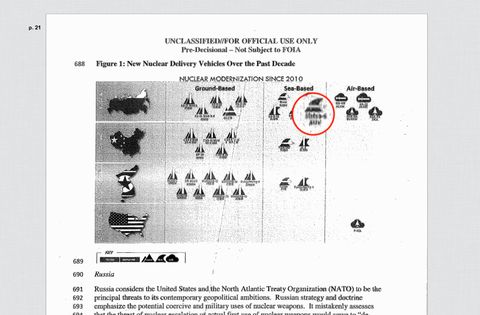
A key U.S. nuclear weapons document confirms that the Russian government is developing the most powerful nuclear weapon in more than a half century. A leaked copy of the Pentagon’s Nuclear Posture Review states that Russia is developing a “new intercontinental, nuclear-armed undersea autonomous torpedo.”

The existence of the weapon, known as Kanyon to the Pentagon and “Ocean Multipurpose System Status-6” to Russia, was first leaked by Russian television in November 2015. A test involving the Sarov-class submarine mothership was leaked in December 2016. The Nuclear Posture Review report, dated January 2018, lists the weapon as part of Russia’s underwater nuclear arsenal. Here’s a screen capture, with Kanyon circled in red:

Kanyon is reportedly a very long range autonomous underwater vehicle that has a range 6,200 miles, a maximum depth of 3,280 feet, and a speed of 100 knots according to claims in leaked Russian documents.

But what really makes Kanyon nightmare fuel is the drone torpedo’s payload: a 100-megaton thermonuclear weapon. By way of comparison, the atomic bomb dropped on Hiroshima was 16 kilotons, or the equivalent of 16,000 tons of TNT. Kanyon’s nuke would be the equivalent of 100,000,000 tons of TNT. That’s twice as powerful as Tsar Bomba, the most powerful thermonuclear weapon ever tested. Dropped on New York City, a 100-megaton bomb would kill 8 million people outright and injure 6 million more.

Kanyon is designed to attack coastal areas, destroying cities, naval bases, and ports. The mega-bomb would also generate an artificial tsunami that would surge inland, spreading radioactive contamination with the advancing water. To make matters worse there are reports the warhead is “salted” with the radioactive isotope Cobalt-60. Contaminated areas would be off-limits to humanity for up to 100 years.

Kanyon is designed to get around American ballistic missile defenses, primarily the Ground-Based Interceptor missiles based in Alaska and California. Although GBI is meant to counter small numbers of intercontinental ballistic missiles from rogue countries such as Iran and North Korea, Russia wants to make it abundantly clear that it could still penetrate U.S. defenses even if they were scaled up to deal with larger, more powerful nuclear arsenals. More here.

Status6

The Pentagon writes:

In addition to modernizing ‘legacy’ Soviet systems, Russia is developing and deploying new nuclear warheads and launchers. These efforts include multiple upgrades for every leg of the Russian nuclear triad of strategic bombers, sea-based missiles, and land-based missiles. Russia is also developing at least two new intercontinental range systems, a hypersonic glide vehicle, and a new intercontinental, nuclear-armed, undersea autonomous torpedo. Link

The Pentagon report notes the Russians plan attacks from the erroneous position that a coercive nuclear “first use” policy might allow Russia to then negotiate terms favorable to itself (this is referred to as the escalate-to-de-escalate doctrine). The Pentagon writes:

Effective U.S. deterrence of Russian nuclear attack and non-nuclear strategic attack now requires ensuring that the Russian leadership does not miscalculate regarding the consequence of limited nuclear first use, either regionally or against the United States itself. Russia must instead understand that nuclear first-use, however limited, will fail to achieve its objectives, fundamentally alter the nature of a conflict, and trigger incalculable and intolerable costs for Moscow. Our strategy will ensure Russia understands that any use of nuclear weapons, however limited, is unacceptable. More here.

The full 64 page document is here.