Deep Throat, Deep State and #SpyGate is Old News

C’mon remember the Watergate break-in? Former CIA operatives were part of that. But wait, Nixon himself was being surveilled by the FBI. Anna Chennault, a GOP operative had interesting connections all throughout Asia. Those relationships were of big concern to the FBI and the Bureau was tracking those connections. That was all related to the Paris Peace talks on North and South Vietnam. Due to FBI eavesdropping and collections of diplomatic cables, Lyndon Johnson knew all about Nixon’s subterfuge. Have we forgotten the secret Nixon tapes? Too bad we can’t ask Mark Felt questions, dead men tell no tales.

Using intelligence agencies is an old habit yet Obama appears to have made an art of that exploitation. Obama spied on journalists including James Rosen of Fox News. Obama likely approved of John Brennan’s operation to spy on the senate staffers working on the enhanced interrogation techniques report headed by Senator Dianne Feinstein. Heck, Obama spied on Angela Merkel of Germany. Enter the NSA, they have everything. Edward Snowden proved that right? Not too sure FISA warrants were ever really needed in the first place, think about that.

Spies, informants and operatives come in many forms. They can be staffers, hired ladies, lawyers, lobbyists, policy wonks, people having cocktails at conventions, summits or conferences where business cards are exchanged for later email/phone call follow-up.

It is all old news. Old news and old tactics that get refined to due electronic communications, apps and encryption.

So, how do we know about these activities? Follow the money for starters. Remember the DNC and Hillary law firm, Perkins Coie.

The Obama for America committee paid Perkins Coie around $3 million during the 2012 election cycle, according to filings with the Federal Election Commission, A vast majority of the payments were earmarked for “Legal Services.”

Was Fusion GPS hired by Obama to surveil on Romney for opposition research? Was the media involved? Oh yeah, remember that debate and the advanced questions?  Then of course we have Fusion GPS and Trump.

Okay, this brings us to the current #Spygate and the names bubbling to the surface.

One such name is Stefan Halper. During the presidential transition, Donald Trump’s top trade advisor Peter Navarro, recommended Halper for an ambassadorship. Heck Halper was in the White House Executive Office wing last summer to discuss Asia with particular emphasis on China.

Stefan Halper goes all the way back to the Reagan/Carter days. Oh, wait, even Gerald Ford and George HW Bush were included in Halper’s political history. Is there a difference between spying, intelligence collection and being a political operative? You decide.

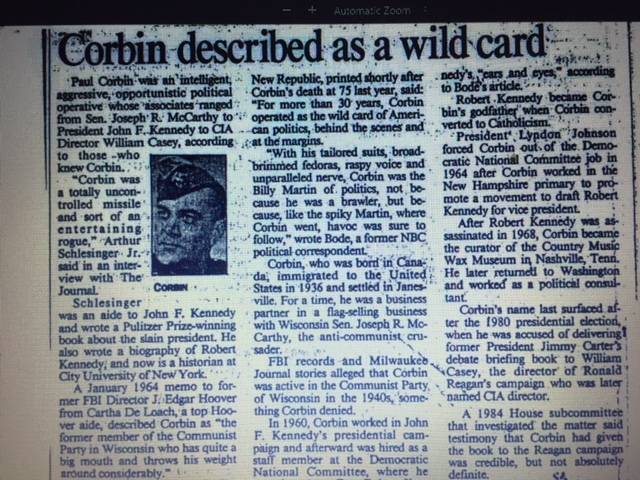
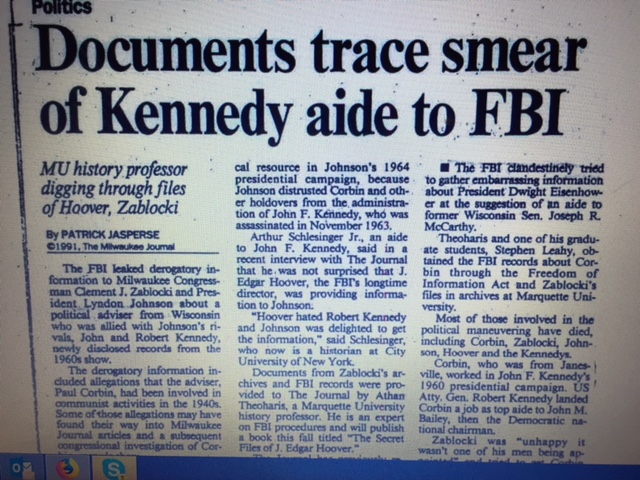
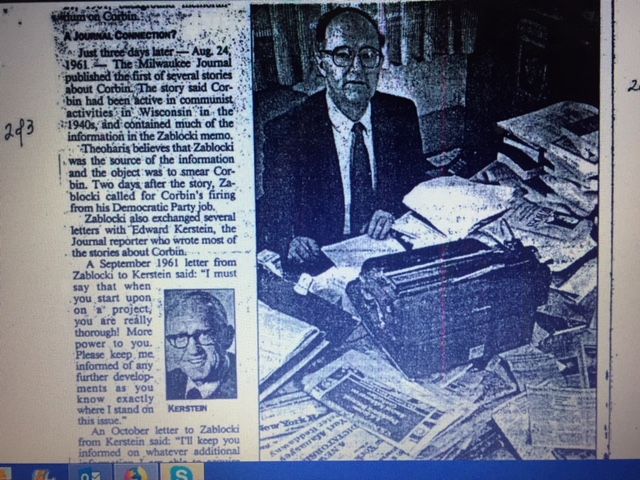
There is more, How about Paul Corbin? He was a communist. And yes, he was an campaign operative too. He worked on the John F. Kennedy campaign. There was also ‘Debategate‘.


Moving on and do NOT hang your hat on Carter Page. Remember the Washington Post editorial board doing an early interview with Trump and a question arose about his foreign policy team? Well, Trump threw out 2 names from the hip, Carter Page and George Stephanopoulos. In fact neither had any quality role in the Trump operation. Another was Zalmay Khalilzad, former U.S. ambassador to Afghanistan, Iraq and the United Nations. Heck Trump never met Khalilzad. He remains a back channel fella with concerns still with Pakistan, Afghanistan and Iraq. Khalilzad was part of a money laundering investigation in 2014. Could he be an operative too?

Now take a moment and see the issue of Russian operatives and spies in the United States to understand how the FBI tails these people. In 2010, there was a spy swap (10 operatives) that included 2 key people. One such person was Anna Chapman who was assigned to get inside the Hillary State Department operation(s) and she did. The other is Sergei Skripal. He is the former Russian military officer and double agent that Russia just attempted to kill with Novichok, a nerve agent. Then there was this other double agent in New York that was captured in a counter-intelligence operation as a result of spy operations that work out of the Russian Mission to the United Nations.

Are you beginning to understand the other work of the FBI? President Bush expelled 50 Russians, Reagan expelled 55 Soviets and both Obama and Trump have expelled 35 and 60 respectively.

With those facts, does it stand to reason that the FBI rank and file agents are very concerned about foreign operatives in politics and campaigns? There is for sure an argument to be made that informants and plants are not only used by required.

Will we ever know all the puzzle parts to these cases? NO

Is #Spygate a one off with regard to President Trump? NO

Perhaps there is something yet to be discovered in Hillary’s missing emails or Peter and Lisa’s text messages. Hello IG report by Michael Horowitz.

The tactics are tried and true…however, when will the media much less the Republicans call out the abuse of power the Obama administration on all of this? In summary, the Trump administration should fight back and impeach those Obama operatives, what say you?


SecState Pompeo’s Note-taking During Hearing

This was a Congressional Budget Session for the State Department Fiscal year 2019.

The Latest: Pompeo hopeful N. Korea talks will take place

The Congressman Gregory Meeks got on his high horse about the commitment to diplomatic security. Meeks in his last comment proved to be an ass. Check out that little 3 minute snippet here.

Now, we can’t know if this is a ‘to-do’ list for himself or those of his staff but an Associated Press photographer captured an interesting photo.

So, let’s go down the list shall we?

#7 Meet IG.:There are several that have been published recently with regard to the State Department. They include: Operation Inherent Resolve and Operation Pacific Eagle, a Fraud Alert and Operation Freedom’s Sentinel. (The Freedom’s Sentinel is a quarterly report) Click here to see those IG reports.

#8 Jim Donovan: Last year, Donovan was on the short list to be Deputy Treasury Secretary and withdrew his name. He is a managing director and partner at Goldman Sachs and has close ties to Jeb Bush and Mitt Romney.

#9 Call Lavrov: Well we should all know him, he is the Minister of Foreign Affairs of Russia. Now this is an interesting call because Lavrov is on his way to visit the DPRK, you know lil Kim Jung Un and Lavrov has is nurturing a relationship with Zohrab Mnatsakanyan, the Foreign Minister of Armenia. Or how about telling Lavrov, ‘he dude, this meddling thing and propaganda gig against the U.S. comes with consequences‘.

#10 Mexico Ambassador: This could have a couple of options. a) Our National Guard on the border b) The U.S ambassador to Mexico resigned in March and we presently don’t have one. Under consideration is Edward Whitacre Jr., a former CEO at General Motors and AT&T. Whitacre has also worked previously with Carlos Slim, Mexico’s richest man.

This brings us to #11 Carlos Slim: Could this be some kind of NAFTA issue or regarding The Economic Coordinating Council in Mexico?

#12 Robert Reilly: Reilly has a long history at the State Department and in global media. He is a conservative and a senior policy fellow at the America Foreign Policy Council, The Claremont Institute. He was part of the Information Strategy Office at the Pentagon as well as a senior advisor on Operation Iraqi Freedom.

#13 Need help…no idea

#14 Diversity Data….hummm

Could bad math have us skipping to #20? Sam Feist: Well, perhaps Pompeo has a whole truck load of stuff to discuss with Sam. He is the Senior Vice President, Washington Bureau Chief for CNN.

#21 Help….no idea

#22 PC on Iran: After the Deal to a New Deal? Europe vs. U.S. on sanctions maybe?

Meanwhile: Pompeo says Singapore is “still” a go, cites “the preparations for our historic meeting with North Korea, still scheduled for June 12. We have a generational opportunity to solve a major national security challenge.” “We are clear-eyed about the regime’s history. It’s time to solve this once and for all. A bad deal is not an option. The American people are counting on us to get this right. If the right deal is not on the table, we will respectfully walk away.”

Pompeo assumed a similarly hard line on resuming talks with Iran, promising to “apply unprecedented financial pressure” and suggesting that economic sanctions are just one of several measures the United States will use against the regime in Tehran. To achieve a new nuclear deal, he added, Iran “simply needs to change its behavior.”

He did not back off the Trump administration’s threat to apply sanctions to European companies that do business with Iran, saying companies must wind down operations in Iran or else face penalties, and promised lawmakers that “we will come back to you seeking further authority” for additional measures to squeeze Tehran.

But the hearing turned combative as Democrats challenged Pompeo for presenting Congress with a State Department budget that maintains deep cuts to diplomatic and developmental activities — a budget that Rep. Eliot L. Engel (N.Y.), the ranking Democrat on the foreign affairs panel, called “insulting” and predicted that Congress would reject. More here.

Whining Congress on Election Security Really Doesn’t Care

On March 21, 2018, the Senate Intelligence Committee held a hearing after much whining from Democrats on the topic of election security. It was quite the hearing where aggressive and snotty questions were put to current DHS Secretary Kirstjen Nielsen and former DHS Secretary Jeh Johnson.

Since that hearing, the Department of Homeland Security has reached out to almost every state and collaborated on issues of security of voter databases, ensuring security of voting machine software and held sessions of advise on what had transpired during the election year of 2016. Many states have taken substantial steps to ensure integrity of all systems.

The Senate Intelligence Committee members met in closed session to discuss their findings with former Director of National Intelligence James Clapper, former CIA director John Brennan, and former National Security Agency director Adm. Mike Rogers. None has wavered from the conclusions about Russian interference in the election, according to senators who were in the room.

Former FBI director James Comey had also been invited to testify about the findings to the panel, but did not attend.

4 out of 5 House members skip classified briefing on ... photo

So, in a classified setting both the House Committee on Homeland Security and the Department of Homeland Security hosted a briefing on the facts of Russian intrusion into the U.S. election infrastructure where all 435 members of Congress were invited. Those that were whining back in March were on the invitation list. How many did finally show up to assuage their concerns? Less than 50 and by most estimates, it was 30.

The Department of Homeland Security — which found evidence of Russian hackers targeting systems in 21 states ahead of the 2016 vote — is taking the lead on helping states secure their digital election assets. Meanwhile, the FBI is working to counter foreign influence operations. Coats was present to provide lawmakers with an overall threat picture.

“Americans’ votes must count, and they must be counted correctly,” Nielsen said.

Officials provided lawmakers with an unclassified resource guide of the services Homeland Security is offering to state and local officials who request aid, which range from simple cyber “hygiene” scans that can be done remotely to more rigorous risk and vulnerability assessments that require federal officials to be on the ground in states to test their systems.

Lawmakers from both parties have expressed concerns that Russia or other foreign adversaries would look to sow discord in future elections — fears that were echoed on Tuesday.

***

DHS is offering states voluntary cyber services, including remote checks of their election systems and on-site vulnerability assessments. It’s also granting security clearances to election officials, though they haven’t all been finalized.

States are now deciding how to use their share of $380 million in federal election security grants that came with the omnibus spending package earlier this year. But it’s hardly enough to update aging voting equipment in most states ahead of the November polls, and many state officials are hoping Congress will approve more dollars. More here.

Sweden Tells 4.8 Million Homes to Prepare for War

Those that take heed and prepare are left to help a country survive. Sweden is a member of the European Union. Question is what is the EU Headquarters in Brussels response to this? So far, silence.

It is all due to Russia, Crimea and Ukraine especially Kaliningrad. Roughly 220 miles of ocean separates Sweden from the heavily militarized Russian port of Kaliningrad. The country’s long, narrow shape leaves it vulnerable to air assault from multiple sides. And Sweden, along with neighboring Finland, are in the unique position as the only non-NATO aligned nations on the Baltic Sea.

The United States Army performs with Aurora 17.

 Aurora 17

Hence, the nation spent the Cold War years preparing to fend for itself against a great power invasion, drawing up plans for how to mobilize the entirety of the civilian population and infrastructure to defend its territory. And then the Soviet Union collapsed, a new era of peace dawned and those plans were left to fall fallow.

Sweden Advises Its Citizens to Prepare Wet Wipes and Tinned Hummus in the Event of War

Sweden has not gone to war with another country for over two centuries, but that hasn’t stopped the government from reissuing an emergency manual from World War II that advises citizens on how best to cope with hypothetical hostilities.

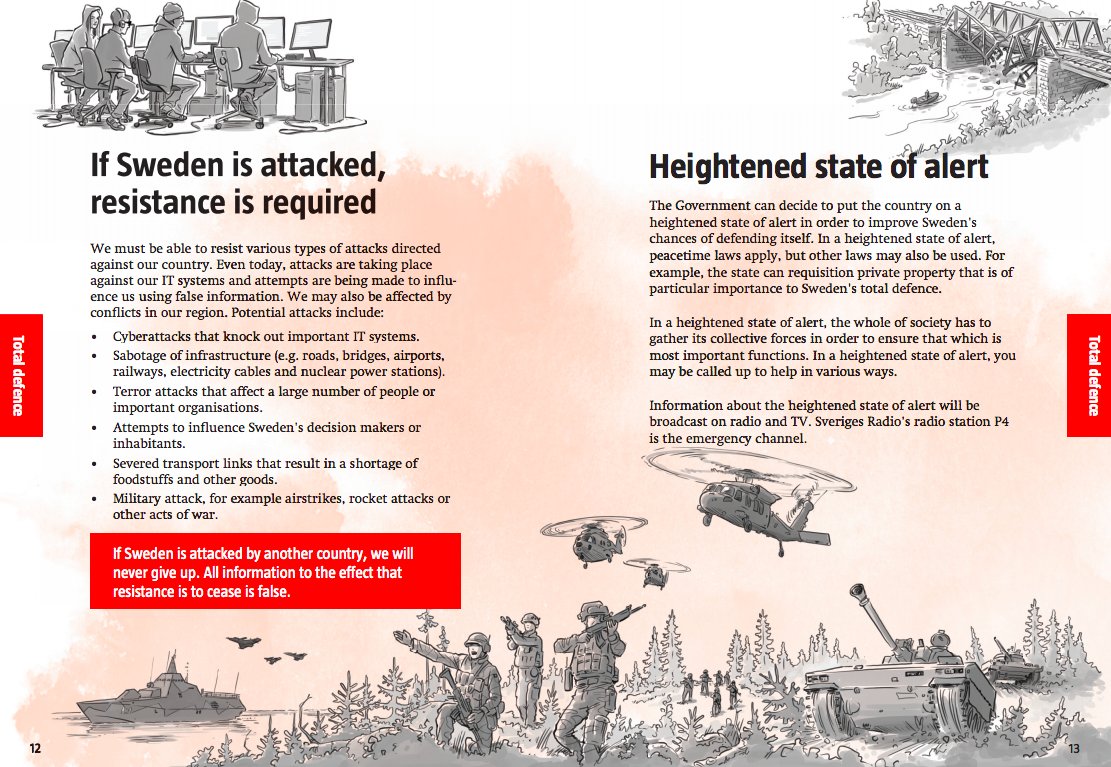
The newly updated 20-page pamphlet, entitled Om krisen eller kriget kommer (‘If crisis or war comes”), offers strategies for handling everything from cyber attacks and terrorism to climate change, food shortages and fake news.

“What would you do if your everyday life was turned upside down?” the English language version of the manual begins.

Since supplies could run low during a crisis, the leaflet provides checklists of what to stock up on, including mineral water, wet wipes and tinned hummus. It also offers tips on where to find bomb shelters, what to do without access to ATMs, cellphones or the internet, and how to spot propaganda.

** Very interesting. has sent a pamphlet with instructions on how to “be prepared for war” to 4.8million homes. Random quote: “If Sweden is attacked … we will never give up. All information to the effect that resistance is to cease is false.”

“Although Sweden is safer than many other countries, there are still threats to our security and independence,” the brochure says. “If you are prepared, you are contributing to improving the ability of the country as a whole to cope with a major strain.”

The illustrated instructions went online Monday and are being sent to all 4.8 million households in the country in the first such public awareness campaign since 1961. The handbook was last updated for government officials’ use during the Cold War, according to the Guardian.

The newly minted pamphlets do not specify an attacker, but their release comes amid escalating security concerns following Russia’s annexation of Crimea in 2014. Sweden has accused Moscow of repeatedly infringing on its airspace and territorial waters — claims the Kremlin dismisses as “Russiaphobia.”

Sweden began increasing its military spending in 2016, reversing years of cuts. It also reinstated the military draft last year, citing Russian assertiveness as one of the justifications, and is considering joining NATO.

In the event of a “heightened state of alert,” the pamphlet emphasizes the expectation that everyone can be marshaled for Sweden’s “total defense.”

“If Sweden is attacked by another country, we will never give up,” the publication reads. “All information to the effect that resistance is to cease is false.”

***

Similar leaflets were first distributed in neutral Sweden in 1943, at the height of the second world war. Updates were issued regularly to the general public until 1961, and then to local and national government officials until 1991.

“Society is vulnerable, so we need to prepare ourselves as individuals,” said Dan Eliasson of the Swedish civil contingencies agency, which is in charge of the project. “There’s also an information deficit in terms of concrete advice, which we aim to provide.”

A Swedish cold-war era defence leaflet.

U.S. Takes Steps on Venezuela and President Maduro

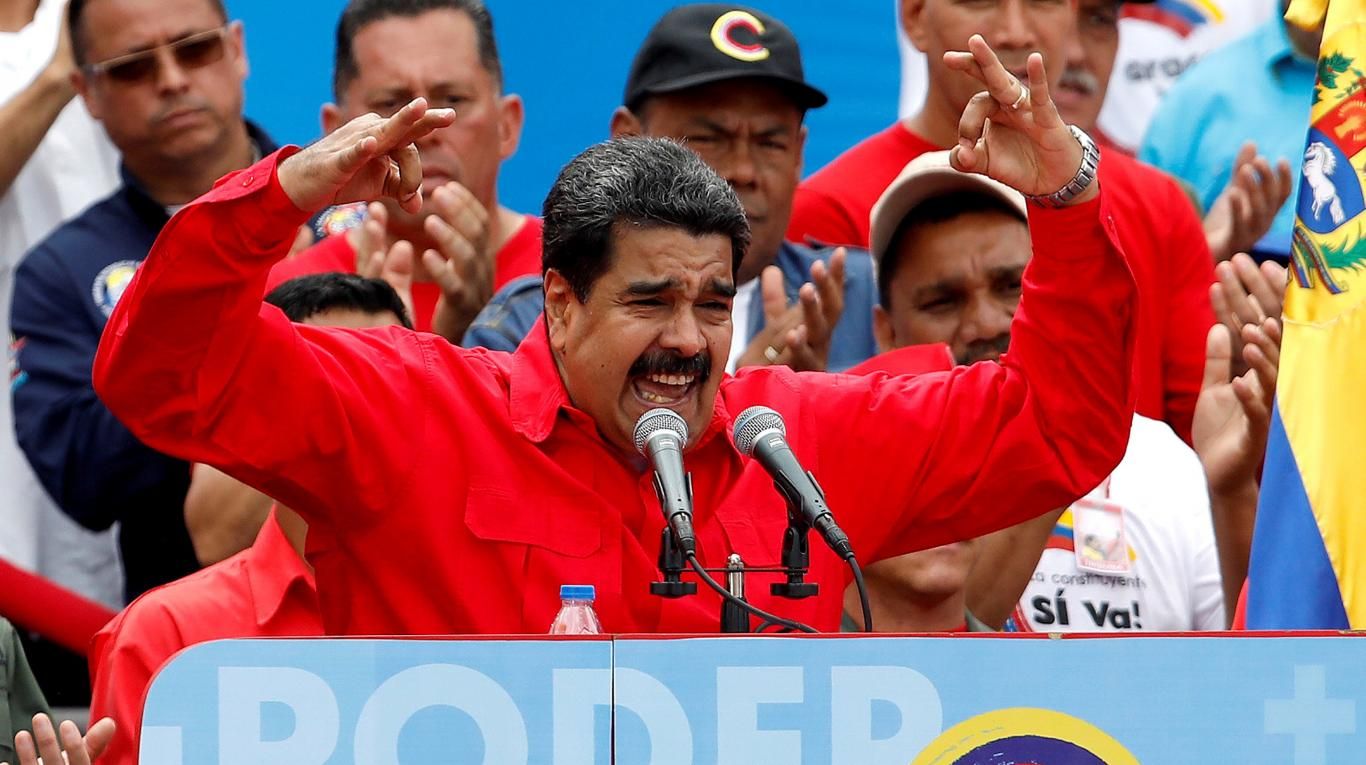
Primer: Venezuela’s diplomatically isolated president got a show of support from his Turkish counterpart Tayyip Erdogan and Argentine soccer legend Diego Maradona on Thursday ahead of a weekend election widely decried as unfair.

The United States, the European Union and major Latin American countries have criticized Sunday’s vote in which leftist President Nicolas Maduro is likely to win re-election to a six-year term. More here.

Venezuelan presidential elections for April 22 — MercoPress  photo

Hundreds protest against ‘fixed’ election in Venezuela: (Reuters) – Several hundred Venezuelan opposition demonstrators blocked traffic in a march to the Organization of American States (OAS) headquarters in Caracas on Wednesday to protest this weekend’s presidential vote, which they say is rigged.

Related reading: Black Market for Food and Medicine

Actually, this is a gesture and for the most part meaningless, because China has first right of ownership and refusal of Venezuela’s oil, however:

President Donald Trump stepped up economic pressure on Venezuela President Nicolas Maduro with an order prohibiting purchases of debts owed to the government, including to the state-run oil company Petroleos de Venezuela.

The executive order, which covers all transactions on any debts owed to the Venezuelan government or state-owned enterprises including accounts receivable, was posted on the Treasury Department website Monday afternoon.

Trump administration officials who spoke on condition of anonymity said the order was intended to restrict the Maduro regime’s ability to liquidate its assets and close off avenues for corruption.

The prohibition on purchases of debts owed to Venezuela specifically includes accounts receivable. One administration official said the action was intended to choke off funding the Maduro regime has been raising by selling off money owed in future to the government and state-owned enterprises in exchange for immediate payment cash.

In response, Maduro expelled U.S. diplomats.

CARACAS (Reuters) – President Nicolas Maduro on Tuesday ordered the expulsion of the top U.S. diplomat in Venezuela in retaliation for a new round of sanctions over Venezuela’s widely-condemned election.

The United States was among a string of countries that did not recognize Sunday’s vote.

The 55-year-old successor to Hugo Chavez won re-election easily, but critics said the vote was riddled with irregularities, from the barring of two popular opposition rivals to the offering of a government “prize” to voters.

President Donald Trump responded with an executive order limiting Venezuela’s ability to sell state assets, heightening pressure on the cash-strapped government.

A press officer for the U.S. embassy in Caracas said she had no immediate comment in response to Maduro’s statements.

Earlier on Tuesday, Venezuela’s foreign ministry called the sanctions “a crime against humanity.” Maduro’s socialist administration, which has long said a U.S.-led “economic war” is to blame for a deep crisis in the OPEC nation, said the new sanctions violated international law.

“Venezuela once again condemns the systematic campaign of aggression and hostility by the U.S. regime to punish the Venezuelan people for exercising their right to vote,” the Foreign Ministry said in a statement. “These arbitrary and unilateral measures constitute a crime against humanity.”

Venezuela’s opposition has accused the Maduro government of behaving immorally and trying to hide shortcomings and corruption behind bombastic rhetoric. The mainstream opposition coalition boycotted Sunday’s vote, calling it a sham aimed at legitimizing Maduro’s rule despite his low popularity.

Among widespread international condemnation of the vote, the European Union said in a statement on Tuesday that the elections did not comply with “minimum international standards for a credible process” and repeated that it would consider the “adoption of appropriate measures.”

The latest U.S. sanctions appeared to target in part Citgo[PDVSAC.UL], a U.S.-based oil refiner owned by Venezuela state oil company PDVSA [PDVSA.UL]. More obstacles to PDVSA’s ability to sell oil abroad could restrict already-dwindling foreign exchange earnings, worsening the economic crisis and pressuring Maduro.

While it only applies to U.S. citizens and residents, a U.S. official told reporters on Monday that the Trump administration has also tried to convince China and Russia to stop issuing new credit to Venezuela. The two have provided billions of dollars in funding for Venezuela in recent years.

But they appeared unlikely to heed the U.S. warnings. Beijing said on Tuesday it believed the United States and Venezuela should resolve their differences via talks, while Moscow said it would not comply with the sanctions.

Accusing U.S. charge d’affaires Todd Robinson of being involved in “a military conspiracy,” Maduro ordered him and another senior diplomat, Brian Naranjo, to leave within 48 hours.

He gave no details of the accusations, but said the U.S. Embassy had been meddling in military, economic and political issues, and vowed to present evidence to the nation shortly.

“Neither with conspiracies nor with sanctions will you hold Venezuela back,” Maduro said, at an event in downtown Caracas at the headquarters of the election board, which is run by government loyalists. Full story here.