Iran to Hit Infrastructure with Cyber Attack

Primer: (Reuters) – Iran has built a factory that can produce rotors for up to 60 centrifuges a day, the head of its atomic agency said on Wednesday, upping the stakes in a confrontation with Washington over the Islamic Republic’s nuclear work.

Under the terms of the 2015 agreement, which was also signed by Russia, China, Britain, France and Germany, Iran agreed to curb its nuclear program in exchange for sanctions relief.

The other signatories have been scrambling to save the accord, arguing it offers the best way to stop Iran developing a nuclear bomb.

The Aspen Security Forum Releases 2017 Agenda - Aspen ...

*** At the Aspen Security Summit on Iran

In part:

ASPEN, Colo. — Iranian hackers have laid the groundwork to carry out extensive cyberattacks on U.S. and European infrastructure and private companies, and the U.S. is warning allies, hardening its defenses and weighing a counterattack, say multiple senior U.S. officials.

Despite Iran having positioned cyber weapons to carry out attacks, there is no suggestion an offensive operation is imminent, according to the officials, who requested anonymity in order to speak.

Cyber threats have been a major theme of the 2018 Aspen Security Forum, with administration officials from Director of National Intelligence Dan Coats, FBI Director Chris Wray, and Deputy Attorney General Rod Rosenstein all warning of the pervasive danger from Russia, China, Iran, and North Korea.

In Aspen Thursday, DNI Coats said that Russia was a more active cyber foe than Iran or China — “by far” the most aggressive, he said.

While Russia may be the most aggressive, the U.S. officials said Iran is making preparations that would enable denial-of-service attacks against thousands of electric grids, water plants, and health care and technology companies in the U.S., Germany, the U.K. and other countries in Europe and the Middle East.

“Iran has a penchant for using such tools against the West,” said Ben Taleblu. “The cyber domain permits the Islamic Republic to engage in graduated escalation, a hallmark of Iranian security policy.”

U.S. officials have alerted America’s allies in Europe and the Middle East to the potential Iranian threat and have begun preparing a menu of possible responses, according to both current and former US officials. It’s unclear if the options include a preemptive cyberattack to deter Iran from launching one.

Senior U.S. officials remain divided over the use of a preemptive cyberattack. More here.

Perhaps it is almost important to be reminded about the bomb plot last month in Paris. For a full summary of events at the #FreeIran event in Paris, go here.

Israel’s Mossad spy agency thwarted a terror attack in a Paris suburb last month, giving authorities in France, Germany, and Belgium crucial intelligence that led to arrests of a cell headed by an Iranian diplomat, Hebrew media reported Thursday.

The cell, headed by an Iranian diplomat at the Austrian embassy in Vienna, also consisted of  two Belgian nationals and an alleged accomplice in France. They planned to bomb a June 30 conference organized by an Iranian dissident group, the People’s Mujahedeen of Iran.

The operation included tracking the suspects and eavesdropping on them,  Hadashot said.

The Belgian nationals, a husband and wife identified as Amir S. and Nasimeh N., were charged earlier this month with their role in the plot.

The couple, described by Belgian prosecutors as being “of Iranian origin,” carried 500 grams (about a pound) of the volatile explosive TATP along with a detonation device when an elite police squad stopped them in a residential district of Brussels.

The arrests came days before Iranian Foreign Minister Mohammed Javad Zarif met with European nations to try to shore up the 2015 nuclear accord, after US President Donald Trump walked away from the deal.

Israeli Prime Minister Benjamin Netanyahu alluded to the operation ahead of the meeting.

“There is a meeting this week by the P4 without the United States…” and “the P4 invited Iran’s President Rouhani to attend,” Netanyahu said derisively at an event to mark US Independence Day. More here.


Elections’ Voter Registration System and the Russian Investor

Remember the outrage when sites all over the internet published items that Soros owned the voting machines? Remember that same outrage when Soros invested heavily in the State’s secretaries that were responsible for the respective elections process?

Remember the outrage that a Russian investor was able to buy American uranium in a deal concocted by Hillary? We learned then about the Committee for United States Foreign Investment.

Remember the outrage when Obama deferred the ‘red-line’ chemical weapons removal in Syria to Moscow that killed thousands? Anyone remember the anger when Russia shot down MH17, a civilian airliner, killing everyone on board?

Remember that we have lost regard for the top ranks of the FBI due to the Russian investigation and the Hillary investigation?

Remember

Remember the horror and voting rigging reported across various states in the recent elections?

Our votes are the most sacrosanct privilege Americans have. Okay so how about the very under reported matter in Maryland?

See, it was not until AFTER the Justice Department announced the indictment of 12 Russian military intelligence officers for computer hacking that Maryland officials reached out to Rod Rosenstein. FBI officials in the Maryland office held a briefing with the Maryland officials and did not want to make the information public….that is due to a wider investigation on the matter. What matter is that?

Well….

In part:

Four FBI agents informed state officials Thursday that a vendor Maryland has contracted with — ByteGrid LLC — to host data for statewide elections has ties to a Russian oligarch, Miller and Busch said.

Vladimir Potanin Vladimir Potanin

Potanin acquired his wealth notably through the controversial loans-for-shares program in Russia in the early to mid-1990s.

He is one of the wealthiest men in Russia, with an estimated net worth of $15.9 billion, ranking 83rd on the 2018 Forbes The World’s Billionaires list, and 6th in Russia. His long-term business partner was Mikhail Prokhorov until they decided to split in 2007. Subsequently, they put their mutual assets in a holding company, Folletina Trading, until their asset division was agreed upon.

In January 2018, Potanin appeared on the US Treasury’s “Putin list” of 210 individuals closely associated with Russian president Vladimir Putin.

ByteGrid LLC owns the servers that hold the data for voter registration, candidacy, election management, and election night results, state elections officials said. An ownership stake in the company was purchased by AltPoint Capital Partners, whose largest investor is a Russian oligarch named Vladimir Potanin, the election officials said.

Busch said that Potanin is “very close” to Russian Pesident Vladimir Putin and that Altpoint’s managing partner is Gerald T. Banks, a Russian millionaire who changed his name from Guerman Aliev.

But Busch said the state has no evidence that Potanin or Banks had done anything untoward.

“We don’t have any idea whether they meddled in any elections at all,” Busch said.

Attempts to reach the companies were unsuccessful.

The Maryland officials also said they had no indication the Russian-linked firm had anything to do with the problems that arose shortly before June’s primary election in which more than 80,000 voters’ change of address and party affiliation requests were never forwarded from the Motor Vehicle Administration to election officials.

The Maryland news came hours after the Department of Justice indicted 12 Russian intelligence officers, charging that they hacked the computer networks of Hillary Clinton’s 2016 presidential campaign, the Democratic National Committee and the Democratic Congressional Campaign Committee.The 11-count indictment alleges that the Russian agents infiltrated the networks, implanting malicious computer code and stealing documents on field operations, opposition research and campaign analytics as a way of interfering with the election.

The charges include conspiracy to commit an offense against the U.S., aggravated identity theft and money laundering.

According to the indictment, the Russians posted stolen documents online and worked with an organization — unnamed but believed to be WikiLeaks — to spread them further, and take advantage of continuing tensions between supporters of Clinton and primary opponent Bernie Sanders.

The federal indictment charging 12 Russian includes an allegation that a Twitter account, @BaltimoreIsWhr, was set up to invite people to join a “flash mob” and to post images using the hashtag “#BlacksAgainstHillary.”

It is the latest revelation of how social media were used locally and nationally in an attempt to influence the election. Cyber security analysts in September told The Baltimore Sun that a Facebook ad that referred to the Black Lives Matter movement and targeted Baltimore users in the months following the 2015 riots was likely part of a broader effort by Russia to sow discontent and deepen racial tension.

In response to such ads, the General Assembly in April passed a bill requiring social media platforms and websites with significant traffic to track all political ads and record which users are being targeted. In May, Hogan expressed reservations that the law could be found unconstitutional and allowed the bill to become law without his signature.

The @BaltimoreIsWhr account has been suspended.  Read more here.

Election officials in Maryland along with Governor Hogan have asked the Department of Homeland Security for technical assistance to evaluate the network used by the State elections board. ByteGrid, interesting name, was bought by the Russian investor in 2015 without the knowledge of Maryland officials. ByteGrid hosts the entire state system including registration, online ballot delivery systems and unofficial election night results.

Oh yeah, one last item, Maryland was one of the states that had very suspicious online activity in the 2016 election according to DHS and the FBI. That suspicious activity was for online registration and in the ballot request system.

IT Solution Providers

According to the ByteGrid website, they offer: With ByteGrid’s Compliant Hosting Solutions you get security, compliance and control over your business-critical data. Our CISA and CRISC certified experts have you covered. Industry sectors include: Life Sciences, Health IT, Financial and Government.

Mueller’s Team Indicted More Russians

During the open session of the dual congressional committee hearing with FBI CT expert, Peter Strzok, the democrats went off on republicans for not having hearings on Russian interference and protecting the American campaign/election process.

On the republican side, there has been a constant call to terminate the Mueller operation. I have stood rather alone as a conservative supporting the Mueller operation because we do need to punish all things Russia.

Will Rod Rosenstein serve as a check on Jeff Sessions?

Per the indictment, Russian officers are accused of hacking the DNC server, stealing login in credentials of Clinton campaign associates including John Podesta. The indictment includes such text as aggravated identity theft, conspiracy to launder money and the illegal release of stolen data/intelligence. The hackers also targets state and local officials that do administer the elections process yet, NO VOTE COUNTS OR TALLIES WERE ALTERED.

The information purloined from the hacks was funneled through the internet under the names DCLeaks and Guccifer 2.0, the government contends. The DAG noted that a number of Americans “corresponded with several Russians through the internet.” No allegations have been brought against those Americans at this point for knowingly communicating with Russian intelligence officers, Rosenstein said.

An important point made by Rosenstein, which leads to the growing fact that no Americans, including candidate Trump or his aides had taken part in any collusion. collaboration or conspiracy known to date.

So today, AG Rod Rosenstein announced 12 indictments of Russian operatives. As President Trump is in Europe, he was briefed on this indictment announcement. His response?

Rosenstein briefed POTUS earlier this week on today’s indictments of Russian agents. Trump said today he would be asking Putin about it during their meeting Monday.

The timing of this announcement is quite important as President Trump is meeting with Vladimir Putin in Helsinki on Monday. Other world leaders have accused Moscow of doing the exact same thing in their respective countries, to include France, Mexico and Germany.

So, what say you democrats now?

Politico reported it this way:

Special counsel Robert Mueller indicted 12 Russian military officers on Friday, and accused them of hacking into the Democratic National Committee to sabotage the 2016 presidential election.

The indictments, announced by Deputy Attorney General Rod Rosenstein, come just days before a scheduled Monday summit in Helsinki between President Donald Trump and Russian President Vladimir Putin.

They are the latest charges in a probe that has already netted guilty pleas from three former Trump campaign aides while the president himself remains under investigation by Mueller for potential obstruction of justice.

Rosenstein said the Russians stole and released Democratic documents after planting malicious computer codes in the network of the DNC as well as the Democratic Congressional Campaign Committee.

He said Russia’s GRU military intelligence service was behind online entities that disseminated and promoted the documents under the names Guccifer 2.0 and DCLeaks.

The indictment dramatically shifts the context for Trump’s upcoming meeting with Putin, whom U.S. intelligence services have concluded was behind the 2016 election interference scheme whose goal was to elect Trump.


Trump Takes on Germany/Europe at NATO Summit

Toplines from Trump at the NATO summit:

  1. Trump accused Germany of being “totally controlled” by Russia in comments about their proposed Nord Stream 2 gas pipeline.
  2. German Chancellor Angela Merkel replied that she’d already “experienced the Soviet occupation … it is good that we are independent today.”
  3. Trump called on NATO members to double their defense spending commitment to 4%. (The U.S. is at 3.5%). Only five nations (if you include Poland at 1.99%) currently meet the 2% target for 2024.

Axios’ Jonathan Swan asked NATO Secretary General Jens Stoltenberg a pair of questions in Brussels.

  • Swan 1: Did President Trump assure you he wouldn’t make any concessions in his meeting with Vladimir Putin — for example on Crimea?
  • Stoltenberg 1: “Action speaks louder than words. And I’m absolutely confident about the U.S. commitment to European security.” Stoltenberg noted that all allies, including the U.S., signed a declaration today saying they don’t recognize Russia’s illegal annexation of Crimea. (But he dodged the question about what assurances he sought and received.)
  • Swan 2: Has President Trump, in any of his conversations with you, suggested he thinks the United States has too many troops in Europe?
  • Stoltenberg 2: “This is the unified position of all allies… The illegal annexation of Crimea is one of the main reasons why NATO has implemented the biggest reinforcement of collective defense since the end of the Cold War.” (Again, separating Trump’s words from the Trump administration’s deeds.)

Swan’s thought bubble: Stoltenberg has a point about Trump’s words versus his administration’s deeds (so far). Trump has not done anything to reduce U.S. military support for NATO and has actually increased military investments in Europe.

  • But at the same time Trump has done what no recent U.S. president has done — publicly questioned the value of NATO for the U.S. and in the process made some of America’s closest allies privately question whether they can still rely on American protection.

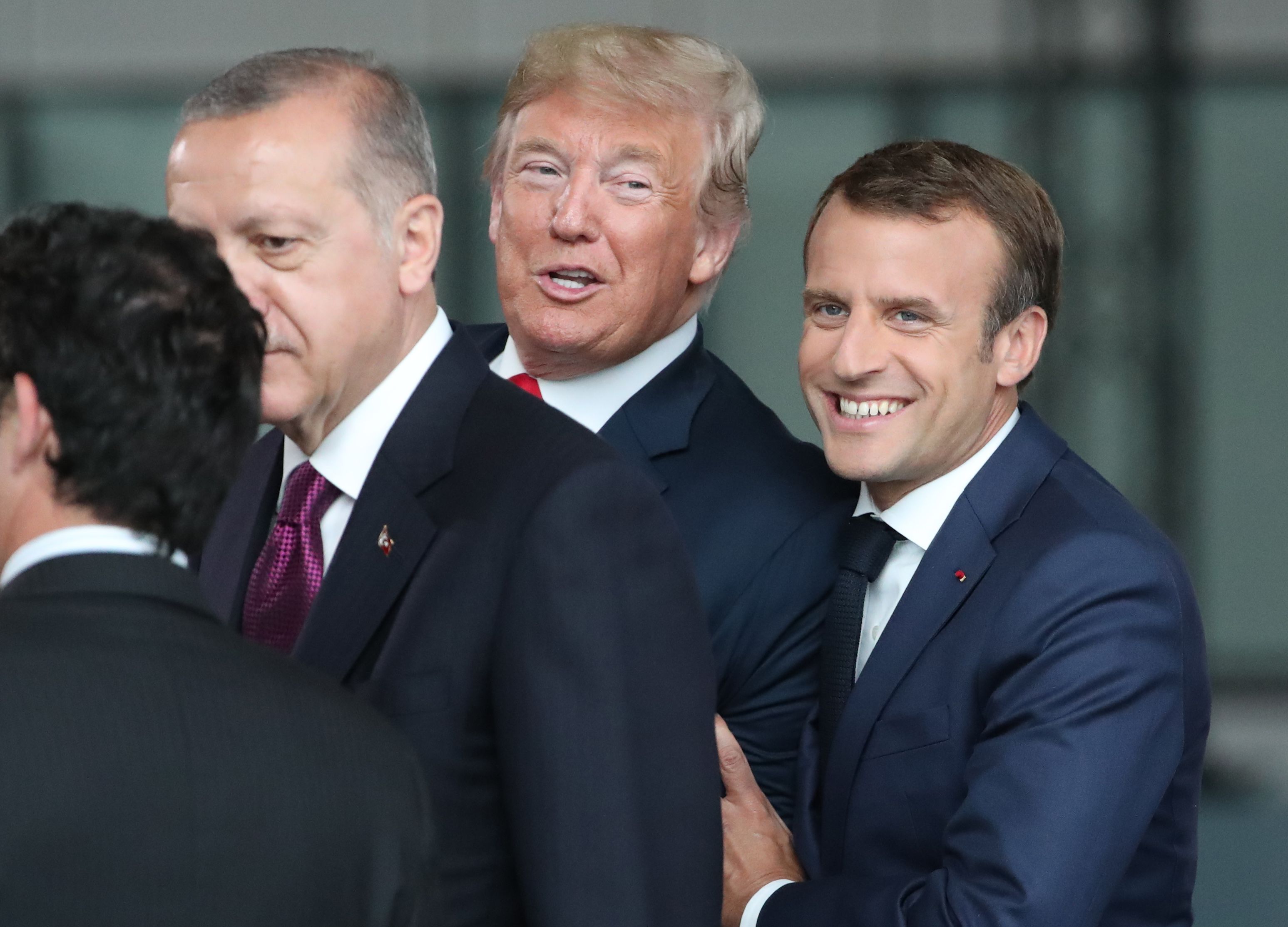
Macron and Trump France’s President Emmanuel Macron jokes with President Trump. Photo by Tatyana Zenkovich/AFP/Getty Images.

So, what about NATO?

Former defense minister of Georgia stands to ask if NATO regrets not giving full them membership, because “it was seen as an invitation for Russia” to invade. And asks when will there be appetite for NATO expansion. Germany’s Defense Minister Ursula von der Leyen: “I have been to a lot of NATO meetings… this summit has the most substance that I have seen”
President Trump asserts that Germany is ‘captive to Russia’ over pipeline project in testy exchange with NATO chief. That was at the breakfast meeting.

Then is Europe threatened by Russia, hence the reason for NATO? Yes, an example –>

A group of Russian special operations forces parachuted onto the island of Gogland in a Russian-controlled portion of the Gulf of Finland. They hid their parachutes, journeyed deep into the interior, and destroyed a series of mock communications stations, radars and ASM batteries. They then prepped a landing site for a helicopter escape — despite the fact that the island already has a helipad.

The troops jumped from a Mi-8AMTSH helicopter at an altitude of 2,500 meters, and used satellite navigation equipment to guide them to their landing site, notes a July 10 press release on the drill from the Russian Ministry of Defense. The soldiers that took part in the exercise had “not less than a hundred jumps with parachutes of various types,” it said.

Aki Heikkinen, who curates Russianmilitarywatch.com, pointed out that Gogland, seized by Russia in 1944, is just 24 miles from the Finnish city of Kotka. More here.

So, as these encounters went on today at the NATO Summit, Trump went so far as to suggest 4% of GDP payments to NATO members.

Meanwhile: NATO existed below the creation of the European Union, and…

President Trump has consistently railed against other members of the NATO security alliance for freeloading off the United States and not doing enough to manage their own defense.

“NATO has not treated us fairly,” he told reporters before leaving for a NATO summit meeting this week in Brussels. “We pay far too much and they pay far too little.”

As with many Trump crusades, there’s truth to his claims—but more to the story. Trump will press for more European defense spending at this week’s meeting, which is likely to be contentious. Other NATO members are already pushing back, arguing that their commitment to defense is rising and they back US priorities in other important ways. But the basic numbers support Trump.

The United States has been the biggest contributor to NATO since Western nations founded the alliance in 1949 to help prevent any more world wars and shield Europe from the Soviet Union. Underpayments by European nations have been contentious since long before Trump started complaining about the problem–especially following the fall of the Berlin Wall in 1989, when many nations began to slash defense spending.

In 2014, NATO agreed that each member country should spend a minimum of 2% of GDP on defense within a decade. So far, only five countries meet that threshold: the United States, the United Kingdom, Greece, Estonia and Latvia. The United States spends 3.5% of GDP on defense, the most of any NATO member. Among other big NATO members, France spends 1.8% of GDP on defense, Germany 1.2%, Italy 1.2%, and Spain 0.9%.

NATO has 29 member countries. Here’s how they measure up:

Graphic by David Foster

NATO said earlier this year that eight members will meet the 2% threshold in 2018, with Poland, Romania, and Lithuania joining the club. The alliance also said 15 nations would hit the target by 2024, though it hasn’t identified the other seven. That would still leave 14 members falling short of NATO’s own spending target. And that’s if there’s no recession by then, which could force governments to cut spending, not raise it, as tax revenue declines.

European leaders seem to realize they have a weak argument when Trump blasts them for subpar defense spending. Donald Tusk, president of the European Council, argued in a statement prior to Trump’s visit that Europe spends more on defense than China and Russia, and he urged Trump to “appreciate your allies.” But he also acknowledged that Trump is right on spending, saying “dear Europe, spend more on your defence, because everyone respects an ally that is well-prepared and equipped.”

While Trump is right about the spending numbers, some analysts worry he’s overly fixated on one metric that doesn’t fully capture the way various NATO members contribute to real-world security operations. Also important, for instance, are troop and equipment contributions to NATO missions. By those metrics, some of the deadbeat members look much more involved.

NATO members other than the United States have taken on steadily more of the NATO mission in Afghanistan since the US first invaded in 2001, for instance. Seven nations—the Czech Republic, Romania, Montenegro, Albania, Denmark, Croatia and Germany—contributed more troops to Afghanistan operations, as a percentage of their total military force, than the United States did between 2015 and 2017, according to analysis by the Center for Strategic and International Studies.

By the same metric, nine NATO members, led by Canada, Norway and Denmark, contributed a larger portion of their military force to operations against ISIS than the US did in 2016. And the US ranks 18th in refugees taken in due to Mideast instability as a percentage of total population, with Turkey, Sweden and Norway accepting the most.


Here Comes a 6th Branch of the Military, Space Force

It has been a concept that has been floated for several months. The Pentagon and the Air Force are actually asking for this. The United States is vulnerable in this frontier which is but one reason for Space X. Consider what is in space: navigation, guided missiles, warning systems and satellites for drones, naval ships, communications and more.

Key Speakers At The 32nd Space Symposium | Getty Images

Russia and China are increasing their space operations and General John Hyten of U.S. Strategic Command has warned of the vulnerabilities for quite some time. China and Russia both have laser weapons designed to damage our systems. Boeing, Northrop Grumman and Lockheed Martin as well as Raytheon on poised to be recipients of Pentagon dollars and the future programs.

Steve Isakowitz, CEO of The Aerospace Corporation says ‘we are approaching a point where Star Wars is not just a movie.’

Seems, Ronald Reagan had great vision. And in 2001, former Defense Secretary Donald Rumsfeld also expressed significant concerns on space systems being attacked by an adversarial country. Read more here.

U.S. Army Research, Development and Engineering Command

As part of the National Defense Strategy, the Air Force asked for an 8% increase in space funding. Watch out too, as Boeing and Apple are examining the option of building a parallel internet in space.

President Donald Trump announced Monday that he is directing the Department of Defense to create a new “space force” to become the sixth branch of the U.S. military.

“My administration is reclaiming America’s heritage as the world’s greatest spacefaring nation,” Trump said at a meeting of the National Space Council, with Vice President Mike Pence standing by him. “The essence of the American character is to explore new horizons and to tame new frontiers, but our destiny beyond the Earth is not only a matter of national identity but a matter of national security, so important for our military.”

“When it comes to defending America, it is not enough to merely have an American presence in space; we must have American dominance in space, so important,” Trump said. “Very importantly, I am hereby directing the Department of Defense and Pentagon to immediately begin the process necessary to establish a space force as the sixth branch of the Armed Forces.”

Trump said the Air Force and future Space Force would be “separate, but equal.”

Trump ordered Gen. Joseph Dunford, chairman of the Joint Chiefs of Staff, to begin implementing the directive.

Trump has previously spoken about creating a space force, but this is the first concrete move, at least publicly, in that direction. The Air Force is currently responsible for space warfare, with the Air Force Space Command in charge of operating and protecting military satellites.

The National Aeronautics and Space Administration is responsible for the country’s civilian space program. Budget cuts in recent have resulted in fewer Americans going into space, leading some observers to call for the U.S. to explore space in a way not done since before the space shuttle came into existence.