U.S. nor Saudi +20 Can Stop Putin’s Bombing

As Obama is in California playing golf, the White House says he took time to have a phone call with Putin on Syria and Ukraine. Not even Obama, heh…..seems to be able to convince Putin to stop bombing U.S. allies in Syria.
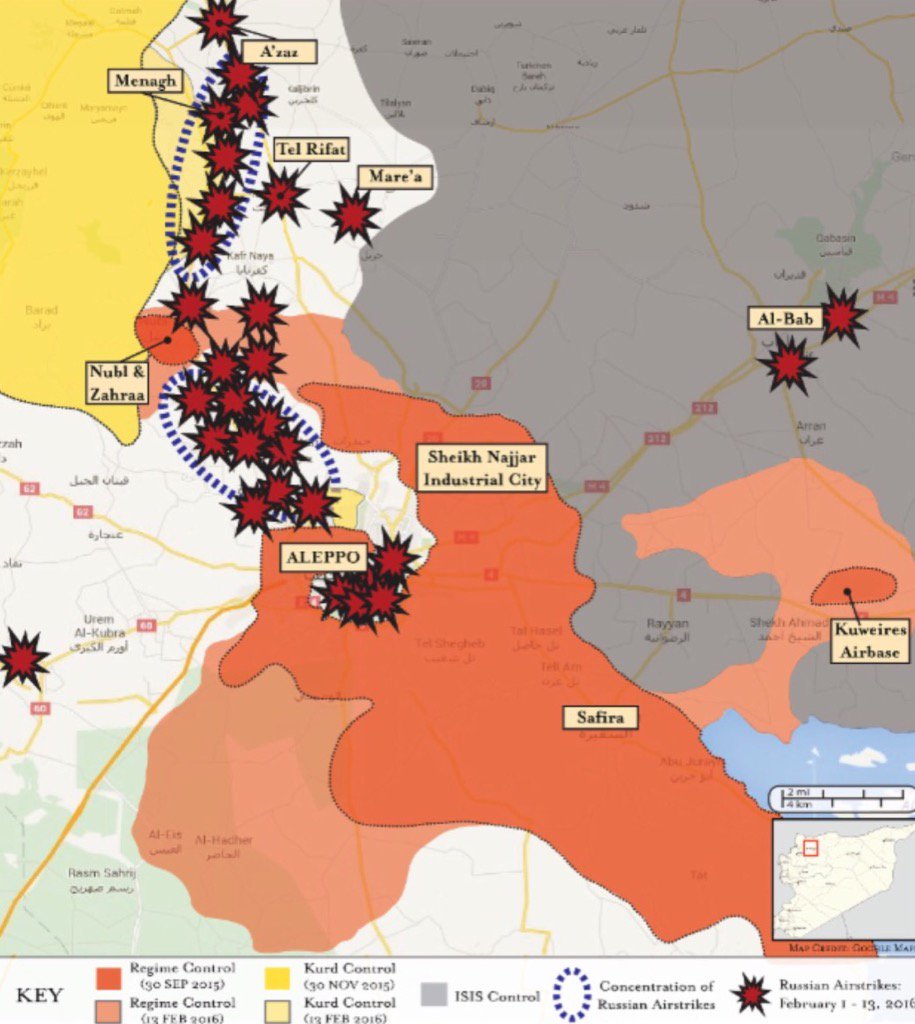
   Russian airstrikes in areas around Aleppo.

Turkey to Extend Strikes on Kurdish Fighters in Syria

VoA: Turkey says it will continue to target U.S.-allied Kurdish fighters on the Syrian frontier near its border, despite mounting international pressure on the Ankara government to stop the artillery bombardments.

Turkish Prime Minister Ahmet Davutoğlu, in telephone talks Sunday, told German Chancellor Angela Merkel that Turkish forces will “not permit” the Kurdish People’s Protection Units fighters (YPG), of the Democratic Union Party (PYD) “to carry out aggressive acts.”

Both France and the United States have called for an “immediate halt” to the Turkish bombardments.

According to Turkish official,s Davutoğlu spoke this weekend with U.S. Vice President Joe Biden concerning Turkish anger about YPG military encroachments in northern Syria, adding that Biden had said he would pass the Turkish Prime Minister’s remarks on to the “relevant parties.”

U.S. officials say there is little to be done to counter militarily the Russian-backed Assad offensive and they argue the vicious five-year-long Syrian civil war that has left upwards of 250,000 dead won’t be resolved by the clash of arms but through a negotiated political settlement. Full story here.

****

RIYADH: Troops from around 20 countries were gathering in northern Saudi Arabia Sunday for “the most important” military maneuver ever staged in the region, the official news agency SPA reported.

The “Thunder of the North” exercise involving ground, air, and naval forces sends a “clear message” that Saudi Arabia and its allies “stand united in confronting all challenges and preserving peace and stability in the region,” SPA said.

Saudi Arabia is currently leading a military campaign against Iran-backed rebels in its southern neighbor Yemen. Last December, it also formed a new 35-member coalition to fight “terrorism” in Islamic countries.

Sunday’s announcement also comes as the kingdom, a member of the US-led coalition targeting the jihadist Daesh group, said it has deployed warplanes to a Turkish air base in order to “intensify” its operations against Daesh in Syria.

SPA did not specify when the military exercise will begin or how long it will last.

However, the agency called it the “most important and largest in the region’s history” in terms of the number of nations taking part and the weaponry being used.

Twenty countries will be taking take part, SPA said.

Among them are Saudi Arabia’s five partners in the Gulf Cooperation Council, as well as Chad, Egypt, Jordan, Malaysia, Morocco, Pakistan, Senegal and Tunisia, it added.

A Saudi source said on Thursday that members of the new “anti-terrorism” coalition will gather in Saudi Arabia next month for its first publicly announced meeting.

Riyadh has said the alliance would share intelligence, combat violent ideology and deploy troops if necessary.

****

I24: Amid ongoing tension on Israel’s northern borders, a new threat has emerged for Israeli fighter pilots conducting spying missions in Lebanon, Walla reports.

Using radar technology it has acquired since Russia’s entry into the Syrian civil war, Hezbollah has started using sophisticated radars to “lock on” to Israeli spy jets on reconnaissance flights over its northern neighbor.

The new technology can identify all Israeli fighter jets, according to sources within Israel’s security establishment. By locking on to the jets as targets, Walla says, Hezbollah can then fire missiles at them.

Nonetheless, the sophistication of Israel’s fighter fleet means they are equipped to deal with such threats, which enables them to detect and follow radars that threaten to lock onto them ahead of launching missiles.

In such an event, pilots can change their plane’s route, especially when they are simply on an intelligence-gathering mission.

Israeli security officials believe Hezbollah has acquired the technology through its ties with Russia, forged as a result of their mutual fight against Islamic State in Syria, Walla reported.

“The connection between Hezbollah, Russia and Syria have greatly changed the rules of the game in the region,” a security official was quoted as saying in Walla.

“Hezbollah is indicating to Israel that it is ready for the next stage.”

During the last all-out war between Israel and Hezbollah in 2006, the Shi’ite militant group hit just one Israeli fighter jet using an anti-tank missile, but while the aircraft was grounded. In the wake of the war, Hezbollah began acquiring advanced anti-aircraft weapons from Iran and Syria, Walla says.

The Israel Air Force has on several occasions attacked weapons convoys making their way from Syria to Lebanon over the last few years, according to foreign media reports.

In January, The Daily Beast reported that the Russians are supplying Hezbollah with sophisticated weaponry, including precision ground-to-ground missiles,  long-range tactical missiles, laser guided rockets, and anti-tank weapons.

The Hezbollah militants who told The Daily Beast about the arms transfers said that the group, the Assad regime and Iran have a “relationship of complete coordination” and that Hezbollah is receiving the arms “with no strings attached.”

“We are strategic allies in the Middle East right now—the Russians are our allies and give us weapons,” one of the Hezbollah officers in charge of five units in Syria told The Daily Beast.

Pay Your Bills Years in Advance, Negative Interest Rate

Primer: 

The Federal Reserve System‍—‌also known as the Federal Reserve or simply as the Fed‍—‌is the central banking system of the United States. It was created on December 23, 1913, with the enactment of the Federal Reserve Act, largely in response to a series of financial panics, particularly a severe panic in 1907. Over time, the roles and responsibilities of the Federal Reserve System have expanded, and its structure has evolved. Events such as the Great Depression in the 1930s were major factors leading to changes in the system.[10]

The U.S. Congress established three key objectives for monetary policy in the Federal Reserve Act: Maximizing employment, stabilizing prices, and moderating long-term interest rates. The first two objectives are sometimes referred to as the Federal Reserve’s dual mandate. Its duties have expanded over the years, and as of 2009 also include supervising and regulating banks, maintaining the stability of the financial system and providing financial services to depository institutions, the U.S. government, and foreign official institutions. The Fed conducts research into the economy and releases numerous publications, such as the Beige Book.

Negative 0.5% Interest Rate: Why People Are Paying to Save

When you lend somebody money, they usually have to pay you for the privilege.

NYT’s: That has been a bedrock assumption across centuries of financial history. But it is an assumption that is increasingly being tossed aside by some of the world’s central banks and bond markets.

A decade ago, negative interest rates were a theoretical curiosity that economists would discuss almost as a parlor game. Two years ago, it began showing up as an unconventional step that a few small countries considered. Now, it is the stated policy of some of the most powerful global central banks, including the European Central Bank and the Bank of Japan.

On Thursday, Sweden’s central bank lowered its bank lending rate to a negative 0.5 percent from a negative 0.35 percent, and said it could cut further still; European bank stocks were hammered partly because investors feared what negative rates could do to bank profits. The Federal Reserve chairwoman, Janet Yellen, acknowledged in congressional testimony Wednesday and Thursday that the American central bank was taking a look at the strategy, though she emphasized no such move was envisioned.

But as negative rates — in which depositors pay to hold money in bank accounts — become a more common fixture, there are many unknowns about what these policies mean for finance, for the economy and even for the definition of money.

These are some of the key questions, and, where we have them, the answers.

So how do negative interest rates work?

It depends. In the cases of interest rate targets set by central banks like the E.C.B. and Swedish Riksbank, they set a negative target rate for banks, and banks in turn pass it along to their customers. The E.C.B., for example, currently has a negative 0.3 percent rate, meaning that when banks deposit money at the central bank overnight, they pay for the privilege.

Banks have different ways of passing the negative rates on to depositors, often framed as fees for keeping money in an account, which is basically negative interest rates by another name.

Bond markets reflect these negative rates, too, including for longer-term government debt. For example, if you bought a two-year Swiss government bond on Thursday, you would have needed to pay a price that resulted in a yield of negative 1.12 percent. Even 10-year Swiss bonds have a negative rate, a sign markets expect below-zero rates to persist in Switzerland for many years to come.

Generally companies that borrow money are viewed as riskier than governments, so they have to pay higher interest rates. Therefore negative-rate corporate debt is still rare. But it has happened, including with corporate bonds issued by the Swiss food giant Nestle.

But don’t people just withdraw cash rather than pay to deposit it at their bank or buy a government bond that will give them back less than they paid?

You’d think, right? This was exactly why economists had long thought that negative interest rates were impossible. It helps explain why central banks first turned to other tools, including quantitative easing, when they saw a need to ease monetary policy despite interest rates that were already near zero.

But it looks as if the convenience of keeping money in a bank account is worth a small negative interest rate or fees for most consumers and businesses, at least at the only slightly negative rates currently in place. Storing and providing security for cash may be more expensive than a small bank charge.

When initial experiments in Switzerland and Sweden didn’t result in mass withdrawals from the banking system, larger central banks in need of easier money moved gingerly in the same direction. They’ll stop when either their economies start to grow or they see more concrete evidence that negative rates are doing more harm than good.

How is this supposed to help the economy?

Pretty much the same way it always is supposed to help the economy when a central bank cuts rates. Lower rates encourage business investment and consumer spending; increase the value of the stock market and other risky assets; lower the value of a country’s currency, making exporters more competitive; and create expectations of higher future inflation, which can induce people to spend now.

We have decades of experience with central banks trying to manage the economy by, for example, cutting bank rates to 2 percent from 3 percent when there is an economic downturn. The shift to negative rate policies is, hypothetically at least, the same, but with a starting point of rates already around zero.

So does it work?

It’s hard to say with any certainty yet. At a minimum, it seems to have an effect of lowering the value of a currency, which makes export industries very happy. It’s less clear whether it can help create sustained economic growth, particularly when the hard-to-calculate downsides are factored in.

What are those downsides?

The global financial system is built on an assumption of above-zero interest rates. Going below zero could cause damage to the very architecture by which money and credit zoom through the economy, and in turn inhibit growth.

Banks could cease to be viable businesses, eliminating a key way that money is channeled from savers to productive investments. Money market mutual funds, widely used in the United States, could well cease to exist. Insurance companies and pension funds could face their own major strains.

In a speech last year, Hervé Hannoun, then the deputy general manager of the Bank for International Settlements, even argued that this could “over time encourage the use of alternative virtual currencies, undermining the foundations of the financial system as we know it today.”

Is the Federal Reserve going to do this in the United States?

Janet Yellen doesn’t think so. But in two days of congressional testimony this week, she also didn’t rule it out.

For one thing, the United States economy, and particularly its labor market, looks to be in stronger shape than that of many others around the world. So the Fed expects to be in interest-rate raising mode this year (though exactly how fast is very much in question). But even if the economy does take a turn for the worse, there’s no certainty that negative rates are the path the Fed would take.

There is a question of whether that would even be legal. It’s not clear if the language of the Federal Reserve Act allows negative bank rates (J.P. Koning, a financial commentator, runs through the legal issues here). Ms. Yellen said in testimony this week that the legality of negative rates “remains a question that we still would need to investigate more thoroughly.”

She also said that “it isn’t just a question of legal authority.”

“It’s also a question of could the plumbing of the payment system in the United States handle it?” she said. “Is our institutional structure of our money markets compatible with it? We’ve not determined that.”

Financial markets do not now price in meaningful odds of negative rates in the United States. Want one modest clue that negative rates can’t be ruled out, though? In its annual stress test of major banks, the Fed asked the firms to figure out what would happen to their finances in a “severely adverse” scenario that included a sharp rise in unemployment and a rate of negative 0.5 percent rate on short-term Treasury bills — in other words, what you’d expect to see if there were a recession and the Fed cut rates well below zero.

Ms. Yellen noted that the rates on Treasury bills could go negative even in the absence of a policy shift by the Fed, as has happened a few times in the past.

So what are some of the weird things that could happen in a world in which negative rates become routine?

The policies in Europe and Japan are still relatively new and involve rates only slightly below zero. But if the policies become long-lasting, or negative rates go much lower, there are a lot of mind-bending ways it could affect routine transactions.

For example, would people start prepaying years’ worth of cable bills to avoid having money tied up in a money-losing bank account? How about property taxes? Would companies and governments put in place new policies prohibiting people from paying their bills too early?

Or consider this: Many commercial transactions now take place with some short-term credit attached — for example, a company that gets a 60-day grace period to pay bills from its suppliers. Would that flip, and suddenly suppliers would prohibit upfront payment and insist that their customers wait 60 days to pay?

Might new businesses sprout up that allow people to securely store thousands of dollars in bundles of $100 bills, or could people buy physical objects as stores of value that the banks can’t charge a negative interest rate on?

“Negative interest rates in Japan is blowing my mind,” said Jose Canseco, the provocative retired baseball player not normally known for his economic musings, on Twitter. And the truth is, he’s not the only one.

Aleppo Codex, Oldest Surviving Treasure

As the chatter among some world leaders centers around a cessation of hostilities in Syria, tragically Aleppo is a big turning point for history and control. If Damascus is the next target, then history in the region is all but erased.

The Aleppo Codex was written in the 10th century, C.E. At some point the Codex was transferred to Egypt and emerged in Syria. It remained there for 600 years until in 1947, there were riots against Jews and their properties in Aleppo and an ancient synagogue was burned but the Codex survived with some damage. The Aleppo Jewish and Christian community protected the Codex allegedly in a cave as the most sacred possession.

The United Nations Educational, Scientific and Cultural Organization (UNESCO) has officially recognized the Codex as a world treasure.

World treasure: UNESCO recognizes oldest surviving copy of Hebrew Bible

FNC: It is one of the world’s greatest treasures.

Written sometime around 930 A.D. in the town of Tiberias on the shores of the Sea of Galilee, the Aleppo Codex is the oldest surviving copy of the Hebrew Bible, according to experts.

The United Nations Educational, Scientific and Cultural Organization, UNESCO, added the millennium-old manuscript earlier this week to its International Memory of the World Register, which honors some of the most important discoveries in human history.

“It is regarded as the oldest complete Hebrew Bible in the world,” Don Bassett, director of the Biblical Museum of History in Tennessee, told FoxNews.com. “The text has been preserved with phenomenal accuracy,” Bassett said.

Damage to Historical Sites in the Syrian Civil War | Graphiq   Interactive map of damaged or destroyed sites.

All current versions of the Old Testament are believed to have stemmed “in one way or another, from this ancient manuscript,” Adolfo Roitman, head curator of the Shrine of the Book Museum in Jerusalem, told the Christian Post.

“The best Bible for scholarly study available today is traceable back to the Aleppo Codex,” added Bassett.

The Codex, which was smuggled out of Syria and brought into Israel in 1958, currently resides at the museum.

Some 190 pages of the Codex — around 40 percent of the total — are missing, Bassett told FoxNews.com.

The missing pages include four out of five books of the Pentateuch — the first section of books in the Bible also called the Five Books of Moses — and five books from the last section –Lamentations, Ecclesiastes, Esther, Daniel and Ezra, i24News reported.

“It’s fitting the Aleppo Codex has been designated as a world treasure, given its storied past and significance to Jews and Christians through the ages,” said Michael Holmes, Ph.D., executive director of the Museum of the Bible’s research arm, the Scholar’s Initiative. “It’s simply unparalleled in the world of biblical manuscripts.”

There is also a disagreement over who owns the priceless text.

Filmmaker Avi Dabach, who is making a documentary on the ancient manuscript, told the newspaper he believes the Codex belongs to the Jewish community that fled Syria.

“In the 1960s the Aleppo-Jewish community sued the people who brought the Codex to Israel,” Dabach said, according to the Christian Post. “The Israeli authorities decided to confiscate this item and then, from a position of strength, force on the community an arrangement.”

UNESCO says on its website that the manuscript, also known as the “Crown,” is “the oldest extant nearly complete Hebrew Bible (Old Testament).”

“It is considered by many scholars to be the most exact and authoritative Hebrew Bible and served as a source of text, cantillation and vocalization of the Bible – both in the past and present,” according to UNESCO.

Russians Working at Islamic State Gas Plant

Why Are Russian Engineers Working at an Islamic State-Controlled Gas Plant in Syria?
Moscow says it’s at war with the jihadist group — but both sides aren’t opposed to cutting economic deals amid the bloodshed.


FPM: Officially, Syrian President Bashar al-Assad’s government and his Russian allies are at war against the Islamic State. But a gas facility in northern Syria under the control of the jihadi group is evidence that business links between the Syrian regime and the Islamic State persist. According to Turkish officials and Syrian rebels, it is also the site of cooperation between the Islamic State and a Russian energy company with ties to President Vladimir Putin.

The Tuweinan gas facility, which is located roughly 60 miles southwest of the Islamic State’s de facto capital of Raqqa, is the largest such facility in Syria. It was built by Russian construction company Stroytransgaz, which is owned by billionaire Gennady Timchenko, a close associate of Putin. The company’s link to the Kremlin is well-documented: The U.S. Treasury Department previously sanctioned Stroytransgaz, along with the other Timchenko-owned companies, for engaging in activities “directly linked to Putin” amidst the confrontation over Ukraine.

The story of the controversial plant involves the Assad regime, Russian-Syrian businessmen, the Islamic State, and moderate Syrian groups, which together tried to activate the facility for the financial and logistical benefits it could provide for them.

The Syrian government originally awarded the contract to construct the Tuweinan facility to Stroytransgaz in 2007. The construction utilized a Syrian subcontractor, Hesco, which was owned by Russian-Syrian dual national George Haswani. Last November, the Treasury Department sanctioned Haswani for allegedly brokering oil sales between the Islamic State and the Assad regime, charges he denies.

The partnership between Hesco and Stroytransgaz goes far beyond this one deal. The companies have worked in joint projects in Sudan, Algeria, Iraq, and the UAE since 2000, according to Haswani’s son-in-law, Yusef Arbash, who runs Hesco’s Moscow office.

Construction continued slowly until a coalition of Syrian rebel groups seized the facility in a joint operation with the al Qaeda-affiliated al-Nusra Front in January 2013. Abu Khalid, a member of the Qwais al-Qarani brigade, which was a part of the rebel coalition, said that when they entered the area, Russian engineers and advisors had already fled, leaving Syrian employees behind. “We decided to protect this plant; we thought it is belonging to Syrian people since it was owned by the Syrian state,” he said.
The Islamic State has been in control of the facility since early 2014.

A senior Turkish official said that after its seizure, Stroytransgaz, through its subcontractor Hesco, continued the facility’s construction with the Islamic State’s permission.


Syrian state-run newspaper Tishreen published a report appearing to corroborate this claim. In January 2014, after the facility was captured by the Islamic State, the paper cited Syrian government sources, saying that Stroytransgaz had completed 80 percent of the project and expected to hand over the facility to the regime during the second half of the year. The article didn’t mention that the facility was under the control of the Islamic State.

According to David Butter, an associate fellow at London-based Chatham House, who has seen a letter written by George Haswani explaining the details of the project, the facility’s first phase of production started towards the end of 2014, and it became fully operational during 2015. “Some of the natural gas goes to the Aleppo power station, which operates under the Islamic State’s protection, and the remainder is pumped to Homs and Damascus,” he said.

Abu Khalid said that Russian engineers still work at the facility, and Haswani brokered a deal with the Islamic State and the regime for mutually beneficial gas production from the facility. “IS allowed the Russian company to send engineers and crew in return for a big share in the gas and extortion money,” he said, using an acronym for the Islamic State and attributing the information to Syrian rebel commanders fighting the Islamic State in the area. “Employees of the Russian company were changing their shifts via a military base in Hama governorate.”

Haswani has rejected the Treasury Department’s allegations that he worked as a middle man in oil deals between the Islamic State and the Assad regime. But he has never denied Hesco’s continued work on the gas facility after the Islamic State captured it.

The details of the Tuweinan deal brokered between the Islamic State and Hesco was first reported by the Syrian media collective Raqqa Is Being Slaughtered Silently in October 2014. The group claimed that Hesco signed an agreement with the Islamic State promising to leave a larger chunk of the profit to them. In October 2015, the Financial Times reported that the gas produced in the plant was sent to the Islamic State-held thermal power plant in Aleppo. The deal provides 50 megawatts of electricity for the regime, while the Islamic State receives 70 megawatts of electricity and 300 barrels of condensate. The engineers who worked at the plant told the Financial Times that Hesco also sends the Islamic State roughly $50,000 every month to protect its valuable equipment.

While Syria remains politically fractured, the deal at the Tuweinan gas facility shows that the rival parties are still cutting economic agreements amid the war. Aron Lund, editor of the Carnegie Endowment for International Peace’s website Syria in Crisis, said that similar gas and oil arrangements exist all over Syria. “You have them between the IS and the regime, but also between IS and rival Sunni Arab rebels, between the Kurds and the regime, Kurds and rebels, the rebels and the regime, and so on,” he said. “You have lots of informal trade connections that emerge among armed groups, smugglers, or private business to fill the gaps between the various sides as the country falls apart, while national institutions, infrastructure, and much of the economy will necessarily remain shared.”

Syria: Cessation of Hostilities? Huh?

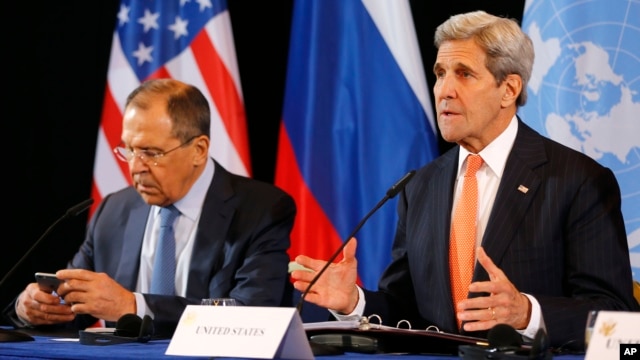
Russian Foreign Minister Lavrov and U.S. State Department Secretary John Kerry announce an accelerated and expanded delivery of humanitarian relief in Syria and also a nationwide cessation of hostilities within a week.

U.S. Secretary of State John Kerry, right, and Russian Foreign Minister Sergey Lavrov attend a news conference after the International Syria Support Group (ISSG) meeting in Munich, Germany, Feb. 12, 2016.

It is complicated…..

The working group of 17 countries meeting in Munich agreed “to implement a nationwide cessation of hostilities to begin in a target of one week’s time,” he said.

They also agreed to immediately “accelerate and expand” humanitarian aid to the war-torn country.

“Sustained delivery will begin this week, first to the areas where it is most urgently needed… and then to all the people in need throughout the country, particularly in the besieged and hard to reach areas,” Kerry said.

He also said peace talks between rebels and the Syrian government would resume in Geneva “as soon as possible”.

VOA: Kerry told reporters early Friday in Munich that the cessation of hostilities will not apply to terrorist groups, including Islamic State, al-Nusra and others. He said the 17-nation International Syria Support Group has agreed that a task force co-chaired by the U.S. and Russia will work to “determine the modalities of a long-term reduction in violence.”

The top U.S. diplomat added on a cautionary note that the ISSG meeting has produced commitments on paper, but that the real test will be if all the parties honor their commitments.

The support group also agreed to “accelerate and expand” delivery of humanitarian assistance, starting with key troubled areas and then widening to provide increased humanitarian aid to the entire country. Read the full summary here.


Meanwhile, Assad has won and so has Islamic State….

If Assad Wins, Islamic State Wins

Bloomberg: The civilians fleeing Aleppo don’t prove definitively that, with Russian backing, President Bashar al-Assad will win the Syrian civil war. But it’s certainly time to game out that scenario and ask: What would victory look like to Assad? And what will happen to the other regional actors engaged in this fight?

The decisive element to consider is whether Assad needs to defeat Islamic State to be a winner. If the answer is yes — and if Assad could do it — the world would probably breathe a sigh of relief, and accept Assad’s victory, despite its extraordinary human costs and egregious violations of human rights.

But Assad will probably calculate that he doesn’t need to beat Islamic State, just contain it so that it doesn’t constitute an existential threat to his regime. That would put Islamic State well on its way to becoming a statelet, accepted by its neighbors for lack of will to defeat it. The long-term consequences for the world would be high, but Assad’s regime would be substantially better off.

For now, Assad appears to be moving toward at least a limited victory over the ill-organized Free Syrian Army forces around Aleppo. It isn’t rocket science. He’s combining intense air support from Russian planes with ground forces drawn from what remains of the Syrian army.

The Battle of Aleppo has been going on since 2012. What’s changed in this round is the intensity of Russian airstrikes. Republican presidential candidate Ted Cruz may have said that he wants to carpet bomb Islamic State to find out if sand can glow in the dark, but it’s Russian President Vladimir Putin who’s following a version of that strategy against the Syrian opposition.

It’s still conceivable that the Free Syrian Army could rally, but it doesn’t look likely. That would mean Assad could consolidate control over Aleppo and whatever number of people remains there. The population was some 2.5 million before the war, and it’s certainly much smaller now.

Over time, opposition fighters could in theory infiltrate back and attempt an insurgency. If Assad can’t spare sufficient troops to hold Aleppo, the Free Syrian Army might stage a comeback. But it would be doing so from a much reduced position, and the war-weary public might very well be unwilling to support  it.

Once the formula of intense Russian bombing plus Syrian ground troops has been shown to be a success, Assad and Putin will repeat it over whatever Syrian territory remains in Free Syrian Army or Syrian Kurdish hands. It is entirely reasonable to think it would succeed again.

That will lead to a major strategic crossroads. Assad and Putin will at least be tempted to try their winning formula against Islamic State.

Putin would love to show the world that he can succeed where the West has failed. Beating the Sunni militant group would significantly improve Russia’s global military prestige. Added to his taking of Crimea, it would make Putin the first Russian leader in more than a generation to win wars, which will also burnish his domestic reputation. It might be possible to achieve all this without Russian ground troops. And if airstrikes aren’t enough, Putin can simply blame the Syrian ground forces for being inadequate.

The upside for Assad would be a return to something not unlike the status quo before the Sunni uprising against him — but with a smaller national population with fewer Sunni Arabs, because many will remain in Turkey and Europe as refugees.

At one time, it seemed unimaginable that the Assad regime could return to national control. But that doesn’t seem quite as unrealistic now. Iran would favor and support Assad, as it always has. Now that Iran’s regional position has improved as a result of the nuclear deal with the U.S. and the lifting of economic sanctions, Iran would be better placed than ever to support Assad.

The Israelis have looked Islamic State in the face and concluded they’d rather have Assad than total chaos. Turkey had warm relations with Assad and was establishing open borders with Syria until the uprising broke those ties. As a geostrategic matter, Turkey would eventually take Assad back into the fold, whatever its continuing anger about the massacres he’s perpetrated. Even Saudi Arabia, which sees the Assad regime as the cat’s-paw of its rival Iran, would be prepared to live with Assad if it meant a return to regional stability.

The great risk for Assad in taking on Islamic State is the possibility of overreach. Even if he has enough troops to beat the militants, he might not be able to hold down the rest of the country. And if Islamic State forces flee Syria into Iraq, which would be the rational thing for them to do, they could come back and harass whatever forces Assad left behind. Unlike the Free Syrian Army, Islamic State would have a base from which to pursue an insurgency. It also has ideologically motivated troops with some combat experience. What’s more, Assad simply may not want to govern Sunnis area in Syria that have either sided with Islamic State or accepted its rule as a practical matter.

Assad therefore might decide that he’d be better off with a de facto border that Islamic State respects out of self-interest. If he leaves the group alone and is left alone in exchange, he can re-establish some semblance of sovereignty in much of Syria, surely his No. 1 priority. Essentially, Islamic State becomes everyone else’s problem, not Assad’s.

This scenario seems to me more likely than a serious Syrian countermilitant push. It would leave Islamic State as a threat to Iraq, to regional security and the rest of the world. The possibility of Islamic State as a long-term, de facto state looms.