Democrats Social Reconstruction in America via Putin

Primer for this interview: Why did Baraq Obama put Chuck Hagel in as Secretary of Defense? Global Zero. Further, while everyone is caught up in the election cycle, it is important to know that Obama has removed our first strike option to deploy a nuclear weapon. Kinda don’t need that pesky nuclear football that is with Obama at all times.

This week, Trevor interviews Jeffrey R. Nyquist, geopolitical expert and author of “Origins of the Fourth World War: And the Coming Wars of Mass Destruction.” This particularly frightening episode of LoudonClear delves into what happened to the communists after the cold war, the Russian propaganda machine and Donald Trump’s Russian ties. Hat tip to NoisyRoom. Related reading:

Russia Weaponizing the Arctic

Hillary’s Relationship with Russia is Approved Espionage

Russian spies claim they can now collect crypto keys

The U.S. has had a Russian Problem of Espionage for Decades

The Games of Russia and the IRGC, that Kidnapped our Sailors

What you Need to Know About the Gerasimov Doctrine’

That should keep you busy for a while and provide an in sight into how the willing accomplices within our government are either carrying the baton for the Kremlin or are too stupid to know otherwise.


Edward Snowden has Gone Hollywood

The U.S. v. Edward Snowden criminal complaint is under seal but the cover is here.

New Snowden Movie Depicts Traitor as Hero; Profiting from His Treason May Violate Law

JudicialWatch: The upcoming Hollywood movie about traitor Edward Snowden—criminally charged by the U.S. government under the Espionage Act—portrays the National Security Agency (NSA) subcontractor who leaked top secret information as a courageous patriot. Nothing surprising there considering the film’s Academy award-winning director, Oliver Stone, referred to Snowden as a “hero”back in 2013 when he fled to Moscow to avoid prosecution after betraying his country. Snowden’s illegal disclosures have helped terrorist groups like Al Qaeda and led to the death of innocent people. Last year Snowden began openly engaging with ISIS and Al Qaeda members and supporters via social media.

Image result for edward snowden Buzzfeed

“Snowden has done incalculable damage to the NSA and, in the process, to American national security,” according to University of Virginia Law School Professor Robert F. Turner, who specializes in national security issues and served as Counsel to the President’s Intelligence Oversight Board at the White House. “Officials in position to know said good people have already lost their lives thanks to Snowden. Countless more are likely to lose theirs now that our enemies know our most closely guarded sources and methods of communications intelligence collection.” Turner adds that Snowden is hailed as a hero and “whistleblower” by those who are clueless to the devastation he’s done. “When all of the smoke clears, it may very well be proven that Snowden is the most injurious traitor in American history.”

This would make it illegal to profit from his crimes and the Department of Justice (DOJ) should confiscate all money made by the violators. Snowden is no whistleblower. In fact he violated his secrecy agreement, which means he and his conspirators can’t materially profit from his fugitive status, violation of law, aiding and abetting of a crime and providing material support to terrorism. It’s bad enough that people are profiting from Snowden’s treason, but adding salt to the wound, the Obama administration is doing nothing about it. Judicial Watch has launched an investigation and is using the Freedom of Information Act (FOIA) to obtain records. True whistleblowers and law-abiding intelligence officers such as Lt. Colonel Anthony Shaffer, FBI Special Agent Robert G. Wright and Valerie Plame got release authority in accordance with their secrecy agreement and did not seek money or flee to Russia. A federal appellate court has ruled that government employees, such as Snowden, who signed privacy agreements can’t profit from disclosing information without first obtaining agency approval. The case involved a CIA agent (Frank Snepp) who violated his agreement with the agency by publishing a book. A federal court denied Snepp royalties from his book and an appellate court upheld the ruling, reiterating that the disgraced agent breached the “constructive trust” between him and the government.

Related reading:  Audit of the Federal Bureau of Investigation’s Implementation of Its Next Generation Cyber Initiative

Furthermore, Snowden, Stone and the producers of a 2014 Oscar-winning Snowden film titled “Citizenfour” may be in violation of the Anti-Terrorism Act (ATA), which forbids providing material support or resources for acts of international terrorism. Many deep-pocketed institutions have been sued under the law for providing terrorist organizations or affiliates resources that assisted in the commission of terrorist acts. Just last month the families of victims killed and injured by Hamas filed a $1 billion lawsuit against Facebook under ATA for providing the terrorist group with material support by letting it use its services to help carry out attacks. A number of banks have also been sued under the law for financing terrorist activities, albeit unknowingly.

Both Stone and “Citizenfour” director Laura Poitras had clandestine meetings abroad with Snowden. Stone told a Hollywood trade publication he met Snowden in Russia and that he moved production overseas because filming in the U.S. was too risky. “We didn’t know what the NSA might do, so we ended up in Munich, which was a beautiful experience,” Stone said. Poitras actually collaborated with Snowden’s defection to China then Russia and had email communication with him before he committed his crimes so she had foreknowledge. This is all included in her documentary. On May 20, 2013 Snowden flew to Hong Kong to meet with British journalists and Poitras. He gave them thousands of classified documents and Poitras became known as the woman who helped Snowden spill his secrets, or rather commit treason. When Citizenfour won the 2015 Academy Award, Poitras was joined by Snowden’s girlfriend during her acceptance speech at the Dolby Theater in Hollywood, California. “The disclosures that Edward Snowden revealed don’t only expose a threat to our privacy but to our democracy itself,” Poitras said in her acceptance speech. “Thank you to Edward Snowden for his courage and for the many other whistleblowers.”

Snowden remains a fugitive from U.S. law protected by Russia. On June 14, 2013, federal prosecutors charged him with “theft of government Property,” “unauthorized communication of national defense information” and “willful communication of classified communications intelligence information to an unauthorized person.” Al Qaeda keeps using information leaked by Snowden to help its fighters evade surveillance technology, according to a British newspaper report. “The terrorist group has issued new video guidance based on what they have learnt about Western spying methods from the Snowden disclosures which have been made public on the internet,” the article states. “The move confirms the worst fears of British and American intelligence chiefs who warned that Snowden’s betrayal would play into the hands of the terrorists. The video even uses footage of news reports of the Snowden leak, highlighting how ‘NSA is tracking millions of phones.’”

New Color-coded Cyber Threats

Remember when the Democrats and lobby groups ridiculed George W. Bush for using a color coded threat matrix? Carry on….

The White House now has a color-coded scale for cyber-security threat
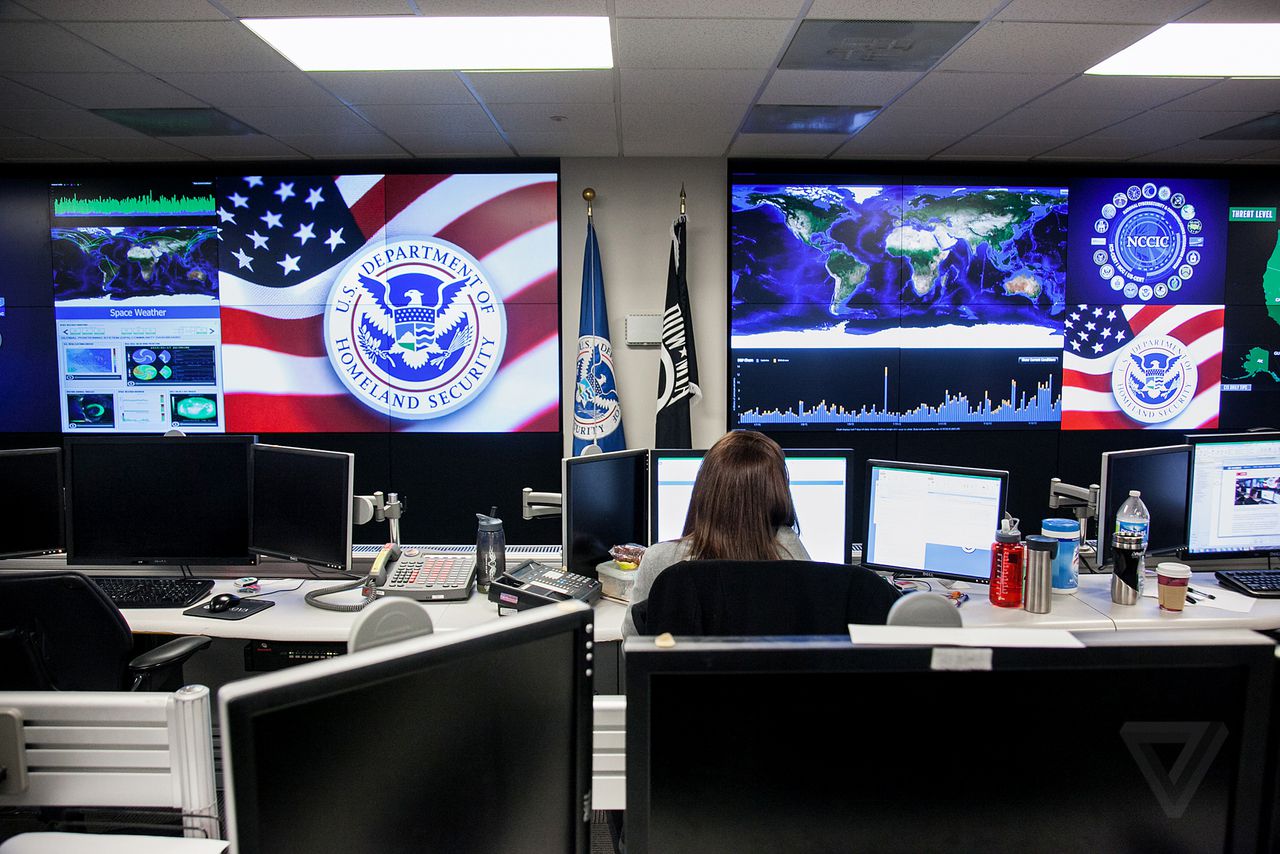
TheVerge:  As the Obama administration nears its final months, the White House has released a framework for handling cyberattacks. The Presidential Policy Directive on United States Cyber Incident Coordination builds on the action plan that Obama laid out earlier this year, and it’s intended to create a clear standard of when and how government agencies will handle incidents. It also comes with a new threat level scale, assigning specific colors and response levels to the danger of a hack.

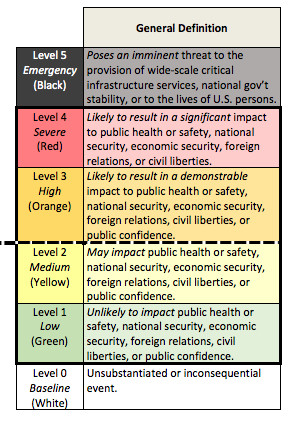
The cyberattack severity scale is somewhat vague, but it’s supposed to make sure that the agencies involved in cybersecurity — the Department of Justice, Department of Homeland Security, and Office of the Director of National Intelligence — respond to threats with the same level of urgency and investment. A Level One incident is “unlikely to impact public health or safety, national security, economic security, foreign relations, civil liberties, or public confidence,” while a red Level Four one is “likely to result in a significant impact to public health or safety, national security, economic security, foreign relations, or civil liberties.” One final designation — Level Five, or black — covers anything that “poses an imminent threat to the provision of wide-scale critical infrastructure services, national government stability, or to the lives of US persons.”

The upshot of this is that anything at Level Three or above will trigger a coordination effort to address the threat. In addition to the groups above, this effort will include the company, organization, or agency that was attacked.
Cybersecurity is a growing concern, and both Congress and the White House have spent the past several years pushing various frameworks for shoring it up. This includes a series of hotly debated bills that culminated in the Cyber Information Sharing Act, which has raised privacy questions as it’s been put into practice. At the same time, high-profile hacks have led to serious consequences for companies like Sony Pictures, Target, and Ashley Madison. Most recently, an unknown hacker or hackers — potentially linked to Russia — breached the Democratic National Committee’s servers, releasing large numbers of embarrassing documents and emails. This announcement doesn’t tell us exactly how the federal government will handle future cyberattacks, but along with everything else, it does signal that they’re becoming a more and more standard part of the security equation.

*****

From the White House FACT SHEET: Presidential Policy Directive

The PPD builds on these lessons and institutionalizes our cyber incident coordination efforts in numerous respects, including:

  • Establishing clear principles that will govern the Federal government’s activities in cyber incident response;
  • Differentiating between significant cyber incidents and steady-state incidents and applying the PPD’s guidance primarily to significant incidents;
  • Categorizing the government’s activities into specific lines of effort and designating a lead agency for each line of effort in the event of a significant cyber incident;
  • Creating mechanisms to coordinate the Federal government’s response to significant cyber incidents, including a Cyber Unified Coordination Group similar in concept to what is used for incidents with physical effects, and enhanced coordination procedures within individual agencies;
  • Applying these policies and procedures to incidents where a Federal department or agency is the victim; and,
  • Ensuring that our cyber response activities are consistent and integrated with broader national preparedness and incident response policies, such as those implemented through Presidential Policy Directive 8-National Preparedness, so that our response to a cyber incident can seamlessly integrate with actions taken to address physical consequences caused by malicious cyber activity.

We also are releasing today a cyber incident severity schema that establishes a common framework within the Federal government for evaluating and assessing the severity of cyber incidents and will help identify significant cyber incidents to which the PPD’s coordination procedures would apply.

Incident Response Principles

The PPD outlines five principles that will guide the Federal government during any cyber incident response:

  • Shared Responsibility – Individuals, the private sector, and government agencies have a shared vital interest and complementary roles and responsibilities in protecting the Nation from malicious cyber activity and managing cyber incidents and their consequences.
  • Risk-Based Response – The Federal government will determine its response actions and  resource needs based on an assessment of the risks posed to an entity, national security interests, foreign relations, or economy of the United States or to the public confidence, civil liberties, or public health and safety of the American people.
  • Respecting Affected Entities – Federal government responders will safeguard details of the incident, as well as privacy and civil liberties, and sensitive private sector information.
  • Unity of Effort – Whichever Federal agency first becomes aware of a cyber incident will rapidly notify other relevant Federal agencies in order to facilitate a unified Federal response and ensure that the right combination of agencies responds to a particular incident.
  • Enabling Restoration and Recovery – Federal response activities will be conducted in a manner to facilitate restoration and recovery of an entity that has experienced a cyber incident, balancing investigative and national security requirements with the need to return to normal operations as quickly as possible.

Significant Cyber Incidents

While the Federal government will adhere to the five principles in responding to any cyber incident, the PPD’s policies and procedures are aimed at a particular class of cyber incident: significant cyber incidents.  A significant cyber incident is one that either singularly or as part of a group of related incidents is likely to result in demonstrable harm to the national security interests, foreign relations, or economy of the United States or to the public confidence, civil liberties, or public health and safety of the American people.

When a cyber incident occurs, determining its potential severity is critical to ensuring the incident receives the appropriate level of attention.  No two incidents are the same and, particularly at the initial stages, important information, including the nature of the perpetrator, may be unknown.

Therefore, as part of the process of developing the incident response policy, the Administration also developed a common schema for describing the severity of cyber incidents, which can include credible reporting of a cyber threat, observed malicious cyber activity, or both.  The schema establishes a common framework for evaluating and assessing cyber incidents to ensure that all Federal departments and agencies have a common view of the severity of a given incident, the consequent urgency of response efforts, and the need for escalation to senior levels.

The schema describes a cyber incident’s severity from a national perspective, defining six levels, zero through five, in ascending order of severity.  Each level describes the incident’s potential to affect public health or safety, national security, economic security, foreign relations, civil liberties, or public confidence.  An incident that ranks at a level 3 or above on this schema is considered “significant” and will trigger application of the PPD’s coordination mechanisms.

Lines of Effort and Lead Agencies

To establish accountability and enhance clarity, the PPD organizes Federal response activities into three lines of effort and establishes a Federal lead agency for each:

  • Threat response activities include the law enforcement and national security investigation of a cyber incident, including collecting evidence, linking related incidents, gathering intelligence, identifying opportunities for threat pursuit and disruption, and providing attribution.   The Department of Justice, acting through the Federal Bureau of Investigation (FBI) and the National Cyber Investigative Joint Task Force (NCIJTF), will be the Federal lead agency for threat response activities.
  • Asset response activities include providing technical assets and assistance to mitigate vulnerabilities and reducing the impact of the incident, identifying and assessing the risk posed to other entities and mitigating those risks, and providing guidance on how to leverage Federal resources and capabilities.   The Department of Homeland Security (DHS), acting through the National Cybersecurity and Communications Integration Center (NCCIC), will be the Federal lead agency for asset response activities.  The PPD directs DHS to coordinate closely with the relevant Sector-Specific Agency, which will depend on what kind of organization is affected by the incident.
  • Intelligence Support and related activities include intelligence collection in support of investigative activities, and integrated analysis of threat trends and events to build situational awareness and to identify knowledge gaps, as well as the ability to degrade or mitigate adversary threat capabilities.  The Office of the Director of National Intelligence, through the Cyber Threat Intelligence Integration Center, will be the Federal lead agency for intelligence support and related activities.

In addition to these lines of effort, a victim will undertake a wide variety of response activities in order to maintain business or operational continuity in the event of a cyber incident.  We recognize that for the victim, these activities may well be the most important.  Such efforts can include communications with customers and the workforce; engagement with stakeholders, regulators, or oversight bodies; and recovery and reconstitution efforts.   When a Federal agency is a victim of a significant cyber incident, that agency will be the lead for this fourth line of effort.  In the case of a private victim, the Federal government typically will not play a role in this line of effort, but will remain cognizant of the victim’s response activities consistent with these principles and coordinate with the victim.

Coordination Architecture

In order to facilitate the more coordinated, integrated response demanded by significant cyber incidents, the PPD establishes a three-tiered coordination architecture for handling those incidents:

National Policy Level:  The PPD institutionalizes the National Security Council-chaired interagency Cyber Response Group (CRG).  The CRG will coordinate the development and implementation of United States Government policy and strategy with respect to significant cyber incidents affecting the United States or its interests abroad.

National Operational Level:  The PPD directs agencies to take two actions at the national operational level in the event of a significant cyber incident.

  • Activate enhanced internal coordination procedures.  The PPD instructs agencies that regularly participate in the Cyber Response Group to develop these procedures to ensure that they can surge effectively when confronted with an incident that exceeds their day-to-day operational capacity.
  • Create a Unified Coordination Group.  In the event of a significant cyber incident, the PPD provides that the lead agencies for each line of effort, along with relevant Sector-Specific Agencies (SSAs), state, local, tribal and territorial governments, international counterparts, and private sector entities, will form a Cyber Unified Coordination Group (UCG) to coordinate response activities.  The Cyber UCG shall coordinate the development, prioritization, and execution of cyber response efforts, facilitate rapid information sharing among UCG members, and coordinate communications with stakeholders, including the victim entity.

Field Level:  The PPD directs the lead agencies for each line of effort to coordinate their interaction with each other and with the affected entity.

Integration with Existing Response Policy

The PPD also integrates U.S. cyber incident coordination policy with key aspects of existing Federal preparedness policy to ensure that the Nation will be ready to manage incidents that include both cyber and physical effects, such as a significant power outage resulting from malicious cyber activity.  The PPD will be implemented by the Federal government consistent with existing preparedness and response efforts.

Implementation tasks

The PPD also directs several follow-on tasks in order to ensure its full implementation.  In particular, it requires that the Administration develop and finalize the National Cyber Incident Response Plan – in coordination with State, Local, Territorial, and Tribal governments, the private sector, and the public – to further detail how the government will manage cyber incidents affecting critical infrastructure.  It also directs DHS and DOJ to develop a concept of operations for how a Cyber UCG will operate and for the NSC to update the charter for the CRG.

Russia IS in Ukraine and Planning Another Offensive

Militants preparing offensive at Svitlodarsk bridgehead: Ukraine intelligence Militants are preparing for combat operations in the Donetsk and Slaviansk directions, the Main Directorate of Intelligence of Ukraine’s Defense Ministry wrote on Facebook.

Pro-Russian rebels in eastern Ukraine accuse government soldiers of launching a new offensive near a prized but obliterated airport in the separatists’ de facto capital of Donetsk.

“The intelligence service has detected signs of enemy preparations for combat operations in the Donetsk and Slaviansk directions (Svitlodarsk bridgehead). From August 4 to 8, there is threat of an intensified offensive or raid actions to expand controlled areas,” the report read.

Read also: Donbas militants keep tanks, Grad launchers near Makiyivka, Donetsk – intel

The militants also continue to conduct reconnaissance. In particular, the intelligence service spotted a reconnaissance group of the 9th separate Assault Marine Regiment (Novoazovsk) of the 1st Armed Corps (Donetsk) of the Russian Armed Forces. Sabotage and reconnaissance groups are also scheduled to make an appearance in the following settlements: Maiorsk, Zaitseve, Avdiyivka and Opytne, as well as Pisky, Krasnohorivka and Maryinka. In addition, the intelligence service has reported the arrival of railway cargo from the territory of the Russian Federation to Ilovaisk, comprising two railcars filled with anti-tank and anti-personnel mines, six railcars with ammunition, one railcar with medicines and another one with the uniforms. More here. 
******

Russia has been and is paying special attention to Ukraine. This was the case during tsarist and Soviet times. This is the case now. Consequently, Ukraine has been widely infiltrated by Russian agents, who help their “brotherly neighbors” direct the course of the Ukrainian state into the pro-Russian channel. These agents of influence are not only the Russian mass-media, like the Russian Vesti media conglomerate, the Opposition  Bloc Party, the Ukrainian Choice organization (pro-Russian group created by Putin’s crony Viktor Medvedchuk — Ed.), the numerous parishes of the Moscow Patriarchate, and the Russian business structures that continue to operate in Ukraine. Russian agents have even infiltrated the structures that display their pro-Ukrainian orientation.

Putin’s “Brusilov Offensive” is based on isolating Ukraine from the West on the one hand and destabilizing Ukraine on the other. He has already accomplished portions of the plan; he may yet accomplish others. But we alone will determine to what extent we will resist this “offensive” and if we have enough endurance and the ability to be guided by cold reason. Read more here.

$400M is but One Payment to Iran, from a 1996 Legal Case

It is not ransom, it is not ransom…okay…well let’s go further shall we?

Justice Department Officials Raised Objections on U.S. Cash Payment to Iran

Some officials worried about message being sent, but were overruled, WSJ

Then, Obama violated his own Executive Order as noted here and dated February 5, 2012.

Why did we convert to cash in various currencies and not just wire the money into designated Iranian banks? Well the excuse is sanctions. And Iran demanded cash such that later purchases or transactions could not be monitored, so John Kerry was cool with that. The result was smuggling $400 million on pallets on an unmarked cargo plane that landed in the middle of the night. Smuggling?

What is bulk cash smuggling?

Bulk Cash Smuggling is a reporting offense under the Bank Secrecy Act, and is part of the United States Code (U.S.C.). The code stipulates:

Whoever, with the intent to evade a currency reporting requirement, knowingly conceals more than $10,000 in currency or other monetary instruments on the person of such individual or in any conveyance, article of luggage, merchandise, or other container, and transports or transfers or attempts to transport or transfer such currency or monetary instruments from a place within the United States to a place outside of the United States, or from a place outside the United States to a place within the United States, shall be guilty of a currency smuggling offense.

What authorities govern bulk cash smuggling offenses?

Title 31 U.S.C. § 5332 (Bulk Cash Smuggling) makes it a crime to smuggle or attempt to smuggle more than $10,000 in currency or monetary instruments into or out of the United States, with the specific intent to evade the U.S. currency reporting requirements codified in Title 31 U.S.C. §§ 5316 and 5317.

ICE HSI relies on other financial authorities granted under Title 31 U.S.C. (Money and Finance), specifically those related to violations of reporting requirements and structuring financial transactions, as well as criminal authorities, such as Title 18 U.S.C. § 1960 (Unlicensed Money Transporter/Transmitter), Title 18 U.S.C. § 1952 (Interstate and Foreign Travel or Transportation in Aid of Racketeering Enterprises) and Title 18 U.S.C. § 1956 (Money Laundering). These authorities allow ICE HSI to disrupt and dismantle criminal networks that move bulk cash, wherever they may operate.

What are monetary instruments?

Monetary instruments are financial instruments that can be used similarly to cash. Specifically, monetary instruments are defined on the second or reverse side of the FinCEN Form 105:

  1. Coin or currency of the United States or of any other country.
  2. Traveler’s checks in any form.
  3. Negotiable instruments (including checks, promissory notes, and money orders) in bearer form, endorsed without restriction, made out to a fictitious payee, or otherwise in such form that title thereto passes upon delivery.
  4. Incomplete instruments (including checks, promissory notes, and money orders) that are signed but on which the name of the payee has been omitted.
  5. Securities or stock in bearer form or otherwise in such form that title thereto passes upon delivery.

Monetary instruments do not include the following:

  • Checks or money orders made payable to the order of a named person which have not been endorsed or which bear restrictive endorsements.
  • Warehouse receipts
  • Bills of lading.   More here.

****

Remember the plane was delayed for reasons no one was willing to declare but then John Kerry blamed it on a glitch with the passenger list.

There had been expectations that they would leave on Saturday, while the final round of talks on sanctions were taking place. But the Swiss plane carrying Jason Rezaian, the Washington Post’s Tehran bureau chief, Saeed Abedini, a pastor from Idaho and Amir Hekmati, a former Marine from Flint, Michigan as well as some of their family members did not leave until Sunday morning.

It had been reported when the plane took off that Nosratollah Khosravi-Roodsari, about whom little is known, was on board. But a senior U.S. official later said he was not traveling with the other released prisoners. More here.

It is also important to remember as Iran released 4 prisoners, the United States released 7. It is also important to remember that Obama had to issue a pardon for those 7 to be released.

Iran’s official state news agency, IRNA, named the Iranians set for release as Nader Modanlou, Bahram Mechanic, Khosrow Afghahi, Arash Ghahraman, Tooraj Faridi, Nima Golestaneh and Ali Saboonchi. Mechanic’s lawyer told Reuters that Mechanic, Faridi and Afghahi had been pardoned, but Mechanic and Faridi had not yet been freed from custody as their release was contingent on the four American prisoners leaving Iran. The U.S. government has yet to confirm the identities of the Iranians to be freed. All seven have the option of staying in the U.S. rather than returning to Iran. The U.S. State Department also dropped an international request to detain 14 Iranians on trade violations on Saturday, saying the extradition requests were unlikely to be successful. More here.

Okay, so with all of that, what about the rest of the money allegedly owed to Iran?

Well it seems someone needs to look at the lawsuit in clear detail as it was not filed until 1996. The U.S. response to the lawsuit is here in .pdf.

On August 12, 1996, the Islamic Republic of Iran filed aStatement of Claim (Doc . 1) in a new interpretive dispute againstthe United States, Case No . A/30, alleging that the United Stateshas violated its commitments under the Algiers Accords byinterfering in Iran’s internal affairs and implementing economicsanctions against Iran.

The Government of Iran, which has a long record of using terrorism and lethal force as an instrument of state policy, isseeking a ruling from the Tribunal that the United States hasviolated the Algiers Accords by intervening in Iran’s internalaffairs and enacting economic sanctions against it . Iran assertsthat the United States has violated two obligations under theAlgiers Accords : the pledge in Paragraph 1 of the GeneralDeclaration that it is and will be the policy of the UnitedStates not to intervene in Iran’s internal affairs, and therequirement in Paragraph 10 of the General Declaration to revokeall trade sanctions imposed in response to Iran’s seizing the

U.S . Embassy and taking 52 American hostages on November 4, 1979.

To hear the State Department spokesperson, Admiral Kirby (ret), John Kerry and the White House spokesperson Josh Earnest tell it, the U.S. was about to be rendered a decision by The Hague that we lost the case. Really when it began over kidnapping, hostages and terrorism? C’mon….