Liberating Mosul, Iraq is Great Until it Isn’t Due to Iran

Did one ever consider that all those back-channels that Barack Obama opened early in 2008-2009 with Iran for an eventual deal on the nuclear program included a demand by Iran that the United States get out of Iraq, which we did in 2011 so Iran could annex the country and government? Signs are pointing for this to be true. The same goes with Russia annexing Syria and challenging the Baltics as well as Ukraine at the same time.


The United States has been forced to tolerate Iranian militia all over Iraq for many years…liberating Ramadi, Fallujah and soon to be Mosul is our work with the Kurds to hand it all over to Iran…really? Uh huh.

US officials: Up to 100,000 Iran-backed fighters now in Iraq

FNC: As many as 100,000 Iranian-backed Shiite militia are now fighting on the ground in Iraq, according to U.S. military officials — raising concerns that should the Islamic State be defeated, it may only be replaced by another anti-American force that fuels further sectarian violence in the region.

The ranks have swelled inside a network of Shiite militias known as the Popular Mobilization Forces. Since the rise of Sunni-dominated ISIS fighters inside Iraq more than two years ago, the Shiite forces have grown to 100,000 fighters, Col. Chris Garver, a Baghdad-based U.S. military spokesman, confirmed in an email to Fox News. The fighters are mostly Iraqis.

Garver said not all the Shia militias in Iraq are backed by Iran, adding: “The [Iranian-backed] Shia militia are usually identified at around 80,000.”

According to some experts, this still is an alarmingly high number.

“The effect of the Obama administration’s policy has been to replace American boots on the ground with the Iranian’s. As Iran advances, one anti-American actor is being replaced with another,” Thomas Joscelyn, a senior fellow at the Foundation for Defense of Democracies, said in a recent phone interview.

Garver said other Popular Mobilization fighters also consist of Sunni tribal fighters from Anbar and Nineveh provinces in Iraq.

Whether the force size is 80,000 or 100,000, the figures are the first-known estimates of the Iranian-backed fighters. The figure first surfaced in a recent Tampa Bay Times article and marks the latest evidence of Tehran’s deepening involvement in the war against ISIS, with the U.S. military also confirming that Russian bombers are now flying into Syria from a base in Iran. The growth also could create greater risk for Americans operating in the country, as at least one Iran-backed group vowed earlier this year to attack U.S. forces supporting the Iraqis.

Even more troubling to the U.S. military are reports that Qassem Soleimani, an Iranian general who commands the Islamic Revolutionary Guard’s Quds Force, is now on the ground outside Mosul ahead of an expected operation to retake Iraq’s second-largest city which has been under ISIS control for the past two years.

According to the Long War Journal, a spokesman for the Iranian-backed forces said earlier this month that Soleimani is expected to play a “major role” in the battle for Mosul.

When asked about Shia militias participating in the liberation of Sunni-dominated Mosul, the top U.S. military commander in Iraq said last week, “The government of Iraq is in charge of this war. We’re here to support them. So, who they [want in] the campaign is really their decision.”

A U.S. military official could not confirm Soleimani’s presence in Mosul, but said Soleimani had been seen throughout Iraq and Syria in the past two years coordinating activities.

Garver stressed Tuesday there is no coordination between the U.S. and Iranians. “We are not coordinating with the Iranians in any way, we are not working with them in any way,” he said during a press conference, adding: “However the government of Iraq comes up with the plan, we are supporting [their] plan for the seizure of Mosul.”

Last August, Fox News first reported Soleimani’s visit to Moscow 10 days after the landmark nuclear agreement in July to meet with Russian President Vladimir Putin and top Russian officials to plan Russia’s upcoming deployment to Syria in late September.

Soleimani is banned from international travel through United Nations Security Council resolutions. He was first designated a terrorist and sanctioned by the U.S. in 2005. In October 2011, the U.S. Treasury Department tied Soleimani to the failed Iranian plot to assassinate the Saudi ambassador to the United States at a popular restaurant in Washington, D.C. Soleimani’s Quds Force is the special forces external wing of the Iranian Revolutionary Guard, responsible for supporting terrorist proxies across the Middle East.

At his confirmation hearing last year, Chairman of the Joint Chiefs of Staff Gen. Joseph Dunford was asked how many Americans were killed by Iranian-backed forces under the command of Soleimani.

“The number has been recently quoted as about 500. We weren’t always able to attribute the casualties we had to Iranian activity, although many times we suspected it was Iranian activity even though we didn’t necessarily have the forensics to support that,” Dunford said.

The threat to American troops remains. Last month, firebrand Shia cleric Muqtada al-Sadr — responsible for attacks against U.S. troops in Iraq a decade ago – once again called for his supporters to kill American troops.

“[U.S. forces] are a target for us,” he said on his website.

In March, one Iranian-backed group said it would attack U.S. forces after the Pentagon announced that hundreds of U.S. Marines were supporting Iraqi forces with artillery fire.

“If the U.S. administration doesn’t withdraw its forces immediately, we will deal with them as forces of occupation,” Asa’ib Ahl al-Haq (AAH) said on its TV channel.

The Iranian-backed group has claimed responsibility for over 6,000 attacks against U.S. forces in Iraq since 2006 and operates under the supervision of Soleimani, according to a report by the Institute for the Study of War.

Meanwhile, there are more indications that Russia and Iran are expanding their military ties. The U.S. military has confirmed that Russian bombers flying from a base in Iran have bombed three areas in Syria.

In addition to the up to 100,000 Iranian-backed forces in Iraq, there are thousands of Iranian-backed forces in Syria as well in support of President Bashar al-Assad.  Some of these Iranian-backed forces come from as far as Afghanistan and hundreds have recently died fighting Syrian rebels in the city of Aleppo, according to recent reports.
Russia v. Ukraine Real Conflict Coming?

For Putin, it is all financial and likely to flush out NATO operations if possible.

**** 

BusinessInsider: Ukraine says it thinks Vladimir Putin is planning a new invasion, and it’s not hard to see why: the Russian leader has built up troops on its border and resumed the hostile rhetoric that preceded his annexation of Crimea two years ago.

But despite appearances, some experts say Putin is more likely seeking advantage through diplomacy than on the battlefield, at least this time around.

“It’s about sanctions,” Andrey Kortunov, director general of the Russian International Affairs Council, a Moscow-based foreign policy think tank close to the Russian Foreign Ministry, told Reuters.

“It looks like a way of increasing pressure on Western participants of the Minsk peace process,” he said of a peace deal set up for eastern Ukraine, where pro-Russian separatists have battled against government forces.

For two years, Russia has been under U.S. and EU sanctions over its annexation of Crimea and support for the separatists in eastern Ukraine. European leaders say the sanctions cannot be lifted unless the Minsk peace deal is implemented, but for now it looks moribund, with fighting occasionally flaring and both sides blaming each other for failing to implement truce terms. More here.

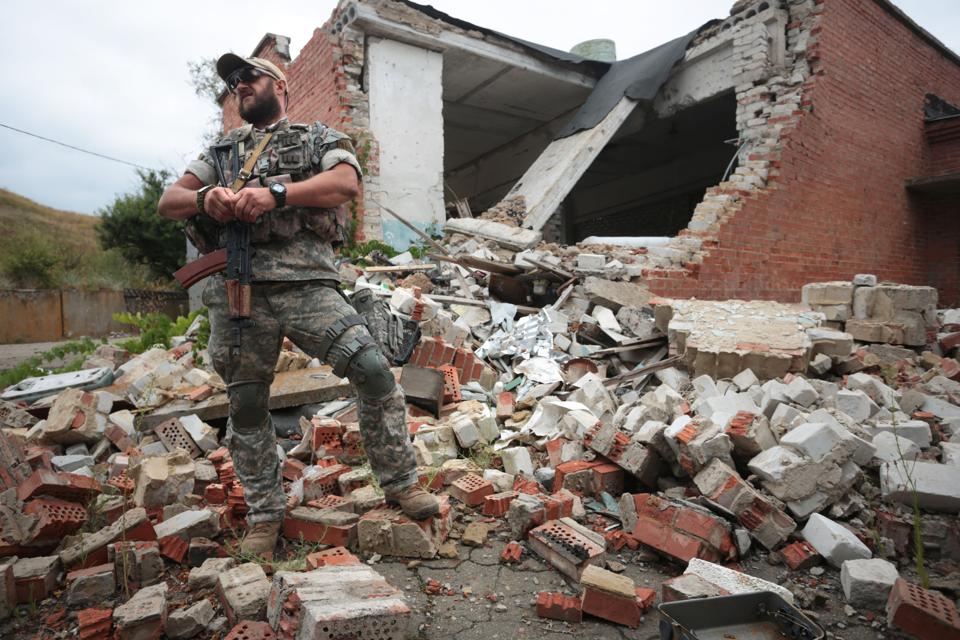
A Ukrainian paratrooper walks among the ruins of building destroyed by pro-Russian separatists shelling on August 14, 2016. Pro-Russian rebels allegedly have ramped up their shelling of one key village: the once quiet coastal resort village of Shyrokyne in Donetsk has turned into one of the bloodiest battlefields of the 27-month separatist revolt. (Photo by ALEKSEY FILIPPOV/AFP/Getty Images)

Forbes: The fog of war has become a Russian specialty.  Did they invade Ukraine? Did they not? Did Crimeans vote for secession on their own volition? Did they not? In any event, the market seems to be ignoring the recent escalation of tensions between Ukraine and Russia. Tensions do not bode well for sanctions removal, even though it seems pretty certain to everyone that a Hillary Clinton presidency will keep sanctions in place come January.

The latest fiasco: a border skirmish in Crimea with Ukrainian forces led to the death of two Russian soldiers.

Nevertheless, the skirmish may not have even happened. The New York Times reported Monday from Moscow that Ukraine denied the killing of two soldiers. The official word from Kiev is that the Kremlin invented the story to escalate tensions in order to whip up nationalist passions ahead of parliamentary elections in September. A Russian television report documenting the arrest of a couple of Ukrainian commandos in Crimea included shots of a full moon at dusk, though the moon was waning on the date of the alleged incident, the Times reported. The shot may have been stock footage, however.

And while all this tit-for-tat was going on, the Market Vectors Russia (RSX) fund rose 2.27%, two times more than the MSCI Emerging Markets Index.

The jury is out as to why this is happening in Crimea. One theory is that Ukraine was the instigator. Ukraine has a strong, even existential, interest in ensuring that the U.S. continues to provide support. To this end, it is advantageous for Ukraine to paint Putin and Russia as bad guys, an increasingly easy task.

Pro-Russia political analyst Sergei Markov even says U.S. intelligence agencies and the Hillary Clinton campaign itself were behind it in order to make pro-Russia Republican Donald Trump look to be supportive of a rogue nation.

“An escalation of tensions between Russia and Ukraine would be highly expedient for Hillary Clinton, who has repeatedly issued sharp-worded, aggressive statements against Putin and Russia,” he was quoted as saying by the Khodorkovsky Center’s editorial writers on Monday.

RSX sold off only a tad late after market hours on Monday.

Why would Vladimir Putin want to cause more trouble in Ukraine than he already has? His United Russia party has very little opposition. His approval rating remains high. But a little bit of Russian firepower, especially where Russia is looked at as being picked on by Western back forces, plays well with United Russia fans.

Putin has state Duma elections coming up and he may take the view that both Europe and the U.S. are too weak to seriously punish him beyond extending sanctions, which is a given if in a Clinton presidency.

Putin may also take the view that a foreign policy distraction is a good pretext for a bit of political housecleaning at

home, explaining the exit of long-standing supporter, Chief of Staff Sergei Ivanov, notes Jan Dehn, head of research for emerging market investment firm Ashmore in London.

As for the investment implications, Russia’s ability and willingness to pay its debts to foreign banks remain solid. If bond spreads should blow out materially, buyers are likely to outweigh sellers in a rather short period of time. This happened back in November of 2014 when the central bank changed its currency trading band and raised interest rates three times in less than a month. Spreads were over 900 basis points over Treasurys. The Russian bond lords were the first to pile in.

That made Russia one of the best bond trades in the world and stood as evidence that the market has faith in Russia debt, at least. It will get paid. It actually yields. Holy lord…

Meanwhile, the Russian economy is turning a corner and investors are hoping to see GDP crack zero this year. Year on year growth rates were -0.6% in the second quarter from -1.2% in the first. Inflation is stabilizing but not enough yet for a rate cut. So long as inflation doesn’t go the other way, the central bank will cut rates and that will be supportive of equities.

The only thing to pull the rug out of Russia would be oil heading to the $30s again. It’s not unlikely. But it’s definitely not consensus.

Russia Making More Aggressive Moves in Iran and Syria

Shoigu Says Russia Prevented NATO Missile Strikes in Syria, Even as Russia Asks for Permission to Send Missiles Over Iran, Iraq

Pro-Assad Media Outlet: Russia Deploys Bombers To Iran

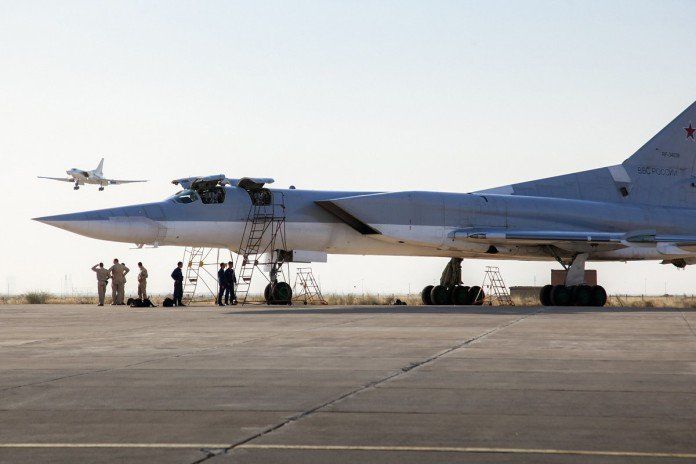
Interpreter: Al Masdar, a media outlet with close ties to the Syrian security apparatus which is widely considered to be pro-Assad, reports that Russian bombers are now operating out of the Hamedan Air Base in western Iran. The outlet says that they have received exclusive pictures from the base. Al Masdar reports:

Currently, the strategic TU-22M3 bombers take flight from southern Russia at Modzok airfield; however, this newly signed military agreement with Iran will allow Russia to reduce flight time by 60%, saving the Kremlin both money and improving airstrike effectiveness.

The distance of these flights equal roughly 2,150km to reach a target near Palmyra. From Hamedan Air Base in Iran the distance to reach a target near Palmyra equals roughly 900km.

The Khmeimim Airbase in Latakia province – which Russia was granted access to in late 2015 – is not suitable for the massive TU-22M3, the largest bomber jet in the world.

Russia deploys jets at Iranian Airbase to combat insurgents in Syria Al-Masdar News has obtained exclusive photos of Russian warplanes being deployed to the Hamedan Air Base in western Iran. Currently, the strategic TU-22M3 bombers take flight from southern Russia at Modzok airfield; however, this newly signed military agreement with Iran will allow Russia to reduce flight time by 60%, saving the Kremlin both money and improving airstrike effectiveness.

View full page →

Aug 16, 2016 00:40 (GMT)

The report has been circulated by several pro-Kremlin propagandists, adding credibility to the claims.

Just hours ago we reported that, according to Interfax, Russia has sought permission from Iran and Iraq to fire cruise missiles over their airspace.

James Miller
*****

Tu-22M3 and Su-34 bombers flew from Iran’s Hamadan base Tuesday to attack Islamic State and Nusra Front targets in Syria’s Aleppo, Deir ez-Zor and Idlib provinces, the Russian Defense Ministry said in an e-mailed statement. They returned to the base after completing their missions, it said.

The bombers were supported by fighter jets from Syria’s Hmeimeem base that Russia’s used to carry out airstrikes in support of President Bashar al-Assad since September. Russia’s announcement that it’s using an Iranian base to carry out attacks in Syria comes after President Vladimir Putin discussed the fight against terrorism with Iranian leader Hassan Rouhani when they met in Azerbaijan last week. Russian Defense Minister Sergei Shoigu and Iranian defense officials agreed on expanded military cooperation at talks in Moscow this month, according to the Izvestia daily. Russia and Iran are backing Assad’s army against opposition groups in Syria’s civil war, which has killed more than 280,000 people and displaced millions.

Russia asked Iran and Iraq last week to allow cruise missiles to pass through their airspace, the Interfax news service reported Monday, citing an unidentified person with knowledge of the matter. Russian warships in the Caspian Sea fired 26 cruise missiles at targets in Syria in October, shortly after Putin ordered the military campaign to commence. More from Bloomberg.

*****

Russia Building New Underground Nuclear Command Posts

U.S. intelligence detects dozens of hardened bunkers for leaders

FreeBeacon: Russia is building large numbers of underground nuclear command bunkers in the latest sign Moscow is moving ahead with a major strategic forces modernization program.

U.S. intelligence officials said construction has been underway for several years on “dozens” of underground bunkers in Moscow and around the country.

Disclosure of the underground command bunkers comes as Army Gen. Curtis Scaparrotti, commander of U.S. European Command, warned recently that Russia has adopted a nuclear use doctrine he called “alarming.”

“It is clear that Russia is modernizing its strategic forces,” Scaparrotti told a conference sponsored by the U.S. Strategic Command.

“Russian doctrine states that tactical nuclear weapons may be used in a conventional response scenario,” Scaparrotti said on July 27. “This is alarming and it underscores why our country’s nuclear forces and NATO’s continues to be a vital component of our deterrence.”

Mark Schneider, a former Pentagon nuclear policy official, said Russia’s new national security strategy, which was made public in December, discusses increasing civil defenses against nuclear attack, an indication Moscow is preparing for nuclear war.

“Russia is getting ready for a big war which they assume will go nuclear, with them launching the first attacks,” said Schneider, now with the National Institute for Public Policy, a Virginia-based think tank.

“We are not serious about preparing for a big war, much less a nuclear war,” he added.

Additionally, Russian officials have been issuing nuclear threats.

“A lot of things they say they are doing relate to nuclear threats and nuclear warfighting,” he said. “Active and passive defense were a major Soviet priority and [current Russian leaders] are Soviets in everything but name.”

Russia is engaged in a major buildup of strategic nuclear forces, building new missiles, submarines, and bombers. A State Department report on Russian activities under the New START arms treaty stated in the spring that Moscow added 153 strategic nuclear warheads to its arsenal under the treaty.

The increase in warheads is said to be the result of the deployment of new SS-27 Mod 2 intercontinental ballistic missiles with multiple warheads and SS-N-32 submarine-launched missiles.

In addition to new missiles, Russia is building a drone submarine, code-named “Kanyon,” which is said to be designed to carry a megaton-class warhead. Moscow also is moving ahead with a hypersonic strike vehicle designed to deliver nuclear warheads through advanced missile defense systems.

A report by the National Institute for Public Policy concludes that one reason for the Russian nuclear expansion is to sow fear of Moscow.

“Russian leaders appear to view nuclear weapons as the ultimate way to make the world ‘fear,’ or at least respect Russia, and provide a political lever to intimidate, coerce, and deter Western states from attempting to interfere militarily against Russian expansionism,” the report said.

Military analysts say possible U.S. responses to Russia’s underground nuclear complexes include the development of deep-penetrating nuclear bombs capable of placing Russia’s command structure at risk.

Another option proposed by nuclear experts is to develop low-yield nuclear arms that could be used in precision strikes.

Few details about the new nuclear underground bunkers were disclosed. State-run Russian press reports have said underground bunkers are being built in Moscow as part of the strategic forces buildup.

Russia’s Defense Ministry revealed in January that a modernized command and control system will be delivered to strategic forces this year.

The system was described by RIA-Novosti as a fifth-generation advanced command and control system.

Defense Ministry spokesman Maj. Dmitri Andreyev stated that the new system, known by its Russian acronym IASBU, will use digital signals to send combat orders and control strategic forces.

“The fifth-generation advanced integrated automated combat control system is being tested at industry enterprises,” Andreyev said, adding that by the end of the year missile units will be equipped with the “modernized control posts and advanced strategic missile systems under development with IASBU sections.”

The new system is being used with new SS-27 intercontinental missile units and will provide greater security so that orders will reach those units.

“This will enable use of missile systems without limiting distances while carrying out maneuvering and broadening of options in choosing their combat patrol routes,” the spokesman said.

The new underground nuclear facilities appear similar to earlier construction for command and control complexes during the Cold War, one official said. Russia also continued building underground nuclear facilities after the fall of the Soviet Union in 1991.

The CIA reported through classified channels in March 1997 that construction included an underground subway system from the residence of then-President Boris Yeltsin outside Moscow to a leadership command center.

“The underground construction appears larger than previously assessed,” a CIA report on the facilities stated. “Three decrees last year [1996] on an emergency planning authority under Yeltsin with oversight of underground facility construction suggest that the purpose of the Moscow-area projects is to maintain continuity of leadership during nuclear war.”

Construction work was underway on what the report described as a “nuclear-survivable, strategic command post at Kosvinsky Mountain,” located deep in the Ural Mountains about 850 miles east of Moscow.

Satellite photographs of Yamantau Mountain, also located about 850 miles east of Moscow in the Urals near the town of Beloretsk, revealed development of a “deep underground complex” and new construction at each of the site’s above-ground support areas. Yamantau Mountain means “Evil Mountain” in the local Bashkir language.

“The command post at Kosvinsky appears to provide the Russians with the means to retaliate against a nuclear attack,” the CIA report said, adding that the Russians were building or renovating four complexes within Moscow that would be used to house senior Russian government leaders during a nuclear conflict.

The CIA identified a bunker to be used by Russian leaders at Voronovo, about 46 miles south of Moscow. A second bunker located at Sharapovo, some 34 miles from Moscow, was equipped with a special subway running directly to it.

The nuclear war preparations are estimated to cost billions of dollars, and raise questions about past U.S. aid to Moscow that was aimed at helping secure Russian nuclear facilities.

Ukraine on War-footing vs. Russia

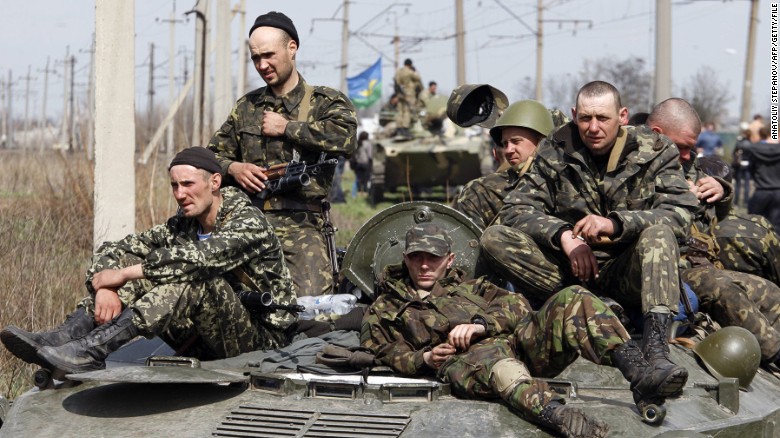
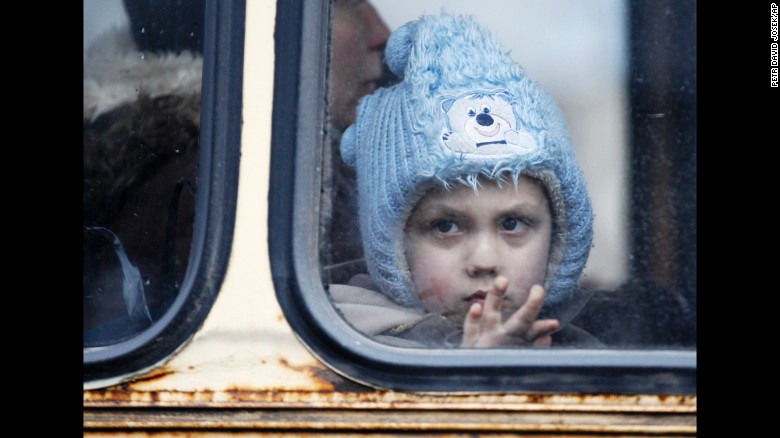
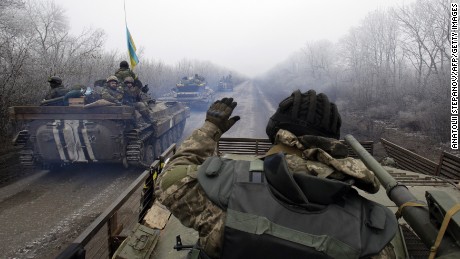
Ukrainian security forces patrol in the village of Bobrovyshche on July 14, 2015. More than 6,400 people have been killed in the conflict in Ukraine since April 2014, the United Nations says.

(CNN)Ukraine is ordering its troops to be on the “highest level of combat readiness” Thursday, amid growing tensions with Russia over Crimea.

The order comes after Russia accused Ukraine on Wednesday of launching a militant attack at “critically important infrastructure” near the city of Armyansk, Crimea, according to Russia’s state news service TASS.
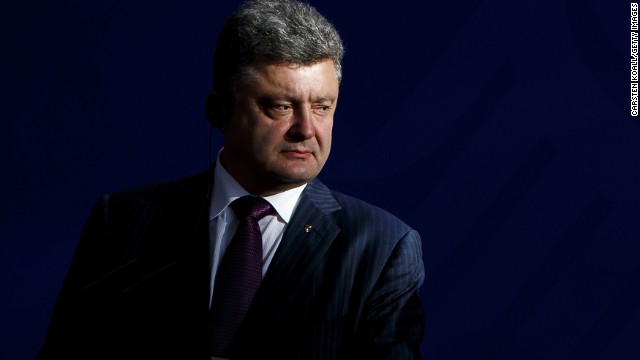
But Ukrainian President Petro Poroshenko refuted the claims, calling them “insane” and suggesting Russia’s aim was more military threats against its neighbor. More here.

(CNN)It began as a dispute over a trade agreement, but it mushroomed into the bloodiest conflict in Europe since the wars over the former Yugoslavia in the early 1990s.

Click here for more photos and videos courtesy of CNN.

After Russia annexed Crimea in 2014 following tensions with its neighbor, world leaders managed to install a shaky peace deal in 2015. But violence continues in the conflict zone in eastern Ukraine — and 2016 has seen an increase in casualties.
So how did this dispute begin and how did it then erupt in to civil war? CNN examines the evolution of the Ukraine crisis.

Protests begin in Kiev …

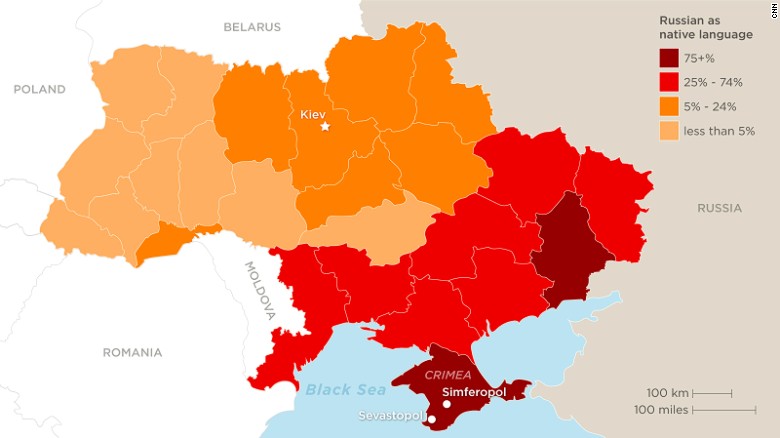
Ukrainian is spoken by 70% of the country, but Russian is the mother tongue of many in the east.

November 21, 2013: After a year of insisting he would sign a landmark political and trade deal with the European Union, Ukrainian President Viktor Yanukovych suspends talks in the face of opposition from Russia, which has long opposed Ukraine forming closer ties with the EU. Tens of thousands of protesters hit the streets in the following days, highlighting the deep divide between the pro-European west and Yanukovych’s power base in the pro-Russian east of Ukraine.

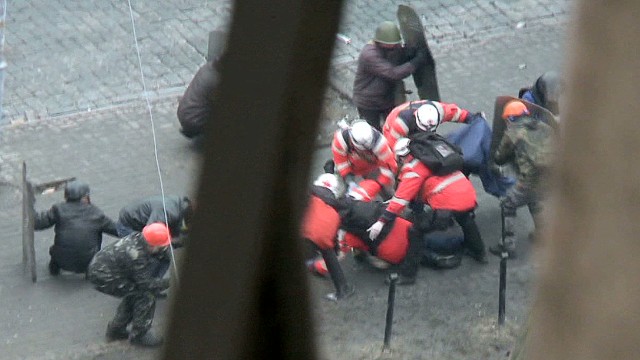
First aid medics fired on in Ukraine

 
February 20, 2014: Violence that has been simmering for weeks bubbles over when a gunfight erupts between protesters and police in Maidan (Independence) Square in central Kiev, leaving dozens of people dead. Protesters say government snipers opened fire on them; Yanukovych’s government blames opposition leaders for provoking the violence.

… and the Ukrainian President flees

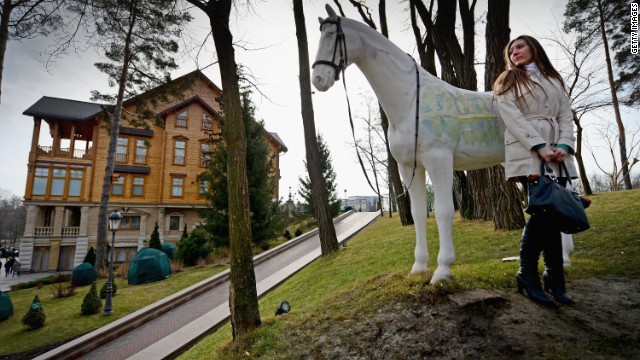
Inside Yanukovych's palace

February 22, 2014: Yanukovych flees Kiev as his guards abandon the presidential compound. Thousands storm the grounds, marveling at the lavish estate he left behind. Former Prime Minister (and Yanukovych adversary) Yulia Tymoshenko — jailed in 2011 for “abuse of office” after a trial that was widely seen as politically motivated — is released from prison and addresses pro-Western protesters in Maidan Square.

A week later, troops enter Crimea …

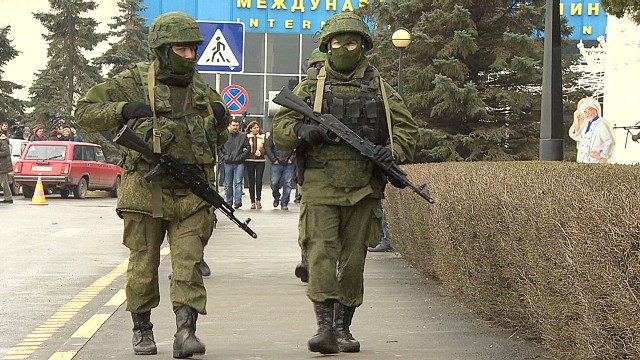
Masked gunmen occupy Crimea

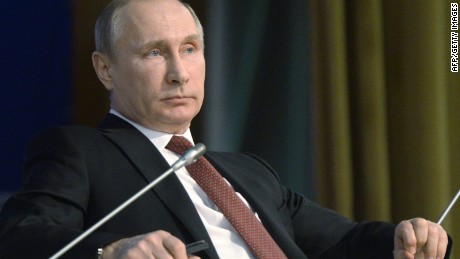
March 1, 2014: Russia’s parliament signs off on President Vladimir Putin‘s request to send military forces into Crimea, an autonomous region of southern Ukraine with strong Russian loyalties. Thousands of Russian-speaking troops wearing unmarked uniforms pour into the peninsula. Two weeks later, Russia completes its annexation of Crimea in a referendum that is slammed by Ukraine and most of the world as illegitimate.

… and soon Kiev starts cracking down in eastern Ukraine

April 15, 2014: Kiev’s government launches its first formal military action against the pro-Russian rebels who have seized government buildings in towns and cities across eastern Ukraine. Putin warns that Ukraine is on the “brink of civil war.” Less than a month later, separatists in the eastern regions of Donetsk and Luhansk declare independence after unrecognized referendums.

In the spring, a new President takes power in Kiev …

Billionaire claims victory in Ukraine

 
May 25, 2014: The “Chocolate King” Petro Poroshenko, a candy company magnate and one of the country’s richest men, declares victory in Ukraine’s presidential elections. Pro-Russian separatists are accused of preventing people from voting in the violence-wracked east of the country.

… and that contentious EU trade deal finally gets signed.

Poroshenko: Putin can be 'emotional'

Poroshenko: Putin can be ’emotional’

 
June 27, 2014: Poroshenko signs the EU Association Agreement — the same deal that former President Yanukovych backed out of in 2013 — and warns Russia that Ukraine’s determination to pursue its European dreams will not be denied.

A commercial airliner is blown out of the sky …

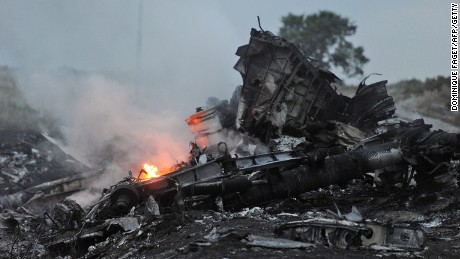
July 17, 2014: 298 people are killed when Malaysia Airlines Flight 17 is shot down by a surface-to-air missile above rebel-held territory in eastern Ukraine. Initially, gunmen prevent international monitors from reaching the crash site, exacerbating the grief of the families of the victims, and it takes days before rebels allow investigators to examine the bodies.

… and months later, a ceasefire follows

September 20, 2014: Ukraine and pro-Russian separatists agree to a complete ceasefire and buffer zone that require all sides to pull heavy weaponry back from the front lines of the conflict, two weeks after an initial truce was agreed to. Meanwhile, a convoy of Russian trucks streams into the border area without the Ukrainian government’s approval. Russia insists the trucks are filled with humanitarian aid, but Kiev is skeptical.

Come winter, the fight in the east becomes bitter …

November 12, 2014: A NATO commander says that Russian tanks, other weapons and troops are pouring across the border into Ukraine, in apparent violation of the September ceasefire — a claim that Moscow denies. And by the end of the year, the U.N. says more than 1.7 million children in the conflict-torn areas of eastern Ukraine are facing “extremely serious” situations exacerbated by unusually harsh winter conditions.

… and harsher …

January 22, 2015: Donetsk International Airport, which was rebuilt ahead of the European soccer championships in 2012, falls to rebels after months of fighting with Ukrainian government forces. Days later, amid spiraling violence, President Poroshenko announces he will ask the International Criminal Court at The Hague to investigate alleged “crimes against humanity” in the conflict.

… and the West becomes divided

Ukraine's fragile ceasefire

 
February 12, 2015: Germany’s Angela Merkel and France’s Francois Hollande hammer out a ceasefire agreement with Ukraine and Russia after the United States says it is considering supplying lethal aid to Ukraine. European leaders are opposed to arming Kiev’s government forces, and they fear it could further ignite a conflict that has now killed more than 5,000 people, including many civilians. Three days later, the ceasefire goes into effect, but violations quickly follow. Over the next few days, Ukraine says several of its service members were killed. Ukraine’s National Defense and Security Council reports 300 violations of the ceasefire by February 20.

… then the EU extends sanctions on Russia

ukraine conflict aid intv bociurkiw walker intv_00005815

June 22, 2015: European Union foreign ministers extend sanctions against Russia, imposed because of the country’s actions in Crimea and eastern Ukraine. The Kremlin calls the sanctions “unfounded and illegal.” The sanctions, and the events that preceded their imposition, reflect the tug of war between East and West over the future of Ukraine.

… in eastern Ukraine there’s growing despair

March 3, 2016: Ukraine’s prolonged stalemate is causing grief and isolation among millions living in the conflict zone, the United Nations warns. The fragile ceasefire is pierced daily by violations, while the number of conflict-related civilian casualties keeps climbing. Since the beginning of the conflict in April 2014, nearly 9,500 people have been killed in the violence and more than 22,100 injured, including Ukrainian armed forces, civilians and members of armed groups, the UN says.

… and civilian casualties highest for a year

August 5, 2016: The Office of the UN High Commissioner for Human Rights releases new figures showing that the conflict on the frontline has resulted in a spike in civilian casualties. The agency documented 69 civilian casualties in eastern Ukraine in June, including 12 dead and 57 injured — nearly double the figure for May and the highest toll since August 2015. July saw 73 civilian casualties, including eight dead and 65 injured.

Meanwhile there is Rosneft, Deeper Russian Terror

Primer: From January 2015

Foreign Firm Funding U.S. Green Groups Tied to State-Owned Russian Oil Company

Executives at a Bermudan firm funneling money to U.S. environmentalists run investment funds with Russian tycoons, a shadowy Bermudan company that has funneled tens of millions of dollars to anti-fracking environmentalist groups in the United States is run by executives with deep ties to Russian oil interests and offshore money laundering schemes involving members of President Vladimir Putin’s inner circle. One of those executives, Nicholas Hoskins, is a director at a hedge fund management firm that has invested heavily in Russian oil and gas. He is also senior counsel at the Bermudan law firm Wakefield Quin and the vice president of a London-based investment firm whose president until recently chaired the board of the state-owned Russian oil company Rosneft.In addition to those roles, Hoskins is a director at a company called Klein Ltd. No one knows where that firm’s money comes from. Its only publicly documented activities have been transfers of $23 million to U.S. environmentalist groups that push policies that would hamstring surging American oil and gas production, which has hurt Russia’s energy-reliant economy.

****

Why is this important? Arms trafficking….there is always a darker side including people. Anyone remember the name Viktor Bout?

 Photo: CNN

*****

Notorious Russian arms dealer ‘refused US offer for lighter sentence’

FITSANAKIS: The wife of Viktor Bout, the imprisoned Russian arms dealer dubbed ‘the merchant of death’, said he rejected an offer by his American captors who asked him to testify against a senior Russian government official. Born in Soviet Tajikistan, Bout was a former translator for the Soviet military. After the end of the Cold War, he set up several low-profile international air transport companies and used them to transfer large shipments of weapons that fueled wars in Africa, Asia, Latin America and Europe. He made millions in the process and acquired international notoriety, which inspired the Hollywood blockbuster Lord of War. But his business ventures ceased in 2008, when he was arrested in Bangkok, Thailand, by the United States Drug Enforcement Administration, with the cooperation of the Royal Thai Police. He was eventually extradited to the US and given a 25-year prison term for supplying weapons to the Afghan Taliban, and for trying to sell arms to the Revolutionary Armed Forces of Colombia (FARC). Bout is currently serving his sentence at the Brooklyn Metropolitan Detention Center in New York.

In a newspaper interview on Tuesday, Bout’s wife, Alla Bout, said her husband could have gotten away with a considerably lighter sentence had he agreed to testify against a senior Russian government official. Speaking to Moscow-based daily Izvestia, Alla Bout said her husband had been approached by American authorities after being extradited to the United States from Thailand. He was told that US authorities wanted him to testify against Igor Sechin, a powerful Russian government official, whom American prosecutors believed was Bout’s boss. In return for his testimony, US prosecutors allegedly promised a jail sentence that would not exceed two years, as well as political asylum for him and his family following his release from prison. Alla Bout added that her husband’s American lawyers were told by the prosecution that the ‘merchant of death’ “would be able to live in the US comfortably, along with his wife and daughter”, and that his family could stay in America during his trial “under conditions”. Alla Bout claimed she was told this by Bout himself and by members of his American legal team.

From 2008 to 2012, Sechin, who has military background, served as Russia’s Deputy Prime Minister. Today he heads the Board of Directors of Rosneft, a government-owned oil extraction and refinement company, which is considered one of the world’s most powerful business ventures. Many observers see Sechin as the most formidable man in Russia after Russian President Vladimir Putin. He is also believed to be a senior member of the Siloviki, a secretive group of government officials in the Putin government who have prior careers in national security or intelligence. Although Bout and Sechin have never acknowledged having met each other, some investigators of Bout’s weapons-trading activities believe that the two were close allies. It is believed that the two men first met in Angola and Mozambique in the 1980s, where they were stationed while serving in the Soviet military. But the two men deny they knowing each other. According to Alla Bout, Viktor told his American captors that he “never worked for Sechin and did not know him in person”. He therefore turned down the prosecution’s offer and was handed a 25-year sentence. When asked by the Izvestia reporters whether Bout was simply protecting the powerful Russian government official, Alla Bout insisted that the two “have never even met, not once”.

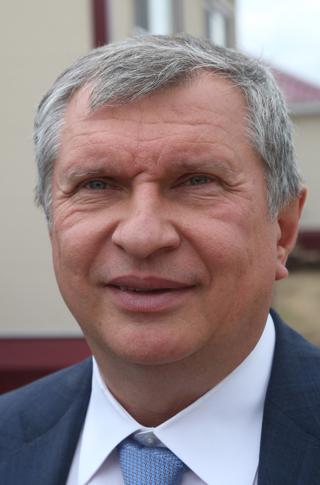
**** Igor Sechin

Forbes: Igor Sechin may be the left hand man to the World’s Most Powerful Man, but that didn’t stop him or his giant oil company, Rosneft, from landing on a U.S. visa and financial sanctions list announced after the Russian military intervention in the Ukraine. “Putin trusts him more than anyone else,” says Russian expert Mark Galeotti of NYU. “And if Putin trusts you, power and wealth always follow.” Suffice it to say that the Kremlin is one of Rosneft’s major stockholders.