
What About Those Stingrays? You Cool With This?

Surveillance Nation is here today and are you good with this?

Is Microsoft reading YOUR emails? Windows 10 may threaten your privacy, watchdogs warn

Windows 10:  DailyMailUK

Within 45 pages of terms and conditions, the privacy information suggests Microsoft begins watching from when an account is created, saving customer’s basic information, passwords and credit card details, Newsweek reported.

The tech giant is also said to save Bing search queries and conversations with Cortana, as well as lists of which websites and apps users visit and the contents of private emails and files, as well as their handwriting.   The privacy statement says: ‘your typed and handwritten words are collected.’

The policy adds that Microsoft collects information about a user’s speech and handwriting to ‘help improve and personalise our ability to correctly recognise your input,’ while information from their contacts book is used, such as names and calendar events ‘to better recognise people and events when you dictate messages or documents’.

Cortana, for example, makes use of information about who a user calls on their phone, plus data from their emails and texts, calendar and contacts, as well as their web history and location.  Microsoft says that data is collected to provide users with a more personalised service and better character recognition, for example, but may also be used for targeted adverting, meaning it may share information with third parties.

The company assigns each of its users a unique advertising ID so it does not reveal what they ‘say in email, chat, video calls or voice mail, or your documents, photos or other personal files to target ads to you.’

But it has still come under fire from privacy campaigners.

Online privacy pressure group, European Digital Rights (EDRi) told The Times that Microsoft’s policy was ‘not only bad news for privacy. Your free speech rights can also be violated on an ad hoc basis.’

Microsoft ‘basically grants itself very broad rights to collect everything you do, say and write with on your devices in order to sell more targeted advertising or to sell your data to third parties.’

Kirsten Fiedler, EDRi’s Managing Director told MailOnline: ‘Unlike Microsoft’s promise, the company’s new 45 page-long terms of service are not straightforward at all.

‘Online companies should finally start explaining their terms in an understandable manner so that we can make informed choices about the services we want to use.


Stingray surveillance sparks privacy concerns in Congress

USAToday: WASHINGTON — Members of Congress are increasingly trying to rein in a secretive federal law enforcement program that uses devices known as Stingrays to capture cellphone data from unsuspecting Americans.

“They are spying on law-abiding citizens as we speak,” said Rep. Darrell Issa, R-Calif., who recently won House approval of a measure to end the program.

The box-shaped Stingray devices are the size of small suitcases, cost about $400,000 to buy and operate, and are usually attached to the cars of federal, state or local law enforcement agents. They mimic cellphone towers, tricking phones within a certain radius to connect to and feed data to police about users’ locations, text messages, calls and emails.

At least a half-dozen federal agencies — including the FBI, the Drug Enforcement Administration, and Immigration and Customs Enforcement — use the technology, which can penetrate the walls of a home, apartment complex or office.

Police say the technology — which can also be attached to planes — helps them catch criminals by tracking their movements and actions. But critics complain that it violates the constitutional rights of innocent citizens whose cellphone data is also seized, often without a warrant.

At least 53 law enforcement agencies in 21 states also use Stingrays or similar devices, according to research by the American Civil Liberties Union. Local police typically buy the devices with grants from the federal government and sign agreements with the FBI not to disclose their use, said ACLU attorney Nathan Wessler.

A June 2014 investigation by USA TODAY and Gannett newspapers found that an increasing number of local and state police agencies were deploying Stingrays and other technology to secretly collect cellphone data from suspected criminals and law-abiding Americans not suspected of any wrongdoing.

“It’s become clear how staggeringly widespread the use of this technology is,” Wessler said. “We’ve been heartened to see that some members of Congress are taking the privacy concerns quite seriously.”

The House this summer passed, by voice vote, a Justice Department spending bill that included Issa’s amendment to bar funding for the use of Stingrays without a warrant. Issa said he won’t stop there, in part because the Senate is unlikely to pass that measure .

“I will use additional opportunities to get it done,” Issa told USA TODAY. “Right now, law enforcement won’t even tell us how many Stingrays they have. The only way to protect the American people is to change the law.”

Sen. Ron Wyden, D-Ore., and Rep. Jason Chaffetz, R-Utah, also are targeting the Stingray program in a broader bill called the GPS Act. The legislation would require law enforcement agents to obtain warrants before tracking Americans’ locations by using Stingray-type devices or tapping into cellphones, laptops, or GPS navigation systems.

“I don’t see how you can use a Stingray without it raising very substantial privacy issues,” Wyden told USA TODAY. “I want police to be able to track dangerous individuals and their locations, but it ought to be done with court oversight under the Fourth Amendment.”

The FBI has said it has a policy of obtaining warrants before using Stingray devices, although it has broad exceptions, including one that allows the technology to be used in public places where the agency believes people shouldn’t have an expectation of privacy.

“It’s how we find killers, it’s how we find kidnappers, it’s how we find drug dealers, it’s how we find missing children, it’s how we find pedophiles,” FBI Director James Comey told reporters in Charlotte. last fall. “It’s work you want us to be able to do.”

Chaffetz is also using his position as chairman of the House Oversight and Government Reform Committee to gather information as part of an investigation into the use of stingrays, said his spokesman, M.J. Henshaw.

At the same time, Senate Judiciary Committee Chairman Charles Grassley, R-Iowa, and Sen. Patrick Leahy of Vermont, the senior Democrat on the panel, have been pressing the Department of Justice for answers about Stingray practices and policies. Sen. Bill Nelson, R-Fla., has also called on the Federal Communications Commission to review how the devices are used.

A spokesman for the Department of Justice said the agency is reviewing its policies for the use of Stingray devices. He said he didn’t know when the review would be done.

“With regards to this technology, the Department of Justice is in the process of examining its policies to ensure they reflect our continued commitment to conducting our vital missions while according appropriate respect for privacy and civil liberties,” said spokesman Patrick Rodenbush.

While the Justice Department reviews its policies, states have begun passing their own laws to ban state and local police from using Stingrays without a warrant.

Washington Gov. Jay Inslee signed a ban in May after legislation was passed with overwhelming bipartisan support in the state Legislature. In addition to requiring police to obtain a warrant before using Stingray devices, the law says police must quickly delete any data collected on people who were not targets of a criminal investigation.

Similar laws have been passed in Virginia and Utah and are being considered in California, New York and Texas.

“The American people are looking for a balance between security and liberty,” Issa said. “After 9/11, we moved too far towards security. We need to move back toward liberty.”
Microsoft and Their $100 BILLION Offshore

While some domestic corporations do maintain headquarter offices in the United States, their money is often elsewhere to avoid the destructive tax code. But does Microsoft get an official pass or waiver from the Obama administration?

In September of 2014, Obama and Jack Lew at Treasury took decisive action.

Washington Post: The Obama administration took action Monday to discourage corporations from moving their headquarters abroad to avoid U.S. taxes, announcing new rules designed to make such transactions significantly less profitable.

The rules, which take effect immediately, will not block the practice, and Treasury Secretary Jack Lew again called on Congress to enact more far-reaching reforms. But in the meantime, he said, federal officials “cannot wait to address this problem,” which threatens to rob the U.S. Treasury of tens of billions of dollars.

“This action will significantly diminish the ability of inverted companies to escape U.S. taxation,” Lew told reporters. “For some companies considering deals, today’s action will mean that inversions no longer make economic sense.

“These transactions may be legal, but they’re wrong,” he added. “And the law should change.”

Tax analysts praised the new regulations, saying they will make it much harder for U.S. firms to bring cash earned abroad back to the United States tax-free — a major incentive in the relocations known as tax “inversions.” It was not immediately clear, however, whether the new rules would be sufficient to head off a wave of inversions expected to cascade over the American landscape in the weeks before the Nov. 4 midterm congressional elections.

Microsoft’s Offshore Profit Pile Surges Past $100 Billion Mark

Microsoft Corp.’s stockpile of offshore profits rose to $108 billion, with a 17 percent increase over the past year as the company continues reaping profits in low-tax foreign jurisdictions.

The company crossed the $100 billion mark, making it just the second U.S. corporation — after General Electric Co. — to do so, according to a securities filing July 31. Apple Inc. has more cash abroad than Microsoft, but it already has assumed for accounting purposes that it will pay tax on some of the stockpile and thus has less than $70 billion offshore that would affect earnings directly if repatriated.

What’s keeping Microsoft’s cash abroad is the U.S. tax code. The company would be required to pay the difference between its foreign taxes and the 35 percent U.S. corporate tax rate if it brought the money home.

To get its $108.3 billion back, Microsoft would have to pay the U.S. $34.5 billion in taxes. That equals a 31.9 percent rate, which suggests that the company has paid as little as 3.1 percent in taxes on its foreign income, because of operations in low-tax Ireland, Singapore and Puerto Rico.

The Internal Revenue Service and Microsoft are in the midst of an intense legal battle over the company’s transfer pricing, or intracompany transactions. The federal government is auditing the company’s returns as far back as 2004, and Microsoft has challenged the government’s hiring of outside lawyers.

Peter Wootton, a spokesman for Microsoft, declined to comment.

Repatriating Profits

Under current law, U.S. companies owe the full 35 percent rate on profits they earn around the world, but they don’t have to pay the U.S. until they repatriate the profits. That gives companies an incentive to book profits overseas and leave them there, and that’s just what they’ve done.

U.S. companies have more than $2 trillion amassed outside the U.S., according to a Bloomberg News review earlier this year of the securities filings of 304 companies.

Apple has more than $200 billion in cash stockpiled, with almost 90 percent of it overseas. As of its most recent annual report, Apple had $69.7 billion in profits on which it hasn’t assumed taxes.

U.S. lawmakers are looking for ways to get some of that cash back in the U.S. President Barack Obama supports a one-time 14 percent tax on stockpiled profits, with the proceeds going to highways and other infrastructure programs. Some Republicans favor a similar approach and are working on a detailed plan.

Putin’s Kill List and a Victim

Putin ‘personally ordered Litvinenko’s murder’: QC at inquest into Russian spy’s death says ‘direct and solid evidence’ ties ‘morally deranged’ President to the killing

By Steph Cockroft for MailOnline

Vladimir Putin ‘personally ordered’ the killing of Alexander Litvinenko and should be held responsible for his death, the inquiry into the former spy’s death has heard.

The lawyer for Mr Litvinenko’s family said there is ‘direct and solid evidence’ which ties the Russian state to the 43-year-old spy’s ‘assassination’.

Making his closing remarks at the end of the six-month inquiry into 2006 poisoning, Ben Emmerson QC added that it would be ‘impossible’ for the killing to have taken place without the approval of the ‘morally deranged’ Russian president.

He added that Mr Putin – whom he described as an ‘increasingly isolated tinpot despot’ – targeted Mr Litvinenko because he was ‘bent on exposing him and his cronies’.

He told the inquiry: ‘Vladimir Putin stands accused of this murder on solid and direct evidence – the best evidence that is ever likely to be available in relation to secret and corrupt criminal enterprise in the Kremlin.’ The Kremlin has always denied the claims.

Mr Litvinenko died nearly three weeks after drinking tea laced with polonium-210 in London in November 2006. Police concluded that the fatal dose was probably consumed during a meeting with Dmitri Kovtun and Andrei Lugovoi at a hotel in central London.

British authorities later decided that the pair – who deny involvement – should be prosecuted for murder. But the inquiry heard how the trial is now unlikely to take place.

Speaking outside the Royal Courts of Justice, Mr Litvinenko’s widow Marina claimed that her husband’s killers had finally been ‘unmasked’

She added that her husband had ‘vowed to expose corruption’ in the Russian Federal Security but that he had ‘paid the ultimate price’.

Paying tribute to the ‘loving father and husband’ who she says was killed by ‘nuclear terrorsim’, she said: ‘It was very difficult but very important to do this.

‘I’m very, very happy for what (the inquiry) will be able to bring to the open air for all people to be able to listen and see and discuss. Even more I’m so glad that people are still interested after more than nine years.’

Asked how certain she was that Mr Putin was behind her husband’s death, she said: ‘After 15 years being in charge, of course he is responsible for this. What I want to say I did exactly by this public inquiry. What I did is my tribute to my husband.

‘Any reasonable who looks at the evidence will see my husband was killed by agents of the Russian state in the first ever act of nucelar terrorsim on the streets of london and this could not have happened without the knowledge of Mr Putin.’

The inquiry, which began at the end of January, has heard from 62 witnesses in a bid to establish how Mr Litvinenko died and, crucially, who was responsible.

Sir Robert was told about forensic evidence linking Kovtun and Lugovoi to the murder, including the discovery of polonium-210 in the pair’s hotel rooms.

The inquiry also heard how Litvinenko’s whistle-blowing about Mr Putin and his alleged links to organised crime made him an ‘enemy of the state’.

Mr Emmerson QC had described the pair as ‘henchman’ who had been ordered to ‘liquidate’ Mr Litvinenko by the Russian state with the backing of Mr Putin.

WHO POISONED SPY LITVINENKO? THE PRIME SUSPECTS 

Dmitri Kovtun and Andrei Lugovoy are suspected of murdering the Alexander Litvinenko.

Litvinenko, 43, died nearly three weeks after consuming tea laced with polonium-210 in London in November 2006.

Mr Litvinenko is thought to have been working for British secret service MI6 whilst in the UK.

Both Kovtun and Lugovoy deny any involvement and remain in Russia.

They both initially refused to take part in the inquiry.

However in March 2015, Kovtun dramatically changed his mind and offered to give evidence before pulling out today. 

He described an honour awarded to Lugovoi for services to the ‘Motherland’ by the president in March as an attempt by Russia to undermine the inquiry.

He said: ‘It was a crass and clumsy gesture from an increasingly isolated tinpot despot – a morally deranged authoritarian who was at that very moment clinging desperately on to political power in the face of international sanctions and a rising chorus of international condemnation,’ he said.

‘Putin’s award to Lugovoi should be seen for what it was – a crude attempt to intimidate an independent judicial inquiry through cowardly political bluster.’

The inquiry had been due to hear from the prime suspect in the case, Mr Kovtun, but he withdrew at the 11th hour, amid claims of interference from Moscow.

Sir Robert said of the last-minute withdrawal: ‘This unhappy sequence of events drives me to the conclusion either that Mr Kovtun never in truth intended to give evidence and that this has been a charade.

‘Alternatively, if he has at some stage been genuine in his expressed intention to give evidence, obstacles have been put in the way of his doing so.’

In a statement given to the Inquiry, Mr Kovtun claimed he had ended up in the bar at the Millennium Hotel with Mr Litvinenko and Mr Lugovoi ‘completely by chance’.

He said Mr Litvinenko had ‘flopped down’ at their table before grabbing a teapot and pouring himself some tea.

‘He gulped down two cups and then had a coughing fit. In the course of the conversation he coughed constantly and wiped his mouth with a napkin.’

Mr Kovtun added that he had the impression that Mr Litvinenko had ‘mental health problems’ and was ‘driven to despair’, adding: ‘He was prepared to do anything to achieve his financial goals.’

The hearing had also heard from Mr Litvinenko’s father Walter, who claimed that his son’s final words on his deathbed were: ‘Daddy, Putin has poisoned me’. He said that his son also claimed the Russian president was ‘perverted’ and ‘very dangerous’, warning him to be ‘careful’ himself.

The Russian Embassy in London said it did not trust the public inquiry, which it claimed it had been ‘politicised’, and disregarded international law.

Both Mr Emmerson and inquiry chairman Sir Robert Owen praised the meticulous detective work of the Metropolitan Police.

Mr Emmerson described the investigation as one of the most extensive murder inquiries ever carried out in the UK and the post mortem on Mr Litvinenko as “the most dangerous” in British history.

Inquiry chairman Sir Robert Owen said he expected to return his conclusion by the end of the year.

Every U.S. Corporation Hacked by China

From the Former NSA Director McConnell via CNN:

“The Chinese have penetrated every major corporation of any consequence in the United States and taken information,” he said. “We’ve never, ever not found Chinese malware.”
He said the malware lets Chinese spies extract information whenever they want. McConnell, who also led the NSA from 1992 until 1996, continues to investigate hacks as a high-ranking adviser to Booz Allen Hamilton (BAH).
He listed victims he has come across during his investigations: U.S. Congress, Department of Defense, State Department (which is currently dealing with Russian hackers) and major corporations.
The U.S. government has said it has caught Chinese spies stealing blueprints and business plans. Last year, federal prosecutors took the unprecedented step of filing formal criminal charges against five Chinese government spies for breaking into Alcoa (AA), U.S. Steel Corp. (X), Westinghouse and others.

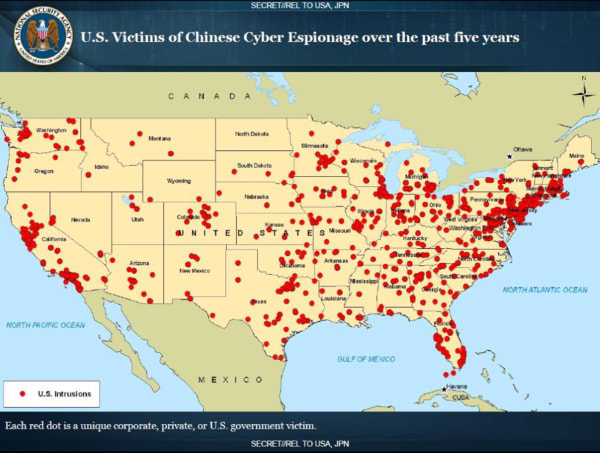
Exclusive: Secret NSA Map Shows China Cyber Attacks on U.S. Targets

A secret NSA map obtained exclusively by NBC News shows the Chinese government‘s massive cyber assault on all sectors of the U.S economy, including major firms like Google and Lockheed Martin, as well as the U.S. government and military.

The map uses red dots to mark more than 600 corporate, private or government “Victims of Chinese Cyber Espionage” that were attacked over a five-year period, with clusters in America’s industrial centers. The entire Northeast Corridor from Washington to Boston is blanketed in red, as is California’s Silicon Valley, with other concentrations in Dallas, Miami, Chicago, Seattle, L.A. and Detroit. The highest number of attacks was in California, which had almost 50.

Each dot represents a successful Chinese attempt to steal corporate and military secrets and data about America’s critical infrastructure, particularly the electrical power and telecommunications and internet backbone. And the prizes that China pilfered during its “intrusions” included everything from specifications for hybrid cars to formulas for pharmaceutical products to details about U.S. military and civilian air traffic control systems, according to intelligence sources.

The map was part of an NSA briefing prepared by the NSA Threat Operations Center (NTOC) in February 2014, an intelligence source told NBC News. The briefing highlighted China’s interest in Google and defense contractors like Lockheed Martin, and in air traffic control systems. It catalogued the documents and data Chinese government hackers have “exfiltrated” — stolen — from U.S. corporate, government and military networks, and also listed the number and origin of China’s “exploitations and attacks.”

The map suggests that NSA has been able to monitor and assess the Chinese cyber espionage operations, and knows which specific companies, government agencies and computer networks are being targeted.

The NSA did not immediately respond to repeated requests for comment.


Selected Israeli Intelligence Items Revealed on Iran Talks

The deal is just too dangerous, even some Democrats are expressing that dynamic.
On Nov. 26, 2013, three days after the signing of the interim agreement (JPOA) between the powers and Iran, the Iranian delegation returned home to report to their government. According to information obtained by Israeli intelligence, there was a sense of great satisfaction in Tehran then over the agreement and confidence that ultimately Iran would be able to persuade the West to accede to a final deal favorable to Iran. That final deal, signed in Vienna last week, seems to justify that confidence. The intelligence—a swath of which I was given access to in the past month—reveals that the Iranian delegates told their superiors, including one from the office of the Supreme Leader Ayatollah Khamenei, that “our most significant achievement” in the negotiations was America’s consent to the continued enrichment of uranium on Iranian territory.

That makes sense. The West’s recognition of Iran’s right to perform the full nuclear fuel cycle—or enrichment of uranium—was a complete about-face from America’s declared position prior to and during the talks. Senior U.S. and European officials who visited Israel immediately after the negotiations with Iran began in mid 2013 declared, according to the protocols of these meetings, that because of Iran’s repeated violations of the Nuclear Non-Proliferation Treaty, “Our aim is that in the final agreement [with Iran] there will be no enrichment at all” on Iranian territory. Later on, in a speech at the Saban Forum in December 2013, President Barack Obama reiterated that in view of Iran’s behavior, the United States did not acknowledge that Iran had any right to enrich fissile material on its soil.

In February 2014, the first crumbling of this commitment was evident, when the head of the U.S. delegation to the talks with Iran, Wendy Sherman, told Israeli officials that while the United States would like Iran to stop enriching uranium altogether, this was “not a realistic” expectation. Iranian foreign ministry officials, during meetings the Tehran following the JPOA, reckoned that from the moment the principle of an Iranian right to enrich uranium was established, it would serve as the basis for the final agreement. And indeed, the final agreement, signed earlier this month, confirmed that assessment.

The sources who granted me access to the information collected by Israel about the Iran talks stressed that it was not obtained through espionage against the United States. It comes, they said, through Israeli spying on Iran, or routine contacts between Israeli officials and representatives of the P5+1 in the talks. The sources showed me only what they wanted me to see, and in these cases there’s always a danger of fraud and fabrication. This said, these sources have proved reliable in the past, and based on my experience with this type of material it appears to be quite credible. No less important, what emerges from the classified material obtained by Israel in the course of the negotiations is largely corroborated by details that have become public since.

In early 2013, the material indicates, Israel learned from its intelligence sources in Iran that the United States held a secret dialogue with senior Iranian representatives in Muscat, Oman. Only toward the end of these talks, in which the Americans persuaded Iran to enter into diplomatic negotiations regarding its nuclear program, did Israel receive an official report about them from the U.S. government. Shortly afterward, the CIA and NSA drastically curtailed its cooperation with Israel on operations aimed at disrupting the Iranian nuclear project, operations that had racked up significant successes over the past decade.

On Nov. 8, 2013, Secretary of State John Kerry visited Israel. Israeli Prime Minister Benjamin Netanyahu saw him off at Ben Gurion Airport and told him that Israel had received intelligence that indicated the United States was ready to sign “a very bad deal” and that the West’s representatives were gradually retreating from the same lines in the sand that they had drawn themselves.

Perusal of the material Netanyahu was basing himself on, and more that has come in since that angry exchange on the tarmac, makes two conclusions fairly clear: The Western delegates gave up on almost every one of the critical issues they had themselves resolved not to give in on, and also that they had distinctly promised Israel they would not do so.

One of the promises made to Israel was that Iran would not be permitted to stockpile uranium. Later it was said that only a small amount would be left in Iran and that anything in excess of that amount would be transferred to Russia for processing that would render it unusable for military purposes. In the final agreement, Iran was permitted to keep 300kgs of enriched uranium; the conversion process would take place in an Iranian plant (nicknamed “The Junk Factory” by Israel intelligence). Iran would also be responsible for processing or selling the huge amount of enriched uranium that is has stockpiled up until today, some 8 tons.

The case of the secret enrichment facility at Qom (known in Israel as the Fordo Facility) is another example of concessions to Iran. The facility was erected in blatant violation of the Non Proliferation Treaty, and P5+1 delegates solemnly promised Israel at a series of meetings in late 2013 that it was to be dismantled and its contents destroyed. In the final agreement, the Iranians were allowed to leave 1,044 centrifuges in place (there are 3,000 now) and to engage in research and in enrichment of radioisotopes.

At the main enrichment facility at Natanz (or Kashan, the name used by the Mossad in its reports) the Iranians are to continue operating 5,060 centrifuges of the 19,000 there at present. Early in the negotiations, the Western representatives demanded that the remaining centrifuges be destroyed. Later on they retreated from this demand, and now the Iranians have had to commit only to mothball them. This way, they will be able to reinstall them at very short notice.

Israeli intelligence points to two plants in Iran’s military industry that are currently engaged in the development of two new types of centrifuge: the Teba and Tesa plants, which are working on the IR6 and the IR8 respectively. The new centrifuges will allow the Iranians to set up smaller enrichment facilities that are much more difficult to detect and that shorten the break-out time to a bomb if and when they decide to dump the agreement.

The Iranians see continued work on advanced centrifuges as very important. On the other hand they doubt their ability to do so covertly, without risking exposure and being accused of breaching the agreement. Thus, Iran’s delegates were instructed to insist on this point. President Obama said at the Saban Forum that Iran has no need for advanced centrifuges and his representatives promised Israel several times that further R&D on them would not be permitted. In the final agreement Iran is permitted to continue developing the advanced centrifuges, albeit with certain restrictions which experts of the Israeli Atomic Energy Committee believe to have only marginal efficacy.

As for the break-out time for the bomb, at the outset of the negotiations, the Western delegates decided that it would be “at least a number of years.” Under the final agreement this has been cut down to one year according to the Americans, and even less than that according to Israeli nuclear experts.

As the signing of the agreement drew nearer, sets of discussions took place in Iran, following which its delegates were instructed to insist on not revealing how far the country had advanced on the military aspects of its nuclear project. Over the past 15 years, a great deal of material has been amassed by the International Atomic Energy Agency—some filed by its own inspectors and some submitted by intelligence agencies—about Iran’s secret effort to develop the military aspects of its nuclear program (which the Iranians call by the codenames PHRC, AMAD, and SPND). The IAEA divides this activity into 12 different areas (metallurgy, timers, fuses, neutron source, hydrodynamic testing, warhead adaptation for the Shihab 3 missile, high explosives, and others) all of which deal with the R&D work that must be done in order to be able to convert enriched material into an actual atom bomb.

The IAEA demanded concrete answers to a number of questions regarding Iran’s activities in these spheres. The agency also asked Iran to allow it to interview 15 Iranian scientists, a list headed by Prof. Mohsen Fakhrizadeh, whom Mossad nicknamed “The Brain” behind the military nuclear program. This list has become shorter because six of the 15 have died as a result of assassinations that the Iranians attribute to Israel, but access to the other nine has not been given. Neither have the IAEA’s inspectors been allowed to visit the facilities where the suspected activities take place. The West originally insisted on these points, only to retreat and leave them unsolved in the agreement.


In mid-2015 a new idea was brought up in one of the discussions in Tehran: Iran would agree not to import missiles as long as its own development and production is not limited. This idea is reflected in the final agreement as well, in which Iran is allowed to develop and produce missiles, the means of delivery for nuclear weapons. The longer the negotiations went on, the longer the list of concession made by the United States to Iran kept growing, including the right to leave the heavy water reactor and the heavy water plant at Arak in place and accepting Iran’s refusal of access to the suspect site.

It is possible to argue about the manner in which Netanyahu chose to conduct the dispute about the nuclear agreement with Iran, by clashing head-on and bluntly with the American president. That said, the intelligence material that he was relying on gives rise to fairly unambiguous conclusions: that the Western delegates crossed all of the red lines that they drew themselves and conceded most of what was termed critical at the outset; and that the Iranians have achieved almost all of their goals.