
Arms Race, Cyber Defenses Fail

By: Damian Paletta, Danny Yadron and Jennifer Valentino-DeVries
Countries toiled for years and spent billions of dollars to build elaborate facilities that would allow them to join the exclusive club of nations that possessed nuclear weapons.
Getting into the cyberweapon club is easier, cheaper and available to almost anyone with cash and a computer.
A series of successful computer attacks carried out by the U.S. and others has kicked off a frantic and destabilizing digital arms race, with dozens of countries amassing stockpiles of malicious code. The programs range from the most elementary, such as typo-ridden emails asking for a password, to software that takes orders from a rotating list of Twitter handles.
The proliferation of these weapons has spread so widely that the U.S. and China-longtime cyber adversaries-brokered a limited agreement last month not to conduct certain types of cyberattacks against each other, such as intrusions that steal corporate information and then pass it along to domestic companies. Cyberattacks that steal government secrets, however, remain fair game.
This comes after other countries have begun to amass cyberweaponry on an unprecedented scale. Pakistan and India, two nuclear-armed rivals, regularly hack each other’s companies and governments, security researchers said. Estonia and Belarus are racing to build defensive shields to counter Russia. Denmark and the Netherlands have begun programs to develop offensive computer weapons, as have Argentina and France.
In total, at least 29 countries have formal military or intelligence units dedicated to offensive hacking efforts, according to a Wall Street Journal compilation of government records and interviews with U.S. and foreign officials. Some 50 countries have bought off-the-shelf hacking software that can be used for domestic and international surveillance. The U.S. has among the most-advanced operations.
In the nuclear arms race, “the acronym was MAD-mutually assured destruction-which kept everything nice and tidy,” said Matthijs Veenendaal, a researcher at the NATO Cooperative Cyber Defence Centre of Excellence, a research group in Estonia. “Here you have the same acronym, but it’s ‘mutually assured doubt,’ because you can never be sure what the attack will be.”
Governments have used computer attacks to mine and steal information, erase computers, disable bank networks and-in one extreme case-destroy nuclear centrifuges.
Nation states have also looked into using cyberweapons to knock out electrical grids, disable domestic airline networks, jam Internet connectivity, erase money from bank accounts and confuse radar systems, experts believe.
Large conventional militaries and nuclear forces are ill-suited to this new kind of warfare, which evens the playing field between big and small countries. Cyberattacks are hard to stop and sometimes impossible to trace. The West, as a result, has been forced to start reconfiguring its militaries to better meet the threat.
 
Access to cyberweapons, according to U.S. and foreign officials and security researchers, is far more widespread than access to nuclear weapons was at the height of the nuclear arms race, a result of inexpensive technology and the power of distributed computing.
More than two dozen countries have accumulated advanced cyberweapons in the past decade. Some Defense Department officials compare the current moment to the lull between the World Wars when militaries realized the potential of armed planes.
“It’s not like developing an air force,” in terms of cost and expertise, said Michael Schmitt, a professor at the U.S. Naval War College and part of an international group studying how international law relates to cyberwarfare. “You don’t need to have your own cyberforce to have a very robust and very scary offensive capability.”
For example, hackers aligned with the Syrian government have spied into the computers of rebel militias, stolen tactical information and then used the stolen intelligence in the ongoing and bloody battle, according to several researchers, including FireEye Inc.
Most cyberattacks linked to the U.S. and foreign governments in recent years involve cyberspying-breaking into a computer network and stealing data. More-aggressive covert weapons go further, either erasing computer records or destroying physical property.
“With some countries, we’re comfortable with knowing what their capabilities are, but with other countries we’re still lost,” said Andre McGregor, a former cyber special agent at the Federal Bureau of Investigation and now the director of security at Tanium Inc., a Silicon Valley cybersecurity startup. “We don’t have the visibility into their toolset.”
The Military Balance, a widely read annual assessment of global military powers published by the International Institute for Strategic Studies in London, tallies tanks, battalions and aircraft carriers. When it comes to national cyberforces it says “capabilities are not assessed quantitatively.”
In the U.S., the National Security Agency, Central Intelligence Agency, FBI and others all play roles in combing through intelligence.
U.S. officials say their biggest concerns are the cyberweapons held by the Chinese, Russians, Iranians and North Koreans, countries that have deployed advanced attacks that either dug inside U.S. government networks or targeted top U.S. companies. Even Israel, a U.S. ally, was linked to hacking tools found on the computers of European hotels used for America’s diplomatic talks with Iran, according to the analysis of the spyware by a top cybersecurity firm. Israeli officials have denied spying on the U.S.
Cyberarmies tend to be integrated with a country’s military, its intelligence services, or both, as is the case in China and the U.S.
In China, hackers are famous for the relatively low-tech tactic of “phishing”-sending a flood of disguised emails to trick corporate employees and government bureaucrats to letting them into their networks.
The U.S. suspects that is how they penetrated the Office of Personnel Management, using a phishing email to breach an OPM contractor and then crack the agency’s network. The records of more than 21 million people were exposed in the 2014 and 2015 data breach, disclosed this summer. China has said it wasn’t involved.
China’s army has divisions devoted to cyberattacks, and recent evidence shows links between the country’s military and hackers who appear to be pressing the country’s interests abroad.
“They used to be snap and grab-get in and dump everything they can,” said Tommy Stiansen, co-founder and chief technology officer at Norse Corp., a California cybersecurity firm that tracks nation-state activity. “Now they trickle out the information, stay hidden in the system. We’ve even seen Chinese actors patch and repair networks once they’ve broken in.”
China opposes the militarization of cyberspace or a cyberarms race, said Zhu Haiquan, a spokesman for the Chinese Embassy in Washington, adding China “firmly opposes and combats all forms of cyberattacks in accordance with law.”
Choosy in targets
 
Russian hackers have targeted diplomatic and political data, burrowing inside unclassified networks at the Pentagon, State Department and White House, also using emails laced with malware, according to security researchers and U.S. officials.
They have stolen President Barack Obama‘s daily schedule and diplomatic correspondence sent across the State Department’s unclassified network, according to people briefed on the investigation. A Russian government spokesman in April denied Russia’s involvement.
“Russia has never waged cyberwarfare against anyone,” Andrey Akulchev, a spokesman for the Russian Embassy in Washington, said in a written statement Friday. “Russia believes that the cybersphere should be used exclusively for peaceful purposes.”
Russia’s top hackers tend to be choosier in their targets, tailoring email attacks to those they believe might unwittingly open links or attachments.
“They are sitting there trying to think through ‘how do I really want to compromise this target?’ ” said Laura Galante, director of threat intelligence at FireEye, a Silicon Valley cybersecurity company that works closely with Washington. “The Chinese just want a foothold into the target. Russian theft is very personal.”
U.S. spies and security researchers say Russia is particularly skilled at developing hacking tools. Some malicious software linked to Russia by security researchers has a feature meant to help it target computers on classified government networks usually not connected to the Internet.
The virus does this by jumping onto USB thumb drives connected to targeted computers, in the hopes that the user-such as U.S. military personnel-will then plug that USB drive into a computer on the classified network.
Russian hackers also make efforts to hide stolen data in normal network traffic. In one example, a piece of malware hides its communications in consumer Web services to fool cybersecurity defenses. The code downloads its instructions from a set of Twitter accounts. It then exports data to commercial storage services. This tactic is effective because corporate cybersecurity systems often don’t block traffic to and from these sites.
Government investigators believe Iranian hackers implanted the Shamoon virus on computers at Saudi Arabia’s Saudi Aramco, the world’s largest energy firm, in 2012. The Aramco attack erased 75% of the company’s computers and replaced screen images with burning American flags. The attack didn’t affect oil production, but it rattled the company, and security officials, as it revealed the extent of Iran’s cybercapabilities. A spokesman for Aramco didn’t respond to a request for comment.
The move was at least partly in retaliation for the alleged U.S.-Israeli attack on Iran discovered in 2010 that deployed the Stuxnet computer worm to destroy Iranian nuclear centrifuges-considered to be the most successful and advanced cyberattack ever. The U.S. and Israel haven’t confirmed or denied involvement with Stuxnet.
Director of National Intelligence James R. Clapper has said that Iran used malware to destroy computers last year at Las Vegas Sands Corp., a casino company run by Sheldon Adelson, a major critic of the Iranian government. A Sands spokesman declined to comment.
Adm. Michael Rogers, center, director of the National Security Agency and commander of the U.S. Cyber Command, confers with Deputy Defense Secretary Robert Work ahead of testifying before the Senate Armed Services Committee in September. Photo: Win McNamee/Getty Images
Defense officials have also said Iranian hackers have temporarily overwhelmed the websites of numerous U.S. banks, in an annoying but relatively pedestrian technique known as a “denial of service” attack. The attack was allegedly in response to a YouTube video depicting the Prophet Muhammad. Some U.S. officials suspected it was retaliation for sanctions and the Stuxnet attack.
In 2012, Iran’s Supreme Leader Ayatollah Ali Khamenei publicly announced the creation of the Supreme Council of Cyberspace charged to oversee the defense of Iran’s computer networks and develop “new ways of infiltrating or attacking the computer networks of its enemies.”
National Security Agency Director Adm. Michael Rogers said Iranian cyberattacks have slowed since nuclear talks intensified last year, but that Tehran appears “fully committed” to using cyberattacks as part of its national strategy.
A spokesman for the Iranian government didn’t respond to request for comment.
Sony hack
 
U.S. officials accused North Korea of destroying computer files and records at Sony Corp.’s Hollywood film unit in 2014, allegedly in retaliation for “The Interview,” a satirical movie about assassins of North Korean leader Kim Jong Un. The breach was considered one of the most successful nation-state attacks. North Korea successfully implanted malware on Sony computers, which allowed them to both steal and destroy company records, the FBI alleged.
South Korea has also accused North Korea of trying to hack a nuclear reactor, television networks and at least one bank.
“Cybercapability, especially offensive cybercapability, is a relatively inexpensive method that a country can exploit to ‘hit above its weight class,’ which North Korea is fully aware of and is attempting to leverage,” said Steve Sin, a former U.S. Army counterintelligence officer who now researches unconventional weapons and technology.
Defense contractor Northrop Grumman Corp., meanwhile, has advertised for a “cyber operations planner” to “facilitate” offensive computer attacks with the South Korean and U.S. governments, according to a job posting it listed online.
A Northrop spokesman said the customer determines the scope of work performed.
A spokesman for North Korea couldn’t be reached for comment. The country hasn’t commented publicly on cyberprograms.
Many cybersecurity experts, however, consider the U.S. government to have the most advanced operations. When Kaspersky Lab ZAO, a Russian cybersecurity company, this year released a report on a group it called the Equation Group-which U.S. officials confirmed was a thinly veiled reference to the NSA-it referred to the operatives as the “crown creator of cyberespionage.”
Former National Security Agency contractor Edward Snowden leaked documents that showed the NSA had implanted malware on tens of thousands of foreign computers. That allowed the U.S. government secret access to data and, potentially, the industrial control systems behind power plants and pipelines. The Pentagon’s U.S. Cyber Command didn’t respond to a request for comment.
In some instances, Kaspersky found, the NSA was able to burrow so deeply into computers that it infected the code that controls how a hard drive spins. So-called firmware isn’t scanned by computer defenses.
“We, too, practice cyberespionage, and, in a public forum, I’m not going to say how successful we are, but we’re not bad,” Mr. Clapper, the Director of National Intelligence, told a Senate panel in September.
U.S. Cyber Command now has nine “National Mission Teams” with plans to build four more. These each comprise 60 military personnel that will “conduct full-spectrum cyberspace operations to provide cyber options to senior policy makers in response to attacks against our nation,” a Pentagon spokesperson said.
The Navy, Army, and Air Force will each build four teams, with the Marines building a single unit. Each will have a “separate mission with a specific focus area,” though these have so far remained secret.
Air Force Chief of Staff Gen. Mark A. Welsh III told a group of reporters in April that he wanted to see the military develop “blunt force trauma” powers with their cyberweapons. He gave examples of computer codes that could “make an enemy air defense system go completely blank” or have an enemy’s “radar show a thousand false targets that all look real.” He didn’t say the military had finished designing such powers.
Defense Secretary Ash Carter has made the development of new cyberweapons a priority, although the policy seems in flux after questions were raised by the Pentagon’s inspector general.
This activity has prompted other countries to join the digital buildup.
In 2014, the Netherlands announced it would begin training its own Internet troops through a domestic cybersecurity company, called Fox-IT. The head of the Dutch armed forces, Major Gen. Tom Middendorp, said in a symposium the group should be prepared to carry out attacks, not just block them, according to a Dutch media report. The Netherlands’ military strategy, laid out in various documents, refers to hacking as a “force multiplier.” A Dutch military spokesman confirmed the efforts but declined to make Gen. Middendorp available for an interview.
In 2013, Denmark’s Defense Ministry began allocating about $10 million a year for “computer network operations,” which include “defensive and offensive military operations,” according to government budget documents. That amount is just 0.24% of the Danish defense budget, reflecting the tiny barrier of entry.
Countries unable to develop their own weapons can buy off-the-shelf systems from private parties. Earlier this year, an attack and document leak on the Italian firm Hacking Team revealed the company had sold its surveillance tools to dozens of countries, including Sudan, Egypt, Ethiopia and Azerbaijan.
Hacking Team touted its product as “the hacking suite for governmental interception,” and computer security researchers who studied its program said it took advantage of holes in popular software to get onto opponents’ computers and mobile devices. The FBI is among the groups listed as clients of Hacking Team. An FBI spokesman said it didn’t comment on specific tools or techniques.
Most of these countries use surveillance software on domestic enemies or insurgent groups, according to officials with numerous countries and researchers.
States aren’t the only players. About 30 Arabic-fluent hackers in the Palestinian territories, Egypt and Turkey are building their own tools to hit targets in Egypt, Israel and the U.S., according to researchers at Kaspersky Lab.
And in August, the U.S. used a drone to kill Islamic State hacker Junaid Hussain in Raqqa, Syria, showing the extent to which digital warfare has upset the balance of power on the modern battlefield.
The British citizen had used inexpensive tools to hack more than 1,000 U.S. military personnel and published personal and financial details online for others to exploit. He helped sharpen the terror group’s defense against Western surveillance and built hacking tools to penetrate computer systems, according to people familiar with the matter.
National-security and cyberweapon experts are watching the growing digital arms stockpile nervously, worried that one-off attacks could eventually turn messier, particularly given how little is known about what each country is capable of doing.
“What we can do, we can expect done back to us,” said Howard Schmidt, who was the White House’s cybersecurity coordinator until 2012. The U.S. is thinking, “Yeah, I don’t want to pull that trigger because it’s going to be more than a single shot that goes off.”

Nuclear smugglers sought terrorist buyers

CHISINAU, Moldova (AP) — Over the pulsating beat at an exclusive nightclub, the arms smuggler made his pitch to a client: 2.5 million euros for enough radioactive cesium to contaminate several city blocks.

It was earlier this year, and the two men were plotting their deal at an unlikely spot: the terrace of Cocos Prive, a dance club and sushi bar in Chisinau, the capital of Moldova.

“You can make a dirty bomb, which would be perfect for the Islamic State,” the smuggler said. “If you have a connection with them, the business will go smoothly.”

But the smuggler, Valentin Grossu, wasn’t sure the client was for real — and he was right to worry. The client was an informant, and it took some 20 meetings to persuade Grossu that he was an authentic Islamic State representative. Eventually, the two men exchanged cash for a sample in a sting operation that landed Grossu in jail.

The previously unpublicized case is one of at least four attempts in five years in which criminal networks with suspected Russian ties sought to sell radioactive material to extremists through Moldova, an investigation by The Associated Press has found. One investigation uncovered an attempt to sell bomb-grade uranium to a real buyer from the Middle East, the first known case of its kind.

In that operation, wiretaps and interviews with investigators show, a middleman for the gang repeatedly ranted with hatred for America as he focused on smuggling the essential material for an atomic bomb and blueprints for a dirty bomb to a Middle Eastern buyer.

In wiretaps, videotaped arrests, photographs of bomb-grade material, documents and interviews, AP found that smugglers are explicitly targeting buyers who are enemies of the West. The developments represent the fulfillment of a long-feared scenario in which organized crime gangs are trying to link up with groups such as the Islamic State and al-Qaida — both of which have made clear their ambition to use weapons of mass destruction.

The sting operations involved a partnership between the FBI and a small group of Moldovan investigators, who over five years went from near total ignorance of the black market to wrapping up four sting operations. Informants and police posing as connected gangsters penetrated the smuggling networks, using old-fashioned undercover tactics as well as high-tech gear from radiation detectors to clothing threaded with recording devices.

But their successes were undercut by striking shortcomings: Kingpins got away, and those arrested evaded long prison sentences, sometimes quickly returning to nuclear smuggling, AP found.

For strategic reasons, in most of the operations arrests were made after samples of nuclear material had been obtained rather than the larger quantities. That means that if smugglers did have access to the bulk of material they offered, it remains in criminal hands.

The repeated attempts to peddle radioactive materials signal that a thriving nuclear black market has emerged in an impoverished corner of Eastern Europe on the fringes of the former Soviet Union. Moldova, which borders Romania, is a former Soviet republic.

Moldovan police and judicial authorities shared investigative case files with the AP in an effort to spotlight how dangerous the black market has become. They say a breakdown in cooperation between Russia and the West means that it is much harder to know whether smugglers are finding ways to move parts of Russia’s vast store of radioactive materials.

“We can expect more of these cases,” said Constantin Malic, one of the Moldovan investigators. “As long as the smugglers think they can make big money without getting caught, they will keep doing it.”

The FBI and the White House declined to comment. The U.S. State Department would not comment on the specifics of the cases.

“Moldova has taken many important steps to strengthen its counter nuclear smuggling capabilities,” said Eric Lund, spokesman for the State Department’s bureau in charge of nonproliferation. “The arrests made by Moldovan authorities in 2011 for the attempted smuggling of nuclear materials is a good example of how Moldova is doing its part.”

Wiretapped conversations exposed plots that targeted the United States, the Moldovan officials said. In one case, a middleman said it was essential the smuggled bomb-grade uranium go to Arabs, said Malic, an investigator in all four sting operations.

“He said: ‘I really want an Islamic buyer because they will bomb the Americans.'”

___

“HAVE YOU EVER HEARD OF URANIUM?”

Malic was a 27-year-old police officer when he first stumbled upon the nuclear black market in 2009. He was working on a fraud unit in Chisinau, and had an informant helping police take down a euro counterfeiting ring stretching from the Black Sea to Naples, Italy.

The informant, an aging businessman, casually mentioned to Malic that over the years, contacts had periodically offered him radioactive material.

“Have you ever heard of uranium?” he asked Malic.

Malic was so new to the nuclear racket that he didn’t know what uranium was, and had to look it up on Google. He was horrified — “not just for one country,” he said, “but for humanity.”

“Soon after, the informant received an offer for uranium. At about that time, the U.S. government was starting a program to train Moldovan police in countering the nuclear black market, part of a global multi-million dollar effort.

In Malic’s first case, three people were arrested on Aug. 20, 2010, after a sample of the material, a sawed-off piece of a depleted uranium cylinder, was exchanged for cash. That kind of uranium would be difficult to turn into a bomb.

Authorities suspected, but couldn’t prove, that the uranium had come from the melted down Chernobyl reactor in Ukraine, Malic said.

Malic transported the seized radioactive material in a matchbox on the passenger seat of his car. It did not occur to him that the uranium should have been stored in a shielded container to protect him from possible radiation.

When FBI agents came to collect it, they were stunned when he simply proffered the matchbox in his uncovered hand: “Take it,” Malic said.

“Madman!” the American officers exclaimed.

The uranium, fortunately, turned out not to be highly toxic.

___

PLUTONIUM FOR FREE

Several months later, a former KGB informant, Teodor Chetrus, called Malic’s source, the Moldovan businessman. Chetrus told him he had uranium to sell, but was looking for a Middle Eastern buyer.

Unlike Malic’s first case, this one involved highly enriched uranium, the type that can be used to make a nuclear bomb.

Smarter and more cautious than the members of the previous gang, Chetrus was a bit of a paradox to the investigators. He was educated and well dressed, yet still lived in his dilapidated childhood farmhouse in a tiny village on Moldova’s border with Ukraine.

In many of the smuggling cases, the ringleaders insulated themselves through a complex network of middlemen who negotiated with buyers in order to shield the bosses from arrest. In this case, Chetrus was the go-between.

But he had his own agenda. Chetrus clung to a Soviet-era hatred of the West, Malic said, repeatedly ranting about how the Americans should be annihilated because of problems he thought they created in the Middle East.

“He said multiple times that this substance must have a real buyer from the Islamic states to make a dirty bomb,” Malic said.

Chetrus and the informant hammered out a deal to sell bomb-grade uranium to a “buyer in the Middle East” over months of wiretapped phone calls and meetings at Chetrus’ house.

The informant would show up with a recording device hidden in a different piece of clothing each time. On the other side of the road would be Malic, disguised as a migrant selling fruit and grains from a van — watching the house for signs of trouble.

In one early phone call, the informant pressed Chetrus to find out whether he had access to plutonium as well as uranium, saying his buyer had expressed interest, according to wiretaps. But Chetrus was suspicious, and insisted that before big quantities of either substance could be discussed, the buyer had to prove that he was for real and not an undercover agent.

Chetrus’ boss decided to sell the uranium in installments, starting with a sample. If the buyers were plants, he reasoned, the police would strike before the bulk of the uranium changed hands — an acceptable risk.

“I have to tell you one thing,” Chetrus told the informant in a wiretapped phone call. “Intelligence services never let go of the money.”

Eventually they worked out the terms of a deal: Chetrus would sell a 10-gram sample of the uranium for 320,000 euros ($360,000). The buyer could test it and if he liked what he saw, they could do a kilogram a week at the same rate — an astonishing 32 million euros every time until the buyer had the quantity he wanted. Ten kilograms of uranium was discussed — about a fifth of what was used over Hiroshima.

The two later met in the dirt courtyard of Chetrus’s house to discuss plutonium. The informant had a video camera hidden in his baseball cap. Chetrus can be seen in an army-green V-neck, talking animatedly as a rooster squawks in the background.

“For the plutonium,” Chetrus said, “if they prove they are serious people, we will provide the sample for free. You can use a small amount to make a dirty bomb.”

He spread his hands wide. Then waved them around, as if all before him was laid to waste.

Malic found the video chilling. “I was afraid to imagine what would happen if one of these scenarios happened one day.”

___

A REAL BUYER IN SUDAN

The man behind the bomb-grade uranium deal was Alexandr Agheenco, known as “the colonel” to his cohorts. He had both Russian and Ukrainian citizenship, police said, but lived in Moldova’s breakaway republic of Trans-Dniester.

A separatist enclave that is a notorious haven for smuggling of all kinds, Trans-Dniester was beyond the reach of the Moldovan police.

In a selfie included in police files, the colonel is balding, mustachioed, and smiling at the camera.

In June 2011, he arranged the uranium swap. He dispatched a Trans-Dniester police officer to smuggle the uranium to Moldova, according to court documents. At the same time, he sent his wife, Galina, on a “shopping outing” across the border to the capital.

Her job was to arrange a handoff of the uranium to Chetrus.

Galina Agheenco arrived in downtown Chisinau in a Lexus GS-330, parking near a circus. She met the police officer, who handed her a green sack with the uranium inside.

Meanwhile, the informant and Chetrus, sporting a dark suit and striped tie, pulled up at the Victoriabank on the city’s main drag in a chauffeur-driven gray BMW X5. Inside the bank, Chetrus inspected a safe deposit box with 320,000 euros, court documents show. He counted the bills and used a special light to check whether they were marked.

Satisfied, Chetrus went to collect the uranium package from the Lexus, where the colonel’s wife had left it. When he turned it over to the informant, the police pounced.

The bust, captured on video, shows officers in balaclavas forcing Chetrus to his knees and handcuffing him. Galina was arrested, too.

But the police officer-turned-smuggler managed to escape back to Trans-Dniester, where he and the colonel could not be touched by Moldovan police.

The arrests took Malic by surprise. He and the informant had been told that police would allow the sample exchange to go forward, so they could later seize the motherlode of uranium and arrest the ringleaders.

Malic was furious. Instead of capturing the gang leaders intent on selling nuclear bomb-grade material to terrorists, his Moldovan bosses had jumped the gun.

“What they did was simply create a scene for the news media,” Malic said. “We lost a huge opportunity to make the world safer.”

Tests of the uranium seized confirmed that it was high-grade material that could be used in a nuclear bomb. The tests also linked it to two earlier seizures of highly enriched uranium that investigators believed the colonel was also behind.

A search of Chetrus’ house showed just how dangerous the smugglers were. After police made their arrests in Chisinau, Malic combed through documents in the farmhouse.

He found the plans for the dirty bomb. Worse, there was evidence that Chetrus was making a separate deal to sell nuclear material to a real buyer.

Investigators found contracts made out to a Sudanese doctor named Yosif Faisal Ibrahim for attack helicopters and armored personnel carriers, government documents show. Chetrus had a copy of Ibrahim’s passport, and there was evidence that Chetrus was trying to help him obtain a Moldovan visa. Skype messages suggested that he was interested in uranium and the dirty bomb plans.

The deal was interrupted by the sting, but it looked like it had progressed pretty far. A lawyer working with the criminal ring had traveled to Sudan, officials said. But authorities say they could not determine who was behind Ibrahim or why he was seeking material for a nuclear bomb. AP efforts to reach Ibrahim were unsuccessful.

Consequences for the smugglers were minimal. Galina Agheenco got a light 3-year sentence because she had an infant son; and Chetrus was sentenced to a 5-year prison term. Interpol notices were issued for the colonel and the Trans-Dniester policeman who got away.

Moldovan officials say there were indications from a foreign intelligence agency that the colonel fled with his infant son through Ukraine to Russia shortly after the bust.

The authorities don’t know if the colonel also took a cache of uranium with him.

“Until the head of the criminal group is sentenced and jailed, until we know for sure where those substances seized in Europe came from and where they were going to, only then will we be able to say a danger is no longer present,” says Gheorghe Cavcaliuc, the senior police officer who oversaw the investigation.

___

A COOL FACE, A POUNDING HEART

In mid-2014, an informant told Malic he had been contacted by two separate groups, one offering uranium, the other cesium. The Moldovan police went directly to the FBI, who backed up their operations.

Malic volunteered to work undercover, posing as an agent for a Middle Eastern buyer. He did not have much training, and struggled with his nerves, resorting to shots of vodka before each meeting. He went into them with no weapon — showing a cool face while taming a pounding heart.

The FBI fitted him with a special shirt that had microphones woven into the fabric, so that even a pat-down could not reveal that he was wired. They also set him up in a white Mercedes S-Class to look like a gangster.

It worked. At one point, the unwitting smuggler said in text messages obtained by the AP that his gang had access to an outdated Russian missile system capable of carrying a nuclear warhead. The man said he could obtain two R29 submarine-based missiles and provide technical background on how to use them.

Following the same script as in 2011, the team wrapped up the investigation after a sample of 200 grams of unenriched uranium was exchanged for $15,000 on Dec. 3, 2014. Six people were arrested, five got away.

What worried Malic was what appeared to be a revolving door of smugglers. Three criminals involved in the new case had been taken into custody following the earlier investigations. Two of them had served short sentences and immediately rejoined the smuggling network, helping the new ring acquire the uranium. A third criminal was none other than the man who drove Chetrus to make his uranium deal.

The investigators tracked the new uranium for sale to an address in Ukraine. Although they reported it to the authorities, they never heard back.

As Malic’s frustration grew, so did the danger to him and his colleagues.

Early this year, at the Cocos Prive nightclub in Chisinau, the stakes became apparent. The middleman, Grossu, warned that his cesium supplier was a retired FSB officer with a reputation for brutality.

If there was any trouble, Grossu told a wired informant, “They will put all of us against the wall and shoot us,” Malic recalled.

Grossu’s bosses wanted the cesium to reach the Islamic State. “They have the money and they will know what to do with it,” he said.

The sellers claimed to have a huge cache of cesium 137 — which could be used to make a dirty bomb. As in previous cases, they insisted that the buyers prove their seriousness by first purchasing a sample vial of less-radioactive cesium 135, which is not potent enough for a dirty bomb.

They were busted on Feb. 19. Grossu and two other men were arrested. The suspected FSB officer and the remaining cesium disappeared.

It is not clear whether the Moldovan cases are indicative of widespread nuclear smuggling operations.

“It would be deeply concerning if terrorist groups are able to tap into organized crimes networks to gain the materials and expertise required to build a weapon of mass destruction,” said Andy Weber, former U.S. assistant secretary of defense, who oversaw counter-proliferation until a year ago.

On May 28, the FBI honored Malic and his team at an awards ceremony for the two recent investigations. But by then the Moldovan police department had disbanded the team amid political fallout and police infighting.

Chetrus’ 5-year prison sentence was supposed to run into next year. But Chetrus’ sister said this summer that he had been released in December, which the AP confirmed.

He had served barely three years for trying to sell a nuclear bomb to enemies of the United States.

Justice Dept Helps Erase our Sovereignty via UN

Just some of the text from the website:  A global network of local authorities united in building resilience to prevent violent extremism.  The Strong Cities Network aims to connect cities and other local authorities on an international basis, to enhance local level approaches to prevent violent extremism; including facilitating information sharing, mutual learning and creation of new and innovative local practices. Find out more about the Strong Cities Network strategic objectives below.

The ‘Strong Cities Network’ (SCN) has been created to achieve a focused and rapid exchange of ideas and methods to strengthen the safety, security and cohesion of communities and cities. The Strong Cities Network will connect cities and local authority practitioners through practical workshops, training seminars and sustained city partnerships.

Strong Cities Network member cities will also contribute to, and benefit from, an ‘Online Information Hub’ of municipal-level good practices and web-based training modules, as well as ‘City-to-City Exchanges’. Strong Cities Network member cities will be eligible for grants supporting new innovative pilot projects. Click here to learn more and then start asking some hard questions.

Why be concerned? The U.S, Attorney General, Loretta Lynch joined Vice President Joe Biden at the United Nations this week to introduce this global objective. There has been such chatter and fear about United Nations interference into American culture especially with regard to an outside power and authority where America’s sovereignty continues to fade away. Now we could have real cause for that concern.  Read on…none of this is in our best interest.

The United States has hundreds of thousands of people in powerful positions and advanced technology where profiling must be considered and to cure ‘violent extremism’ we go global for solutions? Heck global is part of the cause.


Launch of Strong Cities Network to Strengthen Community Resilience Against Violent Extremism

Cities are vital partners in international efforts to build social cohesion and resilience to violent extremism.  Local communities and authorities are the most credible and persuasive voices to challenge violent extremism in all of its forms and manifestations in their local contexts.  While many cities and local authorities are developing innovative responses to address this challenge, no systematic efforts are in place to share experiences, pool resources and build a community of cities to inspire local action on a global scale.

“The Strong Cities Network will serve as a vital tool to strengthen capacity-building and improve collaboration,” said Attorney General Loretta E. Lynch.  “As we continue to counter a range of domestic and global terror threats, this innovative platform will enable cities to learn from one another, to develop best practices and to build social cohesion and community resilience here at home and around the world.”

The Strong Cities Network (SCN)  – which launches September 29th at the United Nations – will empower municipal bodies to fill this gap while working with civil society and safeguarding the rights of local citizens and communities.

The SCN will strengthen strategic planning and practices to address violent extremism in all its forms by fostering collaboration among cities, municipalities and other sub-national authorities.

“To counter violent extremism we need determined action at all levels of governance,” said Governing Mayor Stian Berger Røsland of Oslo while commenting on their participation in the SCN.  “To succeed, we must coordinate our efforts and cooperate across borders.  The Strong Cities Network will enable cities across the globe pool our resources, knowledge and best practices together and thus leave us standing stronger in the fight against one of the greatest threats to modern society.”

The SCN will connect cities, city-level practitioners and the communities they represent through a series of workshops, trainings and sustained city partnerships.  Network participants will also contribute to and benefit from an online repository of municipal-level good practices and web-based training modules and will be eligible for grants supporting innovative, local initiatives and strategies that will contribute to building social cohesion and resilience to violent extremism.

The SCN will include an International Steering Committee of approximately 25 cities and other sub-national entities from different regions that will provide the SCN with its strategic direction.  The SCN will also convene an International Advisory Board, which includes representatives from relevant city-focused networks, to help ensure SCN builds upon their work.  It will be run by the Institute for Strategic Dialogue (ISD), a leading international “think-and-do” tank with a long-standing track record of working to prevent violent extremism:

“The SCN provides a unique new opportunity to apply our collective lessons in preventing violent extremism in support of local communities and authorities around the world”, said CEO Sasha Havlicek of ISD.  “We look forward to developing this international platform for joint innovation to impact this pressing challenge.”

“It is with great conviction that Montréal has agreed to join the Strong Cities Network founders,” said the Honorable Mayor Denis Coderre of Montreal.  “This global network is designed to build on community-based approaches to address violent extremism, promote openness and vigilance and expand upon local initiatives like Montréal’s Mayors’ International Observatory on Living Together.  I am delighted that through the Strong Cities Network, the City of Montréal will more actively share information and best practices with a global network of leaders on critical issues facing our communities.”

The Strong Cities Network will launch on Sept. 29, from 4:00 p.m. to 5:30 p.m. EDT, following the LeadersSummit on Countering ISIL and Violent Extremism.  Welcoming remarks will be offered by the United Nations High Commissioner for Human Rights, Prince Zeid Ra’ad Al Hussein and Mayor Bill de Blasio of New York City, who will also introduce a Keynote address by U.S. Attorney General Lynch.  Following this event, the Strong Cities International Steering Committee, consisting of approximately 25 mayors and other leaders from cities and other sub-national entities from around the globe, will hold its inaugural meeting on Sept. 30, 2015, from 9:00 a.m. to 4:00 p.m. EDT.


Pentagon Will Not Share ISIS Intelligence with Russia

What we DO know about the Islamic State leadership:

Actual Treasury designations listed here.

Treasury and State Department Target Islamic State Financiers –

Jonathan Schanzer 29th September 2015 – FDD Policy Brief The U.S. Department of the Treasury announced this morning the terrorism designations of 15 Islamic State (IS) terrorism facilitators. The U.S. Department of State also issued designations against a separate tranche of IS-linked entities and individuals. The designations reveal several important things about Washington’s understanding of the organization and its efforts to combat it. First, the designation list underscores the global reach of IS to include: Syria, Iraq, Yemen, Morocco, Tunisia, Libya, the United Kingdom, Indonesia, Saudi Arabia, Afghanistan, Pakistan, the Caucasus, France, Russia, Algeria, Egypt, Tajikistan, and Bosnia. The expansive network is an indicator of the challenges ahead for the U.S.-led Counter-ISIL Finance Group and the pressing need for global cooperation. The overlap between IS and al-Qaeda affiliate groups on the Treasury list is also striking. For example, Mu’tassim Yahya ‘Ali al-Rumaysh coordinated with al-Qaeda in the Arabian Peninsula (AQAP) and the Syrian al-Qaeda affiliate the Nusra Front to facilitate the travel of IS members. Similarly, Mounir Ben Dhaou Ben Brahim Ben Helal provided material support to al-Qaeda in the Islamic Maghreb (AQIM) and worked to assist foreign terrorist fighters’ travel throughout North Africa to join IS. These designations would seem to challenge the notion that al-Qaeda and IS are competing. Indeed, if these designations are indicators, the two global jihadist groups may be cooperating. The Treasury designations also reinforce the centrality of Turkey to IS finance. Three individuals (al-Rumaysh, Tarad Mohammad Aljarba, and Morad Laaboudi) were all identified as having facilitated the transfer of foreign fighters between Turkey and Syria. While U.S. officials claim there has been a marked improvement in Turkey on this score, the Treasury designations tell another, more troubling story. The designation of individuals on the ground in Syria and Iraq is a good sign for U.S. intelligence. The prevailing assumption is that intelligence collection has been limited amidst the escalating chaos. These designations, particularly those issued by the Treasury, seem to indicate that the U.S. has increased its collection capabilities – a crucial component in the effort to defeat IS. Today’s designations are the result of hundreds of man-hours in research, demonstrating a renewed seriousness on the part of the Obama administration to combat IS. Unfortunately, the impact of today’s designations will be limited. Most, if not all, of the actors identified do not transact through the formal financial sector. Designations are a limited tool that must ultimately supplement a broader Syria strategy that the administration has yet to formulate. – See more at: http://www.defenddemocracy.org/media-hit/schanzer-jonathan-treasury-and-state-department-target-islamic-state-financiers/#sthash.exGCCX7u.dpuf

The Pentagon is taking a hard line against Russia’s intervention in Syria yet the Obama National Security Council refuses to allow military latitude in air operations. The Pentagon is essentially in revolt however their operations are stifled and intelligence cooperation will not occur with Russia even as it becomes compromised.

GateStone Institute:

  • The increasingly erratic conduct of one of Africa’s more despotic rulers, as well as his tilt toward China, is raising serious concerns about the future of a vital American intelligence-gathering base that plays a central role in targeting al-Qaeda and Islamic State militants in countries such as Yemen and Syria.
  • It will be the first time a head of state has been ordered to appear before a British court since King Charles I of England in 1649, who was subsequently beheaded for treason.

The increasingly erratic conduct of one of Africa’s more despotic rulers is raising serious concerns about the future of a vital American intelligence-gathering base that plays a central role in targeting al-Qaeda and Islamic State (ISIS) militants in countries such as Yemen and Syria.

Since coming to power 1999, President Ismail Omar Guelleh of Djibouti, in the Horn of Africa, has emerged as a vital ally of the United States, in spite of his despotic style of government and mounting criticism over his country’s lamentable record on human rights.

Successive American administrations — including that of President Barack Obama, who claims to champion greater democracy in Africa — have willingly turned a blind eye to Mr. Guelleh’s dictatorial style, in return for being allowed to operate the Camp Lemonnier military base that is located in the strategically-important African state.

Sited at the junction between the Gulf of Aden and the Red Sea, the sprawling Camp Lemmonier complex, which houses 4,500 U.S. military personnel and is the only U.S. military based located in Africa, has developed into one of America’s key listening posts since the September 11, 2001 attacks. Apart from being a sophisticated communications centre for the Arab world and beyond, it also houses U.S. Special Forces, fighter planes and helicopters, as well as being a major operational center for drone operations in Africa and the Middle East.

But the unpredictable behaviour of Mr. Guelleh, who has been summoned to make an unprecedented appearance at a London court next month, has prompted senior counter-terrorism officials in Washington to question whether the U.S. can afford to maintain its decade-long alliance with the Djibouti strongman.

Mr. Guelleh will certainly find himself under intense scrutiny next week, after a judge at London’s Commercial Court, which is hearing fraud claims lodged by the Djibouti government, took the extraordinary decision to rule that Mr. Guelleh must appear in person, rather than via video link, when the court resumes its hearings on October 5. The judge made the order after Mr. Guelleh’s legal team were accused of deliberately misleading the court. It will be the first time a head of state has been ordered to appear before a British court since King Charles I of England in 1649, who was subsequently beheaded for treason.

But while this unique twist in the forthcoming legal proceedings is likely to dominate the headlines when the case resumes, it is the effect Mr. Guelleh’s erratic conduct is having on Djibouti’s political stability, as well as the country’s worrying tilt towards China, that is causing most concern for the Pentagon.

In recent months Mr. Guelleh has intensified his efforts to form a strategic partnership with China, which is keen to expand its military presence throughout the African continent. China, which is already contracted to build a railway linking Djibouti to Ethiopia, has negotiated a $400 million deal to develop Djibouti’s port facilities, a development Pentagon officials believe will lead to China establishing its own military presence just a few miles from the highly sensitive Camp Lemonnier complex.

China’s foothold in Djibouti, moreover, has raised fears in Washington that Mr. Guelleh is turning away from his erstwhile ally in the U.S., with all the implications that could have for the future operational security of Camp Lemmonier.

Consequently, senior policymakers in Washington are now hoping to prevent Mr. Guelleh from running for a fourth term in office when the next round of presidential elections are held next year. Certainly, if China continues with its plans to establish a military presence in the Horn of Africa, the Pentagon will have to give serious consideration to relocating some of Camp Lemonnier’s more sensitive operations elsewhere.

“The trade deal between Djibouti and China has raised serious concerns with regard to Camp Lemonnier,” commented a senior U.S. security official. “There are now genuine concerns that if President Guelleh gets too close to China, then he may be tempted to impose restrictions on U.S. access to the base, which would seriously impact on the West’s counter-terrorism operations against Islamic State and al-Qaeda.”

If Mr. Guelleh continues with his confrontational approach towards Washington, then Mr. Obama is likely to come under pressure to press for political reform in Djibouti, thereby ending the president’s long-running dictatorship. After all, it was only last July that Mr. Obama, in his keynote speech to the African Union, made a scathing attack on Africa’s culture of presidents-for-life, urging the continent’s leaders to follow the example of George Washington and Nelson Mandela by respecting term limits — a warning is particularly pertinent so far as Mr. Guelleh is concerned.

Con Coughlin is the Defence Editor at Daily Telegraph, London


NYC Honors Ethel Rosenberg, Executed for Treason

From the hearing transcripts in part:

VERDICT

COURT: Bring the jury in.

CLERK: Will the jurors please answer as their names are called? (Juror’s names called by the clerk.)

CLERK: Mr. Foreman, have you agreed upon a verdict?

FOREMAN: Yes, your Honor, we have.

CLERK: How say you?

FOREMAN: We, the jury, find Julius Rosenberg guilty as charged. We, the jury, find Ethel Rosenberg guilty as charged. We, the jury, find Morton Sobell guilty as charged.

CLERK: Members of the jury, listen to your verdict as it stands recorded. You say you find the defendant Julius Rosenberg guilty, Ethel Rosenberg guilty, and Morton Sobell guilty and so say you all?

JURORS: Yes.

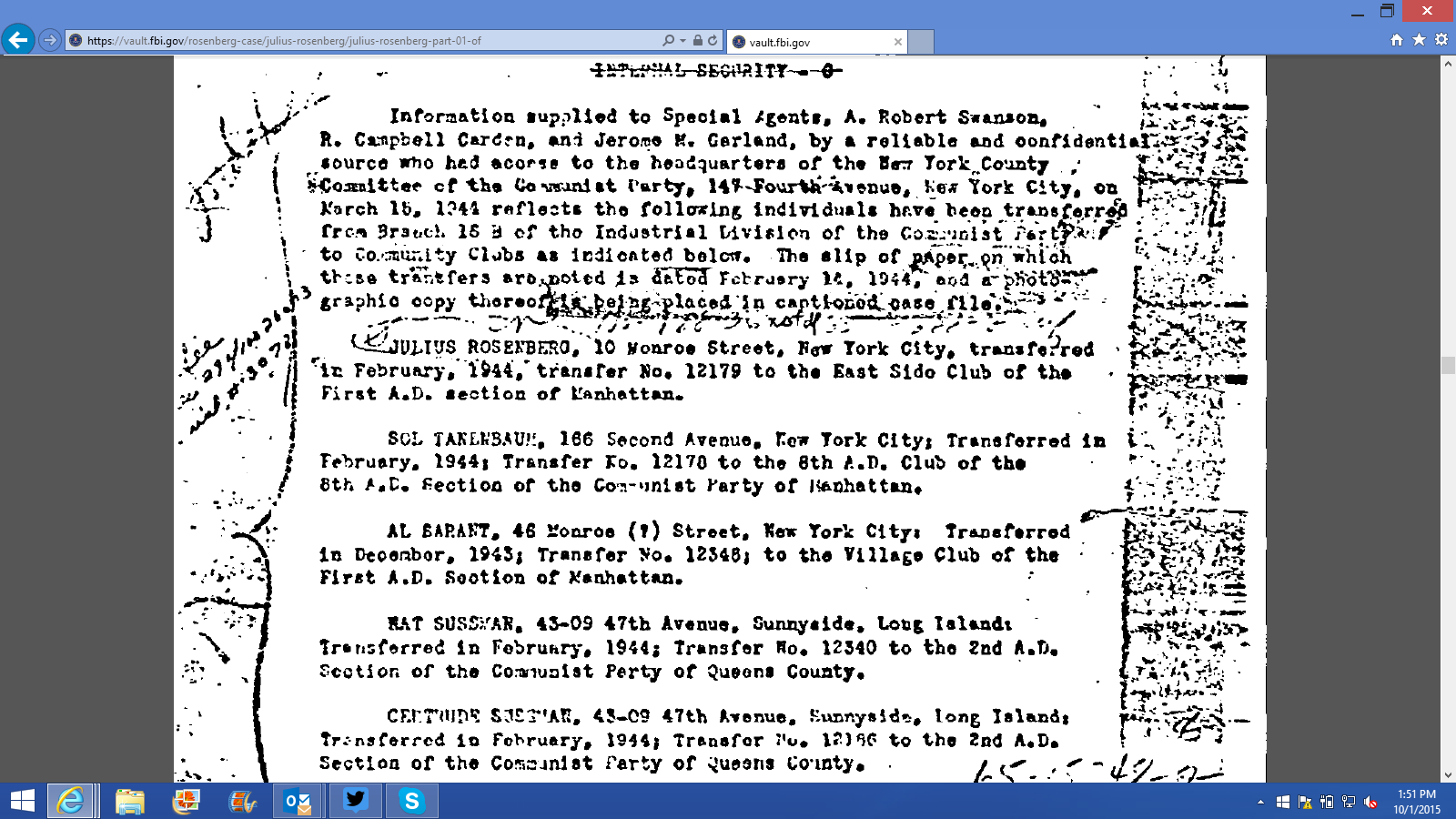
There are countless files in the FBI vault on the Rosenbergs.

Rosenberg


Via NYPost:

City Council honors Ethel Rosenberg for ‘great bravery’

The New York City Council this week honored convicted spy Ethel Rosenberg for “demonstrating great bravery” during a 1935 strike against the National New York Packing and Supply Co., the New York Post reports.

Rosenberg, along with her husband, Julius, and brother David Greenglass, were convicted of passing nuclear secrets to the Soviet Union in 1951. The Rosenbergs were executed in 1956, and Greenglass served 10 years of a 15-year sentence.

The council issued two proclamations, saying that Rosenberg was “wrongfully” executed for helping her husband. Decoded Russian cables released in the 1990s indicated that Julius Rosenberg passed secrets to the USSR, but they do not mention his wife.

“A lot of hysteria was created around anti-communism and how we had to defend our country, and these two people were traitors and we rushed to judgment and they were executed,” Councilman Daniel Dromm, a Queens Democrat said.

Three members of the council joined Manhattan Borough President Gale Brewer in issuing the proclamations honoring Rosenberg on the 100th anniversary of her birth. She was a resident of New York’s Lower East Side.