Iran Defying Iran Deal, WH and Kerry Still Trust ‘Em

Iran holds 4 Americans in their prisons, while the Obama administration says the track for talks to have them released was separate from the Iran talks. Yet, it must be know, the United States actually holds several Iranians in our prisons and one such detainee Iran wants back badly.

Iran wants it both ways as noted with this scientist they demand to be released.

An Iranian-American engineer has been sentenced to more than eight years in prison for sending sensitive U.S. military documents to his native Iran.

U.S. prosecutors say Mozaffar Khazaee, who had worked as an employee of U.S. defense contractors, stole and shared with Iran information on U.S. military jet engine programs over the span of several years.

Khazaee, a 61-year-old dual citizen, was arrested in January 2014 as he tried to leave the United States with sensitive military documents in his luggage.

A swap is likely part of the obscure talks with John Kerry and Iran’s Foreign Minister Mohammad Zarif.

The matter of the PMD’s (Possible Military Dimension) sites are still in dispute and Iran declares they are defying the JPOA by stating they will not remove the uranium stockpile. They will also not repurpose the heavy water reactor, both of which are stipulations of the JPOA.

“Any action regarding Arak and dispatching uranium abroad … will take place after the PMD file is closed,” Supreme Leader Ayatollah Ali Khamenei wrote in a letter to President Hassan Rouhani.

The letter, published on Khamenei’s website, approved implementation of a nuclear deal agreed with world powers in July, subject to certain conditions.

Meanwhile, the waivers are being signed to lift selected sanctions against Iran, demonstrating the White House, the State Department and the National Security Councils as well as those Democrats in Congress have not said a single word about the contraventions of the P5+1 Iran agreement.

NEW YORK (Reuters) – The United States approved conditional sanctions waivers for Iran on Sunday, though it cautioned they will not take effect until Tehran has curbed its nuclear program as required under a historic nuclear deal reached in Vienna on July 14.

“I hereby direct you to take all necessary steps to give effect to the U.S. commitments with respect to sanctions described in (the Iran deal),” U.S. President Barack Obama said in a memo to the secretaries of state, treasury, commerce and energy released by the White House press office.

Several senior U.S. officials, who spoke to reporters on condition of anonymity, said actual implementation of the deal was still at least two months away. In addition to Washington’s conditional orders to suspend U.S. nuclear-related sanctions, U.S. officials said the United States, China and Iran were re-emphasizing their commitment to the redesign and reconstruction of the Arak research reactor so that it does not produce plutonium.

The fate of the Arak reactor was one of the toughest sticking points in the nearly two years of negotiations that led to the July agreement.

Other steps Iran must take include reducing the number of uranium-enrichment centrifuges it has in operation, cutting its enriched uranium stocks and answering U.N. questions about past activities that the West suspects were linked to work on nuclear weapons.

Kerry noted that the IAEA had already said Iran had met its obligation to provide answers and access to the agency.

The Democrats, the White House and the State Department have a real talent for ignoring threats, facts and actions when it comes to reality.

It is beyond dispute that each item in question for Iran and the JPOA, Iran is rupturing the agreement and Barack Obama is ignoring the infractions. Perhaps someone should begin to ask Hillary about the JPOA since it was her State Department that deployed Jake Sullivan to open the Iran doors to these talks…what is she thinking now?

WikiLeaks Posts the Hacked Emails of CIA Director

Yet another Obama administration placeholder that was using a private email for sensitive material.

Of particular note is the partially written summary on Iran from 2009, which appear to be the genesis and words the White House used to justify normalizing relations with the rogue nation. John Brennan was applying to obtain high security clearance to enter the Obama White House before 2009 and later assuming the role of the chief of the CIA.

*** “The United States has no choice but to find ways to coexist — and to come to terms — with whatever government holds power in Tehran,” Brennan said in the three-page memo. He added that Iran would have to “come to terms” with the U.S. and that “Tehran’s ability to advance its political and economic interests rests on a non-hostile relationship with the United States and the West.”

In the memo, Brennan advised Obama to “tone down” rhetoric with Iran, and swiped at former President George W. Bush for his “gratuitous” labeling of Iran as part of a worldwide “axis of evil.” Brennan also said the U.S. should establish a direct dialogue with Tehran and “seek realistic, measurable steps.” Although he didn’t specifically call for the regime of financial sanctions that the Obama administration, along with Europe, Russia and China, pushed against Iran, Brennan told the president-elect to “hold out meaningful carrots as well as sticks.” ***

In part, a deeper look at the text is as follows:

The Conundrum of Iran

Iran will be a major player on the world stage in the decades ahead, and its actions and
behavior will have a major and enduring impact on near- and long-term U.S. interests on
a wide variety of regional and global issues. With a population of over 70 million, xx
percent of the world’s proven oil reserves, a geostrategic location of tremendous
(enviable?) significance, and a demonstrated potential to develop a nuclear-weapons
program, the United States has no choice but to find a way to coexist—and to come to
terms—with whatever government holds power in Tehran. At the same time, the Iranian
Government also must come to terms with Washington, as Tehran’s ability to advance its
political and economic interests rests on a non-hostile relationship with the United States
and the West.
There are numerous hurdles that stand in the way of improved U.S.-Iranian relations, but
none is more daunting than the theocratic regime’s nearly 30-year track record of
engaging in transnational terrorism, both directly and indirectly, to advance its
revolutionary agenda. Tehran’s proclivity to promote its interests by playing the terrorist
card undermines its standing as a responsible sovereign state and calls into question
virtually all of its actions, even when pursuing legitimate political, economic, and
strategic interests. While the use of terrorism(*footnote on definition) is reprehensible
and of serious concern irrespective of the source, the wielding of the terrorism club by a
nation state such as Iran is particularly alarming and insidious because of the ability of a
government to use its instruments of national power to support, conceal, facilitate, and
employ terrorist violence. Specifically, a sovereign government has the ready ability to
provide all of the logistical requirements—e.g. the fabrication of official documentation,
explosives, and weapons; the protected use of diplomatic facilities, staff, and pouches;
and the provision of expertise, funding, and targeting intelligence—that can be used to
great effect to plan and carry out successful terrorist attacks. Too often, and for too long,
Iran has excelled at such activities.

An anonymous teen hacker claimed to have stolen a handful of files from CIA Director John Brennan’s private email account, U.S. officials reported on Monday.

CIA Director John Brennan emails

Today, 21 October 2015 and over the coming days WikiLeaks is releasing documents from one of CIA chief John Brennan’s non-government email accounts. Brennan used the account occasionally for several intelligence related projects.

John Brennan became the Director of the Central Intelligence Agency in March 2013, replacing General David Petraeus who was forced to step down after becoming embroiled in a classified information mishandling scandal. Brennan was made Assistant to the President for Homeland Security and Counterterrorism on the commencement of the Obama presidency in 2009–a position he held until taking up his role as CIA chief.

According to the CIA Brennan previously worked for the agency for a 25 year stretch, from 1980 to 2005.

Brennan went private in 2005-2008, founding an intelligence and analysis firm The Analysis Corp (TAC). In 2008 Brennan became a donor to Obama. The same year TAC, led by Brennan, became a security advisor to the Obama campaign and later that year to the Obama-Biden Transition Project. It is during this period many of the Obama administration’s key strategic policies to China, Iran and “Af-Pak” were formulated. When Obama and Biden entered into power, Brennan was lifted up on high, resulting in his subsequent high-level national security appointments.

If you have similar official documents that have not been published yet, send them to WikiLeaks.

John Brennan Draft SF86

“National Security Position” form for John Brennan. This form, filled out by Brennan himself before he assumed his current position, reveals a quite comprehensive social graph of the current Director of the CIA with a lot of additional non-govermental and professional/military career details. (17 November 2008, Author: John Brennan)

Download PDF or view HTML version.

The Analysis Corporation

FAX from the General Counsel of the CIA to the Goverment Accountability Office about a legal quarrel between the CIA and “The Analysis Corporation”. TAC seems to have lost a tender for a US watchlist-related software project to a competitor. Issues seem to revolve around “growth of historical data” and “real-time responsiveness” of the system. (15 February 2008, Sender: CIA, Office of General Counsel, Larry Passar)

Download PDF or view HTML version.

Draft: Intel Position Paper

Challenges for the US Intelligence Community in a post cold-war and post-9/11 world; a calling for inter-agency cooperation, a ten-year term for the Director of the CIA and the Director of National Intelligence. It also demands the autonomy of the Intelligence Community, that it “… must never be subject to political manipulation and interference.” An unfinished paragraph is titled “Damaging Leaks of Classified Information”. (15 July 2007, Author: John Brennan)

Download PDF or view HTML version.

The Conundrum of Iran

Recommendations to the next President (assuming office in Jan. 2009) on how to play the figures on the U.S.-Iranian Chessboard (18 November 2007, Author: John Brennan)

Download PDF or view HTML version.

Torture

Letter from Vice Chairman Bond, Senate Select Committee on Intelligence, to his fellow board members with a proposal on how to make future interrogation methods “compliant” and “legal”. Instead of listing all allowed methods, every kind of interrogation should be considered compliant, as long as it is not explicitly forbidden by the “Army Field Manual” (AFM). (May 2008)

Download PDF or view HTML version.

Torture Ways

A bill from July 2008 called “Limitations on Interrogation Techniques Act of 2008” explicitly list the forbidden interrogation techniques mentioned in the previous document and can be considered a direct implementation of the recommendations of Christopher Bond. (31 July 2008)

Download PDF or view HTML version.

Server-Gate or Deep Throat Part 2?

Hillary says often that the State Department gave her permission to use a private server and email. Think about that, who at State did that? She was HEAD of the State Dept, so did she give herself permission? C’mon….

Then there is the excuse that everyone does it so it must be okay right?

State Department’s Cybersecurity Weakened Under Hillary Clinton

From 2011 to 2014, the State Department’s poor cybersecurity was identified by the inspector general as a “significant deficiency.”

WASHINGTON (AP) — The State Department was among the worst agencies in the federal government at protecting its computer networks while Hillary Rodham Clinton was secretary from 2009 to 2013, a situation that continued to deteriorate as John Kerry took office and Russian hackers breached the department’s email system, according to independent audits and interviews.

The State Department’s compliance with federal cybersecurity standards was below average when Clinton took over but grew worse in each year of her tenure, according to an annual report card compiled by the White House based on audits by agency watchdogs. Network security continued to slip after Kerry replaced Clinton in February 2013, and remains substandard, according to the State Department inspector general.

In each year from 2011 to 2014, the State Department’s poor cybersecurity was identified by the inspector general as a “significant deficiency” that put the department’s information at risk. The latest assessment is due to be published in a few weeks.

Clinton, the front-runner for the Democratic presidential nomination, has been criticized for her use of a private email server for official business while she was secretary of state. Her private email address also was the recipient of malware linked to Russia, and her server was hit with malware from China, South Korea and Germany. The FBI is investigating whether her home server was breached.

State Department officials don’t dispute the compliance shortcomings identified in years of internal audits, but argue that the audits paint a distorted picture of their cybersecurity, which they depict as solid and improving. They strongly disagree with the White House ranking that puts them behind most other government agencies. Senior department officials in charge of cybersecurity would speak only on condition of anonymity. More here.

With Jake Tapper, Hillary laughed at this scandal…a weird moment in that interview.

Observer: Hillary Clinton emerged from Tuesday night’s inaugural Democratic debate in Las Vegas the clear leader in her party’s field. As Democrats attempt to hold onto the White House in 2016, polling demonstrated a revitalized Hillary campaign, which had been in the doldrums for months due to the ongoing scandal about her misuse of email as Secretary of State.

Mounting talk of Vice President Joe Biden entering the race–to take the place of an ailing Hillary–has dissipated in the wake of the debate, where Ms. Clinton dismissed the email issues as Republican-driven political theater. That Senator Bernie Sanders vigorously backed Ms. Clinton on the point helped her cause, as did her brusque dismissal of Lincoln Chafee’s efforts to raise the issue again, which got raucous applause from the crowd.

It’s evident the Democratic base agrees with Ms. Clinton that her emails are just GOP theatrics. President Obama reflected the sentiment in an interview with 60 Minutes airing two days before the debate, during which he allowed that Secretary Clinton had “made a mistake” with her email but it “is not a situation in which America’s national security was endangered.”

Though the White House soon walked back on some of the president’s statements, which seemed to many to be inappropriate West Wing commentary regarding an ongoing FBI investigation, it’s apparent that the Clinton campaign and the Obama team have united around a message: this issue is fundamentally contrived by Republicans, and is certainly not a threat of any kind to national security.

Democrats unsurprisingly find this take congenial, but it’s less clear if other Americans consider it persuasive. Naturally, Republicans view Ms. Clinton’s email activities with a great deal of suspicion, but recent polls show even independents have concerns regarding EmailGate and Ms. Clinton’s honesty. While the Clinton camp is now confident the email problems will likely not bar her party’s nomination next summer, the issue may loom larger in the race for the White House next fall.

There’s also the matter of exactly what the FBI is investigating. Recent revelations hint that the compromising of classified information on Ms. Clinton’s “private” email and server was more serious than originally believed. While earlier reports indicated only a small percentage of the sensitive information that “spilled over” onto Ms. Clinton’s personal email was highly classified at the Top Secret level, that may be only a small portion of what was potentially compromised.

Particularly disturbing is the report that one of the “personal” emails Ms. Clinton forwarded included the name of a top CIA asset in Libya, who was identified as such. The source of this information was Tyler Drumheller, a retired senior CIA operations officer, who served as a sort of one-man private spy agency for Sid Blumenthal, the Clintons’ close family friend and factotum whose sometimes long-winded emails, particularly regarding Libya, have generated much of the controversy behind EmailGate.

Mr. Drumheller became a fleeting hero to liberals with his resistance to George W. Bush’s White House over skewed intelligence behind the 2003 invasion of Iraq, but he was never particularly popular at CIA and he left Langley under something of a cloud. His emails to Mr. Blumenthal, which were forwarded to Ms. Clinton, were filled with espionage-flavored information about events in Libya. In many cases, Mr. Drumheller’s reports were formatted to look exactly like actual CIA reports, including attribution to named foreign intelligence agencies. How much of this was factual versus Mr. Drumheller embellishing his connections is unclear.

What is abundantly clear is that the true name of an identified CIA asset is a highly classified fact and intentionally revealing it is a Federal crime, which Mr. Drumheller, a career spy, had to know. Why he compromised this person who was secretly helping the United States – possibly endangering his life in the process — may never be known because Mr. Drumheller conveniently died of cancer in early August.

Libya may have a great deal to worry about since new information continues to show just how slipshod Ms. Clinton’s security measures were for her “private” server. That Ms. Clinton’s server experienced multiple cyber-attacks from abroad, including by Russians, does not inspire confidence that any classified information stored in her emails remained in American hands.

To make matters worse, a recent investigation by the Associated Press demonstrates that even relatively low-skill hackers could have hacked Hillary’s unencrypted server, which was left vulnerable to exposure on the open Internet to a degree that cyber-warriors find difficult to believe. “Were they drunk?” a senior NSA official asked me after reading the AP report. “Anybody could have been inside that server – anybody,” he added.

Since the communications of any Secretary of State are highly sought after by dozens of intelligence agencies worldwide – a reality expressed by Secretary John Kerry recently when he said it’s “very likely” the Russians and Chinese are reading his email, a view that any veteran spy would endorse – Ms. Clinton putting her emails at such risk means they have to be assumed to be compromised. If the more skilled state-connected hackers in Russia can fool even NSA these days, they could have gotten into Hillary’s unprotected server without breaking a sweat.

This makes Mr. Obama’s quip that EmailGate represents no threat to American national security all the more puzzling in its dishonesty. Unsurprisingly, some at the FBI are not pleased the president made this pronouncement before the Bureau completed its investigation. “We got the message,” an FBI agent at the Washington Field Office, which is spearheading the EmailGate case, explained: “Obama’s not subtle sometimes.”

In 2012, while the FBI was investigating CIA director David Petraeus for mishandling classified information, Mr. Obama similarly dismissed the national security implications of the case at a press conference. Although FBI director James Comey pressed for serious charges against Mr. Petraeus, the White House demurred and the Department of Justice allowed him to plead guilty to a misdemeanor, sentenced to probation with no jail time.

Some at the FBI were displeased by this leniency and felt Mr. Obama showed his hand to the public early, compromising the Bureau’s investigation. Is the same happening with Ms. Clinton? It’s too soon to say, though the anger of some at the FBI has seeped into the media already. Comments to tabloids reflect the widespread frustration and fear among federal law enforcement and intelligence circles that Mr. Obama will let Ms. Clinton skate free from EmailGate.

For now, the FBI is pursuing its investigation with diligence, bringing other intelligence agencies into the case, and recent reports indicate that specific provisions of the Espionage Act are being re-read carefully, particularly regarding “gross negligence” – which may be the most appropriate charge that Ms. Clinton or members of her inner circle could face.

It will be weeks, even months, before the FBI’s investigation concludes and the Department of Justice has to decide whether any of the events surrounding EmailGate reach the threshold of prosecution. Many in the FBI and the Intelligence Community suspect the fix is already inside the West Wing to prevent that from happening, but it’s still early in this investigation.

It can be expected that if the White House blocks Hillary’s prosecution during the election campaign, leaks will commence with a vengeance. “Is there another Mark Felt out there, waiting?” asked a retired senior FBI official. “There usually is,” he added with a wry smile, citing the top Bureau official who, frustrated by the antics of the Nixon White House, became the notorious “Deep Throat”who leaked the dirty backstory to Watergate to the Washington, DC, media.

Mr. Obama and the Clinton camp should be advised to be careful about who they throw under the bus in this town.

Hacking of Dow Jones and CIA Director?

Out of control…exactly where are the upgrades to all government systems to prevent hacking further…what about those pesky personal email accounts that continue to pop up with classified material?

Heh….so Barack Obama takes an opportunity several weeks ago when the Chinese President was in town to say stop hacking us…or did he?

In part from WashingtonFreeBeacon: A U.S. cybersecurity firm that works with the government has evidence that Chinese government-linked hackers violated the cyber agreement reached between President Obama and Chinese President Xi Jinping less than a month ago.

The Wall Street Journal reported that CrowdStrike Inc. will announce Monday that some of its customers fell victim to unsuccessful cyber attacks that violated the leaders’ Sept. 25 agreement to stop state-sponsored cyber attacks on companies for commercial gain.

According to the firm, customers from the technology and pharmaceutical industries that will remain unnamed were targeted by hackers linked to the Chinese government. A pair of hacking attempts occurred on the days before and after Obama hosted Jinping for a state dinner at the White House during which the leaders reached the agreement. Other attempted hacks continued through October.

The Obama administration is “aware” of the report from CrowdStrike.

“We are aware of this report. We’ll decline comment on its specific conclusions. We have and will continue to directly raise our concerns regarding cybersecurity with the Chinese,” a senior administration official stated.

Director of National Intelligence James Clapper admitted last month that he did not have confidence that the deal between Obama and Jinping would stop China from launching cyber attacks on U.S. businesses.

*** So who exactly nailed the Director of the CIA, John Brennan? Well a Palestinian sympathizer who is a ‘stoner’. (No pun intended)

Teen stoner says he hacked CIA director’s AOL account

From NYPost: Hillary Rodham Clinton’s email scandal didn’t stop the head of the CIA from using his own personal AOL account to stash work-related documents, according to a stoner high school student who claims to have hacked into them.

CIA Director John Brennan’s private account held sensitive files — including his 47-page application for top-secret security clearance — until he recently learned that it had been infiltrated, the hacker told The Post.

Other emails stored in Brennan’s non-government account contained the Social Security numbers and personal information of more than a dozen top American intelligence officials, as well as a government letter about the use of “harsh interrogation techniques” on terrorism suspects, according to the hacker.

The FBI and other federal agencies are now investigating the hacker, with one source saying criminal charges are possible, law enforcement sources said.

“I think they’ll want to make an example out of him to deter people from doing this in the future,” said a source who described the situation as “just wild” and “crazy.”

“I can’t believe he did this to the head of the CIA,’’ the source added. “[The] problem with these older-generation guys is that they don’t know anything about cybersecurity, and as you can see, it can be problematic.”

In a series of phone conversations with The Post, the hacker described himself as an American high school student who is not Muslim and was motivated by opposition to US foreign policy and support for Palestine.

He wouldn’t reveal his name or say where he lived but made good on a promise to tweet “CWA owns John Brennan of the CIA” as a means of verifying his control over the @phphax Twitter account.

Hello guys this Twitter account is going now as things are starting to get hot, we will still be getting our words out though. 😉

If i go quiet on this account, the CIA losers have found me and I’m being tortured by their stupid methods of ruining a guys thoughts.

He explained “CWA” stood for “Crackas With Attitude,” which he said referred to him and a classmate with whom he smokes pot.

The hacker contacted The Post last week to brag about his exploits, which include posting some of the stolen documents and a portion of Brennan’s contact list on Twitter. The hacker’s Twitter page includes the Muslim Shahada creed, which translates as, “There is no god but Allah, Muhammad is the messenger of Allah.”

He said the stolen documents were stored as attachments to about 40 emails that he read after breaking into Brennan’s account on Oct. 12, more than six months after the controversy erupted over Clinton’s use of a private computer server to handle emails while serving as secretary of state.

The hacker said he used a tactic called “social engineering” that involved tricking workers at Verizon into providing Brennan’s personal information and duping AOL into resetting his password.

Brennan’s account was disabled as of Friday, he said.

He claimed he has repeatedly prank-called America’s top spy since August, once reciting Brennan’s Social Security number to him.

“He waited a tiny bit and hung up,” the hacker said.

And he also got into the online Comcast account of Homeland Security Secretary Jeh Johnson and posted a redacted screenshot of a billing page. He claimed that he listened to Johnson’s voicemails.

In a statement, the CIA said: “We are aware of the reports that have surfaced on social media and have referred the matter to the appropriate authorities.”

*** Then to Dow Jones….

Bloomberg states that the ongoing investigation conducted by US authorities was probing allegations that there is a Russian gang behind the Dow Jones hack.

Dow Jones has provided further information on the data breach that the company has recently suffered.

A week ago, the CEO of Dow Jones & Co disclosed the incident confirming that 3,500 people were affected.

The Dow Jones firm confirmed it discovered unauthorized access to its customer payment system that occurred between August 2012 and July 2015.

The investigators believe that the attackers were searching for contact information of current and former Dow Jones subscribers, whom records include name, addresses, email addresses, and phone numbers.

“As part of the investigation to date, we also determined that payment card and contact information for fewer than 3,500 individuals could have been accessed, although we have discovered no direct evidence that information was stolen. We are sending those individuals a letter in the mail with more information about the support we are offering. If you do not receive such a letter, we have no indication that your financial information was involved,” the letter states published by the Dow Jones Chief Executive William Lewis .

Yesterday Bloomberg reported that the ongoing investigation conducted by the FBI, US financial watchdog the SEC, and America’s Secret Service were probing allegations that there is a Russian criminal ring behind the attack. According to the investigators, the Russian gang was financially motivated, the hackers search for unpublished financial data and news articles and press releases from the Dow Jones computers to get an edge on the market. Attackers are now stealing sensitive information and selling it to traders and operators in the industry.

“A group of Russian hackers infiltrated the servers of Dow Jones & Co., owner of the Wall Street Journal and several other news publications, and stole information to trade on before it became public, according to four people familiar with the matter.” states Bloomberg Business.

Telegram, New Platform for Terrorists to Communicate

Sitting on the knife’s edge when it comes to protecting people’s communication from investigative agencies like the FBI and the NSA is a slippery and inexact argument. The Director of the FBI, James Comey has begged Congress for some legislation such that some encryption can be broken for terror and other criminal cases to be investigated yet nothing is forthcoming and not likely in the future.

FBI Director James Comey spoke to legal professionals and scholars this week about cyber threats and the FBI’s abilities to counter and investigate those evolving threats.

In remarks at the American Law Institute on Tuesday and at a cyber security summit on Wednesday at Georgetown University Law Center, Comey said the group calling itself the Islamic State, or ISIL, represents the FBI’s most urgent threat. He described the organization’s use of social media to motivate troubled people in the United States to engage in acts of violence—either by traveling to the so-called caliphate or killing where they are. Comey said ISIL reaches out to individuals on Twitter and elsewhere, then moves their more sensitive communications to encrypted platforms.

“The threat we face has morphed,” Comey said on Wednesday. “It’s a chaotic spider web through social media—increasingly invisible to us because the operational communications are happening in an encrypted channel.”

Comey later elaborated on the issue of encryption, which is a process of encoding messages—on mobile phones for example—that only authorized parties can access. While it can be effective at thwarting digital thieves, strong encryption also limits the amount of information—or evidence—that law enforcement can effectively gather from a device.

“Increasingly we’re finding ourselves unable to read what we find, or unable to open a device,” Comey said, “and that is a serious concern.”

The issue of “going dark,” as the Bureau calls it, is worthy of a larger public conversation about the balance between privacy and public safety, Comey said. Momentum toward universal encryption, he explained, may have unintended consequences.

“As all of our lives become digital, the logic of encryption is all of our lives will be covered by strong encryption, and therefore all of our lives—including the lives of criminals and terrorists and spies—will be in a place that is utterly unavailable to court-ordered process,” he said. “And that, I think, to a democracy should be very, very concerning.”

The Director also pointed to provisions of the Patriot Act of 2001 that, if allowed to expire on June 1, could hobble the FBI’s investigative abilities. One of the provisions is Section 215, which authorized the National Security Agency’s database of telephony records and metadata.

Comey said the FBI relies on that provision fewer than 200 times a year—in particular cases to get particular records. “If we lose that authority,” Comey said, “we can’t get information that I think everybody wants us to attain.”

Two other provisions include:

  • Roving wiretaps. The FBI has had authority since the 1980s to use legally authorized roving wiretaps in criminal cases—allowing authorities to follow surveillance targets rather than their phones, which can be easily trashed and replaced. The Patriot Act extended that authority to terrorism and counterintelligence cases.
  • The Lone Wolf provision. In 2004, Congress amended the Foreign Intelligence Surveillance Act to authorize intelligence gathering on individuals not affiliated with any known terrorist organization.

“These three are going to go away June 1,” Comey said, “and I don’t want them to get lost in the conversation about metadata.”

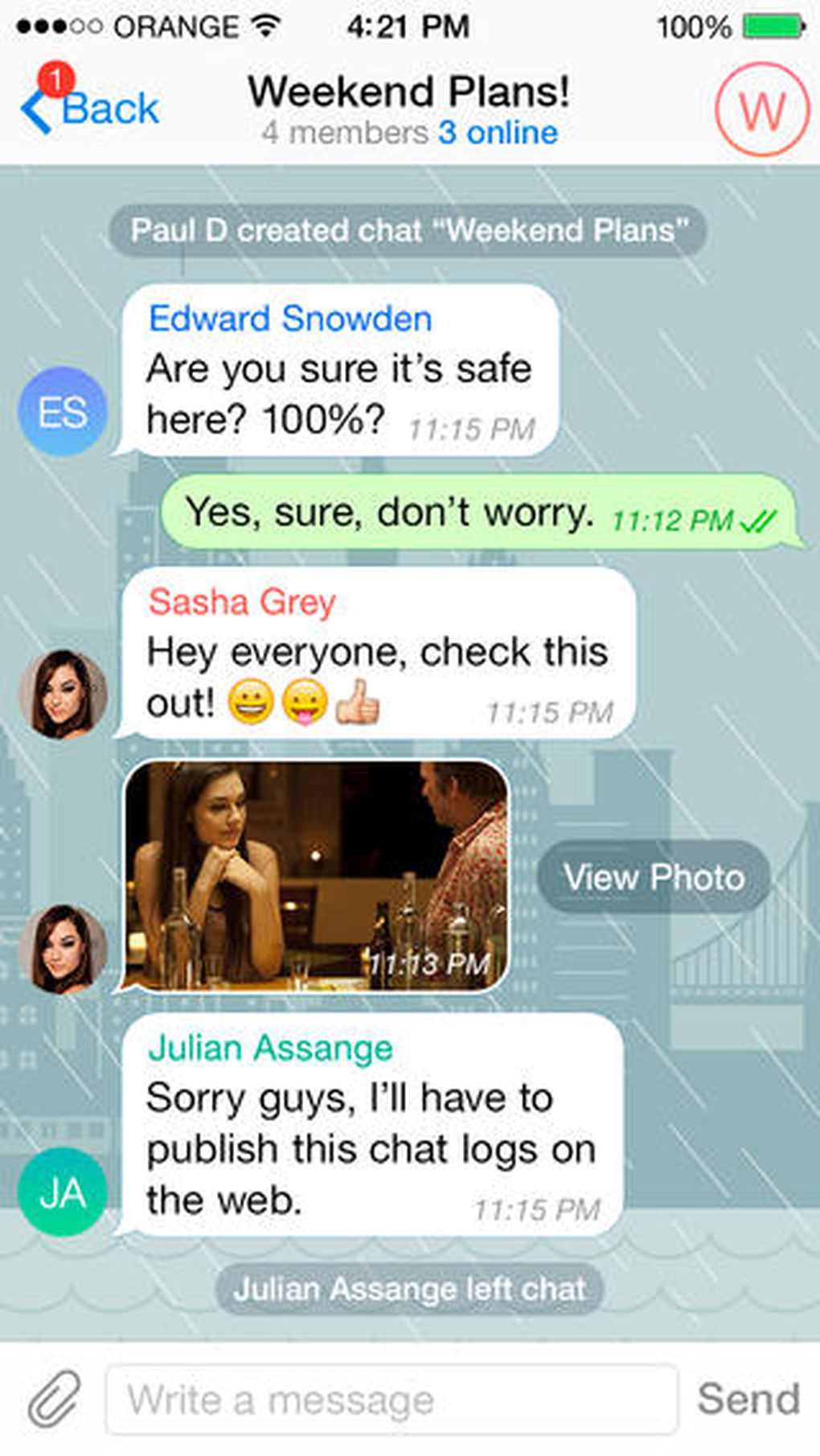
It was not but a few months ago, the leadership of Islamic State (ISIS) published an edict for the top terror commanders to use an app called ‘Telegram’ and they are.

Now what? How is the conflict of civil liberties resolved?

Director Comey Speaks at Georgetown University Law Center


Why Telegram has become the hottest messaging app in the world

Secret messages and advanced cryptography pose a challenge to WhatsApp

When WhatsApp went down for four hours this weekend, nearly 5 million people signed up for messaging service Telegram. The app skyrocketed to the top of the App Store charts, and is now the top free app in 46 countries from Germany to Ecuador. In the US and several other countries, the app is no. 1 in the social networking category, ahead of Facebook, WhatsApp, Kik, and others.

Screen568x568 4.1393343382

It’s not immediately clear why Telegram emerged as the alternative of choice following WhatsApp’s downtime. Users could have switched to Kik, or Facebook Messenger, or LINE — all of which have hundreds of millions of users. There’s seemingly something different about Telegram. Its rise isn’t only due to WhatsApp’s acquisition and subsequent downtime. “We have been the no. 1 app in Spanish, Arabic, and several Latin American app stores for several weeks before the Facebook deal happened,” says Telegram’s Markus Ra. “The growth was there — so the WhatsApp acquisition and problems merely multiplied the effect across all affected countries.” According to app analytics site App Annie, Telegram started truly gaining steam on February 17th, days before the WhatsApp news even hit.

Built by the pioneering Durov brothers behind Russia’s largest social network, VKontakte (also known as VK), Telegram is a messaging service combining the speed of WhatsApp with Snapchat’s ephemerality and advanced new security measures. WhatsApp might have heralded the first time we heard of Telegram, but it certainly won’t be the last.

Telegram feels in many ways like a straight-up clone of WhatsApp, from its green double-checkmark read receipts to its cartoonish wallpapers. There’s also the usual gamut of messaging app features including the ability to see a friend’s online status and attach photos, videos, your location, contacts, and documents to messages. But where it lacks originality, Telegram makes up for it in speed and security features. “Telegram is the fastest and most secure mass market messaging system in the world,” the company claims, which it attributes in part to Nikolai Durov’s open-sourced MTProto protocol. Telegram was in fact built as a testing bed for MTProto, Reuters reported when the app launched back in August. The company is so confident in the security of MTProto that it’s offering $200,000 to anyone who can crack it. It’s not unusual for companies to offer bug bounties, but bounties of this size are generally only reserved for critical bugs in widely used apps like Windows.

“The no. 1 reason for me to support and help launch Telegram was to build a means of communication that can’t be accessed by the Russian security agencies,” Durov told TechCrunch. Durov built in a feature that lets you start a “Secret Chat” with any of your friends. According to Telegram, Secret Chats offer end-to-end encryption, leave no trace on the company’s servers, and let you set Snapchat-esque self-destruct timers on messages that range from two seconds to one week. There’s also the ability to check the security of your Secret Chats using an image that serves as an encryption key. By comparing your encryption key to a friend’s, you can effectively verify that your conversation is secure and less vulnerable to man-in-the-middle attacks, the company says. But despite Telegram’s alleged sophistication, no cryptographic method is infallible. The company has, in fact, already doled out $100,000 to one developer for finding a critical bug, TechCrunch reports.

“The no. 1 reason for me to [help launch] Telegram was to build a means of communication that can’t be accessed by the Russian security agencies.”

Telegram is interesting not just because of its stringent security standards, but also because it allows any developer to build a Telegram client of their own, and even for desktop computers. Most new messaging services today, including WhatsApp, build one-size-fits-all messaging apps and lock out third-party developers. It’s hard to blame them, since maintaining one federated language and security paradigm across dozens of apps is difficult. Also, making money off of a platform takes more thought than making money off a simple paid app. Yet, the Durovs’ VKontakte found a lot of success letting developers build alternate versions of its site. More importantly, Telegram operates as a non-profit organization, and doesn’t plan to charge for its services.

“Telegram is not intended to bring revenue, it will never sell ads or accept outside investment. It also cannot be sold,” the company writes in its FAQ. “We’re not building a ‘user base,’ we are building a messenger for the people.” If Telegram ever “runs out” of the money supplied by the Durov brothers, the company says, it will ask for donations from its users. Telegram’s noble goals echo the sentiments of many bright-eyed startup founders, but with the Durovs’ pocketbook in hand and the service’s open API available to third-party developers, it may actually have a chance at fulfilling its goals. Telegram isn’t a CryptoCat for the masses, considering it uses your phone number, of all things, as an identifier — but it’s an important step towards finding a highly encrypted messaging platform that’s accessible to anyone.

“Telegram is not intended to bring revenue, it will never sell ads.”

Championing an ostensibly noble goal, free services, and the experience of VKontakte’s creators, Telegram would seem like a great alternative to any of the leading messages apps out there. After WhatsApp’s acquisition news and downtime, the app is spiking at the right time. The company incentivized several million new users into switching over, but keeping those users will be a continuous challenge. “The switching cost for users on a phone number-based messaging services is at or near zero,” argues Union Square Ventures partner Albert Wenger in a blog post, but that’s only half the story. A network is only as strong as the number of friends you have using it, and convincing all of your friends to switch is no easy task. If Facebook thought that WhatsApp users were liable to switch at a moment’s notice, it wouldn’t have paid $19 billion for the company.

Facebook paid for WhatsApp’s user base, but also for its brand — a brand that spent years solving a very important problem: that it costs a fortune to text across borders. Perhaps the next messaging problem to solve is personal security, considering WhatsApp’s alleged cryptographic weaknesses and the NSA’s data collection policies. WhatsApp became synonymous with texting. Perhaps for Telegram to succeed, it will need to become synonymous with security.