
Putin’s Hidden Agents in ISIS

It is about a global power-ranking. When Russia and Iran team up to destabilized Syria, refugees, millions of them flee. Destination for the refugees, The West. The West is forced to accommodate millions, pay for them, house them, educated them and provide medical care, breaking the financial structure. How come Russia has not taken any refugees or Iran or any country in the Middle East? They already know. Now the challenge for the West is to have aggressive leadership by the United States, not until 2017 will that be realized or will it?

The KGB/FSB has an agenda, it is well underway…..As you read below, submit your thoughts.

NewAmerican: On December 6, 2015, in a televised interview with the Ukrainian news program ТСН Тиждень (TSN Tyzhden, Ukrainian for TSN Weekly), a former FSB officer admitted that Russia is behind ISIS while ostensibly opposing it.

Former FSB officer codenamed “Yevgeniy” (shown, back toward camera) revealed that Russia’s FSB security services was, at the very least, complicit in the Paris attacks carried out by ISIS, and most shockingly that the FSB was involved in the creation of ISIS, which it influences through its agents who staff it as well as other related Islamic terrorist organizations.

The FSB, which stands for Federal Security Service in Russian, was organized in 1995 as the successor to the Soviet KGB. After the KGB was officially dissolved in 1991, it was briefly renamed the AFB (Agency for Federal Security), which was reorganized that same year as the MB (Ministry of Security). In 1993, the MB became the FSK (Federal Counter-Intelligence Service), which was again reorganized into its present form and name as the FSB on April 12, 1995.

Yevgeniy reportedly specialized in both terrorist organizations and counter-terrorism activities within the FSB. Defecting for personal reasons rather than ideological, Yevgeniy told TSN’s Andriy Tsaplienko that among the vast number of refugees entering Europe were certain Russian operatives whose task it was to infiltrate the Muslim communities. Financed by the FSB, these undercover Muslim operatives would rise to prominence within their respective communities, in turn providing the Kremlin with valuable intelligence of Muslim activates in Europe and allowing Moscow to exert influence over the communities. More here.

****   Russia's Hidden Influence Agents Within ISIS (Pt. 1)

WikiLeaks Forum:
Part one of this series looked at the historical manipulation of Islamists by Russian security services. Jihadists were armed and trained to fight by the FSB and GRU in places like Georgia and Nargono-Karabakh. Domestically, jihadists were infiltrated by the FSB into nationalist separatist movements in Dagestan and Chechnya, effectively painting those movements as religious radicals rather than freedom fighters battling an oppressive regime in Moscow.
Related Posts

Part two looked at a few specific examples of Chechen and Georgian jihadists who are probably witting or unwitting FSB assets, and how they have become power players within ISIS. The reasons for this are twofold and represent a re-creation of the same strategy used in Chechnya. Chechen jihadists helped to re-contextualize the Syrian rebels, Islamizing them in the world’s eyes. By doing this, they also acted as a spoiler force, preventing the CIA from being able to train and arm many Syrian rebels because of the presence of so many jihadi groups, a draw for many of the moderates in the region.
This article will take a look at ISIS propaganda, or what the world’s intelligence services would call information operations or psychological operations, and ask the question as to whether there is a hidden hand behind these propaganda videos.

Wahhabywood

The allure that ISIS holds for young jihadis and the fear they inspire in the rest of the world stems not from the actual combat prowess of the organization, but from its image. That image is carefully crafted, and much has been written about the high production values of the propaganda ISIS puts out. Their videos display dehumanized Islamic warriors in black masks, fully devoted to the cause of creating an Islamic caliphate. They never sleep, they never tire, they will conquer the entire world, bathing it in the blood of infidels and installing some kind of Muslim mojo hocus pocus 7th-century sharia law, or so we are told.

ISIS represents the darkest nightmares the Western world has about the Middle East, Arabs, and Muslims. The Islamic State represents a temporally displaced land of barbarians that has no place in the modern world. These nightmares are carefully cultivated by ISIS in slick propaganda films that show a deep awareness of liberal Western cultural values; the images and actions in these films are often specifically targeting Western audiences. ISIS’s reputation in the Middle East, much of it gained by way of their propaganda, is so profound, this author has been told that when an ISIS convoy rolls up to a village, all they need to do is blink their headlights and the locals will completely abandon their homes without a fight.

Their propaganda is good. Maybe too good.

ISIS propaganda targets Western liberal sensitivities in a very deliberate manner. There are many ways they do this, but four stand out quite clearly.

1. Mass executions, especially of Christians.
ISIS thrives on the blood bath of mass executions. No one is spared. Shia Muslims, children, ordinary civilians, so-called infidels and apostates, suspected traitors, Kurds, it hardly matters to ISIS. They are also known to carry out summary beheadings when they arrive in a village of the first person they can get their hands on just to prove that they are now in charge. However, it is the deliberate mass murder of Christians in Syria, Iraq, and Libya that is clearly designed to antagonize Western populations.

2. Sexual slavery
Openly flaunting sexual slavery is another propaganda point for ISIS, one that intentionally provokes Western values, but arguably human values across the world. Murder is one thing, but holding slave auctions in Mosul and selling off 13-year-old Yezidi girls or handing them out as gifts to ISIS fighters is particularly vile. ISIS is quite proud of this and brags about it in videos and public statements; their brand of sharia law also openly endorses it. This savage behavior deliberately provokes Westerners sensitive to gender issues.

3. Destruction of antiquities
The truth is that many Americans could care less about what happens in the Middle East. Arabs have been killing each other for hundreds of years and will continue to do so unabated. But even some of the most jaded people in the West get outraged at the destruction of antiquities. Following in the footsteps of the Taliban, who destroyed ancient Buddha statues, ISIS knows that their destruction of ancient Roman and Assyrian artifacts and structure will invite the ire of the world.

4. Targeting homosexuals
ISIS beheads and murders people at whim, but full-page spreads of professionally done photographs capturing ISIS tossing homosexual men from rooftops is something else entirely. Gay rights is an important issue in the West, and ISIS not only murders gays but makes sure that the entire world knows about it by recording these executions.
It is important to remember that none of these propaganda videos or pictures are released without permission from ISIS. We see what ISIS wants us to see. I am not cherry-picking the worst behavior of ISIS to present to our readers, I’m simply pointing out the images they want foremost in our minds. ISIS is baiting the Western world. Their end goal is also stated in the open: They want a coalition of Western nations to attack them.

Reflexive control

Reflexive control is a theory of psychological warfare designed to control enemy perceptions and has been studied and developed by Russian intelligence services for over 40 years. “Reflexive control is defined as a means of conveying to a partner or an opponent specially prepared information to incline him to voluntarily make the predetermined decision desired by the initiator of the action,” writes Timothy Thomas. Reflexive control involves studying the opposition’s decision-making process, then introducing socially, strategically, or politically loaded information into that process in order to influence it in a direction favorable to your objectives.

Russian defense analysts perceive America’s 1980s “Star Wars” or SDI program as a perfect example of reflexive control. According to the Russians, America knew that the USSR would respond to match horizontal and vertical proliferation of weapons, as well as the countermeasures to stop them. Therefore, America instituted the Star Wars program to trick the Soviet Union into investing in novel new weapons programs it could not afford, which then led to the crash of the Soviet economy. By doing this, we “compelled the enemy to act according to a plan favorable to the U.S.” (Thomas, 239).

By definition, reflexive control occurs when the controlling organ conveys (to the objective system) motives and reasons that cause it to reach the desired decision, the nature of which is maintained in strict secrecy. The decision itself must be made independently. A “reflex” itself involves the specific process of imitating the enemy’s reasoning or imitating the enemy’s possible behavior and causes him to make a decision unfavorable to himself (Thomas, 241).

In other words, once you understand how the enemy thinks, you then feed him information you know will cause him to reach an independent decision favoring your own strategy. In essence, you are using deception to trick the enemy, hoping that they will blunder into something that they wouldn’t attempt if they knew that they were being presented with loaded, and potentially false, information. While we are focused on Russian stratagems here, it may also be useful to reflect back of the deception tactics used by China as well, many of them derived from the period of the Warring States.

ISIS feeds the West loaded information

There is no proof that Russian intelligence has a hand in ISIS information/propaganda operations. However, considering what we have discussed thus far, this scenario should be taken seriously. ISIS is actively gaming the psychological makeup of Western audiences in order to provoke the United States and allied nations into a full-blown military confrontation with the Islamic State in Syria and Iraq. If the hypothesis about Russian influence agents in ISIS is correct, and if they are participating in ISIS propaganda efforts, then we should ask why Russia would be interested in doing this to begin with.

The answer is fairly straightforward. Keeping America bogged down and preoccupied in the Middle East is of massive benefit to the Russian Federation. By goading America into another war in the Middle East, Russia has more opportunity to engage in military aggression in Ukraine, Dagestan, Chechnya, Georgia, Moldova, Akbazia, Nagorno-Karabakh, Uzbekistan, Tajikistan, Turkmenistan, and on and on throughout Russia’s near abroad. For sure, there would also be some more specific tactical and strategic goals, but in the general sense, the Gulf War III would help keep America off Russia’s back.

ISIS, and perhaps Russian intelligence, understands America’s future rationalizations for war very well. In the past we could justify war as being battles against communism or fascism for the preservation of the American way of life. Before that, more jingoistic narratives about manifest destiny were brought into play. But these justifications for war, racial or nationalistic, will have no place in future liberal Western nations. Instead wars will be justified as fights for gay rights, women’s rights, and other equality issues. One hypothetical example: Americans will be told that we have to invade Iran because gays are stoned to death or beheaded by the Iranian regime.

The Islamic State knows that there is no better way to terrify and incite Americans than to use mass executions, the murder of Christians, the use of sex slaves, the destruction of ancient relics, and the killing of homosexuals. ISIS is at war with Western consciousness, and it is a very deliberate effort.

Basically, we see Daesh, we see the Islamic State — especially in the West — we see it from the surface, which is the mix of their propaganda; their version of what they really do. You see the pictures of actual killings, slaughtering, beheadings, blowing up things, mixed with their propaganda, or mixed with the things which are not true. They are controlling whatever comes out of their area. For example, if you take the pictures and the images we have of the Islamic State, 99% are approved by their PR department. They give us pictures of all these lined-up Humvees, guys with guns, perfect afternoon light set in the desert. They have accepted the presence of a few photographers who are in the area, from AFP, Reuters, AP; the big agencies, no matter if they would be considered Zionists, masons, imperialists, infidel agencies — they are in their area and they had to swear allegiance and in most cases the office is directly controlling all the images before they are permitted to submit them or it’s made clear to them. They sort of tell them, ‘if you do something wrong which harms our reputation, you know what will happen to you. We know you; we will find you.’ So the images that are transferred through the agencies, all the big agencies, are images that have been approved by Daesh. And Daesh invites the photographers to their events.—Christoph Reuters

None of this proves that this effort is being led, sponsored by, or covertly influenced by Russian intelligence assets. ISIS seems quite capable of hiring contractors with technical expertise, from oil industry engineers to computer hackers. Also, it is not as hard to make professional-looking films as it was 10 or 20 years ago. A kid with a decent digital camera and a laptop with film-editing software can do a pretty good job at filmmaking. Perhaps ISIS has developed all of this methodology on their own, but I am far from the first person to be surprised by ISIS’s slick Madison Avenue-worthy propaganda.

There are far more questions than answers here. For example, what about the Baath party leadership cells that actually run ISIS? These old dogs are not suicidal by any means and are actually quite cunning. A coalition of Western states spearheading a third Gulf War seems like it would be counterproductive to their goals. Yet, it would be impossible to believe that a few influence agents within ISIS have completely hijacked their propaganda efforts away from the Baathists. Maybe they are getting something in return? One can only speculate. While the first two parts of this article give some solid evidence for the reader to ponder, part three is an extrapolation on the first two articles. We don’t know if Russian intelligence has a hand in ISIS propaganda.

Finally, Hillary’s Security Clearance in Jeopardy?

Humm –> Expect to undergo one or more interviews and often a polygraph as part of the clearance process. These steps are used by investigators to get a better understanding of your character, conduct and integrity. You might also have to answer questions designed to clear up discrepancies or clarify unfavorable data discovered during the background investigation. The ultimate goal is for government security personnel to determine your eligibility for a clearance, a decision based on the totality of the evidence and information collected.

August of last year: Intelligence community wants Clinton’s security clearance suspended

WashingtonTimes: Security experts say that if Hillary Rodham Clinton retained her government security clearance when she left the State Department, as is normal practice, it should be suspended now that it is known her unprotected private email server contained top secret material.

“Standard procedure is that when there is evidence of a security breach, the clearance of the individual is suspended in many, but not all, cases,” said retired Army Lt. Gen. William Boykin, who was deputy undersecretary of defense for intelligence in the George W. Bush administration. “This rises to the level of requiring a suspension.”

“The department does not comment on individuals’ security clearance status,” the official said.

Mrs. Clinton is the front-runner for the Democratic presidential nomination. A campaign spokesman did not reply to a query, but she did get a vote of support from a key congressional Democrat.

Sen. Dianne Feinstein, the top Democrat on the Senate intelligence committee, said Thursday there is no evidence Mrs. Clinton herself sent classified information and that the emails now under scrutiny were not marked classified at the time she sent them.

Clinton’s Security Clearance Is Under Scrutiny

Bloomberg: Now that several e-mails on Hillary Clinton’s private server have been classified, there is a more immediate question than the outcome of the investigation: Should the former secretary of state retain her security clearance during the inquiry? Congressional Republicans and Democrats offer predictably different answers.

The State Department announced Friday that it would not release 22 e-mails from Clinton’s private server after a review found they contained information designated as top secret. U.S. officials who reviewed the e-mails tell us they contain the names of U.S. intelligence officers overseas, but not the identities of undercover spies; summaries of sensitive meetings with foreign officials; and information on classified programs like drone strikes and intelligence-collection efforts in North Korea.

The FBI is investigating the use of Clinton’s home server when she was secretary of state, which the bureau now has. The New York Times reported in August that  Clinton is not a target of that investigation. We reported in September that one goal is to discover whether a foreign intelligence service hacked in.


Representative Adam Schiff, the ranking Democrat on the House Intelligence Committee, said Clinton should not lose her security clearance for receiving information that was not marked classified at the time. “I’m sure she does hold a clearance, and she should,” he told us.

Representative Mike Pompeo, a Republican member of that committee who also has read the e-mails, told us, “It’s important, given all the information we now know, that the House of Representatives work alongside the executive branch to determine whether it’s appropriate for Secretary Clinton to continue to hold her security clearances.”

Senate Intelligence Chairman Richard Burr told us the decision lies with the White House. “I think that’s up to what the National Security Council is comfortable with,” he said.

Burr, who has also read all 22 e-mails, said Clinton should have known to better protect the information they contain. “They are definitely sensitive,” he said. “Anybody in the intelligence world would know that the content was sensitive.”

His Democratic counterpart, Senator Dianne Feinstein, who also read them, told us that Clinton didn’t originally send any of the e-mails and that they were largely from her staff, although she did sometimes reply. Feinstein said the intelligence community is being overly cautious by designating the e-mails as top secret.

“There’s no question that they are over-classifying this stuff,” she said.

Clinton’s discussion of classified programs on an unclassified e-mail system is hardly rare. The issue, called “spillage,” has plagued the government for years. It can apply to anything from a spoken conversation about intelligence programs outside of a secure facility, to printing out a document with classified information on an unsecure printer.

Still, it is forbidden. The State Department’s Foreign Affairs Manual says “transmitting classified information over a communication channel that is unauthorized for the level of information being transmitted” is a “security violation.” Such violations must be investigated by the State Department’s own bureaus of human resources and diplomatic security. Punishment can vary from a letter of reprimand to loss of security clearance, according to the manual.

When asked about the status of Clinton’s security clearance, State Department spokesman John Kirby said: “The State Department does not comment on individuals’ security clearance status. We will say, however, that generally speaking there is a long tradition of secretaries of state making themselves available to future secretaries and presidents. Secretaries are typically allowed to maintain their security clearance and access to their own records for use in writing their memoirs and the like.”

The Clinton campaign declined to comment.

During the Obama administration, it has not been automatic for officials to lose their security clearance while an investigation is underway. Just last week, the Washington Post reported that the chief of naval intelligence, Vice Adm. Ted Branch, had his security clearance suspended because he is wrapped up in a Justice Department investigation into contracting corruption. He has not been able to read, see, or hear classified information since November 2013. Branch has not been charged with any crime and continues to serve in that post.

But when then-CIA director David Petraeus came under FBI investigation at the end of 2012, his security clearance was not formally revoked. After he resigned, his access to classified information was suspended, according to U.S. officials. In that case, Petraeus had provided notebooks with highly classified information to his biographer and mistress Paula Broadwell, whose security clearances did not permit her to receive it.

Unlike Broadwell, officials familiar with the e-mails tell us that Clinton and her e-mail correspondents were cleared to receive the information that has been classified after the fact. Steven Aftergood, who heads the project on government secrecy for the Federation of American Scientists, told us, “It’s entirely possible for information to start out as unclassified and to be classified only when the question of public disclosure arises.”

William Leonard, who oversaw the government’s security classification process between 2002 and 2008 as the director of the Information Security Oversight Office, told us this kind of “spillage” was common. “The bottom line is this, if you have the opportunity to pore through any cleared individual’s unclassified e-mail account, it’s almost inevitable you would find material that someone, some way would point out should be classified.” He also said that in Clinton’s case, “there is no indication that she deliberately disregarded the rules for handling classified information so I see no reason why she should not remain eligible for a security clearance.”

Nonetheless, Leonard added that Clinton’s decision to use the private e-mail server as secretary of state “reflected exceedingly poor judgment, and those that advised her on this did not serve her well.”

The FBI investigation may determine that neither Clinton nor her aides broke the law, but Clinton herself has said she used poor judgment. It’s an open question how that poor judgment will affect her access to state secrets, during and after the FBI’s investigation.

Epic Chinese Hacking is Forecasted


In 2015: Washington (CNN) A highly trained group of Chinese hackers is targeting defense, commercial and political organizations worldwide, pulling off sophisticated heists of sensitive information, according to new research out Wednesday.

Though Chinese cyberespionage has been well-documented, researchers from Dell SecureWorks Counter Threat Unit — a division of Dell tech company — say this group, nicknamed Emissary Panda by another research firm, has pulled off cyberattacks at a level of sophistication and specialization rarely seen before among Chinese hackers. More here.

Security Firm Warns of
New Chinese Cyber Attacks

FreeBeacon: China’s cyber attacks against U.S. government and private sector databases are part of a major intelligence-gathering operation and are likely to continue, according to a new report by a cyber security firm.

Chinese hackers stole health care data pertaining to some 80 million Americans last year, and the Office of Personnel Management cyber attacks netted sensitive records on 22 million federal workers, according to an annual threat report made public Wednesday by CrowdStrike, a cyber security and intelligence company. The company is widely consulted by both government and private sector organizations.

The gathering of personal data by the Chinese represents a new trend in Beijing’s aggressive cyber attacks.

“This targeting underscores that intrusion operations associated with nation-states pose a significant risk to all data, no matter how uninteresting it may seem,” the report said.

The 49-page “2015 Global Threat Report” also states that the U.S.-China agreement not to conduct commercial cyber theft has had little impact on Beijing’s cyber operations.

“Beneath the surface, however, China has not appeared to change its intentions where cyber is concerned,” the report said.

Any reduction in Chinese cyber attacks this year likely will be temporary, and an apparent reduction may result from the use of more clandestine methods for conducting attacks following a major military reorganization.

The military changes “will likely increase [China’s] reliance on its civilian intelligence agencies and associated contractors, all of which generally employ better tradecraft,” the report said.

“If observed campaigns in late 2015 were any indication, it is unlikely China will completely cease its cyber operations, and 2016 will show the new direction it is headed,” the report said.

More cyber attacks seeking personal data could take place in the future, and organizations that hold such data “should remain alert to the possibility of similar activity going into 2016,” the report said.

China’s cyber spies usually use cyber intrusions to steal strategic information, such as intellectual property, business operations data, and sensitive government documents.

Stolen personal data, on the other hand, “is typically used to facilitate identity theft or other types of financially motivated crimes,” the report said.

However, the compromised personal information from health insurance companies Anthem, Premera, and CareFirst last year could be used by the government or state-run companies.

The large data theft also appears to be part of Chinese efforts to “build out profiles on individuals to support future operations.”

The federal government data breaches were more damaging and included sensitive background investigation information on federal employees, the report said.

“Without doubt, access to this degree of [personally identifiable information] for both successful and unsuccessful applicants represents a treasure trove of information that may be exploited for counterintelligence purposes,” the report said.

The Chinese can now exploit millions of stolen records for intelligence operations.

“Knowledge acquired during these operations could be used to create more individualized, and therefore more effective, spear phishing campaigns, or also in more traditional, real-world espionage activity,” the report said, noting that the background investigation data “would be particularly useful to traditional [human intelligence] operations as it contains details of a very personal nature about current and former government employees, as well as private sector employees working on government contracts.”

The Chinese government, through the Ministry of Public Security, has launched a major domestic campaign to crack down on online dissent. The Ministry is conducting cyber operations against people and websites that post information opposed by communist authorities, including use of an offensive cyber security force called the “Great Cannon,” a supplement to the Great Firewall designed to block online users from accessing unapproved content.

In Russia, hackers linked to the government used malicious software for intelligence-gathering and for political coercion, such as against Ukraine. Moscow hackers also have conducted cyber reconnaissance—preparation of the cyber battlefield—in Europe and elsewhere.

“In February, widespread spear phishing … was detected and analyzed,” the report said. “These attacks targeted numerous entities in government, defense, and non-governmental organizations (NGOs) in the U.S., Europe, Asia, and South America.”

Russian hackers used stolen emails from a hack against the U.S. strategic consulting firm Stratfor, the report said, a tactic not typical of Russian hacking in the past.

International pressure on Moscow over its military activities, such as the annexation of Ukraine’s Crimea “portend increased intelligence collection by Russia-based adversaries particularly against regional targets and global energy companies,” the report said.

A Russian cyber intelligence operation, dubbed Berserk Bear, targeted oil and gas companies in the Middle East. Another operation, called Fancy Bear, targeted Chinese defense firms.

One Russian hacker group called CyberBerkut operating in Ukraine appears linked to Russian intelligence services.

North Korean cyber activities last year principally involved intelligence-gathering operations directed against South Korea.

Pressure from China could prompt Pyongyang to take a more aggressive cyber posture. And North Korean cyber activities also could expand into criminal activities to raise money for the regime, the report said.

Iran is expected to step up cyber attacks against Saudi Arabia. Regional tensions “increase the likelihood that Iran would use its proven cyber capabilities in 2016, targeting Saudi Arabia and regional governments that are becoming involved in the two countries’ dispute by choosing to align with Saudi Arabia.”

The report names more than 70 cyber adversaries and divides them into three types of attackers: Target intruders, such as nation states, cyber criminals, and “hacktivists.”

For cyber crime, attacks on banks and the use of ransom schemes increased during 2015.

“Phishing emails continued to dominate crimeware distribution throughout the year as the primary mechanism used for the aforementioned banking Trojans and ransomware threats,” the report said.

So-called hacktivist activities including politically motivated cyber attacks by groups like the Syrian Electronic Army and pro-ISIS hackers.

Several pro-Iranian hacker groups also were active last year, including Parastoo, Remember EMAD, and SOBH Cyber Jihad.

The group Remember EMAD—named after the Hezbollah terrorist Imad Mughniyah who was killed in a Damascus car bomb in 2009—claimed to have penetrated Pentagon networks and then threatened to release stolen data. No data was ever released.

ISIS hacking was very active last year and included campaigns of web defacement, the release of personal data—known as “doxing”—and the hijacking of social media accounts.

Rendition for Edward Snowden?

Edward Snowden did perform a duty and that was to expose the NSA programs and the associated intrusions. However, stealing documents and sharing them with roque nations and adversarial countries is best described as high crimes and misdemeanors. Would planning a rendition operation be altogether misguided?

Secret US flight flew over Scottish airspace ‘to capture Snowden’

TheNational: THE UK GOVERNMENT is facing demands to reveal the details of a secret flight through Scottish airspace which was at the centre of a plot to capture whistleblower Edward Snowden.

The plane, which passed above the Outer Hebrides, the Highlands and Aberdeenshire, was dispatched from the American east coast on June 24 2013, the day after Snowden left Hong Kong for Moscow. The craft was used in controversial US ‘rendition’ missions.

Reports by Scottish journalist Duncan Campbell claim the flight, travelling well above the standard aviation height at 45,000 feet and without a filed flight plan, was part of a mission to capture Snowden following his release of documents revealing mass surveillance by US and UK secret services.

That the flight passed over Scotland, airspace regulated by the UK, has raised questions over UK complicity in a covert mission to arrest Snowden and whether any police, aviation or political authorities in Scotland were made aware of the flight path.

Alex Salmond, the SNP foreign affairs spokesman and Scotland’s First Minister when the flight took place, has called for full transparency from the UK Government over the case.

He said: “As a matter of course and courtesy, any country, particularly an ally, should be open about the purposes of a flight and the use of foreign airspace or indeed airports.”

“What we need to know now is, was this information given to the UK Government at the time. If so, then why did they give permission? If not, then why not? As a minimum requirement, the UK authorities should not allow any activity in breach of international law in either its airspace or its airports.

“That is what an independent Scotland should insist on. Of course, since no rendition actually took place in this instance, it is a moot point as to whether intention can constitute a breach of human rights. However, we are entitled to ask what the UK Government knew and when did they know it.”

The flight took place after US federal prosecutors filed a criminal complaint against Snowden on June 14. Regular meetings with the FBI and CIA, convened by US Homeland Security adviser Lisa Monaco, then planned Snowden’s arrest for alleged breaches of the Espionage Act, according to The Washington Post.

New documents, revealed by Danish media group Denfri, confirm that the N977GA plane was held at a Copenhagen airport for “state purposes of a non-commercial nature”. Two days later Danish authorities received an “urgent notification” from the US Department of Justice to cooperate in arresting Snowden.

N977GA was previously identified by Dave Willis in Air Force Monthly as an aircraft used for CIA rendition flights of US prisoners. This included the extradition of cleric Abu Hamza from the UK. Snowden accused the Danish Government of conspiring in his arrest. In response to flight reports, he said: “Remember when the Prime Minister Rasmussen said Denmark shouldn’t respect asylum law in my case? Turns out he had a secret.”

Snowden was behind the largest leak of classified information in history, revealing spying activities that were later deemed illegal on both sides of the Atlantic. He was elected rector at the University of Glasgow in February 2014, yet is unable to fully carry out his duties.

Patrick Harvie, co-convener of the Scottish Green Party, echoed calls for an inquiry into the flight: “It will certainly raise suspicions that an aircraft previously identified as involved in rendition flew through UK airspace at that time. We have a right to know what UK and Scottish authorities knew about this flight given it is implicated in the US response to whistleblowing about global surveillance.”

ATTEMPTS to arrest Snowden have failed as Russian authorities refused to comply. However, pressure from US authorities made it dangerous for Snowden to travel from Russia to Latin America, where Ecuador, Nicaragua, Bolivia, and Venezuela have all offered him asylum.

The presidential plane of Bolivian leader Evo Morales was forced to ground in Vienna, after four EU nations refused airspace access on the mistaken belief that Snowden was hidden on board.

In 2013 Police Scotland launched an investigation into whether other US rendition flights – where prisoners were taken to blacklist torture sites – used Scottish airports or airspace.

In 2006 aviation expert Chris Yates said it was likely that a US rendition flight had passed through Scottish airspace to Syria, in a case where the prisoner, Maher Arar, said he was tortured.

In 2008 then foreign secretary David Miliband admitted that UK airports had been used for US rendition flights and apologised for previous government denials.

American politics lecturer John MacDonald, director of foreign policy group the Scottish Global Forum, said: “Given the constitutional arrangements, there are a number of areas in which the Scottish Government may well have interests or concerns but will be excluded because security arrangements with the US are deemed ‘out of bounds’ for Scotland.

“However, if you take serious the supposition that all responsible governments have a moral and legal obligation to raise questions about flights which may be involved in dubious security and intelligence activities, then the Scottish Government may well have an interest in – or even be obliged to –raise questions.

“Questions have already been raised about the nature of military and intelligence air traffic through Scotland and if this activity is raising concerns within Scottish civil society – and it seems to be – then it is surely incumbent upon the Scottish Government to raise the issue with London.”

National Air Traffic Control Systems (Nats), who control flight access to UK airspace, said rendition flights are an issue for the UK Government. In response to questions, the UK Government refused to provide details on attempts to arrest Snowden or on the passage of the N977GA flight.

The Scottish Government also avoided a direct statement on the case on legal grounds. A spokesman said: “There is already an ongoing Police Scotland investigation, directed by the Lord Advocate. This investigation will seek to gather all available evidence of rendition flights using Scottish airports. As this is a live investigation it would be inappropriate to comment further.”

During his two and a half years in Moscow, Snowden has caused diplomatic ruptures and a worldwide debate on privacy and state security. In October 2015 the European Parliament voted narrowly, in a non-binding motion, to drop charges against him in recognition of “his status as [a] whistle-blower and international human rights defender”.

John Kerry Sent Classified Material via iPad to Hillary

Quietly, this past Friday, January 29, the State Department did release some emails that you are invited to harvest. Here is that link.

Ever wonder where John Kerry has been with regard to Hillary’s emails? After all, he heads the State Department that is tasked with sorting, reviewing, classifying and posting Hillary’s emails? Ever wonder when and if they are going to search personal property including homes for printed material? In fairness, the intelligence community and the FBI assigned this expensive task of Hillary’s emails and server (the whole expense of which she should personally pay for) is quite concerned to determine all the compromised conditions by foreign espionage and intelligence operations. Further, another area for real concern, is the Clinton Global Foundation which appears to be in full violation of IRS ‘foundation’ law a matter that will require a separate huge investigation, that is IF the IRS well….heh would even cooperate legitimately.

Then there is Sidney Blumenthal and those emails.

State Dept. Records Show John Kerry Sent Hillary A ‘SECRET’ Email From His iPad

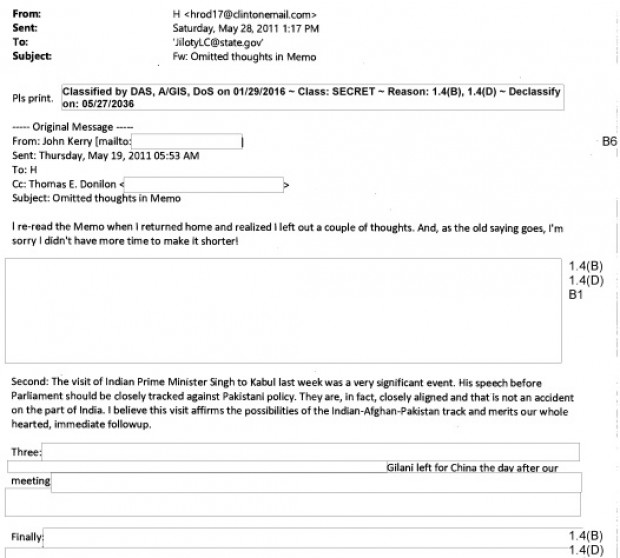
 Ross/DailyCaller: Emails released by the State Department on Friday show that in 2011, then-Massachusetts Sen. John Kerry sent then-Sec. of State Hillary Clinton an email from his iPad that has been deemed to contain information classified as “Secret.”While previous releases of Clinton’s emails have shown that she and her staff communicated directly with Kerry when he was a senator, the new email is the first from Kerry that the State Department has determined contains sensitive information.

Kerry has largely been silent throughout the Clinton email controversy. He has sent letters asking the State Department’s inspector general to review the agency’s records keeping practices, but he has not publicly criticized Clinton for exclusively using a personal email account and a home-brew email server.

Perhaps now we know why.

In the heavily-redacted email, dated May 19, 2011, Kerry, who then chaired the Senate Foreign Relations Committee, appears to be discussing negotiations between India and Pakistan. Besides Clinton, the email was sent to Tom Donilon, who then served as President Obama’s National Security Advisor.

kerryemail

Clinton forwarded the email to an aide, instructing her to “Pls print” the document.

The redactions in the email are listed under the Freedom of Information Act exemptions 1.4(b) and 1.4(d), which are categories reserved for information gleaned from foreign government sources.

The kicker is that Kerry sent Clinton the information from his iPad, a communications device that would have been much more vulnerable to hackers than an encrypted communications system.

According to the Republican National Committee, which flagged the Kerry email in an email to reporters, the batch of Clinton records released on Friday contained 11 emails that the State Department now says contain “Secret” information. That’s more than double the number of emails that contained similarly classified information released in all of the previous releases combined.

According to the RNC’s calculations, 243 emails released Friday were classified at some level, bringing the overall number of classified Clinton emails to 1,583. The State Department also announced Friday that it is withholding in full and into perpetuity 22 emails that contain “Top Secret” information — the highest classification category.

The State Department says it is uncertain whether the information in those emails was classified at the time they were originated. The Intelligence Community’s inspector general has said that two separate Clinton emails were contained information that was “Top Secret” when sent. That distinction is crucial because Clinton has maintained that none of the classified emails found on her server were classified when created.

As Clinton’s successor at the State Department, Kerry has overseen the release of the work-related emails that the Democratic presidential candidate handed over in Dec. 2014. But the Democrat and his agency have been criticized by many for appearing to side with Clinton in a battle with the intelligence community over the classification status of many of her emails.

During a press conference in Canada on Friday, Kerry declined to comment on the news that the State Department was acknowledging that 22 of Clinton’s emails contain “Top Secret” information.

“I can’t speak to the specifics of anything with respect to the technicalities, the contents … because that’s not our job,” he said, according to Reuters. “We don’t know about it, it’s in other hands.”

He was not asked about his sensitive communications with Clinton.

Another question Kerry hasn’t answered is why, since he knew that Clinton used a personal email account while at the State Department, he failed to demand that she turn her emails over to the State Department until autumn 2014 after agency lawyers uncovered Clinton’s email address while reviewing documents related to the House Select Committee on Benghazi’s investigation.

It is unclear if Kerry knew about Clinton’s use of a private server, though other high-ranking State Department officials likely did. Emails obtained by The Daily Caller earlier this month show that Patrick Kennedy, the under secretary of management, was on an email chain in which Clinton’s server was being discussed.

***

It is quite likely that Barack Obama will apply ‘executive privilege’ to both Hillary Clinton and John Kerry. It can be challenged in court as was the case for the Fast and Furious documents and Eric Holder. This month, however a judge did rule that those Fast and Furious documents must be turned over the Congress.

When it comes to the definition of ‘executive privilege’ here is a short summary:


So what is executive privilege?

The president can invoke executive privilege in order to withhold some internal executive branch communications from the other branches of government. The privilege is based on the separation of powers between the branches.

Executive privilege has been invoked since the U.S.’s early days but isn’t in the Constitution. It was only in 1974, when Richard Nixon tried to prevent the release of White House tapes during the Watergate investigation, that the Supreme Court upheld its constitutionality, and set some parameters for it. The Court ruled that no claim on executive privilege is absolute, and can also be overcome if evidence is needed in a criminal trial. (For a full legal history, see this report from the Congressional Research Service.)

So what does it usually cover?

Various administrations have set their own policies as to when they can invoke the privilege. (The Washington Post has a handy timeline showing when presidents have used it.)

Bill Clinton used them a lot, 14 times during his presidency. In 1998, his attempt to keep White House aides from testifying about the Monica Lewinsky scandal was struck down, the first time since Nixon that executive privilege was overruled in court. George W. Bush invoked the privilege six times, not always successfully.

Legal challenges have established two general categories of executive privilege: presidential communications and deliberative process.

The presidential communications privilege applies to communications involving the president or his staff that immediately pertain to the president’s decision-making process. The idea, according to Mark Rozell, a professor at George Mason University, and author of a book on executive privilege, is that “the president should have the right to candid advice without fear of public disclosure.”

Deliberative process involves a broader scope of executive branch activity: discussions involving White House staff or within other agencies on legal or policy decisions that don’t necessarily involve the president or his immediate advisers. Again, the argument is that government officials need to feel like they can talk honestly. The deliberative process privilege, Rozell says, is generally easier to challenge than a claim of presidential communications privilege.