An affordable price is probably the major benefit persuading people to buy drugs at www.americanbestpills.com. The cost of medications in Canadian drugstores is considerably lower than anywhere else simply because the medications here are oriented on international customers. In many cases, you will be able to cut your costs to a great extent and probably even save up a big fortune on your prescription drugs. What's more, pharmacies of Canada offer free-of-charge shipping, which is a convenient addition to all other benefits on offer. Cheap price is especially appealing to those users who are tight on a budget
Service Quality and Reputation
Although some believe that buying online is buying a pig in the poke, it is not. Canadian online pharmacies are excellent sources of information and are open for discussions. There one can read tons of users' feedback, where they share their experience of using a particular pharmacy, say what they like or do not like about the drugs and/or service. Reputable online pharmacy canadianrxon.com take this feedback into consideration and rely on it as a kind of expert advice, which helps them constantly improve they service and ensure that their clients buy safe and effective drugs. Last, but not least is their striving to attract professional doctors. As a result, users can directly contact a qualified doctor and ask whatever questions they have about a particular drug. Most likely, a doctor will ask several questions about the condition, for which the drug is going to be used. Based on this information, he or she will advise to use or not to use this medication.
U.S. Identifies Key Player in ISIS Attacks on Europe
Frontline: Almost a year after Islamic State terrorists killed 130 people in Paris, U.S. intelligence agencies have identified one of the suspected masterminds of that plot and a follow-up attack in Brussels.
U.S. counter-terror officials said the man, who goes by the name Abu Sulaiyman al Fransi (Abu Sulaiyman, the Frenchman) is a 26-year old Moroccan who once served in Afghanistan as a soldier in the French Foreign Legion. He did prison time for drug running before going to Syria in 2014 and joining ISIS, according to U.S. officials and French court documents. His real name is Abdelilah Himich, according to U.S. counter-terror officials.
Despite his relative youth, Himich’s military experience and knowledge of France have made him a key figure in the Islamic State’s external operations unit, which has led a terror campaign against Europe, officials said. He is thought to be in Syria.
“We believe he is one of the top guys involved in spearheading the Paris attack and the Brussels attacks,” a U.S. counter-terror official said. “He was involved in creating that infrastructure” of the external operations unit.
U.S. and European counter-terror officials were interviewed for this story as part of a report by ProPublica and FRONTLINE about terrorism in Europe.
Officials acknowledged that they have struggled to pin down details about the identities and activities of the ISIS planners. U.S. and European counter-terror officials note that several Islamic State fighters have used the nom de guerre Abu Sulaiyman al Fransi. (The nickname is spelled in a number of ways, U.S. officials say.) In the past, he has variously been described by European officials and media reports as a blond convert and a former physical education teacher.
But U.S. officials said there was strong evidence indicating that the senior French fighter in question is Himich. They said French intelligence has been informed of that assessment and agrees with it.
European counter-terror officials interviewed by ProPublica earlier this year said they also suspect that a militant known as Abu Sulaiyman the Frenchman helped to plan the Paris and Brussels attacks. But they did not disclose his full identity.
Officials said that months of investigations and intelligence work in Europe and the Middle East have begun to shed light on the command structure of what the Islamic State calls external operations. The predominantly Arab leaders of ISIS have given senior and mid-level European fighters considerable autonomy to select targets and decide details of plots in their home turf, according to Western counter-terror officials.
Nonetheless, the ISIS unit that plots attacks overseas is also quite bureaucratized, according to U.S. intelligence officials. The unit exerted increasingly direct control over plots in Europe starting in 2015, according to Western counter-terror officials, and is part of an ISIS intelligence structure known as the Enmi.
“ISIS-directed plots in Europe have usually involved several planners and organizers who might change for each project,” said Jean-Charles Brisard, the chairman of the Center for the Analysis of Terrorism in Paris, who has been studying the unit. “It’s more a team process than a single mastermind’s plan.”
Abu Mohamed al-Adnani, a Syrian who served as a spokesman for the Islamic State, was a top figure overseeing external operations, counter-terror officials say. A U.S. drone strike killed Adnani in August.
There is hard evidence that another ISIS militant in Syria, a man known as Abu Ahmad, played a hands-on role in the Paris and Brussels cases, according to European counter-terror officials. A laptop computer recovered by Belgian police after the Brussels bombings in March contained encrypted communications detailing Abu Ahmad’s direct role in the plot.
During the four months after the Paris attacks, Abu Ahmad discussed targets, strategy and bomb-making techniques from Syria via encrypted channels with survivors of the terrorist cell who were hiding in Brussels. The fugitive suspects referred to Abu Ahmad as their “emir,” or leader, according to Belgian counter-terror officials.
The communications in the laptop indicate that the original plan was to hit France again, European officials say. When Belgian police closed in, however, Abu Ahmad told the fugitives to strike in Brussels instead, officials said. The suicide bombings killed 32 people at the airport and a subway station on March 22.
Abu Ahmad was described by two captured ISIS fighters as a lead planner of the Paris massacre as well. The suspects, an Algerian and a Pakistani, told interrogators that Abu Ahmad chose and prepared them for the plot last fall, and sent them to Europe posing as Syrian refugees, according to European counter-terror officials.
When the two landed in Greece in October, however, Greek border guards discovered they were not Syrian, and held them for a few weeks, according to European and U.S. counter-terror officials. After being released, the duo communicated with Abu Ahmad, who sent them money and instructions not to join the rest of the attackers, according to officials. The two suspects were arrested in Austria in December.
The men described Abu Ahmad as a Syrian, according to European counter-terror officials. But the recovered clandestine communications with the plotters in Europe indicate clearly that he speaks French, raising questions about his true nationality, the officials said.
“He has to be French, or speak French well,” a European counter-terror official said. “They use French slang.”
The investigation shows that Abu Ahmad worked with the senior fighter known as Abu Sulaiyman al Fransi, according to European and U.S. counter-terror officials. During the massacre at the Bataclan concert hall in Paris, witnesses overheard gunmen talk to each other about calling a person named Abu Sulaiyman, according to European and U.S. officials.
Himich, the man identified by U.S. intelligence as Abu Sulaiyman, has an unusual story. He was born in Rabat, Morocco, in 1989, according to U.S. counter-terror officials and French court documents. His family emigrated when he was an adolescent to Lunel, a southern French town about 20 miles from Montpellier, officials say.
Lunel has a population of about 25,000 and a rich history as a Jewish cultural center in medieval times. The town has a large population of Muslim descent as the result of immigration from North Africa beginning in the 1960s.
In 2006, Himich’s name appeared in a Lunel high school newspaper as the author of an article about teenage drinking. Although he went to school in France, he remains a Moroccan citizen, according to officials and court documents. In 2008, he joined the French Foreign Legion, a legendary and hard-nosed force whose soldiers come from all over the world.
Himich “distinguished himself during various missions in Afghanistan,” according to the court documents. In 2010, however, he deserted, according to the officials and documents.
“Wanting to attend the burial of his father, he left his post without authorization,” the documents say. “After his return to France, he did vocational training to work in the security field and also considered becoming a nurse.”
A year later, he got in trouble with the law. French customs police intercepted him arriving on a train from Amsterdam at the Gare du Nord station in Paris on Dec. 13, 2011, according to court documents. Police discovered he was carrying a backpack containing 2.6 pounds of cocaine with a street value of about $55,000. He also tested positive for cocaine and marijuana.
Himich testified that he had met a Senegalese man at a hookah bar in Paris, and told him he needed money because he had left the Foreign Legion. Himich said the man hired him to bring a package from Rotterdam, offering to pay $1,600. Himich, whom the documents describe as “adopting an arrogant attitude” during a court hearing, denied knowing that the package contained drugs.
Himich spent five months in jail. He was convicted in April 2013, and sentenced to three years in prison with a year suspended, according to the documents, though it appears he did not spend much more time behind bars. It was his first criminal conviction. He appears to have followed a classic trajectory from crime into radicalization.
Despite its picturesque setting, Lunel has made headlines as a hub of extremism. By 2015, at least two dozen young people — of North African descent as well as Muslim converts — had left Lunel to fight in Syria, where at least six of them died.
Himich joined that exodus in early 2014, according to U.S. counter-terror officials. He rented a car and drove via Italy, Greece and Turkey to Syria, according to Brisard. That route is popular with Syria-bound jihadis who travel with their families, according to Italian police. Himich has a wife and two children, officials said.
In Syria, Himich first fought in an Al Qaeda-linked group, officials say. Then, like many extremists in Syria, he moved to the increasingly powerful Islamic State. He soon became a battlefield commander, according to U.S. officials and Brisard, the French counter-terror expert.
“He was quickly promoted by ISIS to lead one of its fighting brigades in the first half of 2014,” Brisard said. “His rapid rise within ISIS could be explained by his military service in the French Foreign Legion.”
France and Interpol have issued warrants for Himich’s arrest on suspicion of terrorist activity, according to U.S. officials.
Investigators believe Himich is among a group of ISIS militants in their 20s and 30s, predominantly Francophones, who plot against Europe. The group also includes two Muslim convert brothers from Toulouse, Fabien and Jean-Michel Clain, according to counter-terror officials. Fabien Clain is believed to be the Frenchman who read the official statement in which the Islamic State claimed responsibility for the Paris attacks, officials say.
The Clain brothers surfaced in an investigation in 2009 of a French-Belgian extremist network. Suspects in that case had been investigated for a bombing in Cairo and, according to investigators, told Egyptian interrogators they had discussed a potential attack on the Bataclan, the nightclub that was hit in 2015. The suspects allegedly saw the Paris concert hall as a Jewish target because the owners were Jewish and the venue had hosted pro-Israel events.
Given his military experience, Himich’s stature is likely to grow after the recent deaths of Islamic State leaders in U.S. air strikes, officials said.
“He’s probably one of the most important Frenchmen in ISIS, especially after the death of Adnani,” the U.S. counter-terror official said.
Those who donated to the NRSC between March 16 and October 5, 2016, conducted their transaction on a platform that was compromised by malicious code designed to steal credit card details and personal information. The NRSC quietly corrected the problem sometime around October 6, 2016.
The hacked storefront, which powers the NRSC donation system, was discovered by Willem de Groot – a Dutch developer who discovered thousands of compromised websites running vulnerable versions of the Magento e-commerce platform.
The compromised NRSC transactions included the donor’s first name, last name, email address, billing details (address, city, state, and zip code), employer details, occupation, card type, card number, card expiration, and security code.
Once the data was collected by the malicious code, the compromised transactions were then sent to one of two different domains.
Earlier this year, the criminals responsible for skimming the card data were using jquery-cloud[.]net to receive the compromised records. Later, the code on the NRSC website was altered to send skimmed transactions to jquery-code[.]su.
The malicious .su domain is still operational, and it’s hosted on a network (Dataflow) with some suspicious, if not outright criminal clients – including those that deal with drugs, money laundering, Phishing, and spam.
It isn’t clear who is behind the attack, as anyone can register a domain and obtain hosting. One interesting observation made by de Groot during his research, was that Dataflow and jquery-cloud[.]net came online together during the same week in November of 2015.
As mentioned, once the issue became public earlier this month, the NRSC quietly replaced the compromised storefront with a new one powered by WordPress.
Salted Hash attempted to reach out to the NRSC over the weekend, but the committee hasn’t responded to queries. As of October 17, the NRSC website makes no mention of the new storefront, or the compromised e-commerce platform.
Unfortunately, this means GOP supporters who had their credit card information compromised could be caught by surprise once their accounts show signs of fraudulent activity, and left completely unaware of the problem’s root cause.
During his research, de Groot determined that more than 5,400 storefronts were compromised by the same type of malicious code used on the NRSC domain. So far, he has discovered nine variants of the skimming code, suggesting that multiple people (or groups) are involved.
When de Groot reached out to victims, in an attempt to alert them about their compromised domains, many of the website owners failed to understand the full impact of the situation.
Some responded to the warnings by arguing to de Groot that the code added by the criminals didn’t matter because – “our payments are handled by a 3rd party payment provider” or “our shop is safe because we use HTTPS.”
Those responding like this are missing the bigger point; if the code running the payment processing system is compromised, 3rd-party processing and HTTPS will not prevent a criminal from obtaining your card data or personal information.
SAN FRANCISCO — On the morning of March 10, nine days after Hillary Clinton had won big on Super Tuesday and all but clinched the Democratic nomination, a series of emails were sent to the most senior members of her campaign.
At a glance, they looked like a standard message from Google, asking that users click a link to review recent suspicious activity on their Gmail accounts. Clicking on them would lead to a page that looked nearly identical to Gmail’s password reset page with a prompt to sign in. Unless they were looking closely at the URL in their address bar, there was very little to set off alarm bells.
From the moment those emails were opened, senior members in Clinton’s campaign were falling into a trap set by one of the most aggressive and notorious groups of hackers working on behalf of the Russian state. The same group would shortly target the Democratic National Committee (DNC) and Democratic Congressional Campaign Committee (DCCC). It was an orchestrated attack that — in the midst of one of the most surreal US presidential races in recent memory — sought to influence and sow chaos on Election Day.
The hack first came to light on June 15, when the Washington Post published a story based on a report by the CrowdStrike cybersecurity firm alleging that a group of Russian hackers had breached the email servers of the DNC. Countries have spied on one another’s online communications in the midst of an election season for as long as spies could be taught to use computers — but what happened next, the mass leaking of emails that sought to embarrass and ultimately derail a nominee for president, had no precedent in the United States. Thousands of emails — some embarrassing, others punishing— were available for public perusal while the Republican nominee for president, Donald Trump, congratulated Russia on the hack and invited it to keep going to “find the 30,000 emails that are missing” from Clinton’s private email server. It was an attack that would edge the US and Russia closer to the brink of a cyberwar that has been simmering for the better part of a decade.
The group behind the hacks is known as Fancy Bear, or APT 28, or Tsar Team, or a dozen other names that have been given to them over the years by cybersecurity researchers. Despite being one of the most reported-on groups of hackers active on the internet today, there is very little researchers can say with absolute certainty. No one knows, for instance, how many hackers are working regularly within Fancy Bear, or how they organize their hacking squads. They don’t know if they are based in one city or scattered in various locations across Russia. They don’t even know what they call themselves.
The group is, according to a White House statement last week, receiving their orders from the highest echelons of the Russian government and their actions “are intended to interfere with the US election process.” For the cybersecurity companies and academic researchers who have followed Fancy Bear’s activities online for years, the hacking and subsequent leaking of Clinton’s emails, as well as those of the DNC and DCCC, were the most recent — and most ambitious — in a long series of cyber-espionage and disinformation campaigns. From its earliest-known activities, in the country of Georgia in 2009, to the hacking of the DNC and Clinton in 2016, Fancy Bear has quickly gained a reputation for its high-profile, political targets.
“Fancy Bear is Russia, or at least a branch of the Russian government, taking the gloves off,” said one official in the Department of Defense. “It’s unlike anything else we’ve seen, and so we are struggling with writing a new playbook to respond.” The official would speak only on condition of anonymity, as his office had been barred from discussing with the press the US response to Fancy Bear’s attacks. “If Fancy Bear were a kid in the playground, it would be the kid stealing all the juice out of your lunch box and then drinking it in front of you, daring you to let him get away with it.”
For a long time, they did get away with it. Fancy Bear’s earliest targets in Georgia, Ukraine, Poland, and Syria meant that few in the US were paying attention. But those attacks were where Fancy Bear honed their tactics — going after political targets and then using the embarrassing or strategic information to their advantage. It was in those earliest attacks, researchers say, that Fancy Bear learned to couple their talent for hacking with a disinformation campaign that would one day see them try to disrupt US elections.
“If Fancy Bear were a kid in the playground, it would be the kid stealing all the juice out of your lunch box and then drinking it in front of you, daring you to let him get away with it.”
ID: 9797661
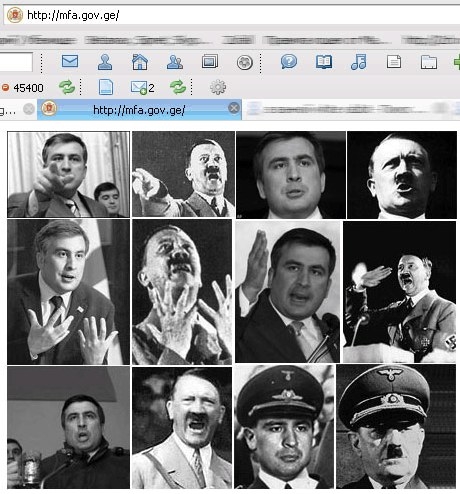
In late July 2008, three weeks before Russia invaded Georgia in a show of force that altered the world’s perception of the Kremlin, a network of zombie computers was already gearing up for an attack against the Georgian government. Many of the earliest attacks were straightforward — the website of then-President Mikheil Saakashvili was overloaded with traffic, and a number of news agencies found their sites hacked. By Aug. 9, with the war underway, much of Georgia’s internet traffic, which routes through Russia and Turkey, was being blocked or diverted, and the president’s website had been defaced with images comparing him to Adolf Hitler.
Sophos Secruity
ID: 9797639
It was one of the earliest cases of cyberwarfare coinciding with a real-world physical war, and Fancy Bear, say researchers, was one of the groups behind it.
“When this group first sprung into action, we weren’t necessarily paying attention to the various Russian threat actors, inasmuch as we weren’t distinguishing them from each other,” said one former cybersecurity researcher, who has since left the private sector to work for the Pentagon. He said he could not be quoted on record due to his current job, but that in 2010, when he was still employed with a private company, they had only just started to distinguish Fancy Bear from the rest of the cyber operations being run by the Russian government.
Kurt Baumgartner, a researcher with the Moscow-based Kaspersky cybersecurity company, said the group had the types of financial and technical resources that only nation-states can afford. They would “burn through zero days” said Baumgartner, referring to rare, previously unknown bugs that can be exploited to hack into systems. The group used sophisticated malware, such as Sourface, a program discovered and named by the California-based FireEye cybersecurity company, which creeps onto a computer and downloads malware allowing that computer to be controlled remotely. Other programs attributed to Fancy Bear gave them the ability to wipe or create files, and to erase their footsteps behind them. FireEye researchers wrote that clues left behind, including metadata in the malware, show that the language settings are in Russian, that the malware itself was built during the workday in Moscow and St. Petersburg, and that IP addresses used in attacks could be traced back to Russian sources.
It wasn’t surprising to cybersecurity experts at that time that Russia would be at the forefront of a cyberattack on a nation-state. Along with China, the US, and Israel, Russia was considered to have one of the most sophisticated cyber-offensive capabilities in the world. While China appeared to have its offensive cyber teams largely organized within its military, the US under the NSA, and Israel under Unit 8200, much of Russia’s cyber operations remained obscure.
There are reports from inside Russia that have helped draw a better picture of Russia’s cyber ops. Russian investigative journalists, like Andrei Soldatov, author of The Red Web, have reported on how, following the dismantling of the KGB, Russia’s cyber operations were organized under the FSB, the KGB’s main successor agency. It was a unit operating under the FSB, for instance, that US intelligence officials believe was responsible for years-long cyber-espionage operations into the White House and State Department, discovered in the summer of 2015. At some point, Russia’s main foreign intelligence agency, the GRU, began its own cyber ops. Soldatov said it’s not clear exactly when that happened — though he says it was likely around the time of the war with Georgia — but Fancy Bear is the name given to the most notorious, and apparently prolific, group of hackers working under the GRU.
“Russia’s intelligence agency operates differently. You won’t see officers [in] uniform and hacking into infrastructure. They embed people in various infrastructure places, like ISPs, or power companies,” said Vitali Kremez, a cybercrime intelligence researcher with the Flashpoint cybersecurity firm. “To orchestrate the DNC hack wouldn’t require dozens of people, it would take two or three people, even one person, if he was talented enough. That person would have his orders for that part of the operation, and someone else, somewhere else, might have orders for a different part.”
For years, cybersecurity companies wrote up reports about Fancy Bear, often adding only in the postscript that the group they were talking about was working on behalf of Russia’s GRU. It wasn’t until last week that the US government officially named them as being tied to the highest echelons of Russia’s government.
“What first caught our attention about Fancy Bear was the targets it went after,” the Pentagon researcher said. “This was a group interested in high-stakes targets, and given who they were after — Georgia, Poland, Russian dissidents — it seemed obvious that a Russian government agency would be after those targets.”
In the years following Georgia, the targets that Fancy Bear went after grew in size, sophistication, and scope. One report, by Germany’s intelligence agency BfV, categorized the group as engaging in “hybrid warfare,” meaning a mix of conventional warfare and cyberwarfare. It gave the example of a Dec. 23, 2015, attack on Ukraine’s power grid that left more than 230,000 people without power, and said that Fancy Bear had also tried to lure German state organizations, including the Parliament and Angela Merkel’s CDU party, into installing malware on their systems that would have given the hackers direct access to German government systems. It’s unclear if anyone opened the emails that installed the malware.
The BfV report concluded that these “cyberattacks carried out by Russian secret services are part of multiyear international operations that are aimed at obtaining strategic information.” It was the first time a government had publicly named Fancy Bear as a Russian cyber operation. And there was one attack, on a French TV station, that cybersecurity researchers say was a precursor of things yet to come.
BuzzFeed News; Getty
ID: 9797703
It was just past 10 p.m. on April 8, 2015, when the French television network TV5Monde suddenly began to broadcast ISIS slogans, while its Facebook page started to post warnings: “Soldiers of France, stay away from the Islamic State! You have the chance to save your families, take advantage of it,” read one message. “The CyberCaliphate continues its cyberjihad against the enemies of Islamic State.”
The posts prompted headlines around the world declaring that the ISIS hacking division, known as the “cyber caliphate,” had successfully hacked into the French television network and taken over the broadcast.
It took nearly a month for cybersecurity companies investigating the attack to determine that it had, in actuality, been carried out by Fancy Bear. One of the companies, FireEye, told BuzzFeed News that they had traced the attack back to the group by looking at the IP addresses used to attack the station, and comparing them to IP addresses used in previous attacks carried out by Fancy Bear. The ISIS claims of responsibility planted on TV5Monde were just a disinformation campaign launched by the Russians to create public hysteria over the prospect of a terror group launching a cyberattack.
“Russia has a long history of using information operations to sow disinformation and discord, and to confuse the situation in a way that could benefit them,” Jen Weedon, a researcher at FireEye told BuzzFeed News following the attack. “In this case, it’s possible that the ISIS cyber caliphate could be a distraction. This could be a touch run to see if they could pull off a coordinated attack on a media outlet that resulted in stopping broadcasts, and stopping news dissemination.”
For nearly a month, headlines in France and across Europe had speculated about ISIS’ cyber capabilities and motives for the attack on TV5Monde. The stories setting the record straight, and reporting that a Russian group had, in fact, launched the attack, ran in a handful of newspapers for a day or two after the discovery.
At the same time, Fancy Bear was running other experiments, including a campaign to harass British journalist Eliot Higgins, and his citizen journalist website, Bellingcat. Higgins, who had published a number of articles documenting Russia’s alleged involvement in the shooting down of a Malaysian jetliner over Ukraine and the Russian shelling of military positions in eastern Ukraine, suddenly received an onslaught of spear-phishing emails. It wasn’t until this year, when Higgins saw a report by the ThreatConnect cybersecurity company on the DNC hacks that he realized that the emails targeting his site might have been similar to those targeting the DNC. He forwarded the spear-phishing emails to ThreatConnect, which confirmed that he, as well, had been targeted by Fancy Bear.
“I think it is possible that the things we were reporting on caught the eye of the hackers,” said Higgins. “More than anything it’s a badge of honor if they are going through so much effort to attack us. We must be getting something right.”
Russian media outlets, including Kremlin-owned Sputnik and Russia Today, have run articles suggesting that Bellingcat is linked to the CIA. The Bellingcat website has been defaced with personal photos of a contributor and his girlfriend.
“I think they are worried,” Higgins said. “So they are trying to discredit us.” He said it surprised him that the spear-phishing emails that targeted him and his campaign followed — almost to a formula — those sent to the DNC. The hackers didn’t bother to change the IP address, URL service, or fake Gmail message they used on either his website or the DNC. It was almost, he said, as if they didn’t mind being traced. “They have a government backing them that doesn’t care about taking down airliners, and bombing civilians in Syria so maybe they don’t care about being caught.”
Both Bellingcat and TV5Monde were, researchers now say, practice runs for Fancy Bear on the use of disinformation campaigns. People would remember a story about a ISIS-led cyberattack on France far more than a story pointing out that it was actually the Russians. Bellingcat’s work on exposing Russian operations would forever be linked, at least in the Russian media, to the accusations that they were CIA operatives. Fancy Bear was honing its skills.
The emails that Higgins, Clinton and the rest of the DNC received were variations of the millions of spear-phishing emails that go out each day. The success of those emails is predicated on the idea that everyone, no matter how savvy or suspicious, will eventually succumb to a spear-phishing attempt given enough time and effort by the attackers.
While Fancy Bear has used sophisticated — and expensive — malware during its operations, its first and most commonly used tactic has been a simple spear-phishing email, or a malicious email engineered to look like it was coming from a trusted source.
“These hacks almost always start with spear-phishing emails, because why would you start with something more complex when something so simple and easy to execute works?” said Anup Ghosh, CEO of the Invincea cybersecurity firm, which has studied the malware found on the DNC systems. “It is the easiest way to get malware onto a machine, just having the person click a link or open an executable file and they have opened the front door for you. Our analysis is on the malware itself, which had remote command and control capabilities. They essentially got the DNC to download malware which let them remotely control their computers.”
Once a spear-phishing email is clicked on, users not only give up their passwords but, in many cases, including in the case of the DNC, download malware onto their computers that gives the attackers instant access to their entire systems.
Cybersecurity experts report that 50% of people will click on a spear-phishing email. In the case of the Democratic Party, Fancy Bear’s success rate was about half of that — but good enough to get them into the accounts of some of the most senior members of the party.
From March 10, 2016, emails appearing to come from Google were sent to 108 members of Democratic presidential nominee Hillary Clinton’s campaign, and another 20 people from the Democratic National Convention (DNC), according to research published by the cybersecurity firm SecureWorks. They found the emails by tracing the malicious URLs set up by Fancy Bear using Bitly, the same service used to target Bellingcat. Fancy Bear had set the URL they sent out to read accounts-google.com, rather than the official Google URL, accounts.google.com. Dozens of people were fooled.
“They did a great job with capturing the look and feel of Google”
ID: 9797677
“We were monitoring bit.ly and saw the accounts being created in real time,” said Phil Burdette, a senior security researcher at SecureWorks, explaining how they stumbled upon the URLs set up by Fancy Bear. Bitly also keeps data on when a link is clicked, which allowed Burdette to determine that of the 108 email addresses targeted at the Clinton campaign, 20 people clicked on the links (at least four people clicked the link more than once). At the DNC, 16 email addresses were targeted, and 4 people clicked on them.
“They did a great job with capturing the look and feel of Google,” said Burdette, who added that unless a person was paying clear attention to the URL or noticed that the site was not HTTPS secure, they would likely not notice the difference.
Once Democratic Party officials entered their information into the fake Gmail page, Fancy Bear had access to not just their email accounts, but to the shared calendars, documents, and spreadsheets on their Google Drive. Among those targeted, said Burdette, were Clinton’s national political director, finance director, director of strategic communications, and press secretary. None of Clinton’s staff responded to repeated requests for comment from BuzzFeed News.
In their June 14 report, CrowdStrike found that not only was Fancy Bear in the DNC system, but that another group linked to Russia known as Cozy Bear, or APT 29, had also hacked into the DNC and was lurking in the system, collecting information. The report stated, “Both adversaries engage in extensive political and economic espionage for the benefit of the government of the Russian Federation and are believed to be closely linked to the Russian government’s powerful and highly capable intelligence services.”
The linked names, say the cybersecurity researchers who come up with them according to their own personal whims, are no coincidence. While both bears sought out intelligence targets and infiltrated government agencies across the world, their styles were distinct. Cozy Bear would go after targets en masse, spear-phishing an entire wing at the State Department or White House and then lurking quietly in the system for years. Fancy Bear, meanwhile, would be more specific in its targets, aggressively going after a single person by mining social media for details of their personal lives.
Both bears were in the DNC system, but whereas Cozy Bear might have been there for years, undetected in the background, CrowdStrike has said that it was Fancy Bear, with their more aggressive intelligence-gathering operation, that tipped off security teams that something was amiss. It was also Fancy Bear, cybersecurity researchers believe, who was behind the disinformation campaigns that made public the thousands of emails from the DNC and Clinton.
Making those emails public, say cybersecurity experts and US intelligence officials, is what shifted the hack from another Russian cyber-espionage operation to a game changer in the long-simmering US–Russia cyberwar. Using the well-established WikiLeaks platform, as well as newly invented figureheads, ensured that the leaked emails got maximum exposure. Within 24 hours of the CrowdStrike report, a Twitter account under the name @Guccifer_2 was established and began tweeting about the hack on the DNC. One of the first tweets claimed responsibility for hacking the DNC’s servers, and in subsequent private messages with journalists, including BuzzFeed News, the account claimed that it was run by a lone Romanian hacker, and that he alone had been responsible for hacking into the DNC servers and, later, the Clinton Foundation, as well as senior members of Clinton’s staff. The account offered to send BuzzFeed News emails from the hacks and appeared to make the same offer to several US publications, including Gawker and the Smoking Gun.
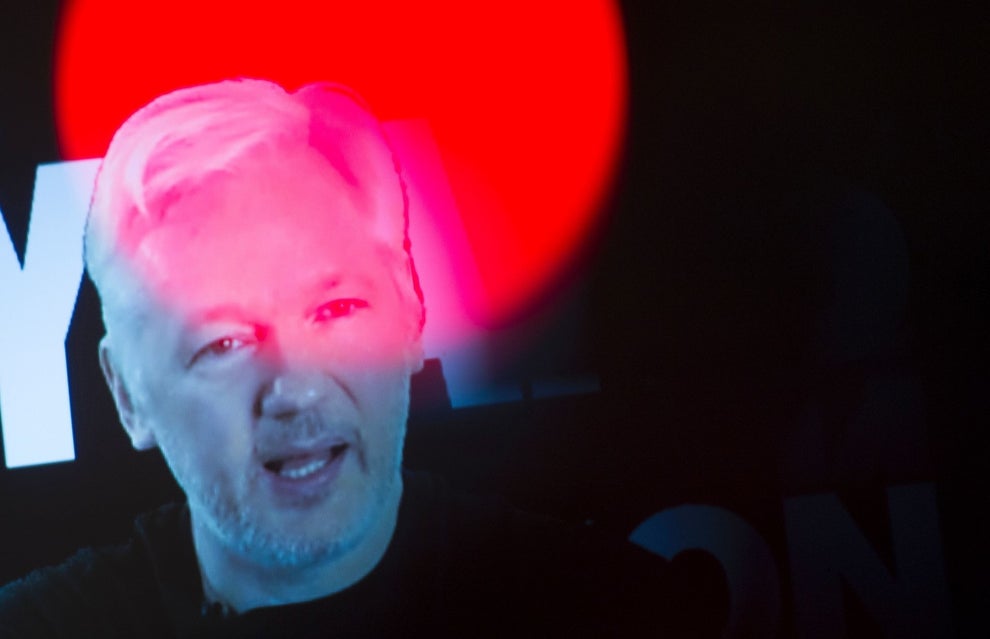
Julian Assange, founder of the online leaking platform WikiLeaks Steffi Loos / AFP / Getty Images
ID: 9797668
Within the week, WikiLeaks had published more than 19,000 DNC emails. Though WikiLeaks would not reveal the source, Guccifer 2.0 gleefully messaged journalists that he had been the source of the leak. Few bought the story — a language analysis on the Guccifer 2.0 account showed it made mistakes typical of Russian speakers, and when asked questions in Romanian by reporters in an online chat, Guccifer 2.0 appeared to not be able to answer. Meanwhile, metadata in the docs, such as Russian-language settings and software versions popular in Russia, led cybersecurity experts to believe that not only were the emails leaked by Russia, but that Guccifer 2.0 was an account created by the Russian state to try and deflect attention.
The same week, a site calling itself DCLeaks suddenly appeared, claiming it was run by “American hacktivists,” and began publishing hacked emails as well.
US intelligence agencies now believe that Guccifer 2.0 and DCLeaks were created by Fancy Bear, or a Russian organization working in conjunction with Fancy Bear, in order to disseminate the hacked emails and launch a disinformation campaign about their origin. WikiLeaks, whose founder Julian Assange has been dogged by his own accusations of close ties to Russia, has refused to state how he got the emails.
“We hope to be publishing every week for the next 10 weeks, we have on schedule, and it’s a very hard schedule, all the US election-related documents to come out before Nov. 8,” Assange said in a recent press conference.
Just weeks before Americans go to the polls, no one knows what material is yet to be published.
ID: 9797650
In a background briefing earlier this year, one US intelligence officer described cyberwar as “a war with no borders, no innocents, and no rules.” The officer, who has been working on US cyberpolicy for over a decade, said he didn’t think it was a question of if the US and Russia would one day be fighting a full-out cyberwar — it was a question of when.
“They’ve been dancing around each other like two hungry bears for a long time. At some point, one of them is going to take a bite,” said the officer. (His use of the word “bears” appeared to be coincidental.)
The White House’s naming of the Russian government as being behind the hacks attributed to Fancy Bear took the US and Russia into uncharted territory. While no one used the word cyberwar, the statement by the Department of Homeland Security and Director of National Intelligence did not mince words.
“The U.S. Intelligence Community (USIC) is confident that the Russian Government directed the recent compromises of e-mails from US persons and institutions, including from US political organizations. The recent disclosures of alleged hacked e-mails on sites like DCLeaks.com and WikiLeaks and by the Guccifer 2.0 online persona are consistent with the methods and motivations of Russian-directed efforts. These thefts and disclosures are intended to interfere with the US election process,” the statement read. “We believe, based on the scope and sensitivity of these efforts, that only Russia’s senior-most officials could have authorized these activities.”
Russian President Vladimir Putin has continued to deny Russia’s involvement in the hacks and said the leaked emails are a “public service.” In a televised address this week, Putin said the hacks were not in Russia’s interest.
Russian President Vladimir Putin Sputnik / Reuters
ID: 9797675
“There’s nothing in Russia’s interest here; the hysteria has been created only to distract the American people from the main point of what was revealed by hackers. And the main point is that public opinion was manipulated. But no one talks about this. Is it really important who did this? What is inside this information — that is what important,” Putin said.
The US is still “writing the playbook,” as one Department of Defense official put it, on what happens next, though sanctions, diplomatic action, and offensive cyberattacks are all being considered. Members of Congress have come forward, asking the White House to take aggressive action against Russia. The two countries are, undoubtedly, facing the lowest point in relations in decades.
Fancy Bear and other Russian hacking groups are still active. As countries in Europe — including France, the UK, and Germany — face upcoming elections, what is to stop Fancy Bear from engaging in the same type of hacking and disinformation campaigns?
“They did this to the United States — there is nothing to stop them from doing this to our allies in Europe,” said Jason Healey, former White House director of cyber infrastructure, and a senior research scholar at Columbia University’s School of International and Public Affairs. “We need to be working with our allies and sharing what we know so that this group doesn’t interfere with elections across Europe.”
Baumgartner, the researcher with Kaspersky, said he’s noticed big changes with Fancy Bear. They appear to be spreading out their operations and focus, he said.
“What used to be one focused and narrow group is now several subgroups,” he said. “They might be running independent of each other, or in parallel, but they seem to be spreading out operations.”
Higgins, who runs the Bellingcat website, said that after a lull of almost a year, he suddenly started getting spear-phishing emails again this week that look identical to the ones Fancy Bear hackers sent him last year.
“They’re sending them every day again,” said Higgins. “They are clearly not going to stop.”
CORRECTION
The Bellingcat website was defaced by photos of one of its contributors. The original version of this story stated that it was defaced with photos of its founder, Higgins.
Russia recently held defense drills for 40 million citizens in apparent preparation for an all-out nuclear war.
“And earlier this month, Putin’s ministers announced they had built bunkers capable of housing Moscow’s 14 million people.
****
The Ministry of Defense of the Russian Federation has stated that it is considering the return of Russian military bases to Cuba and Vietnam. Judging by everything, this information slipped through the cracks into the public space by accident, as most officials now prefer to either remain silent or answer evasively in the face of reporters’ questions. For a list of targeted Russian bases globally, click here.
Russia orders all officials to fly home any relatives living abroad, as tensions mount over the prospect of a global war
DailyMail: Russia is ordering all of its officials to fly home any relatives living abroad amid heightened tensions over the prospect of global war, it has been claimed.
Politicians and high-ranking figures are said to have received a warning from president Vladimir Putin to bring their loved-ones home to the ‘Motherland’, according to local media.
It comes after Putin cancelled a planned visit to France amid a furious row over Moscow’s role in the Syrian conflict and just days after it emerged the Kremlin had moved nuclear-capable missiles near to the Polish border.
Former Soviet leader Mikhail Gorbachev has also warned that the world is at a ‘dangerous point’ due to rising tensions between Russia and the US.
According to the Russian site Znak.com, administration staff, regional administrators, lawmakers of all levels and employees of public corporations have been ordered to take their children out of foreign schools immediately.
Failure to act will see officials jeopardising their chances of promotion, local media has reported.
The exact reason for the order is not yet clear.
But Russian political analyst Stanislav Belkovsky is quoted by the Daily Star as saying: ‘This is all part of the package of measures to prepare elites to some ‘big war’.’
Relations between Russia and the US are at their lowest since the Cold War and have soured in recent days after Washington pulled the plug on Syria talks and accused Russia of hacking attacks
The Kremlin has also suspended a series of nuclear pacts, including a symbolic cooperation deal to cut stocks of weapons-grade plutonium.
Just days ago, it was reported that Russia had moved nuclear-capable missiles near to the Polish border as tensions escalated between the world’s largest nation and the West.
The Iskander missiles sent to Kaliningrad, a Russian enclave on the Baltic Sea between Nato members Poland and Lithuania, are now within range of major Western cities including Berlin.
Polish officials – whose capital Warsaw is potentially threatened – have described the move as of the ‘highest concern’.
RUSSIA TESTS BALLISTIC MISSILES AS TENSIONS BUILD
Russia’s military conducted a series of intercontinental ballistic missile tests on Wednesday, the latest flexing of its muscles as tensions with the US spike over Syria.
Russian forces fired a nuclear-capable rocket from a Pacific Fleet submarine in the Sea of Okhotsk north of Japan, state-run RIA Novosti reported.
A Topol missile was shot off from a submarine in the Barents Sea, and a third was launched from an inland site in the north-west of the vast country, Russian agencies reported.
The latest display of might by Moscow – which has been conducting regular military drills since ties with the West slumped in 2014 over Ukraine – comes as tensions have shot up in recent days.
Russia has pulled the plug on a series of deals with the US – including a symbolic disarmament pact between the two nuclear powers to dispose of weapons-grade plutonium – as Washington has halted talks on Syria.
The Kremlin has also moved an air defence missile system and missile cruisers to the war-ravaged country to bolster its forces there.
That comes as the West has accused Moscow of committing potential war crimes in its bombing of rebel-held part of the city of Aleppo in support of an assault by regime forces.
Washington has previously lashed out at Moscow for resorting to alleged “nuclear sabre-rattling” as East-West relations fell to the worst level since the Cold War following Russia’s seizure of Crimea from Ukraine in March 2014.
Putin’s decision to cancel his Paris visit came a day after French President Francois Hollande said Syrian forces had committed a ‘war crime’ in the battered city of Aleppo with the support of Russian air strikes.
Putin had been due in Paris on October 19 to inaugurate a spiritual centre at a new Russian Orthodox church near the Eiffel Tower, but Hollande had insisted his Russian counterpart also took part in talks with him about Syria.
The unprecedented cancellation of a visit so close to being finalised is a ‘serious step… reminiscent of the Cold War’, said Russian foreign policy analyst Fyodor Lukyanov.
‘This is part of the broader escalation in the tensions between Russia and the West, and Russia and NATO,’ he told AFP.
The Kremlin has also been angered over the banning of the Russian Paralympic team from the Rio Olympics amid claims of state-sponsored doping of its athletes.
Meanwhile, the top advisor to US presidential candidate Hillary Clinton has said the FBI is investigating Russia’s possible role in hacking thousands of his personal emails.
But Russian officials have vigorously rejected accusations of meddling in the US presidential elections and dismissed allegations that Moscow was behind a series of recent hacks on US institutions.
Retired Russian Lt. Gen. Evgeny Buzhinsky told the BBC: ‘Of course there is a reaction. As far as Russia sees it, as Putin sees it, it is full-scale confrontation on all fronts. If you want a confrontation, you’ll get one.
‘But it won’t be a confrontation that doesn’t harm the interests of the United States. You want a confrontation, you’ll get one everywhere.’
Earlier this week British Foreign Secretary Boris Johnson waded into the row, calling for anti-war campaigners to protest outside the Russian embassy in London.
Johnson said the ‘wells of outrage are growing exhausted’ and anti-war groups were not expressing sufficient outrage at the conflict in Aleppo.
‘Where is the Stop the War Coalition at the moment? Where are they?’ he said during a parliamentary debate.
The US has called for a war crimes investigation into Russia’s actions in Syria – saying Moscow owes the world an explanation.
Secretary of State John Kerry said Russian and Syrian strikes on hospitals “beg for an appropriate investigation of war crimes”.
He said such attacks are “way beyond” accidental at this point, and accused Moscow and Damascus of undertaking a “targeted strategy … to terrorise civilians”.
Mr Kerry, who was speaking in Washington alongside his French counterpart Jean-Marc Ayrault, said Syrian forces hit another hospital overnight, killing 20 people and wounding 100.
He was speaking as the lower house in Russia’s parliament ratified a treaty with Syria that allows the Russian military to stay indefinitely in the Middle Eastern country.
The Kremlin-controlled State Duma voted unanimously to ratify the agreement, which formalises Moscow’s military presence at the Hemeimeem air base in Latakia.
It is a show of support for the regime of Syrian President Bashar al Assad, and allows Russia to use the base free of charge and for as long as it needs.
Russia began its air campaign in Syria a year ago, reversing the tide of the nation’s five-year civil war and helping Assad’s forces win back key ground.
Moscow says its aim is to help the Syrian army fight terrorism.
**** So what does history tell us?
Soviet nuclear submarine carrying nuclear weapons sank north of Bermuda in 1986
Top Secret Minutes of Politburo discussion show Soviets learned the lessons of Chernobyl
Open U.S.-Soviet communication regarding the accident on the eve of the Reykjavik summit of Reagan and Gorbachev
Posted October 7, 2016
National Security Archive Electronic Briefing Book No. 562
Edited by Svetlana Savranskaya
For further information, contact:
Svetlana Savranskaya: 202.994.7000 and nsarchiv@gwu.edu
Position of tug Powhaten is shown to the southwest of last K-219 position. (U.S. Navy Photo)
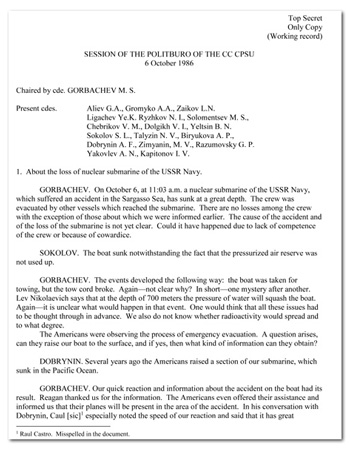
Washington D.C., October 7, 2016 -Thirty years ago, a Soviet nuclear submarine with about 30 nuclear warheads on board sank off U.S. shores north of Bermuda as Mikhail Gorbachev and Ronald Reagan were preparing for their historic summit in Reykjavik, Iceland. But instead of Chernobyl-style denials, the Soviet government reached out to the Americans, issued a public statement, and even received offers of help from Washington, according to the never-before-published transcript of that day’s Politburo session, posted today by the National Security Archive.
The submarine, designated K-219, suffered an explosion in one of its missile tubes due to the leakage of missile fuel into the tube on October 3. The 667-A project Yankee-class boat was armed with 16 torpedoes and 16 ballistic missiles. After the initial explosion, the crew members heroically put out fire and were forced to shut down the nuclear reactors manually because the command-and-control equipment had been damaged. Three crew members died in the blast and fire. Senior Seaman Sergey Preminin stayed in the reactor compartment to shut down reactors, and could not be evacuated. The rest escaped safely.
Initially, it seemed the submarine could be salvaged; it was attached to the Soviet commercial ship Krasnogvardeisk for towing. However, the tow cord broke for unknown reasons and the submarine sank. Submarine Commander Captain Second rank Igor Britanov stayed with the sub until its final moments. He initially came under investigation at home but all charges were removed in 1987. According to statements by U.S. Vice Admiral Powell Carter, the submarine did not present a danger of nuclear explosion or radioactive contamination, as was reported by the New York Times.[1]
The Politburo discussion, published in English for the first time, shows how the Soviet leadership learned the lessons of Chernobyl. The U.S. side was immediately informed about the accident on October 3. The fight for the survival of the submarine lasted three days. Gorbachev notes to his colleagues that Reagan thanked the Soviets for providing information quickly and in a transparent manner. He suggests that “it would be expedient to act in the same manner as we did the last time, i.e. to send information to the Americans, the IAEA, and TASS.” Gromyko emphasizes the need to inform Soviet citizens as well, by issuing a statement from TASS.
The Politburo also heard a report from Deputy Defense Minister Chief of Navy Admiral Vladimir Chernavin. Other members present express concerns about a possible U.S. effort to salvage parts of the submarine and gain access to design information. But Chernavin assures them that the boat design is outdated and therefore is not of any interest to the Americans. Another major concern raised is the possibility of a nuclear explosion or radioactive contamination due to water pressure at extreme depths. Chernavin cites Soviet Navy commission experts who ruled out the possibility of a nuclear detonation and concluded that contamination would happen over a long period and would not reach the surface.
This was the first time the Soviets had ever delivered a public information report immediately after an accident of this type and did not view U.S. actions in the area as a provocation. Communications between the two superpowers were therefore very constructive. Having learned how damaging to the Soviet image the secrecy surrounding the Chernobyl accident was, Gorbachev decided to truly deploy glasnost in this case. In addition to the shadow of Chernobyl, the conduct of both sides, along with the tone of the Politburo discussion, were clearly influenced by preparations for the upcoming summit, which both leaders considered a top priority.
[1] Bernard Gwertzman, “Soviet Atomic Sub Sinks in Atlantic 3 Days After Fire,” The New York Times, October 7, 1986.
FACT SHEET: Presidential Memorandum on Promoting Diversity and Inclusion in the National Security Workforce
Since the beginning of his Administration, President Obama has deepened the commitment of the United States Government to draw upon the talents and skills of all parts of our society. Diversity has always been one of the Nation’s greatest strengths, and it is no different for the Federal workforce, which has a responsibility as the country’s largest employer to lead by example and to reflect the population that we serve. Inclusion has been key to ensuring that the investments we make to develop our workforce result in a more effective and skilled government for the American people.
The imperative to promote diversity and inclusion is also critical for our national security workforce. In a complex and interconnected world, the nature of our national security challenges and opportunities is more global than ever. As a society that can trace its roots to every region around the world, the American people are our greatest asset when it comes to the United States’ ability to build bridges to communities at home and abroad, address foreign threats and aggression, and lead coalitions to promote global peace and prosperity. Promoting diversity and inclusion ensures that national security departments and agencies can recruit their employees from the broadest possible pool of talent and bring a wide range of perspectives, skills, and backgrounds to bear to tackle our toughest problems.
Today, the President is issuing a new Presidential Memorandum that provides guidance on the implementation of policies to promote diversity and inclusion in the national security workforce. Currently, more than three million military and civilian personnel in the U.S. Government are engaged in protecting the country and advancing our interests abroad, through diplomacy, development, defense, intelligence, law enforcement, and homeland security. In broad comparison with the wider Federal Government, the federal workforce dedicated to our national security and foreign policy is – on average – less diverse, including at the highest levels.
While this data does not necessarily indicate the existence of barriers to equal employment opportunity, the Presidential Memorandum outlines a number of actions that will allow departments and agencies to better leverage the diversity and inclusion of the federal workforce, consistent with the existing merit system and applicable law, including:
Collection, analysis, and dissemination of workforce data: Data is an essential tool to help departments and agencies identify workforce talent gaps, assess the efficiency and effectiveness of their diversity and inclusion efforts, and promote transparency and accountability. The memorandum provides guidance for departments and agencies to make key workforce data available to the general public, provide an annual report to their leadership and workforce on the status of diversity and inclusion efforts, expand the use of applicant flow data to assess the fairness and inclusiveness of their recruitment efforts, and identify any additional demographic categories they recommend for voluntary data collection.
Provision of professional development opportunities and tools consistent with merit system principles: Providing access to professional development opportunities consistent with merit system principles is a key element to retaining and developing a diverse and inclusive workforce. The memorandum directs departments and agencies to engage their workforce through regular interviews to understand their views on workplace policies and why they choose to stay or leave, prioritize the expansion of professional development opportunities including programs specifically designed to develop the next generation of career senior executives, and implement a review process for decisions related to certain assignment or geographic restrictions.
Strengthening of leadership engagement and accountability: The memorandum recognizes the critical role that senior leadership and supervisors play in fostering a diverse and inclusive workforce and cultivating talent consistent with merit system principles. It encourages departments and agencies to reward and recognize efforts by senior leaders and supervisors to participate in mentorship, sponsorship, and recruitment; to disseminate voluntary demographic data for external committee and boards that advise the leadership of an agency; and to expand the provision of training on implicit or unconscious bias, inclusion, and flexible work policies.
The guidance in this Presidential Memorandum furthers the initiative that President Obama announced in 2011 in Executive Order 13583, “Establishing a Coordinated Government-wide Initiative to Promote Diversity and Inclusion in the Federal Workforce,” for departments and agencies to develop and implement a more comprehensive, integrated, and strategic focus on diversity and inclusion. It also complements the remarkable progress that the national security workforce has made over the past several years in recognizing the importance of diversity and inclusion to the success of their mission, including but not limited to:
The Department of Defense’s decisions to eliminate all remaining institutional barriers to service by opening all military occupations to women and transgender individuals;
The Central Intelligence Agency’s commissioning and public release of two studies on women and diversity in their leadership and its active implementation of the studies’ recommendations;
The Office of the Director of National Intelligence release of its annual Intelligence Community demographics report, the first time it has ever been publicly released; and
The Department of Justice announced that all law enforcement agents and prosecutors will receive training to recognize and address implicit bias.
The Presidential Memorandum also aligns with a number of congressional efforts to promote the diversity of the national security workforce. Over the past several decades, Congress has passed legislation mandating reforms to ensure that institutions including the Foreign Service, Intelligence Community, and U.S. military provide equal employment opportunity to all those who have the desire and qualifications to serve their country. Under this Administration, the Congress and President Obama have collaborated on important legislation on this issue, most notably on the Don’t Ask Don’t Tell Repeal Act of 2010.