New Mexico Compound was Training for School Shooting

Timeline:

TAOS, N.M. (AP) — The Latest on 11 children found living in a filthy, makeshift compound in New Mexico (all times local):

12:30 p.m.

Prosecutors say in court documents that the father of a missing Georgia boy was training children at a New Mexico compound to commit school shootings.

The documents filed Wednesday say Siraj Ibn Wahhaj (see-DAHJ’ IBN wah-HAJ’) was conducting weapons training at the compound near the Colorado border where 11 hungry children were found in filthy conditions.

Prosecutors filed the documents while asking that Wahhaj be held without bail.

Wahhaj was arrested last week with four other adults. They are facing child abuse charges.

Authorities say the remains of a boy also were found on the compound but have not been positively identified by a medical examiners.

__

9:30 a.m.

New Mexico officials investigating a makeshift compound where 11 children were found hungry plan to ask a judge to hold the father of a missing boy without bail.

New Mexico 8th Judicial District Attorney Donald Gallegos said Tuesday that prosecutors are putting together evidence to ask a judge to hold Siraj Ibn Wahhaj (see-DAHJ’ IBN wah-HAJ’) without bond.

A warrant from Georgia seeks the extradition of Wahhaj to face a charge of abducting his son from that state last December.

He is scheduled to appear in a Taos County court on Wednesday. Wahhaj and four other adults also face felony child abuse charges after a raid by authorities found the 11 children living in filth.

The missing boy was not among the children found in that initial search but authorities say they found the remains of a child that they are working to identify.

___

12 a.m.

The father of a missing boy is due in court Wednesday as authorities work to identify a child’s remains uncovered in an isolated New Mexico compound where he was arrested last week.

A warrant from Georgia seeks the extradition of Siraj Ibn Wahhaj to face a charge of abducting his son from that state last December.

Wahhaj and four other adults also face felony child abuse charges after a raid by authorities revealed 11 hungry children living in filth.

The missing boy was not among the children found in that initial search.

The district attorney said he would withhold comment on the potential for additional charges until investigators identified the remains found on the site.

***

CORRECTS LAST NAME TO MORTON, NOT MORTEN – This photo provided by the Taos County Sheriff’s Department shows Lucas Morton, left, and Siraj Wahhaj. Morton and Wahhaj were arrested after law enforcement officers searching a rural northern New Mexico compound for a missing 3-year-old boy found 11 children in filthy conditions and hardly any food. (Taos County Sheriff’s Department via AP)

For months, neighbors worried about a squalid compound built along a remote New Mexico plain, saying they brought their concerns to authorities long before sheriff’s officials first found 11 hungry children on the lot, and then the remains of a small boy.

Two men and three women also had been living at the compound, and were arrested following a raid Friday that came as officials searched for a missing Georgia boy with severe medical issues.

Medical examiners still must confirm whether the body found at the property in a second search on Monday is that of Abdul-ghani Wahhaj, who was 3 in December when police say his father took him from his mother in Jonesboro, Georgia.

The boy’s father, Siraj Ibn Wahhaj, was among those arrested in the compound raid that has since resulted in the series of startling revelations on the outskirts of Amalia, a tiny town near the Colorado state line marked by scattered homes and sagebrush. Authorities said they found the father armed with multiple firearms, including an assault rifle.

Siraj Ibn Wahhaj was scheduled to appear in court Wednesday on a warrant from Georgia that seeks his extradition to face a charge of abducting his son from that state last December. He had expressed wanting to perform an exorcism on his son, the warrant said.

The group arrived in Amalia in December, with enough money to buy groceries and construction supplies, according to Tyler Anderson, a 41-year-old auto mechanic who lives nearby.

He said Tuesday he helped the newcomers install solar panels after they arrived but eventually stopped visiting.

Anderson said he met both of the men in the group, but never the women, who authorities have said are the mothers of the 11 children, ages 1 to 15.

Anderson did not recall seeing the Georgia boy who was missing. But he said some of the smaller children from the compound turned up to play with children at neighboring properties after the group first arrived.

“We just figured they were doing what we were doing, getting a piece of land and getting off the grid,” said Anderson, who moved to New Mexico from Seattle with his wife seven years ago.

As the months passed, however, they stopped seeing the smaller children playing in the area. They also stopped hearing guns fired off at a shooting range on the property, he said.

Jason Badger, who owned the property where the compound was built, said he and his wife had pressed authorities to remove the group after becoming concerned about the children. The group had built the compound on their acreage instead of a neighboring tract owned by Lucas Morton, one of the men arrested during the raid.

“I started to try and kick them off about three months ago and everything I tried to do kept getting knocked down,” said Badger said.

A judge dismissed an eviction notice filed by Badger against Morton in June, court records said. The records did not provide further details on the judge’s decision.

After the raid, Anderson went over and looked at the property for the first time in months.

“I was flabbergasted from what it had turned into from the last time I saw it,” he said.

Authorities said the compound shielded by old tires, wooden pallets and an earthen wall studded with broken glass had been littered with “odorous trash.”

The 11 children found living at the encampment — described as a small trailer embedded in the ground — had been without clean water and appeared to have not eaten in days, according to Taos County Sheriff Jerry Hogrefe.

At a news conference in Taos, Hogrefe described FBI surveillance efforts in recent months that included photographs of the compound and interviews. He said the images were shared with the mother of Abdul-ghani but she did not spot her son, and that the photographs never indicated the boy’s father was at the compound.

“I had no probable cause to get a search warrant to go onto this property,” the sheriff said.

He said FBI officials were invited to the news conference but declined to attend. An FBI spokesman did not immediately return a call seeking comment.

Hogrefe said the “breaking point” in seeking a search warrant came when Georgia authorities received a message that may have originated within the compound that children were starving inside.

It was not clear who sent the message or how it was communicated. Georgia detectives forwarded it to the Taos County Sheriff’s Office.

Authorities returned to search the compound after interviews on Friday and Saturday led them to believe the boy might still be on the property.

“We discovered the remains yesterday on Abdul’s fourth birthday,” Hogrefe said, appearing to fight back tears.

Aleks Kostich, managing attorney in the Taos County public defender’s office, said the office was gathering information and assigning attorneys to the defendants. He declined to comment on their behalf, saying the case was in its early stages.

However, he questioned the “legal sufficiency” of the criminal complaints filed against the men and women, saying they were vague.

“I’m not sure how much investigating has been done,” he said. “I’m not sure how much law enforcement knows and how long they’ve known it for.”

___

AP writers Kate Brumback in Jonesboro, Georgia, contributed to this report. Hudetz reported from Albuquerque.

Racketeering and the Bloody Streets of Chicago

The news reports, the headlines and numbers are head-shaking. It has to be difficult to listen to the police radios calling due to emergencies all over the city. The reporters are tasked with getting names, ages, locations and getting interviews and responses from law enforcement.

Merely reading the article from the Chicago Tribune from a very bloody weekend in Chicago was hard to finish. Getting crime statistics from the Windy City is one thing, believing them is another.

Is crime just part of Chicago’s DNA, a permanent condition given those like Dillinger, Capone or Durkin? From the earliest days of the Bureau, it was clear that agents were permanently needed in two cities—New York and Chicago. By July 21, 1908, several days before the FBI’s official birthday, the Department of Justice had assigned four special agents to Chicago.

The FBI Chicago Field Office grew larger.

On August 27, 1964, the Chicago Division moved into new space located in the just completed E.M. Dirksen Federal Building and Courthouse. Located at 219 South Dearborn Street in Chicago’s “Loop,” the Chicago FBI occupied the entire ninth floor of the building. Marlin W. Johnson was the special agent in charge, and the office included 281 special agents and 185 support employees. The Dirksen building remained the home of the division for the next 42 years. During that time, the office expanded to occupy the entire eighth and 10th floors and part of the 11th floor.

In October 1969, violent members of a radical group known as the Students for a Democratic Society (SDS) bombed a Chicago police memorial and fomented the “Days of Rage” riot in Chicago. An offshoot of SDS called the Weathermen—later the Weather Underground Organization—which evolved into a domestic terrorist group that used bombings, robberies, arson, and other illegal acts to further its radical political agenda. Chicago agents, along with other field offices across the country, thoroughly investigated this organization and its activities. In 1974, the Chicago Division produced an extensive summary of the group’s motivations and activities.

The FALN (Fuerzas Armadas de Liberación National/Armed Forces of National Liberation)—which advocated Puerto Rican Independence—was another 1970s terrorist group subject to intense investigation by the Chicago Division. In the early morning hours of October 27, 1975, bombs exploded outside three Chicago Loop office buildings, including the Sears Tower. A fourth device was found outside the Standard Oil building, but was disarmed before detonating.

In the late 1970s, the division opened what ended up being the FBI’s longest-running domestic terrorism investigation. On May 28, 1978, a bomb exploded at the University of Illinois at Chicago, injuring one individual. In 1979, an FBI-led task force that included the Bureau of Alcohol, Tobacco, and Firearms and the U.S. Postal Inspection Service was formed to investigate the “UNABOM” case—code-named for the UNiversity and Airline BOMbing targets involved. Sixteen more bombings took place over the next 17 years, killing three and injuring more than 20 people. FBI Chicago, along with nearly all of the FBI’s 56 field offices, pursued this terrorist throughout the 1980s and into the 1990s. After an extensive investigation—and a tip from the bomber’s brother—the FBI arrested Theodore Kaczynski in April 1996. Kaczynski ultimately pled guilty and was sentenced to life in prison for his crimes.

Operation Family Secrets—began in 1999 and culminated in 2005 with the indictment and arrest of 14 known or suspected members of a Chicago organized crime group for 18 unsolved mob hits. A Chicago policeman and Cook County sheriff’s deputy were also charged. The defendants all either pled guilty, were convicted in court, or died prior to trial. Read more detail here.

So, now we have a sanctuary city where gangs and illegals own the streets. Mayor Rahm Emanuel either cant get control of the city or refuses to do so. So, the people of Chicago are protesting, demanding he resign. While there is clearly political corruption in the Mayor’s office, racketeering is nothing new in Chicago. Remember Tony Rezko? He was a former fundraiser for Obama and close friend. Then there was the mortgage scandal for the land slated to be part of the Olympic Park in 2009. Moving forward to 2018, there are shady operations going on with the Obama Presidential Library.

But is there corruption within the ranks of Chicago law enforcement? Appears so.

Just this part February, multiple members of a Chicago Police Department anti-gang unit have been stripped of their authority following a federal probe into allegations that they robbed drug dealers.

In 2016, 762 homicides last year and more than 4,000 people wounded—has been described as an epidemic. Primarily gang-related, the shootings are often spontaneous and unpredictable, and the toll on victims, families, and entire communities cannot be overstated. That’s why the FBI’s Chicago Division, working with the Chicago Police Department (CPD) and other agencies, has undertaken significant measures to address the problem.

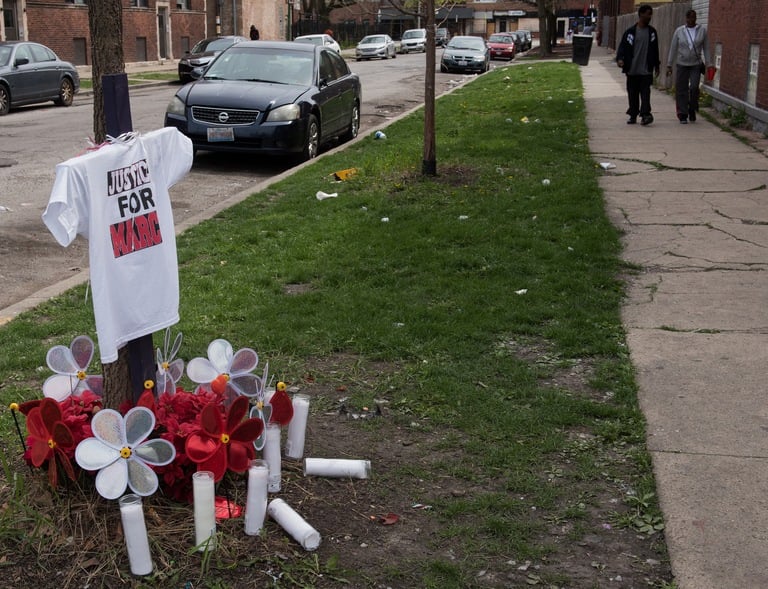
Flowers, candles, and a t-shirt that says “Justice for Marc” mark the spot where an individual was killed in Chicago.  photo

The tasks appear to be too daunting for the FBI in Chicago as they work with law enforcement officials.

That effort involves three major areas:

  • The creation in 2016 of a homicide task force—in addition to the FBI’s existing violent crimes squad—in which agents work alongside CPD detectives and other law enforcement officers to assist in solving the city’s murder cases;
  • Increased intelligence-gathering efforts to identify shooters and “directors of violence,” which includes embedding FBI analysts at CPD headquarters; and
  • Stepping up community outreach efforts to gain the public’s trust and enlist their help in solving crimes and making communities safer.

Legislation Proposed on Front Co.’s/Foreign Investment

Frankly, Britain has a much worse issue, but big hat tip to Senator Rubio. There are cities in America which are pockets of some nasty dark money in real estate.

There needs to be some real reform to CFIUS, Committee for Foreign Investment in the United States.

Crackdown on dirty money shook Miami real estate. Now, Rubio wants to take it national

In a move with significant implications for the U.S. housing market, Florida Republican Sen. Marco Rubio is seeking to take a Treasury Department crackdown on dirty money in luxury real estate and expand it from a few high-priced enclaves to the entire nation.

Rubio says his proposal is an attempt to root out criminals who use illicit funds and anonymous shell companies to buy homes — a form of money laundering that hides the cash’s tainted origin from law enforcement and banks. The widespread practice enables terrorism, sex trafficking, corruption, and drug dealing by providing an outlet for dirty cash, according to transparency advocates.

Through an amendment to an unrelated major spending bill, Rubio will ask Treasury to study whether government regulators should force shell companies that buy homes priced at $300,000 or more in cash nationwide to disclose their owners. That could be a figure as high as 10 percent of the nation’s real-estate deals.

A similar reporting requirement affecting transactions priced at $1 million or more has already had a chilling effect on all-cash corporate sales in Miami-Dade County, which has been under Treasury’s microscope since 2016.

“Shell companies involved in shady activities are a big problem, especially throughout South Florida,” Rubio said in a statement to McClatchy and the Miami Herald. “With this provision, a study would be conducted to look at requiring all shell companies that make cash transactions, regardless of their area, to disclose their identities.”

The amendment builds on a previous Treasury disclosure order that applied only to certain markets, including South Florida.

That order — which forced shell companies buying homes with cash to reveal their true owners to the government — has been in place in some areas since March 2016 at various price points. Its effects were immediate and stunning. As soon as the order took hold, shell companies buying homes with cash dropped off the map, a recent study by academic economists found. In Miami-Dade, the number of corporate cash sales plummeted 95 percent, although a strong overall market suggests creative buyers found ways to circumvent the rules, researchers said.

Before the crackdown, corporate cash sales accounted for roughly a third of home-sale volume in Miami-Dade, which is popular with foreign investors.

The amendment has the support of the top Democrat on the Senate Finance Committee, Oregon’s Ron Wyden, as well as Rhode Island Democratic Sen. Sheldon Whitehouse. Both have tried to widen disclosure of true owners of shell companies, which can be listed in the names of lawyers, accountants, and other fronts. The lack of corporate transparency frustrates law-enforcement officials, who say it stymies their investigations.

A vote is expected on the overall bill as soon as this week, Rubio’s office said.

The powerful real-estate industry has fought attempts from the government to have it act as a watchdog against money laundering, as banks, precious-metals dealers, money-service businesses, and other financial institutions are required to do. Many Realtors and developers say their clients are simply wealthy buyers seeking privacy, not criminals.

But over the past two years, Treasury has moved with force into what had been a largely unregulated sector of the U.S. financial system. Starting in Miami-Dade County and Manhattan two years ago, Treasury’s Financial Crimes Enforcement Network (FinCEN) began requiring anonymous shell companies to disclose their true owners when they bought pricey homes with cash.

The temporary directives — called “geographic targeting orders” or GTOs — were later expanded to other housing markets in Florida, New York, Texas, California, and Hawaii where foreign and anonymous investors are gobbling up real estate and driving up prices. The rules require title agents to identify the owners of shell companies buying homes with cash and disclose their names to the federal government.

“The GTOs are working, and it’s time they were expanded. Laundering money through real estate isn’t new, but [what is new is] an effective approach to combat dirty money,” said Clark Gascoigne, deputy director of the Financial Accountability and Corporate Transparency (FACT) Coalition, a watchdog nonprofit.

Rubio’s proposal to take the project national, Gascoigne added, “sends a strong message that we’re serious about protecting the U.S. financial system, the real-estate market, and communities across the country.”

Stephen Hudak, a spokesman for FinCEN, declined to comment.

Cracking down

The Rubio amendment asks Treasury to consider expanding the FinCEN directive to include all cash real-estate transactions over $300,000 anywhere in the United States.

It would give Treasury 180 days to submit a study to Congress providing details about the data that has been collected by FinCEN since 2016 and how it is being used. The agency is also being asked to determine if it needs more authority to combat money laundering and whether expanding the targeting order would be of use. In addition, FinCEN is asked if a registry of company owners — something supported by a bipartisan cast of federal legislators — would help authorities fight money laundering, tax evasion, election fraud, and other illegal activities.

Previously, the FinCEN disclosure requirement kicked in for corporate cash sales that were priced at $3 million or higher in New York City, $1 million or higher in Miami-Dade, Broward, and Palm Beach, and at different price points in other states. In May, FinCEN enacted a new directive that secretly lowered the number to $300,000 in all GTO areas. Sources familiar with the agency’s thinking say the new order was kept confidential because regulators don’t want to give money launderers a road map for structuring their transactions to avoid reporting.

Rubio’s amendment would start at that lower price point, covering a major chunk of home sales nationwide. Last year, the median U.S. home sold for a price of $247,200, according to the National Association of Realtors.

A cash transaction is one in which there is no mortgage and the property is purchased outright. Cash doesn’t just mean stacks of greenbacks; it also includes such financial instruments as wire transfers, checks, and money orders. Unlike mortgages, cash deals don’t involve heavy scrutiny from banks, which can identify potential money laundering and file suspicious-activity reports to the feds.

The 2016 publication of the Panama Papers spotlighted how anonymous shell companies in faraway tax havens were used to camouflage property purchases in the United States by politicians, drug traffickers, and financial fraudsters. Housing analysts argue that the flow of anonymous money is driving up prices.

“There’s hardly a metropolitan area in the country that is not experiencing a real public-policy issue regarding affordable housing,” said Ned Murray, a housing expert and associate director of Florida International University’s Metropolitan Center. “The whole focus of the real-estate industry is on … supplying homes for wealthy investors that we don’t know much about. It really is a factor for prices and supply.”

Much of the world has responded to the threat of corruption in real estate by requiring greater ownership disclosure. The United States has done relatively less, although Rubio’s amendment could help close the gap.

Those operating in the shadows of the real-estate market certainly seem aware of the Treasury disclosure requirements — and are working to get around them.

Take Carmelo Urdaneta Aqui, who is the former legal counsel to the Venezuelan Ministry of Oil and Mining. He was recently among those charged in a federal $1.2 billion money-laundering case involving funds stolen from Venezuela’s state oil company.

When Urdaneta prepared to close on a brand-new, $5.3 million condo at the Porsche Design Tower in Sunny Isles Beach, he was informed by paperwork from the developer that “taking title [to the unit] under a company or trust may trigger FinCEN reporting requirements,” according to a federal indictment filed last week. He was worried enough about the disclosure that he discussed how to avoid it with a government informant.

Ultimately, Urdaneta set up a company in his wife’s name to do the deal, prosecutors allege.

001 Gil Dezer DS
Developer Gil Dezer’s company built the Porsche Design Tower in Sunny Isles Beach, where units sell for millions of dollars to wealthy out-of-towners.
David Santiago dsantiago@elnuevoherald.com

Dezer Development did not say why it alerts potential buyers that they might end up on Treasury’s radar.

“All language relating to legal requirements associated with closings was prepared by Dezer Development’s outside legal counsel,” a spokeswoman wrote in an email to the Herald on Monday.

The 60-story Porsche Design Tower is famous for a car elevator that allows owners to park in “sky garages” within their units. On Friday, federal prosecutors indicated that they would move to seize the unit.

Bad for brokers?

While overall home sales held steady even after the FinCEN rule went into place, the real-estate study found, luxury home prices were slightly softer in markets affected by the GTO.

That suggests that expanding the GTO could have a dampening effect on the nation’s real-estate market, said Jeff Morr, a luxury real-estate broker at Douglas Elliman and chairman of the Miami Master Brokers Forum, an industry group.

“Does it stop money laundering? Probably, yes,” Morr said. “Is it good for the real-estate market? Probably, no.”

But at least making the rule nationwide might take some of the heat off Miami, he said.

“It may make Florida less unattractive now that it’s everywhere,” Morr said. “We shouldn’t be treated differently than other areas.”

Real Estate Cycle_Edgewater (4).jpeg
The crane has become the unofficial city bird of Miami during the latest construction boom.
Miami Herald

That was exactly the sentiment of the Miami-Dade County Commission when the rule was first enacted in 2016. At the time, commissioners passed a symbolic resolution asking regulators to stop singling out Miami for special scrutiny. The industry still feels the same way.

Legitimate buyers need privacy, too, said Ron Shuffield, president and CEO of EWM Realty International.

“There are wealthy people who don’t want everyone to know that they live at the end of the block,” Shuffield said. “If someone is determined to launder money, they can pick anywhere in the country to do it, from the smallest city in the Midwest to Miami or New York City. It’s only fair that every area have to report. Otherwise, the rules could be scaring people away from certain markets.”


The Demand for Ortega to Step Down

In recent weeks, the Ortega regime has killed an estimated 350 innocent citizens. Anyone besides Senator Rubio paying attention?

OEA condena violaciones de derechos humanos en Nicaragua ...

Thousands of people marched yesterday in Nicaragua to demand that President Daniel Ortega step down. The demonstrations over proposed benefit cuts, which began three months ago, are expected to continue today.

Human rights groups say about 300 people have been killed during the protests, many by police.

U.S. Senator Marco Rubio has warned that deadly clashes in Managua could lead to civil war, and worsen the immigration crisis in the U.S.

CBS News correspondent Manuel Bojorquez reports an eerie quiet during much of the day in the capital city of Managua, as people stay home and business owners close up shop for their own safety.

But after the calm, the sounds of protest pierce the air, and the fear of bloody confrontations returns.

Within minutes of arriving in the capital, Bojorquez encountered an anti-government protest and the sound of mortar fire.

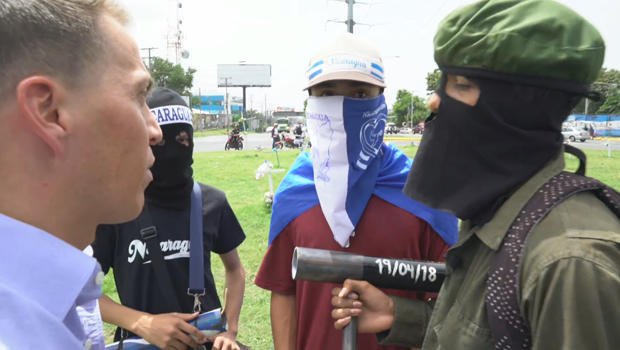
Several young men – masked and holding homemade mortar launchers – told Bojorquez they fire the mortars to warn fellow demonstrators when pro-government forces are near.

They told Bojorquez that they were willing to risk their lives: “The fear is gone,” one said.

manuel-bojorquez-nicaragua-protestors.jpg

Masked protesters in Managua, Nicaragua.

CBS News

The fear was gone on April 19 – that’s the day protests started over proposed cuts to social security benefits. Government forces are accused of killing more than 40 people that week. Hundreds have been killed since then, some even attacked while hiding in a church.

The uprising continues to intensify against President Ortega, whom demonstrators say has turned into a dictator and should step down. But Ortega remains defiant, insisting the protesters are being influenced by outside forces and blaming them for initiating the violence.

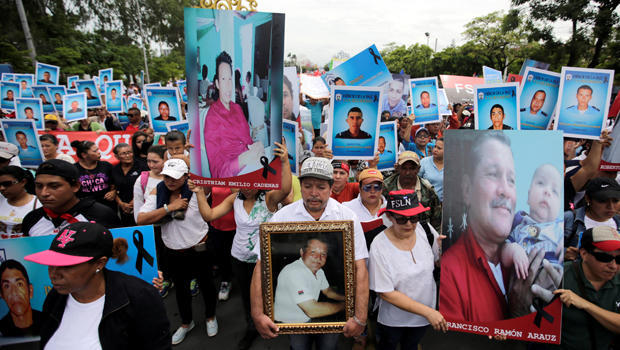
Ortega supporters hold pictures of dead police officers at demonstration in Managua

Supporters of Nicaragua’s President Daniel Ortega hold pictures of dead police officers, who lost their lives during recent protests, at a demonstration in Managua, Nicaragua July 21, 2018.

JORGE CABRERA/REUTERS

In the neighborhood of Monimbo, which had been a stronghold of the opposition, barricades built using cobblestones from the streets can still be seen. It was the site of a bloody confrontation with police last week. At this point, it’s still not clear how many people were killed.

One woman feared being identified on camera, but wanted to let Bojorquez know one thing: her neighborhood was not backing down – that Monimbo had lost the battle, but not the war.

Several international organizations have called on the Nicaraguan government to end the violent suppression of protests and for President Ortega to allow early elections next year. He refuses to back down, which means the protests are likely to continue.

*** Is Russia behind some of this? More Western hemisphere chaos coming to the United States? Let’s go back to 2016 and 2017:

The Russian government is building an electronic intelligence-gathering facility in Nicaragua as part of Moscow’s efforts to increase military and intelligence activities in the Western Hemisphere.

The signals intelligence site is part of a recent deal between Moscow and Managua involving the sale of 50 T-72 Russian tanks, said defense officials familiar with reports of the arrangement.

The tank deal and spy base have raised concerns among some officials in the Pentagon and nations in the region about a military buildup under leftist Nicaraguan leader Daniel Ortega.

Disclosure of the Russia-Nicaraguan spy base comes as three U.S. officials were expelled from Nicaragua last week. The three Department of Homeland Security officials were picked up by Nicaraguan authorities, driven to the airport, and sent to the United States without any belongings. More here.

A War Criminal Next Door? 11 Counts

Former Number Two to Charles Taylor convicted on 11 counts ...

The trial was 3 weeks long and included witnesses and victims including child soldiers that described the most horrific crimes. His sentencing hearing is scheduled for October 15, 2018 and he faces 110 years in prison. Oh yeah, a $4 million fine in USD.

He was arrested in 2014 in Collingdale, Pennsylvania. The case was investigated by U.S. Immigration and Customs Enforcement Homeland Security Investigations and the Federal Bureau of Investigation.

Liberian war criminal living in Delaware County convicted of immigration fraud and perjury

PHILADELPHIA – On July 3, 2018, a defendant in Collingdale, Pennsylvania was found guilty by a federal jury of immigration fraud and perjury charges, following a U.S. Immigration and Customs Enforcement (ICE) Homeland Security Investigations (HSI) led investigation, with assistance from the Federal Bureau of Investigation (FBI).

Jucontee Thomas Woewiyu, 72, lied on his application for U.S. citizenship by denying that he advocated the overthrow of any government by force or violence and by denying that he ever persecuted any person because of membership in a social group or their political opinion.

Woewiyu is a founder and the former Minister of Defense, chief spokesperson, and negotiator for the National Patriotic Front of Liberia (NPFL), which was an armed rebel group led by Charles Taylor and committed to removing the Samuel Doe government forcibly from power in Liberia in the late 1980s and 1990s. On numerous occasions over the years, Woewiyu publicly confirmed his prominent position in the NPFL and advocated the overthrow of the Doe government by force or violence.

During the defendant’s tenure, the NPFL conducted a particularly heinous and brutal military campaign, characterized by torture, rape, forced sexual slavery, conscription of child soldiers, and murder. The jury heard evidence from almost twenty Liberians who lived through Liberia’s notoriously brutal first civil war, from 1989 through 1995. At trial, multiple individuals testified about being forced to become child soldiers under Woewiyu and the NPFL. Additionally, the jury heard testimony about NPFL soldiers cutting off victims’ body parts in front of Woewiyu, while others described checkpoints with skulls and severed heads on stakes (some still dripping with blood) and intestines for ropes, as well as the ethnically based massacre of a village at the hands of the NPFL.

“Today’s verdict clearly demonstrates that this nation will never be a safe haven for human rights violators and war criminals,” said Marlon V. Miller, Special Agent in Charge of HSI Philadelphia. “HSI will not allow our country to be a place where individuals seeking to distance themselves from their pasts can hide or evade detection.”

Since approximately Jan. 13, 1972, Woewiyu has had Lawful Permanent Resident status in the United States. On Jan. 23, 2006, Woewiyu applied for U.S. citizenship by submitting a Form N-400. On that form, and in his immigration in-person interview, Woewiyu swore and certified under the penalty of perjury that, among other things, he had never advocated (either directly or indirectly) the overthrow of any government by force or violence, and that he had never persecuted (either directly or indirectly) any person because of race, religion, national origin, membership in a particular social group, or political opinion.

After a three-week trial, the jury began its deliberations on Monday, July 2. The jury returned a verdict on July 3, finding the defendant guilty of two counts of fraudulently attempting to obtain citizenship, two counts of fraud in immigration documents, two counts of false statements in relation to naturalization, and five counts of perjury.

“The defendant’s tenure as Minister of Defense for the NPFL was marked by almost unimaginable violence and brutality,” said U.S. Attorney McSwain. “He attempted to evade all accountability for his gruesome and horrific crimes by fraudulently obtaining U.S. citizenship. Due to the hard work and perseverance of our prosecutors and law enforcement partners, he has nowhere left to hide. Finally, this defendant has been brought to justice. I hope the conviction today can provide some comfort, however belated, to all of his victims and their families.”

Since 2003, ICE has arrested more than 410 individuals for human rights-related violations of the law under various criminal and/or immigration statutes. During that same period, ICE obtained deportation orders against and physically removed 908 known or suspected human rights violators from the United States. Additionally, ICE has facilitated the departure of an additional 122 such individuals from the United States.

Currently, HSI has more than 135 active investigations into suspected human rights violators and is pursuing more than 1,750 leads and removals cases involving suspected human rights violators from 95 different countries. Since 2003, the HRVWCC has issued more than 75,000 lookouts for individuals from more than 110 countries and stopped over 260 human rights violators and war crimes suspects from entering the U.S.

ICE is committed to rooting out known or suspected human rights violators who seek a safe haven in the United States. ICE’s Human Rights Violators and War Crimes Center investigates human rights violators who try to evade justice by seeking shelter in the United States, including those who are known or suspected to have participated in persecution, war crimes, genocide, torture, extrajudicial killings, and the use or recruitment of child soldiers. These individuals may use fraudulent identities or falsified records to enter the country and attempt to blend into communities in the United States.