July 27th the Next N. Korea Missile Launch?

US sees more signs North Korea is preparing another missile test

(CNN)North Korea appears to be preparing for another missile test, according to a US Defense official. The official said that transporter vehicles carrying ballistic missile launching equipment were seen arriving in Kusong, North Korea on Friday.

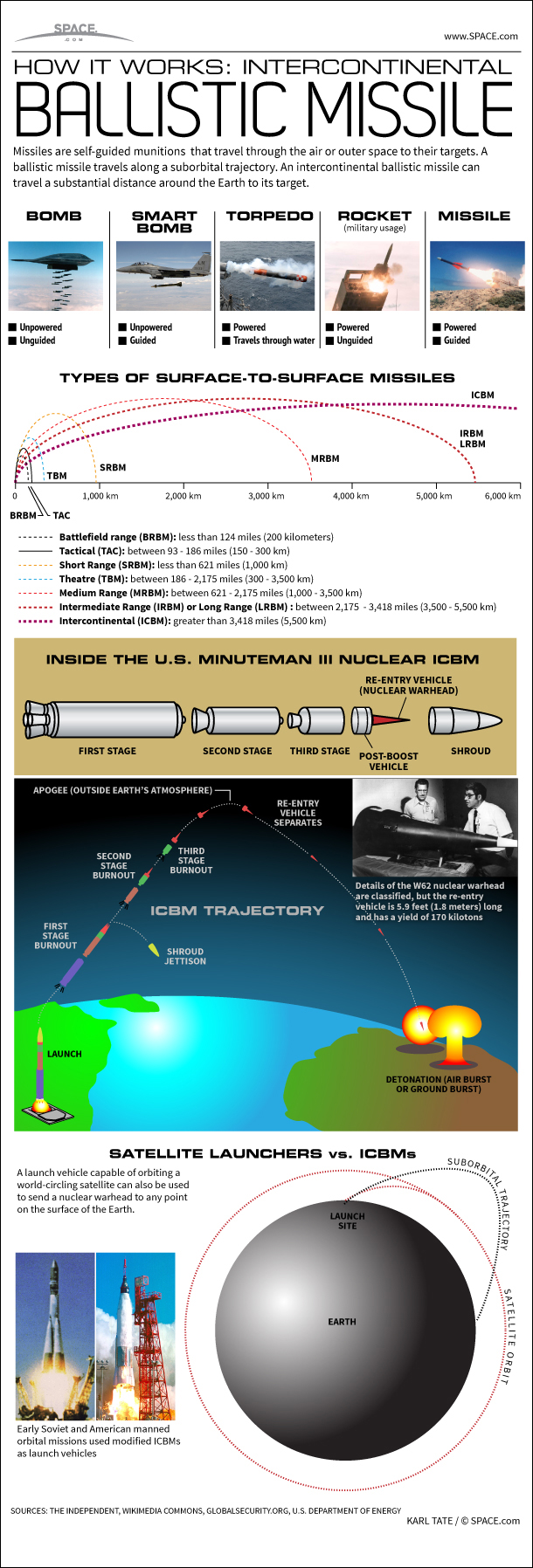
Infographic: Here's how missiles send deadly explosive payloads to targets around the world.
Source SPACE.com: All about our solar system, outer space and exploration

The official said that when such equipment is seen, a launch could occur within six days, which would coincide with the upcoming July 27 North Korean Holiday celebrating the armistice which ended the Korean War.
Last Wednesday, CNN reported that US intelligence indicated that North Korea is making preparations for another intercontinental ballistic missile (ICBM) or intermediate range missile test. Two administration officials familiar with the latest intelligence confirmed they’d seen indicators of test preparations. US satellites have detected new imagery and satellite-based radar emissions indicating that North Korea may be testing components and missile control facilities for another ICBM or intermediate launch, officials say.

(CNN)Hawaii is set to become the first state in the US to test an “attack- warning” system in the event of a North Korean nuclear missile strike.

Starting in November, Hawaii’s disaster warning plan will include a new protocol in case of a nuclear attack, CNN affiliate KNHL reports. But some are concerned the announcement will scare off tourists from visiting the island.
A “guidance summary” from the Hawaii Emergency Management Agency says residents will be alerted of nuclear detonation through siren alarms and flashing white lights. An Emergency Alert System will broadcast over television and radio frequencies as well. More here.
Kusong has been the site of North Korean missile tests in the past, including a May test of a KN-17 intermediate range missile which traveled almost 500 miles before splashing down in the Sea of Japan/East Sea, hitting the water about 60 miles from Vladivostok in eastern Russia, according to US officials.
The last major North Korean missile test took place on July 4, when Pyongyang launched what the US assessed to be an intercontinental ballistic missile.
***
The US military has grown increasingly concerned about the increased pace of North Korean missile testing while simultaneously underscoring that the US is capable of defending itself and its allies from North Korean missiles.
“They’re clearly on a path to develop an intercontinental ballistic missile that can reach the reach the United States and to match that with a nuclear weapon,” the Chairman of the Joint Chiefs of Staff, Gen. Joseph Dunford, told an audience Saturday at the Aspen Security Forum.
“What the North Koreans are capable of today is limited missile attack and we are capable of defending against a limited missile attack for our forces in South Korea, our South Korean allies, our Japanese allies, our forces in Okinawa, our forces in Guam and the American homeland,” Dunford added.
On Thursday, CIA Director Mike Pompeo offered some of the most aggressive comments yet from the Trump administration with regard to North Korean dictator Kim Jong Un.
“It would be a great thing to denuclearize the peninsula, to get those weapons off of that, but the thing that is most dangerous about it is the character who holds the control over them today,” Pompeo said at the Aspen Security Forum.
“As for the regime, I am hopeful we will find a way to separate that regime from this system,” Pompeo said. “The North Korean people I’m sure are lovely people and would love to see him go.”
State Dept to Close War Crimes Division, Bad Decision

  USAToday

Secretary of State Rex Tillerson is shuttering the department’s two-decades-old war crimes office, Foreign Policy reported Monday.

The Office of Global Criminal Justice advises the Secretary of State on issues surrounding war crimes and genocide and helps form policy to address those atrocities.

According to FP, Tillerson’s office has told Todd Buchwald, the special coordinator of the OGCJ, he is being reassigned to the State Department’s office of legal affairs.

Remaining staff might be shifted to the State Department’s Bureau of Democracy, Human Rights, and Labor, FP reported.

According to FP, the closure decision comes at a time when Tillerson has been trying to reorganize the department to concentrate on pursuing economic opportunities for American businesses and strengthening U.S. military prowess.

“There’s no mistaking it — this move will be a huge loss for accountability,” Richard Dicker, the director of Human Rights Watch’s international justice program, told FP. A State Department spokesman told FP in a statement it is “currently undergoing an employee-led redesign initiative, and there are no predetermined outcomes. We are not going to get ahead of any outcomes.” More here.

*** Consider the murderers in countries such as North Korea, Syria, Iran, Yemen, Iraq, Sudan, Nigeria, Afghanistan and more….

Iraq: Execution Site Near Mosul’s Old City

Investigate, Punish Those Responsible for Any War Crimes

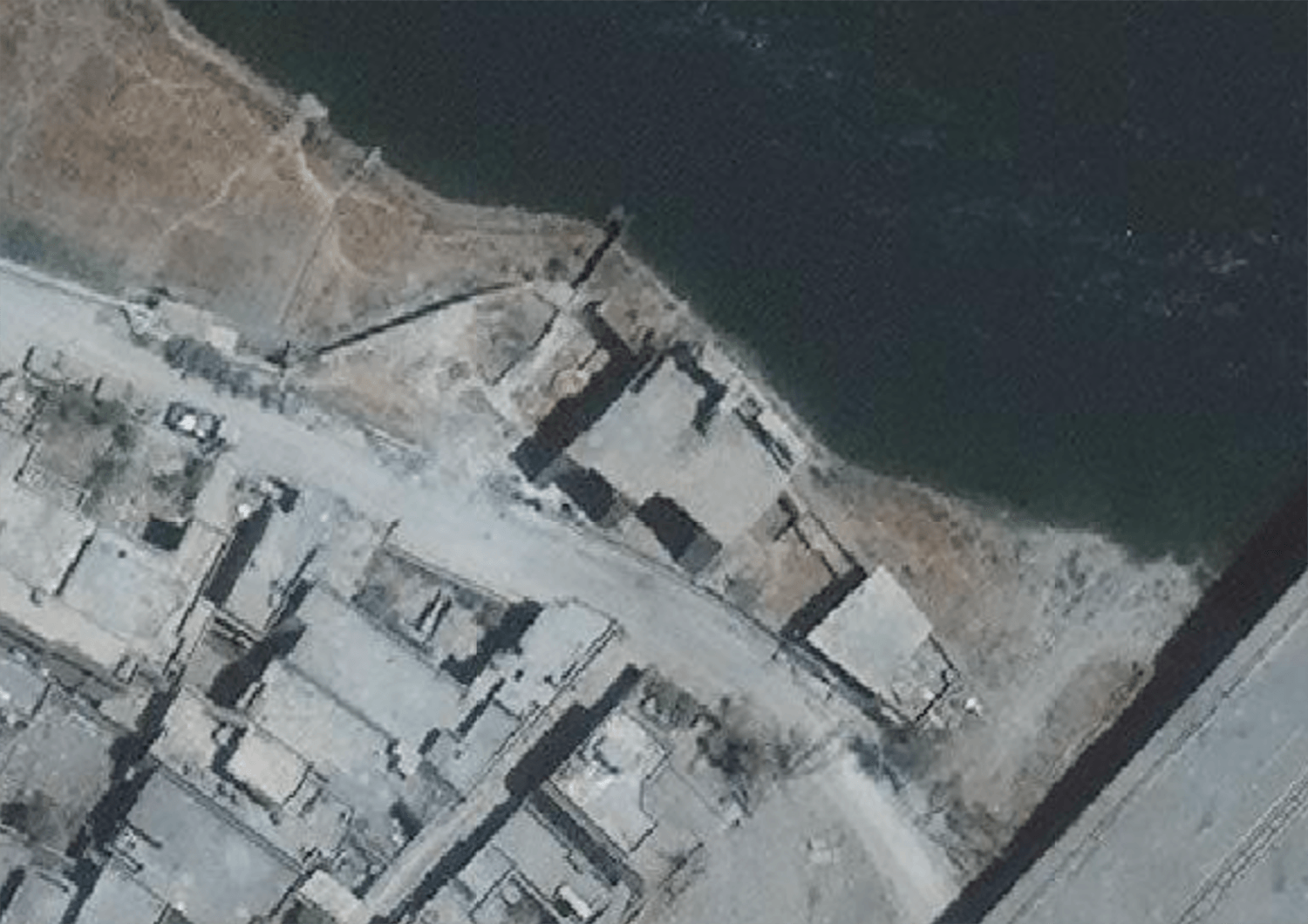
Satellite imagery from July 12 showing the building and Tigris riverbank seen in a video posted of soldiers throwing a detainee off a cliff in west Mosul as well as military vehicles in the vicinity.

Satellite imagery from July 12 showing the building and Tigris riverbank seen in a video posted of soldiers throwing a detainee off a cliff in west Mosul as well as military vehicles in the vicinity.  © 2017 DigitalGlobe
(Beirut) – International observers have discovered an execution site in west Mosul, Human Rights Watch said today. That report, combined with new statements about executions in and around Mosul’s Old City and persistent documentation about Iraqi forces extrajudicially killing men fleeing Mosul in the final phase of the battle against the Islamic State (also known as ISIS), are an urgent call to action by the Iraqi government.
Despite repeated promises to investigate wrongdoing by security forces, Prime Minister Haider al-Abadi has yet to demonstrate that Iraqi authorities have held a single soldier accountable for murdering, torturing, and abusing Iraqis in this conflict.
“As Prime Minister Abadi enjoys victory in Mosul, he is ignoring the flood of evidence of his soldiers committing vicious war crimes in the very city he’s promised to liberate,” said Sarah Leah Whitson, Middle East director at Human Rights Watch. “Abadi’s victory will collapse unless he takes concrete steps to end the grotesque abuses by his own security forces.”
International observers, whose evidence has proven reliable in the past, told Human Rights Watch that on July 17, 2017, at about 3:30 p.m., a shopkeeper in a neighborhood directly west of the Old City that was retaken in April from ISIS took them into an empty building and showed them a row of 17 male corpses, barefoot but in civilian dress, surrounded by pools of blood. They said many appeared to have been blindfolded and with their hands tied behind their back.
They said the shopkeeper told them that he had seen the Iraqi Security Forces’ 16th Division, identifiable by their badges and vehicles, in the neighborhood four nights earlier, and that night had heard multiple gunshots coming from the area of the empty building. The next morning, when armed forces had left the area, he told them, he went into the building and saw the bodies lying in positions that suggested they were shot there and had not been moved. He said he did not recognize any of those killed.
The international observers also saw soldiers from the elite Counter Terrorism Service (CTS) in the area. They contacted Human Rights Watch by phone from the site and later shared five photos they took of the bodies.
On July 17, another international observer told Human Rights Watch they spoke to a senior government official in Mosul who told them he was comfortable with the execution of suspected ISIS-affiliates “as long as there was no torture.” The observer said a commander showed their group a video taken a few days earlier of a group of CTS soldiers holding two detainees in the Old City. They said the commander told them that the forces had executed the men right after the video was taken.
Salah al-Imara, an Iraqi citizen who regularly publishes information regarding security and military activities in and around Mosul, published four videos allegedly filmed in west Mosul on Facebook on July 11 and 12. One video, posted on July 11, appears to show Iraqi soldiers beating a detainee, then throwing him off a cliff and shooting at him and at the body of another man already lying at the bottom of the cliff. Human Rights Watch had verified the location of the first video based on satellite imagery. Other videos showed Iraqi soldiers kicking and beating a bleeding man, federal police forces beating at least three men, and Iraqi soldiers kicking a man on the ground in their custody.
A third international observer told Human Rights Watch on July 18 that they witnessed CTS soldiers bring an ISIS suspect to their base in a neighborhood southwest of the Old City on July 11. The observer did not see what happened to the suspect next, but said that a soldier later showed them a video of himself and a group of other soldiers brutally beating the man, and a second video of the man dead, with a bullet to his head.
“Some Iraqi soldiers seem to have so little fear that they will face any consequence for murdering and torturing suspects in Mosul that they are freely sharing evidence of what look like very cruel exploits in videos and photographs,” Whitson said. “Excusing such celebratory revenge killings will haunt Iraq for generations to come.”
A fourth international observer told Human Rights Watch on July 11 that the day before they had witnessed a group of CTS soldiers push a man whose hands were tied behind his back into a destroyed shop near the main road in the west to the Old City. They said they heard several gunshots, went into the shop after the soldiers had left, and found the man’s body with several bullet holes in the back of his head. They shared the photo of the body.
On July 10, the same observer said they saw Iraqi Security Forces just outside the Old City holding about 12 men with their hands tied behind their backs. They said an officer told them that the military’s 9th Division had detained these men inside the Old City on suspicion of ISIS affiliation. They said they saw the soldiers lead the detained men just out of sight, then heard shots ring out from their direction. The observer was unable to verify what happened.
On July 7, two additional international observers told Human Rights Watch that on different occasions in late June, they witnessed soldiers bring at least five suspected ISIS affiliates out of the Old City to the west, strapped to the hoods of Humvees, when temperatures in the city often reached 48 degrees Celsius, or 118 degrees Fahrenheit.
The nongovernmental organization Mosul Eye has been documenting abuses by all sides in Mosul since 2014, and has posted numerous videos and witness statements about executions on its Twitter feed since July 14, with one reading: “Mass Executions ‘Speicher Style’ [a reference to an ISIS massacre in 2014] for the last survivors of the old city. ISF is killing and throwing bodies of everyone it finds to the river.”
As of July 10, the Iraqi military has prevented access to west Mosul for most journalists, limiting coverage of recent events inside the Old City. Iraqi forces should allow journalists access to west Mosul to report on the conflict and any alleged abuses, Human Rights Watch said.
Throughout the operation to retake Mosul, Human Rights Watch has documented Iraqi forces detaining and holding at least 1,200 men and boys in inhumane conditions without charge, and in some cases torturing and executing them, under the guise of screening them for ISIS-affiliation. In the final weeks of the Mosul operation, Human Rights Watch has reported on executions of suspected ISIS-affiliates in and around Mosul’s Old City.
An Iraqi Ministry of Foreign Affairs representative told Human Rights Watch on July 19 that he would request a government investigation into the allegations. Human Rights Watch has repeatedly raised concerns about allegations of ill-treatment, torture, and executions in meetings with Iraqi officials in Baghdad as well as with representatives from United States-led coalition member countries. Human Rights Watch does not know of a single transparent investigation into abuses by Iraqi armed forces, any instances of commanders being held accountable for abuse, or any victims of abuse receiving compensation.
Iraqi criminal justice authorities should investigate all alleged crimes, including unlawful killings and mutilation of corpses, by any party in the conflict in a prompt, transparent, and effective manner, up to the highest levels of responsibility. Those found criminally responsible should be appropriately prosecuted. Extrajudicial executions and torture during an armed conflict are war crimes.
“Relentless reports, videos, and photographs of unlawful executions and beatings by Iraqi soldiers should be enough to raise serious concerns among the highest ranks in Baghdad and the international coalition combatting ISIS,” Whitson said. “As we well know in Iraq, if the government doesn’t provide an accounting for these murders, the Iraqi people may take matters into their own hands.”

Bill Clinton, Trumps’ and Renaissance Capital

Primer: The 8th person at the Trump Jr. meeting was Ike Kaveladze. He currently serves as Vice President of the Crocus Group in Moscow. Mr Balber, the lawyer for Kaveladze, said he revealed the identity of the eighth participant after receiving a call from a representative of special counsel Robert Mueller – the first indication that the Justice Department investigator is looking into the meeting. Previously, Federal investigators say Kaveladze immediately began laundering money for Russians.

Kaveladze was the president of International Business Creations, a Delaware corporation. Between 1991 and 2000, IBC and sister corporation Euro-American moved $1.4 billion from Eastern Europe through U.S. banks and back to Europe, the Government Accountability Office found in 2000.

But let’s go back to Bill and Hillary shall we? We may determine just why President Trump backed off his campaign pledge and decided not to prosecute Hillary

THE CLINTON FAMILY BUSINESS There may be no Clinton Foundation office in Moscow or St. Petersburg, but it is not for lack of trying. Bill Clinton received half a million dollars in 2010 for a speech he gave in Moscow, paid by a Russian firm, Renaissance Capital, that has ties to Russian intelligence. The Clinton Foundation took money from Russian officials and oligarchs, including Victor Kekselberg, a Putin confidant. The Foundation also received millions of dollars from Uranium One, which was sold to the Russian government in 2010, giving Russia control of 20% of the uranium deposits in the U.S. —  the sale required approval from Hillary Clinton’s State Department. What’s more, at least some of these donations weren’t disclosed. “Ian Telfer, the head of the Russian government’s uranium company, Uranium One, made four foreign donations totaling $2.35 million to the Clinton Foundation. Those contributions were not publicly disclosed by the Clintons, despite an agreement Mrs. Clinton had struck with the Obama White House to publicly identify all such donors,” the Times has reported.

Stephen Jennings is the co-founder and CEO of Renaissance Capital and in 2010 he resided over the launch of Tatu City, a planned community for 60,000 northeast of Nairobi.

Before that Vladimir Dzhabarov was a member of the FSB’s Department “K,” or its financial counter-intelligence division . From 2006-09, he was also the First Vice President at Renaissance Capital, a Moscow-based investment firm, which the 36 year-old Magnitsky claimed was involved in a six-long-year long conspiracy by an organized crime syndicate and Russian government officials to defraud the nation’s taxpayers. Renaissance Capital denies it had any part in any tax frauds; in 2009, the bank’s deputy chief executive Hans Jochum Horn told the New York Times that any illegal transactions involving Renaissance subsidiary companies took place after those companies had been sold off to new owners.

Magnitsky claimed in 2008 that criminals tied to Renaissance Capital, who were allegedly working in lockstep with tax and law enforcement agents, stole some $470 million by orchestrating illegal and complex tax refund schemes. As part of his sweeping investigation, Magnitsky claimed that in 2001-2002, Igor Sagiryan, the former president of Renaissance Capital, had supposedly commissioned named a fellow named Dmitry Klyuev to arrange a series of tax refunds through the corrupt Russian court system. This seconding of a known mobster to a seemingly legitimate financial institution was confirmed by Yuri Sagaidak, a former KGB general who was at the time the vice president of Renaissance Capital, in Russian court testimony.

The Klyuev Group, which U.S. Senator John McCain in 2012 urged President Obama to use an executive order to sanction wholesale as a “dangerous transnational criminal organization,”concocted its first nine-figure refund scheme in 2006, according to Magnitsky and others. The conspirators allegedly included the heads of Moscow Tax Offices 28 and 25, Olga Stepanova and Elena Khimina, respectively; Klyuev’s own attorney, Andrey Pavlov; and an Interior Ministry official, Major Pavel Karpov, who had previously investigated Klyuev for attempting to steal $1.6 billion worth of shares of a profitable Russian iron ore company. (Klyuev received a two-year suspended sentence in that case.)Read more here.

It has now emerged that the US Department of Justice has traced proceeds of the fraud to a bank account in Bournemouth held by Renaissance Capital Investment Management Ltd.

A chart produced by the US Department of Justice shows funds flowing through a series of foreign companies before being channelled into three main firms, including Prevezon, against which the DoJ is taking legal action to seize assets allegedly linked to the money, and the Bournemouth Renaissance account.

Renaissance Capital is a Moscow-based investment bank now controlled by billionaire oligarch Mikhail Prokhorov. Igor Sushchin, until recently the organisation’s head of IT security, was one of two FSB operatives accused by the FBI last month of hacking 500 million Yahoo email accounts. An indictment said it was “unknown” whether the firm “knew of his FSB affiliation”. Read more here for details and to help with the confusion.

*** In case you are wondering what Robert Mueller, the special investigator is looking at with this team, hold on this is going to get worse.

Magnitsky tracked money and found it all over the globe before he was murdered in a Russian prison, where the FSB arrested him for whistle-blowing.

According to records obtained by OCCRP, between Moscow and Geneva the money traveled all over the world in a veritable chain of shell companies set up by GT Group — a company that was connected to the sale of arms from N. Korea to Iran as well as laundering money for the Mexican Sinaloa Cartel.
The couple used the same Credit Suisse accounts to purchase two apartments valued at US$2 million each at Dubai’s Kempinksi resort for tax office deputies Elena Anisimova and Olga Tsareva. According to bank records, the apartments were purchased using the same bank account Stepanova used.
US$3 million arrived in the accounts on January 3, 2008 via Bristoll Export, a company which had been registered by GT Group in New Zealand. In February, companies incorporated in Cyprus, Moldova, and the United Kingdom sent US$9 million to the Credit Suisse accounts. See detailed information on one of the companies, NOMIREX, which processed US$8 million in its accounts while filing as “inactive” in a separate story.
In May and June 2008, the accounts held by Stepanov and Stepanova sent US$10 million to a shell company called Arivust holding. Records obtained by OCCRP show that through a series of agreements, Stepanov is named as the beneficial owner of the company.
The records also show that Stepanov is the beneficial owner of another company, Aikate Properties, which sent US$2 million to his Swiss account.
Hermitage acquired copies of the Credit Suisse transactions and used them to file a complaint with the bank and the Swiss federal attorney general this spring.
Stepanova remains employed by the Russian government. She resigned from the tax ministry but now works for a new defense agency established by Medvedev that oversees procurement and allocation of police and military equipment to the country’s law enforcement and military agencies.
So do Lieutenant Colonel Artyom Kuznetsov, whose assets were estimated at US$3 million although his official annual salary is about US$10,000; and Russian Interior Ministry Pavel Karpov, whose assets were estimated at US$1.5 million while his yearly pay was only US$10,000. Transparency International ranks Russia as the most corrupt large nation on earth, and the large country most likely to bribe abroad. They also estimate that bribery alone costs Russia US$300 billion annually, the total GDP of Denmark.  Bribery “is not even half of the problem,” according to a US House of Representatives Staffer who did not want to be identified because of his frequent work with Russian officials on policy issues including the Magnitsky case. Yep…more here.

Donald Trump Jr. had a meeting with 8 people in the room at Trump Tower in June of 2016. The meeting included Natalia Vesealnitskaya who was hired by and worked closely with Petr Katsyv who is/was the legal owner of Prevezon Holdings. The U.S. Justice Department for the Southern District of New York was prosecuting a money laundering case against Prevezon Holdings and it was settled too quickly directly after Jeff Sessions fired Phreet Bharara. Katsyv is also the vice president of Russian Railways, a state run rail operation run by Vladimir Yakunin and a close confidant of Vladimir Putin. Still confused and overwhelmed? Well there is more here.

Sorry there is yet another name, Sergei Roldugin. This particular Sergei is hardly a money launderer of the garden variety, in fact he is a cellist. But..he is at the center of a global scheme that moved $2.0 billion through Russian state banks, Swiss and Panamanian law firms all tied to Vladimir Putin via the investigation and release of the Panama Papers. Kinda wonder how a cellist is worth $100 million, right? Good question but money mess began at the Bank Rossiya, a top go-to bank for Putin and his inner circle. Oh yeah, Sergei Roldugin the the godfather to Putin’s oldest daughter, Maria.

In September of 2016, Roldugin announced before reporters at the Kremlin that Donadl Trump will be the next U.S. president.


UNESCO declares Hebron shrine Palestinian

  Israeli soldier guards at the Tomb of the Patriarchs in Hebron

You would think by virtue of a UN heritage committee known as United Nations Educational, Scientific and Cultural Organization, they would get history right. Israel has provided proof and historical evidence, where is that from the Palestinians?

The Tomb and the city of Hebron is the second holiest site in Judaism, after the Temple Mount and its Western Wall, he noted. The Bible clearly records its purchase by Abraham. The committee of T21  members are: Angola, Azerbaijan, Burkina Faso, Croatia, Cuba, Finland, Indonesia, Jamaica, Kazakhstan, Kuwait, Lebanon, Peru, Philippines, Poland, Portugal, Republic of Korea, Tunisia, Turkey, United Republic of Tnzania, Vietnam and Zimbabwe. Anymore questions on the countries that refuse history and remain Anti-Semitic?

Now is the time for the United States to defund UNESCO and the UNRWA.

Following the resolution passed by the UNESCO World Heritage Committee regarding the Tomb of the Patriarchs, Prime Minister Benjamin Netanyahu, today (Friday, 7 July 2017), decided to cut an additional $1 million from the membership funds that Israel pays to the UN and to transfer it to the establishment of “The Museum of the Heritage of the Jewish People in Kiryat Arba and Hebron” and to additional heritage projects related to Hebron.

Against UNESCO’s denial of the past, Prime Minister Netanyahu is determined to present to the entire world the historic truth and the Jewish People’s deep connection – of thousands of years – to Hebron.

***

Tomb of Sarah, wife a Patriarch Abraham

JERUSALEM (Reuters) – The U.N. cultural organisation declared an ancient shrine in the occupied West Bank a Palestinian heritage site on Friday, prompting Israel to further cut its funding to the United Nations.

UNESCO designated Hebron and the two adjoined shrines at its heart – the Jewish Tomb of the Patriarchs and the Muslim Ibrahimi Mosque – a “Palestinian World Heritage Site in Danger”.

Israeli Prime Minister Benjamin Netanyahu called that “another delusional UNESCO decision” and ordered that $1 million be diverted from Israel’s U.N. funding to establish a museum and other projects covering Jewish heritage in Hebron.

The funding cut is Israel’s fourth in the past year, taking its U.N. contribution from $11 million to just $1.7 million, an Israeli official said. Each cut has come after various U.N. bodies voted to adopt decisions which Israel said discriminated against it.

Palestinian Foreign Minister, Reyad Al-Maliki, said the UNESCO vote, at a meeting in Krakow, Poland, was proof of the “successful diplomatic battle Palestine has launched on all fronts in the face of Israeli and American pressure on (UNESCO) member countries.”

Hebron is the largest Palestinian city in the occupied West Bank with a population of some 200,000. About 1,000 Israeli settlers live in the heart of the city and for years it has been a place of religious friction between Muslims and Jews.

Jews believe that the Cave of the Patriarchs is where Abraham, Isaac and Jacob and their wives, are buried. Muslims, who, like Christians, also revere Abraham, built the Ibrahimi mosque, also known as the Sanctuary of Abraham, in the 14th century.

The religious significance of the city has made it a focal point for settlers, who are determined to expand the Jewish presence there. Living in the heart of the city, they require intense security, with some 800 Israeli troops protecting them.

Even before Netanyahu’s budget announcement, Internal Security Minister Gilad Erdan signalled Israel would seek to further make its mark at the Hebron shrine, tweeting: “UNESCO will continue to adopt delusional decisions but history cannot be erased … we must continue to manifest our right by building immediately in the Cave of the Patriarchs.”

(Additional reporting by Ali Sawafta in Ramallah and Nidal al-Mughrabi in Gaza; Editing by Robin Pomeroy)

New G20 Action Plan on Counter-Terrorism

  1. We, the Leaders of the G20, strongly condemn all terrorist attacks worldwide and stand united and firm in the fight against terrorism and its financing. These atrocious acts have strengthened our resolve to cooperate to enhance our security and protect our citizens. Terrorism is a global scourge that must be fought and terrorist safe havens eliminated in every part of the world.
  2. We reaffirm that all measures on countering terrorism need to be implemented in accordance with the UN Charter and all obligations under international law, including international human rights law.

    Implementing international commitments and enhancing cooperation

  3. We call for the implementation of existing international commitments on countering terrorism, including the UN Global Counter-Terrorism Strategy, and compliance with relevant resolutions and targeted sanctions by the UN Security Council relating to terrorism. We commit to continue to support UN efforts to prevent and counter terrorism.
  4. We will address the evolving threat of returning foreign terrorist fighters (FTFs) from conflict zones such as Iraq and Syria and remain committed to preventing FTFs from establishing a foothold in other countries and regions around the world. We recall UN Security Council Resolution 2178 (2014), which requires a range of actions to better tackle the foreign terrorist fighter threat.
  5. We will facilitate swift and targeted exchanges of information between intelligence and law enforcement and judicial authorities on operational information-sharing, preventive measures and criminal justice response, while ensuring the necessary balance between security and data protection aspects, in accordance with national laws. We will ensure that terrorists are brought to justice.
  6. We will work to improve the existing international information architecture in the areas of security, travel and migration, including INTERPOL, ensuring the necessary balance between security and data protection aspects. In particular, we encourage all members to make full use of relevant information sharing mechanisms, in particular INTERPOL’s information sharing functions.
  7. We call upon our border agencies to strengthen cooperation to detect travel for terrorist purposes, including by identifying priority transit and destination countries of terrorists. We will support capacity building efforts in these countries in areas such as border management, information sharing and watch-list capability to manage the threat upstream. We will promote greater use of customs security programs, including where appropriate, the World Customs Organization’s (WCO) Security Programme and Counter-Terrorism Strategy, which focus on strengthening Customs administrations’ capacity to deal with security related issues and managing the cross-border flows of goods, people and means of transport to ensure they comply with the law.
  8. We will address in close coordination the evolving threats and potential vulnerabilities in aviation security systems and exchange information on risk assessments. We recall the UN Security Council’s Resolution 2309 (2016) which urges closer collaboration to ensure security of global air services and the prevention of terrorist attacks. We will promote full implementation of effective and proportionate aviation security measures established by the International Civil Aviation Organization (ICAO) in partnership with all its contracting states as necessary. We call to urgently address vulnerabilities in airport security related measures, such as access control and screening, covered by the Chicago Convention and will act jointly to ensure that international security standards are reviewed, updated, adapted and put in place based on current risks.
  9. We highlight the importance of providing appropriate support to the victims of terrorist acts and will enhance our cooperation and exchange of best practices to this end.

    Fighting terrorism finance    

  10. We underline our resolve to make the international financial system entirely hostile to terrorist financing and commit to deepening international cooperation and exchange of information, including working with the private sector, which has a critical role in global efforts to counter terrorism financing. We reaffirm our commitment to tackle all sources, techniques and channels of terrorist financing and our call for swift and effective implementation of UNSCR and the Financial Action Task Force (FATF) standards worldwide. We call for strengthening measures against the financing of international terrorist organisations in particular ISIL/ISIS/Daesh, Al Qaida and their affiliates.
  11. There should be no “safe spaces” for terrorist financing anywhere in the world. However, inconsistent and weak implementation of the UN and FATF standards allows them to persist. In order to eliminate all such “safe spaces”, we commit to intensify capacity building and technical assistance, especially in relation to terrorist financing hot-spots, and we support the FATF in its efforts to strengthen its traction capacity and the effectiveness of FATF and FATF-style regional bodies.
  12. We welcome the reforms agreed by the FATF Plenary in June and support the ongoing work to strengthen the governance of the FATF. We also welcome the FATF intention to further explore its transformation into a legal person, which recognises that the FATF has evolved from a temporary forum to a sustained public and political commitment to tackle AML/CFT threats. We also appreciate FATF commencing the membership process for Indonesia that will broaden its geographic representation and global engagement. We ask the FATF to provide an update by the first G20 Finance Ministers and Central Bank Governors meeting in 2018. We call on all member states to ensure that the FATF has the necessary resources and support to effectively fulfil its mandate.
  13. We welcome that countering terrorist finance remains the highest priority of FATF, and look forward to FATF’s planned outreach to legal authorities, which will contribute to enhanced international cooperation and increased effectiveness in the application of FATF’s standards.
  14. We will advance the effective implementation of the international standards on transparency and beneficial ownership of legal persons and legal arrangements for the purposes of countering financing terrorism.
  15. Low cost attacks by small cells and individuals funded by small amounts of money transferred through a wide range of payment means are an increasing challenge. We call on the private sector to continue to strengthen their efforts to identify and tackle terrorism financing. We ask our Finance Ministers and Central Bank Governors to work with FATF, FSB, the financial sector, Financial Intelligence Units, law enforcement and FinTech firms to develop new tools such as guidance and indicators, to harness new technologies to better track terrorist finance transactions, and to work together with law enforcement authorities to bridge the intelligence gap and improve the use of financial information in counter-terrorism investigations.
  16. We call upon countries to address all alternative sources of financing of terrorism, including dismantling connections, where they exist, between terrorism and transnational organized crime, such as the diversion of weapons including weapons of mass destruction, looting and smuggling of antiquities, kidnapping for ransom, drugs and human trafficking.

    Countering radicalization conducive to terrorism and the use of internet for terrorist purposes

  17. Our counterterrorism actions must continue to be part of a comprehensive approach, including  combatting radicalization and recruitment, hampering terrorist movements and countering terrorist propaganda. We will exchange best practices on preventing and countering terrorism and violent extremism conducive to terrorism, national strategies and deradicalisation and disengagement programmes, and the promotion of strategic communications as well as robust and positive narratives to counter terrorist propaganda.
  18. We stress that countering terrorism requires comprehensively addressing underlying conditions that terrorists exploit. It is therefore crucial to promote political and religious tolerance, economic development and social cohesion and inclusiveness, to resolve armed conflicts, and to facilitate reintegration. We acknowledge that regional and national action plans can contribute to countering radicalisation conducive to terrorism.
  19. We will share knowledge on concrete measures to address threats from returning foreign terrorist fighters and home-grown radicalised individuals. We will also share best practices on deradicalisation and reintegration programmes including with respect to prisoners.
  20. We will work with the private sector, in particular communication service providers and administrators of relevant applications, to fight exploitation of the internet and social media for terrorist purposes such as propaganda, funding and planning of terrorist acts, inciting terrorism, radicalizing and recruiting to commit acts of terrorism, while fully respecting human rights. Appropriate filtering, detecting and removing of content that incites terrorist acts is crucial in this respect. We encourage industry to continue investing in technology and human capital to aid in the detection as well as swift and permanent removal of terrorist content. In line with the expectations of our peoples we also encourage collaboration with industry to provide lawful and non-arbitrary access to available information where access is necessary for the protection of national security against terrorist threats. We affirm that the rule of law applies online as well as it does offline.
  21. We also stress the important role of the media, civil society, religious groups, the business community and educational institutions in fostering an environment which is conducive to the prevention of radicalisation and terrorism.