
KSM, Muslim Brotherhood Kuwait and 9/11

CTC: Nasir al-Wahayshi, AQAP’s Leader
Nasir al-Wahayshi is a tiny wisp of a man with a jutting beard and soft-spoken manner. Known by the kunya Abu Basir, he was born in 1976 in the region of Mukayras in what was then Abyan.[3] Redistricting in 1998 put Mukayras in al-Bayda and that same year al-Wahayshi left Yemen for Afghanistan.[4] He had just graduated from one of Yemen’s private religious institutes, which had been established in the 1970s and 1980s as a way to convince Yemeni tribesmen that a republican form of government was compatible with Islam. Staffed by Egyptian exiles and Saudi teachers, many of these institutes eventually gravitated toward the more radical works of Islamic theology.

Al-Wahayshi arrived in Afghanistan in the months after Usama bin Ladin’s 1998 fatwa, declaring war on the United States and Israel, and he soon joined al-Qa`ida. Bin Laden made the young Yemeni his personal secretary, and for the next four years the two were nearly inseparable.[5] Al-Wahayshi spent all of his time with Bin Ladin, watching as the older man built and ran an international organization. He sat in on councils and helped with correspondence.

After the 9/11 attacks and the confused aftermath of the Battle of Tora Bora in late 2001, al-Wahayshi was separated from the al-Qa`ida commander. Bin Laden escaped into Pakistan, while al-Wahayshi moved south toward Iran, where he was eventually arrested and held for nearly two years.[6] In late 2003, al-Wahayshi was extradited back to Yemen. Apparently unaware of his close connections to Bin Ladin, Yemeni intelligence held him in the general prison population at a maximum-security facility in Sana`a.

AQAP publishes insider’s account of 9/11 plot

Screen Shot 2016-02-10 at 7.35.56 AM

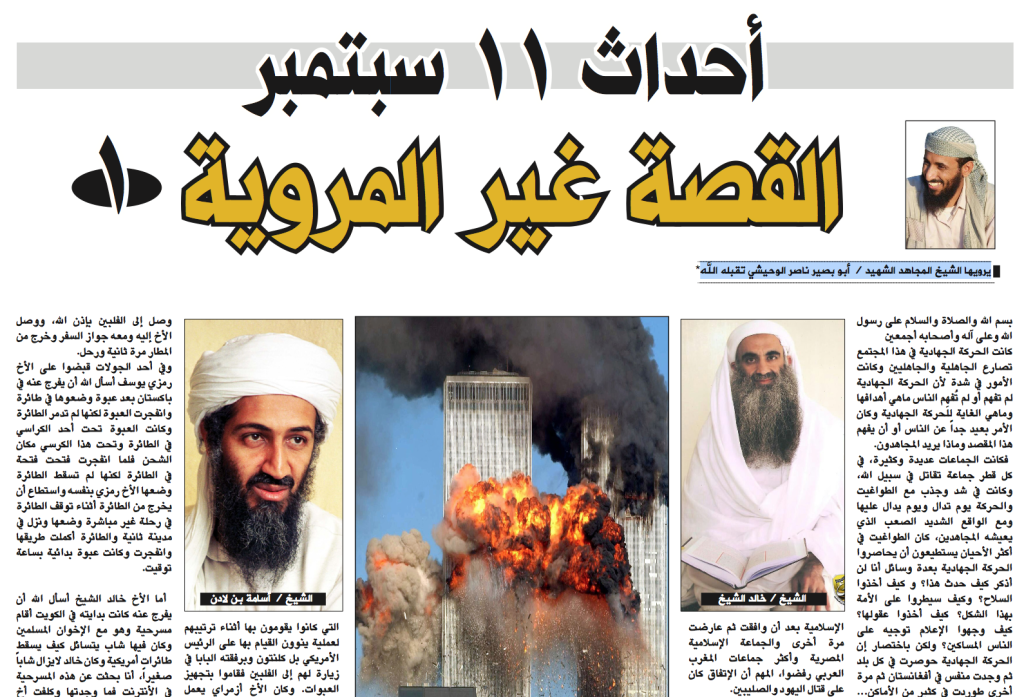
TLWJ: Sometime before his death in a US drone strike in June 2015, Nasir al Wuhayshi recorded an insider’s account of the Sept. 11, 2001 terrorist attacks. As the aide-de-camp to Osama bin Laden prior to the hijackings, Wuhayshi was well-placed to know such details. And al Qaeda in the Arabian Peninsula (AQAP), which Wuhayshi led until his demise, has now published a version of his “untold story.”

A transcript of Wuhayshi’s discussion of the 9/11 plot was included in two editions of AQAP’s Al Masra newsletter. The first part was posted online on Jan. 31 and the second on Feb. 9. The summary below is based on the first half of Wuhayshi’s account.

Wuhayshi began by explaining al Qaeda’s rationale for attacking America. Prior to 9/11, the jihadists’ cause was not supported by the Muslim people, because the mujahideen’s “goals” were not widely understood. The jihadists were divided into many groups and fought “tit-for-tat” conflicts “with the tyrants.” (The “tyrants” were the dictators who ruled over many Muslim-majority countries.)

While the mujahideen had some successes, according to Wuhayshi, they were “besieged” by the tyrants until they found some breathing room in Afghanistan. The “sheikhs” studied this situation in meetings held in Kabul and Kandahar, because they wanted to understand why the jihadists were not victorious. And bin Laden concluded they should fight “the more manifest infidel enemy rather than the crueler infidel enemy,” according to a translation obtained by The Long War Journal. Wuhayshi explained that the former was the “Crusader-Zionist movement” and the latter were the “apostates” ruling over Muslims.

While waging war against the “apostate” rulers was not likely to engender widespread support, no “two people” would “disagree” with the necessity of fighting “the Jews and Christians.” If you fight the “apostate governments in your land,” Wuhayshi elaborated, then everyone – the Muslim people, Islamic movements, and even jihadists – would be against you because they all have their own “priorities.” Divisions within the jihadists’ ranks only exacerbated the crisis, as even the mujahideen in their home countries could refuse to fight.

Wuhayshi then cited Abu Muhammad al Maqdisi, a prominent pro-al Qaeda ideologue, who warned that the “capability” to wage “combat” in Muslim-majority countries did “not yet exist.” So, for instance, if al Qaeda launched a “jihad against the House of Saud,” then “many jihadist movements” would oppose this decision. Al Qaeda’s fellow travelers would protest that they were “incapable” of defeating the Saudi government. And these jihadists would complain they did not want to “wage the battle prematurely,” or become entangled “in a difficult situation.”

For these reasons and more, according to Wuhayshi, bin Laden decided to “battle the more manifest enemy,” because “the people” would agree that the US “is an enemy” and this approach would not sow “discord and suspicion among the people.” Bin Laden believed that the “Islamic movement” would stand with al Qaeda “against the infidels.”

Wuhayshi’s explanation of bin Laden’s reasoning confirms that attacking the US was not al Qaeda’s end goal. It was a tactic, or a step, that bin Laden believed could unite the jihadists behind a common purpose and garner more popular support from “the people.”

Not all jihadists agreed with bin Laden’s strategy. In February 1998, bin Laden launched a “Global Islamic Front for Waging Jihad Against the Jews and Crusaders.” Wuhayshi claimed that a “majority of the groups agreed to” the initiative, but some, like the Libyan Islamic Fighting Group (LIFG), opposed it. (However, some senior LIFG members were folded into al Qaeda.)

Gamaa Islamiya (IG), an Egyptian group, initially agreed to join the venture, but ultimately rejected it. As did other groups in the Arab Magreb, according to Wuhayshi. (Some senior IG leaders remained close to al Qaeda and eventually joined the organization.)

Although Wuhayshi claimed that a “majority” of jihadist organizations agreed with bin Laden’s proposal, only three ideologues joined bin Laden and Ayman al Zawahiri in signing the front’s infamous first fatwa.

In August 1998, just months after the “Global Islamic Front” was established, al Qaeda struck the US Embassies in Kenya and Tanzania. According to Wuhayshi, bin Laden held a series of meetings around this time, as he sought to convince as many people as possible that attacking America was the right course. Some jihadists objected, believing it would ensnare them in a trap. But bin Laden pressed forward, telling those who didn’t agree that they wanted to fight “lackeys” without confronting “the father of the lackeys.” Al Qaeda’s path “will lead to a welcome conclusion,” Wuhayshi quoted bin Laden as saying.

The “initiative against the Crusaders continued” after the US Embassy bombings, Wuhayshi said, and the number of people who supported it increased “dramatically.” During this period, the “Global Islamic Front” launched operations against the “Crusaders” on the ground and at sea, but the idea to strike “from the air with planes” had not yet been conceived.

The origins of the 9/11 plot

Wuhayshi traced the genesis of the 9/11 plot to both Osama bin Laden and Khalid Sheikh Mohammed (KSM), who would come to be known as the “mastermind” of the operation.

But he also credited Abdullah Azzam for popularizing the concept of martyrdom in the first place. Azzam was killed in 1989, but is still revered as the godfather of modern jihadism. After the mujahideen had defeated the Soviets in Afghanistan, they considered “hitting the Americans,” Wuhayshi claimed. Azzam “spoke harshly about the Western military camp.” Azzam also “introduced” the jihadists to a “new tactic.” Wuhayshi recommended that people listen to Azzam’s “final speech,” in which he reportedly said: “God gave me life in order to transform you into bombs.”

Years later, on Oct. 31, 1999, bin Laden watched as the co-pilot of EgyptAir Flight 990 crashed the jet into the Atlantic Ocean, killing more than 200 people on board. Bin Laden, according to Wuhayshi, wondered why the co-pilot didn’t fly the plane into buildings. After this, Wuhayshi claimed, the basic idea for 9/11 had been planted in bin Laden’s mind.

In reality, the EgyptAir crash came after the outline of the 9/11 plot had been already sketched. For instance, the 9/11 Commission found that KSM “presented a proposal for an operation that would involve training pilots who would crash planes into buildings in the United States” as early as 1996. “This proposal eventually would become the 9/11 operation.” In March or April 1999, according to the Commission’s final report, bin Laden “summoned KSM to Kandahar…to tell him that al Qaeda would support his proposal,” which was referred to as the “planes operation.”

Indeed, Wuhayshi recounted how KSM and his nephew, Ramzi Yousef, plotted to attack multiple airliners in the mid-1990s. In the so-called Bojinka plot, KSM and Yousef even conceived a plan to blow up as many as one dozen airliners. Wuhayshi recalled how Yousef placed a bomb on board one jet as part of a test run. Their plot failed and Yousef was later captured in Pakistan. Yousef has been incarcerated for two decades after being convicted by an American court for his role in Bojinka and the 1993 World Trade Center bombing. Wuhayshi prayed for his release.

Wuhayshi told a story that, if true, means KSM had dreamed of attacking the US since his youth. When he was a member of the Muslim Brotherhood in Kuwait, KSM wrote a play in which a character “ponders how to down an American aircraft.” Wuhayshi claimed to have searched for this play online, but he and another “brother” failed to find it.

Still, Wuhayshi insisted that KSM wrote the play, showing he was already thinking of ways to strike America as a young man.
Syria, now Uncontrollable

Opposition Leader: U.S. Diplomacy Costs Syrian Lives

Bloomberg: In the days since the collapse of the Syria peace talks championed by U.S. Secretary of State John Kerry, the humanitarian catastrophe in northern Syria has grown, tens of thousands of new refugees were created, and the Russian- and Iranian-backed killing of civilians has increased. These are all consequences of the flawed U.S. strategy, according to the lead negotiator for the Syrian opposition.

Riyad Hijab was prime minister of Syria in 2012 under the dictator Bashar al-Assad; he became the highest-ranking defector from the regime when he switched sides and joined the rebels. He is now the leader of the High Negotiating Committee that represented the Syrian opposition at last week’s meetings in Geneva, which collapsed after two days. Kerry had pressured the Syrian opposition leaders to attend, even warning they could lose their U.S. funding if they boycotted. Hijab says that Kerry’s approach — to try to persuade Assad and Russia to negotiate while the offensive continues — has actually made things much worse.

“The administration is saying it is testing the good faith of the other side,” Hijab told me in a phone interview on Monday. “But when you are testing these things and it fails, the price that is being paid is horrendous death and the expansion of extremism and terrorism on the ground.”

Syrian forces backed by Russian air power are pressing an offensive against rebel groups in and around Aleppo, the nation’s largest city, that began before the scheduled peace talks. Kerry said Friday, “This has to stop.” He said he would know if the other parties, such as Russia, were “serious” about upholding United Nations Security Council resolutions on protecting civilians after a meeting later this week in Munich of the international group of countries supporting proxies in the Syrian civil war.

In the eyes of the Syrian opposition, Russia and Iran are making a mockery of the peace process, and Kerry’s reluctance to acknowledge this is putting them in deadly harm. It also creates more problems for America’s regional allies, aids the Islamic State and dims the prospects for future peace talks. “The failures of the negotiations end up lowering the credibility of the moderate opposition in front of the Syrian people,” said Hijab. “United States credibility is plummeting within the population of Syria but also in the region as a whole.”

This week, it is Syrians near Aleppo who are paying the price. Regime forces, with Russian support, are advancing toward the Turkish border, threatening to cut off opposition groups and civilians from their source of aid. At least 35,000 people have joined the flood of refugees since the collapse of the talks, ahead of what many anticipate will be another in a long line of starvation sieges the regime is perpetrating on cities. Hijab said there are now 18 cities under siege, three more than when the talks began. More here.

Syria, already a catastrophe, seems on the verge of an uncontrollable disaster

WaPo: Suddenly, after four years of brutal civil war, Syria this week became even more of an uncontrollable military, diplomatic and humanitarian disaster.

“We are not blind to what is happening,” Secretary of State John F. Kerry said Tuesday, as he prepared for a meeting in Munich of stakeholders from outside Syria. “We are all very, very aware of how critical this moment is.”

The Thursday gathering could well be the last gasp of a three-month, Kerry-orchestrated effort to bring together powerful countries on all sides of the conflict — from Russia and Iran on behalf of the government of Syrian President Bashar al-Assad, to the United States and its partners on the opposition side — to try and forge a political solution that would allow them all to focus their efforts on defeating the Islamic State.

What seemed possible even two weeks ago, however, now seems all but hopeless. Failure of planned peace negotiations could lead President Obama finally to a decision he has long resisted — whether to more fully arm and back rebel groups whose cohesion and commitment to a democratic and secular Syria he mistrusts.

In recent days, Russian bombardment of opposition forces north of Aleppo, a rebel stronghold, has severed opposition supply lines and threatens to allow government-aligned forces to encircle the city. In a letter sent to the Obama administration this week, Russia proposed to stop the bombing on March 1, allowing it to continue for another three weeks

The Russian blitz has allowed pro-government ground forces, mostly composed of Iranian-trained militias from Iraq, Iran and Lebanon’s Shiite Hezbollah, to push north to with 20 miles of the Turkish border. This is the same area where the United States and Turkey have planned to carve out an opposition-held zone to combat Islamic State forces approaching it from the east.

Tens of thousands of new refugees have fled Aleppo and its environs to the recently closed Turkish border. Mercy Corps, one of the few aid agencies in a position to help them, said Tuesday that its supplies will soon run out. For those who haven’t fled, the encirclement of Aleppo “would leave up to 300,000 people, still residing in the city, cut off from humanitarian aid unless cross-line access could be negotiated,” the United Nations said.

In Europe, where a flood of nearly a million migrants and refugees from the region, most of them Syrians, have already arrived, political and social tensions are threatening the foundation of European unity constructed over the past 70 years.

“There are fault lines emerging that we thought we had overcome,” said Peter Wittig, Germany’s ambassador to the United States, who described the situation as an existential threat to Europe.

“The United States has been slow to recognize this is a much bigger thing than anything else we’ve experienced since the beginning of the European Union,” Wittig said. “We didn’t see it earlier, we were totally unprepared. . . . We’re not blaming the United States. It takes time for this country to realize that it’s really that serious.”

Germany has taken in the bulk of the migrants and refugees, while some Eastern European members of the E.U. have closed their borders to them.

Negotiation track derided

U.S. ties have become strained with partners closer to the conflict. These allies fear the Obama administration has been blinded to the threat from Russia and Iran by its desire to believe they can be swayed by diplomatic reason and appeals to shared worries about expansion of the Islamic State.

One senior official from a close partner nation described the negotiation track as a farce. The official said that it was unrealistic to expect the opposition to come to the table when its forces are being decimated on the ground and civilians are being starved by Russian bombing and the government gains it has enabled, in violation of United Nations resolutions that Moscow agreed to in order to get the talks started. The official, who said that U.S. leadership is still essential if the war is to end, did not want to be identified by name or nationality in order to speak candidly.

Frontline Turkey, a NATO ally and member of the U.S.-led coalition against the Islamic State, has dithered over its priorities, concerned that a U.S. alliance with Syrian Kurds fighting against the militants will give advantage to Turkish Kurds who seek independence. Even as pro-government forces expand north from Aleppo, Kurdish fighters in Syria’s northwest corner are pushing into the same area.

Turkish President Recep Tayyip Erdogan has demanded that the United States choose between Turkey and the Syrian Kurdish Democratic Union Party. After State Department spokesman John Kirby said this week that the United States does not consider the Syrian Kurds to be terrorists while recognizing that Turkey does, the Ankara government called in U.S. Ambassador John R. Bass on Tuesday for a dressing-down.

Talks between the Syrian government and opposition were suspended before they began this month after rebel representatives said they would not sit at the table until the government provided humanitarian access to besieged areas and released women and children it is holding prisoner. The Munich meeting, originally scheduled to monitor progress in the negotiations, became a final effort to get them started.

Scorched-earth policy

Kerry has long sought a more muscular U.S. policy than Obama has allowed. But he also firmly believes that if negotiations can begin, Assad will eventually be forced from power, with Russian acquiescence in the face of the inevitable.

For the moment, Moscow seems more interested in adjusting the balance of power on the ground — where just months ago, the rebels were on the ascendant — to strengthen Assad’s position before entering talks about his future.

Near the Turkey-Syria border Tuesday, rebels said they fear they are being betrayed by the countries they thought were their allies — most notably the United States. Without significant new injections of arms and ammunition, they said, they will not survive the combined onslaught of intense Russian airstrikes and advances by pro-government ground forces.

“Russia is the second superpower in the world, and Russia is using all of its power against the rebels,” said Mohammed Adib, a political officer with Jabhat Shamiya, the main rebel group fighting in northern Aleppo province. “They’re using a scorched-earth policy, and they don’t care what the international community says.”

“The problem is the friends of the regime are really good friends and give lots of support, whereas our friends sometimes give support and sometimes not,” he said.

While they don’t expect they will receive anti-aircraft missiles, which would have a major impact on the balance of power, rebels said they still hope to receive upgraded weapons, including new-generation models of the TOW missiles that have proved effective at taking out the Syrian government’s aging battle tanks, though these are no match for newly supplied Russian T-90 tanks.

If the rebel fighters cannot rebound, Adib and other rebel spokesmen said, there is a risk that opposition fighters will join more radical organizations, including the Islamic State. “People will not surrender to [Assad] under any circumstances,” said Khaled Shihabeddine, a political adviser to the Noureddin al-Zinki rebel group. “If things stay as they are, with no support and no one stopping Russia, the rebels will be pushed into a corner and . . . all possibilities will be open.”

Saudi Arabia Diving into Islamic State War?

Carter: Saudis to Contribute More in Counter-ISIL Fight

WASHINGTON, February 5, 2016 —The Saudi Arabian government has indicated its willingness to do more with the coalition in the fight against the Islamic State of Iraq and the Levant, Defense Secretary Ash Carter said yesterday at Nellis Air Force Base in Nevada.

Speaking with reporters after addressing airmen at the Air Force installation, Carter said he looks forward to discussing contributions to the accelerated anti-ISIL fight with the Saudis and 25 other nations next week in Brussels.

“The United States has very much indicated our desire to accelerate the campaign to defeat ISIL, [and] we’ll do that better, and it’ll be easier to sustain the defeat … if other countries that are part of the coalition accelerate their efforts at the same time,” Carter said.

Positive Contribution

Saudi Arabia also has said it’s willing to take the lead in marshaling some Muslim-majority countries, he added, noting that the local population in Syria and Iraq will sustain the defeat of ISIL.

“The Saudis indicated that they and other countries would be best positioned to help make those arrangements,” the secretary said. “I think that’s a very positive contribution as well.”

On other contributions, Carter said the Dutch also have said they are willing to join in the counter-ISIL campaign in Syria, as they have done in Iraq.

“So you see others stepping up,” he added, “and the reason I’m going to Brussels next week is to bring the full weight of the coalition behind accelerating the defeat of ISIL.”

Budgetary Priority

To the airmen in Nevada, Carter previewed the Air Force portion of the fiscal year 2017 DoD budget proposal, noting that the Pentagon is adding another $1 billion over the next five years for the kind of training available at Nellis, home of the Air Force Warfare Center.

“Nellis is incredibly important to the Air Force, now and in the future, [and] they can expect increased investments in the quality of the range, in the intensity of the training, the number of exercises conducted here, the variety of aircraft that will be coming here and will need to be maintained here,” Carter said.

“This is a critical place,” he added. “It’s going to stay a critical place, and it’s going to get budgetary priority. The key is readiness — that’s the key to the Air Force today and tomorrow.”

***

Saudi Arabia vs Iran: The view from Turkey, stuck in the middle

ISTANBUL – Turkey should avoid picking sides in the current diplomatic crisis between Saudi Arabia and Iran, according to experts.

“I hope that Turkey doesn’t feel that it needs to rush in and take sides in this issue. It’s not in the interests of the region that everyone lines up on one side or the other,” said Stephen Kinzer, a visiting fellow at the Watson Institute for International Studies and a former bureau chief for the New York Times in Istanbul.

Sunni-majority Saudi Arabia terminated diplomatic ties with its longtime rival Iran, which has a Shi’a majority, on Sunday following an attack by protestors on its embassy in Tehran. The protestors, who the Saudi foreign minister said were supported by the Iranian government, were angry at Saudi Arabia’s execution of prominent Shi’a cleric and critic of the Kingdom Nimr Al-Nimr on Saturday.

“This certainly heralds a more acute period of confrontation between the two,” said Sinan Ülgen, former Turkish diplomat and chairman of The Centre for Economics and Foreign Policy Studies in Istanbul.

Turkey, majority-Sunni, has relations with Saudi Arabia and Iran, and has called for restraint from both sides. Ankara criticized Saudi Arabia for “political death penalties” without specifically mentioning Nimr, and said Iran must protect all diplomatic missions in its country, calling the attacks on the Saudi embassy “unacceptable.”

Ülgen told The Media Line that since the American invasion of Iraq in 2003 and the ensuing instability, “we have seen a rise in sectarian tension between Tehran and Riyadh.”

However, both Ülgen and Kinzer say that dismissing the conflict purely as religious sectarianism is overly simplistic.

“Sectarianism is being used as a façade, behind which Saudi Arabia and Iran are jousting for power in the Middle East,” Kinzer told The Media Line. “Basically these are the only remaining powers in the [region]. You’d like to think the Middle East is big enough for both of them, but it doesn’t seem that way.”

Christian Patrols vs. Islamists in England

Britain First, Fighting Back, what is real on the streets on London and the suburbs. Courtesy of BritainFirst.org.

In towns like Ulster, Dewbury, Rotherham and Luton it is Chritians versus Islam where Britain First is taking a stand to reclaim their country. England is full of ‘no-go’ zones where  the corrupt government has relinquished sovereignty to a violent culture and ideology.

Jayda Fransen, Deputy Leader of Britain First podcast:


Homs. Syria: Today

Context: New York City in 2014 had an estimated population of 8.49 million. Today in Syria, 11 million people have fled the country. Starvation is everywhere.

Iran and Russia have been long time friends with Bashir al Assad and both rogue countries continue to prop up Assad.

Every world leader is responsible for this and to blame. 5 years of Bashir al Assad, years of Islamic State, years of al Nusra. Russia continues to bomb those fighting against the Assad regime with wild abandon. This is 2016, how can a modern day holocaust be so real. No one can fully estimate the death tolls, 200,000 or 500,000?


What are the prospects for anyone to ever return? How can this be rebuilt?

Homs: Homs did not emerge into the historical record until the 1st century BCE at the time of the Seleucids. It later became the capital of a kingdom ruled by the Emesani dynasty who gave the city its name. Originally a center of worship for the sun god El-Gabal, it later gained importance in Christianity under the Byzantines. Homs was conquered by the Muslims in the 7th century and made capital of a district that bore its current name. Throughout the Islamic era, Muslim dynasties contending for control of Syria sought after Homs due to the city’s strategic position in the area. Homs began to decline under the Ottomans and only in the 19th century did the city regain its economic importance when its cotton industry boomed. During French Mandate rule, the city became a center of insurrection and, after independence in 1946, a center of Baathist resistance to the first Syrian governments.

Large parts of Syria are reduced almost entirely to rubble after five years of civil war.

As attitudes and policies towards refugees harden across Europe, a video has emerged that exposes the utter devastation Syrians are fleeing from.

Revealing in detail the consequences of the country’s five-year civil war, the drone footage shows the piles of rubble ruined buildings that Homs – previously Syria’s third largest city – has been reduced to.

While the video reflects the utter desolation in a city that was once home to more than 650,000 people, peace talks aimed at ending hostilities remain frustratingly unproductive.
The video that shows the Syrian peace talks cannot come soon enough
Arguments over who should or should not attend the negotiations overshadowed the continuous damage wrought in a war that has seen over 11 million Syrians flee, more than half the country’s entire population.

The video was shot by Alexander Pushin, a cameraman for Russian state television.

While his drone footage from Syria has been described as propaganda designed to promote Russia’s military involvement in the country, the startling scale of devastation it exposes is beyond question.
Even as news emerged of nine people who died attempting to reach the relative safe haven of Europe, anti-refugee sentiment appears to be growing across the continent.

Denmark recently introduced legislation that permits the seizing of refugees’ valuables, which drew comparisons to the treatment of Jews by Nazi Germany.
Sweden is rejecting applications from 80,000 people who sought asylum in the Scandinavian country last year, while Finland also intends to expel 20,000 of the 32,000 applications received in 2015.

Angela Merkel announced recently that Syrian refugees would be expected to return to the Middle East once the conflict is over, while British Prime Minister David Cameron dismissed those living in the squalor of Calais’ “Jungle” as “a bunch of migrants”.

Starting in 2011, the ongoing conflict in Syria pitches Bashar al Assad’s regime – aided by Russia – against a multitude of different and competing factions, including Islamist group Isis and associated militias.

The language of a continent that once appeared to welcome refugees no longer appears so accommodating, despite the evidently dire situation in Homs, Damascus and other Syrian cities reduced to ruins over the last five years.