
President’s Day, Was George Washington a Spy?

The Spymaster’s Toolkit

CIA: Long before General William Donovan recruited spies to advance the American war efforts during World War II as Director of the Office of Strategic Services (OSS), predecessor to the CIA, General George Washington mastered the art of intelligence as Commander of the Continental Army during the Revolutionary War.

Washington was a skilled manager of intelligence. He utilized agents behind enemy lines, recruited both Tory and Patriot sources, interrogated travelers for intelligence information, and launched scores of agents on both intelligence and counterintelligence missions. He was adept at deception operations and tradecraft and was a skilled propagandist. He also practiced sound operational security. Washington fully understood the value of accurate intelligence, employing many of the same techniques later used by the OSS and CIA.

As we celebrate the 284th birthday of the first American President, we highlight some of the tradecraft employed to secure our independence from the British and offer insights on its use today. Were it not for the use of secret writing, concealment devises, propaganda, and intercepted communications, there may have been a very different outcome to the War of Independence.

* * * * *

SECRET WRITING

Revolutionary War: American agents serving abroad composed their intelligence reports using invisible ink. George Washington believed this would “not only render his communications less exposed to detection, but relieve the fears of such persons as may be entrusted in its conveyance.”

Communicating via invisible ink required the use of several chemical compositions. One mixture was used to write with disappearing ink, the other mixture was applied to the report to make it legible. Despite their invisible communications, it is estimated that the British intercepted and decrypted over half of America’s secret correspondence during the war.

CIA: The CIA has declassified several documents that provided recipes for making invisible ink. One recipe instructs: “Take a weak solution of starch, tinged with a little tincture of iodine. This bluish writing will soon fade away.” A mixture for exposing secret writing included “iodate of potassium, 5 grams, with 100 grams of water, and 2 grams of tartaric acid added” but warned, “run a hot iron over the surface being careful not to scorch the paper.”

During the Cold War, a major advancement in secret writing technology was the shift from liquid invisible inks to dry systems. The KGB was one of the first foreign intelligence services to employ a dry method. The CIA’s Office of Technical Services in the Directorate of Science and Technology spent considerable time researching Soviet systems and finally succeeded not only in “breaking” them, but in anticipating where its KGB counterpart would go next in the never-ending search for more secure systems. By the end of the Cold War, a kind of tacit convergence had emerged as both sides applied new techniques that used very small, almost undetectable quantities of chemical in secret writing messages. In the words of one CIA chemist, it was like “uniformly spreading a spoonful of sugar over an acre of land.”

CONCEALMENT DEVISES

Revolutionary War: Agents used a variety of modified objects to conceal their secret messages.  One device was a wafer-thin lead container that would sink in water, or melt in fire, thus destroying its contents. The device was small enough that an agent could swallow it if no other means of discarding were available. This was done as a last resort as ingestion was typically followed by a severe bout of lead poisoning. The lead container was eventually replaced by a silver, bullet-shaped container that could be unscrewed to hold a message and which would not poison a courier who might be forced to swallow it.

CIA:  A concealment devise can be any object used to clandestinely hide things. They are typically ordinary, every-day objects that have been hollowed out. The best concealment devises are ones that blend in with their surroundings and call no attention to themselves. They can be used to hide messages, documents, or film. Some examples of concealment devises include hollowed out coins, dead-drop spikes, shaving brushes, and makeup compacts.

PROPAGANDA

Revolutionary War: During the American Revolution, the British had a shortage of soldiers so they hired almost 30,000 German Hessian auxiliary forces to fight against the Americans. The Continental Congress devised a propaganda campaign to encourage the Hessian mercenaries to defect to America. The campaign included offering land grants to those mercenaries fighting for the British on American soil. The offers were written in German on leaflets disguised as tobacco packets. A mock-defector ran through the mercenaries’ camps encouraging others to defect as well. As part of the campaign, Benjamin Franklin forged a letter to the commander of the Hessians, “signed” by a German prince. The letter instructed the commander to let the wounded mercenaries die. This dealt a blow to the morale of the Hessians. Between 5,000 and 6,000 Hessian mercenaries deserted from the British, in part because of American propaganda.

CIA: Propaganda campaigns use communication to alter a population’s beliefs and views thus influencing their behavior. There are three types of propaganda: white, black, and grey. White propaganda openly identifies the source and uses gentle persuasion and public relations techniques to achieve a desired outcome. For example, during the Persian Gulf War, the CIA airdropped leaflets before some Allied bombing runs to allow civilians time to evacuate and encourage military units to surrender. Black propaganda, on the other hand, is misinformation that identifies itself with one side of a conflict, but is truly produced by the opposing side – like Franklin sending the letter “from” a German prince. Grey propaganda is the most mysterious of all because the source of the propaganda is never identified.

INTERCEPTED COMMUNICATIONS

Revolutionary War: The Continental Congress regularly received quantities of intercepted British mail. General Washington proposed to “contrive a means of opening them without breaking the seals, take copies of the contents, and then let them go on. By these means we should become masters of the whole plot.”

CIA: Clandestinely opening, reading and resealing envelopes or packages without the recipient’s knowledge requires practice. ‘Flaps and seals’ opening kits were used in the 1960s. A beginner’s kit offered the basic tools for surreptitious opening of letters and packages. Once mastered, an advanced kit with additional tools was used. Many of the tools were handmade of ivory and housed in a travel roll.

* * * * *

Washington employed the use of many other intelligence gathering techniques still in use today to secure our independence and freedom from Great Britain. Not only is he The Father of His Country, but he is heralded as a great spymaster. Upon the conclusion of the Revolutionary War, a defeated British intelligence officer is quoted as saying, “Washington did not really outfight the British. He simply out-spied us.”
The Constitutional Jurist, Scalia has Been Called Home

A man who understood every word of the U.S. Constitution and applied them in their original context. The law does not follow the mood or attitude of the country, rather the country must follow the mood and the attitude of the Constitution.

Two Texas news sources, confirmed by CBS and Fox News, report the sad news that Supreme Court Associate Justice Antonin Scalia is dead:

Scalia, 79, was a guest at the Cibolo Creek Ranch, a resort in the Big Bend region south of Marfa.

According to a report, Scalia arrived at the ranch on Friday and attended a private party with about 40 people. When he did not appear for breakfast, a person associated with the ranch went to his room and found a body.

Chief U.S. District Judge Orlando Garcia, of the Western Judicial District of Texas, was notified about the death from the U.S. Marshals Service.

U.S. District Judge Fred Biery said he was among those notified about Scalia’s death…

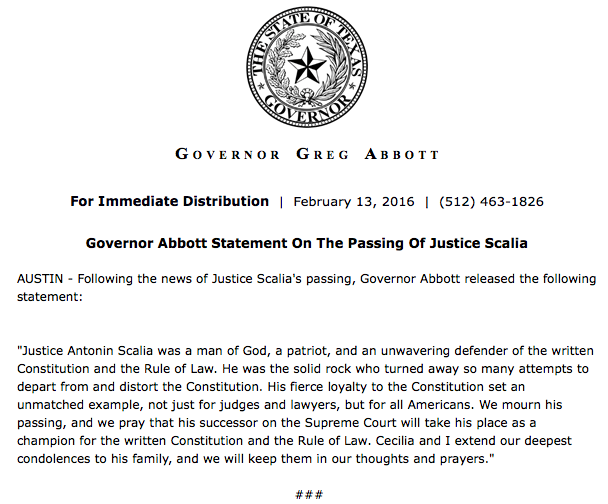
Texas Gov. Greg Abbott released a statement Saturday afternoon, calling Scalia a man of God, a patriot and an “unwavering defender of the written Constitution.”

“He was the solid rock who turned away so many attempts to depart from and distort the Constitution,” Abbott said. “We mourn his passing, and we pray that his successor on the Supreme Court will take his place as a champion for the written Constitution and the Rule of Law. Cecilia and I extend our deepest condolences to his family, and we will keep them in our thoughts and prayers.”

Scalia was nominated to the U.S. Supreme Court in 1986 by President Ronald Reagan.

Here is an interview our own Peter Robinson did with Justice Scalia about three years ago:

NationalLawJournal: U.S Supreme Court Justice Antonin Scalia, the intellectual leader of the court’s conservative wing, is dead at age 79. According to official reports from Texas, he died overnight at a ranch in west Texas where he had gone quail hunting.

His sudden death came as he was about to mark his thirtieth year on the court; he is the longest-serving current member. Appointed by President Ronald Reagan, Scalia is the father of nine and a former law professor.

Scalia’s death sets up a major battle over his successor. Because of Scalia’s pivotal role on the court’s right wing, Republicans could block almost any nominee put forward by President Barack Obama. Scalia once said he would never retired during the tenure of any president whose nominee would try to dismantle his jurisprudence.

Chief Justice John G. Roberts Jr. issued a statement Saturday afternoon: “On behalf of the Court and retired Justices, I am saddened to report that our colleague Justice Antonin Scalia has passed away. He was an extraordinary individual and jurist, admired and treasured by his colleagues. His passing is a great loss to the Court and the country he so loyally served. We extend our deepest condolences to his wife Maureen and his family.

Scalia was perhaps the court’s most bombastic and colorfulmember, with caustic dissents in some of the court’s most landmark decisions.

In the 2013 United States v. Windsor case, he dismissed the majority’s rationale for striking down the Defense of Marriage Act as “legal argle-bargle.” But his dissent proved prescient, forecasting the series of rulings that struck down state bans on same-sex marriage. “It is just a matter of listening and waiting for the other shoe,” Scalia wrote in his dissent.

Asked frequently about Bush v. Gore, the 2000 ruling that resolved the 2000 presidential election, Scalia would just say, “Get over it.”

Read more: http://www.nationallawjournal.com/id=1202749702587/Justice-Antonin-Scalia-Leader-of-Courts-Conservative-Wing-Dies-at-79#ixzz405lGu8O6


Pay Your Bills Years in Advance, Negative Interest Rate

Primer: 

The Federal Reserve System‍—‌also known as the Federal Reserve or simply as the Fed‍—‌is the central banking system of the United States. It was created on December 23, 1913, with the enactment of the Federal Reserve Act, largely in response to a series of financial panics, particularly a severe panic in 1907. Over time, the roles and responsibilities of the Federal Reserve System have expanded, and its structure has evolved. Events such as the Great Depression in the 1930s were major factors leading to changes in the system.[10]

The U.S. Congress established three key objectives for monetary policy in the Federal Reserve Act: Maximizing employment, stabilizing prices, and moderating long-term interest rates. The first two objectives are sometimes referred to as the Federal Reserve’s dual mandate. Its duties have expanded over the years, and as of 2009 also include supervising and regulating banks, maintaining the stability of the financial system and providing financial services to depository institutions, the U.S. government, and foreign official institutions. The Fed conducts research into the economy and releases numerous publications, such as the Beige Book.

Negative 0.5% Interest Rate: Why People Are Paying to Save

When you lend somebody money, they usually have to pay you for the privilege.

NYT’s: That has been a bedrock assumption across centuries of financial history. But it is an assumption that is increasingly being tossed aside by some of the world’s central banks and bond markets.

A decade ago, negative interest rates were a theoretical curiosity that economists would discuss almost as a parlor game. Two years ago, it began showing up as an unconventional step that a few small countries considered. Now, it is the stated policy of some of the most powerful global central banks, including the European Central Bank and the Bank of Japan.

On Thursday, Sweden’s central bank lowered its bank lending rate to a negative 0.5 percent from a negative 0.35 percent, and said it could cut further still; European bank stocks were hammered partly because investors feared what negative rates could do to bank profits. The Federal Reserve chairwoman, Janet Yellen, acknowledged in congressional testimony Wednesday and Thursday that the American central bank was taking a look at the strategy, though she emphasized no such move was envisioned.

But as negative rates — in which depositors pay to hold money in bank accounts — become a more common fixture, there are many unknowns about what these policies mean for finance, for the economy and even for the definition of money.

These are some of the key questions, and, where we have them, the answers.

So how do negative interest rates work?

It depends. In the cases of interest rate targets set by central banks like the E.C.B. and Swedish Riksbank, they set a negative target rate for banks, and banks in turn pass it along to their customers. The E.C.B., for example, currently has a negative 0.3 percent rate, meaning that when banks deposit money at the central bank overnight, they pay for the privilege.

Banks have different ways of passing the negative rates on to depositors, often framed as fees for keeping money in an account, which is basically negative interest rates by another name.

Bond markets reflect these negative rates, too, including for longer-term government debt. For example, if you bought a two-year Swiss government bond on Thursday, you would have needed to pay a price that resulted in a yield of negative 1.12 percent. Even 10-year Swiss bonds have a negative rate, a sign markets expect below-zero rates to persist in Switzerland for many years to come.

Generally companies that borrow money are viewed as riskier than governments, so they have to pay higher interest rates. Therefore negative-rate corporate debt is still rare. But it has happened, including with corporate bonds issued by the Swiss food giant Nestle.

But don’t people just withdraw cash rather than pay to deposit it at their bank or buy a government bond that will give them back less than they paid?

You’d think, right? This was exactly why economists had long thought that negative interest rates were impossible. It helps explain why central banks first turned to other tools, including quantitative easing, when they saw a need to ease monetary policy despite interest rates that were already near zero.

But it looks as if the convenience of keeping money in a bank account is worth a small negative interest rate or fees for most consumers and businesses, at least at the only slightly negative rates currently in place. Storing and providing security for cash may be more expensive than a small bank charge.

When initial experiments in Switzerland and Sweden didn’t result in mass withdrawals from the banking system, larger central banks in need of easier money moved gingerly in the same direction. They’ll stop when either their economies start to grow or they see more concrete evidence that negative rates are doing more harm than good.

How is this supposed to help the economy?

Pretty much the same way it always is supposed to help the economy when a central bank cuts rates. Lower rates encourage business investment and consumer spending; increase the value of the stock market and other risky assets; lower the value of a country’s currency, making exporters more competitive; and create expectations of higher future inflation, which can induce people to spend now.

We have decades of experience with central banks trying to manage the economy by, for example, cutting bank rates to 2 percent from 3 percent when there is an economic downturn. The shift to negative rate policies is, hypothetically at least, the same, but with a starting point of rates already around zero.

So does it work?

It’s hard to say with any certainty yet. At a minimum, it seems to have an effect of lowering the value of a currency, which makes export industries very happy. It’s less clear whether it can help create sustained economic growth, particularly when the hard-to-calculate downsides are factored in.

What are those downsides?

The global financial system is built on an assumption of above-zero interest rates. Going below zero could cause damage to the very architecture by which money and credit zoom through the economy, and in turn inhibit growth.

Banks could cease to be viable businesses, eliminating a key way that money is channeled from savers to productive investments. Money market mutual funds, widely used in the United States, could well cease to exist. Insurance companies and pension funds could face their own major strains.

In a speech last year, Hervé Hannoun, then the deputy general manager of the Bank for International Settlements, even argued that this could “over time encourage the use of alternative virtual currencies, undermining the foundations of the financial system as we know it today.”

Is the Federal Reserve going to do this in the United States?

Janet Yellen doesn’t think so. But in two days of congressional testimony this week, she also didn’t rule it out.

For one thing, the United States economy, and particularly its labor market, looks to be in stronger shape than that of many others around the world. So the Fed expects to be in interest-rate raising mode this year (though exactly how fast is very much in question). But even if the economy does take a turn for the worse, there’s no certainty that negative rates are the path the Fed would take.

There is a question of whether that would even be legal. It’s not clear if the language of the Federal Reserve Act allows negative bank rates (J.P. Koning, a financial commentator, runs through the legal issues here). Ms. Yellen said in testimony this week that the legality of negative rates “remains a question that we still would need to investigate more thoroughly.”

She also said that “it isn’t just a question of legal authority.”

“It’s also a question of could the plumbing of the payment system in the United States handle it?” she said. “Is our institutional structure of our money markets compatible with it? We’ve not determined that.”

Financial markets do not now price in meaningful odds of negative rates in the United States. Want one modest clue that negative rates can’t be ruled out, though? In its annual stress test of major banks, the Fed asked the firms to figure out what would happen to their finances in a “severely adverse” scenario that included a sharp rise in unemployment and a rate of negative 0.5 percent rate on short-term Treasury bills — in other words, what you’d expect to see if there were a recession and the Fed cut rates well below zero.

Ms. Yellen noted that the rates on Treasury bills could go negative even in the absence of a policy shift by the Fed, as has happened a few times in the past.

So what are some of the weird things that could happen in a world in which negative rates become routine?

The policies in Europe and Japan are still relatively new and involve rates only slightly below zero. But if the policies become long-lasting, or negative rates go much lower, there are a lot of mind-bending ways it could affect routine transactions.

For example, would people start prepaying years’ worth of cable bills to avoid having money tied up in a money-losing bank account? How about property taxes? Would companies and governments put in place new policies prohibiting people from paying their bills too early?

Or consider this: Many commercial transactions now take place with some short-term credit attached — for example, a company that gets a 60-day grace period to pay bills from its suppliers. Would that flip, and suddenly suppliers would prohibit upfront payment and insist that their customers wait 60 days to pay?

Might new businesses sprout up that allow people to securely store thousands of dollars in bundles of $100 bills, or could people buy physical objects as stores of value that the banks can’t charge a negative interest rate on?

“Negative interest rates in Japan is blowing my mind,” said Jose Canseco, the provocative retired baseball player not normally known for his economic musings, on Twitter. And the truth is, he’s not the only one.

Aleppo Codex, Oldest Surviving Treasure

As the chatter among some world leaders centers around a cessation of hostilities in Syria, tragically Aleppo is a big turning point for history and control. If Damascus is the next target, then history in the region is all but erased.

The Aleppo Codex was written in the 10th century, C.E. At some point the Codex was transferred to Egypt and emerged in Syria. It remained there for 600 years until in 1947, there were riots against Jews and their properties in Aleppo and an ancient synagogue was burned but the Codex survived with some damage. The Aleppo Jewish and Christian community protected the Codex allegedly in a cave as the most sacred possession.

The United Nations Educational, Scientific and Cultural Organization (UNESCO) has officially recognized the Codex as a world treasure.

World treasure: UNESCO recognizes oldest surviving copy of Hebrew Bible

FNC: It is one of the world’s greatest treasures.

Written sometime around 930 A.D. in the town of Tiberias on the shores of the Sea of Galilee, the Aleppo Codex is the oldest surviving copy of the Hebrew Bible, according to experts.

The United Nations Educational, Scientific and Cultural Organization, UNESCO, added the millennium-old manuscript earlier this week to its International Memory of the World Register, which honors some of the most important discoveries in human history.

“It is regarded as the oldest complete Hebrew Bible in the world,” Don Bassett, director of the Biblical Museum of History in Tennessee, told FoxNews.com. “The text has been preserved with phenomenal accuracy,” Bassett said.

Damage to Historical Sites in the Syrian Civil War | Graphiq   Interactive map of damaged or destroyed sites.

All current versions of the Old Testament are believed to have stemmed “in one way or another, from this ancient manuscript,” Adolfo Roitman, head curator of the Shrine of the Book Museum in Jerusalem, told the Christian Post.

“The best Bible for scholarly study available today is traceable back to the Aleppo Codex,” added Bassett.

The Codex, which was smuggled out of Syria and brought into Israel in 1958, currently resides at the museum.

Some 190 pages of the Codex — around 40 percent of the total — are missing, Bassett told FoxNews.com.

The missing pages include four out of five books of the Pentateuch — the first section of books in the Bible also called the Five Books of Moses — and five books from the last section –Lamentations, Ecclesiastes, Esther, Daniel and Ezra, i24News reported.

“It’s fitting the Aleppo Codex has been designated as a world treasure, given its storied past and significance to Jews and Christians through the ages,” said Michael Holmes, Ph.D., executive director of the Museum of the Bible’s research arm, the Scholar’s Initiative. “It’s simply unparalleled in the world of biblical manuscripts.”

There is also a disagreement over who owns the priceless text.

Filmmaker Avi Dabach, who is making a documentary on the ancient manuscript, told the newspaper he believes the Codex belongs to the Jewish community that fled Syria.

“In the 1960s the Aleppo-Jewish community sued the people who brought the Codex to Israel,” Dabach said, according to the Christian Post. “The Israeli authorities decided to confiscate this item and then, from a position of strength, force on the community an arrangement.”

UNESCO says on its website that the manuscript, also known as the “Crown,” is “the oldest extant nearly complete Hebrew Bible (Old Testament).”

“It is considered by many scholars to be the most exact and authoritative Hebrew Bible and served as a source of text, cantillation and vocalization of the Bible – both in the past and present,” according to UNESCO.

The First Refugee Resettlement Program, Medina

Medina—The First Muslim Refugee Resettlement Program

Kilpatrick ~CrisisMagazine: With all the talk about the Syrian refugees, one point is often overlooked. Much of the debate focuses on the question of whether or not the refugees can be reliably vetted. If they can be certified as one hundred percent terrorist-free, then, presumably, the resettlement can safely proceed.

But even if every terrorist could be excluded from the ranks of the refugees, a problem would remain. Many analysts are concerned that the resettlement program might facilitate the growth of terrorist-tolerant communities in America. By “terrorist-tolerant” I don’t mean that its members are thinking every minute about what they can do to support jihad, but rather that they have come to take for granted things that aren’t assumed in other societies.

Terror, for instance. Nonie Darwish, a former Muslim who grew up in Egypt, puts it this way:

One of the reasons that the so-called moderate Muslims have become irrelevant … is that over the centuries they have become tolerant of Islamic terrorism and considered it as part of normal life.

“Life under Sharia itself is a life under terror,” observes Darwish. And that daily low-level terrorism accustoms Muslims to view it as something “like a natural disaster or part of life that must be tolerated.”

So, although a Syrian refugee may have no personal taste for terror, he can be surprisingly tolerant of it. A 2007 public opinion poll of Syrians revealed that 75 percent of those polled supported financial aid for Hamas, Islamic Jihad, Hezbollah, and “Iraqi fighters” (at that time, mostly al-Qaeda). Need it be mentioned that all these groups are designated as terrorist organizations by the U.S. government? A more recent poll of 1,365 Syrians found that one out of five considered ISIS to be a positive influence on the country. And living in the West doesn’t seem to change these attitudes. A 2014 opinion poll showed that 27 percent of the French population in the 18-24-year-old demographic supported ISIS. Assuming a random sample, and assuming that the majority of pro-ISIS respondents were Muslim, that would mean that the vast majority of young French Muslims support ISIS.

That kind of supportive environment is a factor that’s often overlooked in the debate over Syrian refugees. As defenders of the resettlement program like to point out, terrorists can get into the U.S. by other means than by mingling with refugees. But once here, they need a network to support them and give them cover. And the network itself can only function if the larger community is willing to look the other way.

Europe is now dotted with such networks—in the Paris suburbs, in the Brussels borough of Molenbeek, in the Neukölln district of Berlin, and in numerous other places. There is evidence that similar networks already exist in nascent form in the U.S. Beyond the question of whether terrorists will mix in with refugees lies a larger question about the refugee resettlement program. Will it contribute to a strengthening of our society, or will it lead instead to the strengthening and expansion of terror-supportive networks?

Whether or not a particular group of refugees has been infiltrated by ISIS, there remains the fact that many refugees subscribe to the same general worldview held by members of the Islamic State. After all, they’ve been steeped in the same cultural-religious milieu that produced the terrorists. Many of them will take it for granted that Islam is the supreme religion, that Muhammad was the perfect man, and that Jews and Christians are unclean. They may be averse to committing violence, but they may find it perfectly understandable if other Muslims resort to violence in order to avenge a real or perceived insult to Islam. Although that mindset is alien to us, it shouldn’t be incomprehensible. At the time that a death fatwa was issued against the author Salman Rushdie, I remember talking with several Catholics who felt quite sympathetic to the Ayatollah Khomeini (who issued the fatwa), and rather unsympathetic to Rushdie and his “blasphemous” attitude toward religion.

Given their cultural background, it’s reasonable to expect that Sunni Muslim refugees will bring with them a set of beliefs and attitudes conducive to the incubation of terrorism. Even if there were a foolproof method for excluding active terrorists from their midst, there is no way of vetting for future terrorists—young Muslims who at some point in their development decide that ISIS or some similar movement is the logical conclusion of all they have been taught.

This “conversion” to radical Islam can come quite suddenly. Mohamed Abdelslam, the brother of two of the Paris terrorists, told reporters that his brothers began to change roughly six months before the attack, when they, “stopped drinking and started praying.” Likewise, the radicalization of Mohammod Youssuf Abdulazeez, the Chattanooga jihadist who killed five servicemen, could not easily have been forecast. To his classmates and teachers, he seemed like a normal American boy, and if he had problems, they were of the normal young American male variety—pot-smoking, heavy drinking, and fast driving. Unlike other young Americans, however, he would have been exposed—either at home or on Islamist websites—to the belief that one can wipe out one’s sins by an act of martyrdom.

This “sudden conversion syndrome” to more radical forms of Islam is increasingly common among Muslim youth. But, as I said, it’s not easy to predict. If you’re a government official whose job it is to vet refugees, how can you know if the smiling fourteen-year-old boy standing in front of you and surrounded by his polite and pleasant family is going to go radical three years down the line?

Absent other information and unfair as it may seem, his family’s culture has to be taken into account. To some extent, we are all creatures of our culture, and Islamic cultures seem to produce a disproportionate number of terrorists. Contemporary Western culture, on the other hand, seems to produce a disproportionate number of naïve egocentrics who are incapable of imagining that other cultures may be radically different from their own. Their tendency is to automatically project their own values and attitudes on to all they see.

But, as should now be clear to anyone willing to look, Islamic culture is not simply a colorful variation of our own. In those places where traditional Islam is the governing principle—whether in the Islamic State, or in parts of Pakistan, Indonesia, or Nigeria—the same disdain for non-Muslims and their religions can be found. This attitude is common not just among terrorists, but also among ordinary Muslims. By all accounts, the fifteen Muslim migrants who threw twelve Christians overboard during a Mediterranean crossing were not terrorists, they were simply Muslims who took offense when some of the Christians began to pray. Some of the Muslims who attacked Christians in European refugee camps appear to have been members of ISIS, but others were not. Blind to the differences in culture, European officials initially put Christian and Muslim migrants together in the same camps. With a bit more cultural awareness under their belts, they came to the politically incorrect conclusion that the two groups had to be housed separately. A less violent example of Islamic contempt for other cultures was provided by the Turkish soccer fans who booed and chanted when, during a Turkish-Greek soccer match, a moment of silence was requested for the victims of the Paris massacre.

As concerns the Syrian refugee crisis, Christians are regularly reminded that the Holy Family were once refugees in Egypt. Yes, but the culture brought into the world by the Holy Family is worlds apart from the one introduced six centuries later by Muhammad.

Let’s not forget that the Holy Family were once refugees. But in regard to the present crisis there’s another and perhaps more appropriate analogy to consider: Muhammad and his followers were also once refugees. He and his group of about 100 men, women, and children had long overstayed their welcome in Mecca. According to Muslim chroniclers, they had to flee in order to avoid persecution. Fortunately for Muhammad, the more “enlightened” citizens of Medina extended an invitation to the Muslims to come and live in their city. It is not recorded whether or not they held up large “welcome refugees” banners as is now the custom at European train stations, but they soon enough experienced the kind of regrets that Europeans are now having. Muhammad gradually acquired wealth and converts, and within a half-dozen years he was the master of Medina. Those Medinans who were not exiled or slaughtered were thoroughly subjugated. Muhammad then used Medina as the launching pad for his conquest of all Arabia. Within a century of his death, his followers had conquered nearly half of the civilized world.

The relevant analogy for our society is not the flight to Egypt, but the flight to Medina and the subsequent colonization of that city by the Muslims. A similar process of cultural conquest by migration is now underway in Europe. Citizens of the United States would be well-advised to monitor the situation over there before embarking on their own ill-considered experiment in welcoming the stranger.