ISIS Crossing Southern Border From Mexico and Money?

ISIS Crossing Southern Border From Mexico? More Smugglers Sending Money Transfers To Middle East, Arizona Official Claims

IBT: Arizona’s attorney general is raising the alarm about a potential connection between illegal immigration and Middle East terrorism. Attorney General Mark Brnovich said Arizona residents are worried about border security.
“We’ve seen a huge spike in money transfers coming from places like Nogales on the border, to Middle Eastern countries,” he said on Fox Business Network ahead of the Arizona primary on Tuesday. “Arizona is on the front line, and we have seen consequences of what has happened when we’ve had an unsecured, porous border. I mean, frankly, just six months ago there were six folks apprehended from Middle Eastern countries, from Pakistan and Afghanistan, at our border. I know when you talk to the ranchers down there, they’re concerned because they have found coins from Middle East.”

After waves of terror attacks in Europe and Africa in recent months, conservative lawmakers in the U.S. have increasingly warned about the threat of Islamic State group militants or other terrorists crossing the Mexico border. But immigration reform proponents have argued that making the dangerous border crossing into Arizona is an unlikely path for terrorists, and many of the Middle Eastern migrants who have crossed are more likely to be refugees fleeing war or looking to connect with family members already in the U.S, International Business Times found.

The Arizona Attorney General’s Office issued a report in early March that highlighted the growing money trail between the Middle East and Mexico. Officials launched the investigation in November after six Middle Eastern men were arrested south of Tucson for illegally crossing the border into Arizona.

The report found that people were sending money to the Middle East from Tapachula, a city in southern Mexico that is known for migrant smuggling, and Nogales, which is just across the Arizona border. In one case, a human smuggler received 69 money transfers from names that were reportedly of Middle Eastern origin, according to local media reports.

“The Southwest border is open despite a lot of claims that it’s more secure,”Neville Cramer, a retired immigration special agent who worked on counterterrorism efforts, told local media about the investigation.

The report did not make any links between the wire transfers and terrorism. But that hasn’t stopped some immigration critics from making that connection.

“I can assure you there are terrorist cells, operating in Central and South America. It is of concern and it’s been a concern of the United States Department of Homeland Security,” Cramer said.

Brnovich said in early March he was feared people with “ill intentions” might try to enter the United States through Arizona.

“Is it because they are being smuggled from the Middle East into the United States? Is it because maybe there are terrorism organizations that involved, either in funding or the human-trafficking trade?” he said.

Brnovich said his office was investigating why money is being sent from the Middle East to Mexico and who is sending money to whom and how often.

“For us to effectively be able to look at where money is coming from and being sent to is so important as a tool for law enforcement,” he said.

**** More reading: U.S. Confirms ISIL Planning Infiltration of U.S. Southern Border

In part from Pew Research, illustrating the World Bank is watching the money and transactions closely.

2013:

Despite global shifts in international migration, one constant remains: The U.S. has the world’s largest number of international migrants.

The number of immigrants in the U.S. doubled from 23 million people in 1990 to 46 million in 2013. During this time, no other country has come close to the number of foreign-born people living within its borders. For example, second-ranked Russia had about 11 million immigrants in both 1990 and 2013 (many of whom had moved within the former USSR prior to 1990). Consequently, the U.S. has bolstered its lead in the number of international migrants, doubling second-place Russia in 1990 and quadrupling it by 2013.

The U.S. has also become a major recipient of migrants from key countries with large numbers of emigrants. Although the U.S. was not a leading destination of migrants born in top origin countries in 1990, things have changed considerably in a quarter century. By 2013, nearly 1-in-6 (2.1 million) migrants born in India—the top country of birth for international migrants in 2013–lived in the U.S. Almost the entirety of the 13 million migrants born in Mexico–the second highest country of birth for international migrants in 2013—also lived in the U.S.

And the U.S. is the top recipient of migrants from about a quarter of the world’s countries. In 1990, the U.S. was the top destination of migrants born in 53 countries. In 2013, that number was about the same at 52 countries.

**** The report targets 2013, but in the last 2 years the trend is exploding due to Barack Obama’s policies.

Belgium: Spies, History and Reality

In Brussels Attacks, Chronicle of a Disaster Foretold

Terrorism After Brussels

FA: The recent attacks in Brussels show that terrorists’ ability to strike at the heart of Europe remains apparently undiminished. Early reports suggest a death toll of around 31, with more than 100 injured. The Islamic State (ISIS) has claimed responsibility for the attack.
Belgium may seem an unlikely hub of jihadism, but despite being a small and peaceful nation, Belgian connections to militancy are long established. In the 1990s, bullets and guns made their way from local jihadi crooks in Brussels to the Groupe Islamique Armé, Algerian terrorists aiming to establish an Islamic state in Algeria. Throughout that decade, a smattering of Belgian residents headed off to fight in various foreign conflicts, including the one in Chechnya.
After 9/11, a major terrorism trial in Belgium led to the convictions of over 20 Islamists. Those jailed included Nizar Trabelsi, a former professional soccer player who had joined al Qaeda and planned to commit a suicide attack against a NATO air base. It also included Tarek Maaroufi, who was linked to the assassination of Ahmed Shah Massoud, the Afghan military leader whose death served as al Qaeda’s warm-up act two days before its main event.
More recently, as the war in Syria metastasized, Belgians were drawn there in significant numbers. Of the 5,000-6,000 Europeans who fought in Syria, up to 553 are believed to be Belgian. That makes the country the home of the highest number of foreign fighters in Syria, per capita, of any Western European country. Small wonder that even the country’s justice minister admits that his country has “a foreign fighters problem.” Some of those who arranged for the travel of these fighters to Syria were convicted of terrorism in a Belgian court in February 2015.
By most estimates, over 100 Belgians have now returned from the conflict. Although that is concerning enough, it must also be placed in the context of a broader issue. The Schengen Agreement allows for virtually unhindered freedom of movement throughout much of Europe, something that jihadists have taken advantage of time and again. A fighter from the Syrian jihad who is returning to Germany or France poses as much of a danger to Belgium as one who was born and bred in Brussels. The threat is continent-wide, and approximately 2,000 fighters are thought have returned to Europe.
Despite all this, there may still be some bewilderment about the choice of Belgium as a target of ISIS’ latest attack in Europe. It is not a leading military power like France or the United Kingdom. Yet Belgium is absolutely central to ISIS’ aims to carry out attacks in Europe in the hope of inspiring new recruits to their cause. After all, it was Brussels that first suffered casualties from the foreign fighters returning from Syria: Mehdi Nemmouche, who fought for ISIS in Syria, shot and killed four at the Jewish Museum in Brussels in May 2014.
Belgium was also the site of the first attack in Europe directed by ISIS, as opposed to just being inspired by the group. It was in Verviers, eastern Belgium, last January that ISIS first displayed its talent for getting trained fighters back into Europe from Syria, loading them up with weapons and bombs, and directing them to attempt a major attack. The cell had acquired AK-47s, explosives, walkie-talkies, and GoPro cameras. A Belgian federal prosecutor commented that the cell was plotting “imminent terrorist attacks on a grand scale.” Fortunately, those plans were thwarted. The Belgians had been tracking the cell for weeks and after a dramatic shootout, killed two terrorists and captured another.
Factors relevant to both the Jewish Museum and Verviers plotters would reappear in the months following. The first was the presence of a Belgian national called Abdelhamid Abaaoud, whom investigators regarded as the link between ISIS’ leadership in Syria and their operations in Europe. Abaaoud was in contact with both Nemmouche and the Verviers cell.
The second was that the men all had ties to Molenbeek, the deprived district of Brussels that has been a constant feature in terrorism investigations. This district—an impoverished area rife with unemployment and heavily populated by immigrants—has come up time and again in ISIS-linked terror activities. Ayoub el-Khazzani, who tried to gun down passengers on a train destined for Paris last August, stayed in Molenbeek. Police launched a major raid there after the Paris attacks last November, since many of the perpetrators lived there. Salah Abdeslam, one of the plotters involved in that attack, was arrested after a raid in Molenbeek just days ago.
Abaaoud was killed last November in a raid in Paris. Yet the problems in Molenbeek go way beyond those posed by ISIS and speak to a broader European problem of multiculturalism and effectively integrating newcomers. At a time when Europe is taking in more than a million refugees and economic migrants a year, solving the problem cannot be treated urgently enough. It is a problem that may take generations to resolve.
In the short-term, then, the priority is to get a fix on the size of ISIS’ European network. The group has been allowed to lay down roots in multiple cities. ISIS, or groups and individuals inspired by it, has now struck in France on multiple occasions, and in Belgium and Denmark. Plots have been thwarted in Austria, Italy, Spain, and the United Kingdom. Intelligence agencies have had many successes after 9/11, but the number of attacks getting through is quickly increasing; another successful ISIS attack is almost inevitable. Yet all that European leaders can offer so far are regurgitations of the need for greater EU intelligence sharing.
ISIS has made a bet that Europe’s problems—concerns over the integration of Muslim populations throughout the continent, a lack of clear national identity, open borders, and an overwhelmed security apparatus—run very, very deep. It is wagering that the situation there will become so desperate that it can wage a war for the souls of European Muslims, presenting them with a binary choice of apostasy or support for their Caliphate. It is a bet they will surely lose. Yet the bloodshed that will take place on the way should make us fear what lies ahead for Europe in the years to come.

Assad has North Korean Troops in Syria

Primer for consideration:

North Korea’s Next Missile Test Could Kill

Chang/DailyBeast: Firing back with ‘unprecedented’ provocations against joint South Korean and American annual military exercises, Kim Jung Un could make a dangerously wrong move.

On Monday, North Korea fired five short-range missiles eastward. The projectiles fell into the Sea of Japan, what Koreans call the East Sea. The provocation followed Friday’s launch of two Nodong medium-range missiles, which can put a dent anywhere in South Korea and parts of Japan.

The Democratic People’s Republic of Korea has launched 15 projectiles on four separate occasions since early last month in apparent shows of anger.

Friday’s and Monday’s belligerent acts follow a series of threats to kill all the residents of Manhattan and launch “preemptive and offensive” nuclear strikes. The regime has also taken the unprecedented step of releasing photographs of leader Kim Jong Un standing next to what it implied is a thermonuclear device. Full article here.

North Korea troops fighting in Syrian civil war, delegate says
Asaad Al-Zoubi said “fatally dangerous” North Korean soldiers are fighting on behalf of President Bashar al-Assad.

GENEVA, Switzerland, March 22 (UPI) — Two North Korean military units are fighting on behalf of President Bashar al-Assad in the Syria conflict.

Asaad Al-Zoubi, the head of the Syrian opposition’s High Negotiations Committee delegation, told Russian news agency TASS that North Koreans have committed troops to the civil war.

According to Al-Zoubi, the two units are called Chalma-1 and Chalma-2.

The Syrian delegate provided the information as he attended Syria peace talks at the United Nations European headquarters in Geneva.

Al-Zoubi added there are fighters from Iran and Afghanistan fighting on behalf of Assad.

Russia’s Sputnik International also confirmed the Syrian representative’s statement on North Korean soldiers in the Middle East, and quoted Al-Zoubi as saying the “North Korean troops are fatally dangerous” during an explanation of the presence of foreign troops in the Syrian civil war.

The civil war has continued for five years, and the opposition and the Assad regime are at odds regarding the details of a peace negotiation.

But Pyongyang maintains friendly ties with the dictatorship in Damascus, and Russia has supported Assad’s rule.

North Korea’s presence in the Middle East conflict is unprecedented, but the two countries have cultivated military ties for many years.

North Korea has been a staunch ally of the Syrian government of Bashar al-Assad, opposed by the Islamic State, and Pyongyang helped Syria build a nuclear facility destroyed by an Israeli air raid in 2007.

Last September Syria dedicated a park to former North Korean leader Kim Il Sung.

****** 2013:

38North: When Kim Jong Un assumed power two years ago, foreign observers predicted North Korea would cut its losses short and disengage from Syria in the wake of the overthrow of friendly regimes in Algeria, Egypt and Libya. But this proved to be wishful thinking. On the contrary, Kim Jong Un got off the fence and has joined the Assad government to actively fight against the anti-government rebels in Syria, many of whom are affiliated with Al-Qaeda. Indeed, the DPRK says it is its duty to help a legitimate sovereign government in the fight against international terrorism in Syria.

Careful reading of the DPRK Foreign Ministry’s latest tepid and contorted denial[1] of the persistent rumors that Pyongyang supplies weapons to Syria or flies pilots in anti-rebel air raids suggests that North Korean arms and military advisors may indeed be engaged on the battlefields of the Syrian civil war but not necessarily in the exact manner alleged by the rebels and Western media. Pyongyang is known for its penchant to split hairs: it knows the facts, and even if the rumors come close to the reality, but do not exactly match it, Pyongyang will hit back hard. The fact that it hasn’t suggests that indeed there is fire where there is smoke.

Why Did Kim Jong Un Come to Assad’s Rescue?

In 2013, North Korea’s young leader stepped up military support for his country’s long-time strategic partner, the Assad regime, in the nationwide civil war against the radical Sunni rebels backed by the Western liberal democracies in alliance with conservative Gulf monarchies. Why is North Korea fighting for Assad?

The well-entrenched Kim family came to the rescue of the faltering Assad family, exporting its trademark anti-American “revolutionary spirit of the offensive,” for four reasons. First, birds of a feather flock together. Both countries are former Soviet client states that lost their patron after the collapse of the USSR in the early 1990s. The collapse resulted in the loss of the strategic support that the Soviets had provided them, forcing Pyongyang and Damascus to abandon the dream of “strategic parity” with Seoul and Tel Aviv, respectively, and to adopt a new formula of “strategic deterrence,” vis-a-vis the ROK and Israel, as well as their allies and like-minded countries. In that context, both face an acute security dilemma in their respective neighborhood since they are also divided countries fighting to force out foreign troops that occupy what they believe are their homelands, namely the U.S. forces in the southern half of the Korean peninsula and Israeli troops in the Golan Heights. Finally, both have also been branded as “rogue states” and are isolated in the international community. The United States considers them as “states sponsoring international terrorism” and engaged in “nuclear proliferation” and, therefore, has imposed broad-ranging political and economic sanctions on both countries.

In that context, Pyongyang and Damascus have similar worldviews as part of the anti-US, anti-imperialist united front. Supreme People’s Assembly (SPA) Chairman Choe Tae Bok once said: “The unity of our two peoples fighting in the same trench against the common enemy is everlasting, though Syria and Korea are geographically far away from each other. Our bilateral relations of friendship and cooperation will grow stronger and stronger.”[2] When the DPRK’s nominal head of state Kim Yong Nam met with the Syrian Prime Minister Wael Nader Al Halqi in Tehran in August 2013, the latter said that “Syria regards the DPRK as a military power with tremendous military force and a country of comrades-in-arms struggling against the common enemy.”[3]

This close political relationship is reflected in a number of ways. Neither country has been willing to normalize relations with the other’s enemies. The DPRK rejected Israeli overtures in the early 1990s[4] seeking to establish diplomatic relations,[5] despite Israeli promises to pay considerable compensation (up to USD 500 million) if Pyongyang were to abandon Syria and terminate its missile sales to the Middle East.[6] Similarly, Syria rejected past ROK attempts to normalize relations, unlike the former Soviet Union and China, despite its growing trade and investment links with Seoul.[7] Pyongyang and Damascus also support each other in the United Nations and other international organizations. For example, upon cues from Damascus, Pyongyang denounces US proposals for the Middle East peace process, Lebanon situation, Palestinian problem, and Arab-Israeli settlement.[8] In turn, Syria supports the DPRK’s positions in various talks on denuclearization of the Korean peninsula and inter-Korea reconciliation.[9]

State-to-state and party-to-party ties are well developed and based on extensive institutional links and personal affinities. Since the beginning of this year alone, Kim Jong Un has exchanged personal letters with Bashar Al-Assad on ten different occasions—more than with any other foreign leader, including Chinese. Many senior DPRK leaders have either visited Syria over the past two decades or worked closely with its government.[10] For instance, Kim Yong Nam traveled to Syria as President of the SPA Presidium in July 2002 and June 2000, and as Foreign Minister in July 1992. Former KPA Chief of General Staff hardline general Kim Kyok Sik served as North Korea’s military liaison to Syria in the tumultuous 1970s, coordinating the North’s military assistance to the Assad regime during the October 1973 Arab-Israeli War and post-war rehabilitation of Syrian armed forces in the mid-1970s. He also managed North Korean military sales and military construction projects there for almost a decade. As a result, many North Korean leaders have some personal knowledge of Syria and its leaders, as well as a good understanding of Pyongyang’s stakes in its relationship with Damascus.

Second, in addition to being birds of a feather, geopolitical considerations also push Pyongyang to assist Damascus. As a strategic partner of both Syria and Iran, North Korea may have been contracted by Iran to defend their mutual ally in Damascus. It is also plausible that there may be some DPRK-Syria-Russia connections in the area of military-technical cooperation, probably, in the development of Syrian air defense capabilities. Pyongyang takes full advantage of all-out Russian and Iranian support for Damascus “to defend the frontline of the joint anti-American and anti-imperialist struggle” on the Syrian battlefield without fear of being depicted as a pariah or having to pay diplomatic or political price for its actions.

Third, North Korea’s intervention in Syria’s civil war is aimed at stopping the “hostile forces” and “colored revolutions” they export at the far-flung gates to ensure they will never reach North Korea’s shores. Kim Jong Un allegedly discussed how his government might be able to help the Assad regime fight back against the rebels with a visiting Syrian government delegation on July 24, 2013, when he was accompanied by party secretaries Kim Ki Nam (ideology) and Kim Yang Gon (South Korea), and first vice-foreign minister Kim Gye Gwan, the regime’s heavyweights known for their concern about the possible impact of the Arab Spring on the North.[11] The North’s official mouthpiece, Rodong Sinmun, often discusses “the reactionary ideology and culture of imperialists that can be as effective as military capability in realizing their hegemonic ambition,” stressing that “the youth is the main target of the imperialists’ offensive” because “young people played a large role in bringing about “Egyptian-style change,” “Libyan-style victory,” and “Syrian calamity.”
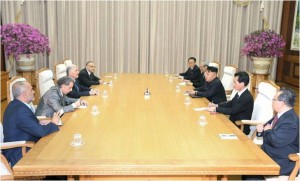
Kim Jong Un holds talks with the high-ranking visiting delegation of Syrian Arab Republic in Pyongyang, on July 24, 2013. (Photo: Rodong Sinmun, July 25, 2013)

Pyongyang may also seek to divert Washington’s attention and resources away from the Korean peninsula by waging a proxy war against the United States and its allies in Syria. The North Korean leadership is not ignorant or naive. It does understand that if the US gets sucked into another war in the Middle East during “sequestration,” not only will it undermine the short-to-mid-term credibility of its defense commitment to South Korea, but it will also buy time for Pyongyang to further build up its own nuclear arsenal and advance its war preparations against the South.

Fourth, while not a military alliance based on legally binding mutual defense obligations, North Korea and Syria have a long history of extensive bilateral military-to-military ties based on their close political relationship. These ties include:

  • Fraternal assistance in several Middle Eastern wars: Since Israel joined the UN coalition troops fighting in the Korean War, the DPRK government has never considered it inappropriate or unwise to send troops to aid the Syrian government in the Arab-Israeli wars in the Middle East. For instance, the DPRK sent 25 pilots to Syria to defend the air space over Damascus during the Arab-Israeli war of 1967.[12] In 1970, the DPRK dispatched 200 tank crewmen, 53 pilots, and 140 missile technicians to Syria. During the October 1973 Arab-Israeli War, the DPRK dispatched 30 pilots to Egypt and Syria, who provided training for Syrian pilots to fight against Israel.[13] Moreover, the North Korean Air Force pilots themselves flew the Soviet-made Egyptian and Syrian airplanes during some key air battles. In 1975 and 1976, Pyongyang sent 75 Air Force instructors and 40 MIG pilots to Damascus, respectively. In 1982, during the Lebanese civil war, the DPRK government dispatched SOF (special operations forces) servicemen to Syria to provide training for guerrilla operations, some killed by the Israeli military. In 1984-1986 and 1990, 50 and 30 North Korean military instructors were sent to Syria, respectively.
  • Military Education and Training: In the mid-1980s, Kim Jong Il approved the request of the Syrian government for its military officers’ to be educated and trained at DPRK military educational institutions at the expense of North Korea. Since then, the North Korean military has been training Syrian military officers at the Kim Il Sung Military University (an analogue of US National Defense University). Officers at the colonel rank usually participate in the one-year high-level officers’ course. Syrian officers at the captain rank are also admitted to the four-year course. They are taught military strategy, operational art, and military tactics, including guerrilla operations. Kim Jong Il is said to have followed with interest the successful careers of the Syrian general officers who graduated from the university.
  • Foreign military sales: Beginning in the late 1970s through the 1980s, the DPRK supplied Syria with various conventional weapons such as rifles, guns, mortars, ammunition, bombs, armored vehicles, anti-tank missiles, radars, and even military uniforms. In particular, in 1978, the DPRK sold 300 recoilless guns to Syria. In 1982, when the civil war broke out in Syria, the Syrian military killed 20,000 civilians by firing “BM-11, 122mm MLRS (Multiple Launch Rocket System),” the weapon system imported from the DPRK. The Israel military snatched the notorious “BM-11” from Syria during the Lebanon war in 1982, killing 25 KPA soldiers who serviced it. In 1992, Pyongyang shipped 20 tons of bombs to Damascus.
  • Weapons of Mass Destruction and Delivery Systems: There is evidence to suggest that North Korea provided technical assistance to Syria in acquiring key nuclear-related technologies in China and Europe as well as in constructing a covert nuclear reactor at Al Kibar that was bombed by the Israeli Air Force in 2007. On ballistic missiles, cooperation began in the late 1980s, with the North selling Scud-C transporter-erector-launchers (TELs) and cluster warheads to Syria, helping to construct two missile assembly plants in Hama and an electronic missile launch control facility near Aleppo and providing special training for Syrian missile technicians in North Korea. Aside from strengthening the self-defense potential of one of its anti-imperialist, anti-US allies, the North has earned good money doing it.[14] On chemical weapons, there is only limited evidence of cooperation, including the interception of DPRK ships heading for Syria carrying cargos that might be useful in defending against chemical attacks. There has also been speculation that the explosion on July 20, 2007, at a facility near the city of Halab was the result of an attempt by North Korean scientists working with Syrian officials to load a chemical warhead onto one of the North Korean missiles, likely the No-dong 1 model. On biological weapons, there is information about bilateral cooperation between the Ministries of Public Health, pharmaceutical companies, and university biotech research labs but little on weapons cooperation. Still, some observers have asserted that “Syria has a biological weapons research and development program, and it is seeking professional assistance from China and North Korea in this area.”[15]

The Syrian conflict provides the North Korean military with an opportunity to gain valuable “real world” experience. Reportedly, North Korean advisors provide technical assistance to Syria’s defense industry, especially factories southeast of Aleppo, in addition to engineering and construction assistance in repairing and rehabilitating destroyed military infrastructure. The KPA is also involved in operational planning and supervision of artillery warfare as demonstrated by the battle for Qusair.[16] The North Korean military advisors are probably involved in planning and execution of the air and air defense operations of the Syrian army as well as collecting battlefield intelligence on the combat use and performance of Western arms, especially those that can potentially be used in the Korean battlefield. Finally, the Syrian civil war offers the North Korean military planners the first-hand look at the combat tactics of anti-regime rebels trained and guided by the US and its allies. And for good measure, there is no doubt that North Korean military advisors are also tasked with erasing any traces of Pyongyang’s past assistance to Assad’s programs to build weapons of mass destruction just in case he does lose power.

The Bottom Line

Given the history of DPRK-Syrian relations, despite what the North might say in public, it would be surprising if the North had not dispatched a small contingent of military advisors and instructors to aid the brotherly Assad regime in its fight against the anti-government rebels. Although that assistance is probably limited and does not have the potential to fundamentally change the course of the civil war, North Korean military expertise can affect the outcomes of local tactical battles, adding to the winning momentum of the Assad forces. Moreover, North Korea’s involvement in Syria may be an indicator that the Kim regime discounts the likelihood of any possible breakthrough in relations with either Washington or Seoul in the near future and views the risk that its national policy goals will be adversely affected by increasing support for the Assad regime as manageable.

Pyongyang’s involvement in Syria characterizes Kim Jong Un more as a steady hand and traditional alliance manager than an erratic wanderer and opportunistic risk-taker. Although he is playing with fire in the shifting sands of far-flung lands like Syria, but he is simply staying the course set forth by his grandfather and upheld by his father, demonstrating continuity in North Korea’s foreign policy. Moreover, potential material and reputational rewards far outweigh possible security or diplomatic risks, especially if Kim’s bet on Assad’s eventual victory proves to be correct. The DPRK’s decision to cast its lot with Damascus may upset wealthy Gulf monarchies—like Kuwait and Qatar—sponsoring the anti-Assad rebel groups and cause them to rethink their employment of North Korean labor and services in construction and irrigation system development projects and their provision of low-interest funds for some of Pyongyang’s infrastructure projects.[17] On the other hand, it may help Pyongyang earn much greater financial or in-kind compensation from other states concerned, including Iran, Russia, and others, and develop new diplomatic clout in the Middle East if Assad eventually wins. Pyongyang’s support for Syria may provoke Jihadist elements to strike back, but it is more likely that the KPA will gain valuable combat experience against the new age enemy—irregular anti-government militia fighting in a suburban setting. Finally, North Korea’s support for Syria may provide new fodder for others to further demonize Pyongyang but it also offers the North a chance to stand by a long-time ally in need, to show its resolve to fight for state sovereignty and territorial integrity on the world stage, and to prove with deeds it is fighting against Al Qaeda and international terrorism, even when it might be more expedient to do otherwise.

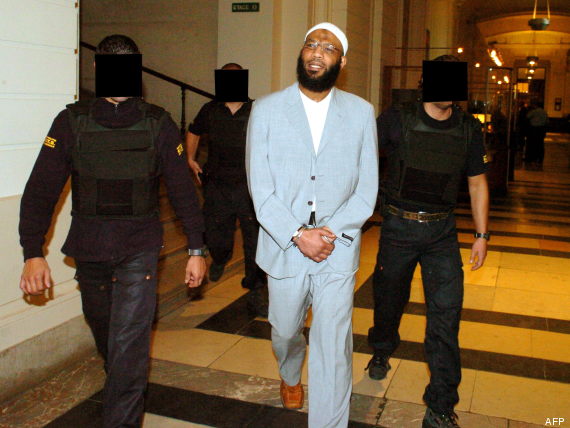


He is Back in the Fight and a Leader

Just a reminder:

Freed Guantánamo convict returns to the fight

Ibrahim al Qosi pleaded guilty to war crimes in exchange for certain release

U.S. Air Force delivered him to Khartoum in 2012; he’s in Yemen now

U.S. officials won’t confirm recidivist case, which comes as Pentagon weighs more Guantánamo releases

GUANTANAMO BAY NAVY BASE, Cuba

MiamiHerald: A former Guantánamo detainee who was released to Sudan after a war court guilty plea has emerged in a key position in Al-Qaida of the Arabian Peninsula, according to an expert on jihadist movements.

“He’s clearly a religious leader in the group,” said Aaron Zelin, senior fellow at the Washington Institute for Near East Policy who edits the Jihadology blog. He found Guantánamo 2002-12 detainee Ibrahim al Qosi — his photo and his biography — on the latest video release from the offshoot of Osama bin Laden’s organization, “Guardians of Shariah.”

Obama administration officials did not confirm or deny the apparent case of recidivism, which was first reported on the Long War Journal website Wednesday.

The video included Qosi’s biography and said he joined the jihad in Yemen in December 2014. It also said he was close to bin Laden “until he was imprisoned in Guantánamo in 2001.” Qosi, now 55, arrived at the detention center on Jan. 13, 2002, according to documents obtained by McClatchy Newspapers from the anti-secrecy group WikiLeaks. He pleaded guilty to foot soldier war crimes in 2010 in exchange for release in 2012.

Qosi’s former U.S. attorney, Paul Reichler, told the Miami Herald on Wednesday that he had not been in touch with the Sudanese man since Qosi left the U.S. Navy base prison for Sudan in July 2012.

“I was told by a Sudanese lawyer a year ago that al Qosi was working as a taxi driver in Khartoum,” Reichler said by email. “I have received no information about his activities since then, and I do not know what he has been doing, or where he is living.”

At the time of Qosi’s return to Sudan, Reichler said he looked forward to being reunited with his wife and family, including two daughters, “and live among them in peace, quiet and freedom.” His wife at the time was the daughter of a former chief bodyguard to bin Laden.

On the AQAP tape, Qosi opines in Arabic on the evolving globalization of jihad. His comments were translated for the Herald by a journalist who is fluent in Arabic.

“As the U.S. has waged war on us remotely as a solution to minimize its casualties, we have fought it remotely, as well by individual jihad,” he is heard saying. “And as the U.S. has killed our men, we have killed its people. But it is not the same. Our dead are in heaven and theirs are in the hellfire, and the war is not over yet.”

Qosi, an accountant, kept the books for a bin Laden business in Khartoum in the early ’90s, according to Pentagon documents made public by WikiLeaks. He then followed bin Laden to Afghanistan in 1996. Because the timeline for war crimes only covers the era in Afghanistan, Qosi pleaded guilty to foot-soldier crimes — sometimes driving for bin Laden, working at al-Qaida’s Star of Jihad compound in Jalalabad, and fleeing the post-Sept. 11 U.S. invasion to Tora Bora, armed with an AK-47 rifle.

The AQAP video biography mirrors much of that noting, “he participated in the famous battle of Tora Bora” with bin Laden “until the withdrawal.”

Qosi was also one of the first at Guantánamo to formally allege torture — the use of strobe lights, sleep deprivation, sexual humiliation, being wrapped in the Israeli flag — in an unlawful detention petition his Air Force attorney filed in federal court in 2004. It was never heard. Instead, he withdrew the habeas corpus suit as part of his 2010 plea agreement.

The disclosure comes at a complicated time: As Secretary of Defense Ash Carter is considering the release to repatriation or resettlement of as many as 17 detainees who have been cleared for transfer. Qosi got out on the war court guilty plea that saw him spend his last two years at the prison Convict’s Corridor separated from the majority of the detainee population.

Pentagon statement

“We take any incidence of re-engagement very seriously, but we don’t comment on specific cases. More than 90 percent of the detainees transferred under this Administration are neither confirmed nor suspected by the Intelligence Community of re-engagement. We work in close coordination through military, intelligence, law enforcement, and diplomatic channels to mitigate re-engagement and to take follow-on action when necessary.” — Navy Cmdr. Gary Ross

Additional reading

Click this, to read about the captive’s 2012 release from Guantánamo.


Meanwhile, Back in Cuba

BREAKING: Group of FARC rebels including top leader was at Cuba-U.S. baseball game attended by Obama: FARC negotiator.

A contingent of 40 members of Colombia’s FARC rebels including their leader Rodrigo Londono were at a baseball game in Havana on Tuesday that was also attended by U.S. President Barack Obama at the end of his historic trip to the Communist-led island.

FARC negotiator Pastor Alape confirmed their attendance and said the game between the Tampa Bay Rays and a Cuban team was a “symbol of peace.” A Reuters witness also spotted the rebels there.

The representatives of the Marxist-led Revolutionary Armed Forces of Colombia are in Cuba for peace talks with the Colombian government.

U.S. Secretary of John Kerry met on Monday with the FARC negotiators and the team representing the Colombian government at the talks.

Cuban President Raul Castro (R) raises US President Barack Obama's hand during a meeting at the Revolution Palace in Havana on March 21, 2016. Cuba's Communist President Raul Castro on Monday stood next to Barack Obama and hailed his opposition to a long-standing economic "blockade," but said it would need to end before ties are fully normalized. AFP PHOTO/Nicholas KAMM / AFP / NICHOLAS KAMM (Photo credit should read NICHOLAS KAMM/AFP/Getty Images)

INJO: During an occasionally awkward press conference this afternoon in Havana, Cuban President Raoul Castro was flummoxed by questions about human rights.

Asked by CNN’s Jim Acosta why Cuba has political prisoners, Castro appeared indignant:

“Give me a list and I’ll release them,” said Castro, adding, “If we have those political prisoners they will be released before tonight ends.”

Many journalists and human rights’ advocates quickly tweeted lists of dozens of prisoner names.

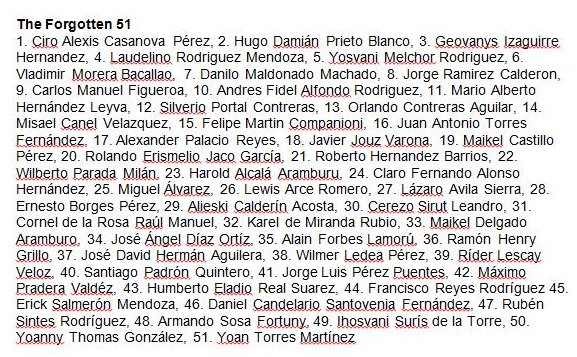
Victims of Communism Memorial Foundation says it has a list of “Forgotten 51” political prisoners in Cuba.

Later in the press conference, which took place after President Obama met privately with Castro to discuss matters, such as human rights, NBC News’ Andrea Mitchell again took a stab at getting Castro to talk about dissidents.

Castro deflected, pointing instead to issues he feels his country does well, like healthcare and education and equal pay—claiming those were more important than human rights.

He argued that not only does he not know of any political prisoners, he didn’t like the idea that an American journalist would broach the topic:

“It’s not right to ask me about political prisoners in general, please give me the name of a political prisoner.”

Shortly thereafter, the press conference came to an end, with this awkward misstep. Castro went for the hand-hold; Obama went for the the back slap.

ChicagoTribune in part: Capping his remarkable visit to Cuba, President Barack Obama on Tuesday declared an end to the “last remnant of the Cold War in the Americas” and openly urged the Cuban people to pursue a more democratic future for this communist nation 90 miles from Miami.

With Cuban President Raul Castro watching from a balcony, Obama said the government should not fear citizens who speak freely and vote for their own leaders. And with Cubans watching on tightly controlled state television, Obama said they would be the ones to determine their country’s future, not the United States.

“Many suggested that I come here and ask the people of Cuba to tear something down,” Obama said. “But I’m appealing to the young people of Cuba who will lift something up, build something new.”

On the streets of Havana, the president’s address sparked extraordinarily rare public discussions about democracy, and some anger with Cuba’s leaders. Cubans are used to complaining bitterly about economic matters but rarely speak publicly about any desire for political change, particularly in conversations with foreign journalists.