Why Iran Funds Foreign Militias

Primer:

In part from Washington Post: As the Obama administration scrambles for options in Syria, officials lament that the United States has no leverage over the Assad regime, Russia or Iran to persuade them to halt their ongoing atrocities, especially in Aleppo. But behind the scenes, the White House is actually working to weaken a sanctions bill lawmakers in both parties see as providing leverage against all three.

According to lawmakers and staffers in both parties, the White House is secretly trying to water down the Caesar Syria Civilian Protection Act, a bipartisan bill that would sanction the Assad regime for mass torture, mass murder, war crimes and crimes against humanity. The bill, guided by House Foreign Affairs Committee ranking Democrat Eliot Engel (N.Y.), would also sanction entities that aid the Syrian government in these atrocities; that includes Russia and Iran.

The bill, named after a Syrian defector who presented the world with 55,000 pictures documenting Assad’s mass torture and murder of more than 11,000 civilians in custody, has 70 co-sponsors, a majority of whom are Democrats.  More here.

****

MiddleEastEye/Karim El-Bar

In wake of Arab Spring, Iran’s backing of foreign militias has drawn much attention. Why is this support so central to Iranian foreign policy?

At a military parade commemorating the 36th anniversary of the Iran-Iraq War, the chief of the Iranian armed forces spoke clearly and bluntly. Tehran holds sway over five Arab countries.

Major General Mohammed Bagheri listed them as Lebanon, Yemen, Palestine, Syria, and Iraq.

Their enemy, as Foreign Minister Mohammad Javad Zarif controversially wrote in the New York Times last month, is Wahhabism, the ultraorthodox brand of Sunni Islam propagated by Saudi Arabia.

In some of these countries, like Lebanon, Iran has a long history. In others, such as Yemen, they have only recently involved themselves. The Palestinian cause, and by extension enmity to Israel, is a cornerstone of the theocratic regime’s domestic legitimacy.

In recent years, however, it has been Syria and Iraq that have dominated global headlines and Iranian foreign policy. Damascus and Baghdad, historically the twin capitals of the Sunni Islamic caliphate, are now under the control of predominately Shia Iran – a twist not lost on large swathes of the local population.

The sectarian dimension of Iran’s involvement in Syria’s civil war is hard to ignore. Late last month, the leader of the Iraqi Shia Najbaa Movement visited Aleppo. In a propaganda video released after his visit, a song can be heard in the background with the chorus “Aleppo is Shia.”

At the time of publication, over 10,000 Shia troops are currently massing outside rebel-held east Aleppo as joint Syrian-Russian airstrikes have all but obliterated it.

Translation: “The leader of the Iraqi Shia Najbaa Movement visits the city of Aleppo”

What unites Iran’s foreign policy in all these countries, and across the decades since the 1979 Islamic revolution, is Tehran’s unwavering support for these foreign militias and non-state actors across the Middle East.

The question is: Why?

Messianism or nationalism?

declassified CIA report, written in 1986, said that while Tehran’s support for non-state actors abroad was meant to further its national interest, it also stemmed from the belief that “it has a religious duty to export its Islamic revolution and to wage, by whatever means, a constant struggle against the perceived oppressor states.”

The messianic nature of Iran’s ruling ideology is often cited as an explanation for Iran’s support of foreign groups, with the preamble to its constitution famously committing it to “the establishment of a universal holy government and the downfall of all others.”

There has been a long-running debate over whether Iran’s support for foreign groups is rooted in national interest or in ideology.


Iranian opposition leader in exile Ayatollah Ruhollah Khomeini gives a speech at Roissy airport near Paris on 31 January, 1979 before boarding a plane bound to Tehran (AFP)

“I think it’s very easy to latch on to this ideological concept of exporting the revolution as a justification or explanation for Iran’s policies,” Dr Sanam Vakil, an associate fellow at Chatham House, told MEE.

“It’s more about the pragmatic element,” she said. “It’s about the national interest.”

Ellie Geranmayeh, a policy fellow at the European Council on Foreign Relations, agreed: “Iran is not doing this out of an ideological zeal.”

Geranmayeh said Iran’s policy in the region has much more to do with national security policy “rather than any sort of large ambition to export revolutionary ideals across the region.”

She pointed to the fact that many of Iran’s predominately Shia citizens would not religiously associate Assad’s Alawite regime with their own religion.

Regional intervention

This has not prevented Iran from throwing the kitchen sink at the Syrian civil war to preserve its sphere of influence, even recruiting poorer Shia from countries as far away as Côte d’Ivoire, Yemen, Afghanistan and Pakistan to fight on their behalf in Syria. This is in addition to the roles of the Islamic Revolutionary Guards Corps (IRGC) and its elite branch, the Quds Force.

Hezbollah was reticent to involve themselves at first. Their involvement is still a point of controversy in the movement, with former leader Subhi al-Tufayli recently slamming their “aggression” in Syria and labelling anyone fighting alongside the Russians, or Americans, as an “enemy” to God.

“Iran has nurtured and maybe even given birth to Hezbollah, but as any parent will tell you children don’t always listen to you over the course of their life,” Vakil said.

Its leader, Hassan Nasrallah, reportedly only agreed after receiving a personal appeal from Khamenei.

“Hezbollah is not necessarily a puppet of Iran as described in the media, even though a large part of the funding comes from Iran. It has a lot of domestic goals and considerations inside Lebanon which are very important for the success of the movement,” Geneive Abdo, a senior policy fellow at the Atlantic Council, told Middle East Eye.

“Neither are the Shia militias in Iraq,” she added, some of which are more loyal to the influential Iraqi Shia cleric Ali al-Sistani than to Iranian Supreme Leader Ali al-Khameini.

“It’s very complicated,” Abdo said. “At the same time that Iran or the revolutionary guards have a great influence on these forces, it doesn’t mean necessarily mean they control them 100 per cent.”

Vakil expresses a similar level of caution: “Saying that Iran is responsible for everything is demeaning on so many levels.”

“Iran has influence, it has money, but it doesn’t have total control of every situation,” she said. “It is important not to overstate Iran’s ability to manage everything. I think that there’s a lot of overstating and as a result everyone assumes that Iran is bigger than it is, more powerful and more influential than it is.

“That in effect plays into the hands of the IRGC and Qassem Soleimani and creates this sort of mythic impression around the region of what’s happening,” she added.

Relations between Hamas and Iran deteriorated sharply following the outbreak of the Syrian revolution in 2011. The following year, the group’s leadership left Damascus after being based there for more than a decade. Their funding was reduced drastically shortly thereafter.


Hamas leader Khaled Meshaal delivers a speech on 16 November, 2003 in front of a giant painting of Syrian President Bashar al-Assad during a ceremony in Beirut (AFP)

“Our position on Syria affected relations with Iran. Its support for us never stopped, but the amounts [of money] were significantly reduced,” a senior Hamas official said in 2013.

In response to this turn of events, Iran ramped up funding for other Palestinian groups, most notably the Palestinian Islamic Jihad.

Iran’s heightened involvement in the Middle East “began in Iraq with the US invasion and the United States’s role in creating a Shia-led government in Iraq,” according to Abdo.

“That paved the way for Iran’s involvement beginning in 2003 not only in Iraq but now we see in other Arab countries,” she said.

For example, the Quds Force have reportedly been arming the Houthis since 2012. In 2013, the Yemeni coast guard intercepted a boat full of arms, explosives, and anti-aircraft missiles suspected to have come from Iran.

In January 2014, the Bahraini authorities also intercepted a boat departing from Iraq with more than 220 pounds of explosives and other weapons such as C-4 explosives, mines and grenades.

Legacy of the Iran-Iraq war

Any analysis of Iran’s role in Iraq, and indeed the wider Middle East, must include reference to Iran’s bloody, eight-year long war with Saddam Hussein’s Iraq.

Geranmayeh emphasised the autonomy of the local actors themselves: “Given the near and imminent fall of Baghdad in 2014, Iran offered its help to Baghdad and that help was legitimately accepted by the central government of Baghdad.”

She sees Iran’s experience in the Iran-Iraq war as crucial to Iran’s approach to foreign militias around the Middle East in general, and Iraq in particular: “The (Iranian) military was weakened during the eight-year war with Saddam Hussein and so a kind of more voluntarily, locally organised Basij paramilitary force emerged in Iran. A lot of people who are in the Iranian military have that experience themselves of the Iran-Iraq war of how to mobilise local operations into a security architecture in times of need and in times where there is essentially a security vacuum in place. So they have certainly transported some of that know-how into Iraq.”


Iraqi soldiers walk after their victory in the battle at al-Howeizah swamps, north of Basra, on 22 March, 1985 (AFP)

She says that a similar dynamic is at play in Syria and the pro-government National Defence Forces (NDF): “What they (Iran) would say with the NDF is that they are in Syria with the legitimately recognised, UN-recognised government of Syria, the Assad regime, having blessed their cooperation in the Syrian sphere. They would see their role as advisory on the ground to local groups fighting at a time essentially when there is a security vacuum.”

“The IRGC has always played a critical role in Iran’s foreign policy,” Geranmayeh continued. “They have a long history, [with] a lot of these people of course fighting in the Iran-Iraq war, they understand the neighbouring countries very well because they spent a lot of time in those countries.”

“They (the IRGC) are most well-known for their defence of Iran during the Iran-Iraq war and the translation of that defence into supporting non-state actors in other countries throughout the world and in the Middle East itself; Hezbollah being their baby, they have created it,” Vakil said. “It’s the same sort of concept in Syria, they are responsible for the Syria portfolio, and they are responsible for any of the other portfolios around the region.”

The rise of the fiercely anti-Shia Islamic State group has increased the IRGC’s domestic popularity in recent years, Geranmayeh claims: “The IRGC is viewed much more now as a security apparatus that is protecting Iran from being contaminated by ISIS fighters… in Syria, for example, the choice is seen as one between Assad or ISIS.”

Abdo emphasised that the IRGC are an “an economic force, they’re a political force, and they’re an ideological force.”

“We have to be specific, it’s the revolutionary guards who are controlling and funding the militias,” she said.

Follow the money

Iran is one of only three countries considered an official state sponsor of terror by the US; it was added to the State Department’s list on 19 January, 1984. The only other countries listed are Sudan and Syria.

The US foreign ministry’s 2013 Country Reports on Terrorism stated that Iran supports non-state actors in Lebanon, Palestine, Syria, Yemen, Bahrain and Iraq.

“I think that an opportunity has been opened for Iran in the Arab world,” Abdo said. “For many decades, Iran didn’t have the opportunity that it has now in the Arab world… It’s a result of the post-Arab uprising era.”

Naame Shaam, an independent campaign group focused on Iran’s role in Syria, published a report in December 2015 in which they estimated the level of support Iran provided non-state actors across the region.

This is a difficult task to say the least, according to Vakil.


A picture taken on 11 April, 2011 shows Iran’s biggest denomination currencies in Tehran (AFP)

“The key is that we just don’t know what those figures are, they’re estimates and guestimates from different sources and outlets,” she said. “The accurate reflection of Iran’s investment in Syria is a big question ultimately. We know it’s a lot but we just don’t know how much it is. And because they’ve invested a lot obviously it’s a clear indication that this strategy means something for them and they have some sort of long-term plan. But, again, there is a lot of opacity as to what that could be.”

With this in mind, Naame Shaam – comprised of Iranian, Syrian, and Lebanese activists and journalists – used publicly available data to make the following estimates:

  • Lebanon: From the 1980s to the beginning of the Arab Spring, Hezbollah received between $100m and $200m annually from Iran. Domestic economic decline and the increasing intervention in Syria led to this number between being cut to around $50m to $100m per year from 2010 onwards.
  • Iraq: From the 2003 invasion of Iraq until the end of Bush’s presidency, Iran provided a range of Iraqi Shia militias with $10m to $35m a year, a number which skyrocketed after 2009 to $100m to $200m a year.
  • Palestine: From its consolidation of power in 2007 to the start of the Arab Spring in Syria and elsewhere in 2011, Hamas received approximately $100m to $250m per year from Iran. Hamas’s refusal to back Assad led to a dramatic decline in funding.
  • Yemen: The Houthis have received anywhere between $10m and $25m a year since 2010.
  • Syria: Assad government forces and its allied militias received between $15bn and $25bn over the first five years of the conflict, amounting to between $3bn and $5bn per year.
  • Overall: Naame Sham estimated that over the period of time mentioned above, Iranian expenditure on foreign militias and non-state actors ranges between a low estimate of $20 billion – and a high estimate of $80 billion.

The money comes partly from public budgets, but largely from the huge sums of money under the direct control of the supreme leader and the IRGC. These funds come from clandestine business networks pumping out billions of dollars of revenue, and are untraceable as they are not accountable to the public, according to Naame Shaam.

History and consistency


Iranian Defence Minister Hossein Dehghan (L) attends the 5th Moscow Conference on International Security (MCIS) in Moscow on 27 April, 2016 (AFP)

Iran’s defence minister is Hossein Dehghan – a former militia commander who orchestrated the bombing of a US Marine barracks in Beirut in 1983, an attack that killed 241 American troops. This was the deadliest terrorist attack in US history before 9/11. Fifty-eight French soldiers were also killed in the same operation on a French military barracks.

The following year saw Hezbollah’s abduction of CIA station chief William Francis Buckley, who was tortured and executed.

In 1992, the Israeli embassy in Argentina was bombed, killing 29 people. Two years later a Jewish cultural centre was bombed in Buenos Aires, killing 85 people.

Iran and its Lebanese proxies were linked to both attacks. Argentina ordered the arrest of infamous Hezbollah commander Imad Mughniyah for his participation in the 1992 attack, as well as Ali Akbar Velayati, a senior adviser to Khamenei, for orchestrating the latter attack.

In 1996, a further 19 US soldiers were killed by an Iran-backed group, this time in Saudi Arabia as a result of the Khobar Towers bombing. Ahmed al-Mughassil, the suspected mastermind of the attack, was arrested last year in Beirut, having lived under Hezbollah’s protection since the attack.

Iran’s reach is not limited to the Arab world either. Its Shia majority, but staunchly secular, neighbour Azerbaijan has also felt the long reach of Tehran’s arm.

In 2006, Baku arrested 15 of its citizens with links to Iran and Hezbollah, who were planning a wave of attacks against Israeli and Western visitors in the country.

Two years later, Azerbaijan foiled a joint Iran-Hezbollah plan to bomb the country’s Israeli embassy in revenge for the 2008 assassination of Mughniyah.

In 2012, Baku carried out another wave of arrests to prevent another planned bombing campaign, again found to be linked to Iran and Hezbollah.

The same year saw five Israelis killed in Bulgaria in an attack that Sofia said had “obvious links” to Hezbollah.

In his 2014 testimony to the US House Committee on Foreign Affairs, Dr Matthew Levitt of the Washington Institute for Near East Policy said the Quds Force’s increase in activities goes back to Hezbollah’s repeated failures to avenge the assassination of Mughniyah in Azerbaijan and elsewhere, leading to growing frustration within IRGC ranks.

“The IRGC would no longer rely solely on Hezbollah to carry out terrorist attacks abroad,” he told the committee. “It would now deploy Quds Force operatives to do so on their own, not just as logisticians supporting Hezbollah hit men.”


Handout mugshot obtained 12 October, 2011 courtesy of the Nueces County, Texas sheriff’s Office shows Manssor Arbabsiar (AFP PHOTO/NUECES COUNTY SHERIFF)

For these reasons, the State Department reported in 2012 “a marked resurgence of Iran’s state sponsorship of terrorism, through its Islamic Revolutionary Guard Corps-Quds Force (IRGC-QF), its Ministry of Intelligence and Security (MOIS), and Tehran’s ally Hezbollah. Iran and Hezbollah’s terrorist activity has reached a tempo unseen since the 1990s.”

The previous year, Iran even tried to assassinate the Saudi ambassador to the United States, Adel al-Jubeir, in the nation’s capital Washington, D.C.

Manssor Arbabsiar, an Iranian-American citizen, pleaded guilty to the plot in June 2013 and admitted to “conspiring with members of the Iranian military in the formulation of the plot,” CNN reported at the time.

Iran vehemently denied involvement, but the plot was allegedly foiled when Arbabsiar’s contact in the Mexican drug cartel he tried to recruit to carry out the assassination turned out to be an undercover US agent.

Al-Qaeda connections

Iranian tensions with America only heightened after the 11 September attacks in 2001.

As the executive and legislative branches in America struggled over whether to allow families of 9/11 victims to sue Saudi Arabia, Iran’s role has also been a point of controversy.

Iran quickly condemned the terrorist attack, but the 9/11 Commission Report, published three years after the attack, found that eight of the 10 hijackers travelled through Iran between late 2000 and early 2001.

They were taking advantage of an agreement with the Iranian government that meant the passports of al-Qaeda members were not stamped as they passed through the country.

In a similar vein, a leading figure of al-Qaeda in Iraq – Abu Musab al-Zarqawi – was given shelter in Iran in 2001 and 2002, with Tehran reportedly refusing to extradite him to Jordan. The links are said to have continued and in 2012, the US Department of the Treasury slammed the Iran’s main intelligence organisation, the Ministry of Intelligence and Security (MOIS), for its “support to terrorist groups, such as al-Qaeda and al-Qaeda in Iraq… again exposing the extent of Iran’s sponsorship of terrorism as a matter of Iran’s state policy.”


A US soldier stands between two images of al-Qaeda leader in Iraq Abu Musab al-Zarqawi during a US military briefing 8 June, 2006 in Baghdad (AFP)

In July, the US Treasury imposed sanctions on three senior al-Qaeda members – all of whom are located in Iran. Faisal al-Khalidi is a former al-Qaeda commander and plays a leading role in weapons acquisition, while veteran member Yisra Bayumi served as a mediator with Iranian authorities as early as 2015 and facilitated the transfer of al-Qaeda funds, and Abu Bakr Ghumayn in 2015 assumed control of the financing and organisation of al-Qaeda members in Iran.

With regards to Iran sheltering al-Qaeda members, Vakil said Tehran was “perhaps using them as bargaining chips.”

“There is very limited love between Iran and al-Qaeda, they have no ideological symmetry in just about anything,” she said. “If they are doing anything, it is quite a pragmatic effort trying to get something out of it and that is what this regime is known for.”

Rouhani and the regime

Hassan Rouhani has often been portrayed as a moderate, at least in comparison to his hard-line predecessor Mahmoud Ahmadinejad. His focus is said to be on rebuilding Iran’s shattered economy and normalising relations with the West.

Experts agree, however, that his impact on foreign policy has been minimal.

“It’s very difficult for one person alone to fundamentally redirect and rearrange regional policy without a consensus being formed at top leadership level,” Geranmayeh said.


Iran’s President Hassan Rouhani (C) leaves after addressing the 71st session of the United Nations General Assembly at the UN headquarters in New York on 22 September, 2016 (AFP)

Vakil agrees: “Rouhani doesn’t actually have that much control and influence over Iran’s foreign policy portfolio.”

“One would assume the president is in charge of these things, but in fact he’s not,” she added. “The purview of foreign policy is primarily in the hands of the supreme leader.”

“I think his impact has been minimal,” Abdo said of Rouhani and Iran’s foreign policy. “I think that he has been used as an instrument in the similar way that Mohammed Khatami was used an instrument to achieve a certain regime objective. In Rouhani’s case it was the nuclear deal, in Khatami’s case, it was to try to improve relations with the West.”

Through this prism, the nuclear deal was not “necessarily a Rouhani victory,” she said, but what the supreme leader authorised.

Nuclear deal

In 2006, then Secretary of State Condoleezza Rice said: “Iran has been the country that has been in many ways a kind of central banker for terrorism in important regions.”

A decade later, Obama’s nuclear deal meant Iran received more than $100bn in sanctions relief as well as reintegration into the pivotal SWIFT international banking system. Rouhani has also made a number of visits to the West to increase economic ties.

The lifting of financial sanctions is a contentious issue, so much so that when the Obama administration sent $400m in cash to Iran last month, he kept his own military out of the loop.

“There was a lot of opposition to the lifting of sanctions on Iran, particularly in the US, based on the argument that the money is going to be funnelled to fund Iran’s regional policies that are essentially opposed to Western interests,” Geranmayeh said of opponents of the nuclear deal.

This was certainly the position of Naame Shaam, who wrote in the conclusion to their report that: “There have been fears that, next to domestic investment needs, part of the released funds could end up fuelling conflicts in the Middle East even further due to increased military spending and financial backing of allied militias and governments like the Assad regime in Syria.

“The increase in Iran’s 2015/16 current defence budget may be a first sign of this,” it continued. “In recent months, Ayatollah Ali Khamenei and the Iranian Minister of Defence, Hossein Dehqan, both made it clear that they had no intention to cut their support to Hezbollah, Hamas, the (Palestinian) Islamic Jihad, the Houthi militias in Yemen, the Syrian and Iraqi governments and their militias, despite a nuclear deal.”
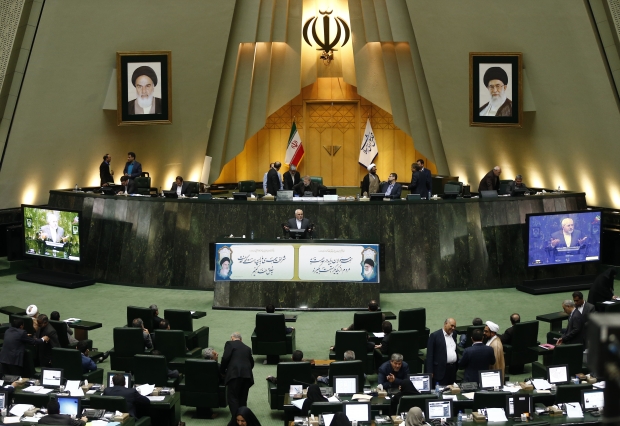


Iranian Foreign Minister Muhammad Javad Zarif addresses the parliament in Tehran on 2 October, 2016 (AFP)

Geranmayeh takes a different view, however: “The majority of the money is going to fund local investment projects to reduce unemployment, to promote job growth, and to tackle issues to do with inflation.”

Vakil agrees: “The country does need the money internally because if Iran is going to hit all of its growth markers for the next 10 years there has to be a lot of investment in the Iranian economy. For the Iranian regime that is a huge part of why it signed the nuclear deal. It wasn’t about anything else except the economy, and trying to get the economy going, and trying to generate foreign and internal investment into different sections of the Iranian economy. It’s about the long-term sustainability of the Islamic republic.”

The consensus is far from unanimous though.

“I think the money will be directed toward non-state actors abroad,” Abdo said. “I think that it’s very unfortunate, but I think that the regime’s strategy is that they will basically maintain the minimum economic commitment required to prevent dissent and uprising, and as long as they can maintain this low level of service to their own people – which means that the subsidies are cut and the value of the currency is low and so forth – they will continue to do this if this means freeing up resources for regional domination.”

“It’s very clear if you go to Iran, the wages are low, the economy is in a bad situation,” she said. “But they’re spending enormous amounts of money on their regional ambitions.”

Sectarianism and survival

Iran supports non-state actors in the Middle East “because they want to have a foothold politically in the Arab world,” Abdo said.

“I think also there is a religious dimension to this and many people disagree with me,” she said. The topic is one she discusses at greater length in her new book, The New Sectarianism, due to be published on 1 December 2016.

“If you go back and look at Khamenei’s speeches during the early years of the Arab uprising, he talked a lot about the Islamic awakening. This is just pure rhetoric,” she said. “In fact what has happened is that the Iranians are supporting Shia groups in the Arab world.”

“Nasrallah has made very clear over the last two years that Hezbollah now functions as a Shia militia,” Abdo said. “Both Iran and Hezbollah never played the Shia card, they never said that they are the military force for Shia in the region, but they departed from that approximately two years ago and now there is no question that both Hezbollah and Iran are military forces to support Shia in the region.”

“This is what I think is very important in what has changed their historic rhetoric since the revolution,” she said.

There is an ethnic, as well as a religious, dimension to the complexity of Iran’s support for foreign militias, Abdo continued, because these groups are comprised mainly of Arab, not Persian, Shia.

“The Iranians are making inroads because the Shia in many of these countries are not gaining any support from their own governments,” she said. “Iraq is a perfect example of this.”

Zarif’s article in the New York Times has refocused attention on this sectarian proxy war currently raging across the Middle East.

“No doubt the Saudis are definitely instrumental in driving this conflict, but I think the important difference is that ideologically the Saudis don’t need this conflict for their survival,” she says. “The Iranian state depends upon conflict with the West ideologically and conflict with its neighbours to maintain its survival and its legitimacy.”

Related reading: Obama administration and State Department are Hiding Iran Agreements

Related reading: Obama Grants Clemency to 7 Iranian Terrorists in United States, but there were really 21 of them and no access to who they were.

1999: Clinton Admin Knew/Facilitated China Military Theft

 Wen Ho Lee

Related reading: 2015, FBI Arrests Chinese Millionaire Once Tied to Clinton $$ Scandal

Related reading: The Russia-China relationship could lead to some interesting changes on the global stage.

And the biggest changes are occurring far away from Washington’s orbit.

obama xi putinUS President Barack Obama (L-R), China’s President Xi Jinping, and Russia’s President Vladimir Putin during a photo shoot at the International Convention Center at Yanqi Lake in Beijing, November 11, 2014. REUTERS/Kim Kyung-Hoon

Although the Sino-Russo relationship predates the Ukraine conflict, there’s no question that the crisis has shifted Moscow even more toward Beijing.

Over the last year, we saw the two countries sign highly publicized energy deals, conduct joint military exercises, and even generally support each others’ foreign policy adventures. More here from BusinessInsider.

Here are a few questions for investigators in both houses of Congress to pose:

NYT’s: To Samuel Berger, the Hogan & Hartson trade lobbyist turned national security adviser: Why can’t Congress see your memo to President Clinton summarizing the devastating Cox report on espionage when it was submitted for security clearance in January? With the report now public, no claim of secrecy can properly be made.

Clinton pretended two months ago to have been uninformed of wholesale espionage. Did Berger’s January cover memo truly reflect the Cox report’s revelations, or did it lull the President into a false sense of national security?

To Bill Richardson, Energy Secretary since September 1998: You were briefed on espionage suspicions in November, and received the Cox report in January. Did you never have occasion to mention its serious implications on China policy to the President? You knew Secretary of State Albright was going to China in February; why did you withhold it from her? Did the White House suggest she be kept ignorant, or was it your own idea?

To F.B.I. Director Louis Freeh: Attorney General Janet Reno says ”I was not apprised of the details of the case at the time the decision was made” to reject wiretap surveillance of Wen Ho Lee at Los Alamos. Didn’t you think this was important enough to take to the top? She also says your 1997 request ”did not contain a request to search any computer.” If that is true, why not?

To the Senate Democratic leader, Tom Daschle: The bipartisan Cox report charges the White House with failing to inform Congress, but you say ”Republican chairs of the Congress were warned about this as early as 1996 and also chose to do nothing.” Did you read those ”warnings” before accusing Senator Arlen Specter and Representative Porter Goss of failing in their intelligence oversight duties? Can the public now see if those staff briefings were complete?

To Dan Burton, chairman of the House Government Reform and Oversight Committee: With Reno Justice allowing all Clinton’s illegal Asian fund-raisers to cop a plea and walk, you’ve subpoenaed Charlie Trie for June 10 and John Huang for June 17. Will you allow the ranking Democrat, Henry Waxman, to turn hearings into a partisan circus, or will you depose Trie and Huang extensively beforehand to discover links to Bruce Lindsey, the D.N.C.’s Don Fowler and Hillary’s Harold Ickes?

To George Tenet, Director of Central Intelligence: You reported to Cox that information on China’s theft of our W-88 nuclear warhead design came from a ”walk-in” planted by Chinese intelligence. That’s counterintuitive counterintelligence; does nobody in C.I.A. dispute the ”dangle” theory? Where is he now, and is he (or she) singing?

To Richard Shelby and Bob Kerrey of Senate Intelligence: The Cox report ran 900 pages, but nearly 400 pages were cut out by the Clinton sanitizers. Was all of this really for security reasons, or do many redactions cover C.I.A., F.B.I. and White House embarrassments?

To Senator Robert Torricelli, Democrat of New Jersey: You told CBS’s Bob Schieffer that Clinton should talk to Reno about ”her ability to perform her duties.” Are you worrying about her judgment under a physical affliction, or making a nonpartisan judgment on sustained misfeasance at Justice — or helping the White House toss her off the sled to save Sandy Berger?

The biggest question is this: Will we fall for the usual ”it’s old news” and ”everybody did it” defenses? Or will we connect the dots from the (a) corrupt Asian and satellite-producer contributions to the (b) refusal to stop the theft of nuclear codes lest it offend Beijing to the (c) change of policy to sell China powerful computers capable of using those codes to simulate tests?

The House is being serious. What about the Senate?

****What is this all about you ask?

*The People’s Republic of China (PRC) has stolen design information on the United States’ most advanced

thermonuclear weapons.

* The Select Committee judges that the PRC’s next generation of thermonuclear weapons, currently under development, will exploit elements of stolen U.S. design information.

* PRC penetration of our national weapons laboratories spans at least the past several decades and almost

certainly continues today.

****

• The stolen information includes classified information on seven U.S. thermonuclear warheads, including every currently deployed thermonuclear warhead in the U.S. ballistic missile arsenal.

• The stolen information also includes classified design information for an enhanced radiation weapon (commonly known as the “neutron bomb”), which neither the United States, nor any other nation, has yet deployed.

• The PRC has obtained classified information on the following U.S. thermonuclear warheads, as well as a number of associated reentry vehicles (the hardened shell that protects the thermonuclear warhead during reentry).

****

In addition, in the mid-1990s the PRC stole, possibly from a U.S. national

weapons laboratory, classified thermonuclear weapons information that cannot be

identified in this unclassified Report. Because this recent espionage case is currently

under investigation and involves sensitive intelligence sources and methods, the

Clinton administration has determined that further information cannot be made public

without affecting national security or ongoing criminal investigations.

The W-88, a miniaturized, tapered warhead, is the most sophisticated nuclear

weapon the United States has ever built. In the U.S. arsenal, it is mated to the D-5 submarine-

launched ballistic missile carried aboard the Trident nuclear submarine. The

United States learned about the theft of the W-88 Trident D-5 warhead information, as

well as about the theft of information regarding several other nuclear weapons, in 1995.

The PRC has stolen U.S. design information and other classified information

for neutron bomb warheads. The PRC stole classified U.S. information about

the neutron bomb from a U.S. national weapons laboratory. The U.S. learned of the

theft of this classified information on the neutron bomb in 1996.

In the late 1970s, the PRC stole design information on the U.S. W-70 warhead

from the Lawrence Livermore Laboratory. The U.S. government first learned of this

theft several months after it took place. The W-70 warhead contains elements that

may be used either as a strategic thermonuclear weapon, or as an enhanced radiation

weapon (“neutron bomb”). The PRC tested the neutron bomb in 1988.

The Select Committee is aware of other PRC thefts of U.S. thermonuclear

weapons-related secrets. The Clinton administration has determined that further

information about PRC thefts of U.S. thermonuclear weapons-related secrets cannot

be publicly disclosed without affecting national security.

The PRC acquired this and other classified U.S. nuclear weapons information as

the result of a 20-year intelligence collection program to develop modern thermonuclear

weapons, continuing to this very day, that includes espionage, review of unclassified

publications, and extensive interactions with scientists from the Department of

Energy’s national weapons laboratories.

**** The full Cox Report is 700 pages but this link is the summary.  So, those questions the New York Times asked in 1999 need to be asked again today of both Hillary and Bill. What say you?

Sudan Govt Use of Chemical Weapons on Civilians in Darfur


Primer: Obama’s choice, Samantha Power as the U.S. Ambassador to the United Nations was an alleged champion of stopping the dying in Darfur by chemical weapons in 2004. Where is she now?

Amnesty says Sudan used deadly chemical weapons in Darfur conflict

(CNN) The Sudanese government has been accused of using chemical weapons against the people of Darfur, according to a report released by Amnesty International on Thursday.

The attacks targeted civilians and may constitute a war crime, the report said. The Sudanese government has denied the allegations, calling them “rumors.”
Amnesty says it has new evidence abuses persist in a war that has been described as one of the world’s worst humanitarian conflicts by the United Nations.
Unidentified witnesses quoted in the Amnesty report said the attacks left a smoke, which turned dark blue and smelled “like rotten eggs,” coating the trees, ground, and humans in a thick black dust.

Witness testimony

After exposure to the smoke, some said their skin turned white and became rotten or hardened and fell off in chunks.
“When the bomb exploded I inhaled the poisonous air which I am still smelling even now,” said one witness.
Some children vomited blood, the report said. Another witness said: “My youngest child was walking before the attack. Now she is only crawling.”
Pictures obtained by Amnesty International show graphic images of children with large welts, peeling skin, and infected lesions.

Civilians targeted

The alleged use of chemical weapons came during a large-scale offensive by the Sudanese forces and its allied groups against an armed opposition group, the Sudan Liberation Army-Abdul Wahid (SLA-AW), which operates in the Jebel Marra region.
The Sudanese government accused the group of looting and attacking civilians and military vehicles prior to the January offensive.
Since the Sudanese military campaign began in January, Amnesty International says up to 250 people have been killed by chemical weapons.
The report alleges the Sudanese forces targeted civilians: “The overwhelming majority of the attacked villages had no formal armed opposition presence at the time of the attacks. The purpose…appears to have been to target the entire population of the village.”
Chemical attacks in some regions have been taking place for eight months, including just weeks before the report’s release.

‘Rumors’

The Sudanese government has denied allegations it had used chemical weapons against civilians, calling them “rumors.”
“I don’t know from where these rumors are being said,” Sudan’s Information Minister Ahmed Bilal told CNN.
Bilal acknowledged a government offensive in Jebel Marra had taken place, saying it was in response to rebel activity.
“It was started by them,” Bilal said. “The rebels were doing some sort of looting, they were attacking innocent people. This has stopped. There is not an inch occupied by rebels,” Bilal said.
“The whole Darfur is quite in peace and the people are very happy,” he said.

Likely more than one chemical

Journalists and humanitarians have been prohibited from entering Jebel Marra for more than four years, making reporting extremely difficult from the region.
Mustard agent

Amnesty International claims to have evidence of the use of suspected chemical weapons in Darfur. It says two independent experts have concluded the evidence suggests exposure to blister agents.

  • Blister agents include sulfur mustard and nitrogen mustard. Sulfur mustard has long been in use as a chemical weapon — it inflicted horrific casualties in World War I.
  • Mustard agents inflict chemical burns on the skin, eyes and lungs, and can also affect the internal organs. Victims can be disabled as a result of exposure. It can be fatal if they come into contact with large amounts.
  • While damage is caused to the body’s cells within minutes of contact with mustard agent, it can take hours before the full effects are felt.
  • Symptoms can include blistering, itching or severe burning of the skin; weeping eyes, swollen eyelids or even blindness; vomiting and collapse.
  • The effects of severe exposure can last for years.
  • There’s no antidote for mustard agent injury.

Sources: U.S. Centers for Disease Control and Prevention; Organisation for the Prohibition of Chemical Weapons

Amnesty International had to do all reporting remotely. Collecting soil samples for confirmation was impossible.
Two chemical weapons experts reviewed photographic and video evidence and both found the symptoms consistent with chemical agents such as sulfur mustard, lewisite and nitrogen mustard — or a combination.
“The symptoms varied between the attacks and this tells me there were likely more than one chemical in use as well as the possibility that the chemicals were mixed or that different chemicals were used at different times for different attacks,” said Dr. Jennifer Knaack, one of the weapons experts involved in the study.
The writer of the report, a senior Amnesty adviser, Jonathan Loeb calls it “by far the most substantial, credible release of evidence of the use of chemical weapons in Darfur since the conflict began.”

History of conflict

The conflict in Darfur began around 2003 when several rebel groups in Darfur took up arms against the government in Khartoum. They had grievances over land and historical marginalization.
In response, the government’s counterinsurgency strategy targeted the opposition groups but reportedly expanded to target tribes associated with the insurgents.
The violence escalated into a war and the in 2008, the UN estimated that 300,000 people may have died in the Darfur conflict, although experts say that figure has likely risen since then.
Sudan’s President, Omar al-Bashir, was charged with crimes against humanity by the International Criminal Court, including genocide, related to the Darfur conflict in 2010.
Bashir has yet to cooperate with the court and continues to travel freely around the continent. South Africa and Uganda have both been criticized for allowing President Bashir to travel to their countries without being turned over to the ICC.

ICANN Soon to be ICANT? Obama Gives Away Internet Control


ICANN, the International Community, and Internet Governance

Because cyberspace and the Internet transcend national boundaries, and because the successful

functioning of the DNS relies on participating entities worldwide, ICANN is by definition an

international organization. Both the ICANN Board of Directors and the various constituency

groups who influence and shape ICANN policy decisions are composed of members from all over

the world. Additionally, ICANN’s Governmental Advisory Committee (GAC), which is

composed of government representatives of nations worldwide, provides advice to the ICANN

Board on public policy matters and issues of government concern. Although the ICANN Board is

required to consider GAC advice and recommendations, it is not obligated to follow those

recommendations.

Many in the international community, including foreign governments, have argued that it is

inappropriate for the U.S. government to maintain its legacy authority over ICANN and the DNS,

and have suggested that management of the DNS should be accountable to a higher

intergovernmental body. The United Nations, at the December 2003 World Summit on the

Information Society (WSIS), debated and agreed to study the issue of how to achieve greater

international involvement in the governance of the Internet and the domain name system in

particular. The study was conducted by the U.N.’s Working Group on Internet Governance

(WGIG). On July 14, 2005, the WGIG released its report, stating that no single government

should have a preeminent role in relation to international Internet governance. The report called

for further internationalization of Internet governance, and proposed the creation of a new global

forum for Internet stakeholders. Four possible models were put forth, including two involving the

creation of new Internet governance bodies linked to the U.N. Under three of the four models,

ICANN would either be supplanted or made accountable to a higher intergovernmental body. The

report’s conclusions were scheduled to be considered during the second phase of the WSIS held

in Tunis in November 2005. U.S. officials stated their opposition to transferring control and

administration of the domain name system from ICANN to any international body. Similarly, the

109th Congress expressed its support for maintaining U.S. control over ICANN (H.Con.Res. 268

and S.Res. 323).39

The European Union (EU) initially supported the U.S. position. However, during September 2005

preparatory meetings, the EU seemingly shifted its support towards an approach which favored an

enhanced international role in governing the Internet. Read more here from FAS.

President Barack Obama’s drive to hand off control of Internet domains to a foreign multi-national operation will give some very unpleasant regimes equal say over the future of online speech and commerce.

Breitbart: In fact, they are likely to have much more influence than America, because they will collectively push hard for a more tightly controlled Internet, and they are known for aggressively using political and economic pressure to get what they want.

Here’s a look at some of the regimes that will begin shaping the future of the Internet in just a few days, if President Obama gets his way.

China

China wrote the book on authoritarian control of online speech. The legendary “Great Firewall of China” prevents citizens of the communist state from accessing global content the Politburo disapproves of. Chinese technology companies are required by law to provide the regime with backdoor access to just about everything.

The Chinese government outright banned online news reporting in July, granting the government even tighter control over the spread of information. Websites are only permitted to post news from official government sources. Chinese online news wasn’t exactly a bastion of freedom before that, of course, but at least the government censors had to track down news stories they disliked and demand the site administrators take them down.

Related reading: Dangerous Transfer: The President’s ICANN Internet Problem

Unsurprisingly, the Chinese Communists aren’t big fans of independent news analysis or blogging, either. Bloggers who criticize the government are liable to be charged with “inciting subversion,”even when the writer in question is a Nobel Peace Prize winner.

Chinese citizens know better than to get cheeky on social media accounts, as well. Before online news websites were totally banned, they were forbidden from reporting news gathered from social media, without government approval. Spreading anything the government decides is “fake news” is a crime.

In a report labeling China one of the worst countries for Internet freedom in the world, Freedom House noted they’ve already been playing games with Internet registration and security verification:

The China Internet Network Information Center was found to be issuing false digital security certificates for a number of websites, including Google, exposing the sites’ users to “man in the middle” attacks.

The government strengthened its real-name registration laws for blogs, instant-messaging services, discussion forums, and comment sections of websites.

A key feature of China’s online censorship is that frightened citizens are not entirely certain what the rules are. Huge ministries work tirelessly to pump out content regulations and punish infractions. Not all of the rules are actually written down. As Foreign Policy explained:

Before posting, a Chinese web user is likely to consider basic questions about how likely a post is to travel, whether it runs counter to government priorities, and whether it calls for action or is likely to engender it. Those answers help determine whether a post can be published without incident — as it is somewhere around 84 percent or 87 percent of the time — or is instead likely to lead to a spectrum of negative consequences varying from censorship, to the deletion of a user’s account, to his or her detention, even arrest and conviction.

This was accompanied by a flowchart demonstrating “what gets you censored on the Chinese Internet.” It is not a simple flowchart.

Beijing is not even slightly self-conscious about its authoritarian control of the Internet. On the contrary, their censorship policies are trumpeted as “Internet sovereignty,” and they aggressively believe the entire world should follow their model, as the Washington Post reported in a May 2016 article entitled “China’s Scary Lesson to the World: Censoring the Internet Works.”

China already has a quarter of the planet’s Internet users locked up behind the Great Firewall. How can anyone doubt they won’t use the opportunity Obama is giving them, to pursue their openly stated desire to lock down the rest of the world?

Russia

Russia and China are already working together for a more heavily-censored Internet. Foreign Policy reported one of Russia’s main goals at an April forum was to “harness Chinese expertise in Internet management to gain further control over Russia’s internet, including foreign sites accessible there.”

Russia’s “top cop,” Alexander Bastrykin, explicitly stated Russia needs to stop “playing false democracy” and abandon “pseudo-liberal values” by following China’s lead on Internet censorship, instead of emulating the U.S. example. Like China’s censors, Russian authoritarians think “Internet freedom” is just coded language for the West imposing “cultural hegemony” on the rest of the world.

Just think what Russia and China will be able to do about troublesome foreign websites, once Obama surrenders American control of Internet domains!

Russian President Vladimir Putin has “chipped away at Internet freedom in Russia since he returned to the Kremlin in 2012,” as International Business Times put it in a 2014 article.

One of Putin’s new laws requires bloggers with over 3,000 readers to register with the government, providing their names and home addresses. As with China, Russia punishes online writers for “spreading false information,” and once the charge is leveled, it’s basically guilty-until-proven-innocent. For example, one of the “crimes” that can get a blogger prosecuted in Russia is alleging the corruption of a public official, without ironclad proof.

Human-rights group Agora estimates that Russian Internet censorship grew by 900% in 2015 alone, including both court orders and edicts from government agencies that don’t require court approval. Censorship was expected to intensify even further throughout 2016. Penalties include prison time, even for the crime of liking or sharing banned content on social media.

Putin, incidentally, has described the entire Internet as a CIA plot designed to subvert regimes like his. There will be quite a few people involved in the new multi-national Internet control agency who think purging the Web of American influence is a top priority.

The Russian government has prevailed upon Internet Service Providers to block opposition websites during times of political unrest, in addition to thousands of bans ostensibly issued for security, crime-fighting, and anti-pornography purposes.

Many governments follow the lead of Russia and China in asserting the right to shut down “extremist” or “subversive” websites. In the United States, we worry about law enforcement abusing its authority while battling outright terrorism online, arguing that privacy and freedom of speech must always be measured against security, no matter how dire the threat. In Russia, a rough majority of the population has no problem with the notion of censoring the Internet in the name of political stability, and will countenance absolutely draconian controls against perceived national security threats. This is a distressingly common view in other nations as well: stability justifies censorship and monitoring, not just physical security.

Turkey

Turkey’s crackdown on the Internet was alarming even before the aborted July coup attempt against authoritarian President Recep Tayyip Erdogan.

Turkey has banned social media sites, including temporary bans against even giants like Facebook and YouTube, for political reasons. Turkish dissidents are accustomed to such bans coming down on the eve of elections. The Turkish telecom authority can impose such bans without a court order, or a warning to offending websites.

Turkey is often seen as the world leader in blocking Twitter accounts, in addition to occasionally shutting the social media service down completely, and has over a 100,000 websites blacklisted. Criticizing the government online can result in anything from lost employment to criminal charges. And if you think social-media harassment from loyal supporters of the government in power can get pretty bad in the U.S., Turks sometimes discover that hassles from pro-regime trolls online are followed by visits from the police.

Turkish law infamously makes it a crime to insult the president, a law Erdogan has already attempted to impose beyond Turkey’s borders. One offender found himself hauled into court for creating a viral meme – the sort of thing manufactured by the thousands every hour in America – that noted Erdogan bore a certain resemblance to Gollum from Lord of the Rings. The judge in his case ordered expert testimony on whether Gollum was evil to conclusively determine whether the meme was an illegal insult to the president.

The Turkish example introduces another idea common to far too many of the countries Obama wants to give equal say over the future of the Internet: intimidation is a valid purpose for law enforcement. Many of Turkey’s censorship laws are understood to be mechanisms for intimidating dissidents, raising the cost of free speech enough to make people watch their words very carefully. “Think twice before you Tweet” might be good advice for some users, but regimes like Erdogan’s seek to impose that philosophy on everyone. This runs strongly contrary to the American understanding of the Internet as a powerful instrument that lowers the cost of speech to near-zero, the biggest quantum leap for free expression in human history. Zero-cost speech is seen as a big problem by many of the governments that will now place strong hands upon the global Internet rudder.

Turkey is very worried about “back doors” that allow citizens to circumvent official censorship, a concern they will likely bring to Internet control, along with like-minded authoritarian regimes. These governments will make the case that a free and open Internet is a direct threat to their “sovereign right” to control what their citizens read. As long as any part of the Internet remains completely free, no sector can be completely controlled.

Saudi Arabia

The Saudis aren’t too far behind China in the Internet rankings by Freedom House. Dissident online activity can bring jail sentences, plus the occasional public flogging.

This is particularly lamentable because Saudi Arabia is keenly interested in modernization, and sees the Internet as a valuable economic resource, along with a thriving social media presence. Freedom House notes the Internet “remains the least repressive space for expression in the country,” but “it is by no means free.”

“While the state focuses on combatting violent extremism and disrupting terrorist networks, it has clamped down on nonviolent liberal activists and human rights defenders with the same zeal, branding them a threat to the national order and prosecuting them in special terrorism tribunals,” Freedom House notes.

USA Today noted that as of 2014, Saudi Arabia had about 400,000 websites blocked, “including any that discuss political, social or religious topics incompatible with the Islamic beliefs of the monarchy.”

At one point the blacklist included the Huffington Post, which was banned for having the temerity to run an article suggesting the Saudi system might “implode” because of oil dependency and political repression. The best response to criticism that your government is too repressive is a blacklist!

The Saudis have a penchant for blocking messaging apps and voice-over-IP services, like Skype and Facetime. App blocking got so bad that Saudi users have been known to ask, “What’s the point of having the Internet?”

While some Saudis grumble about censorship, many others are active, enthusiastic participants in enforcement, filing hundreds of requests each day to have websites blocked. Religious figures supply many of these requests, and the government defends much of its censorship as the defense of Islamic values.

As with other censorious regimes, the Saudi monarchy worries about citizens using web services beyond its control to evade censorship, a concern that will surely be expressed loudly once America surrenders its command of Internet domains.

For the record, the Saudis’ rivals in Iran are heavy Internet censors too, with Stratfor listing them as one of the countries seeking Chinese assistance for “solutions on how best to monitor the Iranian population.”

North Korea

You can’t make a list of authoritarian nightmares without including the psychotic regime in Pyongyang, the most secretive government in the world.

North Korea is so repressive the BBC justly puts the word “Internet” in scare quotes, to describe the online environment. It doesn’t really interconnect with anything, except government propaganda and surveillance. Computers in the lone Internet cafe in Pyongyang actually boot up to a customized Linux operating system called “Red Star,” instead of Windows or Mac OS. The calendar software in Red Star measures the date from the birth of Communist founder Kim Il-sung, rather than the birth of Christ.

The “Internet” itself is a closed system called Kwangmyong, and citizens can only access it through a single state-run provider, with the exception of a few dozen privileged families that can punch into the real Internet.

Kwangmyong is often compared to the closed “intranet” system in a corporate office, with perhaps 5,000 websites available at most. Unsurprisingly, the content is mostly State-monitored messaging and State-supplied media. Contributors to these online services have reportedly been sent to re-education camps for typos. The North Koreans are so worried about outside contamination of their closed network that they banned wi-fi hotspots at foreign embassies, having noticed information-starved North Korean citizens clustering within range of those beautiful, uncensored wireless networks.

This doesn’t stop South Koreans from attempting cultural penetration of their squalid neighbor’s dismal little online network. Lately they’ve been doing it by loading banned information onto cheap memory sticks, tying them to balloons, and floating them across the border.

Sure, North Korea is the ultimate totalitarian nightmare, and since they have less than two thousand IP addresses registered in the entire country, the outlaw regime won’t be a big influence on Obama’s multi-national Internet authority, right?

Not so fast. As North Korea expert Scott Thomas Bruce told the BBC, authoritarian governments who are “looking at what is happening in the Middle East” see North Korea as a model to be emulated.

“They’re saying rather than let in Facebook, and rather than let in Twitter, what if the government created a Facebook that we could monitor and control?” Bruce explained.

Also, North Korea has expressed some interest in using the Internet as a tool for economic development, which means there would be more penetration of the actual global network into their society. They’ll be very interested in censoring and controlling that access, and they’ll need a lot more registered domains and IP addresses… the very resource Obama wants America to surrender control over.

Bottom line: contrary to left-wing cant, there is such a thing as American exceptionalism – areas in which the United States is demonstrably superior to every other nation, a leader to which the entire world should look for examples. Sadly, our society is losing its fervor for free expression, and growing more comfortable with suppressing “unacceptable” speech, but we’re still far better than anyone else in this regard.

The rest of the world, taken in total, is very interested in suppressing various forms of expression, for reasons ranging from security to political stability and religion. Those governments will never be comfortable, so long as parts of the Internet remain outside of their control. They have censorship demands they consider very reasonable, and absolutely vital. The website you are reading right now violates every single one of them, on a regular basis.

There may come a day we can safely remand control of Internet domains to an international body, but that day is most certainly not October 1, 2016.

9/11: POTUS Vetoed JASTA, Ability to Sue Saudi Arabia

House intel chairman threatens to subpoena bin Laden files

FNC: The Republican chairman of the House intelligence committee says he’s prepared to take what may be unprecedented action to get the remaining Usama bin Laden documents from the nation’s top military and intelligence agencies – and subpoena the files.

“If they don’t provide these documents to the committee by October 11th, then we’re going to have to subpoena them — which I don’t want to have to do but it appears like we’ve run out of all options,” Republican Rep. Devin Nunes, R-Calif., told Fox News. “For the administration to basically mislead the American people for this many years is flat-out wrong.”

Nunes is seeking documents and relevant analysis, which is thought to comprise at least 50 reports. In a Sept. 22 letter to Director of National Intelligence James Clapper, CIA Director John Brennan, and Defense Department Undersecretary for Intelligence Marcel Lettre, Nunes says the law required them to comply nearly two years ago based on Section 313 of the Intelligence Authorization ACT (IAA) for fiscal 2014. This section mandated a “complete declassification of the Abbottabad documents within 120 days.”  More here.

Meanwhile there appears to be enough votes to over-ride Obama’s veto on the ability to for the 9/11 families to sue Saudi Arabia.

FNC: With lawmakers eager to return home to campaign ahead of the November election, a vote could come as early as Tuesday. Even House Democratic Leader Nancy Pelosi, an Obama ally, indicated support this week for an override, saying members believe the families “should have their day in court.”

Democratic New York Sen. Chuck Schumer called the veto a “disappointing decision that will be swiftly and soundly overturned in Congress.”

Senate Majority Leader Mitch McConnell’s office said the Senate would take up the override “as soon as practicable in this work period.”

The Justice Against Sponsors of Terrorism Act sailed through both chambers of Congress by voice vote, with final House passage coming just two days before Obama led the nation in marking the 15th anniversary of the attacks that killed nearly 3,000 people in New York, Washington and Pennsylvania on Sept. 11, 2001. More here.

The passed legislation is known as JASTA, S.2040 – Justice Against Sponsors of Terrorism Act was introduced by Senator Cornyn of Texas. It was presented to Barack Obama and was due for final record by 9/23/2016 if Obama did not take his veto action which he did at the last moment during the week of the United Nations General Assembly.

Related reading: House Intel Cmte has Declassified/Released the 28 Pages

Additionally:

Deleted official report says Saudi key funder of Hillary Clinton campaign

#USA2016

MEE: Deputy Crown Prince Mohammed bin Salman reportedly said Saudi has enthusiastically funded Hillary Clinton’s presidential campaign

Saudi Arabia is a major funder of Hillary Clinton’s campaign to become the next president of the United States, according to a report published by Jordan’s official news agency.

The Petra News Agency published on Sunday what it described as exclusive comments from Saudi Deputy Crown Prince Mohammed bin Salman which included a claim that Riyadh has provided 20 percent of the total funding to the prospective Democratic candidate’s campaign.