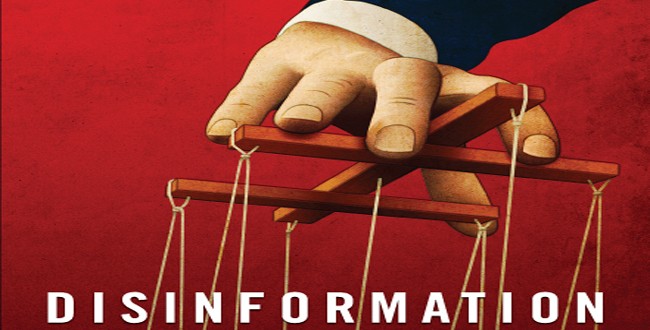
 Fragment of the cover of Disinformation, a book by Ion Mihai Pacepa, ex-deputy chief of communist Romania’s foreign intelligence, and law professor Ronald J. Rychlak
I. The Metropol gala
It may have seemed like any other Thursday in Moscow. The dismally overcast sky and near-freezing temperature lay heavy on the city, heralding the darkening days of winter. On that morning, the historical Art Nouveau-style Hotel Metropol Moscow, situated between the Kremlin and the FSB (formerly KGB) headquarters, was slowly and quietly filling with important guests. It is unlikely that many passers-by noticed the members of Russia’s power elite, headed by President Vladimir Putin, arriving one by one at the hidden entrance.
It was 10 December 2015. Russia’s global propaganda television channel RT (formerly Russia Today) was celebrating its 10th anniversary with a lavish gala. The organizers had put great effort into hand-picking the guests: the tables were filled with high-calibre figures active in the fields of politics, the economy, and propaganda.
When analyzing images taken at the event in light of the information available today, it is immediately clear to a watchful eye that this was a carefully planned Russian active influence operation. Its main objective was not to promote the television channel but to prepare for the massive interference in the upcoming US presidential elections.
Retired US General Michael T. Flynn had taken his place at Putin’s right hand. By that time, it was well known in Moscow that Flynn could play a key role in advising presidential candidate Donald Trump on national security issues. A battle-hardened veteran of the Iraq and Afghanistan wars, Flynn’s pronounced negativity towards Islam suited Russia very well.

Putin and General Flynn at the celebration of RT anniversary in Moscow, 10 December 2015. Photo: Mikhail Klimentyev
Flynn did not fail to meet the expectations of those who had ordered the speech. For 40,000 dollars, the retired general scolded Obama’s administration for its Middle East policy and kept mum about Russia’s aggression in Ukraine, as well as the many civilian casualties of air strikes in Syria. One must not forget that during the Metropol gala the international situation was rather tense, especially when it came to Russia’s relationship with the West. Only a couple of weeks had passed since Turkey had shot down a Russian Su-24M attack aircraft on 24 November 2015. Flynn was not bothered by this.
Putin did not shy away from egging Flynn on during their dinner-table talk. Having essentially been removed from the position of director of the Defence Intelligence Agency (DIA), Flynn had a bone to pick with President Barack Obama. Thus, Putin’s jaundiced views on Obama and Hillary Clinton fell on fertile ground. Flynn admitted in a later interview with Dana Priest of The Washington Post that the only thing he remembers from his table talk with Putin was the latter’s deep mistrust of the Obama administration.
Flynn had likely been under surveillance for a while. When he was still the director of the DIA in 2013, the three-star General Flynn received an unusually warm welcome in Moscow. He was the first—and so far the only—high-profile US officer to have entered the headquarters of Russia’s Main Intelligence Agency (GRU). Flynn himself remembers this with great pride because he was asked to conduct a masterclass on the professional development of leadership. The mind boggles at the thought of what the listeners made of him at the time. After all, countering the activities of the US and its allies was and continues to be one of the GRU’s main priorities.
Nevertheless, it is evident that Flynn ending up as the main guest at the December 2015 gala was no coincidence; the role of RT commentator was merely a suitable cover. However, Flynn was not the only one to attract attention on that table of ten bigwigs.
Right across from Putin sat another fateful figure from the US—the Green Party’s presidential candidate Jill Stein, who is known for her accentuated friendliness towards Russia. She also made a presentation at the gala, although her presence was advertised more modestly than Flynn’s. Still, it was Stein who became the dark horse of the November 2016 elections.

To-be U.S. presidential candidate Jill Stein in Moscow’s Red Square, December 2015. Screenshot from a video
Stein drew more votes in the swing states of Pennsylvania, Wisconsin, and Michigan than Trump’s margin of victory over Hillary Clinton. Stein received the votes of 1.4 million people nationwide, i.e. 1% of voters. All this could have been an additional reason for stopping Clinton from becoming president.
Putin was not the only one gracing Flynn and Stein with his undivided attention at the main table. The conversation was steered by the then Kremlin Chief of Staff and former KGB general Sergey Ivanov, the president’s press secretary Dmitry Peskov (who is also regarded in intelligence circles as Putin’s national defence adviser), one of the Kremlin’s leading propaganda chiefs Alexey Gromov, and RT’s Editor-in-Chief Margarita Simonyan, who is known to be friends with Putin.
In order to help Flynn and Stein blend in with the crowd, the main table also included Willy Wimmer, a veteran German politician from Angela Merkel’s party and a former member of the Bundestag (1976–2009), and the former Czech foreign minister, Cyril Svoboda. Both are also known for their pro-Russian attitude. For instance, Wimmer has said that pursuing an anti-Russia policy is a crime against the whole of Europe. As expected, Wimmer’s analysis has no room for Russia’s aggression against Ukraine, because he believes that the coup in Kyiv was caused by the West.
The picture of what transpired at the Metropol would be incomplete without mention of Julian Assange, whose presentation was broadcast via a live link and who was later suspected of leaking 20,000 emails stolen from the server of the US Democratic Party; former Mayor of London Ken Livingstone, who has justified Russia’s aggression against Ukraine with the need for protection from NATO; and a former analyst at the Central Intelligence Agency, Raymond McGovern, who had become a scandalous political activist in the 1990s. McGovern later admitted to having voted for Stein in the 2016 elections.
As the event at the Metropol drew to a close, few people realized that something big was happening. Back then, nobody outside his immediate circle knew Flynn. Today, his name features in the international media almost every day, and with good reason. The most dramatic outside interference in the US presidential elections is a fact, and Flynn played one of the key roles in it.

Trump and Flynn during the 2016 presidential race. Photo: George Frey
Even though his career as President Trump’s national security adviser was cut short, his suspicious and covert ties managed to cause serious damage to the reputation of the US as the leader of the Western world. The story does not end there. One thing is certain: this is the first time the global public has felt the reach of Russia’s influence operations and the professionalism of its subterfuge so clearly. Many see this as something new and unexpected but, in reality, it was a long time coming.
II. The Marquis de Custine’s timeless testament
In 1839, a French aristocrat, the Marquis de Custine, traveled to Russia to seek support for his reactionary views. He was resentful of the representative democracy of his own country and thought it would lead to mob rule. He was a well-known travel writer and had published eloquent accounts of Spain and Italy.
Custine got the idea to write about Russia from the 1835 book by Alexis de Tocqueville, Democracy in America, in which the author foretells a great future for Russia and the US. Custine was later called “the Russian Tocqueville”.
He spent most of his time in Russia in Saint Petersburg, but he also visited Moscow and Yaroslavl. Custine was interested in the lives, customs, and mindsets of both the aristocracy and common folk. His hopes of finding support for his ideas in Russian authoritarianism were promptly crushed. He was especially appalled by the fact that Russians were ready to cheerfully collaborate with their own enslavers.
Having collected only one year’s worth of immediate impressions and information, Custine managed to turn the material into a book titled La Russie en 1839, which captures the nature of Russia extremely well. The book was so successful that for a long time it was banned by the Russian authorities. The unabridged version of Custine’s book was finally published in Russia 157 years later, in 1996.
Among other things, the author noticed the tendency of Russians to deceive their guests or alter reality. Custine wrote that everything in the country was an illusion and the professional misleading of foreigners was a practice only known in Russia.

In 1839, Custine recorded the thoughts of a noble Russian companion on the role of lie in his government’s policy
A former US ambassador in Moscow, General Walter Bedell Smith, wrote an introduction to the English edition of Custine’s book in 1951. Smith stressed that Custine’s political analysis was “so penetrating and timeless that it could be called the best work so far produced about the Soviet Union.” All of today’s extensive historical books on Russia owe thanks to Custine’s contribution. In Russia, however, the Frenchman is seen as the father of classic Russophobia.
Custine was not the first or only person to draw attention to Russia’s “Susaninist” nature. Even during the Livonian War (1558–83), the tsar’s negotiators tried to leave the misleading impression that Tallinn was situated on ancient Russian land and that Livonia should, therefore, be ruled by Moscow. The “villages” of Prince Potemkin, a favorite of Catherine the Great, have even acquired a proverbial meaning.
III. The KGB and the beginnings of disinformation as a science
The Bolshevik Revolution of 1917 changed everything. All previous experiences paled before the extent to which deliberate lying, deception and misleading became a conscious choice in the forge of the Bolshevik special services. In the course of a century, many people from all over the world, from popes to presidents, from countries to international organizations, witnessed the disinformation skills of the Cheka/GPU/NKVD/KGB/FSB and the implementation of active influence measures in the service of Russian foreign policy.
The use of disinformation as a tactical weapon of influence became organized as early as 1923, when the Deputy Director of the GPU, Józef Unszlicht, formed a special disinformation unit to conduct active intelligence operations. Born in Poland, Unszlicht was one of the founders of the Cheka and saw disinformation as an excellent opportunity to create successful diversions in open Western societies.
On 22 December 1922, Unszlicht and Roman Pillar wrote to Stalin’s Politburo that the special disinformation unit should focus on the creation and distribution of misleading information. The best way to spread disinformation in a credible manner was to use the media of open societies. Stalin and the Politburo approved the proposal and urged Unszlicht to proceed.
The first notable and successful use of disinformation was Operation Trust. This ran from 1923 to 1927 with the aim to mislead the White Army and monarchist organizations in exile and foreign intelligence institutions with false information about an extensive resistance organization, Trust, operating within the Soviet Union. The illusion helped to lure many anti-Soviet (Boris Savinkov and Pavel Dolgorukov) and foreign (Sidney Reilly) agents into Russia, who were then arrested and executed. Interestingly, both the beginning and the end of the operation had close ties to Estonia and Latvia.

Trial of Boris Savinkov, an ardent anti-Bolshevik, who was lured to the USSR by Soviet secret services in August 1924. He was sentenced to 10-year imprisonment and was said to have committed suicide in jail in May 1925. Photo: Wikimedia Commons
Trust was followed by a number of other known and less-known operations that have provided material for hundreds of books. One of the best sources is the collection of notes made by Vasili Mitrokhin during his 30 years as a KGB archivist before he fled to the West in 1992. The historian Christopher Andrew has written two hefty books based on these notes.
Another person who deserves a mention is Ion Pacepa, a general in the Romanian communist special service Securitate, who fled to the US in 1978. In 2013, he published the book Disinformation, in which he uses his own immediate knowledge to shed light on the creation of false narratives such as the framing of Pope Pius XII as “Hitler’s Pope” during World War II.
In the Soviet Union, disinformation became a science in its own right and was honed to perfection over the years. The term was first used in The Great Soviet Encyclopaedia in 1952, where it was presented as classic disinformation. According to the book, disinformation constitutes false news distributed in the media with the intention of misleading the public. The entry added that such tactics were used by the West against the Soviet Union. The truth was, naturally, the exact opposite.
Curiously, “disinformation” did not enter Western dictionaries until the late 1980s. The English word is directly derived from the Russian дезинформация [dezinformatsiya — ed.].
In the late 1960s, the Director of the KGB, Yuri Andropov, took disinformation as a successful instrument of influence to a whole new level. Andropov himself said that
“disinformation is like cocaine—sniff once or twice, it may not change your life. If you use it every day, though, it will make you an addict—a different man.”

FSB reinstalled the memorial plaque to Andropov, which was dismantled in 1991, on its Moscow headquarters in December 1999, shortly before ex-FSB director Vladimir Putin became acting president of Russia. Photo: Anatoly Novak
In general, it is customary for foreign intelligence services to be created on the basis of collected information to advise a country’s political authorities in matters of foreign relations. However, in addition to collecting past facts, the tasks of Russian foreign intelligence involve manipulating the future.
Furthermore, the masterclass of Russian special services includes the creation of a new past to destabilize the opponent, which is then used to tamper with the latter’s international image. I will look at Estonian examples later, but Russian attempts to change the past to serve its foreign-policy interests are best illustrated by the subject of World War II.
It is crucial to understand that the fall of the Soviet Union changed nothing. The KGB was broken up and reorganized, but its tasks remained roughly the same. Mistrust in the Western system of values and security persisted.
For instance, in his 2007 book Comrade J, Pete Earley uses the story of Sergei Tretyakov, a high-ranking Russian intelligence officer who defected while at the UN in 2000, to demonstrate how Moscow continued with active intelligence and influence operations against the US even in the 1990s, the friendliest period in their relationship.
Tretyakov makes a thought-provoking statement in the book:
I want to warn Americans. As a people, you are very naive about Russia and its intentions. You believe because the Soviet Union no longer exists, Russia now is your friend. It isn’t, and I can show you how the SVR [Russia’s Foreign Intelligence Service — ed.] is trying to destroy the US even today and even more than the KGB did during the Cold War.
Thanks to the endless possibilities of the internet, disinformation and national propaganda acquired an entirely new meaning with the rise to power of the former KGB intelligence officer and FSB director Vladimir Putin in 1999. The KGB’s machinery was polished and harnessed to serve Russia’s imperialist interests. The state quickly assumed control over the media, and the leading television stations became the world’s most professional propaganda outlets.
The authorities turned their attention to information security, which quickly found its way into new strategy documents. Its nuances were made famous by Russian general and current Chief of the General Staff, Valery Gerasimov, in his notorious doctrine.
The introduction of social media and its rapid development have proved to be an unprecedented goldmine for intelligence services. The distribution of disinformation is considerably easier in today’s world than it was in the late 1980s, for instance.To compare: it took more than three years for the KGB’s Operation INFEKTION to succeed in spreading a global rumor that the HIV virus originated from the Pentagon’s biological weapons program. This information leak first appeared in a small pro-Soviet Indian paper, Patriot, on 17 July 1983. Two years later, this was referenced by a popular Soviet weekly, Literaturnaya Gazeta, as the source of the scandalous story. From there it found its way to the front page of a British tabloid, and by April 1987 the fake news had been published by the mainstream media of 50 countries.

A standard message featured by a leftist paper within the AIDS disinformation campaign
On the eve of the decisive round of the 2017 French presidential elections, the favorite, Emmanuel Macron, fell victim to a massive hacking attack. The database of his e-mails and other documents went viral on a file-sharing service within minutes. In the space of just three hours, the post was shared around 47,000 times, and half a day later it was trending worldwide on Twitter. Even though Russia has denied involvement, the cyber trails prove otherwise.
In the noughties, several Western intelligence leaders were already complaining that Russia had become more active than it had been during the Cold War, but this went largely unnoticed. Russia was off the radar while the focus lay on Afghanistan and the Middle East in general. The Western political elite began to regard Russia as a threat only after the occupation and annexation of Crimea. This also brought Moscow’s activities back into the sights of intelligence services.
IV. Estonia as a target of Russian information attacks
Depicting Estonia (and Latvia) as a country that discriminates against minorities and promotes Nazism has been one of Russia’s largest and most consistent international deception operations in the last 25 years. The reasons for this are numerous, the main one being Moscow’s strategic interest in restoring its authority over the Baltic States. Russia became particularly pushy in the 1990s when Estonia and the other Baltic States were applying for membership of NATO and the European Union.
On 4 December 1991, only three months after the restoration of independence, the Estonian foreign ministry was forced to send its Soviet counterpart a note condemning President Mikhail Gorbachev’s hostile attitude towards the Baltic States during his appearance on Soviet Central Television the previous day. Gorbachev first blamed the Baltic States for violating the human rights of minorities and then added that Russians, Ukrainians and other minorities living in the Baltic States had requested protection from the Soviet Union. Estonian diplomats treated this as a threat to national security.
Active measures continued to be taken in this spirit on both diplomatic and journalistic levels for years. Essentially, it has not stopped, even today. The situation was particularly severe in the 1990s when Russia tried to influence the West to ignore the Baltic States. Moscow also tried to discourage Estonia from adopting the Aliens Act in 1993 by issuing threats bordering on the undiplomatic.
For instance, on 18 June 1993, the then Russian deputy foreign minister, Vitaly Churkin, who later became Russia’s Permanent Representative to the UN, said on Radio Moscow that: “Russian-Estonian relations are clearly deteriorating. We are currently preparing a package of serious diplomatic, political and perhaps not only political measures with regard to Estonia.” Six days later, President Boris Yeltsin said that Estonia had “forgotten” geopolitical and demographic reality and threatened that Russia had the means to refresh its memory. Foreign Minister Andrey Kozyrev did not hold back on 14 August 1993, saying that international relations in the Baltic States had “strong potential for violence and unrest.”
On 23 August 1993—exactly 54 years after the signing of the Molotov–Ribbentrop Pact—Yeltsin’s press secretary, Vyacheslav Kostikov, naively stated that
“the forces that try to push Russia out of the Baltic States must consider that Russia governed the Baltic geopolitical area for centuries and it has invested great material and intellectual resources into its development.”
On 2 March 1994, Artur Laast, a diplomat at the Estonian Embassy in Moscow, was invited to the Russian foreign ministry, where the head of the Second European Department, Yuri Fokin, made a threatening oral statement about President Lennart Meri’s criticism of Russia in his speech at the annual Matthiae-Mahl dinner in Hamburg on 25 February. The memo of the meeting ends with Laast quoting the Russian diplomat: “If the course that is focused on aggravating the relations between the two neighboring countries does not change, Estonia will assume full responsibility.”
In the 1994 report “Russian Threats to Estonia” by the embassy in Moscow, an Estonian diplomat discusses political hazards among other questions. The author of the report writes that Russia
“attempts to influence Estonia by damaging us on the international arena. For this, it uses the well-known thesis of violating the human rights of the Russian minority, spreads rumors that Estonia has become a transit country for crime and that Estonian citizens participate in military conflicts in Tajikistan and Chechnya, and accuses us of supporting separatism in Russia.”
These are only a few examples from the archive of the Estonian foreign ministry that illustrate Russia’s diplomatic pressure on Estonia, but also on the West. At the time, occupying forces were still in Estonia. The troops were withdrawn on 31 August 1994.
When the First Chechen War broke out at the end of 1994, Russian media gave extensive coverage to a false news story about alleged Baltic female biathletes serving as snipers on Dudayev’s side. As the so-called “White Tights,” the phantom snipers even featured in songs.
From my time as a foreign correspondent in Moscow, I clearly remember a detailed, multi-page account in the daily Moskovskiye Novosti of how Estonians were skilled and disciplined killers: all this to distort our image and influence public opinion at home and abroad.
World War II has remained one of the main arguments in the information war against Estonia over the last 25 years. The tension grew at the beginning of Putin’s tenure and finally led to the Bronze Night events in 2007. Russia has not made much progress on this matter or on other topics.

Russian anti-Estonian cartoon attacks Estonian schools as an alleged hotbed of Nazism as opposed to Russian/Soviet-style “peace education.” Source: newsbalt.ru
Estonia has now been a member of NATO and the EU for 13 years and will use its presidency of the EU Council to collaborate with other member states to implement more effective means to combat Russia’s information attacks and disinformation campaigns.
V. In place of an epilogue
In 1930, Professor Dmitry Manuilsky of Moscow’s Leninist School of Political Warfare wrote that Russia was creating the world’s most progressive peace movement to lull the West to sleep. Convinced that a war between the two great systems was inevitable, Manuilsky thought that
“foolish and decadent capitalist countries will be happy to use the opportunity to cooperate with us to bring about their own destruction. They will use every opportunity to become friends. As soon as the enemy lets their guard down, we will crush them with our iron fist.”
The Soviet empire used various means to achieve its geopolitical goals and, to an extent, world domination. At the forefront of the campaign in the free world were the “useful idiots” and agents of influence.Moscow took good care of its mouthpieces. In the 1980s, French communists were paid 24 million dollars, while Americans received 21 million dollars. Finnish communists received a generous reward of 16.5 million dollars for their pro-Russian views. During the final two decades of the Soviet Union, Moscow distributed more than 400 million dollars of such benefits all over the world, mainly to extremist communist movements.
The fight for the hearts and minds of the free world was on, and it has not subsided even today. Russia’s new clients are mainly extremist forces of both left and right, and by supporting them Moscow tries to weaken the integrity of the European Union and NATO, disrupt the internal stability of their member countries, and create the circumstances for a Finlandization of Europe.
Russia has managed to make a right mess of America’s domestic politics. However, the Dutch and French elections provided some assurance that Moscow’s influence operations have limits and that Europe is not disintegrating. Then again, the fight continues and it is too early to draw any final conclusions.
The international debate has provided many good ideas and political suggestions to counter Russia’s aggression, information attacks, and propaganda. History provides good counsel, even here.
On 14 April 1950, only 12 months after the founding of NATO, the US National Security Council’s special task force presented President Harry Truman with top-secret report No. 68. The 58-page document was essentially the basis for the US long-term policy on the Soviet Union, which culminated with the victory in the Cold War in the late 1980s. The report described the challenge posed by the Soviet Union as something that could cause “the destruction not only of this Republic but of civilization itself.” The Soviet Union was treated as the exact opposite of the US, with Moscow’s expansionist policy deemed a great threat to the security of the free world.
Among other topics, the report also highlighted the fight against the Soviet Union’s influence operations. The document stressed that the campaign for truth must above all become a fight for people’s minds.

Putin boasts of Russia’s fight against ISIS in Syria to the filmmaker Oliver Stone showing a U.S. video from Afghanistan. Screenshots from Stone’s film The Putin Interviews (2017)
A lot has changed by 2017 but, in general, Russia and the US, together with the latter’s allies, remain in fundamental opposition. Hence it is vital that the allies’ conflict-avoidance strategy looks beyond the false hope of solving problems with meaningless dialogue.



 Tomb of Sarah, wife a Patriarch Abraham
 NBC
NBC


 Thomas Jefferson’s “Original Rough Draught” of Declaration of Independence (with revisions by John Adams & Benjamin Franklin)