

Hamas, War Crimes and the DC Fundraiser

Gaza FRThe very left leaning organization known as Amnesty International, which enjoys financial support from Open Society, a George Soros organization has come to admit that Hamas was steeped in war crimes in Gaza last year.   What is most shocking however, is a planned fundraising event in Washington DC for Hamas.

Location Rock Creek Park- Intersection of 16th St. NW & Kennedy St. NW, Washington DC 20011

Date & Time Saturday, May 16 2015 7:00 AM
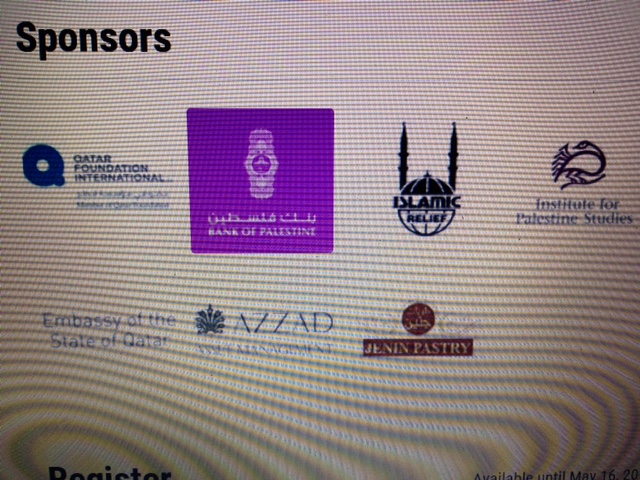
Gaza sponsors


Hamas guilty of war crimes in Gaza clash, Amnesty Internat’l charges

HAIFA, Israel – A horrific missile attack that killed 11 children in Gaza during last summer’s war between Israel and Hamas, for which Israel was broadly condemned at the time, was actually caused by a Palestinian missile misfiring and killing its own people, Amnesty International charged in a report released Thursday.

“In the deadliest incident believed to have been caused by a Palestinian armed group during the conflict, 13 Palestinian civilians – 11 of them children – were killed when a projectile exploded next to a supermarket in the crowded al-Shati refugee camp in Gaza on 28 July 2014, the first day of Eid al-Fitr,” Amnesty’s report said. “The children had been playing in the street and buying crisps and soft drinks in the supermarket at the time of the attack.”

“Although Palestinians have claimed that the Israeli military was responsible for the attack, an independent munitions expert, who examined the available evidence on behalf of Amnesty International, concluded that the projectile used in the attack was a Palestinian rocket.”

The report highlights the fact that the blast could not have been caused by a drone attack or as the result of Israeli shelling. The crater was too shallow, it said, while “its circumference was too wide to have been caused by a tank shell.”

“Palestinian armed groups, including the armed wing of Hamas, repeatedly launched unlawful attacks during the conflict killing and injuring civilians,” said Philip Luther, director of the Middle East and North Africa Programme at Amnesty International. “In launching these attacks, they displayed a flagrant disregard for international humanitarian law and for the consequences of their violations on civilians in both Israel and the Gaza Strip.”

Israel’s insistence from the start that the 13 deaths were caused by one of Hamas’ own missiles going astray was generally disregarded as Hamas rushed to accuse Israel. Even repeated testimony from an Italian journalist in Gaza at the time that indicated a number of journalists were convinced the deaths had been caused by a Hamas shell, failed to persuade most people that the Israel Defense Force (IDF) was telling the truth.

The journalist, Gabriele Barbati, tweeted, “International journos [journalists] say: feeling today’s massacre in Shaati beach playground #gaza was misfired rocket by Hamas or factions.” The following day he added, “@IDFSpokesperson said truth in communique released yesterday about Shati camp massacre. It was not #Israel behind it”.

Barbati subsequently fled for his life from Gaza once his tweets were noticed by Hamas, but later that day tweeted again, “Out of #Gaza far from #Hamas retaliation: misfired rocket killed children y’day in Shati. Witness: militants rushed and cleared debris.”

Amnesty also made note of “other violations of international humanitarian law by Palestinian armed groups during the conflict, such as storing rockets and other munitions in civilian buildings – including UN schools – and cases where Palestinian armed groups launched attacks or stored munitions very near locations where hundreds of displaced civilians were taking shelter.”

The Palestinian Authority of Mahmoud Abbas, which against the wishes of the U.S. and others, intends to apply for membership of the International Criminal Court, next week, may be liable for this and other war crimes committed by Palestinians during the war if accepting ICC jurisdiction. The PA officially became jointly responsible for Gaza as part of the unity government with Hamas on June 2, 2014, some 5 weeks before the conflict began.

Earlier this week, in a special report, FoxNews.com highlighted a new documentary revealing Hamas’ pride at training child soldiers released ahead of an imminent decision by the EU on whether or not to re-instate Hamas’ designation as a terrorist organization that lapsed three months ago due to an EU technicality.

Thursday’s report is the third of four from Amnesty International detailing the human rights organization’s opinion of events in Gaza during the 2014 war. The first two reports mainly focused on the activities of the IDF and included strong criticisms of the Israeli military and accusations of “callous indifference “ and “war crimes”, which were again mentioned by Philip Luther. “The fact that Palestinian armed groups appear to have carried out war crimes by firing indiscriminate rockets and mortars does not absolve the Israeli forces from their obligations under international humanitarian law,” he said.

Luther added, “The devastating impact of Israeli attacks on Palestinian civilians during the conflict is undeniable, but violations by one side in a conflict can never justify violations by their opponents.”

Israel disputes the number and status of the casualties, suggesting that independent analysis of the names of the 2,000 Palestinians reportedly killed shows that nearly 50 percent of the dead were actually combatants. Amnesty has suggested the figure is nearer a quarter. To date, there has been no reaction from Hamas to today’s highly critical report, and across Palestinian media there appears not to have been any coverage of the issue.

“Unlike Hamas, Israel is vigorously investigating its conduct, aiming to draw lessons and minimize civilian harm,” a spokesperson for Israel’s Embassy in London told the Jerusalem Post. “Meanwhile, Hamas continues to incite terrorist attacks against Israeli civilians, boast of building new cross-border assault tunnels, and test-fires rockets, in preparation for further violence against Israelis.”

The fourth and final report from Amnesty into the 50-day conflict is expected later this year and will focus on allegations of Hamas’ executions and summary killings of opposition supporters, and anyone else who questioned their rule of the Islamist enclave during hostilities.

An Iranian Defection During Nuke Talks

Pro-Hassan Rouhani Iranian editor defects while covering nuclear talks in Lausanne

Amir Hossein Motaghi says he no longer sees any “sense” in his profession as he could only write as he was told

A close media aide to Hassan Rouhani, the Iranian president, has sought political asylum in Switzerland after travelling to Lausanne to cover the nuclear talks between Tehran and the West.

Amir Hossein Motaghi, who managed public relations for Mr Rouhani during his 2013 election campaign, was said by Iranian news agencies to have quit his job at the Iran Student Correspondents Association (ISCA).

He then appeared on an opposition television channel based in London to say he no longer saw any “sense” in his profession as a journalist as he could only write what he was told.

“There are a number of people attending on the Iranian side at the negotiations who are said to be journalists reporting on the negotiations,” he told Irane Farda television. “But they are not journalists and their main job is to make sure that all the news fed back to Iran goes through their channels.

“My conscience would not allow me to carry out my profession in this manner any more.” Mr Mottaghi was a journalist and commentator who went on to use social media successfully to promote Mr Rouhani to a youthful audience that overwhelmingly elected him to power.

But he was also subject to the bitter internal arguments within the Iranian regime. One news website claimed he had been forced in to report to the ministry of intelligence weekly, and that he had been tipped off that he might be subject to arrest had he returned to Tehran.


He is said to have been a friend of Jason Rezaian, the Iranian-American reporter for the Washington Post who has been detained in Tehran, and to have campaigned privately for his release.

ISCA, which has come under fire from regime hardliners critical of Mr Rouhani, issued a statement denying that Mr Motaghi was in Lausanne to report for it.

“Amir Hossein Motaghi had terminated his contribution to ISCA and this news agency has not had any reporter at the nuclear talks, except for a photojournalist”, it said.

However, critics said Mr Mottaghi was “prey of the exiled counter-revolutionaries” and had gone to Lausanne with the sole purpose of seeking refugee status in Switzerland.

In his television interview, Mr Mottaghi also gave succour to western critics of the proposed nuclear deal, which has seen the White House pursue a more conciliatory line with Tehran than some of America’s European allies in the negotiating team, comprising the five permanent members of the UN security council and Germany.

“The US negotiating team are mainly there to speak on Iran’s behalf with other members of the 5+1 countries and convince them of a deal,” he said. ***

Meanwhile the clock is ticking to have a final framework agreement and both sides are saying there are some sticking points. But what is most chilling, is this interim agreement may NOT even be a written document with signatures but rather an oral gentlemen’s agreement. That requires repeating, an oral agreement with a handshake. Never has any world leader trusted Iran and John Kerry is asking the P5+1 to consider that? You be the judge.


Congressman has Toolkit to Avoid Deportation

Barack Obama by executive action designed a program titled ‘Childhood Arrivals and Deferred Action for Parental Accountability (DACA). This is NOT law, there is already immigration law that is by edict not being applied, so DACA is additional action forcing immigration enforcers to comply.

There are several in Congress that are ‘all-in’ when it comes to ignoring their oath of office and side with the non-compliance of immigration law.

This congressman deserves the buzzard blue ribbon of the week.

Watch the video here where Congressman Gutierrez explains his mission.

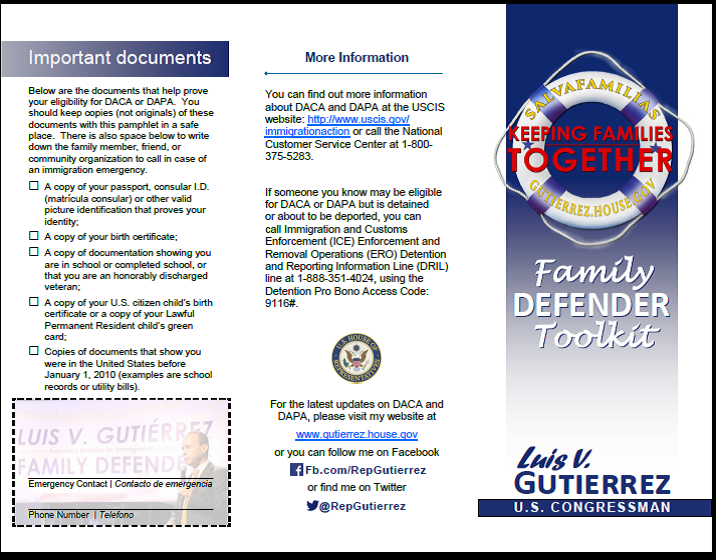
Representative Luis Gutierrez (D., Ill.) has created a “family defender toolkit” to help the potential beneficiaries of President Obama’s executive amnesty avoid deportation while the program is on hold. In an infomercial-style video released earlier this week, Gutierrez explains his toolkit’s key feature: a card designed to help illegal immigrants escape deportation.

He instructs the potential beneficiaries of Obama’s Deferred Action for Childhood Arrivals (DACA) and Deferred Action for Parental Accountability (DAPA) programs to use the card to defend themselves against immigration enforcement officers, but to avoid showing it to local law enforcement if they’re detained for matters unrelated to immigration. “Only pull [the card] out when you’re detained by an immigration official; it explains in English and Spanish that you’re eligible for DACA and DAPA,” Gutierrez says in the video. “By using this card after you’ve been arrested or detained, you can explain that [according to] the policy in place today, you should be released because you’re not a priority for deportation.” Gutierrez, who was challenged by anti-amnesty activists at the University of Southern California last week, may have deliberately avoided publicizing the cards to avoid further political backlash.

His message appears to be directed only at those who stand to benefit from the president’s executive actions. “I hope that you never have to use this card, but if you do, don’t be scared, because you’re prepared,” Gutierrez concluded. “Soon enough the DACA and DAPA applications will be available.”

Gutierrez has even been so generous as to post the brochure toolkit online for download.

toolkitGutierrez is at the core of a political action committee titled Immigration Reform Fund.


Total Receipts $250,045
Total Spent $25,815
Begin Cash on Hand $59,755
End Cash on Hand $283,985
Debts $0
Date of last report December 31, 2014

2014 PAC Contribution Data

Contributions from this PAC to federal candidates (list recipients)
(100% to Democrats, 0% to Republicans)
$5,000
Contributions to this PAC from individual donors of $200 or more ( list donors) $183,950

Official PAC Name:
IMMIGRATION REFORM FUND
Location: WASHINGTON, DC 20002
Industry: Leadership PACs; Democratic leadership PAC
Treasurer: FIGUEROA, OMAIRA
FEC Committee ID: C00530816

Then Gutierrez even hires an illegal for his own office in Illinois.

Washington, DC – Today, Rep. Luis V. Gutierrez (D-IL) announced the hiring of José M. Quintero as an employee in his District Office on North Avenue in Chicago.  Quintero was the first young immigrant in Illinois to receive work authorization via Deferred Action for Childhood Arrivals (DACA), the deportation-relief offered by President Obama to immigrants eligible for the DREAM Act.  Quintero applied for DACA through the Congressman’s office on the first day applications were accepted (Aug. 15, 2012) and received work authorization and his official two-year reprieve from deportation in October.

The Congressman hired Quintero on a temporary basis in December and made him a full-time employee with benefits in January of this year.  He will do casework in the Congressman’s Chicago office, specializing in helping DACA applicants assemble and fill-out the necessary forms and documents to apply.  The Congressman said he plans to hire an additional DACA recipient for his office in Cicero in the coming weeks.

“I am challenging my colleagues to put their money where their mouths are and hire young people who have come forward, applied and received work authorization,” Rep. Gutierrez said.  “It takes a lot of courage for undocumented immigrants to get their records together, pay their fees, and apply for this program and this is a very small way for a Member of Congress to lead by example and to say I want to help you fully participate in your community by working and contributing.”

“José is outstanding and first volunteered to help at DACA workshops we held in Chicago, then we brought him into the office to help and now he is full-time, with health care benefits, and the works,” Gutierrez said.  “He has a great story to tell that is typical of the DREAMers I have met in Chicago and around the country and he is very serious about public service and giving back to his church and his community.  He is a fantastic ambassador for the DACA program, for DREAMers and for immigrant youth in general.”

Quintero was born in Celaya, Guanajuato, Mexico and came to Chicago with his parents at the age of six.  He graduated from Benito Juarez Community Academy in Pilsen and received his Associates Degree from Harold Washington College in Chicago.  He was the first DACA recipient to be identified in Illinois and one of the first in the nation.  He has since been interviewed by numerous local reporters and also told his story on Univision’s national network morning news program “Despierta America” in November.

“Thanks to the help of Congressman Luis Gutierrez, I now have my work permit, two year protection from deportation, a Social Security number and state ID,” Quintero said.  “I am learning so much in his office and have a chance to help other DREAMers apply for DACA.  As immigration reform moves to the center of the national agenda this year, I will have a front row seat and I will be helping Congressman Gutierrez and my community every step of the way.”

Congressman Gutierrez said he has spoken with other Members of Congress about hiring DACA recipients and he thinks a few offices will soon be doing so.  The Congressman is the Chair of the Immigration Task Force of the Congressional Hispanic Caucus and was instrumental in advocating for the adoption of the DACA policy by the White House and in advocating for immigration reform and the DREAM Act.


Yemen’s Revolution in 1961and Today

With the mud and fog of Yemen’s winter came a lull in the fighting between royalist guerrillas and the rebels who overthrew Imam Mohamed el Badr three months ago. But the danger remained that the distant little struggle could bring bloody conflict to other parts of the Middle East. In the hopes of isolating the feud, President Kennedy rushed off notes to Egypt’s Nasser, Crown Prince Feisal of Saudi Arabia, Jordan’s King Hussein and Rebel Leader Abdullah al Sallal, who now calls himself President of Yemen.

*** Ever since, Yemen has been smoldering and countries such as Saudi Arabia, Egypt, Jordan have had thousands of troops on the ready and in some cases active as hostilities in the streets and countryside continued. Today is no different. Nothing was ever resolved much less pledges and agreements were unfinished. Yemeni conditions were ripe for Iran.

The power shift is clearly underway in the Middle East and at last it has gained the attention, albeit perhaps too late of Gulf States. The Saudi Kingdom finally began to take the lead in fending off the fall of Yemen soliciting the assistance of near countries. The Saudis had to no choice as the Shiite Crescent is emerging. Beyond the typical airstrikes on key targets, warships are part of the operation.

Saudi and Egyptian warships deployed to Bab al-Mandab, the strategic strait off Yemen at the entrance of the Red Sea, Egyptian military officials said. The strait gives the only access to Egypt’s Suez Canal from the Arabian Sea and is a vital passage for shipping between Europe and Asia.

*** With Yemen’s president out of the country and its army fractured, al Qaeda is trying to define itself as the most capable force to protect the Sunni majority and gain support in what it calls a holy war against a Shiite rebel movement backed by Iran. Western diplomats have warned that Al Qaeda in the Arabian Peninsula, based in Yemen, could take advantage of the power vacuum to expand. “We’re watching very carefully at the moment, with all the security failures in Yemen, that the opportunity AQAP has right now may allow them to expand and will enable their activities,” said a senior State Department official. *** The United States has not been a reliable force in recent months except with barely sharing intelligence, evacuation operations for possible downed aircraft and signals intelligence. The Middle East has sidelined America with varied reasons including lack of leadership and strategy. Rather than Obama bowing to the Saudi royalty, Obama just bowed out.

(Reuters) – Saudi Arabia kept some key details of its military action in Yemen from Washington until the last moment, U.S. officials said, as the kingdom takes a more assertive regional role to compensate for perceived U.S. disengagement. The Middle East’s top oil power told the United States weeks ago it was weighing action in Yemen but only informed Washington of the exact details just before Thursday’s unprecedented air strikes against Iran-allied Houthi rebels, the officials said. U.S. President Barack Obama’s Middle East policy increasingly relies on surrogates rather than direct U.S. military involvement. He is training Syrian rebels to take on the government of President Bashar Assad and this week launched air strikes to back up Iraqi forces trying to retain the city of Tikrit. To Obama’s Republican critics, he is ceding the traditional U.S. leadership role. The White House denies it is disengaging from the region and says it has been in close contact with the Saudis over their plans in recent days. Although the Saudis spoke with top U.S. officials as they debated an air assault in support of embattled Yemeni President Abd-Rabbu Mansour Hadi, U.S. officials acknowledged gaps in their knowledge of the kingdom’s battle plans and objectives. Asked when he was told by Saudi Arabia that it would take military action in Yemen, General Lloyd Austin, the head of the U.S. military’s Central Command, told a Senate hearing on Thursday he spoke with Saudi Arabia’s chief of defense “right before they took action.” He added that he couldn’t assess the likelihood of the campaign succeeding because he didn’t know the “specific goals and objectives.” Adel al-Jubeir, Saudi Arabia’s ambassador to the United States, said Riyadh consulted closely with Washington on Yemen – but ultimately decided it had to act quickly as Houthi rebels moved toward Hadi’s last redoubt in the southern city of Aden. “The concern was, if Aden falls, then what do you do?” al-Jubeir told a small group of reporters on Thursday. “The concern was that the situation was so dire you had to move.” Saudi Arabia’s air strikes point toward an aspiration to defend its regional interests with less reliance on the U.S. security umbrella that has long been the main thrust of Washington’s relations with the oil-rich kingdom.

MORE ASSERTIVE Riyadh has been growing increasingly assertive since early 2011, when Washington’s reluctance to back former Egyptian leader Hosni Mubarak in the face of mass protests led the Saudis to doubt its commitment to traditional Arab allies. Obama’s decision in summer 2013 not to bomb Syria after the use of poison gas there, coupled with its sudden announcement it had conducted secret nuclear talks with Riyadh’s nemesis Iran, further alarmed the Saudis. “If the operation is successful, I think we will see a major turn in Saudi foreign policy. It’s going to be assertive, become more aggressive in dealing with the Iranian expansionism,” said Mustafa Alani, an Iraqi security analyst with ties to the Saudi Interior Ministry. The Obama administration is reluctant to get drawn into direct military action in another Arab conflict when it is already facing daunting challenges in Syria and Iraq. The worsening Yemen conflict forced Washington to evacuate all remaining U.S. special forces from the country, further undermining the U.S. campaign of drone strikes against the most lethal branch of al Qaeda based there. Sunni Saudi Arabia’s intervention in Yemen is the latest front in a growing regional contest for power with Iran that is also playing out in Syria, where Tehran backs Assad’s government, and Iraq, where Iranian-backed Shi’ite militias are playing a major role in fighting. While U.S. officials have downplayed the scope of the relationship between Iran and Yemen’s Houthis, al-Jubeir said that members of Iran’s Islamic Revolutionary Guard Corps and Iranian-backed Hezbollah are on the ground advising the Houthis. One senior U.S. official described Riyadh’s operation as a “panic response” to the fast-deteriorating situation in Yemen that the Saudis feared could spill over its border. The official, speaking on condition of anonymity, suggested that the 10-nation Saudi-led coalition had been patched together so quickly that its effectiveness was in doubt. The White House says it will not join directly in military operations in Yemen, but has set up a cell to coordinate U.S. military and intelligence support to the operation. But U.S. officials said they were sharing intelligence information on a limited basis so far. U.S. officials said they discussed the deteriorating situation in Yemen with Saudi Arabia over the course of recent weeks. Secretary of State John Kerry discussed Yemen at length during a March 5 visit to Riyadh, but it was “not clear (the Saudis) had made any decisions about potential action at that point,” said a senior U.S. official who spoke on condition of anonymity. “We had been talking with the Saudis throughout the course of the last several days about what they were thinking and what type of support we could render with regards to their actions in Yemen,” U.S. National Security Council spokeswoman Bernadette Meehan said.

A Typical Islamic State Fighter’s Story

Lost, unsure, lack of direction. The solutions are provided by the local mosques.

Captured IS Militants Explain Why They Fought

The Islamic State fighter spoke softly, his voice unbroken by adolescence.  A prisoner of Kurdish YPG (People’s Protection Units) forces, he sent a message to his family asking for forgiveness.  “I destroyed myself and I destroyed them along with me.”

The Syrian youth is among several IS detainees brought to a prison in al-Malikiyah, northeastern Syria. They were captured in a YPG offensive last month to regain Tal Hamis from IS control.

Both the youth and a Turkish fighter spoke separately to VOA’s Kurdish Service while in custody.  Both were hooded but unshackled, the hoods removed when they spoke.  Their names have been changed and identifying details obscured.

The Turkish prisoner, Ahmet, told a story familiar to every expert on IS recruiting.  A young man adrift – a sometime university student, sometime baker, interested in political Islam, in touch online and by phone with a friend with similar or, as it turned out, more extreme inclinations.

The friend traveled to Syria and told Ahmet he had joined the Islamic State group.  Ahmet said he was surprised but intrigued.  “I don’t find American, British or other news agencies, especially on Middle East Muslims, very trustworthy,” he told VOA.  “I wanted to see it with my own eyes.”

Fighting ‘for God’

Ahmet said he traveled to Syria in part to observe, but also because of his beliefs and what he called “the repression.”

“I wanted to get rid of this repression according to God’s order,” he said. “I came to fight for God.  When I kneel down to pray, I think about bombardments that I witnessed, the deaths of children I saw with my own eyes.  I came across all of these.”

Traveling south to a contact near the Syrian border, Ahmet said he met some Europeans, an American, someone from China and a Russian – from Dagestan, he guessed.

Once in Syria, they were divided into groups.  The local leader wanted them to go to the front right away. “We were all very confused because none of us had seen war,” he said.

Four months into his new life with IS, Ahmet said he was told to secure a village near Tal Hamis.  Then the YPG attacked: “We all started to run.”

His companions were killed; he was shot in the leg. “Thirteen, 14 kilometers I crawled with this wounded leg, for three days.”  He hid in a house until the owner came back and turned him over to the YPG.  The Kurds, he said, took him to a hospital, then to jail.

The Syrian prisoner’s tale also starts with a conversion – not online, not in the mosques, but through someone he knew.

Hussein left his family without revealing his plan, then threw himself into his new life: physical training, prayer, weapons instruction.  There were foreigners there, he said, from Senegal, France, Kazakhstan, Turkey, training in separate groups. The cook, he said, was Chinese.

Once his training was complete, Hussein said he was sent from village to village, at times deployed at checkpoints, other times taking part in battles.  He, too, was captured in the Tal Hamis campaign.

Asked about some of the more abhorrent practices of the Islamic State group, Hussein said he never witnessed beheadings, but he did see videos of them shared by cell phone.  He said he was unaware of “jihadi marriages” – women recruited for sexual use by the militants.  And he knew nothing, he said, about how children were recruited, though he added there was a 13-year-old in his group.

Hussein’s own age remained unclear.  His YPG guards said he told them he was 19.  Later the Kurdish authorities said he was born in 1997.  Despite a wisp of a moustache and the beginnings of a beard, his voice and mannerisms made him appear much younger.

Gray zone

What comes next for the prisoners is unclear. They have not been seen by the International Red Cross and Red Crescent, but Kurdish officials say they would welcome any such visit.

Both sides are in a gray zone.  Despite declaring themselves Islamic State soldiers, they are non-state combatants.  Their captors are non-state actors as well.  The de  facto Kurdish government of the self-declared Rojava region is, from a legal point of view, part of Syria.  Kurdish authorities told VOA some detainees have been freed.

Hussein has no thoughts of release.  “I expect I will stay in prison, for sure,” he said.

While the Syrian youth expressed remorse, his Turkish comrade offered no such misgivings.  “I am a student,” Ahmet said, shortly before guards put the hood back over his head and led him away.

Hussein put the hood back on himself.