Obama Defers to Ban Ki MoonBat

Gigantic global policy decisions are always deferred to the United Nations. Only recently did residents of Detroit appeal to the United Nations in the case of water. Countless residents in Detroit were not paying for water and it was shut-off so an appeal was made to the UNI declaring water is a right and no one needs to pay.

The U.N. has become dangerous. It has failed to disarm terrorist states like Iran, Iraq and the Sudan, and it has failed to halt nuclear proliferation in outlaw nations like North Korea, China and Iran. If the U.N. did not pose a danger to the future of America, we could just be amused by its failures and move on. But what’s amazing is how the U.N. has continued to exist as the defeats accumulate.
This is no small matter. This body is supposed to enforce world order, but it aids and abets mass murderers and genocide. It places some of the most despicable governments you can think of — Libya, Cuba, Sudan, China, Venezuela, Zimbabwe — on its Human Rights Council, which is supposed to uphold the highest standards in human rights protection. Yet the council is controlled by African and Middle Eastern countries, which vote in blocs and protect one another from criticism over their own human rights violations.

During the process of the P5+1 discussions with Iran on their nuclear program, Barack Obama has telegraphed that he is going to bypass Congress and take the framework/agreement to the United Nations for ratification. The scandals at the hands of the United Nations are historic and countless including the Oil for Food Program. The United States provides 22% of the United Nations budget and more than 27% of the UN Peacekeeping operations.

So it screams credulity on the causes of why all deference is delivered to the United Nations. Let’s go deeper.

Ban Ki Moon, age 70 is the Secretary General of the United Nations. The short bio on Ban Ki Moon reads as follows:

Ban Ki-moon is the eighth Secretary-General of the United Nations. His priorities have been to mobilize world leaders around a set of new global challenges, from climate change and economic upheaval to pandemics and increasing pressures involving food, energy and water. He has sought to be a bridge-builder, to give voice to the world’s poorest and most vulnerable people, and to strengthen the Organization itself.

“I grew up in war”, the Secretary-General has said, “and saw the United Nations help my country to recover and rebuild. That experience was a big part of what led me to pursue a career in public service. As Secretary-General, I am determined to see this Organization deliver tangible, meaningful results that advance peace, development and human rights.”

Beyond the historic tragedy in human history, the Holocaust, there is yet another tragedy that is all but forgotten in history and Ban Ki Moon was derelict in his duty, the Khmer Rouge.

Justice Squandered: Cambodia’s Khmer Rouge Tribunal

Cambodian Prime Minister Hun Sen was preparing to fight a civil war in 1997 when a senior United Nations official stopped by to ask if he’d like help putting the former leaders of the Khmer Rouge on trial. With a figurative wave of the hand, Hun Sen, a former Khmer Rouge commander himself, said in effect: Sure, go ahead. At that moment, his mind was obviously elsewhere.

Eventually, he and his co­–prime minister, Norodom Ranariddh—the opposition in this little internal war—separately signed an agreement asking the UN for help staging a trial. But then, after Hun Sen defeated Ranariddh and became the nation’s sole leader, he probably looked back and realized that agreeing to a trial was one of the greatest mistakes he had ever made. After all, he and most of his colleagues in government were former Khmer Rouge officers themselves.

So, Hun Sen set out to sabotage the idea he had agreed to. And now, ten years after the court opened for business, he has largely succeeded.

Today, the court is saddled with charges of rampant corruption and malign Cambodian government interference in its operations. Several judges and staff members have quit in disgust. Its reputation is now so bad that donors have largely stopped giving money, so the court is broke. And the trials have dragged on for so long that defendants are growing ill and dying.

Theary Seng, who was left an orphan after the Khmer Rouge killed her parents, became the court’s first “civil party” victims’ representative. She withdrew from the proceedings in 2011, saying the trial had become “an irredeemable political farce.”

The problems began cropping up just as soon as the UN and the Cambodian government began negotiating the trial’s terms in the months following that initial agreement in 1997. Hun Sen and his aides threw up one objection after another. They professed concern about national stability. They complained about infringement upon Cambodian sovereignty. They insisted that any trial take place in home courts—even though Hun Sen knew full well that his court system was thoroughly corrupt. In fact, reforming the courts had been on his own campaign agenda during the most recent election. Today, that has still not been done.

“If foreigners have the right to lack confidence in Cambodian courts,” Hun Sen said defiantly, “we have the right to lack confidence in an international court.” But the UN continued to object to the government’s obstructive pronouncements and refused to use judges handpicked by, and utterly beholden to, Hun Sen and his aides.

“It became such a difficult, convoluted, lengthy, very, very difficult process,” said Kent Wiedemann, the US ambassador to Cambodia at that time, largely because “as far as the UN was concerned, there was no Cambodian qualified to participate in the tribunal in any meaningful way. The secretary general wanted to appoint judges with eminent standing in the international community.”

Finally, Kofi Annan, then secretary general of the UN, threw up his hands and said he’d had enough. Hun Sen must “change his position and attitude,” he declared, and “send a clear message that he is interested in a credible court, a credible tribunal which meets international standards.” Until that day came, Annan announced, the United Nations was backing out of the discussions.

Ten months later, however, the UN General Assembly stepped into the debate and rescinded Kofi Annan’s previous order. It passed a resolution directing “the secretary general to resume negotiations without delay, to conclude an agreement with the Government of Cambodia, based on previous negotiations, to try those suspected of being responsible for the atrocities committed by the Khmer Rouge.”

So it was that the UN and Cambodia commenced negotiations over how the court would be structured, and eventually they agreed to establish a hybrid court with both Cambodian and international judges and prosecutors. They called it the Extraordinary Chambers in the Courts of Cambodia (widely known as the ECCC) to differentiate it from Cambodia’s debased domestic court system.

David Scheffer, who was the US ambassador at large for war crimes issues, visited Cambodia and came up with the compromise that made the negotiations succeed. Under Scheffer’s plan, a majority of the trial judges could be Cambodian. But no decision could be reached unless at least one international judge agreed as well. That formula settled six years of tortured, acrimonious debate. Finally, the court opened for business in 2003.

Two years later, David Tolbert, a United Nations lawyer working at the International Criminal Tribunal for the former Yugoslavia, got a call. Could he please go to Cambodia and try to straighten out the war crimes courtroom there? Nothing was moving. The court was stuck.

Tolbert, a tall, garrulous North Carolinian with a world-weary manner, was to bring his experiences in the heart of the world’s worst recent genocidal moments to Cambodia, where a past genocide was being litigated. The problems he found there were altogether different from the ones he had been dealing with. The court had been trying to organize itself for several years, but Tolbert says that when he arrived, “it had no administrative leadership, particularly with respect to court management, including translation and interpretation and the witness-protection program.”

The international side had essentially given over judicial management to the Cambodian side. But, Tolbert says, “there was really very little judicial management in place. The Cambodian staff in charge had virtually no knowledge or experience, as most had no judicial background. And yet there were a large number of them,” hundreds in fact. What’s more, Cambodian human rights groups alleged that each of the Cambodian judges had paid a large bribe to get his seat on the court’s bench, which would not be at all unusual in that state.

Tolbert concluded that there was no way a trial could proceed at that point. He spent a few weeks drawing up a series of recommendations to get the process moving. Then he returned to Yugoslavia.

In 2008, when the new UN secretary general, Ban Ki-moon, asked Tolbert to step back into the Khmer Rouge trial, he quickly found that five years after the agreement to set up the court, “very little progress had been made. I proposed reducing the budget by 35 percent. The staff was bloated. They had 15 gardeners, which looked like a job-creation program to me.” He also quickly found that Cambodia’s endemic corruption had reared its head in the courthouse, where Cambodian employees were required to turn over a portion of their paychecks to their supervisors.

All during Hun Sen’s battle with the United Nations about the trial, he had been trying to ensure that the UN did not set up an autonomous body inside his country that he could not manipulate to protect himself and his fellow former Khmer Rouge friends. But as he and the rest of the world soon discovered, the Khmer Rouge trial presented a new and different liability. It exposed Cambodia’s way of doing business—incompetent, indolent, rapacious, corrupt—for everyone in the world to see, like a dollhouse with no back wall.

Despite all of that, the court proceeded with the trial of Kaing Guek Eav, widely known as “Duch”—the commander of S-21, the prison and interrogation and torture center in Phnom Penh, where fifteen thousand people died. On July 26, 2010, the court convicted Duch of crimes against humanity and sentenced him to thirty-five years in prison—by almost every reaction, an exceedingly light sentence for a man who oversaw the torture and deaths of so many thousands of innocent civilians. Even with that, he won’t serve the full thirty-five years. After subtracting his time already spent in jail, more for cooperation and good behavior, and still more for a period of illegal detention in a military jail, the court left him with nineteen years to serve. On the day the judge sentenced Duch, he was sixty-seven years old, meaning he could conceivably walk out of prison a free man one day.

After that, the court took up what it called Case 002, four senior Khmer Rouge leaders who were to be tried together. At the same time, more than a dozen legal investigators, foreigners on the UN payroll, were researching new suspects. And in the fall of 2009, the court announced that it intended to charge roughly half a dozen additional suspects. These were labeled cases 003 and 004.

But Hun Sen, implacably opposed, almost instantly went on the offensive. The prime minister was already well known for his “colorful” quips. For example, he had labeled anyone criticizing the trial’s Cambodian judges as “not human; they are animals,” who “even want to seduce their own parents.” Now, referring to the additional defendants, he insisted, “This will not happen on my watch. The UN and the countries that supported Pol Pot to occupy Cambodia’s seat at the UN from 1979 to 1991 should be tried first. They should be sentenced more heavily than Pol Pot.”

Then later that year, undeterred by its illogic, he took up a new line of argument. “If you want a tribunal, but you don’t want to consider peace and reconciliation, and war breaks out again, killing two hundred thousand or three hundred thousand people, who will be responsible?” he asked. “Finally, I have got peace in this country, so I will not let someone destroy it. The people and the nation will not be destroyed by someone trying to lead the country into instability.”

No one bothered to point out that during the Duch trial, there was no unrest, no protest, no sign of any trouble at all. In fact, the vast majority of Cambodians were largely unaware that the trial was under way. Eighty percent of the people live in the countryside, most of them with no modern conveniences such as radio or television. They’re uniformly preoccupied with finding enough food to feed their families each day. The trial was on during the day, when they were at work in the rice paddies. The few who did have car battery–powered televisions, if they had time to watch them, most likely just wanted to be entertained.

Some of the handful who did watch, largely in urban areas, were outraged by the treatment the defendants were getting—three meals a day, hand-delivered; living in air-conditioned cells; sleeping on actual beds with mattresses, a luxury in Cambodia. Bou Meng, a Khmer Rouge survivor, remarked: “I am extremely envious of Duch and the treatment he receives. I don’t understand why the court treats him so well, much better than me.” But most preferred to ignore the trial.

One reason was that many older Cambodians were beset with traumatic mental illnesses, including post-traumatic stress disorder, still lingering after the horrors of the Khmer Rouge years. (In one clinical study of Cambodian refugees who came to the United States in the early 1980s and now live in Long Beach, California, sixty-two percent were diagnosed with PTSD—twenty-five years after their trauma.) The last thing most people in Cambodia wanted to do was watch someone on TV describing their years of horror.

Hun Sen blocked several past and present Cambodian officials from testifying, despite subpoenas from the court. And a Cambodian judge he appointed to the ECCC had a documented history of accepting bribes in exchange for verdicts while he presided over a Cambodian court.

But while Hun Sen’s frontal attacks may have been little noticed by most Cambodians, they had a strong effect in the courtroom. One international judge resigned, blaming government interference in the proceedings, as did half of one defendant’s defense team. A reserve justice, Laurent Kasper-Ansermet, who is Swiss, was promoted to fill the empty judge’s chair, per ECCC protocol. Kasper-Ansermet then tweeted that he looked forward to hearing cases 003 and 004. That was enough to do him in.

On obvious orders from the prime minister’s office, his domestic co-judge refused to work with Kasper-Ansermet. He was denied use of court cars and drivers. He was not given access to the official stamps used to validate affidavits and other court records. And the Cambodian government’s Supreme Council of Magistracy refused to approve his appointment—even though this domestic body answerable to Hun Sen had no authority to involve itself in the appointment of international judges.

After less than six months, Kasper-Ansermet resigned because, as he said, he was unable to work with rampant Cambodian obstructionism. Nearly all of the international investigators quit, too.


For many legal experts today, the ECCC remains an embarrassment to the international legal system. Since its inception in 2003, the court has tried only one individual for the horrific genocide carried out by the Khmer Rouge: Kaing Guek Eav, or Duch, giving him a sentence so light that many Cambodians were appalled. Just one conviction and the court reports that it has already spent $208.7 million over the last ten years. Last year it asked for another $92 million from international donors to fund operations going forward.

But by all accounts donor fatigue has set in alongside disillusionment with Cambodian corruption and obstructionism, and very little money has been raised. In fact, this spring the court’s Cambodian staff went on strike because they had not been paid since last November. Without staff, including court reporters, transcribers, and translators, the court could not function. It shut down. Finally the court management promised to pay them—“sometime soon.” The staff went back to work but vowed to quit for good if the promise was not kept. Still, as international court officials repeatedly pointed out, the Cambodian government was responsible for paying these people. Apparently it was not unhappy to see the court shut down.

That was hardly the only problem. The four former Khmer Rouge leaders in case 002—Ieng Sary, Nuon Chea, Ieng Thirith, and —looked likely to be the final defendants. But all of them were already so old that they were making the case moot.

Last September, Ieng Thirith, minister of social action in the Pol Pot regime, was diagnosed with Alzheimer’s disease, so severe that she could not function in the courtroom. She was released. Then in March 2013, Ieng Sary, her husband and former minster of foreign affairs, died. He was eighty-seven years old.

That left only eighty-six-year-old Nuon Chea, who was known as “Brother No. 2” after Pol Pot, and Khieu Samphan, eighty-one, former president of the so-called Democratic State of Kampuchea. Both are frail and sickly.

The court has said it will need another year to complete these trials. Whether there will ever be a verdict, and if there is, whether the remaining defendants will live to see it, are questions on everyone’s mind. Also, we can’t know what deleterious acts Hun Sen may still have planned.

As the Cambodian government’s Office of the Royal Prosecutor recently put it: The prime minister “has an obligation to ensure political stability and the well being of the Kingdom of Cambodia,” suggesting that Hun Sen can do whatever he wants about the trial and say his actions are intended to assure “stability.”

But Ou Virak, president of the Cambodian Center for Human Rights, is pessimistic—like so many Cambodians. “This really is a case of now or never,” he said. “Both the ECCC’s reputation and justice for victims of the Khmer Rouge are in the last-chance saloon.”

One last question: Where was Jane Fonda on the Khmer Rouge?

One Generation Until Muslim Population Rules

It is not only about the lack of birthrate versus that of Islamists, it is also about the current genocide going on killing Christians.

Study Projects Growth, Shifts in World’s Muslim, Christian Populations

Pew forecast shows number of Muslims will nearly equal that of Christians world-wide by 2050

The world’s Islamic population is growing so rapidly that by 2050, the number of Muslims will be nearly equal to the number of Christians across the planet—possibly for the first time in history.

The new forecast is part of a sweeping religious-population study released Thursday by the nonpartisan Pew Research Center that projects significant demographic shifts across the global religious landscape.

Most major religions—including Christianity—will see their numbers increase. But the exceptional growth of Islam, as well as the rise of those unaffiliated with any religion, is poised to alter historic religious balances across Europe, the U.S. and Africa over the next four decades, the study suggests.

By 2050, the study says, there will be more Muslims than Jews in the U.S.—though both groups will remain small minorities. Researchers note that their count only includes those who identify as Jewish by religion, not those who may consider themselves culturally Jewish but decline to claim it as a religion.

The U.S. will remain a majority Christian nation, though the number of people identifying themselves as Christian is expected to decline from more than three-quarters of the population to two-thirds, the study says. The number of Christians in Europe is expected to decrease by about 100 million people to 454 million.

Christians will remain a large or even the largest group in countries including France, the U.K. and Australia, but they will no longer make up the majority. Many European countries will experience a rise in the number of people unaffiliated with any religion, as well as nearly a doubling of the Muslim share of Europe’s population—to 10% from 5.9%.

The study, based primarily on census and survey data, takes into account the effects of migration, conversion and the ages of religious populations, but “fertility is the single most important factor driving outcomes,” said Conrad Hackett, the study’s demographer.

Muslims have an average of 3.1 children per woman—the highest rate of all religious groups, he said. Christians are second, with 2.7 children per woman. Hindus have 2.4 children per woman, and Jews have an average of 2.3 children per woman.

The projections come as Europe struggles to assimilate its burgeoning Muslim minorities, amid tensions spurred by economic forces and the rise of the terrorist group known as Islamic State.


It also comes as Americans battle over the claims of religious believers who say their rights need protection as society becomes more accepting of gay rights, and as more people in the U.S. turn away from religion.

By 2050, Muslims will make up 30% of the global population, with 2.8 billion adherents, while Christians will comprise 31%, with 2.9 billion followers.

The only other time in history the population figures may have been as close to parity is between the years 1000 and 1600, as Islam expanded and deadly plague ravaged Christian populations in Europe, according to scholars cited in the study.

If population trends continue, Muslims could outnumber Christians by 2100, the study says.

Researchers said that although the Muslim population is expected to increase by more than 70% by 2050, Muslims will still be in the minority in Western Europe and the U.S. Although India will remain a Hindu majority nation, they said, it will also be the country with the largest number of Muslims.

By comparison, Christianity is expected to see an increase of 35% over the same period, enough to hold its current share of the global population as it grows to a projected 9.3 billion from 6.8 billion.

As Islam grows in the U.S. and Europe, Christianity is expected to become more prominent in Africa. By 2050, the Pew study projects, four out of 10 Christians will live in sub-Saharan Africa.

Such global shifts may already be visible on a smaller scale.

In the Quad Cities, a cluster of communities straddling Iowa and Illinois, the small, aging Jewish community of about 500 seems to be getting smaller as people die or leave the area, says Allan Ross, the executive director of the Jewish Federation there.

Funerals are too common, he says, and as children—including his son—grow up and move away to larger cities “they don’t come back to work in daddy’s store.”

Meanwhile, Muslim congregations recently built two mosques in the area.

What you Need to Know about BDS

The pro-Palestinian group has satellite factions all over Europe and the United States. Boycott, Divestment and Sanctions formally began in 2001 at the United Nations General Assembly with the Durban NGO Action Plan.

This movement is composed of a relatively small number of full-time, well-financed, anti-Israel activists, who are inspired and encouraged by senior figures in the Palestinian public, including Omar Barghouti, Mustafa Barghouti, Nabil Sha’att, and others. They organize events mostly throughout Europe and in North America, raise funds, and arrange seminars, conferences, and demonstrations in support of isolating and boycotting Israel in every way possible. They claim to enjoy the support of hundreds of Arab, Palestinian, and other non-governmental organizations signatory to their basic documentation. However, upon examination, many of these NGOs appear to be either fictional, non-existent, and even, in some cases, front-organizations for Hamas and other terror groups.
Their mode of operation includes stalking members of the general public on the streets and arranging seminars intended to “brainwash” activists with factually inaccurate, misleading, and false information and accusations regarding Israel. It also includes threats of action against companies, suppliers, stores, academic institutions, as well as performers, unless they disassociate themselves from any Israel-related connection. In many cases this constitutes blatant harassment of the general public, and arbitrary denial of basic rights to freedom of choice, freedom to use public areas in shopping malls and streets, freedom to enter stores, freedom to purchase, freedom to conduct commercial relations, and freedom to choose cultural and artistic events. The BDS campaign thereby abuses democratic rights and freedoms in the social, cultural, commercial, and educational spheres of those countries in which it is conducted.

*** It is working sadly.

Anti-Israel Groups Praise Virginia State Bar for Boycotting Israel

Anti-Israel groups are rallying around the Virginia State Bar after the legal group announced the cancellation of a planned trip to Israel. The support is coming in the form of a letter signed by 40 groups, which are part of the anti-Israel Boycott, Divestment, and Sanctions (BDS) campaign.

“We write to commend the Virginia State Bar Association for its decision to cancel its Midyear Legal Seminar in Jerusalem. By cancelling the planned seminar, the Virginia State Bar Association has reaffirmed its commitment to the principles of equality enshrined in U.S. law,” reads the letter addressed to the president of the Virginia State Bar, Kevin E. Martingayle.

In thanking the Virginia State Bar Association, we agree with the sentiments expressed by Representative Keith Ellison in 2013 when he stated, “American citizens deserve to travel without fear of being turned away based on their race, religion, or countries they have visited.”

Israel’s routine discrimination against U.S. citizens entering Israel and the occupied Palestinian territory is both well documented and ongoing. In the process of denying entry to U.S. citizens, Israel often subjects them to humiliating searches, intensive interrogations, and invasions of personal privacy, including demanding access to private email accounts.

Those affected by Israel’s policies include teachers, college students, world-renowned university professors, architects, clergy, interfaith delegations, people visiting sick relatives, married couples giving birth, humanitarian workers, human rights monitors, and descendants of signers of the U.S. constitution. In recent years, Israel’s refusal to end its discrimination against U.S. citizens prevented it from entering the Visa Waiver Program and prompted strong condemnations from lawmakers, the administration, and human rights organizations.

In March of 2014, State Department Spokeswoman Jen Psaki said, “The Department of Homeland Security and State remain concerned with the unequal treatment that Palestinian Americans and other Americans of Middle Eastern origin experience at Israel’s border and checkpoints.”

In 2013, sixteen Members of Congress wrote to then-Israeli Ambassador Oren, saying, “we are concerned that Israeli border officials are disproportionally singling out, detaining, and denying entry to Arab and Muslim Americans.” In their letter, Members of Congress quoted a spokesperson for Former Secretary of State Condoleezza Rice, who said, “we expect all American citizens to be accorded the rights that any other American citizen would be accorded…there are no second classes.”


As an association that prides itself on diversity and respect for equal rights, members of the Virginia State Bar Association should reasonably expect to have their civil rights upheld in the course of pursuing professional development opportunities. As you referenced in your cancellation notification, one additional issue with the planned seminar was the insufficient number of individuals who had signed-up to attend. In all likelihood, the low participation rate reflected a justifiable reluctance among practicing attorneys to subject themselves to mistreatment based on their race, religion, or political opinions. Had the gathering occurred as planned, some members of Virginia’s esteemed bar would have undoubtedly suffered discrimination and humiliation at the hands of Israeli border officials and possibly been denied entry outright.

Furthermore, given that membership in the Virginia State Bar Association is required for all practicing attorneys in the state, it is incumbent upon the association to avoid activities which may inherently discriminate against its members. Indeed, such action is required under the Virginia Human Rights Act and federal statutes governing discrimination on the basis of race, color, religion, national origin, sex, pregnancy, childbirth or related medical conditions, age, and disability.

Again, we commend the Virginia State Bar Association for its commitment to upholding the civil rights of its diverse membership. We look forward to the day when everyone living in Israel/Palestine will enjoy equal treatment under the law regardless of race or religion; and all who desire to visit may do so without fear of discrimination or humiliation.

Sincerely,

American Muslims for Palestine
Christian Peacemaker Teams – Palestine
Friends of Sabeel North America
Institute for Policy Studies – New Internationalism Project
Jewish Voice for Peace
Lutherans for Justice in the Holy Land
Methodist Federation for Social Action
National Lawyers Guild – International Committee
Palestine Solidarity Legal Support
Peace Action
United Methodist Kairos Response
US Campaign to End the Israeli Occupation
US Palestinian Community Network

Local and Regional Organizations:
14 Friends of Palestine
Al-Nakba Awareness Project
Bay Area Women in Black
Birmingham Peace Project
Bryn Mawr Peace Coalition
Cape Codders for Peace and Justice
Carolina Peace Resource Center
Citizens for Justice in the Middle East – Kansas City
Coloradans for Justice in Palestine
Committee for Justice in Palestine at The Ohio State University
Committee for Palestinian Rights
Corvallis-Albany Friends of Middle East Peace
Friends of Palestine – Wisconsin
Hilton Head for Peace
Interfaith Council for Peace in the Middle East
Israel-Palestine Task Force, California Nevada Conference, United Methodist Church
Jewish Voice for Peace – Bay Area Chapter
Jewish Voice for Peace – Boston Chapter
Jewish Voice for Peace – DC Metro Chapter
Jewish Voice for Peace – St. Louis Chapter
Massachusetts Peace Action
MidEast: Just Peace
Minnesota Break the Bonds Campaign
Peace for Palestine – West Boston
St. Louis Palestine Solidarity Committee
Upper New York United Methodist Task Force on Israel Palestine
Vancouver for Peace

Obama Advisor Pro Iran Lobby, Not Valerie

Obama Adviser on Iran Worked for Pro-Regime Lobby

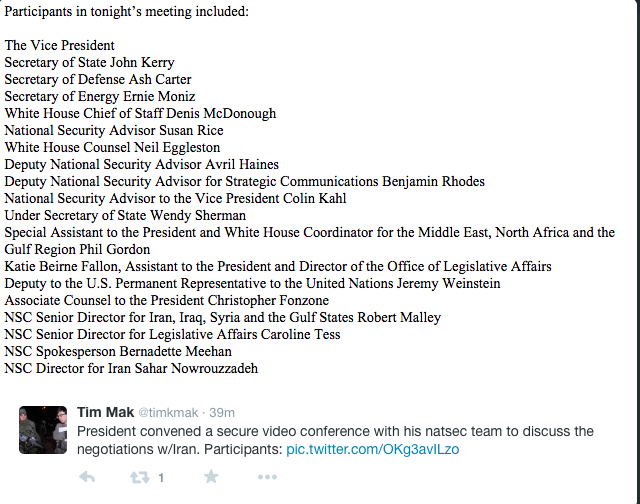
The White House released a list of its high-ranking officials who took part in a video conference with President Obama late Tuesday. Among them appears Sahar Nowrouzzadeh, who has formerly worked for the National Iranian-American Council.

The White House brief, which was disclosed by The Daily Beast, listed Sahar Nowrouzzadeh as the National Security Council Director for Iran. Nowrouzzadeh appears to be a former employee of the alleged pro-Tehran regime lobbying group, NIAC (National Iranian-American Council).

Screen Shot 2015-03-31 at 8.48.17 PM.png

Breitbart News has found that a person with the same name has previously written several publications on behalf of NIAC. According to what appears to be her LinkedIn account, Nowrouzzadeh became an analyst for the Department of Defense in 2005 before moving her way up to the National Security Council in 2014.
A NIAC profile from 2007 reveals that Sahar Nowrouzzadeh appears to be the same person as the one who is currently the NSC Director for Iran. The profiles indicate that she had the same double major and attended the same university (George Washington).

Critics have alleged that NIAC is a lobby for the current Iranian dictatorship under Ayatollah Khamenei. A dissident journalist revealed recently that NIAC’s president and founder, Trita Parsi, has maintained a years-long relationship with Iranian Foreign Minister, Javad Zarif.

NIAC was established in 1999, when founder Trita Parsi attended a conference in Cyprus that was held under the auspices of the Iranian regime. During the conference, Parsi reportedly laid out his plan to introduce a pro-regime lobbying group to allegedly counteract the influence of America’s pro-Israel and anti-Tehran regime advocacy groups.

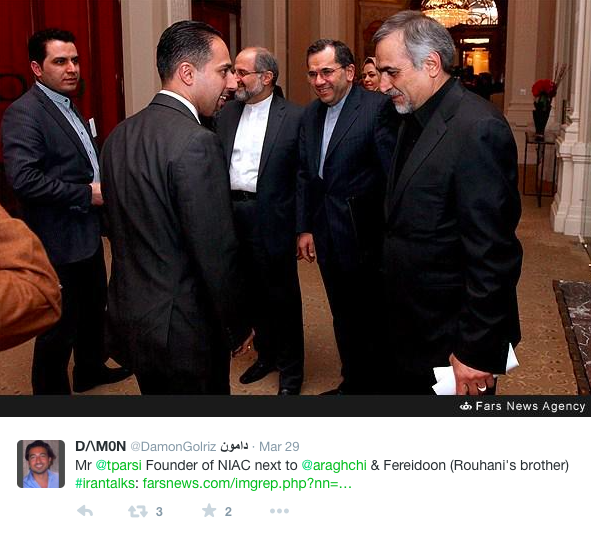
NIAC has been investing heavily in attempts to influence the talks in favor of an agreement with the state sponsor of terror. In recent days, its director, Trita Parsi, has been spotted having amiable conversation with Iranian President Hassan Rouhani’s brother.

Screen Shot 2015-03-31 at 2.22.52 PM.png

The possible revelations about the NSC Director’s apparent past with the alleged pro-regime group come as the U.S. has reportedly struck an agreement with Iran and the rest of the P5+1 world powers on Tehran’s nuclear weapons program.
***
So what else is not being addressed in the negotiations?

LAUSANNE, Switzerland — A top State Department official on Monday dismissed reports that Iran may be hiding key nuclear-related assets in North Korea and implied that she was unaware of the possibility, despite the publication this weekend of several articles by top analysts expressing alarm at the extent of nuclear cooperation between Tehran and Pyongyang.

Marie Harf, a spokeswoman for the State Department, dismissed as “bizarre” the reports, which described the transfer of enriched uranium and ballistic missile technology back and forth between the two rogue regimes.

The existence of an illicit Iranian nuclear infrastructure outside of the Islamic Republic’s borders would gut a nuclear deal that the administration has vowed to advance by Tuesday, according to these experts and others.

If Iran is not forced to disclose the full extent and nature of its outside nuclear work to the United States, there is virtually no avenue to guarantee that it is living up to its promises made in the negotiating room, according to multiple experts and sources in Europe apprised of the ongoing talks.

Gordon Chang, a North Korea expert who has written in recent days about Iran’s possible “secret program” there, described the State Department’s dismissal of these reports as naïve.

“Let me see if I get this straight: The country with the world’s most highly developed technical intelligence capabilities does not know what has been in open sources for years?” Chang said. “No wonder North Korea transfers nuclear weapons technology to Iran and others with impunity.”

“The North Koreans could go on CNN and say, ‘Hey, Secretary Kerry, we’re selling the bomb to Iran,’ and the State Department would still say they know nothing about it,” Chang said. “No wonder we’re in such trouble.”

Other Iranian experts specializing in the country’s military workings also have raised recent questions about Tehran’s collaboration with North Korea.

Ali Alfoneh and Reuel Marc Gerecht, both senior fellows at the Foundation for Defense of Democracies (FDD), have revealed that a nuclear reactor destroyed in Syria in 2007 by Israel was likely a North Korean-backed Iranian project.

Gerecht told the Free Beacon in a follow-up interview that key issues regarding Iran’s past military work and outside collaboration are being ignored in the negotiating room as diplomats rush to secure a tentative deal by Tuesday night.

“It certainly appears that the administration has backed away from [previous military dimensions] questions,” Gerecht said. “The plan appears to be to let the [International Atomic Energy Agency] continue its so far fruitless effort to gain access to sensitive sites, personnel, and paperwork, but to keep these questions out of the talks.”

“The administration is doing this because it fears the Iranians would walk out,” he added. “Any military work revealed by the Iranians would prove the Supreme Leader and [President] Rouhani liars.

Despite concerns from countries such a France over the issue, the United States has attempted to accommodate Iran, Gerecht said.

“The White House wants to believe that monitoring of known sites will be sufficient. It’s a bit mystifying given the Iranian track record and the CIA’s longstanding inability to penetrate the nuclear-weapons program (it’s just too hard of a target to do this reliably),” he explained. “But since they fear a breakdown, they bend their credulity in Iran’s favor. This has been the story of the negotiations from the beginning.”

Alfoneh also told the Free Beacon that Iran should be pressed by the United States to disclose the full extent of its nuclear relationship with North Korea.

“I certainly think the Islamic Republic should come clean concerning its past record of nuclear activities: Did the Islamic Republic ever try to build a nuclear weapon? If not, how are we to understand the opaque references to Tehran-Pyongyang nuclear cooperation in the 1990s?” Alfoneh said.

“As long as the Islamic Republic does not provide a clear record of its nuclear activities in the 1980s and 1990s, and as long as we do not know the full scope of Tehran-Pyongyang nuclear cooperation, there is always the risk of the two states renewing that cooperation, which in turn would jeopardize any agreement the Islamic Republic and the P5+1 Group may reach,” he said.

Another potential complication includes the ability of international inspectors to discern the extent of Iran’s nuclear work in Syria.

“Syria’s current chaos makes it virtually impossible for inspectors to do their job even if the Syrians were compliant,” according to Emanuele Ottolenghi, a onetime advisor to foreign ministries in Europe.

There is no way to determine whether Syria is housing any other nuclear sites on behalf of the Iranian, according to Ottolenghi, another senior fellow at FDD.

“Syria has covered up its nuclear activities after the 2007 [Israeli Air Force] raid on Deir al-Azour,” he said. “After four years of inconclusive efforts, the [International Atomic Energy Agency] ended up deferring the issue to the [United Nations Security Council] after declaring Syria in non-compliance.”

Meanwhile, More Land to the BLM

WASHINGTON, D.C. — President Obama today requested $1.2 billion in appropriations for the Department of the Interior’s Bureau of Land Management for Fiscal Year 2016. The request for BLM’s operating accounts represents an increase of $91.4 million above the 2015 enacted level. The proposal includes strategic investments that underscore the Administration’s continuing strong support for facilitating and improving management of increased energy production, conserving sage-grouse habitat in the West, strengthening BLM’s National Conservation Lands, and establishing a BLM Foundation to foster public partnerships that support BLM’s missions.

“The Bureau of Land Management is proud to play a central role in our Nation’s economy through energy development, recreation, grazing, timber, and conservation activities,” said BLM Director Neil Kornze. “We greatly appreciate the support of the President and Congress in helping us take important steps forward in responsible and robust energy development, and in properly managing some of America’s wildest places.”

The BLM delivers significant economic benefits for communities across the Nation. Each year, lands under the Bureau’s management contribute over $100 billion in local economic activity and support more than 440,000 jobs.  In the last fiscal year, the BLM generated over $5 billion in receipts from public lands, benefiting State governments and the U.S. Treasury.

The BLM is concerned about managing energy production, restoring the habitats for grouse, conservation and wants to create a BLM foundation. Don’t be fooled America.

Federal Land Management Not a Good Deal for Americans

“By nearly all accounts, our federal lands are in trouble, both in terms of fiscal performance and environmental stewardship.” That was an assertion made earlier this month in a study released by the Property and Environment Research Center (PERC). The study focused on the difference between state-managed public lands and federally managed public lands. The federal government is ill-suited to manage vast amounts of land in the West. Short of private ownership, state and local governments are best suited for the task.

Federal Land Ownership. The federal government is the largest land owner in the United States, owning roughly 640 million acres, about 28 percent of the country. The federal government owns nearly half of the land west of the Rockies, and roughly 81 percent of Nevada alone. However, east of the Rockies, the federal government owns an average of only 5 percent of the land in each state. Such a high level of federal ownership of land in Western states has led to controversy over ownership and management of public lands.

Western states have considered resolutions requesting that the federal government transfer title of much of the public land held within their borders. Utah, for example has passed legislation that “requires the United States to extinguish title to public lands and transfer title to those public lands to the state.” Several other states such as New Mexico, Montana, and Wyoming have passed legislation to study the transfer of certain public lands from federal to state agencies. These transfers generally exclude public land such as national parks, national monuments, and tribal lands.

PERC’s Findings. PERC conducted its study by comparing revenues and expenditures for the management of federal land and state trust land in New Mexico, Arizona, Idaho, and Montana. State trust lands are the most common form of state-owned lands in the West. State trust lands were created by land grants made to the states by the federal government and are used for the benefit of public institutions, like schools. The lands generate revenue through uses ranging from timber and grazing to mineral extraction. The study looked at two federal agencies that manage public land: the Bureau of Land Management (BLM) and the United States Forest Service (USFS). According to the study,

  • “The federal government loses money managing valuable natural resources on federal lands, while states generate significant financial returns from state trust lands.”
  • “The states examined in this study earn an average of $14.51 for every dollar spent on state trust land management. The U.S. Forest Service and Bureau of Land Management generate only 73 cents in return for every dollar spent on federal land management.”
  • “On average, states generate more revenue per dollar spent than the federal government on a variety of land management activities, including timber, grazing, minerals, and recreation.” For example, New Mexico receives $12.78 of revenue per dollar spent on administering grazing fees, whereas the USFS and BLM receive $0.10 and $0.14, respectively.
  • “These outcomes are the result of the different statutory, regulatory, and administrative frameworks that govern state and federal lands. States have a fiduciary responsibility to generate revenues from state trust lands, while federal land agencies face overlapping and conflicting regulations and often lack a clear mandate.”

The PERC study calls into question the ability of federal government agencies to manage public lands in the west and supports states’ ability to manage those lands. As The Heritage Foundation’s Nick Loris and Katie Tubb note, “States are already well positioned to help make a transition to better management of these resources.” States are best suited to manage these public lands due to their vested interest in seeing the lands produce revenue and are also held responsible for achieving that objective.