When the U.S. Strategy is to no Longer Lead

Symptomatic of when a country is war weary, the rules of engagement are re-tooled, removing hostilities and the will to win fades away, the wake of destruction becomes worse. How many times has this occurred? Korea, Iraq, Libya, Yemen, Syria and more. If it is not up to the United States of America, then who?

Korea

Sudan

Cambodia

Sinjar Mountain, Iraq

Libya

Dafur

Syria


Ambassador: US handed Cambodia to the ‘butcher’ 40 years ago

American envoy, a German-born Jew, recalls horrors of Pol Pot’s regime, regrets Washington’s ‘abandonment’ of allies

PARIS (AP) — Twelve helicopters, bristling with guns and US Marines, breached the morning horizon and began a daring descent toward Cambodia’s besieged capital. The Americans were rushing in to save them, residents watching the aerial armada believed. But at the US Embassy, in a bleeding city about to die, the ambassador wept.

Forty years later and 6,000 miles (nearly 10,000 kilometers) away, John Gunther Dean recalls what he describes as one of the most tragic days of his life — April 12, 1975, the day the United States “abandoned Cambodia and handed it over to the butcher.”

Time has not blunted the former ambassador’s anger, crushing shame and feelings of guilt over what also proved a milestone in modern American history — the first of several US interventions in foreign countries climaxed by withdrawals before goals were accomplished and followed by often disastrous consequences.

“We’d accepted responsibility for Cambodia and then walked out without fulfilling our promise. That’s the worst thing a country can do,” he says in an interview in Paris. “And I cried because I knew what was going to happen.”

Five days after Operation Eagle Pull, the dramatic evacuation of Americans, the US-backed government fell as communist Khmer Rouge guerrillas stormed into Phnom Penh. They drove its 2 million inhabitants into the countryside at gunpoint, launching one of the bloodiest revolutions of modern times. Nearly 2 million Cambodians — one in every four — would die from executions, starvation and hideous torture.

Many foreigners present during the final months — diplomats, aid workers, journalists — remain haunted to this day by Phnom Penh’s death throes, by the heartbreaking loyalty of Cambodians who refused evacuation and by what Dean calls Washington’s “indecent act.”

I count myself among those foreigners, a reporter who covered the Cambodian War for The Associated Press and was whisked away along with Dean and 287 other Americans, Cambodians and third-country nationals. I left behind more than a dozen Cambodian reporters and photographers — about the bravest, may I say the finest, colleagues I’ve ever known. Almost all would die.

For the general public, the pullout is largely forgotten, overshadowed by the mass, hysteric flight from Saigon and the end of the Vietnam War three weeks later. But for historians and political analysts, the withdrawal from Cambodia signifies the first of what then-US Secretary of State Henry Kissinger termed “bug-outs.”

“It was the first time Americans came anywhere close to losing a war. What worries me and many of us old guys who were there is that we are still seeing it happen,” says Frank Snepp, a senior CIA officer in Saigon and author of “Decent Interval,” which depicts the final years of the Vietnam War. After Cambodia and Vietnam came Laos; there would be other conflicts with messy endings, like Central America in the 1980s, Iraq and — potentially — Afghanistan.

Today, at 89, Dean, a German-born Jew, and his French wife reside in a patrician quarter of Paris, in an elegant apartment graced by statues of Cambodian kings from the glory days of the Angkor Empire. A folded American flag lies across his knees, the same one that he clutched under his arm in a plastic bag as he sped to the evacuation site. Captured by a photographer, it became one of the most memorable images of the Vietnam War era.

In the apartment’s vestibule hangs a framed letter signed by President Gerald R. Ford and dated Aug. 14, 1975. It highlights that Dean was “given one of the most difficult assignments in the history of the Foreign Service and carried it out with distinction.”

But Dean says: “I failed.”

“I tried so hard,” he adds. “I took as many people as I could, hundreds of them, I took them out, but I couldn’t take the whole nation out.”

The former ambassador to four other countries expresses more than guilt. He is highly critical of America’s violation of Cambodian neutrality by armed incursions from neighboring Vietnam and a secret bombing campaign in the early 1970s which killed thousands of civilians and radicalized, he believes, the Khmer Rouge. Once-peaceful Cambodia, he says, was drawn into war for America’s interests, a “sideshow” to Vietnam.

The US bombed communist Vietnamese sanctuaries and supply lines along the Vietnam-Cambodia border, keeping Cambodia propped up as an anti-communist enclave, but it provided World War II aircraft and few artillery pieces to Phnom Penh forces fighting the Khmer Rouge.

“The US wasn’t that concerned about what happened one way or the other in Cambodia but only concerned about it to the extent that it impacted positively or negatively on their situation in Vietnam,” says Stephen Heder, a Cambodia expert at London’s School of Oriental and African Studies.

Opinion on what went wrong in Cambodia remains split to this day. One view is that the country was destabilized by the American incursions and bombings; another is that Washington failed to provide the US-propped Lon Nol government with adequate military and other support.

In his memoirs, Kissinger says the US had no choice but to expand its efforts into the neighboring country, which the North Vietnamese were using as a staging area and armory for attacks on US troops in South Vietnam. And as Cambodia crumbled, he writes, anti-war elements, the media and Congress combined to tie the administration’s hands, preventing further assistance.

Dean is bitter that Kissinger and other power brokers in Washington did not support his quest to persuade ousted Cambodian King Norodom Sihanouk to return from exile and forge a coalition between the Khmer Rouge and Lon Nol. It was Dean’s “controlled solution.”

“We were also on the telephone with Washington shouting, ‘Help us. We are going under. We are going to leave this country unprotected,’” Dean said in earlier oral testimony. But Washington seemed unmoved.

“Ambassador Dean never had (President Richard) Nixon’s or Kissinger’s support because both of them wanted out of Indochina,” Snepp says.

By early 1975, the embassy’s cables, most of them declassified in 2006, were becoming increasingly frantic.

Meeting me one day, a haggard Dean, who had lost 15 pounds, asked rhetorically: “Isn’t there any sense of human decency left in us?”

“Phnom Penh was surrounded by explosions and a night sky of blossoming flares and streaks of tracer bullets,” I wrote in one of my stories at that time. “Children were dying of hunger, the hospitals looked more like abattoirs and the Cambodian army lost as many men in three months as the US did in a decade of war in South Vietnam.”

The Khmer Rouge were tightening their stranglehold on the capital, shutting down the airport from which the embassy had flown out several hundred Cambodians. An April 6 cable from Dean said the Cambodian government and army “seem to be expecting us to produce some miracle to save them. You and I know there will be no such miracle.”

Congress was cutting the aid lifeline to Phnom Penh. The American public had had enough of the war.

Among Cambodians in the know, some anti-American feeling was growing.

“The Americans give temporary aid but ultimately they think only of themselves. We in Cambodia have been seduced and abandoned,” Chhang Song, a former information minister, said one night in early 1975.

But among Phnom Penh residents I found only smiles — “Americans are our fathers,” one vegetable vendor told me — along with a never-never-land mindset that things would turn out to be all right. Somehow.

“I honestly believe we did not do enough. There was something better that could have come out other than a genocide of 1.7 million people,” Dean says, explaining in part why he, a Jew, felt so strongly. “Now you must understand, I was born in Germany and suffered under Nazi oppression, so how could I turn over a people to the butcher?”

Dean’s abiding emotions are shared by others of his former staff.

Alan Armstrong, the assistant defense attache, is still trying to complete a novel to exorcise what he went through. It is called “La Chute,” “The Fall.”

“I was paid by my government to smile, break bread (with Cambodians) and then betray my friends and colleagues. That’s a heavy burden to bear no matter how many years roll by,” says the retired US Army colonel. “The downfall of the Khmer Republic not only resulted in the deaths of countless Cambodians, it has also crept into our souls.”

Historians, distant from the passions of the actors, differ over Dean’s efforts and American culpability.

Benedict Kiernan, a Yale University professor who has written extensively on Cambodia, says that given rifts within the Khmer Rouge leadership a political compromise earlier in the war might have been possible, resulting in a left-wing dominated coalition and not a fanatical revolution.

“Anything was worth trying to stop the Khmer Rouge before they got to Phnom Penh,” says Heder, the academic, who reported in Cambodia during the war and was among those evacuated from the capital.

Milton Osborne, an Australian historian and diplomat who served in Cambodia, describes Dean’s “controlled solution” as a “forlorn hope,” with the Khmer Rouge determined to win totally and execute Phnom Penh’s leaders. “By 1974, it was not a question of if, but when,” he says.

Snepp believes that Dean, desperately grasping at straws, was “living in fantasy land.”

Washington may have abandoned its ally, but the Cambodian elite also bears responsibility for its own demise. Snepp views President Lon Nol — corrupt, inept, superstitious and half-paralyzed — as one in a long line of similar leaders the United States would back in the following decades.

“What we have seen in all cases is that unless the US has a politically viable domestic partner, neither limited nor massive military intervention is going to succeed,” says Heder.

Timothy Carney, the embassy’s political officer, drawing on his record as ambassador to several countries, says that “tolerating corruption saps the legitimacy and support for whatever authority we are trying to prop up in a country.”

In the final days, Carney’s task was to persuade, unsuccessfully, Cambodian leaders to flee the country.

The night before the evacuation, Dean and his deputy drank some of the ambassador’s fine French wine so it wouldn’t fall into Khmer Rouge hands. The next morning, sitting in his office for the last time, he read a letter from Prince Sirik Matak in which the respected former deputy prime minister declined evacuation and thus sealed his own death. It read: “I never believed for a moment that you have this sentiment of abandoning a people which has chosen liberty. I have only committed this mistake of believing in you the Americans.”

Dean today describes it as the “greatest accusation ever made by foreigners. It is wrenching, no? And put yourself in the role of the American representative.”

His embassy closed down at 9:45 a.m., the evacuees driven 10 blocks to a soccer field shielded by a row of apartment buildings from Khmer Rouge gunners about a mile away. The Sikorsky “Jolly Green Giant” helicopters were setting down. The Marines fanned out to form a security cordon around the landing zone.

But fears of possible reprisals by Cambodians proved unfounded.

Children and mothers scrambled over fences to watch. They cheered, clapped and waved to the 360 beefy, armed Marines. A Cambodian military policeman saluted Armstrong smartly. Disgusted and ashamed, he dropped his helmet and rifle, leaving them behind.

I tried to avoid looking into faces of the crowd. Always with me will be the children’s little hands aflutter and their singsong “OK, Bye-bye, bye-bye.”

By 12:15 the last helicopters landed on the deck of the USS Okinawa waiting off the Cambodian coast. Tactically, the 2 1/2-hour operation had been flawless.

In Phnom Penh, Douglas Sapper, an ex-Green Beret who stayed behind to save his company’s employees, recalled the reaction of Cambodians who realized what had happened: “It was like telling a kid that Santa Claus was dead.”

Five days later we received a cable from Mean Leang, an ever-jovial, baby-faced AP reporter who had refused to seek safety. Instead he wrote about the brutal entry of the Khmer Rouge into the city, its surrender and gunpoint evacuation. “I alone in office, losing contact with our guys. I feel rather trembling,” he messaged. “Do not know how to file our stories now … maybe last cable today and forever.”

Barry Broman, then a young diplomat, remembers a Cambodian woman who worked upcountry monitoring the war for the embassy who had also refused evacuation.

“One day she said, ‘They are in the city,’ and her contact said ‘OK, time to go.’ She refused. Later she reported, ‘They are in the building,’ and again refused to leave her post. Her last transmission was, ‘They are in the room. Good-bye.’ The line went dead.”


Who Knew about Bergdahl and Prisoner Swap?

Per flash traffic: At 0430Z, TF 1 Geronimo reported a B Co missing soldier after he did not show up for the 0900L morning roll call at Mest OP, grid 42SVB 59236 47877 Yahya Khail District, Paktika.  A full search was ordered.  At 0535Z, TF 1 Geronimo initiated DUSTWUN procedures for the missing soldier.  At 0645Z, all remaining units had reported in 100% accountability.   Geronimo TOC ordered blocking positions set in and around Mest OP.  At 0707Z, Predator (VooDoo) was on station in support.  At 0940Z, a Pathfinder and tracking dog team arrived at Mest OP in support.  At 0945Z, Predator (Pfingston) arrived on station in support.  At 1012Z, LLVI receives traffic that an American Soldier with a camera is looking for someone who speaks English.  At 1303Z, Graphic 33(2x F-18) arrived on station in support.  At 1309Z, FF receive intelligence that a U.S. soldier has been captured.  At 1351Z, VooDoo and Pfingston RIP with Predator (Sijan).   At 1520Z, Sijan RIPs with Predator (Kisling) and DUDE-21 (2x F-15) arrives on station to support.  Between 1725Z and 1800Z, B Co conducted 2 breaches of suspected enemy locations with NSTR.  Additional forces were moving into the area to place blocking positions and conduct searches based on all of the aerial and ground based intelligence sources available throughout the day and through the night.

ISAF Tracking #06-2426

Event Title:CAPTURED SOLDIER
Zone:null
Placename:ISAF# 06-2426
Outcome:null

S:1 X US SOLDIER
A: MISSSING SOLDIER
L:VB 592 478
T:300430zJUNE09
U: Bco 1-501
R: INITIATE DUSTWUN

Action operations to find Bergdahl are explained fully here.

So who in the media and in the DC circles knew about Bergdahl from the immediate days he removed his uniform and left America behind? What were the swift demands of the Haqqani network demand for the return of Bergdahl?

Untangling the Mysteries Behind Bowe Bergdahl’s Rescue Mission

It was before dawn at Observation Post Mest-Malak, a U.S. Army outpost surrounded by Taliban-controlled villages in eastern Afghanistan, when the men in Blackfoot Company 2nd Platoon first noticed that Bowe Bergdahl was missing. An Army veteran who says he was one of Bergdahl’s closest friends in Afghanistan and spoke to Newsweek on the condition of anonymity, remembers the moment well. “[Specialist Shane] Cross came over and he whispered, ‘Hey, you seen Bergdahl?’ and I knew instantly he was gone. I said, ‘He’s gone. He’s fucking gone.’”

The U.S. Army boasts that it does not leave men behind, so when Private First Class Bergdahl disappeared in Paktika province on June 30, 2009, the Army was going to find him, no matter the cost.

His platoon-mates all knew Bergdahl was eccentric, a quiet kid who prided himself on the wilderness survival skills he learned growing up in Idaho. He was one of the fittest in the platoon, two of them told Newsweek, and he was meticulous about the gun-cleaning, field-manual-memorizing details of military life. He and his buddies liked to spend nights drinking chai with the Afghan National Police officers stationed up on a dusty hill. He smoked a pipe. Some of the guys thought he was weird, but they all thought he was reliable. “Up until the second he walked away, he was the example of the good soldier,” says Army Specialist Gerald Sutton. “He was always doing his job. We never had to worry about him.” Bergdahl’s close friend from the platoon adds: “He always did what he was told, always there to help you. Always.”

In downtime bitch sessions, when the men talked about shooting themselves in the foot or other schemes to get out of the war early, Bergdahl reportedly said his plan would be to walk to India. Or he said he would shed his weapons and gear, Siddhartha-like, and join the Kochis, nomadic Pashtun tribes whose dark tents dotted the Afghan valleys that looked eerily similar to the Idaho backcountry where he had honed his Man vs. Wild skills. His buddies thought it was just talk. “Everybody wanted to leave. We thought he was just venting,” the friend says. “We didn’t take it seriously. [At OP Mest] you couldn’t even walk outside the base. We were in contact with the enemy anytime we left…. It was like, ‘Whatever, [Bergdahl], you’re full of shit.’”

But he did leave. Alone and unarmed, the 23-year-old was abducted within hours by local Zadran tribe militants, sources tell Newsweek, who passed him up the Taliban’s regional chain of command. He was held as a hostage for five years, and only returned last year after a prisoner swap that freed five Taliban fighters from the U.S. military’s Guantanamo Bay Detention Camp.

04_10_FE0115_Bergdahl_10 From left, Colonel Bradley J. Kamrowski, Ph.D., Major General Joseph P. DiSalvo, and Colonel Ronald N. Wool deliver a press conference in San Antonio, Texas to report on Sgt. Bowe Bergdahl’s return to the United States and reintegration at Brooke Army Medical Center. Drew Anthony Smith/Getty

Ten months after returning to home soil, Bergdahl was formally charged on March 25, 2015, with two crimes under the Army’s Uniform Code of Military Justice: “Desertion With Intent to Shirk Important or Hazardous Duty” and the more serious “Misbehavior Before the Enemy by Endangering the Safety of a Command, Unit or Place.” He is awaiting an Article 32 hearing, similar to a grand jury, and is working a desk job at Fort Sam Houston in San Antonio. The Army tries dozens of desertion cases each year (17 men were found guilty of the charge in 2009), and the maximum punishment is five years in military prison, a dishonorable discharge and the loss of back pay. The misbehavior-and-endangerment charge is far more serious, exceptionally rare (according to Stars & Stripes, the last high-profile case was in 1968) and brings the maximum penalty of life in prison.

‘You’re Gonna Be Looking for Bergdahl’

Why Bowe Bergdahl walked into a hostile war zone isn’t much clearer now than it was the day he left. OP Mest was operating without an officer at the time, and according to his lawyer, Bergdahl snuck away to report disciplinary problems in his unit to an officer at a nearby base.

For the men he left behind in Blackfoot Company and the 1st Battalion of the 501st Regiment that night, life in Afghanistan changed instantly and dramatically. “From the second he left until we left the country, our whole mission was screwed up,” Bergdahl’s friend says. “[In] every operation order until March 2010, he was thrown in the mix: ‘You’re gonna be looking for Bergdahl.’”

“It changed the mission [in Afghanistan] for everyone,” says Sergeant Jordan Vaughan, who served in a separate Blackfoot Company platoon and says he was sent on at least 50 missions to find the missing soldier. “We stopped the regular counter-insurgency mission and instead went and looked for Bergdahl.” According to Vaughan and other men from Blackfoot Company, at least eight soldiers were killed on those searches. Platoon medic Josh Cornelison told NBC News last June, “Every single person that died [out there] was doing something to find Bowe Bergdahl.”

In both legal and moral terms, the charge that Bergdahl’s actions led to the deaths of fellow soldiers is the most important and disturbing one he faces, and yet the Pentagon has steadfastly denied the claim. “I do not know of specific circumstances or details of U.S. soldiers dying as a result of efforts to find and rescue Sergeant Bergdahl,” former defense secretary Chuck Hagel said last summer. Bergdahl had been promoted during his captivity.

The families of those fallen men are outraged and frustrated by this apparent contradiction of facts and testimony. “They’re not liars,” says Cheryl Brandes of the soldiers’ claims. Her son, Matthew Martinek, died from wounds suffered during an ambush on September 4, 2009, while on a mission, his comrades told her, to find Bergdahl. “There needs to be an investigation,” she told Fox News. “Why is this such a cover-up? Why can they not just tell us, ‘Yes, your son was looking for another soldier?’ What’s so bad about that?”

The Pentagon cannot answer Brandes without conceding an awkward and troubling fact: On the day her son was flanked by Taliban militants in an ambush that also killed 2nd Lieutenant Darryn Andrews, officials in Washington and Kabul already had overwhelming intelligence that Bergdahl was no longer in Afghanistan.

‘We Assumed It Became a CIA Operation’

From the hilltop guard post at OP Mest, it was just 25 miles or so to the Pakistani border, and, according to a former State Department official who spoke to Newsweek on the condition of anonymity, there was a widespread assumption in Kabul that Bergdahl would be shuttled to Pakistan as fast as his captors were able.

The day he was reported DUSTWUN (Duty Status Whereabouts Unknown), American military commanders working with the International Security Assistance Force (ISAF) ordered a secretive military unit—variously referred to as the intelligence support activity, mission support activity, the activity or gray fox—to track leads about his whereabouts. One of the first officers on the case was an unconventional-operations specialist who was attending a jirga, a meeting of Afghan tribal elders, when he got the call about Bergdahl. The officer, who is not authorized to discuss the case and spoke on the condition of anonymity, says, “I got a call from our guy in Kabul. He said, ‘Hey, we got a lost puppy.’  “We just happened to be talking to the elders in this tribe with knowledge of the area [where Bergdahl went missing],” the officer tells Newsweek. He says he immediately got to work, calling dozens of sources across Afghanistan. “We talked to Taliban lawyers and mullahs, border security police, a lot of people.”  The intelligence-gathering quickly brought precise information about Bergdahl’s captors. “We knew how they were going to move him, where they were going to move him. We figured it would be 48 hours at the most before he was across the border,” the officer says. When he investigated whether the Army could prevent Bergdahl’s captors from taking him across that border, the answer was clear. “There is no way to shut down border traffic. It’s the Silk Road, for God’s sake,” he says. “It’s been a smugglers’ transit route for thousands of years. So [the Taliban] better be pretty good at it. And they are.”

Within days, this officer was told by his superior to give up the search: “I was told to drop it, that someone else has got it.” The following week, he learned that the Joint Special Operations Command (JSOC), which planned and executed the most sensitive raids of the war—including Operation Neptune Spear, the mission that killed Osama bin Laden in May 2011—had also been called off. “When JSOC was told to stand down,” the officer tells Newsweek, “we assumed it became a CIA operation in Pakistan.”

The moment Bergdahl was taken across the Afghan-Pakistani border, the search for him jumped its own distinct legal boundary. Rescuing the “lost puppy” went from the purview of traditional military operations to a covert intelligence mission. “Anything south of that line was outside the area of Operation Enduring Freedom,” the military mission in Afghanistan, the officer says. At that point, “it would have taken the president or a CIA operation to call a cross-border raid.”

By the second week of July, civilian and military officials were so confident Bergdahl had been smuggled across the Pakistani border that the JSOC and clandestine special operations units were called off the search…

So why did the Army continue to send infantrymen in Afghanistan on dozens of missions in hostile territory to find him?

A High-Value Hostage

The militants who captured Bergdahl were never coy about their identity or why they had kidnapped him. Two days after he was abducted, they held the Taliban equivalent of a press conference to take responsibility and make their demands. “The case will be referred to Sirajuddin Haqqani and other top Taliban leadership,” Mullah Sangeen, a well-known Taliban commander in Paktika, told a CBS reporter on July 2, 2009. “They have to decide the future of the U.S. soldier, but we would not mind a prisoner exchange.”

The Pentagon was equally clear about the players involved. “An American soldier captured in southeastern Afghanistan is being held by a notorious militant clan, a senior U.S. military official said,” is how CNN’s Barbara Starr put it. Reports by the BBC, The Washington Post, and The Long War Journal concurred: Bergdahl had been taken by the Haqqani Network.

The Haqqanis were a terrorist threat that was well known in Washington and Kabul, and they were a constant source of diplomatic headaches. During the Cold War, Jalaluddin Haqqani was a handsomely paid CIA proxy in the fight against the Soviets, but after 9/11, his family took up arms against the latest infidel invaders. “In Pakistan’s tribal areas of North and South Waziristan, Maulavi [Jalaluddin] Haqqani and his sons run a network of madrasas and training bases and provide protection for foreign fighters and terrorist groups, including Al-Qaeda,” The New York Times reported in June 2008.

In November of that year, the Haqqanis lured Times reporter David Rohde to an interview south of Kabul, then snatched him and immediately smuggled him across the border to Pakistan’s Federally Administered Tribal Areas. “The Haqqanis oversee a sprawling Taliban mini-state in North Waziristan with the acquiescence of the Pakistani military,” Rohde said in A Rope and a Prayer, the 2010 book he co-wrote with his wife, Kristen Mulvihill, about his seven months as a Haqqani hostage. By the spring of 2009, several months into his captivity, Rohde’s situation was common knowledge to then-secretary of state Hillary Clinton, State Department ambassadors to the region, management of The New York Times, American intelligence and law enforcement agencies, as well as the private hostage negotiators and consultants Rohde’s wife and family had recruited.

On June 20, 2009, Rohde fled in a daring and successful escape, the details of which remain unclear. Ten days later, in a stroke of luck for a terrorist group that had made kidnapping a pillar of its business, the Haqqanis replaced the journalist with an even more valuable hostage—the first and only American soldier captured in that war.

‘Looking for Someone Who Speaks English’

Before Sangeen called that press conference, Bergdahl’s captors hurried to make a proof-of-life tape and deliver it to the highest-ranking American official they could reach in Kabul. Having video proof was a high priority for the militants, first discussed in a conversation intercepted by American spy planes about six hours after Bergdahl’s platoon reported him missing. “An American soldier with a camera is looking for someone who speaks English” is how the Army interpreter paraphrased the intercepted radio or cellphone chatter. That message, which was logged in the classified Army record later published by WikiLeaks, matches the memories of men in Blackfoot Company who heard the interpreter’s words over the radio that morning. It is cited as proof by some members of the platoon and multiple media organizations that Bergdahl had gone looking to join the Taliban, that he was a traitor. “That means he’s going to collaborate with the enemy, [doesn’t] it?” Sean Hannity said on his Fox News show.

But according to Robert Young Pelton, a journalist consulted by the military to help find Bergdahl, that message was wrong, a bad translation from the captor’s Pashto language. It wasn’t the young American who had a camera and was looking for someone who spoke English; it was Bergdahl’s kidnappers, hurrying to speak to and record proof of their high-value hostage.

Pelton was working in Afghanistan as the director of AfPax, a subscription-based, conflict-zone information service. For a monthly fee, he provided clients with a stream of information gathered by local sources. “We had subscribers from every venue: media, State Department, [nongovernmental organizations], etc.,” Pelton tells Newsweek. “The military, special operations, came to us and asked us for help [tracking Bergdahl].” One former military intelligence officer who would not talk on the record about the Bergdahl incident tells Newsweek that AfPax was the best source of clean intelligence in Afghanistan at the time.

The day after Bergdahl walked off his base, the spy planes picked up another conversation between militants about their new prize: “Can you guys make a video of him and announce it all over Afghanistan that we have one of the Americans?” the first asked. Another man replied, “We already have a video of him.”

To Pelton, who tracked Rohde and other kidnapping victims in eastern Afghanistan, Bergdahl’s destination was never in doubt: “We knew he was going to Pakistan as soon as [the Army] said they were missing a guy.” Pelton worked with RC-East commanders—conventional U.S. forces in eastern Afghanistan—for about two weeks before he was told to stop. “We went over to their office and they had maps on the wall, and we would point to Pakistan and say, ‘He’s going that way.’ That’s when they told us to wave off,” he says.

Pelton, who wrote about his work tracking Bergdahl for Vice, says, “Everyone knew that Bergdahl was in Pakistan, and now everyone is trying to rewrite history.”

Ransom Demand: $19m and 25 Prisoners

By the time the Haqqanis released their first proof-of-life video to the media, some Army officials had been informed that Bergdahl was already over the border. According to Qayum Karzai, the older brother of then-Afghan president Hamid Karzai, the Haqqanis delivered their first messages, via a courier, to Major General Edward Reeder Jr., commander of Special Operations in Operation Enduring Freedom at the time. The militants wanted $19 million and 25 prisoners from Gitmo, roughly the same ransom demands first made to free Rohde. “Everyone knew he was in Pakistan…the Afghan government, tribal leaders, Afghan reporters,” Karzai tells Newsweek. “Everyone talked about it.” At a time when many feared Bergdahl had been killed, Karzai says he also helped deliver a message from the prisoner to his parents in Idaho.

According to Linda Robinson, a senior policy analyst at the Rand Corporation, who interviewed Reeder for her book One Hundred Victories: Special Ops and the Future of American Warfare, the general learned of Bergdahl’s location from two sources. The first, a former Taliban minister who had joined the Afghan government, told Reeder that Bergdahl had been taken to Miran Shah, the same town where Rohde spent most of his seven months in captivity. The second was the courier. Sometime shortly after Reeder received the first ransom demand, the courier brought a second message that lowered the ransom to $5 million and dropped the request for a prisoner swap. Reeder told Robinson he passed the message up the chain of command, but to his surprise, “none of his superiors followed up on it.”

Reeder declined to comment on this story through an Army public affairs officer. Both retired general Stanley McChrystal, Reeder’s superior at the time, and retired general Mike Flynn, the director of the Defense Intelligence Agency during the search, also declined to answer Newsweek’s questions related to the Bergdahl case. (Reporter’s disclosure: For the first year of Bergdahl’s captivity, I worked in his hometown, and his father was the UPS deliveryman at the office where I worked.)

On July 18, 2009, 18 days after Bergdahl had walked away from his base, the Haqqanis released a video of him to the international press, and ABC News reported that, according to “a person actively involved in the search,” he had been taken to Pakistan. In interviews with ABC News, U.S. officials at the Pentagon and in Kabul denied the claim, insisting he was still in Afghanistan.

‘The War Was About to Be Lost’

The idea that America’s only prisoner of war in the post-9/11 era was being held inside the borders of a key ally in its War on Terror posed some serious problems. In mid-2009, when Bergdahl apparently was smuggled over one of the most dangerous borders in the world, Washington had real concerns over “not wanting to go to war with Pakistan,” says Ahmed Rashid, a Lahore, Pakistan–based journalist and author.

Bergdahl’s abduction coincided with the start of the largest American surge in the 13 years of that war—from less than 40,000 servicemen in early 2009 to about 100,000 in late 2010. In the summer of 2009, the Taliban were ascendant across southern Afghanistan, and, as Robinson writes, the Americans realized “the war was about to be lost.” The escalation affected both sides of the border. On the Pakistan side, CIA drone strikes (that the Bureau of Investigative Journalism reports likely killed many more civilians than militants) rose from 35 in 2008 to 117 in 2010. After an errant ISAF helicopter killed three Pakistani soldiers stationed near the border, the Pakistanis temporarily cut off the ISAF’s main supply artery, and relations between Washington and Islamabad hit new lows.

Rashid, who consulted with both the Rohde and Bergdahl families during their negotiation efforts, says the captured soldier was an inconvenient truth for the Americans. At such a delicate moment, a covert cross-border raid to retrieve one infantryman was a catastrophic risk. Bergdahl was trumped, says Rashid, by the top American priority: “protect the already fragile but still useful relationship with Pakistan to get at Al-Qaeda.”

On Christmas Day 2009, nearly six months after the Army called off its elite special operations and JSOC units from the search, and after commanding officers sent the men of Blackfoot Company on nearly six months’ worth of raids and missions to allegedly find him, the Haqqanis released a second proof-of-life video, a strange and uncomfortable spectacle. A thin Bergdahl sometimes reads and sometimes rambles through a lengthy indictment of American policy:

“And so do I, my family members, my fellow soldiers in the Army and their families, and all the regular Americans, do we or even should we trust those that send us to be killed in the name of America? Because aren’t our leaders, be it Obama or a Bush or whoever, aren’t they simply the puppets of the lobbies that pay for their election campaigns?”

Speaking for the Pentagon, Rear Admiral Gregory Smith called the video an affront to the soldier’s family and friends. “It reflects nothing more than the violent, deceitful tactics of the Taliban insurgency,” he said. “We will continue our search for Bowe Bergdahl.”

‘You Will Be Hunted…’

In the days after Bergdahl disappeared, Blackfoot Company scrambled its platoons. For the first 35 to 40 days, according to several men, the search was “nonstop.” Squads were sent to follow every lead, in any direction. For some, that meant driving to sit in far-off “blocking positions” to intercept any Taliban vehicles that might be stowing him. Some soldiers were sent beyond the reach of the Army’s supply trucks, to desert frontiers where contracted Russian pilots air-dropped food and water from helicopters that looked older than the Americans on the receiving end. The soldiers of Blackfoot Company were also sent to raid distant Afghan villages. Infantrymen distributed pamphlets to Afghan civilians asking for information about Bergdahl. The flyers had pictures of American soldiers kicking down doors and a caption that read, “If you do not release the U.S. soldier then…you will be hunted.”

Bergdahl’s platoon’s missions soon ranged beyond Paktika and into neighboring border provinces. “It was a wild goose chase,” says Bergdahl’s friend from the 2nd Platoon. “We went all over southeast Afghanistan.” But, he adds, “we did whack a lot of people in the process.”

As the weeks wore on, another Blackfoot Company team leader, Sergeant Johnathan Rice, suspected his commanders weren’t really looking for Bergdahl. “Common sense dictates that [whoever took him wasn’t] going to keep him around for long.” But unlike most of the soldiers in his platoon, Rice saw a method in the Army’s madness. “From an infantryman standpoint, we were doing our job for once,” he says. “We were actually going to towns, doing our assaults, raiding places.”

Before Bergdahl went missing, Rice says, his men had their hands tied. “We weren’t able to do ‘hard knocks’—when you hit a target and breach their house early in the morning or overnight. We would need a ridiculous amount of intel to get the green light to do that kind of thing. But if it was a mission to retrieve Bergdahl, it was an instant green light. It was always worded as ‘These people could have information on Bergdahl.’ But my speculation is that they were targets that we wanted to bring in anyway.”

Rice felt his men were now taking the fight to the enemy, rather than “just knocking on the door and asking to have some tea.” Before Bergdahl left, “we were walking through markets buying goats because we had nothing else to do.” During these searches for Bergdahl, “we had excuses to hit high-value targets or hit people of interest.”

“A lot of valuable intelligence was gathered,” Rice says, and Bergdahl was the excuse his commanders needed to do their jobs. “Leadership took the opportunity, and I stand 100 percent behind it.”

The #Bergdahl Lynch Mob

After being held hostage for five years, a pale and bald Sergeant Bergdahl emerged from the back of a militant’s Nissan, allegedly in the border province of Khost, and boarded an American Blackhawk helicopter. Within a day, about 8,000 miles to the west, five Taliban detainees (at least two of whom had been in leadership positions) boarded a U.S. C-17 military transport plane at Guantanamo Bay, Cuba, and were flown to Qatar, where they would be free but monitored and travel-restricted for a year. When National Security Adviser Susan Rice announced the swap as a triumph for America, further proof the U.S. Army doesn’t abandon its men, the frustrations of the soldiers who had searched for Bergdahl roiled social media.

In the fall of 2009, the Army had the men in Blackfoot Company sign nondisclosure agreements, requiring them to never talk about the Bergdahl affair. But as stories from Afghan War soldiers started showing up on Twitter and Facebook, six veterans of the 2nd Platoon, including Specialist Sutton, were recruited by Republican strategist Richard Grenell for a media tour. They were flown to New York last summer from Michigan, South Dakota, Texas, Washington and California and, says Sutton, put up in a cramped Manhattan hotel paid for by Fox News. They trashed Bergdahl, calling him a deserter first and foremost, but also, some said, a traitor, a sympathizer of America’s enemy and a coward.

Much of the mainstream political media jumped in gleefully, speculating about Bergdahl’s motives, his politics and his religion. They also opined on his parents’ politics and religious beliefs, his father’s “suspicious” beard, how frequently they talked to their son. And most important to the analysts of policy and politics, they talked about whether Bergdahl was “worth it.”

After those soldiers and their families went public, Bergdahl’s hometown of Hailey, Idaho, was swarmed, and the FBI was called in when Bergdahl’s family received multiple death threats. This spring, with each update about his case, including the recent news that he will face desertion and misbehavior-and-endangerment charges, the #Bergdahl lynch mob is roused again, overflowing with the righteous vengeance of those who want Bergdahl imprisoned for life, or worse. “The evidence shows right now that U.S. soldiers were killed searching for the man,” Bill O’Reilly said on his Fox News show in late March. That statement is not quite accurate. The full truth—that the Army sent infantrymen on dangerous missions to find a soldier it knew was no longer missing—is far more complicated, and confounding.

Forged in the political heat of TV news studios, the vitriolic descriptions of Bergdahl’s character and behavior do not match what those who knew him best say about him now. “He was a heck of a soldier,” says Bergdahl’s friend from 2nd Platoon. “He was odd. He was different, which is why the other guys didn’t like him.… He did meditating and Buddhist stuff and people thought it was weird. I’m weird. Everyone is weird in their own way.”

In politics and war, simple myths are more useful than complex realities. The soldiers who searched for Bergdahl did so without question, and in their selflessness, they called upon the military’s essential and sacred codes of honor. The families and small towns that lost men in those searches bear a powerful witness to the horror and confusion of America’s longest war. They deserve an honest accounting of what happened to their sons and why.

And as he prepares to defend himself against the charge that he caused their deaths, so does Bowe Bergdahl.

This story was updated to clarify that Qayum Karzai did not deliver, handle, or have knowledge of the video or ransom demands for Bowe Bergdahl. He helped deliver a letter from the prisoner to his parents. 

Slight (White) House Mocks Netanyahu

The Iranian Supreme Leader, Khamenei is throwing sand in the gear of the P5+1 framework agreement lead by U.S. Secretary of State, John Kerry.

He is not only non-committal on the matter but what is worse he has taken the same posture as the Iranian Foreign Minister, Mohammad Zarif, stating that ALL sanctions must be lifted before anything will go forward. This is a morning after additional dynamic, putting John Kerry and the White House in damage control.

But it is actually worse.

Iran: We’ll Start Using Advanced Centrifuges After Deal Signed

Iran’s negotiator in the nuclear negotiations and its nuclear chief revealed on Tuesday that after a final deal is signed by a June 30 deadline on the framework reached last week, Iran will unleash its most advanced centrifuges for uranium enrichment, threatening a quick turnover in producing a nuclear weapon.

Iran’s semi-official FARS news agency reported on a closed meeting held Tuesday by Foreign Minister Javad Zarif and Atomic Energy Organization of Iran (AEOI) chief Ali Akbar Salehi, in which they briefed members of Iran’s parliament on the deal being finalized.

In their statements, they said Iran’s most advanced IR-8 centrifuges will be used as soon as the deal removing world sanctions against Iran begins.

The report noted the two said the advanced centrifuges enrich uranium 20 times faster than the current IR-1 models, meaning they would radically reduce the breakout time needed for Iran to obtain a nuclear arsenal.

In the meeting Zarif and Salehi told the parliament “that the country would inject UF6 gas into the latest generation of its centrifuge machines as soon as a final nuclear deal goes into effect by Tehran and the six world powers,” according to the report.

“The AEOI chief and the foreign minister presented hopeful remarks about nuclear technology R&D which, they said, have been agreed upon during the talks, and informed that gas will be injected into IR-8 (centrifuges) with the start of the (implementation of the) agreement,” Iranian MP Javad Karimi Qoddousi was quoted as saying by the site.

Qoddousi also said the Iranian foreign ministry will present a “fact sheet” showing Iran’s version of the agreement to parliamentarians in the next few days.

Iranian and US versions of the framework have shown numerous contradictions, with the issue of advanced centrifuges being primary among them.

The US version claims Iran agreed to not use its advanced centrifuges, including IR-2, IR-4, IR-5, IR-6 or IR-8. However, the Iranian text says “on the basis of solutions found, work on advanced centrifuges shall continue on the basis of a 10-year plan,” apparently contradicting the American version.

This point is crucial, as experts have anticipated that under the deal Iran will be able to develop its centrifuge technology and reach a point where it can make a three week dash to obtain a nuclear weapon.

Israel has pointed out that of the 17 states with peaceful nuclear programs, none enrich uranium as Iran is being allowed to continue doing by the deal.

The statements come after US President Barack Obama admitted in an interview that as a result of the deal, Iran will be able to reach a “zero” breakout time by 2028, meaning it could produce nuclear weapons immediately whenever it wanted to.

Some interesting notes:

1. Iran collectively owes an estimated $119 billion in restitution for past terror acts and refuses to pay it stating the Foreign Sovereignty Act.

2. Iran also states that there will be no monitoring of their facilities.

3. The base line standard on the Iranian nuclear program performed by the IAEA was so long ago that a current report on the uranium enrichment and centrifuges is impossible to report.

4. The inspections mentioned in the recent framework are to be performed by the United Nations Security Council, who are not only not qualified, but Russia has a veto vote on that council.

Meanwhile, the White House has taken to a satire agenda, mocking Israel. This does not make for good policy, good governance or good relationships. Shame on the Slight (White) House.

White House tweet pokes fun at Israel on Iran nuke deal

The White House is taking another swipe at Israeli Prime Minister Benjamin Netanyahu, defending the Iran nuclear deal by posting a diagram of a nuclear bomb on Twitter similar to one used by the Israeli leader to warn against an agreement.

The administration’s tweet of a cartoon bomb is accompanied by a list of consequences of not striking a deal, including “resumed production of highly enriched uranium” and “no limits on stockpile of enriched uranium.” The supposed benefits of a deal include “no production or stockpile of highly enriched uranium.”

The sketch closely resembles one held up by Mr. Netanyahu during a speech in 2012 at the United Nations, when he warned that Iran’s push to develop a nuclear weapon must be stopped at all costs. His drawing of a bomb included a red line at the top to show how close Iran was to completing a nuclear device.

The White House diagram also includes a red line and proclaims, “Under the framework for an Iran nuclear deal, Iran uranium enrichment pathway to a weapon will be shut down.”

Mr. Netanyahu is an outspoken opponent of the framework agreement announced last week, in which sanctions against Iran will be lifted in exchange for scaling back Tehran’s nuclear program. President Obama’s push for an agreement with Iran has raised tensions in what was already an uneasy relationship with Mr. Netanyahu.


Russian Aggression Noticed Globally

The West has gone back to the future, Cold War conditions when it comes to Russia. When it comes to Ukraine, the media refers to the conflict as coming from Russian separatists, this is a misnomer, they are ‘Soviet’ loyalists.

US aerospace command moving comms gear back to Cold War bunker

Washington (AFP) – The US military command that scans North America’s skies for enemy missiles and aircraft plans to move its communications gear to a Cold War-era mountain bunker, officers said.


The shift to the Cheyenne Mountain base in Colorado is designed to safeguard the command’s sensitive sensors and servers from a potential electromagnetic pulse (EMP) attack, military officers said.

The Pentagon last week announced a $700 million contract with Raytheon Corporation to oversee the work for North American Aerospace Command (NORAD) and US Northern Command.

Admiral William Gortney, head of NORAD and Northern Command, said that “because of the very nature of the way that Cheyenne Mountain’s built, it’s EMP-hardened.”

“And so, there’s a lot of movement to put capability into Cheyenne Mountain and to be able to communicate in there,” Gortney told reporters.

“My primary concern was… are we going to have the space inside the mountain for everybody who wants to move in there, and I’m not at liberty to discuss who’s moving in there,” he said.

The Cheyenne mountain bunker is a half-acre cavern carved into a mountain in the 1960s that was designed to withstand a Soviet nuclear attack. From inside the massive complex, airmen were poised to send warnings that could trigger the launch of nuclear missiles.

But in 2006, officials decided to move the headquarters of NORAD and US Northern Command from Cheyenne to Petersen Air Force base in Colorado Springs. The Cheyenne bunker was designated as an alternative command center if needed.

That move was touted a more efficient use of resources but had followed hundreds of millions of dollars worth of modernization work at Cheyenne carried out after the attacks of September 11, 2001.

Now the Pentagon is looking at shifting communications gear to the Cheyenne bunker, officials said.

“A lot of the back office communications is being moved there,” said one defense official.

Officials said the military’s dependence on computer networks and digital communications makes it much more vulnerable to an electromagnetic pulse, which can occur naturally or result from a high-altitude nuclear explosion.

Under the 10-year contract, Raytheon is supposed to deliver “sustainment” services to help the military perform “accurate, timely and unambiguous warning and attack assessment of air, missile and space threats” at the Cheyenne and Petersen bases.

Raytheon’s contract also involves unspecified work at Vandenberg Air Force Base in California and Offutt Air Force Base in Nebraska.

***

Russia is so close that the F-16 fighter pilots can see it on the horizon as they swoop down over a training range in Estonia in the biggest ever show of U.S. air power in the Baltic countries.

The simulated bombs release smoke on impact, but the M-61 cannon fires live ammunition, rattling the aircraft with a deafening tremor and shattering targets on the ground.


The four-week drill is part of a string of non-stop exercises by U.S. land, sea and air forces in Europe — from Estonia in the north to Bulgaria in the south — scaled up since last year to reassure nervous NATO allies after Russia’s military intervention in Ukraine. U.S. and Russian forces are now essentially back in a Cold War-style standoff, flexing their muscles along NATO’s eastern flank.

The saber-rattling raises the specter that either side could misinterpret a move by the other, triggering a conflict between two powers with major nuclear arsenals despite a sharp reduction from the Cold War era.

“A dangerous game of military brinkmanship is now being played in Europe,” said Ian Kearns, director of the European Leadership Network, a London-based think-tank. “If one commander or one pilot makes a mistake or a bad decision in this situation, we may have casualties and a high-stakes cycle of escalation that is difficult to stop.”

With memories of five decades of Soviet occupation still fresh, many in the Baltic countries find the presence of U.S. forces a comfort rather than a risk.

In recent months, Estonia, Latvia and Lithuania have seen hundreds of U.S. armored vehicles, tanks and helicopters arrive on their soil. With a combined population of just over 6 million, tiny armies and no combat aircraft or vehicles, the last time tanks rumbled through their streets was just over 20 years ago, when remnants of the Soviet army pulled out of the region.

The commander of Estonia’s tiny air force, Col. Jaak Tarien, described the roar of American F-16s taking off from Amari — a former Soviet air base — as “the sound of freedom.”

Normally based in Aviano, Italy, 14 fighter jets and about 300 personnel from the 510th Fighter Squadron are training together with the Estonians — but also the Swedish and Finnish air forces. Meanwhile, Spain’s air force is in charge of NATO’s rotating air patrols over the Baltic countries.

“A month-long air exercise with a full F-16 squadron and, at the same time, a Spanish detachment doing air policing; that is unprecedented in the Baltics,” said Tarien, who studied at the U.S. Air Force Academy in Colorado Springs.

In Moscow the U.S. Air Force drills just 60 miles from the Russian border are seen in a different light.

“It takes F-16 fighters just a few minutes to reach St. Petersburg,” Foreign Ministry spokesman Alexander Lukashevich said, referring to the major Russian port city on the Baltic Sea. He expressed concern that the ongoing exercise could herald plans to “permanently deploy strike aircraft capable of carrying nuclear weapons at the Russian border.”

Moscow also says the U.S. decision to deploy armored vehicles in Eastern Europe violates an earlier agreement between Russia and NATO.

American officials say their troop deployments are on a rotational basis.

Russia has substantially increased its own military activity in the Baltic Sea region over the past year, prompting complaints of airspace violations in Estonia, Finland and Sweden, and staged large maneuvers near the borders of Estonia and Latvia.

“Russia is threatening nearly everybody; it is their way,” said Mac Thornberry, the Republican chairman of the U.S. House Armed Services Committee, during a recent visit to Vilnius, the Lithuanian capital.

“They want to intimidate the Baltic states, Poland, Ukraine and Romania, country after country. And the question is, do you let the bully get away with that or do you stand up and say ‘no, you can threaten, but we will not allow you to run over us,'” Thornberry said.

The Pentagon has said that some 3,000 U.S. troops will be conducting training exercises in Eastern Europe this year. That’s a small number compared to the hundreds of thousands of U.S. troops that have been withdrawn from Europe since the days when the Iron Curtain divided the continent. But the fact that they are carrying out exercises in what used to be Moscow’s backyard makes it all the more sensitive; the Kremlin sees NATO’s eastward expansion as a top security threat.

During a symbolic visit to Estonia in September, U.S. President Barack Obama said that the defense of the Baltic capitals of Tallinn, Riga and Vilnius is just as important as defending Berlin, Paris and London — a statement warmly received in Estonia, a nation of 1.3 million and with a mere 5,500 soldiers on active duty.

Welcoming the U.S. fighter squadron to Estonia, U.S. Ambassador Jeffrey D. Levine said the air drill was needed “to deter any power that might question our commitment to Article 5” — NATO’s key principle of collective defense of its members.

On Wednesday, The Associated Press observed bombing and strafing drills at the Tapa training ground both from the ground and from the back seat of one of the two F-16s taking part.

On board the fighter jet, the pull of the G-force was excruciating as the pilot swooped down onto his target before brutally ascending to circle the range.

After dropping six practice bombs each, the two jets returned to Amari air base, flying so low over the flat Estonian countryside that they frequently had to gain altitude to avoid radio towers.

On the ground, Lt. Col. Christopher Austin, commander of the 510th Squadron, dismissed the risk of his pilots making any rash moves that could provoke a reaction from the Russians.

“We stay far enough away so that we don’t have to worry about any (border) zones or anything like that,” he said. “We don’t even think about it.”

Greece, Nazis, Germany, Russia and the Euro

Greece has a new government and on tap is a huge payment of debt to the International Monetary Fund. Greece is in no position to meet this payment of $450 million. So Greece is looking to other countries for help and could be prepared to give up several pieces of key infrastructure. Iran, Greece and China are eager to come to the rescue, which could add to the power balance in Europe.

The Prime Minister of Greece, Alexis Tsipras is himself has a communist background.

Greece Nazi occupation: Athens asks Germany for €279bn

The Greek government says Germany owes Greece nearly €279bn (£204bn; $303bn) in war reparations for the Nazi occupation during World War Two.

It is the first time Greece has officially calculated what Germany allegedly owes it for Nazi atrocities and looting during the 1940s.

However, the German government says the issue was resolved legally years ago.

Greece’s radical left Syriza government is making the claim while struggling to meet massive debt repayment deadlines.


Reacting to the Greek claim, German Economy Minister Sigmar Gabriel said it was “dumb” to link Greece’s bailout by the eurozone with the question of war reparations.

“To be honest I think it’s dumb. I think that it doesn’t move us forward one millimetre on the question of stabilising Greece,” he said.

He said ordinary Greek citizens however deserved “huge respect” for their economic sacrifices under the bailout programme. The Greek elite had “plundered” the country, he complained.

‘Legally closed’

Greek Prime Minister Alexis Tsipras raised the reparations issue when he met German Chancellor Angela Merkel in Berlin last month.

The new figure given by Greek Deputy Finance Minister Dimitris Mardas includes €10.3bn for an occupation loan that the Nazis forced the Bank of Greece to pay.

“According to our calculations, the debt linked to German reparations is 278.7bn euros,” Mr Mardas told a parliamentary committee investigating responsibility for Greece’s debt crisis.

Mr Mardas said the reparations calculation had been made by Greece’s state general accounting office.

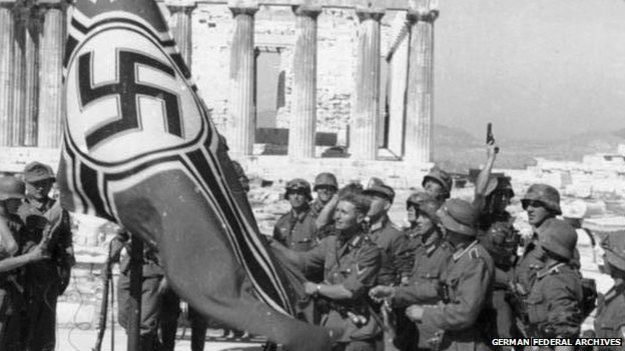
German soldiers raising the German war flag over the Acropolis
Greece was invaded by Nazi Germany in 1941 – here German soldiers raise their flag over the Acropolis

Berlin paid 115m Deutschmarks to Athens in 1960 in compensation – a fraction of the Greek demand. Greece says it did not cover payments for damaged infrastructure, war crimes and the return of the forced loan.

Germany insists the reparations issue was settled in 1990, before Germany reunified.

The budget spokesman for Chancellor Merkel’s Christian Democrats, Eckhardt Rehberg, reiterated on Tuesday that “the reparations issue is for us closed, politically and legally – the same applies to the so-called forced loan”.

Syriza politicians have frequently blamed Germany for Greek citizens’ hardship under the austerity imposed by international lenders.

Mr Tsipras is trying to renegotiate the €240bn EU-IMF bailout that saved Greece from bankruptcy. Greece has not received bailout funds since August last year, as the lenders are dissatisfied with the pace of Greek reforms.

A Greek repayment of €448m to the International Monetary Fund is due this Thursday.

Greek Finance Minister Yanis Varoufakis has said that Greece “intends to meet all obligations to all its creditors, ad infinitum”.