An affordable price is probably the major benefit persuading people to buy drugs at www.americanbestpills.com. The cost of medications in Canadian drugstores is considerably lower than anywhere else simply because the medications here are oriented on international customers. In many cases, you will be able to cut your costs to a great extent and probably even save up a big fortune on your prescription drugs. What's more, pharmacies of Canada offer free-of-charge shipping, which is a convenient addition to all other benefits on offer. Cheap price is especially appealing to those users who are tight on a budget
Service Quality and Reputation
Although some believe that buying online is buying a pig in the poke, it is not. Canadian online pharmacies are excellent sources of information and are open for discussions. There one can read tons of users' feedback, where they share their experience of using a particular pharmacy, say what they like or do not like about the drugs and/or service. Reputable online pharmacy canadianrxon.com take this feedback into consideration and rely on it as a kind of expert advice, which helps them constantly improve they service and ensure that their clients buy safe and effective drugs. Last, but not least is their striving to attract professional doctors. As a result, users can directly contact a qualified doctor and ask whatever questions they have about a particular drug. Most likely, a doctor will ask several questions about the condition, for which the drug is going to be used. Based on this information, he or she will advise to use or not to use this medication.
President Trump spoke with Vladimir Putin on Saturday and the readouts of the calls from both sides don’t quite match. Notwithstanding, is this the real reason for the call?
News has been circulating on the internet since Friday[27 Jan]stating that Syrian President Bashar al-Assad is experiencing serious health problems. Some media outlets said that Assad had suffered a stroke; while others said that he was shot and has been taken to Damascus Hospital for treatment.
France’s Le Point, speculated that Assad might have been assassinated by his personal Iranian Bodyguard Mehdi al-Yaacoubi, going so far as to say that he shot him in the head.
Lebanese newspaper, al-Mustaqbal, quoted “reliable sources” as saying that Assad suffered from a cerebral infraction and was transferred to Damascus Hospital where he is being treated under high security.
As for the Saudi newspaper Okaz, Assad is suffering from a “brain tumor.” He tried to cover up his illness through short and frequent appearances. According to its sources, Assad is being treated by a Russian-Syrian medical team on a weekly basis, adding that he has undergone medical tests when he was in Moscow in October.
Pro-Syrian regime Lebanese newspaper al-Diyar reported on Friday that Assad suffered from a stroke, but denied the news today.
There were also rumors that Assad is at the American University Hospital
(AUH) in Beirut. However, Al Arabiya contacted the hospital and no information on the issue was given. Al Arabiya has also tried to contact Damascus Hospital, but there has been no response. On the other hand, in a statement carried by the Presidency of the Syrian Arab Republic page on Facebook, Syrian authorities said that such rumors were incorrect.
***
Meanwhile, not being able yet to add credibility to the rumors above, on to the next call and when….
A draft Syrian constitution prepared by Russia suggests that the word “Arab” will be removed from the official name of the Syrian Arab Republic, currently ruled by a faction of the pan-Arab nationalist Baath Party.
Russia’s constitutional proposals were revealed during the Astana peace talks this week, according to Sputnik.
As far back as June 2016, the state-owned Russian news agency reported: “Russia suggested that Syria should change its official name from the Syrian Arab Republic to the Republic of Syria, in order to appeal to ethnic minorities such as Kurds and Turkmen.”
Pre-war Syria had a 74 percent majority Arab population; nine percent were Kurds and there were about 100,000 Turkmen. More here.
The activists released several images in social networks showing several groups of the Russian armored vehicles of Vodnik in Tartus port in Mediterranean Sea.
The activists also said that the Syrian army will receive the Russian armored vehicles soon. Military journalists underlined that deployment of high-speed Vodnik armored vehicles along with T90 tanks will help the Syrian army in the war on terrorism.
The Arabic desk of massdar news said it seems that these armored vehicles have been imported to equip Faylaq al-Khames forces that were formed by the Syrian army and Russia’s full military back up.
Media sources disclosed on Saturday that the Russian Armed Forces would likely send back a number of soldiers and military hardware to Humeimim base in Lattakia province to reinvigorate their forces’ combat capabilities again. The Russian language Nezavisimaya Gazeta daily said Russia seemed to redeploy its forces and equipment to the Humeimim base after the Astana peace talks.
The daily opined that liberation of Aleppo had not been a turning point in war on ISIL terrorists in Syria and Moscow made a hurried decision when started to withdraw a part of its forcers and equipment from Syria.
***
In part from Newsweek: Buried within the U.S. intelligence community’s report on Russian activities in the presidential election is clear evidence that the Kremlin is financing and choreographing anti-fracking propaganda in the United States. By targeting fracking, Putin hopes to increase oil and gas prices, destabilize the U.S. economy and threaten America’s energy independence.
Fracking, or hydraulic fracturing, is a decades-old drilling technique in which water and sand is pumped through rock at a high pressure to release previously unreachable deposits of oil and natural gas.
Thanks to new technologies which are making the process more efficient and environmentally friendly, fracking now supports 4.3 million jobs and generates about half a trillion dollars in economic benefit to the United States every year. Additionally, natural gas prices have dropped in half thanks to the corresponding boost in supply, saving American families an average of $200 a year.
Fracking is the major reason why the United States is on pace to become completely energy independent by 2020. America relies on fracking to produce more than 1.5 billion barrels of oil a year — over half of the total U.S. oil output.
Or could the next conversation include Afghanistan?
Challenging the U.S., Moscow Pushes Into Afghanistan
WSJ: Russia is making fresh inroads into Afghanistan that could complicate U.S. efforts to strengthen the fragile Kabul government, stamp out the resilient Taliban insurgency and end America’s longest war.
Moscow last month disclosed details of contacts with the Taliban, saying that it is sharing information and cooperating with the radical movement on strategy to fight the local affiliate of Islamic State.
Translation: For among times of arms, the laws fall mute. But is this true?
Much opposition was forced on President GW Bush for his actions by executive order and presidential findings directly after the 9/11 attack. Bush ordered countless legal authorities inside and outside government for legal decisions on every step he took including that of ‘enhanced interrogation techniques’.
We have a major debate that will not be solved any time soon on the legality of the President Trump executive order on the refugee question which has caused major protests and legal action already as we see detentions of foreign nationals at airports. All executive orders are subject to judicial review. Presidents have been given the option of using extraordinary power and in many cases that is a good condition, yet in the matter of law, there have been without question many abuses.
This post is not meant to form any conclusion on the legal veracity of this executive order, rather it is designed to add it more facts and additional questions moving forward. President Trump has a mess to clean up left by Barack Obama, of this, there is no dispute. The White House did take action at the stroke of the pen to begin to make America safer, however was this action taken too soon and without legal opinions including that of the Office of Legal Council? That has not been answered.
So, here are some items that must be included in this debate that extends the whole view and argument.
These are not in any specific order so the reader can individually prioritize.
Should President Trump have set an effective date of this Executive Order?
How was TSA, DHS and all other associated agencies briefed on those already in transit and with validated travel documents in hand?
Did the White House consider exemptions or waivers for those that have been vetted previously that worked or work for the USG in some capacity?
Why were some countries on this list while others were not? The San Bernardino shooters were from Pakistan, but do we need Pakistan for the war in Afghanistan?
The majority of the terrorists on 9/11 were from Saudi Arabia and yet Saudi was omitted from the list, why? Could it be that Trump had/has business interests there or because some that were formally in the Kingdom did aide often the United States when it came to terror like in the case of kidnapped CIA operative William Buckley in Beirut of which the Saudis helped finance his recovery? It is without question the Saudis dislike Iran as much as the United States.
We have seen millions of refugees enter all parts of Europe in recent years and yet they can enter the United States under the ‘visa waiver’ program. Did the Trump White House take this under full consideration? The answer is a ‘kinda, yes’ they did but that review has been ordered and not yet deployed.
We have countless refugees and asylees entering the United States from our southern border, but was Mexico on the list? No, yet we don’t know either if the phone discussion President Trump had with President Nieto, this topic was addressed.
There are in fact limitations to who can be accepted into the United States under 8 U.S. Code S 1182 and applying those restrictions remain in the authority of the President while waivers can be issued and it is germane to ask if this law has been considered.
Refugees too have rights and legal protections which was in fact determined after WW II and we have witnessed millions in the Middle East that are forced to live outside their homeland in camps that are simply inhumane. So when it comes to the ‘huddle masses’, the United States does have a responsibility however, the genesis of the current refugee/asylee issue remains with Susan Rice, Barack Obama and Hillary Clinton. The solution in the long term is almost impossible for President Trump and his team to solve unless the hostilities and conflicts in the Middle East are solved.
The protests of those standing against the Trump executive order was not spontaneous, nor were those immediate lawsuits against this temporary refugee ban. Following the money and the continued chaos will not soon go away. What is the proper counter-measure going forward? A question that remains without an answer.
In 2011, Obama did ban Iraqis wanting to enter the United States and this was in fact the exact year the United States pulled out in total from Iraqi. Obama did however issue some selective waivers. The concern for Obama at the time was the matter of two people in Kentucky plotting a terror attack. This alone is a single great argument for Trump’s action and Senator Schumer should be reminded as should Nancy Pelosi. But it is not the full argument as noted by the items above.
There are historical events that do offer President Trump great legal standing that is unless courts will rule otherwise in upcoming cases.
ABC: Over the veto of President Woodrow Wilson, Congress passed the 1917 Immigration Act amid social outcry over national security during World War I. According to the Office of the Historian of the U.S. Department of State, the legislation extended to barring most Asian nation immigration overall, with the exception of Japan, which was protected by a prior bilateral diplomatic agreement, and the Philippines, then a U.S. colony.
The act was officially repealed by the Magnuson Act in 1943, in the context of the U.S. alliance with China against Japan during World War II. Still, actual Chinese immigration to the U.S. remained capped at 105 persons a year until 1965.
National Origins Formula
For the first time in the 1920s — through the Emergency Quota Act of 1921 and the Immigration Act of 1924, or the Johnson-Reed Act — the U.S. further restricted immigration by establishing a wide-scale quota system based on national origins. According to the Office of the Historian of the U.S. Department of State, in addition to putting a blanket ban on immigration from Asian countries, now including Japan in the case of the Johnson-Reed Act, the national origins immigration policies also had the effect of reducing immigration from southern and eastern Europe.
According to a 2015 report by the Pew Research Center about 20th century U.S. immigration, the impact of the system was intended to “try to restore earlier immigration patterns by capping total annual immigration and imposing numerical quotas based on immigrant nationality that favored northern and western European countries.”
The U.S. immigration system remained based on the national origin of would-be immigrants until the passage of the Immigration Act of 1965 during the presidency of Lyndon B. Johnson.
“It was designed for racist reasons,” said Steve Legomsky, professor of law at the Washington University School of Law in St. Louis, referring to the national origins system as well as the prior exclusion of Asian immigrants. “Today, I don’t think that’s what’s driving the immigration ban [proposed by Trump]. I think it’s more a fear of terrorism and a concern for national security.”
Legomsky, who was also formerly the chief counsel of U.S. Citizenship and Immigration Services, added that “the impulses are different [now], but the effect is the same.”
In summary, this article is hardly complete with all the facts and laws, rather it is meant for the reader to consider a wider range of moving parts while inviting the reader to individually research more before an ‘all in’ as full support of Trump’s executive action be assumed.
This site has posted often on General Gerasimov and his doctrine. The games and propaganda that the Kremlin applies is still not taken seriously by the American people as they continue to scoff at Russian intrusions into our culture.
Russia is playing a double game and it is time to set aside manufactured notions and seek the expertise of countless Russian scholars as well as what the Pentagon and intelligence communities are publishing.
«Military-industrial courier» is a weekly illustrated All-Russian newspaper. The main topics of the newspaper are politics and economics, role of legislative and executive power in the process of military reform providing. «Military-industrial courier» is position on the newspaper market as a respectable edition which highlights defence industries and institutions, adds to military products promotion to the domestic and foreign markets.
The newspaper boasts of domestic military chiefs and defence leaders interviews in which most important issues of that sector of the economy are raised.
For a short period of time «Military- industrial courier» has achieved recognition with the Russian high-ranking military officials.
The newspaper is distributed on a subscription and by retail within the Russian Federation and abroad. The circulation is more than 50000 copies.
In February 2013, an article insipidly entitled “The Value of Science in Prediction” appeared in the Russian publication Military-Industrial Courier. The article was penned by Valery Gerasimov, chief of the general staff of the Russian Federation. Few in the West recognized the article at all, much less its significance, at the time of its publication.
In the article, Gerasimov analyzed “new-type conflicts.” These conflicts entail an array of strategies and tactics employed in the gray zone to achieve national interests, even military, without a declaration of war and without crossing the threshold that would provoke a kinetic response.
“The very ‘rules of war’ have changed,” Gerasimov wrote.
Dr. Mark Galeotti, an expert on Russian history and security issues who annotated an English translation of Gerasimov’s article, identified the most important line as, “The role of nonmilitary means of achieving political and strategic goals has grown and, in many cases, they have exceeded the power of force of weapons in their effectiveness.”
Gerasimov’s “nonmilitary means” included “broad use of political, economic, informational, humanitarian and other nonmilitary measures – applied with the protest potential of the population.”
Experts see one hybrid tactic – narrative and cyber – playing an increasingly prominent role in current conflicts.
War Narratives
An old Wall Street adage goes, “You’d have to be a paranoid Russian poet to understand global finance.” Today, that maxim might be paraphrased for an equally unexpected insight: “It helps to be a literary critic in understanding contemporary warfare.”
In The Art of War, Sun Tzu described the “five constant factors” of conventional warfare, but none included narrative. Experts now point to the influential role of narrative in military, geopolitical and ideological “new-type conflicts.”
Nations like Russia and China, as well as terrorist organizations like the Islamic State of Iraq and Syria (ISIS), are using narrative to motivate audiences, advance agendas and engage adversaries.
Scholars have long argued that literary techniques are not the special purview of novelists, poets and playwrights. From philosophers’ research on metaphor to cognitive scientists’ investigations into parable, literary devices reveal and appeal to basic human cognition. Perhaps that’s why narrative’s use by governments, institutions, businesses and ideologues is not new.
When employed in military or geopolitical conflicts, Brad Allenby and Joel Garreau, co-directors of The Weaponized Narrative Initiative of the Center on the Future of War, call it “weaponized narrative.” And they believe its recent effectiveness will encourage further use.
In an email interview, Allenby said, “Weaponized narrative is not a temporary or passing phenomenon. It is based on significant recent advances in science, technology and social use of technology.”
Combined with tactics afforded by cyberspace, narrative’s influence broadens. But Dr. Ajit Maan, affiliate scholar at the Center for Narrative and Conflict Resolution and CEO of Narrative Strategies, notes that narrative’s power precedes technology.
In an email interview with Fifth Domain, Maan said:
Advanced technologies work to disseminate messages farther and wider than they would be otherwise, but narratives are already there, on the ground, in people’s heads. The enemies of the U.S. and her allies understand this very well. Advanced technology is a tool. The center of gravity is the narrative.
The “Era of Cybered Conflict”
Current conflicts play out, at least partly, in cyberspace.
Dr. Chris C. Demchak, RDML Grace Murray Hopper professor of cybersecurity and director of the Center for Cyber Conflict Studies at the U.S. Naval War College, characterizes today’s environment as one of “cybered conflict.”
In an interview – in which she offered her views and not the views of the U.S. government, U.S. Navy or U.S. Naval War College – Demchak said:
Due to the massively insecure technology of the global cyberspace, we in the West have created a widely spread, poorly secured cyberspace “substrate” that allows attackers in any numbers, from anywhere, with any tools and for any reason to cheaply reach into our critical systems with minimal chances of being punished. The result is that the world has been thrust into an era of “cybered conflict.”
Like Gerasimov’s blurred line between war and peace, Demchak described cybered conflicts as “stretch[ing] from peace through traditional war.” Importantly, Demchak highlighted the strategic advantages of cybered conflict relative to conventional war:
Most cybered conflict – which can have existential consequences – does not involve killing anyone or destroying something explosively. Rather, it is marked by exceptional advantage to deception in what tools are used and opaqueness in who, in what numbers, are using them. Going to the end of the spectrum – to “cyberwar” – is relatively inefficient and opens oneself up to direct retaliation throughout one’s own societal systems. Instead, one can slowly demolish an opponent without ever killing someone or destroying something with a kinetic tool traceable back to oneself … [which] is much safer, reliable and easier to outsource.
Russia, China and ISIS are all leveraging the advantages afforded by cybered conflict to employ hybrid warfare tactics – from hacking to weaponized narrative.
Russia and the Grand Nationalist Narrative
Russia’s use of hybrid warfare long predates Gerasimov’s article. Noting the Soviet Union’s traditional outward posture since the Cold War’s advent, Demchak said, “Russia innovated the strategy of disinformation and personalized brutality to ‘eat a democracy from the inside out’ … producing the involuntary servitude of the former Warsaw Pact.”
Allenby noted favorable conditions for disinformation persist today: “The Russian system tends to reward the cynical, morally relativistic psychology that best aligns with developing and deploying weaponized narratives.”
As foreshadowed by Gerasimov, Russia has displayed its hybrid capabilities during the Ukraine conflict. Allenby points to Russia resurrecting the historical “Novorossiya” and adopting the newer “Russian Eurasian Empire” narratives.
Such narratives matter, Allenby explained, “Because suborning an adversary through weaponized narrative is far, far less costly than a conventional attack. Weaponized narrative offered an important way to achieve Russian ends while not justifying a conventional response under the UN charter.”
Allenby also noted the hybrid approach, which included narrative and “fomenting insurrection and insurgency, and judicious application of ‘little green men,’” or suspected Russian troops.
Allenby added, “Was the invasion [of Crimea] effective? Absolutely. Was it a strategic success? For that, we’ll have to wait and see.”
Asked about the similarities and differences between Russia’s tactics in Ukraine and the alleged activities carried out during the 2016 U.S. presidential election, Allenby said:
The two are similar, in that causing a degree of confusion and social fragmentation in the target is a major strategic goal. The tools are different because the cultures are very different, and the follow through is different … Nonetheless, the underlying processes, operations and design of weaponized narrative campaigns must be similar because they are based on the same advanced science, new technologies and rapidly evolving understanding of human psychology.
China and the Sovereignty Narrative
China is also using narrative to further its geopolitical agenda. China’s interest in expanding territorial sovereignty in the South China Seas is well known. Less so is China’s “cyber sovereignty” narrative, which Demchak has examined.
At issue is, Demchak wrote, “China wants her borders in cyberspace and will take nothing less.” Whereas the West sees the internet as a tool for global democratization, “the Chinese narrative accentuates the instability and greater dissent that can accrue with a border-spanning open internet.”
China’s view implicitly acknowledges Gerasimov’s “protest potential of the population.”
To achieve cyber sovereignty, China has employed hybrid gray-zone tactics.
“China,” Demchak wrote, “is also hoping to hurry along the [U.S.’s] apparent decline with narratives, money and stealth and yet control the narrative of a no-threat peaceful rise well enough to stay short of physical conflict.”
China’s cyber sovereignty is part of a grander narrative. “China justifies its rise in the world – its ‘rightful place’ – on the basis of its population,” Demchak said. “China will not over time tolerate U.S. obstruction of its ‘rightful’ rise as the global hegemon.”
ISIS and the Narrative of the Islamic Caliphate
The rise of ISIS surprised many in the West. Narrative and cyberspace played a central role, experts say.
Counterterrorism scholars have studied the “messaging and counter-messaging” of ISIS. Maan thinks ISIS’s narratives are more “profound and pervasive” than simple messaging.
“It is through narrative that identity is constructed: Personal identity, communal/clan identity and national identity,” she said. “It is formative in the identity layers of all parties to communication long before any communication has taken place between them.”
In her writing, Maan has examined a common idea across ISIS’s communications: “Islam is under attack.” That is a title, not the narrative, she explained.
Despite the West’s claims otherwise, “Islam is under attack” resonates with ISIS followers in many forms. “Narrative provides and determines the meaning of events,” Maan said. “Events don’t speak for themselves. Narratives speak for events.”
Maan argues, rather than focusing on counter-narrative, which oftentimes “emboldens” the original, the West should develop its own. To succeed, Maan thinks the West’s narratives must be credible and based on the “production of common sense.”
“That is how successful narratives appear. They don’t seem like a construction. They seem to reflect ‘just the way things are,’” she said.
Few appear to remember the brazen, corruption and deceptive operation when pro-Russian separatists invaded Crimea. The world was in shock and now Ukraine is falling victim to the same operation as NATO fights against this.
If you want to understand the Russian operation in Eastern Europe and how the Kremlin game is played, one must begin with the twisting of information, news and propaganda.
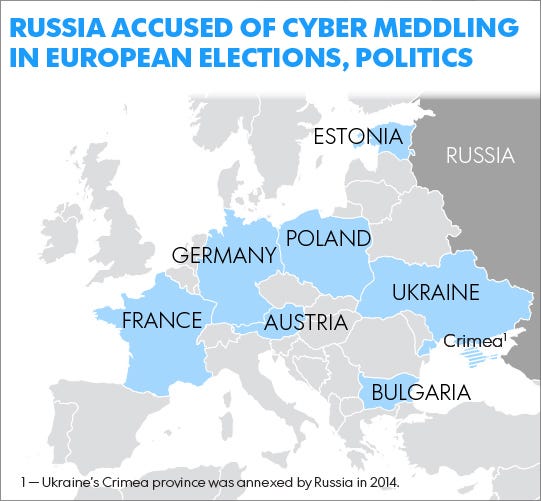
Much has been debated as to the penetration of Russia into the U.S. election system. This is not a new phenomenon for the Kremlin.
The survival of Ukraine as a sovereign, democratic nation was at stake. And the presidential election needed to go smoothly—thus making it a prime target for a Russian cyberattack.
Four days prior to the election, on May 21, 2014, a pro-Russian hacktivist group called CyberBerkut launched a cyberattack against Ukraine’s Central Election Commission computers. According to Ukrainian news reports, the attack destroyed both hardware and software, and for 20 hours shut down programs to monitor voter turnout and tally votes.
On election day, 12 minutes before polls closed, CyberBerkut hackers posted false election results to the election commission’s website. Russia’s TV Channel One promptly aired the bogus results. More here.
Newsweek: Ukraine’s former top security official has gone from tracking down Russian spies to fighting what he perceives to be the country’s greatest threat—corruption.
“The question is, are we going to survive or not?” Valentyn Nalyvaichenko told The Daily Signal from his offices in Kiev, Ukraine’s capital.
Nalyvaichenko, 50, is the former head of the Security Service of Ukraine, or SBU, which is Ukraine’s successor agency to the Ukrainian Soviet Socialist Republic’s branch of the KGB, the Soviet Union’s main security agency.
“At stake is survival of the country,” Nalyvaichenko said. “At stake is whether we’ll finally get rule of law and a functioning state instead of chaos, corruption, weakness and [being] not capable to defend our territory and the country. So, at stake is the country, its independence.”
During his interview with The Daily Signal, Nalyvaichenko wore a well-appointed suit and tie. He spoke fluent English, evidence of his university degree in linguistics.
His affable demeanor and emotive manner of talking hinted more at his background as a diplomat and member of parliament than his years in charge of Ukraine’s successor agency to the KGB.
Nalyvaichenko led the SBU for the first time from 2006 to 2010. He took over the security agency for a second time on Feb. 24, 2014, two days after deposed former Ukrainian President Viktor Yanukovych fled to Russia in the closing days of the revolution.
Nalyvaichenko has also served as a member of parliament and as Ukraine’s deputy minister of foreign affairs.
Nalyvaichenko’s 2015 departure from the SBU was controversial. In June 2015, while the security agency was investigating high-level Ukrainian officials for financial crimes, Ukrainian President Petro Poroshenko sacked Nalyvaichenko from his leadership post at the SBU.
Today, Nalyvaichenko is the leader of two upstart anti-corruption political platforms: the Justice Civil-Political Movement, and the Nalyvaichenko Anti-Corruption Movement.
“Our people, our common people, are suffering because of corruption, corruption at the top,” Nalyvaichenko said, pounding his fist on the table for emphasis.
“I really like what [Winston] Churchill said in the Second World War,” Nalyvaichenko said. “‘If you’re going through hell, keep going.’ If we’re corrupt, it doesn’t mean we have to say, ‘OK, we’re a failed state.’ No, it’s not true.”
Purge
True to his diplomatic roots, Nalyvaichenko recently traveled to Washington to present evidence to Congress about Russia’s involvement in the war in eastern Ukraine and to press for U.S. assistance in anti-corruption efforts.
As part of his anti-corruption platform, Nalyvaichenko has called for the FBI to investigate the financial crimes of Ukraine’s current and former political leaders.
He also wants U.S. and EU prosecutors to oversee the adjudication of corruption investigations, and for the U.S. to press Ukrainian officials to make Ukraine’s newly minted National Anti-Corruption Bureau independent from the executive and judicial branches.
People look out over the Maidan, or Independence, Square on May 22, 2014, in Kiev, Ukraine. Nolan Peterson writes that corruption still taints almost every aspect of Ukrainian life. University students in Kiev, for example, say it’s still common practice to pay their professors a bribe to pass exams. Dan Kitwood/Getty
Nalyvaichenko said Ukraine has a chance to “show for the whole world, especially to the Russian people, that there is an opportunity, there is a plan B, to such nations after the Soviet Union time to be democratic, to be not corrupt, to live in a not corrupt state, to be independent.”
“Ukraine belongs to the Western world,” he added.
Nalyvaichenko added that Ukraine has “several months, two or three months” to show real progress in anti-corruption measures before Western partners begin to break ranks on measures such as maintaining punitive sanctions against Russia.
“It will be no tolerance from the new administration in the United States,” Nalyvaichenko said. And next year, “there might be many changes in the European Union,” he said. “That’s, I think, what is at stake when we’re talking about the European Union and the United States.”
Within Ukraine, Nalyvaichenko’s strategy is to reach out to civil society leaders working at the grassroots level. He wants to convince Ukrainians to believe in the democratic process, despite a quarter-century of oligarchic thug rule after the fall of the Soviet Union.
To that end, Nalyvaichenko’s two anti-corruption organizations—which comprise 10,000 activists across Ukraine—have provided pro bono legal assistance to more than 3,000 Ukrainian citizens involved in court cases against allegedly corrupt government officials.
Nalyvaichenko’s groups have also given free medical care to more than 9,000 civilians in the war zone.
“If you would like to stop Russian aggression, if you would like to get back not only territories but people…we have to show them what?” Nalyvaichenko said. “Believe me, not Kalashnikovs and not tanks. We have to show them a better life.”
Lifestyle
That better life has not yet materialized for many Ukrainians.
For one, the hryvnia, Ukraine’s national currency, is currently less than one-third its value against the dollar than it was before the revolution. Wages have not concurrently risen to match the falling currency, dramatically reducing Ukrainians’ spending power.
Also, corruption still taints almost every aspect of Ukrainian life. University students in Kiev, as an example, say it’s still common practice to pay their professors a bribe to pass exams.
According to an October 2016 public opinion poll conducted by the International Republican Institute, and funded by the government of Canada, 30 percent of Ukrainians surveyed who had visited a doctor in the previous 12 months said they paid a bribe for service.
Among those who interacted with the police, 25 percent said they paid a bribe.
A large part of Ukraine’s economy is off the books—what Ukrainians refer to as the “shadow economy.” Ukraine’s Economic Development and Trade Ministry said the shadow economy was 40 percent of the country’s gross domestic product in 2015.
This black market economy robs the government of valuable tax revenue. It also leaves many returning combat veterans, many of whom were drafted, no legal recourse to recover their jobs at the conclusion of their military service.
Many veterans previously worked off the books and were paid in cash so their employers could skirt payroll taxes.
According to the 2016 International Republican Institute study, 72 percent of Ukrainians surveyed said the country was moving in the wrong direction, while 11 percent said the country was on the right track.
As a point of comparison, a year prior to the revolution in May 2013, 69 percent of Ukrainians surveyed said the country was moving in the wrong direction, and 15 percent said the country was moving in the right direction.
According to the same poll, 73 percent of Ukrainians disapprove of Poroshenko’s performance as president, and 87 percent of Ukrainians have an unfavorable opinion of their parliament.
Nalyvaichenko said he no longer has faith in Poroshenko.
“For me this is not personal,” he said. “Whoever becomes president or prime minister is immediately part of a corrupt and not transparent system. Immediately they are reproducing the same Soviet or simply corrupt practices and environment…. So, to get rid of that, to dismantle, to change the system, to reboot the country [we need to] get new people with absolutely different minds and mentality into the governmental offices.”
A New Fight
Nalyvaichenko is among a new breed of Ukrainian reformers who have emerged after the 2014 revolution.
Among Nalyvaichenko’s allies is former Georgian President Mikheil Saakashvili, who resigned as governor of Ukraine’s Odessa Oblast in November. The move was a protest against what Saakashvili claimed was stonewalling by Poroshenko and the majority of Ukraine’s political class in implementing anti-corruption reforms.
Saakashvili has since launched his own anti-corruption, opposition party called Wave.
“We had a revolution with lots of casualties,” Saakashvili told The Daily Signal in an earlier interview. “And every time a revolution happens, people have a right to expect revolutionary changes.”
One bright spot for Ukraine is its budding civil society. Across the country, political activists and humanitarian workers, including many millennials, have enabled the spread of democratic norms and are pushing for government accountability at the grassroots level.
“Across the country there is real willingness at the local level, at the grassroots level to stop corruption,” Nalyvaichenko said. “Fifteen or 20 years ago it was unimaginable that Ukraine would have such a powerful civil society.”
He continued:
I remember my parents and how modest the family used to be. How we young, young kids in Zaporizhia and other regions dreamed about another life. And to really have a chance with a free market, with the rule of law … for our children to create a new country with more opportunities. Our better future is here, and we should fight for that. I will not take no for an answer—from anyone.
Sacked
As head of the SBU, Nalyvaichenko endeavored to purge the security agency of its Soviet KGB past. He booted many personnel who had served in the SBU when it was the Ukrainian Soviet Socialist Republic’s branch of the KGB.
Nalyvaichenko spearheaded an effort to open up the SBU’s KGB archives, launching fresh investigations into Soviet crimes in Ukraine, including Joseph Stalin’s organized mass famine in the 1930s known as the Holodomor.
He also hunted down and expelled Russian spies in Ukraine who were working for Russia’s successor agency to the KGB, the Federal Security Service of Russia, or FSB.
“With SBU, what I started with was to stop KGB practices,” Nalyvaichenko said. “I was the first and only chief of the SBU who actually started to detain FSB officers in Ukraine.”
The intent of Nalyvaichenko’s personnel scrub at the SBU went beyond security concerns. He wanted to shed the agency of its “Soviet mindset.”
To fill out the SBU’s thinned ranks, Nalyvaichenko tapped young political activists and reformers who had no living memory of life in the Soviet Union.
“That is my approach and my understanding of how it could be done in all the country,” Nalyvaichenko said, explaining how his SBU scrub could be used as a model for nationwide reforms.
The solution to beating corruption in Ukraine, according to Nalyvaichenko, is to elevate a new generation of political and business leaders.
“Let the generation shift happen in Ukraine,” Nalyvaichenko said. “For the new generation to be in the offices, to let them finally rule the country … it’s high time to finally stop with old practices.”
Nalyvaichenko’s second term as head of the SBU came at a tumultuous time for Ukraine. In the months following the February 2014 revolution, Russia launched a hybrid invasion of Ukraine’s Crimean Peninsula, ultimately annexing the territory.
Russia followed up the seizure of Crimea with a proxy war in the Donbas. A combined force of pro-Russian separatists and Russian regulars was on the march in eastern Ukraine in 2014, and there were worries then that Ukraine could be cleaved in two, or that Russian forces massed on Ukraine’s borders might stage a large-scale invasion.
In Kiev, the post-revolution government was at the time trying to establish its legitimacy and follow through on the pro-democratic promise of the revolution.
Meanwhile, officials were piecing together a military campaign out of the remnants of Ukraine’s armed forces, which had been gutted by decades of corruption and purposeful neglect.
Amid all of this, Nalyvaichenko pushed to prosecute corrupt government officials.
A New Fight
In Ukraine, opinions diverge about the hierarchy of threats facing the country.
A nearly three-year-old war between Ukrainian troops and a combined force of pro-Russian separatists and Russian regulars continues to simmer in the Donbas, Ukraine’s embattled eastern territory on the border with Russia.
About 10,000 Ukrainians have so far died in the conflict, which has also displaced about 1.7 million people. The war cost Ukraine an equivalent 20 percent of its gross national product in 2015, according to a 2016 report by the Institute for Economics and Peace.
The February 2015 cease-fire has failed. Military and civilian casualties still occur almost every day from landmines, artillery fire, rocket attacks, and small arms gun battles.
Ukraine’s military has rebuilt itself since 2014, but many front-line soldiers complain that after nearly three years of combat, they still aren’t getting basic supplies.
Despite the war’s cost in blood and treasure, Nalyvaichenko said the greatest threat facing Ukraine today is not on the battlefields of the Donbas, but within Kiev’s government halls.
“If you don’t understand how deep and how destroying the corruption is, you’ll never win the war,” Nalyvaichenko said. “This system, as I understand it, is not workable anymore. And because of war, because of Russian aggression, we now understand why. We simply, as a country, as a nation, have no time and no space anymore to continue with such corrupt practices.”
There is, however, a countervailing, quieter faction, particularly among Ukraine’s military brass, which says the war effort should take priority over any anti-corruption crusades.
Ukrainian military officials who spoke to The Daily Signal on background cautioned against ambitious anti-corruption agendas while the country is still at war.
And, according to the October 2016 International Republican Institute poll, most Ukrainians consider the war to be the biggest threat to the country.
Of the Ukrainians surveyed in the poll, 53 percent said the war in the Donbas was the country’s most important issue, compared with 38 percent who singled out corruption as the top issue.
“The tens of thousands of Russian soldiers, tanks, and artillery sitting along Ukraine’s southern and eastern borders are Ukraine’s sole existential threat,” Alexander Motyl, professor of political science at Rutgers University-Newark, wrote in OZY. “If [Russian President] Vladimir Putin gives the command, they could invade and possibly destroy large parts of the country. Corruption, by comparison, could eviscerate Ukraine’s institutions, but only in the long term.”
Outsider
As SBU chief, Nalyvaichenko spearheaded an investigation into a June 8, 2015, fire at an oil depot near Vasylkiv, Ukraine. The investigation allegedly implicated government officials in financial crimes, according to Nalyvaichenko’s account of events.
The investigation also revealed the undisclosed involvement of a Russian company in the oil depot.
Nalyvaichenko said he personally presented Poroshenko with the evidence and pushed for the issuance of arrest warrants.
Then, on June 15, 2015, Poroshenko fired Nalyvaichenko as head of the SBU. And three days later, Ukraine’s parliament voted to approve Nalyvaichenko’s ouster.
“That’s why I decided to be outside the government,” Nalyvaichenko said. “I really understood and understand for sure that to be subordinated and to fight the corruption, which is above you, is impossible. You become a part of this corrupt group of people, or you are outside. Here’s a red line. For me it was a clear decision.”
The Poroshenko administration declined a request for comment for this article. But, in an emailed statement to The Daily Signal, the SBU defended its track record of investigating and prosecuting corrupt officials.
“After the Revolution of Dignity, state leadership gave a clear indication to law enforcement authorities to begin the real fight against corruption, regardless of position, party affiliation, and the number of stars on one’s epaulets,” the SBU wrote in its statement to The Daily Signal.
According to the SBU, the security agency investigated 673 Ukrainian officials for corruption in 2016, compared with 545 in 2015, and 359 in 2014. The SBU said its investigations led to 256 convictions in 2016, an increase from 184 in 2015, and 181 in 2014.
“This suggests an increase in the intensity of the intelligence agencies in this cause,” the SBU said in its statement.
Nalyvaichenko acknowledged that Ukraine has made some progress in fighting corruption, but he said the past few years of investigations have largely targeted mid- and low-level government officials.
“The worst thing, I think, is that no single person from the top of the previous government [has been] prosecuted,” Nalyvaichenko said. “No single trial, or public hearings, or other procedures were organized by this government, by these officials. That’s I think the worst thing for the country and for Ukrainians.”
Nolan Peterson, a former special operations pilot and a combat veteran of Iraq and Afghanistan, is The Daily Signal’s foreign correspondent based in Ukraine.
Add outgoing Secretary of State John Kerry who will not be attending and not providing a reason. Further, in Barack Obama’s last White House press briefing, he refused to comment on his thoughts as to those in his party that will not be attending.
****
In his final press conference as president on Wednesday, Barack Obama declined to comment on the growing list of Democrats who are refusing to attend President-elect Donald Trump’s inauguration on Friday
FOX News’ Kevin Corke asked the 44th president if he supports the dozens of Democratic lawmakers who have vowed to boycott Trump’s inauguration.
“With respect to the inauguration, I’m not going to comment on those issues,” Obama responded. “All I know is I’m going to be there, so is Michelle.”
First lady Michelle Obama seemed to indicate her support for Rep. John Lewis, who is one of the most prominent lawmakers boycotting the inauguration, when she sent a tweet calling him a “great leader” on Monday. More here.