What did Google Know, When did The Know it?

Image result for google russian hacking Techviral

A Glimpse Into How Much Google Knows About Russian Government Hackers

A 2014 leaked private report from Google shows how much the internet giant knows about government hacking groups.

Motherboard: In October of 2014 an American security company revealed that a group of hackers affiliated with the Russian government, dubbed APT28, had targeted Georgia and other Eastern European countries in a wide-ranging espionage campaign. Two and a half years later, APT28—also known as “Fancy Bear” or “Sofacy”—is a household name not just in the cybersecurity industry, but in the mainstream too, thanks to its attack on the US Democratic party and the ensuing leaks of documents and emails.

Before that report by FireEye, APT28 was a well-kept secret within the cybersecurity industry. At the time, several companies were willing to share information about the hacking group. Even Google investigated the group, and penned a 40-page technical report on the hacking group that has never been published before.

This sort of document, which Motherboard obtained from two independent sources, may be a common sight in the threat intelligence industry, but the public rarely gets to see what such a report from Google looks like. The report draws from one of Google’s most interesting sources of data when it comes to malware and cybersecurity threats: VirusTotal, a public malware repository that the internet giant acquired in 2012.

Sofacy and X-Agent, the report read, referring to the malware used by APT28, “are used by a sophisticated state-sponsored group targeting primarily former Soviet republics, NATO members, and other Western European countries.”

“It looks like Google researchers were well aware of Sofacy before it was publicly disclosed.”

While Google security researchers don’t dwell into who’s really behind these operations, they do hint that they agree with the now widespread belief that APT28 works for the Russian government in a clever, indirect, way—in the very title of the report: “Peering into the Aquarium.”

While that might seem like an obscure title, for those who follow Russian espionage activities, it’s a clear reference to the headquarters of the military intelligence agency known as GRU or Glavnoye Razvedyvatel’noye Upravleniye, which are popularly known as “The Aquarium.”

“It looks like Google researchers were well aware of Sofacy before it was publicly disclosed,” Matt Suiche, a security researcher and the founder of Comae Technologies and the OPCDE  conference, told Motherboard in an online chat after reviewing the report. “And also attributed Sofacy and X-Agent to Russia before it was publicly done by FireEye, ESET or CrowdStrike.”

In its report Google security researcher note that APT28 attacks a large number of targets with its first-stage malware Sofacy, but only uses the more tailored and sophisticated X-Agent, which was recently used against Ukraine’s military units, for “high-priority targets.”

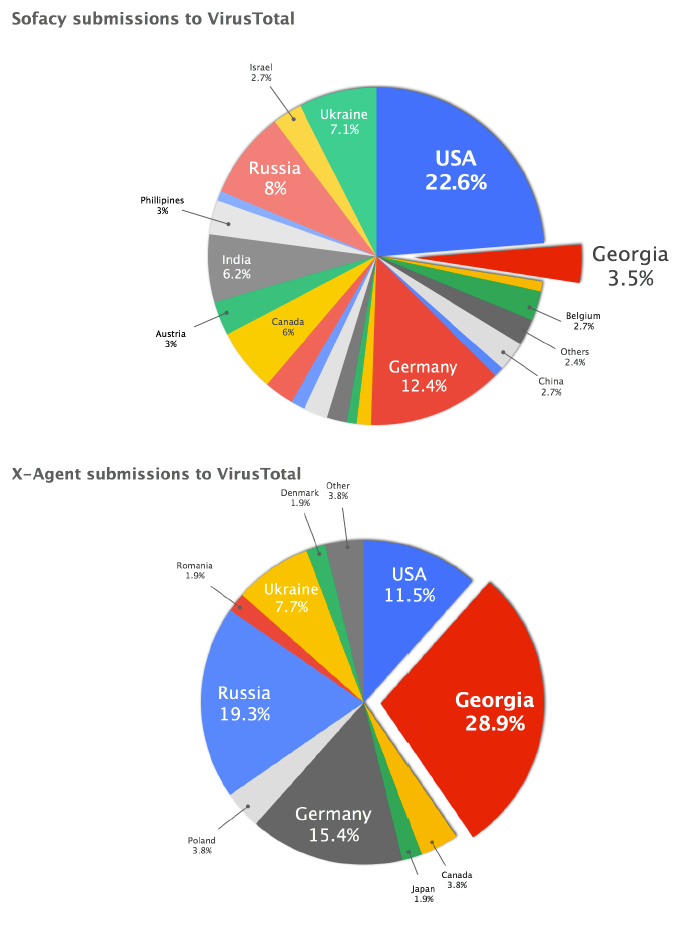
“Sofacy was three times more common than X-Agent in the wild, with over 600 distinct samples,” Google’s report stated.

Asked for comment, a Google spokesperson said via email that the company’s “security teams are constantly monitoring potential threats to internet users, and regularly publish information to better protect them.”

The report noted that Georgia had the highest ratio of submissions of Sofacy malware, followed by Romania, Russia and Denmark.

While this report is now a bit dated, it shows that for all its sophistication, APT28 has been often caught in the act of hacking politically interesting targets, betraying the origin of the hackers behind the dry nickname. It also reveals how much a company like Google, which doesn’t have software installed on thousands of customers computers like other antivirus and security vendors that is designed to specifically detect malware, can still learn a lot about government hacking groups thanks to the other data it has access to.
*** Related reading:

State-sponsored hackers targeting prominent journalists, Google warns

Politico: Google has warned a number of prominent journalists that state-sponsored hackers are attempting to steal their passwords and break into their inboxes, the journalists tell POLITICO.

Jonathan Chait of New York Magazine said he received several messages from Google warning him about an attack from a government-backed hacker starting shortly after the election. He said the most recent warning came two to three weeks ago.

Julia Ioffe, who recently started at The Atlantic and has covered Russia for years, said she got warnings as recently as two weeks ago. (See one of the warnings: http://bit.ly/2kMUyRb)

Some journalists getting the warnings say they suspect the hackers could be Russians looking to find incriminating emails they could leak to embarrass journalists, either by revealing alleged liberal bias or to expose the sausage-making of D.C. journalism.

“The fact that all this started right after the election suggests to me that journalists are the next wave to be targeted by state-sponsored hackers in the way that Democrats were during it,” said one journalist who got the warning. “I worry that the outcome is going to be the same: Someone, somewhere, is going to get hacked, and then the contents of their gmail will be weaponized against them — and by extension all media.”

The Russian embassy did not respond to a request for comment.

Image result for russian embassy washington dc Russian embassy Washington DC

Google cautioned that the warnings did not mean the accounts had been compromised already and were sent due to “an abundance of caution.”

“Since 2012, we’ve notified users when we believe their Google accounts are being targeted by government-backed attackers,” said a Google spokesperson in a statement. “We send these warnings out of an abundance of caution — they do not indicate that a user’s account has already been compromised or that a more widespread attack is occurring when they receive the notice.”

Ezra Klein, the founder of Vox, said he had received the warning as recently as a few days back. CNN senior media reporter Brian Stelter said he has been getting the alerts for the past few months.

Other journalists who confirmed they’ve recently gotten the warnings include New York Times national security correspondent David Sanger, Times columnist Paul Krugman and Yahoo Washington bureau chief Garance Franke-Ruta.

GQ special contributor Keith Olbermann said the warnings started a few weeks after the election, and he received the most recent alert earlier this week, a “big bright red bar” across the top of his Gmail. Some of the reporters say they are tightening up their email security to try to prevent the hackers from getting in.

Chait also said he was “contacted over email by a stranger who offered to help me by giving me an encryption key to protect me from hackers. He would not give me his name, meet me or talk on the phone, despite repeated requests.”

The stranger also emailed The Atlantic’s David Frum, James Fallows and Adam Serwer, Andrew Sullivan and Ars Technica’s Dan Goodin.

Stanford professor Michael McFaul, the former U.S. ambassador to Russia, said he also received hacking warnings from Google. He added: “Given my background, one would have to guess that it’s the Russians.”

Russian Spy Operations History in the U.S.

In 2015:

The FBI announced on Monday that it had busted a Russian spy ring that was allegedly focused on obtaining economic information including details about US markets and sanctions on Russian banks.

According to a federal complaint filed by FBI special agent Gregory Monaghan in a Manhattan federal court on Friday, an alleged spy, Evgeny Buryakov, posed as a banker in the New York office of an unnamed Russian bank.

Buryakov is reportedly being arraigned in the Southern District of New York.

Monaghan said Buryakov (aka”Zhenya”) was on “deep cover” and working for Russia’s Foreign Intelligence Service (SVR) to gather intelligence and transmit it back to Moscow. The SVR used multiple forms of cover.

The complaint includes several stunning revelations, including claims that staffers at an unidentified Russian news organization in the US are engaged in spying; and indications that American law enforcement bugged the New York office of the Foreign Intelligence Service.

According to the complaint, Buryakov worked with two other men who were involved in intelligence-gathering activities for the SVR: Victor Podobnyy and Igor Sporyshev. The complaint said Sporyshev served as a trade representative to the Russian Federation in New York. Podobnyy was allegedly an attaché to the permanent mission of the Russian Federation to the United Nations. More here from BusinessInsider.

***

Related reading: Russian Hacking, We knew Because we had an Inside Operative(s)

SPIES, SPIES EVERYWHERE
A journey through D.C. espionage

WaPo: Mystery and intrigue are running wild in the capital these days. Secret conversations with dangerous diplomats, explosive foreign dossiers on American leaders, handwringing over national security and leaky intelligence. If you dip into our new book “Spy Sites of Washington, D.C.,” you will find that sneaking, lying and skullduggery are as old as the republic itself. And our region is full of the traces: hotels and parks and saloons and embassies and government offices where the deceitful and disloyal got up to their antics. Here is a sampling of sites where our nation’s espionage history has played out.

Presidential Daily Briefing for Trump on Russia

There are rumors flying that the intelligence agencies are holding back on key items that would otherwise be included in the PDB’s, especially items regarding Russia. Okay, we cannot know for sure that is true or not. In fact there are denials this is accurate. While countless media outlets are reporting that some ‘higher-ups’ in some intel agencies are in a war with President Trump, it is all because he is in a war with them. Sheesh….while all this is going on, other allied world leaders are watching all this and are feeling quite uneasy over intelligence collaboration and most especially where all this leads.

Image result for russian spy ship norfolk, virginia

Some one needs to restore order and confidence here and do it fast. At issue is Russia and Iran.

  1. The Russian spy ship doing an ‘in-your-face’ Atlantic coast water adventure and is presently just outside of Norfolk, Virginia and headed back to the Cuba region.
  2. Meanwhile, the new Secretary of State, Rex Tillerson is in Germany meeting with his Russian counterpart Sergey Lavrov.
  3. Another item is General Dunford is in Azerbaijan, meeting with Russian Chief of General Staff of the Armed Forces, Gerasimov.
  4. Qassem Soleimani, head of the Iranian Qods Force is in Moscow. Soleimani has a U.S. and U.N. travel ban and sanctions on him such that he is not allowed to travel. Hah…
  5. Ciaran Martin, head of GCHQ’s new National Cyber Security Centre states that Russia is escalating the rate of hacks against the UK. The United States, Canada, Australia and the UK are the four countries of record that make up GCHQ.
  6. Deputy Defense Secretary Bob Work met with Ukrainian Foreign Affairs Minister Pavlo Klimkin at the Pentagon regarding discussion over the recent escalation of violence by combined Russian separatist forces in eastern Ukraine.
  7. Because of Russian aggression and the lasting threat to the Baltic States, General Mattis has ordered U.S. troops deploy in Bulgaria.
  8. Russian troops attacked Ukrainian positions 139 times using heavy armor in all sectors in Donbas in the past 48 hours.

    Situation in Donbas February 13, 2017 Ukraine conflict map

    9.  Russia tells White House it will not return Crimea to Ukraine.
    10. Russia has secretly deployed a new cruise missile that American officials say violates a landmark arms control treaty, posing a major test for President Trump as his administration is facing a crisis over its ties to Moscow. The missile (Kalibr) is a SSC-8. It is a nuclear capable missile first tested in 2008. While this launch was ground based, it can also be launched from a submarine and is capable of holding 1000 lbs of conventional explosives or a nuclear warhead. There are variants to this weapon, there is also the Iskander and the 9M728. Nonetheless, it is a violation of the INF Treaty.
    Lastly and a very good thing, while Vladimir Putin is calling for full intelligence cooperation with the United States, General Mattis has not, no….not ready. Further, Mattis said that Russia needs to prove itself….tic tic tic…

    11. Soldiers, tanks and M88 recovery vehicles from the 1st Battalion, 8th Infantry Regiment’s “Fighting Eagles” recently arrived at the airbase in Romania in support of Operation Atlantic Resolve. So far, more than 350 U.S. soldiers have arrived this month with another 150 set to arrive before the end of February.

So, should there be some normalizing of relations between the White House and the Kremlin? Nah….has not worked out so well when it comes to Iran or Cuba…

Operation Blockbuster: Lazarus Group Hacks Again

Why should you care? There was a long investigation in separate yet concentrated efforts by both government and private/independent cyber corporations as it related to the hack of Sony. Enter the Lazarus Group, an applied name to hackers that have hit industries such as government, military, financial and entertainment. Few countries are really exempt, as their signature malware has also been found in Japan, India and China.

Image result for lazarus group cyber

Lazarus Group has been active since 2009 and to date cannot be attributed to any single actor or country.

For the comprehensive report, go here. Operation Blockbuster: Image result for operation blockbuster cyber

Recent malware attacks on Polish banks tied to wider hacking campaign

Hackers targeted more than 100 organizations in more than 30 countries

ComputerWorld: Malware attacks that recently put the Polish banking sector on alert were part of a larger campaign that targeted financial organizations from more than 30 countries.

Researchers from Symantec and BAE Systems linked the malware used in the recently discovered Polish attack to similar attacks that have taken place since October in other countries. There are also similarities to tools previously used by a group of attackers known in the security industry as Lazarus.

The hackers compromised websites that were of interest to their ultimate targets, a technique known as watering-hole attacks. They then injected code into the websites that redirected visitors to a custom exploit kit.

The exploit kit contained exploits for known vulnerabilities in Silverlight and Flash Player; the exploits only activated for visitors who had Internet Protocol addresses from specific ranges.

“These IP addresses belong to 104 different organizations located in 31 different countries,” researchers from Symantec said in a blog post Sunday. “The vast majority of these organizations are banks, with a small number of telecoms and internet firms also on the list.”

In the case of the targeted Polish banks, it’s suspected that the malicious code was hosted on the website of the Polish Financial Supervision Authority, the government watchdog for the banking sector. The BAE Systems researchers found evidence that similar code pointing to the custom exploit kit was present on the website of the National Banking and Stock Commission of Mexico in November. This is the Mexican equivalent to the Polish Financial Supervision Authority.

The same code was also found on the website of the Banco de la República Oriental del Uruguay, the largest state-owned bank in that South American country, according to BAE Systems.

Included in the list of targeted IP addresses were those of 19 organizations from Poland, 15 from the U.S., nine from Mexico, seven from the U.K., and six from Chile.

The payload of the exploits was a previously unknown malware downloader that Symantec now calls Downloader.Ratankba. Its purpose is to download another malicious program that can gather information from the compromised system. This second tool has code similarities to malware used in the past by the Lazarus group.

Lazarus has been operating since 2009, and has largely focused on targets from the U.S. and South Korea in the past, the Symantec researchers said. The group is also suspected of being involved in the theft of $81 million from the central bank of Bangladesh last year. In that attack, hackers used malware to manipulate the computers used by the bank to operate money transfers over the SWIFT network.

“The technical/forensic evidence to link the Lazarus group actors … to the watering-hole activity is unclear,” the BAE Systems researchers said in a blog post Sunday. “However, the choice of bank supervisor and state-bank websites would be apt, given their previous targeting of central banks for heists — even when it serves little operational benefit for infiltrating the wider banking sector.”


The Other NSA Thief Indicted, Worse than Snowden?

What is going on at the NSA? Or is it really the NSA contractor, Booz, Allen and Hamilton? Either way…this is beyond dangerous.

Bring in Harold Martin…..  Image result for harold martin nsa NBC

Read the full indictment here.

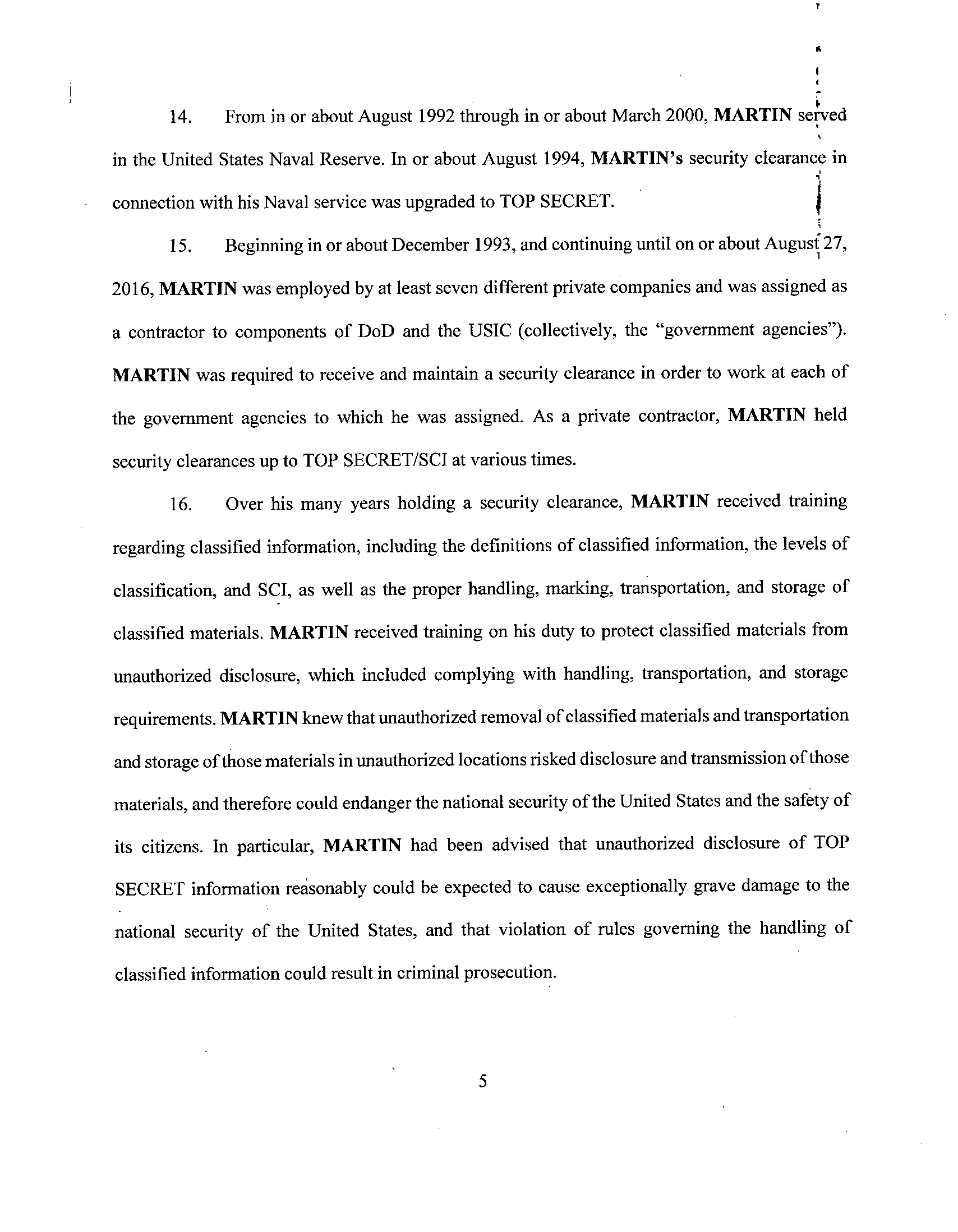
According to an indictment released Wednesday, the information stolen by Harold Martin, a former NSA contractor who was arrested in August of last year, may be far more damaging to the U.S. intelligence community than anything taken by Edward Snowden.

On October 5, the New York Times broke the story that the FBI had arrested an employee of the intelligence community over suspicions the worker had stolen highly classified computer code.

From that report:

“The contractor was identified as Harold T. Martin III of Glen Burnie, Md., according to a criminal complaint filed in late August and unsealed Wednesday. Mr. Martin, who at the time of his arrest was working as a contractor for the Defense Department after leaving the NSA, was charged with theft of government property and the unauthorized removal or retention of classified documents.”

According to the Times, a neighbor saw “two dozen FBI agents wearing military-style uniforms and armed with long guns” storm Martin’s home and later escort the man out in handcuffs.

At the time, there was speculation that Martin could be connected to stolen NSA code that found its way into the hands of a group called the Shadow Brokers — for a period, Martin worked for the elite NSA unit from which the data was taken — but even now, authorities can’t prove he actually passed on any information.

But the mere fact that he possessed such highly sensitive material is enough to put Martin away for the rest of his life, as the recently released indictment indicates.

“For more than two decades,” Business Insider wrote on Thursday, “Martin allegedly made off with highly-classified documents that were found in his home and car that included discussions of the US military’s capabilities and gaps in cyberspace, specific targets, and ‘extremely sensitive’ operations against terror groups, according to an indictment released Wednesday.”

The indictment gives the public a much clearer look at the type of data Martin allegedly stole. And next to Edward Snowden, whose security clearance limited the documents he took to mostly training materials, it appears Harold Martin’s reach went far further into the national intelligence community.

Martin is charged with 20 counts of having unauthorized possession of classified material. The government alleges that over this long intelligence career, the 51-year-old took material from the NSA, the National Reconnaissance Office, U.S. Cyber Command, and even the CIA.

Some of the items allegedly taken, according to text from the indictment, include:

A 2008 CIA document containing information regarding foreign intelligence collection sources and methods, and relating to a foreign intelligence collection target.

A USCYBERCOM document, dated August 17, 2016, discussing capabilities and gaps in capabilities of the US military and details of specific operations.

A description of the technical architecture of an NSA communications system.

An outline of a classified exercise involving real-world NSA and US military resources to demonstrate existing cyber intelligence and operational capabilities.

Martin’s first court appearance is set for February 14. If found guilty, he faces up to 200 years in prison. More here.

***

Meanwhile, Putin is allegedly considering returning Edward Snowden to the United States as a goodwill gesture. If so, it is a double game as Putin would never do anything out of kindness without something attached. If Snowden does stand trial for treason/espionage or theft, the United States would then have to offer up classified material and reveal sources and methods which is likely what Russia wants. The Kremlin extended the visa for Snowden until 2020.

*** Image result for edward snowden

In part from NBC: Snowden’s ACLU lawyer, Ben Wizner, told NBC News they are unaware of any plans that would send him back to the United States.

“Team Snowden has received no such signals and has no new reason for concern,” Wizner said.

Snowden responded to NBC’s report on Twitter and said it shows that he did not work with the Russian government.

“Finally: irrefutable evidence that I never cooperated with Russian intel,” Snowden said. “No country trades away spies, as the rest would fear they’re next.”

Snowden’s Russian lawyer, Anatoly Kucherena, reacted to the report with dismay.

“There are no reasons to extradite Edward Snowden to the U.S.,” Kucherena said, according to TASS, the state-owned news agency. “This is some kind of speculation coming from so-called US special service sources. I think this topic was and remains on the political plane in the U.S., but it’s American special services that are puppeteering this story with sporadic information plants.”

“There is not the slightest reason to raise or discuss this topic in Russia,” Kucherena said.

Russia, he said, does not sell people. “The Snowden issue cannot be a bargaining chip on any level, neither political nor economic,” he said, according to the news agency.

Former deputy national security adviser Juan Zarate urged the Trump administration to be cautious in accepting any Snowden offer from Russian President Vladimir Putin.

“For Russia, this would be a win-win. They’ve already extracted what they needed from Edward Snowden in terms of information and they’ve certainly used him to beat the United States over the head in terms of its surveillance and cyber activity,” Zarate said.