Taiwan More Advanced than U.S. to Deal with Coronavirus

Taiwan, while in a contentious government power struggle with China, the country has a very conservative approach on economic stability and encourages entrepreneurial strengths.

(Reuters) – China is pressuring Taiwan with “provocative” air force maneuvers near the island and spreading fake news to sow discord during the coronavirus outbreak, security sources and government officials in Taiwan say.

This sets the table for why Taiwan’s master plan to thrive during the coronavirus outbreak.

Angry Taiwan blames China for UN aviation meet snub | The ...

You can be assured corporate leaders in the United States are taking notice and are hosting some top level meetings regarding research and development across the country during this anxious time in America and across the world.

Taiwan records its first coronavirus death as global toll ...

Read on for some interesting actions Taiwan has taken given how interacted the country is with China.

***

Taiwan is 81 miles off the coast of mainland China and was expected to have the second highest number of cases of coronavirus disease 2019 (COVID-19) due to its proximity to and number of flights between China.1 The country has 23 million citizens of which 850 000 reside in and 404 000 work in China.2,3 In 2019, 2.71 million visitors from the mainland traveled to Taiwan.4 As such, Taiwan has been on constant alert and ready to act on epidemics arising from China ever since the severe acute respiratory syndrome (SARS) epidemic in 2003. Given the continual spread of COVID-19 around the world, understanding the action items that were implemented quickly in Taiwan and assessing the effectiveness of these actions in preventing a large-scale epidemic may be instructive for other countries.

COVID-19 occurred just before the Lunar New Year during which time millions of Chinese and Taiwanese were expected to travel for the holidays. Taiwan quickly mobilized and instituted specific approaches for case identification, containment, and resource allocation to protect the public health. Taiwan leveraged its national health insurance database and integrated it with its immigration and customs database to begin the creation of big data for analytics; it generated real-time alerts during a clinical visit based on travel history and clinical symptoms to aid case identification. It also used new technology, including QR code scanning and online reporting of travel history and health symptoms to classify travelers’ infectious risks based on flight origin and travel history in the past 14 days. Persons with low risk (no travel to level 3 alert areas) were sent a health declaration border pass via SMS (short message service) messaging to their phones for faster immigration clearance; those with higher risk (recent travel to level 3 alert areas) were quarantined at home and tracked through their mobile phone to ensure that they remained at home during the incubation period.

Moreover, Taiwan enhanced COVID-19 case finding by proactively seeking out patients with severe respiratory symptoms (based on information from the National Health Insurance [NHI] database) who had tested negative for influenza and retested them for COVID-19; 1 was found of 113 cases. The toll-free number 1922 served as a hotline for citizens to report suspicious symptoms or cases in themselves or others; as the disease progressed, this hotline has reached full capacity, so each major city was asked to create its own hotline as an alternative. It is not known how often this hotline has been used. The government addressed the issue of disease stigma and compassion for those affected by providing food, frequent health checks, and encouragement for those under quarantine. This rapid response included hundreds of action items (eTable in the Supplement).

Recognizing the Crisis

In 2004, the year after the SARS outbreak, the Taiwan government established the National Health Command Center (NHCC). The NHCC is part of a disaster management center that focuses on large-outbreak response and acts as the operational command point for direct communications among central, regional, and local authorities. The NHCC unified a central command system that includes the Central Epidemic Command Center (CECC), the Biological Pathogen Disaster Command Center, the Counter-Bioterrorism Command Center, and the Central Medical Emergency Operations Center.5

On December 31, 2019, when the World Health Organization was notified of pneumonia of unknown cause in Wuhan, China, Taiwanese officials began to board planes and assess passengers on direct flights from Wuhan for fever and pneumonia symptoms before passengers could deplane. As early as January 5, 2020, notification was expanded to include any individual who had traveled to Wuhan in the past 14 days and had a fever or symptoms of upper respiratory tract infection at the point of entry; suspected cases were screened for 26 viruses including SARS and Middle East respiratory syndrome (MERS). Passengers displaying symptoms of fever and coughing were quarantined at home and assessed whether medical attention at a hospital was necessary. On January 20, while sporadic cases were reported from China, the Taiwan Centers for Disease Control (CDC) officially activated the CECC for severe special infectious pneumonia under NHCC, with the minister of health and welfare as the designated commander. The CECC coordinated efforts by various ministries, including the ministries of transportation, economics, labor, and education and the Environmental Protection Administration, among others, in a comprehensive effort to counteract the emerging public health crisis.

Managing the Crisis

For the past 5 weeks (January 20-February 24), the CECC has rapidly produced and implemented a list of at least 124 action items (eTable in the Supplement) including border control from the air and sea, case identification (using new data and technology), quarantine of suspicious cases, proactive case finding, resource allocation (assessing and managing capacity), reassurance and education of the public while fighting misinformation, negotiation with other countries and regions, formulation of policies toward schools and childcare, and relief to businesses.

Border Control, Case Identification, and Containment

On January 27, the National Health Insurance Administration (NHIA) and the National Immigration Agency integrated patients’ past 14-day travel history with their NHI identification card data from the NHIA; this was accomplished in 1 day. Taiwan citizens’ household registration system and the foreigners’ entry card allowed the government to track individuals at high risk because of recent travel history in affected areas. Those identified as high risk (under home quarantine) were monitored electronically through their mobile phones. On January 30, the NHIA database was expanded to cover the past 14-day travel history for patients from China, Hong Kong, and Macau. On February 14, the Entry Quarantine System was launched, so travelers can complete the health declaration form by scanning a QR code that leads to an online form, either prior to departure from or upon arrival at a Taiwan airport. A mobile health declaration pass was then sent via SMS to phones using a local telecom operator, which allowed for faster immigration clearance for those with minimal risk. This system was created within a 72-hour period. On February 18, the government announced that all hospitals, clinics, and pharmacies in Taiwan would have access to patients’ travel histories.

Resource Allocation: Logistics and Operations

The CECC took an active role in resource allocation, including setting the price of masks and using government funds and military personnel to increase mask production. On January 20, the Taiwan CDC announced that the government had under its control a stockpile of 44 million surgical masks, 1.9 million N95 masks, and 1100 negative-pressure isolation rooms.

Communications and Politics
Reassure and Educate the Public, While Fighting Misinformation

In addition to daily press briefings by the minister of health and welfare the CECC, the vice president of Taiwan, a prominent epidemiologist, gave regular public service announcements broadcast from the office of the president and made available via the internet. These announcements included when and where to wear a mask, the importance of handwashing, and the danger of hoarding masks to prevent them from becoming unavailable to frontline health workers. The CECC also made plans to assist schools, businesses, and furloughed workers (eTable in the Supplement).

Taiwan’s Outcomes so Far (as of February 24)
Interim Outcomes

The CECC has communicated to the public in a clear and compassionate manner. Based on a poll of 1079 randomly selected people conducted by the Taiwan Public Opinion Foundation on February 17 and 18, the minister of health and welfare received approval ratings of more than 80% for his handling of the crisis, and the president and the premier received an overall approval rating of close to 70%. As of February 24, Taiwan has 30 cases of COVID-19. These cases represent the 10th-highest case number among countries affected thus far, but far fewer than the initial models predicting that Taiwan would have the second-highest importation risk.

Challenges

First, real-time public communications were mostly in Mandarin Chinese and sign language. Other than the Taiwan CDC website, there was not enough communication in different languages to non-Taiwanese citizens traveling or residing in Taiwan. Second, while its attention was focused on air travel, Taiwan permitted the docking of the Diamond Princess cruise ship and allowed passengers to disembark in Keelung, near New Taipei City, on January 31, before the ship left for Japan. The ship was subsequently found to have numerous confirmed infections onboard. This created a temporary public panic with concern about community spread. The government published the 50 locations where the cruise ship travelers may have visited and asked citizens who may have been in contact with the tour group to conduct symptom monitoring and self-quarantine if necessary. None were confirmed to have COVID-19 after 14 days had passed. Third, whether the intensive nature of these policies can be maintained until the end of the epidemic and continue to be well received by the public is unclear.

Conclusions

Taiwan’s government learned from its 2003 SARS experience and established a public health response mechanism for enabling rapid actions for the next crisis. Well-trained and experienced teams of officials were quick to recognize the crisis and activated emergency management structures to address the emerging outbreak.

In a crisis, governments often make difficult decisions under uncertainty and time constraints. These decisions must be both culturally appropriate and sensitive to the population. Through early recognition of the crisis, daily briefings to the public, and simple health messaging, the government was able to reassure the public by delivering timely, accurate, and transparent information regarding the evolving epidemic. Taiwan is an example of how a society can respond quickly to a crisis and protect the interests of its citizens.

Article Information

Corresponding Author: C. Jason Wang, MD, PhD, Stanford University, 117 Encina Commons, CHP/PCOR, Stanford, CA 94305 (cjwang1@stanford.edu).

Published Online: March 3, 2020. doi:10.1001/jama.2020.3151

Conflict of Interest Disclosures: None reported.

References and footnotes found here in detail.

Operation Mega Flex

From July to September last year, Customs and Border Patrol in that 3 month period seized 1061 shipments of counterfeit goods at our cargo ports of entry. Items from Louis Vuitton bags to sports equipment with faulty parts. Other items included children’s toys, drug paraphernalia, deadly opioids, and really scary were (are) counterfeit drivers’ licenses. Recreational drugs, clothing, jewelry and even food and nutritional items (may contain toxins) are part of the counterfeit items affecting likely every American and business.

Image result for cbp counterfeit

Unlike legitimate drug manufacturers that are subject to inspections by the U.S. Food and Drug Administration, labs that manufacture counterfeits have no such oversight. According to a 2019 Better Business Bureau study, “companies based in China, Hong Kong, Singapore, and India shipped 97 percent of the counterfeit medicines seized in the U.S.”In March 2019, Europol, the European Union’s law enforcement agency, seized 13 million doses of counterfeit medicine ranging from opioids to heart medication. Europol noted that this type of counterfeiting is on the rise due to the relatively low risk of criminal detection.

Check those items in retail operations of all sorts and locations and what you purchase in the e-commerce realm, not the from the street vendor at the corner and when purchasing books, movies or music, you could be in real trouble for a transaction that violates copyright protected work.

Image result for cbp counterfeit

Watches and jewelry follow at 13 percent of total seizures. During the Mega Flex operation on August 21, 2019, for example, CBP officers seized counterfeit Rolex watches valued at over $1.4 million. Handbags and wallets represented nearly 11 percent of all seizures, including counterfeits of luxury brands such as Louis Vuitton, Michael Kors, and Gucci. Consumer electronicsrepresented 10 percent of seizures, including products such as iPhones, hover boards, earbuds, microchips, and others. Pharmaceuticals and personal care items account for only 7 percent of total seizures. However, as discussed in the next section, many of the products in these categories pose significant dangers to the consumer. Fake prescription drugs can lack active ingredients, contain incorrect dosages, or include dangerous additives. Fake personal care items such as cosmetics have been found to contain everything from harmful bacteria to human waste. Between 2017 and 2018, CBP and ICE Homeland Security Investigations (HSI) seized over $31 million in fake perfumes from China.

Law enforcement officials have uncovered intricate links between the sale of counterfeit goods and transnational organized crime. A study by the Better Business Bureau notes that the financial operations supporting counterfeit goods typically require central coordination, making these activities attractive for organized crime, with groups such as the Mafia and the Japanese Yakuza heavily involved. Criminal organizations use coerced and child labor to manufacture and sell counterfeit goods. In some cases, the proceeds from counterfeit sales may be supporting terrorism and dictatorships throughout the world.

In FY 2018, 12 percent of DHS seizures included counterfeit versions of critical technological components, automotive and aerospace parts, batteries, and machinery. Each of these industrial sectors have been identified as critical to the defense industrial base, and thus critical to national security. One example drawn from a 2018 study by the Bureau of Industry and Security within the Department of Commerce featured the import of counterfeit semiconductors or “Trojan chips” for use in defense manufacturing and operations. Such Trojan chips can carry viruses or malware that infiltrate and weaken American national security. The problem of counterfeit chips has become so pervasive that the Department of Defense has referred to it as an “invasion.” Companies from China are the primary producers of counterfeit electronics.

According to a 2019 report, Instagram and Counterfeiting, nearly 20 percent of the posts analyzed about fashion products on Instagram featured counterfeit or illicit products. More than 50,000 Instagram accounts were identified as promoting and selling counterfeits, a 171 percent increase from a prior 2016 analysis. Instagram’s Story feature, where content disappears in twenty-four hours, was singled out as particularly effective for counterfeit sellers.

For the full report, go here.


Justice Dept Brands Huawei as a Criminal Enterprise

Gotta hope that Europe takes note, especially Britain. Europe so far has approved Huawei as the vendor platform for 5G. Check your use of apps at the Google store and take a second look at your smart devices.

Image result for huawei source

FDD: The U.S. Department of Justice (DOJ) indicted Chinese telecommunications firm Huawei Technologies and its subsidiaries last week for alleged racketeering, theft of intellectual property, and conspiracy to commit bank fraud, among other charges. The indictment portrays Huawei not merely as a company that has broken the law, but as a fundamentally criminal enterprise.

The new charges target Huawei, four of Huawei’s subsidiaries (Huawei Device Co. Ltd., Huawei Device USA Inc., Futurewei Technologies Inc., and Skycom Tech Co. Ltd.), and Huawei’s chief financial officer, Meng Wanzhou, for violating the Racketeer Influenced and Corrupt Organizations (RICO) Act, which Congress passed in 1970 to combat organized crime.

According to the DOJ, the Huawei business model entailed “the deliberate and repeated misappropriation of intellectual property of companies headquartered or with offices in the United States.” DOJ also highlighted other violations, including Huawei’s role in sanctions evasion and fraudulent activities.

Last week’s indictment marks the first time DOJ charged a company with suspect connections to a foreign government as a criminal enterprise. Although Huawei asserts it is not state-owned, the company has indirect ties to the Chinese government and has yet to publically disclose who exactly owns and controls the company. Huawei’s majority shareholder is the company’s labor union, which keeps the details of its membership and governance structure out of the public eye. Last year, Jiang Xisheng, a top executive, explained during a press conference that the labor union’s ownership is simply a matter of legal convenience; this only further obfuscated who is really in charge. Additionally, Huawei’s founder, Ren Zhangfei, served in the Chinese military and is a member of the Chinese Communist Party.

While the indictment does not say that Beijing directed Huawei to operate as a criminal enterprise, China’s National Intelligence Law of 2017 requires Huawei and other private companies to provide the government with their data to “support, assist, and cooperate with state intelligence according to the law.” In short, the law empowers Beijing to exploit Huawei as an intelligence asset whenever it sees fit.

In other high-profile cases, the Chinese government has stolen sensitive U.S. data to achieve a strategic advantage. U.S. officials have even deemed China’s espionage and intelligence activities as a “long-term existential threat to the security of our nation.” In 2012, the head of the U.S. National Security Agency estimated that China’s economic espionage cost U.S. companies $250 billion in annual losses. Additionally, the targeting of strategic industries has allowed Beijing to enhance its own military capabilities at America’s expense.

The exploitation of Huawei could clearly enhance Beijing’s intelligence collecting capabilities. Just last week, the U.S. government reported that for over ten years Huawei secretly maintained “back doors” on its mobile networks that allowed the company – and potentially the Chinese government – to have direct access to their users’ most sensitive data.

The indictment of Huawei as a criminal enterprise shows that the Trump administration was mistaken when it placated Beijing by softening previous penalties for Huawei’s misconduct. If the court finds Huawei guilty under RICO, the administration should ensure the full application of all penalties necessary to end its criminal pursuits.


Iran to be Blacklisted as a Country

Financial Action Task Force, a Paris based organization will take blacklisting action on Iran this week. Finally, it appears Europe is joining the United States in this effort even while former Secretary of State John Kerry and a democrat U.S. Senate delegation met with Iranian leaders in a secret setting.
The task force designation will encompass 39 member countries and organizations where this calls for sanctions on Iran due to money-laundering, financing of terror organizations, corruption politicians, international crime, illegal arms trade and drug trafficking. It is unclear if the United Nations has offered any resistance or comment. The only other country under this full designation is North Korea, yet another 12 countries are subject to the same scrutiny and punitive actions by the task force. Banking and access to international trade will be limited or terminated in many cases completely.

Meanwhile, Russia and China have stepped in to provide more support and aid to Iran.
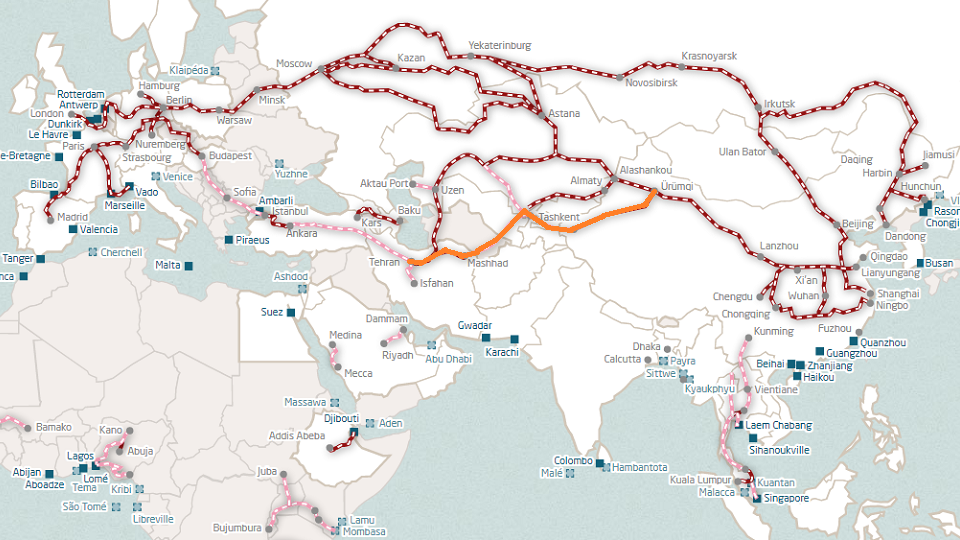
In an effort to preserve trade and revenue, Iran was construction a rail system into Central Asia connecting the Caspian countries of Azerbaijan, Kazakhstan, Azerbaijan, Russia, Kazakhstan and Turkmenistan. Due to US sanctions, Iran has been in a financial tailspin and construction has essentially stopped and the costs were escalating due to the difficult mountainous regions and regional politics. Enter China and Russia.

source

The project is expected to cost 1.2 billion euros ($1.5 billion) and is being financed by an export credit that Moscow has extended to Tehran. It will involve the electrification of 495 kilometers of existing line, including 203 kilometers in mountainous areas, and the updating of 31 stations and 95 tunnels. This railway segment is projected to carry up to ten million tons of cargo annually upon completion, in 2024. Russian and Iranian officials are jubilant: “All this creates conditions for the growth of goods traffic along the International North–South Transport Corridor and the intensification of economic ties in the Caspian region,” they say (Casp-geo.ru, February 18). The reasons are obvious: if this rail project is completed, Russia and Iran will be able to control much of the trade coming through or out of Central Asia, thus limiting the freedom of action of the states of that region and giving Moscow and Tehran a greater voice in Chinese decisions there (Casp-geo.ru, November 28, 2019; Ru.irna.ir, November 13, 2019).

***

Development of Xinjiang

For China, the project is extremely important due to several factors. First, it will stimulate the economic development of the Xinjiang Uygur Autonomous Region. This autonomous region of China plays a significant role in rail freight transportation on the New Silk Road. The majority of container trains from central, eastern and southern China to Europe run via Xinjiang. Its capital, Urumqi, is also an important railway hub on the corridor towards Europe.

Kashgar, one of the westernmost cities in China, could be another junction in Xinjiang. The Chinese government is discussing the construction of two railway lines from Kashgar: one westward to Kyrgyzstan and Uzbekistan, and another southward. The latter heads to Pakistan, where China Overseas Port Holding Company operates Gwadar Deep Sea Port, and where China intends to build its second, after Djibouti, overseas naval base.

New Silk Road

The second factor of success is the potential of the railway line for the New Silk Road. According to estimations, the Xinjiang – Kyrgyzstan – Uzbekistan route will shorten the route from China to Uzbekistan. Currently, containers going to this Central Asian country must cover long distances and cross the territory of neighbouring Kazakhstan.

Moreover, the railway link between China and Uzbekistan links to Iran (via Turkmenistan) and Turkey, as well as eventually to Europe, especially to Southeast Europe. With this, the route from China to Southeast Europe could be reduced up to 900 kilometres, equal to up to seven or eight days. At the same time, the new railway will allow China to better involve Kyrgyzstan and Uzbekistan into the New Silk Road.

Chinese Spy Leading California Public Pension Fund?

This may add some very new and different questions when it comes to the Biden foreign operations….read on….

Rep. Jim Banks, R-Ind., joined “Mornings with Maria” to explain why he wrote a letter to California Gov. Gavin Newsom highlighting his concerns about the state public pension fund’s chief investment officer having ties to China.

The fund has invested $3.1 billion in Chinese companies, some of which have been blacklisted by the U.S. government, Banks told FOX Business’ Maria Bartiromo.

“If this were up to me, I would fire [Chief Investment Officer Yu Ben Meng] immediately because of these suspicious ties,” he said. “We learned that Mr. Meng, who is the chief investment officer of CalPERS, was actually recruited to this position by the [Chinese Communist Party] through something called the Thousand Talents Program. Now he’s denied it.”

CalPERS stands for the California Public Employees’ Retirement System, the largest public pension fund in the nation.

“What is unusual is that many of these companies are companies that we’ve blacklisted, that make Chinese military equipment or are responsible for technologies like Hikvision, which is the equipment that’s used by the Chinese for surveillance on the Uighur Muslim population that they’ve been abusing in their own country,” Banks said.

The Commerce Department blacklisted Hikvision in October “for engaging in or enabling activities contrary to the foreign policy interests of the United States.”

CalPERS defended Meng.

“This is a reprehensible attack on a U.S. citizen. We fully stand behind our Chief Investment Officer who came to CalPERS with a stellar international reputation,” a CalPERS spokeswoman told Reuters.

China's Social Credit System – It's Coming To The United ...

Hold on, it is actually worse… going back 4 months ago….

(Reuters) – Some of the biggest public pensions funds in the United States have invested in one of the world’s largest purveyors of video surveillance systems that the U.S. government claims are used in wide-scale repression of the Muslim population of western China.

The Trump administration’s decision to put the company, Hangzhou Hikvision Digital Technology Co (002415.SZ), on a blacklist last week has prompted at least two of the pension plans to say they are reviewing or monitoring that development.

The blacklist applies to Hikvision and seven other companies because they allegedly enabled the crackdown that has led to mass arbitrary detentions in the Xinjiang region.

“We are tracking the situation given this new development with the Department of Commerce’s announcement,” a spokeswoman for the California State Teachers’ Retirement System (CalSTRS) said in an email.

CalSTRS owned 4.35 million Hikvision shares at the end of June 30, 2018, the last data available. The holding, owned directly and through emerging market exchange-traded funds, would be worth $24 million at that share count.

The New York State Teachers Retirement System also owned Hikvision, reporting 81,802 shares at the end of June, up from 26,402 shares at the end of 2018, fund disclosures show.

“Our holdings are primarily held according to their weights in passive portfolios matching the MSCI ACWI ex-U.S. index, our policy benchmark. We are monitoring the situation,” said a spokesman for the teachers’ fund. The ex-U.S. All Country World Index includes stocks from 22 developed and emerging markets.

The blacklisting means Hikvision and the other companies will not be able to buy U.S. technology, such as software and microchips, without specific U.S. government approval. It does not prevent U.S. investors from buying the companies’ shares. In August, Hikvision had been banned from selling to U.S. federal agencies because the government said its products could allow access to sensitive systems.

Hikvision’s General Manager Hu Yangzhong told Reuters on Wednesday it has been talking to the U.S. government about Xinjiang and has hired human rights lawyers to defend itself against the blacklisting.

A spokeswoman for law firm Sidley Austin LLP, which has lobbied for Hikvision this year, declined to comment.

Another major fund investing in Hikvision shares is the Florida Retirement System (FRS), with 1.8 million shares at the end of June.

A spokesman for the fund said it was working closely with external money managers “related to the issue in order to meet all regulatory and fiduciary requirements.”

POSTER CHILD

Risk consultants say the ease with which money used for the retirements of tens of millions of Americans is being invested in such companies should concern U.S. authorities at every level, as well as Americans generally.

“Hikvision has emerged as the corporate poster child for enabling Chinese human rights abuses, with its surveillance cameras visible atop the walls of detention camps incarcerating some one million or more Uighurs in Xinjiang,” said Roger Robinson, president and CEO of Washington DC-based risk consultancy RWR Advisory Group.

Beijing denies any mistreatment of people at the camps, which it says provide vocational training to help stamp out religious extremism and teach new work skills.

Robinson said that many Americans are unwittingly owning shares in such companies because they are in index funds. “They are picked up by the index providers in sizable numbers and sluiced into U.S. investor portfolios with seemingly very little, if any, due diligence or disclosure in the categories of national security and human rights.”

MSCI Inc (MSCI.N), whose products are designed for global investors, added Hikvision to its benchmark emerging markets index last year. MSCI declined to comment.

One other company among the blacklisted eight that is owned by some of the big pension funds is iFlytek Co Ltd (002230.SZ), a speech-recognition firm. Its shares were owned by funds in Florida, New York State as well as CalSTRS and the California Public Employees Retirement System (CalPERS) indirectly through the iShares MSCI Emerging Markets ETF at their last disclosure dates. IShares, a top ETF provider owned by BlackRock Inc (BLK.N), declined to comment.

CUTTING TIES

Not all the funds have stuck with Hikvision.

The New York State Common Fund, one of the country’s biggest pension funds, liquidated its position months ago. It had owned 2.7 million shares worth $14.2 million at the end of March through an external fund manager, but sold them in May, a spokesman said, declining to say why.

U.S. mutual funds have also cut or eliminated positions in Hikvision amid the negative publicity, which included it being named in a Human Rights Watch report on mass surveillance in Xinjiang in May.

Just 9% of global emerging markets funds now own Hikvision, down from 20% in 2018, according to Copley Fund Research. One fund to pull out is the $2.7 billion Artisan Developing World Fund (APDYX.O), which had a $66 million position in Hikvision at the end of March but reported holding no shares three months later, fund disclosures show. Artisan did not respond to a request for comment.

At least one U.S. pension fund had worried this summer about whether to invest in the Chinese surveillance company.

The $33 billion Alaska Permanent Fund had considered an investment in a China fund featuring Hikvision as a top holding, according to minutes of a June meeting of its trustees and staff. The minutes were published last month.

Schroders Global Asset Management, a finalist for the fund’s mainland China investment mandate, touted Hikvision as a top performer.

Some Alaska trustees, however, worried about “headline risks” of investing in companies that aid the Chinese government’s surveillance activities, according to the minutes.

Jack Lee, portfolio manager of the China fund, assured Alaska pension officials he had spoken with Hikvision executives. Hikvision will “try to avoid that kind of business,” the trustees were told, but “they don’t necessarily know how their equipment is used,” Lee told the trustees, according to the minutes.

Reuters could not determine whether Alaska made an investment in the Schroders fund that included Hikvision stock.

A spokeswoman for the Alaska Retirement Management Board, which oversees the pension, said it does not have any additional information to share regarding Schroders’ efforts. A Schroders spokesman declined to comment.