An affordable price is probably the major benefit persuading people to buy drugs at www.americanbestpills.com. The cost of medications in Canadian drugstores is considerably lower than anywhere else simply because the medications here are oriented on international customers. In many cases, you will be able to cut your costs to a great extent and probably even save up a big fortune on your prescription drugs. What's more, pharmacies of Canada offer free-of-charge shipping, which is a convenient addition to all other benefits on offer. Cheap price is especially appealing to those users who are tight on a budget
Service Quality and Reputation Although some believe that buying online is buying a pig in the poke, it is not. Canadian online pharmacies are excellent sources of information and are open for discussions. There one can read tons of users' feedback, where they share their experience of using a particular pharmacy, say what they like or do not like about the drugs and/or service. Reputable online pharmacy canadianrxon.com take this feedback into consideration and rely on it as a kind of expert advice, which helps them constantly improve they service and ensure that their clients buy safe and effective drugs. Last, but not least is their striving to attract professional doctors. As a result, users can directly contact a qualified doctor and ask whatever questions they have about a particular drug. Most likely, a doctor will ask several questions about the condition, for which the drug is going to be used. Based on this information, he or she will advise to use or not to use this medication.

U.S. Naval Operations in the Caribbean VS. Maduro VS China

There are nine naval assets in the Caribbean due to Venezuela and Nicolas Maduro and his position as a drug king pin. the assets include destroyers, amphibious assault ships, reconnaissance, fighter aircraft, a submarine and drones.

Newsweek has a great map of the deployments and ship descriptions. Included in the Newsweek piece is the following:

The deployment reflects the Trump administration’s assertive approach to countering drug trafficking while signaling pressure on the Venezuelan government. Late on Tuesday, U.S. forces in the region launched a missile strike that destroyed a suspected drug boat linked to Venezuela, killing those on board, Trump said on his Truth Social platform.

By positioning advanced warships and long-range aircraft near Venezuelan waters, Washington is seeking to demonstrate both tactical capability and political resolve. In response, Venezuela is mobilizing troops and military assets, raising the prospect of a direct standoff in the southern Caribbean.

What is likely not revealed by these operations in the Caribbean is the matter of China. China has moved into the region in a huge force and very few are even aware of this threat. How so you ask?

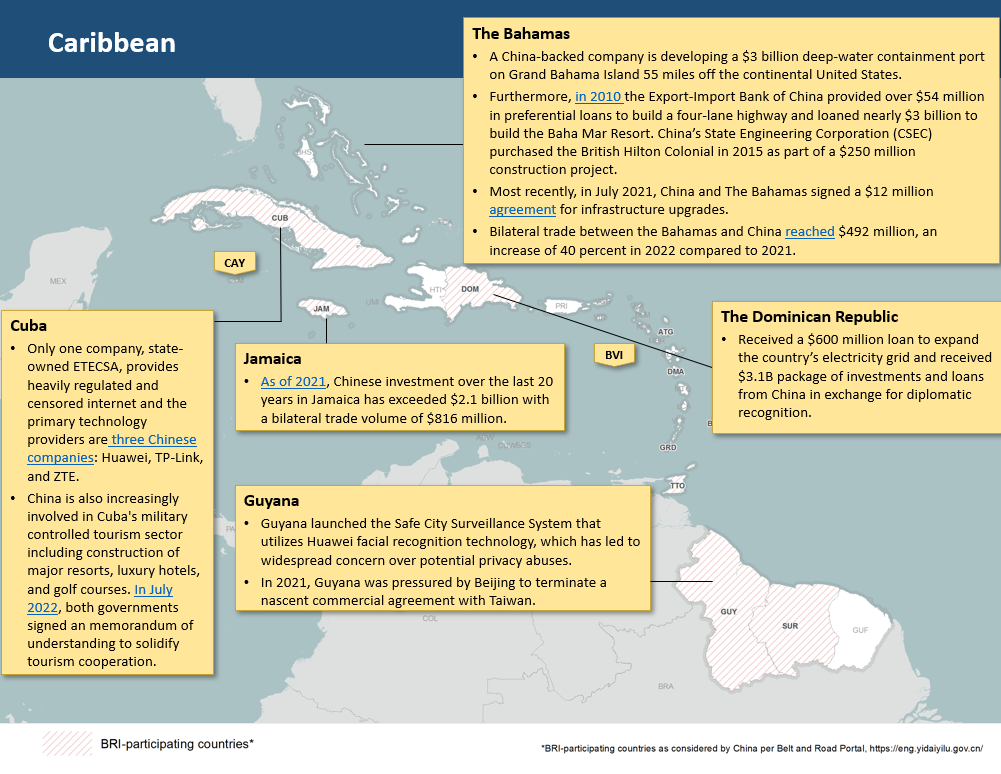
In part: By 2022, ten countries had already joined Beijing’s so-called Belt and Road Initiative: Cuba, Suriname, Guyana, Trinidad and Tobago, Grenada, Barbados, Dominica, Antigua and Barbuda, the Dominican Republic, and Jamaica

China’s growing influence in Cuba and the broader Caribbean region has raised concerns among U.S. experts, who warn that Beijing’s expanding economic and military presence could pose a strategic threat to the United States.

China has significantly expanded its influence in the region through economic investments, diplomatic ties, and military cooperation, particularly with authoritarian regimes like Cuba. Experts warn that these efforts are part of a broader strategy to turn the Caribbean into a “Chinese lake,” according to Newsweek report published on Sunday.

According to World Trade Organization data, Chinese manufacturing exports surged to $1.81 trillion in 2023, a 30-fold increase from 2002, while the U.S. global trade deficit exceeded $1.2 trillion. Chinese trade with the Caribbean skyrocketed from $1 billion in 2002 to $8 billion in 2019, including $6.1 billion in exports and $1.9 billion in imports.

China’s Deepening Ties With Cuba

Cuba has been one of China’s most loyal allies in the region for decades, with strong economic and military cooperation. A significant uptick in this relationship was observed in 2021, following Cuba’s July 11 (11J) protests, when Chinese paramilitary forces trained Cuban elite security units responsible for suppressing dissent. The Brigada Especial Nacional (BEN), a unit under Cuba’s Ministry of the Interior, reportedly received tactical training from China’s People’s Armed Police (PAP), a paramilitary force specializing in riot control and counterterrorism.

Sources told ADN Cuba that PAP training in Cuba began approximately six years before the 2021 protests, focusing on sniper tactics, intervention strategies, and specialized training for elite Cuban security forces. This collaboration underscores China’s role in bolstering the Cuban regime’s ability to suppress political opposition.

Beyond infrastructure projects and military cooperation, China is also strengthening its diplomatic and cultural footprint in communist Cuba. In May 2024, Beijing and Havana resumed direct flights between the two countries. The Cuban regime has also introduced visa exemptions for Chinese citizens with ordinary passports, making travel between both nations easier. More details here.

20th anniv. of China-Bahamas ties marked in Beijing - Xinhua | English ...

*** FNC has called on experts to describe the Chinese threat so close to to the U.S. coastline.

China is steadily expanding in the Bahamas through projects that blur economic development and geopolitical aims, an expert warned.

“The People’s Republic of China has been making diplomatic, economic and even military and quasi-military inroads into the Caribbean, South and Central America for the past couple of decades,” retired Rear Adm. Peter Brown, former Homeland Security advisor to President Donald Trump, told Fox News Digital.

Brown pointed to the rise in dual-use infrastructure projects along the Bahamas coastline, which is located just 50 miles off the coast of Florida.

“It doesn’t take a lot of imagination for the People’s Republic of China to use its commercial footprint in the Bahamas to monitor, exploit and perhaps even do worse to [the] U.S.,” he said.

Pointing to the Chinese-controlled British Colonial Hotel in Nassau, Bahamas, Brown said that its location directly across from the U.S. Embassy could give way to intelligence gathering on U.S. personnel.

“It doesn’t take a lot of imagination to think that additional electronics were put in there with the purpose and the task of keeping an eye not only on the U.S. Embassy itself, but also the U.S. Embassy visitors,” he said.

The hotel is owned by a Chinese company, Chow Tai Fook Enterprises, which has raised geopolitical concerns given its location. Fox News Digital has reached out to the British Colonial Hotel for comment.

China has invested heavily in the Bahamas through a range of additional high-profile projects, including a $40 million grant for a national stadium, a $3 billion mega-port in Freeport, and $40 million for the North Abaco Port and Little Abaco Bridge.

Additionally, China EXIM Bank provided over $54 million in loans to construct a four-lane highway and nearly $3 billion to finance the development of the Baha Mar Resort.

*** You can bet our high tech naval assets are picking up information and reporting back to the national security council and Secretary of State Marco Rubio…it is no wonder he has spent a good deal of time in the region.

Should DOGE include the E for Espionage Also?

ProPublica is not one of my ‘go-to’ sites but they get a hat tip for this one.… the enemy foreign and domestic has burrowed in…anyone really paying enough attention? One could argue CISA has failed as has  the NSA and Microsoft…..

Microsoft is using engineers in China to help maintain the Defense Department’s computer systems — with minimal supervision by U.S. personnel — leaving some of the nation’s most sensitive data vulnerable to hacking from its leading cyber adversary, a ProPublica investigation has found.

The arrangement, which was critical to Microsoft winning the federal government’s cloud computing business a decade ago, relies on U.S. citizens with security clearances to oversee the work and serve as a barrier against espionage and sabotage.

But these workers, known as “digital escorts,” often lack the technical expertise to police foreign engineers with far more advanced skills, ProPublica found. Some are former military personnel with little coding experience who are paid barely more than minimum wage for the work.

“We’re trusting that what they’re doing isn’t malicious, but we really can’t tell,” said one current escort who agreed to speak on condition of anonymity, fearing professional repercussions.

The system has been in place for nearly a decade, though its existence is being reported publicly here for the first time.

Microsoft told ProPublica that it has disclosed details about the escort model to the federal government. But former government officials said in interviews that they had never heard of digital escorts. The program appears to be so low-profile that even the Defense Department’s IT agency had difficulty finding someone familiar with it. “Literally no one seems to know anything about this, so I don’t know where to go from here,” said Deven King, spokesperson for the Defense Information Systems Agency.Biden review board blames Microsoft for China hack that targeted US ... source

National security and cybersecurity experts contacted by ProPublica were also surprised to learn that such an arrangement was in place, especially at a time when the U.S. intelligence community and leading members of Congress and the Trump administration view China’s digital prowess as a top threat to the country.

The Office of the Director of National Intelligence has called China the “most active and persistent cyber threat to U.S. Government, private-sector, and critical infrastructure networks.” One of the most prominent examples of that threat came in 2023, when Chinese hackers infiltrated the cloud-based mailboxes of senior U.S. government officials, stealing data and emails from the commerce secretary, the U.S. ambassador to China and others working on national security matters. The intruders downloaded about 60,000 emails from the State Department alone.

With President Donald Trump and his allies concerned about spying, the State Department announced plans in May to “aggressively revoke visas for Chinese students” — a pledge that the president seems to have walked back. The administration is also trying to arrange the sale of the popular social media platform TikTok, which is owned by a Chinese company that some lawmakers believe could hand over sensitive U.S. user data to Beijing and fuel misinformation with its content recommendations. But experts told ProPublica that digital escorting poses a far greater threat to national security than either of those issues and is a natural opportunity for spies.

“If I were an operative, I would look at that as an avenue for extremely valuable access. We need to be very concerned about that,” said Harry Coker, who was a senior executive at the CIA and the National Security Agency. Coker, who also was national cyber director during the Biden administration, added that he and his former intelligence community colleagues “would love to have had access like that.”

It is difficult to know whether engineers overseen by digital escorts have ever carried out a cyberattack against the U.S. government. But Coker wondered whether it “could be part of an explanation for a lot of the challenges we have faced over the years.”

Microsoft uses the escort system to handle the government’s most sensitive information that falls below “classified.” According to the government, this “high impact level” category includes “data that involves the protection of life and financial ruin.” The “loss of confidentiality, integrity, or availability” of this information “could be expected to have a severe or catastrophic adverse effect” on operations, assets and individuals, the government has said. In the Defense Department, the data is categorized as “Impact Level” 4 and 5 and includes materials that directly support military operations.

John Sherman, who was chief information officer for the Department of Defense during the Biden administration, said he was surprised and concerned to learn of ProPublica’s findings. “I probably should have known about this,” he said. He told the news organization that the situation warrants a “thorough review by DISA, Cyber Command and other stakeholders that are involved in this.”

In an emailed statement, the Defense Information Systems Agency said that cloud service providers “are required to establish and maintain controls for vetting and using qualified specialists,” but the agency did not respond to ProPublica’s questions regarding the digital escorts’ qualifications.

It’s unclear whether other cloud providers to the federal government use digital escorts as part of their tech support. Amazon Web Services and Google Cloud declined to comment on the record for this article. Oracle did not respond to requests for comment.

Microsoft declined to make executives available for interviews for this article. In response to emailed questions, the company provided a statement saying its personnel and contractors operate in a manner “consistent with US Government requirements and processes.”

Global workers “have no direct access to customer data or customer systems,” the statement said. Escorts “with the appropriate clearances and training provide direct support. These personnel are provided specific training on protecting sensitive data, preventing harm, and use of the specific commands/controls within the environment.” In addition, Microsoft said it has an internal review process known as “Lockbox” to “make sure the request is deemed safe or has any cause for concern.” A company spokesperson declined to provide specifics about how it works but said it’s built into the system and involves review by a Microsoft employee in the U.S.

Over the years, various people involved in the work, including a Microsoft cybersecurity leader, warned the company that the arrangement is inherently risky, those people told ProPublica. Despite the presence of an escort, foreign engineers are privy to granular details about the federal cloud — the kind of information hackers could exploit. Moreover, the U.S. escorts overseeing these workers are ill equipped to spot suspicious activity, two of the people said.

Even those who helped develop the escort system acknowledge the people doing the work may not be able to detect problems.

“If someone ran a script called ‘fix_servers.sh’ but it actually did something malicious then [escorts] would have no idea,” Matthew Erickson, a former Microsoft engineer who worked on the escort system, told ProPublica in an email. That said, he maintained that the “scope of systems they could disrupt” is limited.

Yes, China is Surrounding the S. China Sea, but what about Florida?

The two faced dragon….tie to really recalibrate the relationship between the United States and China AGAIN….Previously n this website, I have discussed not only by a post but several times on radio about how the former intelligence/snooping base owned by Russia in Cuba known as the Lourdes SIGINT station was sold to China….no one in media or the national security realm seems to give it much attention…but now…we have an additional problem with China and that is the Bahamas.

How about the largest Chinese embassy in the world with hundreds of Chinese intelligence officers deployed there…..Embassy of China in Nassau in Nassau, Bahamas (Google Maps)

In part from FNC:

“The People’s Republic of China has been making diplomatic, economic and even military and quasi-military inroads into the Caribbean, South and Central America for the past couple of decades,” retired Rear Adm. Peter Brown, former Homeland Security advisor to President Donald Trump, told Fox News Digital.

Brown pointed to the rise in dual-use infrastructure projects along the Bahamas coastline, which is located just 50 miles off the coast of Florida.

“It doesn’t take a lot of imagination for the People’s Republic of China to use its commercial footprint in the Bahamas to monitor, exploit and perhaps even do worse to [the] U.S.,” he said. Pointing to the Chinese-controlled British Colonial Hotel in Nassau, Bahamas, Brown said that its location directly across from the U.S. Embassy could give way to intelligence gathering on U.S. personnel.

The hotel is owned by a Chinese company, Chow Tai Fook Enterprises, which has raised geopolitical concerns given its location. Fox News Digital has reached out to the British Colonial Hotel for comment.

China has invested heavily in the Bahamas through a range of additional high-profile projects, including a $40 million grant for a national stadium, a $3 billion mega-port in Freeport, and $40 million for the North Abaco Port and Little Abaco Bridge.

In 2019, now-Secretary of State Marco Rubio warned in a Miami Herald op-ed that the devastation caused by the natural disaster could create an opening for the People’s Republic of China to use aid as a Trojan horse to gain a foothold near American shores.

“By targeting the Bahamian government in this period of crisis, Beijing would be making the same opportunistic play to access critical foreign infrastructure,” Rubio wrote in 2019. “But in this case, the national security threat is especially perilous, as it would give China a foothold just 50 miles from the coast of Florida.”

***

How about another look at things in the Caribbean…Chinese expansion

Chinese Expansion in the Caribbean (Extra) - Virtual Mirage

China’s Influence in the Caribbean:

China is a member of both the Inter-American Development Bank (IDB) and the Caribbean Development Bank (CDB) and an observer at the Organization of American States (OAS). Alongside Italy and Germany, China is the third largest shareholder at the CDB with 5.6% of overall shares, exponentially higher than the majority of Caribbean countries.

The People’s Republic of China’s (PRC) engagement in the Caribbean has largely focused on investments in infrastructure and developing trade relationships. As of 2022, ten Caribbean countries have signed up to Belt and Road (BRI) – Cuba, Jamaica, Dominican Republic, Antigua & Barbuda, Dominica, Barbados, Grenada, Trinidad & Tobago, Guyana, and Suriname.

The PRC is working towards diminishing the region’s ties to Taiwan as the region contains the largest bulk of Taiwan’s diplomatic allies. Today, St. Lucia, St. Vincent and the Grenadines, St. Kitts and Nevis, Haiti, and Belize remain the only Caribbean nations that recognize Taiwan.

China’s Trade and Economic Investment in the Caribbean

While the Caribbean’s trade with China has grown at a slower pace than overall trade with the region, it increased from $1 billion in 2002 to $8 billion in 2019, with an estimated $6.1 billion in Chinese exports and $1.9 billion in imports.

China is a major trading partner of Cuba’s and Chinese businesses are involved in the Cuba’s telecommunications, tourism, mining, and energy sectors.

Cuba is highly dependent on China and ongoing economic challenges resulted in the reconstructing of an estimated $4 billion in debt to China in 2011 and another restructuring in 2015. For more reading click here.

The U.S. Must Join China’s Belt and Road In Developing The Caribbean ...

The U.S. Must Join China’s Belt and Road In Developing The Caribbean ...

The $200M Smuggling Bust at the Long Beach Port

FoxLA:


LA Ports smuggling bust: Feds arrest 8 suspected of smuggling $200M in Chinese goods

Federal authorities have arrested eight individuals in connection with a large-scale smuggling operation that allegedly brought counterfeit and illegal goods from China into the United States through the Ports of Los Angeles and Long Beach.

The operation, involving logistics companies, warehouse owners, and corrupt truck drivers, is believed to have smuggled at least $200 million worth of goods. An additional defendant, believed to be the lead orchestrator, remains at large and is thought to be in China. The defendants face multiple charges, including conspiracy, smuggling, and breaking customs seals.

9 charged in 15-count indictment

What We Know: Federal law enforcement has charged nine defendants in a 15-count indictment with conspiracy, smuggling, and breaking customs seals. The defendants allegedly collaborated with partners in China to manipulate shipping containers flagged for inspection, using logistics companies to facilitate the smuggling of counterfeit goods into the U.S. Investigators have seized over $130 million in contraband, and the organization is believed to have smuggled at least $200 million worth of goods through this scheme. The Ports of Los Angeles and Long Beach, the busiest container ports in the Western Hemisphere, were the focal points of the operation.

How the crime ring operated

According to Acting United States Attorney Joseph T. McNally, the scheme involved logistics companies, warehouse owners, and corrupt truck drivers working together to defy U.S. customs laws. The defendants and their partners in China filled shipping containers with contraband, including counterfeit goods and illegal chemicals. They circumvented the security system by learning the unique serial numbers of security seals and creating duplicate fake seals. These counterfeit seals were sent from China to the U.S. When shipments arrived at the port, instead of going to secondary inspection sites, corrupt truck drivers took the containers to offsite warehouses. There, the seals were cut, contraband removed, and new counterfeit seals applied before presenting the containers to Customs and Border Protection (CBP) for inspection. Truck drivers were paid significantly above normal rates to transport the containers illegally.

Timeline: The indictment details a conspiracy that operated from at least August 2023 to June 2024. The scheme involved filling shipping containers in China with contraband, counterfeit goods, and illegal chemicals. These containers were sealed with unique security seals, whose numbers the conspirators obtained in advance to create duplicate fake seals. Upon arrival in the U.S., the containers were diverted to offsite warehouses instead of secondary inspection sites, where the contraband was removed, and new counterfeit seals were applied before presenting the containers for Customs and Border Protection (CBP) inspection. Seven defendants were arrested on Friday, with an eighth taken into custody on Saturday. The arraignment for the seven arrested took place on Friday, where they pleaded not guilty, and a trial date was set for March 18. The eighth defendant is expected to be arraigned soon.

The Backstory: The smuggling operation involved executives from logistics companies, warehouse owners, and corrupt truck drivers who coordinated the shipment of contraband from China to the U.S. through the Port of Los Angeles. The defendants allegedly circumvented customs inspections by breaking security seals on containers, removing contraband, and replacing the seals with counterfeit ones to evade detection.

Read more here.


The War has Begun in the S. China Sea, but it is a Quiet One

So quiet…no one domestically is reporting it….Electronic warfare/jamming and cyber are cheap tools of destruction…and then there is space. So, has the Commander in Chief…if there is one…approved real Rules of Engagement….anywhere?

(below is word for word)

***

Over the vast expanse of the South China Sea, a war without gunfire quietly unfolded, its unique impact capturing the world’s attention. On June 30th, a brief yet meaningful tweet from the official Weibo account of China’s Southern Theater Command—“Thick smoke deep in the blue sea, good night”—sparked a massive online reaction, leaving netizens speculating about the secrets behind it.

Recently, there have been widespread rumors online of an intense electronic warfare between China and the United States in the South China Sea, ending with the US deciding to withdraw.

Reports indicate that the skies over northern Philippines recently fell into an unprecedented silence, with all electronic signals cut off. Satellite phones, GPS navigation, television signals—everything reliant on electronic communication seemed to lose its vitality overnight. The twelve-hour “blackout” shocked local residents and global public opinion. This was a direct result of an intense electronic warfare over the South China Sea.

The story begins with a minor conflict between the Philippines and China. Following a fierce confrontation at Ren’ai Reef, the Philippines felt aggrieved by China’s legitimate actions, and the US, as its backer, seized the opportunity. A joint military exercise involving 29 countries was held in the South China Sea, ostensibly to showcase “unity” and “strength,” but with hidden motives—the US military intended to use this opportunity to lay newly developed anti-submarine devices on the seabed, spying on the movements of China’s strategic nuclear submarines and further restricting China’s strategic space.

However, China’s response was swift and decisive. When the US military’s P-8A anti-submarine patrol aircraft quietly dropped high-tech monitoring equipment in the South China Sea, it was promptly detected by the PLA. The Chinese Coast Guard quickly launched a recovery operation. The US military panicked, as losing this equipment would mean wasted effort, and the advanced technology could not fall into PLA hands. This sparked a sensitive reaction, leading to a battle over these critical pieces of equipment.

The US hastily deployed a joint fleet to intercept the Chinese Coast Guard vessels. With the addition of the Shandong carrier strike group, a standoff formed between Chinese and US fleets in the South China Sea. Seeing the unfavorable situation, the US immediately dispatched electronic warfare aircraft to assist the joint fleet in launching severe interference against the Chinese fleet. In response, China rapidly deployed its Y-9 electronic warfare aircraft and 815A electronic reconnaissance ship.

In this battlefield without smoke, electronic warfare took center stage. The US deployed Growler electronic warfare aircraft and RC-135 electronic reconnaissance aircraft in an all-out effort to paralyze the command systems of the Chinese fleet with strong electronic interference. However, the Chinese forces did not retreat; the Y-9 electronic warfare aircraft and 815A electronic reconnaissance ship quickly countered, engaging in fierce electronic offensive and defensive operations over the South China Sea.

The intense electronic warfare near the northern Philippines far exceeded external expectations. Ultimately, the US fleet faced an unprecedented crisis—screens full of static and a total loss of GPS signals. In modern naval warfare, losing communication and navigation capabilities is akin to losing sight and hearing. Confronted with such a scenario, the US had to choose to retreat to avoid greater losses.

The entire electronic warfare lasted a full twelve hours, plunging northern Philippines into complete communication paralysis and sparking widespread global attention and discussion. According to Taichung News, the mysterious battle gained an official tone, with retired generals critiquing the US military’s outdated electronic warfare equipment, asserting it is a full generation behind China’s.