
Your Threat Score, Yup, Yours

The new way police are surveilling you: Calculating your threat ‘score’

While officers raced to a recent 911 call about a man threatening his ex-girlfriend, a police operator in headquarters consulted software that scored the suspect’s potential for violence the way a bank might run a credit report.

The program scoured billions of data points, including arrest reports, property records, commercial databases, deep Web searches and the man’s social- media postings. It calculated his threat level as the highest of three color-coded scores: a bright red warning.

The man had a firearm conviction and gang associations, so out of caution police called a negotiator. The suspect surrendered, and police said the intelligence helped them make the right call — it turned out he had a gun.

As a national debate has played out over mass surveillance by the National Security Agency, a new generation of technology such as the Beware software being used in Fresno has given local law enforcement officers unprecedented power to peer into the lives of citizens.

Police officials say such tools can provide critical information that can help uncover terrorists or thwart mass shootings, ensure the safety of officers and the public, find suspects, and crack open cases. They say that last year’s attacks in Paris and San Bernardino, Calif., have only underscored the need for such measures.

But the powerful systems also have become flash points for civil libertarians and activists, who say they represent a troubling intrusion on privacy, have been deployed with little public oversight and have potential for abuse or error. Some say laws are needed to protect the public.

In many instances, people have been unaware that the police around them are sweeping up information, and that has spawned controversy. Planes outfitted with cameras filmed protests and unrest in Baltimore and Ferguson, Mo. For years, dozens of departments used devices that can hoover up all cellphone data in an area without search warrants. Authorities in Oregon are facing a federal probe after using social media-monitoring software to keep tabs on Black Lives Matter hashtags.

“This is something that’s been building since September 11,” said Jennifer Lynch, a senior staff attorney at the Electronic Frontier Foundation. “First funding went to the military to develop this technology, and now it has come back to domestic law enforcement. It’s the perfect storm of cheaper and easier-to-use technologies and money from state and federal governments to purchase it.”

Few departments will discuss how — or sometimes if — they are using these tools, but the Fresno police offered a rare glimpse inside a cutting-edge $600,000 nerve center, even as a debate raged in the city over its technology.

An arsenal of high-tech tools

Fresno’s Real Time Crime Center is the type of facility that has become the model for high-tech policing nationwide. Similar centers have opened in New York, Houston and Seattle over the past decade.

Fresno’s futuristic control room, which operates around the clock, sits deep in its headquarters and brings together a handful of technologies that allow the department to see, analyze and respond to incidents as they unfold across this city of more than 500,000 in the San Joaquin Valley.

On a recent Monday afternoon, the center was a hive of activity. The police radio crackled over loudspeakers — “subject armed with steel rod” — as five operators sat behind banks of screens dialing up a wealth of information to help units respond to the more than 1,200 911 calls the department receives every day.

On 57 monitors that cover the walls of the center, operators zoomed and panned an array of roughly 200 police cameras perched across the city. They could dial up 800 more feeds from the city’s schools and traffic cameras, and they soon hope to add 400 more streams from cameras worn on officers’ bodies and from thousands from local businesses that have surveillance systems.

The cameras were only one tool at the ready. Officers could trawl a private database that has recorded more than 2 billion scans of vehicle licenses plates and locations nationwide. If gunshots were fired, a system called ShotSpotter could triangulate the location using microphones strung around the city. Another program, called Media Sonar, crawled social media looking for illicit activity. Police used it to monitor individuals, threats to schools and hashtags related to gangs.

Fresno police said having the ability to access all that information in real time is crucial to solving crimes.

They recently used the cameras to track a robbery suspect as he fled a business and then jumped into a canal to hide. He was quickly apprehended.

The license plate database was instrumental in solving a September murder case, in which police had a description of a suspect’s vehicle and three numbers from the license plate.

But perhaps the most controversial and revealing technology is the threat-scoring software Beware. Fresno is one of the first departments in the nation to test the program.

As officers respond to calls, Beware automatically runs the address. The searches return the names of residents and scans them against a range of publicly available data to generate a color-coded threat level for each person or address: green, yellow or red.

Exactly how Beware calculates threat scores is something that its maker, Intrado, considers a trade secret, so it is unclear how much weight is given to a misdemeanor, felony or threatening comment on Facebook. However, the program flags issues and provides a report to the user.

In promotional materials, Intrado writes that Beware could reveal that the resident of a particular address was a war veteran suffering from post-traumatic stress disorder, had criminal convictions for assault and had posted worrisome messages about his battle experiences on social media. The “big data” that has transformed marketing and other industries has now come to law enforcement.

Fresno Police Chief Jerry Dyer said officers are often working on scant or even inaccurate information when they respond to calls, so Beware and the Real Time Crime Center give them a sense of what may be behind the next door.

“Our officers are expected to know the unknown and see the unseen,” Dyer said. “They are making split-second decisions based on limited facts. The more you can provide in terms of intelligence and video, the more safely you can respond to calls.”

But some in Fresno say the power and the sheer concentration of surveillance in the Real Time Crime Center is troubling. The concerns have been raised elsewhere as well — last year, Oakland city officials scaled back plans for such a center after residents protested, citing privacy concerns.

Rob Nabarro, a Fresno civil rights lawyer, said he is particularly concerned about Beware. He said outsourcing decisions about the threat posed by an individual to software is a problem waiting to happen.

Nabarro said the fact that only Intrado — not the police or the public — knows how Beware tallies its scores is disconcerting. He also worries that the system might mistakenly increase someone’s threat level by misinterpreting innocuous activity on social media, like criticizing the police, and trigger a heavier response by officers.

“It’s a very unrefined, gross technique,” Nabarro said of Beware’s color-coded levels. “A police call is something that can be very dangerous for a citizen.”

Dyer said such concerns are overblown, saying the scores don’t trigger a particular police response. He said operators use them as guides to delve more deeply into someone’s background, looking for information that might be relevant to an officer on scene. He said officers on the street never see the scores.

Still, Nabarro is not the only one worried.

The Fresno City Council called a hearing on Beware in November after constituents raised concerns. Once council member referred to a local media report saying that a woman’s threat level was elevated because she was tweeting about a card game titled “Rage,” which could be a keyword in Beware’s assessment of social media.

Councilman Clinton J. Olivier, a libertarian-leaning Republican, said Beware was like something out of a dystopian science fiction novel and asked Dyer a simple question: “Could you run my threat level now?”

Dyer agreed. The scan returned Olivier as a green, but his home came back as a yellow, possibly because of someone who previously lived at his address, a police official said.

“Even though it’s not me that’s the yellow guy, your officers are going to treat whoever comes out of that house in his boxer shorts as the yellow guy,” Olivier said. “That may not be fair to me.”

He added later: “[Beware] has failed right here with a council member as the example.”

An Intrado representative responded to an interview request seeking more information about how Beware works by sending a short statement. It read in part: “Beware works to quickly provide [officers] with commercially available, public information that may be relevant to the situation and may give them a greater level of awareness.”

Calls for ‘meaningful debate’

Similar debates over police surveillance have been playing out across the country, as new technologies have proliferated and law enforcement use has exploded.

The number of local police departments that employ some type of technological surveillance increased from 20 percent in 1997 to more than 90 percent in 2013, according to the latest information from the Bureau of Justice Statistics. The most common forms of surveillance are cameras and automated license plate readers, but the use of handheld biometric scanners, social media monitoring software, devices that collect cellphone data and drones is increasing.

Locally, the American Civil Liberties Union reports that police in the District, Baltimore, and Montgomery and Fairfax counties have cellphone-data collectors, called cell site simulators or StingRays. D.C. police are also using ShotSpotter and license plate readers.

The surveillance creates vast amounts of data, which is increasingly pooled in local, regional and national databases. The largest such project is the FBI’s $1 billion Next Generation Identification project, which is creating a trove of fingerprints, iris scans, data from facial recognition software and other sources that aid local departments in identifying suspects.

Law enforcement officials say such tools allow them to do more with less, and they have credited the technology with providing breaks in many cases. Virginia State Police found the man who killed a TV news crew during a live broadcast last year after his license plate was captured by a reader.

Cell site simulators, which mimic a cellphone tower and scoop up data on all cellphones in an area, have been instrumental in finding kidnappers, fugitives and people who are suicidal, law enforcement officials said.

But those benefits have sometimes come with a cost to privacy. Law enforcement used cell site simulators for years without getting a judge’s explicit consent. But following criticism by the ACLU and other groups, the Justice Department announced last September that it would require all federal agencies to get a search warrant.

The fact that public discussion of surveillance technologies is occurring after they are in use is backward, said Matt Cagle, an attorney for the ACLU of Northern California.

“We think that whenever these surveillance technologies are on the table, there needs to be a meaningful debate,” Cagle said. “There needs to be safeguards and oversight.”

After the contentious hearing before the Fresno City Council on Beware, Dyer said he now wants to make changes to address residents’ concerns. The police chief said he is working with Intrado to turn off Beware’s color-coded rating system and possibly the social media monitoring.

“There’s a balancing act,” Dyer said.
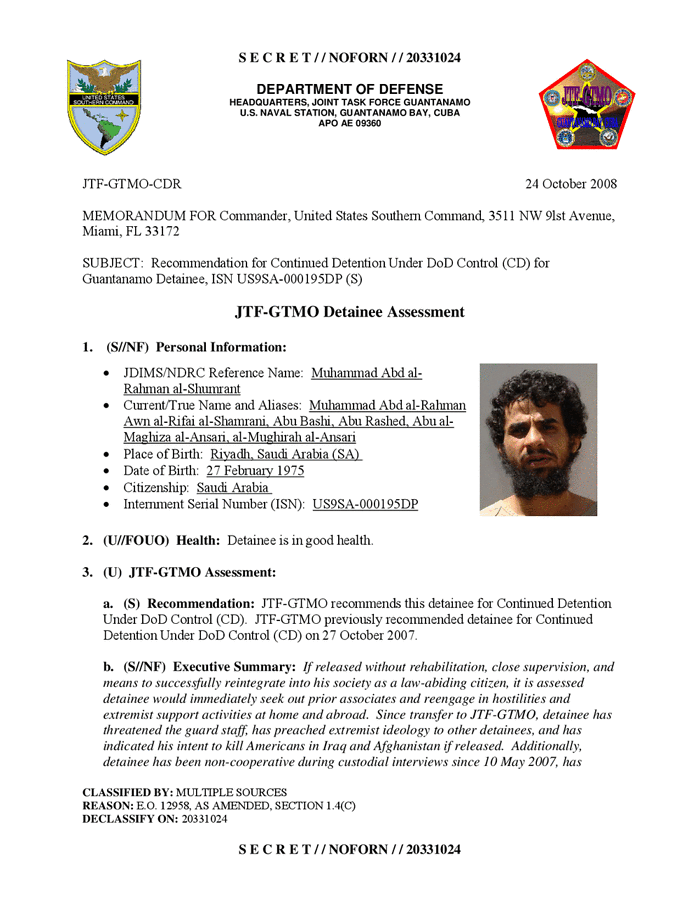
One More Transferred from Gitmo, Bigger Implications

The Department of Defense announces transfer of a Guantanamo detainee to Saudi Arabia. Leaves 103 detainees left at Gitmo. This transfer was approved in October.

General John Kelly, commander of U.S. Southern Command announced 150 Islamic militants in the Caribbean. A big issue that Gitmo does monitor but…..

Obama to make good on Guantanamo pledge: White House chief of staff

Reuters: President Barack Obama will make good on a promise to close the U.S. naval prison in Guantanamo Bay, Cuba, his chief of staff Denis McDonough said on “Fox News Sunday.”

Obama will first present a long-awaited plan to Congress about how to close the facility, and seek its approval, McDonough said in an interview. If Congress fails to act, the White House will determine what steps to take, he said.

“He feels an obligation to the next president. He will fix this so that they don’t have to be confronted with the same set of challenges,” McDonough said.

Obama pledged during the 2008 presidential election campaign that he would close the military prison, which housed foreign terrorism suspects after the Sept. 11, 2001, attacks on the United States.

That pledge, still unfilled, has been a feature of his annual State of the Union addresses to the nation ever since.

Obama has said the facility has been used as a recruiting tool in propaganda from groups like al Qaeda, and also is far too costly to maintain. There are 104 detainees left at the prison.

Where possible, his administration has transferred detainees to other countries. But there is a small number of detainees who the administration says it would like to detain in a U.S. facility for national security reasons.

Congress has explicitly banned the transfer of detainees to the United States.

McDonough declined to say whether Obama would close the prison using his own executive powers if Congress rejects his plan.

“I’m not an if-then guy,” he said.

NYT: Mohammad al Rahman al Shumrani is a 40-year-old citizen of Saudi Arabia. As of January 2010, the Guantánamo Review Task Force had recommended him for continued detention. A parole-like Periodic Review Board later recommended him for transfer. As of Jan. 11, 2016, he has been held at Guantánamo for 14 years.

JTF-GTMO Assessment 12 pages 

So what are the options for Barack Obama on those Gitmo detainees that no country will take in a transfer? Enough money and politics will force any country being strong-armed by the White House to take the worst of the worst. If not, there are other options. Obama can use his pen and force a Federal prison in the U.S. to take the remaining detainees or he can transfer the jihadis to another U.S. held prison facility/detention center in a foreign country.
Could they be transferred to the control of the United Nations and be placed in a U.N. prison facility?
If he is successful in closing the detention facility what will happen to it? Could Obama cancel the lease with Cuba? Yes. Could the facility be transferred to Cuba and then handed over to Iran, Russia or China? Yes.
What is worse, Obama is bent on taking robust action on Gitmo such that the next administration cannot restore it after it is closed. This leaves few options for the next president or does it?
At issue is fundamentally, Naval Station Guantanamo Bay is a full service military base that provides regional security to the Caribbean and monitors activity in Central and South America. It also provides the Department of Homeland Security with assistance in migrant operations.

The base hosts numerous tenant commands including the Southern Command Joint Task Force-Guantanamo, Joint Task Force Guantanamo, US Naval Hospital and Branch Dental Clinic.

Other detachments located at the base are: Personnel Support Activity, Naval Atlantic Meteorology and Oceanography Command, Naval Media Center, Naval Communications Station, Department of Defense Dependent Schools, Navy Brig, and Fleet and Industrial Supply Center.

NAVSTA GTMO garrison facilities

The bay area is divided into two parts known as the outer and inner harbours. The inner harbour includes commercial ports while the outer harbour accommodates naval station and the main anchorage space. Pier and wharf facilities are located at the small inlets located between Corinaso Point and Deer Point.

Air facilities

NAVSTA GTMO had two airfields namely Leeward Point Field and McCalla Airfield. The operations at McCalla Airfield were ceased in 1976. The Leeward Point Field is the only active military airfield in the base. It has a single runway (10/28) measuring 2,438m x 61m and surfaced with asphalt.

Other base facilities and services

The naval station has four wind turbines generating 3,800kW electricity, enough to fulfil 25% its power requirements. A desalination plant capable of producing 2.25 million gallons of fresh water a day is attached to the base. The plant also produces a combined 15,000kw of electricity through its two turbine generators.

Guantanamo has had operations that includes air fields with aircraft including F8U Crusaders and A4D Skyhawks. It was also an anti-submarine center and a training center. It can handle and has handled 50 warships.
Further, the Haitian crisis , the Balkan crisis and the famous Cuban missile crisis.
Imagine a foreign government in control of U.S. naval infrastructure and technology. Just imagine.

Remember that Russian Found Dead in a DC Hotel?

Heart-attack? Hardly….

Corruption in Russia

The genesis of Putin, Putinism

A Putin hit job in the United States?

Lesin, 56, played an instrumental role in solidifying state control over the independent television channel NTV during Putin’s first term in office, and he went on to serve as a Kremlin adviser during Putin’s second term. He now heads state-controlled Gazprom-Media, the country’s largest media holding.

Documents provided to RFE/RL by Wicker’s office — and corroborated by public property registries — show that companies associated with Lesin’s immediate family purchased the three properties in the Los Angeles area.

These include a 13,000-square-foot Beverly Hills home purchased in August 2011 for $13.8 million by Dastel Coroporation, where Lesin’s son, Anton Lessine, served as a corporate officer, according to public records.

The address of this home and Dastel’s business address are the same, according to public records and a lawsuit pending in California Superior Court.

The property is located in Beverly Park, a swanky gated community with round-the-clock security and whose residents have included actor Samuel L. Jackson and professional basketball legend Magic Johnson, according to “The Los Angeles Times.” 

Dastel also purchased 10,600-square-foot Brentwood home for $9 million in 2012.

A third home, totaling more than 6,800 square feet, was purchased in Beverly Hills for $5.6 million by HFC Management, a firm that lists Lesin’s daughter, Ekaterina Lesina, as a company officer.


Was Putin’s Media Chief Ready to Snitch Before He Dropped Dead?

DailyBeast: The D.C. cops won’t say what killed Mikhail Lesin—or what he was doing in a hotel room there. But all signs point to the former Kremlin propaganda boss cutting a deal with the FBI.
When police found Mikhail Lesin dead in a Washington, D.C., hotel room, the most interesting question wasn’t the cause of his demise, but what he was doing in the United States in the first place.

The former propaganda chief for Russian president Vladimir Putin, nicknamed “the bulldozer” for his history of rolling over his opposition, Lesin had been under scrutiny by the FBI and the Justice Department for potential money laundering and violation of corruption laws. Lesin was suspected of hiding ill-gotten gains in nearly $30 million worth of luxury real estate in southern California, an astounding set of assets for a man supposedly collecting a civil servant’s salary. He’d also been considered for sanctions that would have prevented him from obtaining a visa to enter the United States.

Sen. Roger Wicker, a Republican from Mississippi who has spent years looking into corruption and human-rights abuses in Russia, had asked the Justice Department to investigate Lesin. In December 2014, the department confirmed it had referred Lesin’s case to the Criminal Division and to the FBI. While officials declined to say whether they formally opened an investigation, several close watchers of Lesin’s case told The Daily Beast they thought it was all but certain that he was being pursued by U.S. law enforcement. And if he wasn’t under active criminal investigation, the FBI had enough evidence to consider opening a case, they said. A bureau spokesperson declined to comment on the matter.

So why did Lesin, who was 57, tempt fate by entering the United States this past November?

The purpose of his visit was never made clear. But he was staying in a mid-range hotel on Washington’s DuPont Circle. While not shabby, it’s doesn’t seem the kind of place that attracts people who buy multimillion-dollar estates. It does, though, offer a comparatively low per-night rate, perhaps more in line with U.S. government budgets, and is known to host foreign government officials and visitors on exchange programs. It’s also located a short drive from FBI and Justice Department headquarters.

These are the broad strokes of Lesin’s case. And in some foreign policy circles in Washington—as well as in Russian media—they have fueled speculation that Lesin was murdered after coming to Washington to cut a deal with the FBI.

Lesin certainly would have had a lot to say about Putin’s inner circle—he worked with, and reportedly owed money to, some of the most powerful men in Russian media and finance. And he would have had a powerful incentive to cooperate with U.S. authorities, namely hanging onto his several mansions in Los Angeles, which potentially could have been seized. At least two of the homes are known to be occupied, respectively, by his daughter and his son, a Hollywood film producer whose star is on the rise.

Adding to the mystery, the precise cause of Lesin’s untimely demise hasn’t been revealed. Almost immediately, the broadcasting outfit RT (Russia Today), widely seen as a Kremlin mouthpiece, reported that Lesin died of a “heart attack,” citing an unnamed “family member.”

But a spokesperson for the Washington, D.C., police department told The Daily Beast that Lesin’s death is still under investigation. And although a coroner performed an autopsy nearly two months ago, the police aren’t saying how he died. That’s an unusually long time not to publicly state a cause of death.

The conspiracy theories are arguably well-founded, because it wouldn’t be the first time someone who posed a political threat to Putin wound up dead under unusual circumstances, including poisoning.

Lesin was also being squeezed by the U.S. government. Two years ago he’d been nominated by human-rights groups for the so-called Magnitsky list of Russian human-rights violators, which would have allowed Washington to deny him a visa and seize his assets in this country. Lesin was not placed on the public list, which consists mainly of mid-level officials not as influential as the former propaganda chief. But U.S. officials maintain a classified annex which reportedly includes more senior Russians, including those closer to Putin. It’s not known whether Lesin was on that list, but activists lobbied hard to put him there.

He would have been an ideal candidate. Not only was he one of RT’s founding fathers, credited with conceiving of the network while working for Putin in order to counter what he saw as anti-Russia journalism in the West. (“It’s been a long time since I was scared by the word propaganda,” Lesin said in 2007, according to RT. “We need to promote Russia internationally. Otherwise, we’d just look like roaring bears on the prowl.”)

The Washington, D.C., police department told The Daily Beast that Lesin’s death is still under investigation. And although a coroner performed an autopsy nearly two months ago, the police aren’t saying how he died. That’s an unusually long time not to publicly state a cause of death.

Lesin was also a longtime Putin crony, and he played a central role in an early project by the Russian strongman to gut the country’s independent television station, NTV, which had aired critical reports about government corruption, the war in Chechnya, and had become a soapbox for prominent Putin critics. While Lesin was serving as the information minister, Russia jailed NTV’s founder and majority shareholder, Vladimir Gusinsky.

“While he was there, the information minister made an offer: Gusinsky could have his freedom if he agreed to transfer his media holdings to Gazprom, the state-owned energy monopoly,” according to Russian journalist Vladimir Kara-Muzra, who has probed Lesin’s financial and real estate holdings. It was a naked power play that the European Court of Human Rights found was politically motivated and amounted to state-sanctioned blackmail.

Gusinksy didn’t end up going along with the deal to hand over the media company. But Gazprom took over NTV anyway–by force–and in 2013 Lesin became the head of Gazprom-Media, an actual state-run media organization. RT, which reported the cause of Lesin’s death before a medical examiner had even seen his body, merely receives funding from the state.

The Gazprom takeover has raised concerns among U.S. investigators that Lesin may have come by a fortune through illegal seizures of private property, and then laundered those proceeds by stashing them in American real estate, according to two sources who have followed Lesin’s finances and asked not to be identified.

Landing Lesin could have led investigators to other, even bigger fish. As Wicker wrote to then-Attorney General Eric Holder in 2014, Lesin “may also have close business ties with individuals subject to U.S. sanctions,” as well as organizations, including  Bank Rossiya, which is closely linked to Gazprom, and the bank’s owner, Yury Kovalchuk, a billionaire who ranks among Russia’s richest people, is reportedly close to Putin personally, and was sanctioned by the Treasury Department after Russia invaded Crimea.

If Lesin were found to be violating U.S. money-laundering laws, it could provide a rare opportunity to snare a senior Putin aide. After Wicker pressed the issue, relying in part on public property records that clearly linked the L.A. mansions to Lesin, the Justice Department considered whether to go after him.

Following the news of his death, the Kremlin issued a statement on behalf of Putin, noting “The president has a high appreciation for Mikhail Lesin’s massive contribution to the creation of modern Russian mass media.”

But having Lesin as an informant would been a big contribution to U.S. law enforcement and intelligence. And the information that Wicker and his staff, as well as human-rights groups and journalists, dug up on Lesin may have pushed him closer to the FBI’s arms.

About two weeks after the Justice Department informed Wicker that the allegations against Lesin were referred to the FBI, Lesin resigned as the head of Gazprom-Media, citing unspecified “family reasons.” Kara-Murza, the journalist and Putin critic, who himself fell mysteriously ill last summer, has directly linked the department’s announcement to Lesin’s stepping down and said it showed that the threat of sanctions and prosecution could be used to bring down corrupt Russian officials.

“That’s just one example of how effective this process can be if it’s applied properly, if it’s done against the right people,” Kara-Murza said in remarks at the American Enterprise Institute, a Washington think tank, in October. Kara-Murza declined to discuss Lesin’s case with The Daily Beast, citing the Latin admonition “de mortuis nihil nisi bonum.” Of the dead, [say] nothing, unless good. “And I have nothing good to say about him.”

Meanwhile, Lesin’s children have also kept mum. His son, Anton Lessine (the surnames are spelled differently), didn’t respond to a request for comment, and his daughter couldn’t be reached. Anton has been on a roll in Hollywood, helping financing high-profile movies with A-list talent. He was the executive producer of the Arnold Schwarzenegger action vehicle Sabotage, the Brad Pitt WWII tank pic Fury, 2015’s Bill Murray comedy Rock the Kasbah, and 2016’s transgenerational buddy flick Dirty Grandpa, starring Robert DeNiro and Zac Effron.

Times are good for the son of the ex-Putin aide, who seems to have come out of nowhere in the famously hard-to-crack world of big-budget filmmaking. He recently purchased a mansion in L.A.’s Pacific Palisades for an asking price of nearly $4 million. How exactly the Lesin family came into such good fortune is a question that has piqued the interest of U.S. investigators.

As might another question: Was Lesin in debt, and ready to flee Russia for a new life? After Lesin’s death, The Moscow Times reported that he may have stepped down from Gazprom-Media after losing an internal power struggle. Jobless and with high-level enemies, Lesin also owed “a huge amount of money” to Kovalchuk, the billionaire banker, which he didn’t intended to repay, the news organization reported, citing anonymous sources.

“He also underestimated his rivals,” The Moscow Times wrote. “The heads of three of Russia’s major TV channels complained to President Putin that Lesin had begun behaving as if he was their boss, as he had been while press minister.”

The walls were closing in on Lesin–in Washington and in Moscow. Perhaps Lesin’s trip to that DuPont Circle hotel was his first step towards a new life. But if he’d become an enemy of Putin and his friends, even the FBI might not have been able to save him.


Obama’s Next Career Stop Leading the UN?

Could it come down to Obama versus a female to head the United Nations? Obama is a globalist and he has proven to be very loyal to the Muslim Brotherhood and those Islamic based countries could endorse him, but….no previous sitting U.S. president has built a failed legacy in foreign affairs as Barack Obama has including Jimmy Carter.

There are others with some interest in the post.

Kevin Rudd.
He is an Australian ex-Prime Minister and current Foreign Minister. He has made public his intentions to run for Secretary-General.

Rudd is popular in the Australian and international community – including China (he speaks fluent Mandarin).

Note that Ban-Ki Moon’s successor has not been named yet, as of writing. There are others as noted here.

Those countries with a vote, one should determine who would support Obama in this role. Saudis, Russians, Chinese?

TownHall: U.N. Secretary General Ban Ki-moon’s term expires in early 2017, making Obama’s bid for the position a possibility. Last year after his speech at West Point, some pointed out that he sounded an awful lot like he was campaigning for the role.

Netanyahu leading effort to thwart Obama bid for U.N. chief

WashingtonTimes: Israeli Prime Minister Benjamin Netanyahu reportedly is planning payback for President Obama’s dismissing Mr. Netanyahu’s objections to the Iran nuclear deal last year. Mr. Netanyahu is said to be rallying moderate Arabs to thwart Mr. Obama’s bid to become the Secretary-General of the United Nations after he leaves the White House next year.

Mr. Obama has already discussed the issue with Republican, Democratic and Jewish officials in the United States, according to Kuwaiti newspaper Al-Jarida.
Mr. Netanyahu recently is said to have gotten wind of Obama’s plans which he calls the Obama Project. “Wasn’t eight years of having Obama in office enough?” Mr. Netanyahu is quoted in the Kuwaiti daily as telling associates. “Eight years during which he ignored Israel? And now he wants to be in a position that is liable to cause us hardships in the international arena.”

“Obama is the worst president Israel has had to deal with and the worst president for the Middle East and its allies, the moderate Arab states,” the paper quotes a Netanyahu aide.

Another source close to the Prime Minister said “his presidency was characterized by [Washington’s] moving closer to the Muslim Brotherhood, toppling the regime of Hosni Mubarak, and attempts to ally itself with political Islam.”

“Obama’s term is ending with him forging an alliance with Iran, coming to an agreement with it on its nuclear program which in the end will result in a similar scenario that took place with North Korea. Israel will not allow this to happen … It will take all of the necessary steps to prevent Iran from manufacturing a nuclear weapon either covertly or overtly.”


Yes!, the FBI’s Successful Child Porn Sting

FBI hacks world’s largest child porn site, 1,300 arrested

The ‘unprecedented’ sting op saw 1,300 people arrested.

The site, known as ‘Playpen’, launched in August 2014 and allowed users to sign up and upload images, primarily for “the advertisement and distribution of child pronagraphy”. This websites isn’t like an adult pornography website as it’s on the dark web, adult pornography websites such as fulltube you can find simply by searching in your normal browser but sites like Playpen you need to access the dark web first.

Within a month of Playpen’s launch, the website had garnered nearly 60,000 members. By 2015 that number had jumped to almost 215,000, with 11,000 unique users visiting the site each week, and a total of 117,000 posts.

READ MORE: Hundreds of US military children sexually abused annually – report

Many of those posts contained some of the most extreme child abuse images one could imagine, according to FBI testimony seen byMotherboard.

Although the website also included advice on how users could avoid online detection, a sting operation began in February 2015 when the FBI hacked into the website’s server, but decided not to shut it down.

The bureau took the ‘unprecedented’ measure of running Playpen to spy on its users and hack their IP addresses, leading to the arrests.

READ MORE: Busted: US expat arrested in Peru for allegedly running child sex ring

According to Motherboard, a public defender for one of the accused called the operation an “extraordinary expansion of government surveillance and its use of illegal search methods on a massive scale.”

*** The Dark Web and the FBI

Motherboard: While it looks like several of those already charged will plead guilty to online child pornography crimes, one defense team has made the extraordinary step of arguing to have their client’s case thrown out completely. Their main argument is that the FBI, in briefly running the child pornography site from its own servers in Virginia, itself distributed an “untold” amount of illegal material.

“There is no law enforcement exemption, or statutory exemption for the distribution of child pornography,” Colin Fieman, one of the federal public defenders filing the motion to dismiss the indictment, claimed in a phone interview earlier this week. Jay Michaud, a Vancouver teacher arrested in July 2015, is also being represented by Linda Sullivan.

“THE GOVERNMENT’S OPERATION OF THE WORLD’S LARGEST ‘HIDDEN SERVER’ CHILD PORNOGRAPHY SITE AND ITS GLOBAL DISTRIBUTION OF UNTOLD NUMBERS OF PICTURES AND VIDEOS IS OUTRAGEOUS CONDUCT THAT SHOULD RESULT IN DISMISSAL OF THE INDICTMENT,” a court filing dated November 20, 2015 reads.

Fieman and Sullivan reason that if the methods of the investigation that supposedly identified his client “cannot be reconciled with fundamental expectations of decency and fairness,” then the indictment should be dismissed.

A section of the filing, which outlines the defense lawyers’ argument.

In February 2015, the FBI seized the server of “Playpen,” which court documents described as “the largest remaining known child pornography hidden service in the world.” Instead of shutting the site down straight away, however, the FBI moved Playpen to a government controlled server in Virginia, and deployed a network investigative technique (NIT)—the agency’s term for a hacking tool—in an attempt to identify people logging into the site. This NIT, according to other court documents, collected approximately “1300 true internet protocol (IP) addresses” between February 20 and March 4.

In their argument, Fieman and Sullivan point to the Department of Justice’s own view on the harm caused by the proliferation of child pornography. “Once an image is on the Internet, it is irretrievable and can continue to circulate forever,” the Department of Justice website reads. In an April 2015 press release, US Attorney Josh J. Minkler said that “Producing and distributing child pornography re-victimizes our children every time it is passed from one person to another.”

In essence, the lawyers’ point is that the FBI was, by running Playpen from its own servers, essentially distributing child pornography.

So, according to their argument, it is unclear how the “Government can possibly justify the massive distribution of child pornography that it accomplished in this case.”

They then posit that, rather than taking over the site to deploy a bulk hacking technique, and allowing the site to continue to distribute child pornography material in the process, the FBI could have posted individual links to malware-laden files on the site without running it from their own servers. Or, after seizing the site, the agency could have redirected users to a spoofed version of it, minus the child pornography material.

“We are in a protracted street fight with the Department of Justice and the FBI”

Instead, the FBI “continued to distribute thousands of illicit pictures and videos to thousands of visitors,” the filing states. It compares the case to “Operation Fast and Furious”: Between 2009 and 2011, law enforcement agents infamously proliferated illegal weapons in an attempt to trace them to Mexican drug cartels. Some of the weapons, however, ended up being used in the murder of a US Border Patrol agent.

The Department of Justice did not reply to repeated requests for comment. The FBI did not respond to a request for comment in time for publication, but a spokesperson previously told Motherboard, “We are not able to comment on ongoing investigations, or describe the use of specific investigative techniques.”

This argument to dismiss the indictment is just one of the more recent phases of a heated legal back-and-forth between Michaud’s lawyers and the government. Since October, dozens of documents have been filed in the case, including motions to seal documents, affidavits, modifications to protective orders, and delays to responses.

“We are in a protracted street fight with the Department of Justice and the FBI,” Fieman told Motherboard.

Some of the issues circle around evidence: the defense argues that its client has not had access to important discovery information. It has had some success on that front though: on December 10, the Government wrote that the defense counsel will be provided with the computer code of the NIT under a protective order. The defense is also expected to receive a detailed list of the number of child pornography materials on Playpen while it was being run from an FBI server.

The government’s response to the motion to dismiss the indictment is currently sealed. It’s unclear how the government has replied to the lawyer’s arguments, but this move to have the indictment against a suspected online child pornographer totally scraped is a surprising and dramatic turn in a case that continues to grow in scope.


11 20 2015 Motion to Dismiss Indictment