The 7th Fleet Deployment v. China


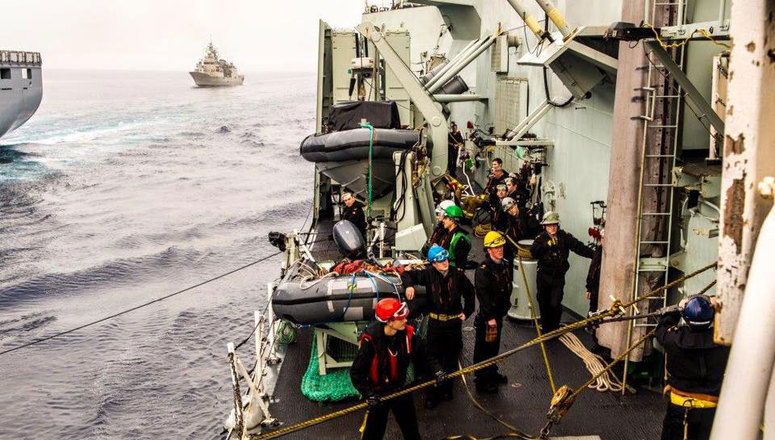
SOUTH CHINA SEA – USS Stockdale (DDG 106) is conducting a routine patrol in international waters of the South China Sea as part of the John C. Stennis Strike Group and Great Green Fleet on a regularly scheduled 7th Fleet deployment.

“The strike group is exercising our right to operate in international waters,” said Rear Adm. Ron Boxall, commander, John C. Stennis Strike Group. “Our presence here promotes peace and stability in the region. We’ve got vibrant economies in the Western Pacific, and it’s really important for us to be there for our national interests and to ensure that we can keep the sea lanes free.”

In recent months, other U.S. Navy ships have conducted similar operations in the 7th Fleet area of operations including the Arleigh Burke-class guided-missile destroyers USS Curtis Wilbur (DDG 54), USS Lassen (DDG 82), USS McCampbell (DDG 85) and USS Preble (DDG 88), the multi-purpose amphibious assault ship USS Essex (LHD 2), the Ticonderoga-class guided missile cruiser USS Chancellorsville (CG 62) and the Freedom-class littoral combat ship USS Fort Worth (LCS 3). The amphibious dock landing ship USS Ashland (LSD 48) completed a similar patrol, Feb. 26.

Stockdale is currently on patrol in 7th Fleet as part of the John C. Stennis Strike Group (JCSSG). The strike group is comprised of USS John C. Stennis (CVN 74) with Carrier Airwing (CVW) 9 and Destroyer Squadron (DESRON) 21 embarked, Arleigh Burke-class guided-missile destroyers USS Chung-Hoon (DDG 93), USS Stockdale (DDG 106), USS William P. Lawrence (DDG 110) and Ticonderoga-class guided-missile cruiser USS Mobile Bay (CG 53).

CVW-9 consists of Helicopter Maritime Strike Squadron (HSM) 71, Helicopter Sea Combat Squadron (HSC) 14, Airborne Early Warning Squadron (VAW) 112, Electronic Attack Squadron (VAQ) 133 and Strike Fighter Squadrons (VFA) 151, 97, 41, 14.

JCSSG is providing a ready force supporting security and stability in the Indo-Asia- Pacific.

****

For a full photo essay, go here.

What China Has Been Building in the South China Sea

NYT: China has placed runways and radar facilities on new islets in the South China Sea, built by piling huge amounts of sand onto reefs. The construction is straining already taut geopolitical tensions.

The speed and scale of China’s island-building spree in the South China Sea last year alarmed other countries with interests in the region. After announcing in June that the process of building seven new islands by moving sediment from the seafloor to reefs was almost done, China has focused its efforts on building ports, three airstrips, radar facilities and other military buildings on the islands. The installations bolster China’s foothold in the Spratly Islands, a disputed scattering of reefs and islands in the South China Sea more than 500 miles from the Chinese mainland. China’s activity in the Spratlys is a major point of contention between China and the United States, and has prompted the White House to send Navy destroyers to patrol near the islands twice in recent months.

The speed and scale of China’s island-building spree in the South China Sea last year alarmed other countries with interests in the region. After announcing in June that the process of building seven new islands by moving sediment from the seafloor to reefs was almost done, China has focused its efforts on building ports, three airstrips, radar facilities and other military buildings on the islands. The installations bolster China’s foothold in the Spratly Islands, a disputed scattering of reefs and islands in the South China Sea more than 500 miles from the Chinese mainland. China’s activity in the Spratlys is a major point of contention between China and the United States, and has prompted the White House to send Navy destroyers to patrol near the islands twice in recent months.

Sources: C.I.A., NASA, China Maritime Safety Administration

The new islands allow China to harness a portion of the sea for its own use that had been relatively out of reach. Although there are significant fisheries and possible large oil and gas reserves in the South China Sea, China’s efforts serve more to fortify its territorial claims than to help it extract natural resources, said Mira Rapp-Hooper, formerly the director of the Asia Maritime Transparency Initiative at the Center for Strategic and International Studies, a Washington research group. Though they are too small to support large military units, the islands will also enable sustained air and sea patrols, strengthening China’s influence in the area.

***

Several reefs have been destroyed outright to serve as a foundation for the new islands, and the process also causes extensive damage to the surrounding marine ecosystem. Frank Muller-Karger, professor of biological oceanography at the University of South Florida, said sediment “can wash back into the sea, forming plumes that can smother marine life and could be laced with heavy metals, oil and other chemicals from the ships and shore facilities being built.” Such plumes threaten the biologically diverse reefs throughout the Spratlys, which Dr. Muller-Karger said may have trouble surviving in sediment-laden water. 

Although China was a relative latecomer to construction in the Spratly archipelago, its island building is much more extensive than similar efforts by other countries in the area. The recent activity has unsettled the United States, which has about $1.2 trillion in bilateral trade go through the South China Sea every year.

Washington does not recognize China’s ownership of the islands, and in February President Obama reiterated the government’s position that “the United States will continue to fly, sail and operate wherever international law allows.” To reinforce the message, the United States Navy sent missile destroyers in October and January within 12 nautical miles of the islands, the conventional limit for territorial waters. According to statements from David Shear, the top Pentagon official in charge of Asia and the Pacific, the last time before October that the United States had sent ships or aircraft that close to the islands was in 2012.

***

What Is on the Islands

China has built airstrips, ports, radar facilities, solar arrays, lighthouses and support buildings on the islands. The airstrips and ports lengthen the reach of Chinese ships and planes, while the radar facilities allow the country to keep a closer eye on what is happening nearby. Imagery from January compiled for a recent report by the C.S.I.S. suggests that China may be constructing a longer-range high-frequency radar installation on Cuarteron Reef that would help the country monitor air and ship traffic in the south, farther from the Chinese mainland.

***

Fiery Cross Reef is one of China’s most strategically important new islands, with an airstrip that is long enough to allow the country to land any plane, from fighter jets to large transport aircraft.

***

Two additional airstrips on Mischief Reef and Subi Reef that China has been building since mid-2015 are nearing completion, bringing China’s total to three airstrips in the region.

***

Though China’s airstrips expand the country’s ability to operate in the South China Sea, they are not the first in the region — every other country that occupies the Spratlys already operates an airstrip as well.

***

Vietnam, Malaysia, the Philippines and Taiwan have also expanded islands in the Spratlys, but at a much smaller scale than China’s efforts.

***

China’s reefs hosted smaller structures for years before the current surge in construction. By preserving these initially isolated buildings, China can claim that it is merely expanding existing facilities, similar to what other countries have done elsewhere in the region.

***

Construction on Johnson South Reef from January 2014 to February 2016.

Image by DigitalGlobe, via CSIS Asia Maritime Transparency Initiative


Europe Calls on NATO to Clean up the Mess

So, the damage is done, destruction to Europe is throughout the region. European leaders refuse to fully live up to their respective NATO membership and fight the good cause, rather they need NATO to clean up a mess they caused……immigration, migration, crime and broken borders.

It begins in Turkey, a NATO country quite tired of hosting millions of refugees and demanding Assad be removed from power. The next step in Greece, just a few hours boat ride from Turkey where people pay smuggling boat people to take them to the shores of Greece.

Greece itself is broken financially and is happy to stick it to the European Central Bank for not fully bailing out Greece’s socialism.

Please NATO help us out. Stop the migrant insurgency.

Schengen is suspended and likely dead….

NATO Secretary General welcomes expansion of NATO deployment in the Aegean Sea

NATO took swift decisions to deploy ships to the Aegean Sea to support our Allies Greece and Turkey, as well as the EU’s border agency FRONTEX, in their efforts to tackle the migrant and refugee crisis. NATO ships are already collecting information and conducting monitoring in the Aegean Sea. Their activity will now be expanded to take place also in territorial waters.

Our commanders have defined our area of activity in close consultation and coordination with both Greece and Turkey. Our activities in territorial waters will be carried out in consultation and coordination with both Allies. The purpose of NATO’s deployment is not to stop or push back migrant boats, but to help our Allies Greece and Turkey, as well as the European Union, in their efforts to tackle human trafficking and the criminal networks that are fueling this crisis.

NATO’s Maritime Command has also agreed with FRONTEX on arrangements at the operational and tactical level. NATO and FRONTEX will be able to exchange liaison officers and share information in real time, to enable FRONTEX, as well as Greece and Turkey, to take action in real time.

This is an excellent example of how NATO and the EU can work together to address common challenges. I welcome the fact that we were able to finalise these arrangements in such a short time. In this crisis, time is of the essence, and cooperation is key.

**** You are by now asking what is FRONTEX….heh…well it is a European commission that has clearing failed in it’s charter.

Mission and Tasks

Frontex promotes, coordinates and develops European border management in line with the EU fundamental rights charter applying the concept of Integrated Border Management.

Frontex helps border authorities from different EU countries work together. Frontex’s full title is the European Agency for the Management of Operational Cooperation at the External Borders of the Member States of the European Union. The agency was set up in 2004 to reinforce and streamline cooperation between national border authorities. In pursuit of this goal, Frontex has several operational areas which are defined in the founding Frontex Regulation and a subsequent amendment. These areas of activity are:

Joint Operations— Frontex plans, coordinates, implements and evaluates joint operations conducted using Member States’ staff and equipment at the external borders (sea, land and air).

Training— Frontex is responsible for developing common training standards and specialist tools. These include the Common Core Curriculum, which provides a common entry-level training rationale for border guards across the Union, and mid- and high-level training for more senior officers.

Risk Analysis— Frontex collates and analyses intelligence on the ongoing situation at the external borders. These data are compiled from border crossing points and other operational information as well as from the Member States and open sources including mass media and academic research.

Research— Frontex serves as a platform to bring together Europe’s border-control personnel and the world of research and industry to bridge the gap between technological advancement and the needs of border control authorities.

Providing a rapid response capability— Frontex has created a pooled resource in the form of European Border Guard Teams (EBGT) and an extensive database of available equipment which brings together specialist human and technical resources from across the EU. These teams are kept in full readiness in case of a crisis situation at the external border.

Assisting Member States in joint return operations— When Member States make the decision to return foreign nationals staying illegally, who have failed to leave voluntarily, Frontex assists those Member States in coordinating their efforts to maximise efficiency and cost-effectiveness while also ensuring that respect for fundamental rights and the human dignity of returnees is maintained at every stage.

Information systems and information sharing environment— Information regarding emerging risks and the current state of affairs at the external borders form the basis of risk analysis and so-called “situational awareness” for border control authorities in the EU. Frontex develops and operates information systems enabling the exchange of such information, including the Information and Coordination Network established by Decision 2005/267/EC and European border surveillance system.

While fulfilling its mandate, Frontex liaises closely with other EU partners involved in the development of the area of Freedom, Security and Justice such as Europol, EASOEurojustFRA or CEPOL, as well as with customs authorities in order to promote overall cohesion.

Frontex also works closely with the border-control authorities of non-EU/Schengen countries — mainly those countries identified as a source or transit route of irregular migration — in line with general EU external relations policy.

**** So Turkey, get your act together and take these people back. They are not Turks, few are even Syrians…..but a NATO country must accept them?

Commission Visa Progress Report: Turkey makes progress towards visa liberalisation

The Commission has today adopted the second report on progress by Turkey in fulfilling the requirements of its Visa Liberalisation Roadmap, highlighting the steps made by Turkey since the last report in October 2014. At the EU-Turkey Summit of 29 November, Turkey committed to accelerating the fulfilment of the Roadmap, including by anticipating the application of all the provisions of the EU-Turkey Readmission agreement, with the objective of completing the visa liberalisation process by October 2016, provided all the benchmarks have been met by then. Today’s report welcomes the new level of engagement and determination demonstrated by the Turkish authorities.


Boeing Secret Deals with Iran, Skirting Sanctions

Why Boeing kept Iran dealings under the radar

Author: Saam Borhani

alMonitor: Barely a week after the Jan. 16 lifting of nuclear-related sanctions on Iran, Tehran hosted its first international business summit in years. The event, sponsored by the Centre for Aviation (CAPA), brought together 400 executives of the global aviation industry to re-establish links with their Iranian counterparts after a decades-long estrangement. What raised eyebrows in Tehran and Washington, however, was the conspicuous absence of Boeing, the world’s largest aircraft manufacturer. Boeing’s curious decision to skip the CAPA event raised questions about the United States’ commitment to the sanctions relief mandated under the July 14, 2015, Joint Comprehensive Plan of Action (JCPOA). The decision Boeing made to stay home, likely prompted by unease as to the confusing web of remaining US sanctions, is a harbinger of things to come for the delicate dance between Iran and American business.

It turns out that Boeing, while skipping the high-profile CAPA event in Tehran, has actually been unofficially negotiating behind the scenes with Iranian civil aviation officials for a considerable time. Indeed, weeks after European rival Airbus signed a multibillion dollar deal for 118 passenger jets with Iran, Washington finally gave the go-ahead for Boeing to begin official negotiations and to apply for special licenses to sell aircraft to the Iranians.

As the world cashes in on an Iran ready to do business, the United States risks being late to the game because of a mixture of political sensitivities, confusion about the remaining American sanctions and structural impediments that make trading with Iran prohibitively risky for all but the most adept American companies.

American trade with Iran is known to attract seething headlines in both countries. A simple form on McDonald’s website about franchise opportunities in Iran last year prompted warnings of an impending cultural invasion of the country in the Iranian right-wing media. Similarly, US companies risk the wrath of special interest groups devoted to inflicting reputational damage because of trade with Iran. Halliburton and Hewlett-Packard are prominent examples of companies that have been attacked in the American media for previous legal business relations with Iran.

Groups such as United Against a Nuclear Iran have also been successful in convincing around half of the state legislatures to pass measures punishing companies operating in Iran. These local laws have directed state pension funds with billions of dollars in assets to divest from targeted companies and sometimes have barred these companies from public contracts. The impact of these state “sanctions” on the JCPOA is not clear and may yet prompt a political and legal battle between the federal government and state officials. Indeed, the harm to the reputations of US companies by such local punitive measures is a strong deterrent to engaging with the Iranian consumer. It is also an issue that is likely to continue, as long as Iran remains listed as a state sponsor of terrorism by the State Department.

For American companies large enough to weather bad publicity, the remaining and now largely unilateral US sanctions on Iran represent a potentially costly minefield. The JCPOA allows for licensed sales of American airliners to Iran and the legal importation of Iranian foodstuffs and rugs. Besides these specific carve-outs, US companies may trade with Iran under the general licenses that were available before the JCPOA and under specific licenses granted by the Office of Foreign Assets Control (OFAC), the Treasury Department’s sanctions administrator. In addition, foreign subsidiaries of US companies that are not under the control and direction of US persons may trade directly with Iran. Maintaining a robust compliance system and routinely checking company interactions with Iran to make sure that they do not run afoul of OFAC regulations is a costly and time-consuming endeavor. Indeed, any American company that trades with Iran under the terms of the JCPOA, and especially under the complicated foreign subsidiary clause, must be large enough to support sufficiently adept legal compliance teams. Small and medium-size US businesses are thus effectively shut out of a presence in Iran for this very reason.

For the large multinational American companies that may be able to gain a foothold in Iran, there remain structural constraints that residual US sanctions place on legal trade with Iran. The United States has made it clear that no payments linked to Iran may be processed through its financial system. This means that profits made by American businesses in Iran will likely not be able to be directly repatriated and probably will remain offshore in segregated foreign accounts. American companies must also contend with strict bars on doing business with any Iranian entities that remain on OFAC’s “specially designated nationals” list, the Iranian government and the Islamic Revolutionary Guard Corps. Each of these barred entities took over vast parts of the Iranian economy as a result of the international sanctions that have now been lifted.

The JCPOA has opened small opportunities for trade between American and Iranian firms. However, the remaining labyrinth of hard-to-understand restrictions will likely spook most Americans.

Both the Iranian and US governments have a vital interest in seeing that the JCPOA is an enduring agreement — and this partly depends on sanctions relief benefiting Iranian and American private sectors in a way that would effectuate the “buy-in” of JCPOA skeptics. A mutually beneficial trading arrangement that connects the private sectors of the United States and Iran — despite political differences — would strengthen the nuclear deal by attaching a direct economic cost to nonadherence. The limited avenues for legal trade, if quickly institutionalized, can be insulated from the historically volatile political relationship between Iran and the United States.

In this vein, a quiet Iranian commitment to protect American investors in Iran and to tone down the harshest anti-US rhetoric, at least with respect to American business, would give space for Wall Street to influence a change in Washington’s largely monolithic view of a hostile Iran. More importantly, a quiet US commitment to actively support legal trade with Iran — with the same zeal that it uses to enforce sanctions — would give the Iranians space to consider future negotiated compromises.


The Muslim Brotherhood, Then, Now and Hillary

Wonder if Hillary or Anne Patterson received and read the full Great Britain document on the investigation into the Muslim Brotherhood? The scrubbed UK investigation report is here.

Misguided diplomacy at the White House and the U.S. State department is mission objectives and investment over terror facts and names, of this there is no dispute.


Hillary Emails: State Discussed ‘Cooperating,’ ‘Increased Investment’ With Egypt’s Muslim Brotherhood Government

TEL AVIV – 1,500 pages of former Secretary of State Hillary Clinton’s emails provide insight into the level of support the U.S. was considering in 2012 for Egypt’s newly elected Muslim Brotherhood government.

Breitbart: On August 30, 2012, Robert D. Hormats, the under-secretary of state for economic affairs, wrote to Clinton’s then-Deputy Chief of Staff Jake Sullivan to update him on a meeting he held with .

Shater was later sentenced to life imprisonment and then to death for multiple alleged crimes, including inciting violence and financial improprieties.

The email reveals Hormats and other U.S. diplomats discussed  methods of cooperation with Shater, including an increase in American direct foreign investment.

Hormats wrote:

Anne Patterson, Bill Taylor, and I met with Muslim Brotherhood Deputy Supreme Guide Khairat al-Shater. He discussed broad principles of economic development based on 100 large infrastructure projects (over a billion dollars each) as part of Morsi’s Nadah (Renaissance Plan) Plan; ways of cooperating with the US to obtain support for these projects and for SMEs; and his hope for an IMF agreement and increased foreign direct investment from the US, the West, and the Arab world. He also noted that it was a priority for the GOE to build a true democratic system based on human rights and the rule of law.

Patterson, the U.S. Ambassador to Egypt at the time, was known for her repeated engagement with the Muslim Brotherhood. Taylor was the U.S. Special Coordinator for Middle East Transitions; that is, the U.S. envoy to the new leadership that emerged in the wake of the so-called Arab Spring.

Hormats’ meetings with the Muslim Brotherhood were not secret. But the emails reveal the scope of his discussions with the group about possible future investment.

In September 2012, the New York Timesreported that Hormats had led a delegation of businesses to Egypt to discuss possible private investment.

That same month, the State Department published a document that received little news media attention. It revealed that in August and September 2012, “Hormats visited Egypt to negotiate possible bilateral debt relief,”but the document did not provide further details.

After the toppling of Egypt’s longtime president Hosni Mubarak, the Muslim Brotherhood’s Muhammad Morsi served as president from June 30, 2012 to July 3, 2013, when he was removed from office amidst widespread protests and a military coup. After Mubarak was removed from office, the Obama administration pledged $1 billion in assistance to bolster Egypt’s transition to democracy.

Clinton and Secretary of Defense Leon Panetta each visited Cairo and met with Morsi during his tenure as president.

The meeting that Hormats describes in the email took place while the U.S. was negotiating an aid package to help relieve Egypt’s debt crisis amid concerns from U.S. lawmakers about funding the Muslim Brotherhood.

The email was sent a week and a half before protesters besieged the U.S. Embassy in Cairo on September 11, 2012, the same day the U.S. Special Mission in Benghazi came under attack.

Following the attacks, Obama stated of Morsi’s government, “I don’t think that we would consider them an ally, but we don’t consider them an enemy.”

***

Back in November of 2015, Senator Cruz was leading a charge in the Senate to list the Muslim Brotherhood as a terror organization. The Muslim Brotherhood is part of several proven terror organizations. Going back to 2014, Saudi Arabia joined the United Arab Emirates and Bahrain in withdrawing its ambassadors from Qatar, which it sees as an important supporter of the Muslim Brotherhood.

in 2014, Prime Minister David Cameron ordered an investigation into the Muslim Brotherhood as a terror organization and the results were conclusive they were, however due to internal pressure from Islamists all over Europe and especially the UK, Cameron pulled the report.


After Ukraine, DHS Warns Domestic Utility Companies

Feds advise utilities to pull plug on Internet after Ukraine attack

WashingtonExaminer: The Department of Homeland Security advised electric utilities Thursday that they may need to stop using the Internet altogether, after the agency found that a cyberattack that brought down Ukraine’s power grid in December could have been far more devastating than reported.

The Dec. 23 cyberattack forced U.S. regulators to place utilities on alert after unknown attackers caused thousands of Ukrainian residents to lose power for hours by installing malicious software, or malware, on utility computers. But the Department of Homeland Security said Thursday that the attack may have been directed at more than just the country’s electricity sector, suggesting the attackers were looking to cause more harm than was reported.

In response, federal investigators are recommending that U.S. utilities and other industries “take defensive measures.” To start with, they need to best practices “to minimize the risk from similar malicious cyber activity,” according to an investigative report issued Thursday by Homeland Security’s Industrial Control Systems Cyber Emergency Response Team.

But the team is also recommending more drastic action, such as keep control-system computers away from the Internet.

“Organizations should isolate [industrial control system] networks from any untrusted networks, especially the Internet,” the report says. “All unused ports should be locked down and all unused services turned off. If a defined business requirement or control function exists, only allow real-time connectivity to external networks. If one-way communication can accomplish a task, use optical separation.”

The findings show that the power outages were caused by three attacks using cyberintrusion software to attack electric power distribution companies, affecting about 225,000 customers. It also reveals that once power was restored, the utilities continued “to run under constrained operations,” implying that the damage to grid control systems was profound.

The team also learned that “three other organizations, some from other critical infrastructure sectors, were also intruded upon but did not experience operational impacts.” That suggests the attackers were going after more than just the power grid, and may have been planning a much more economy-wide attack. The team does not disclose what other sectors of the country were targeted.

The team said the attack was well-planned, “probably following extensive reconnaissance of the victim networks,” the report says. “According to company personnel, the cyberattacks at each company occurred within 30 minutes of each other and impacted multiple central and regional facilities.”

The attackers were attempting to make the damage permanent. The report says the attackers installed “KillDisk” malware onto company computers that would erase data necessary to reboot operations after a cyberattack.

There is also a mystery to the attackers’ actions.

“Each company also reported that they had been infected with BlackEnergy malware; however, we do not know whether the malware played a role in the cyberattacks,” the report says. The malware was delivered using an email embedded hacking technique known as “spear phishing” that contained a number of malicious Microsoft Office attachments.

“It is suspected that BlackEnergy may have been used as an initial access vector to acquire legitimate credentials; however, this information is still being evaluated,” the team says.

The investigation was done with Ukraine authorities and involved the FBI, Department of Energy and the North American Electric Reliability Corporation.

*** 

New research is shining a light on the ongoing evolution of the BlackEnergy malware, which has been spotted recently targeting government institutions in the Ukraine.

Security researchers at ESET and F-Secure each have dived into the malware’s evolution. BlackEnergy was first identified several years ago. Originally a DDoS Trojan, it has since morphed into “a sophisticated piece of malware with a modular architecture, making it a suitable tool for sending spam and for online bank fraud,” blogged ESET’s Robert Lipovsky.

“The targeted attacks recently discovered are proof that the Trojan is still alive and kicking in 2014,” wrote Lipovsky, a malware researcher at ESET.

ESET has nicknamed the BlackEnergy modifications first spotted at the beginning of the year ‘BlackEnergyLite’ due to the lack of a kernel-mode driver component. It also featured less support for plug-ins and a lighter overall footprint.

“The omission of the kernel mode driver may appear as a step back in terms of malware complexity: however it is a growing trend in the malware landscape nowadays,” he blogged. “The threats that were among the highest-ranked malware in terms of technical sophistication (e.g., rootkits and bootkits, such as Rustock, Olmarik/TDL4, Rovnix, and others) a few years back are no longer as common.”

The malware variants ESET has tracked in 2014 – both of BlackEnergy and of BlackEnergy Lite – have been used in targeted attacks. This was underscored by the presence of plugins meant for network discovery, remote code execution and data collection, Lipovsky noted.

“We have observed over a hundred individual victims of these campaigns during our monitoring of the botnets,” he blogged. “Approximately half of these victims are situated in Ukraine and half in Poland, and include a number of state organizations, various businesses, as well as targets which we were unable to identify. The spreading campaigns that we have observed have used either technical infection methods through exploitation of software vulnerabilities, social engineering through spear-phishing emails and decoy documents, or a combination of both.”

In a whitepaper, researchers at F-Secure noted that in the summer of 2014, the firm saw samples of BlackEnergy targeting Ukrainian government organizations for the purposes of stealing information. These samples were nicknamed BlackEnergy 3 by F-Secure and identified as the work of a group the company refers to as “Quedagh.” According to F-Secure, the group is suspected to have been involved in cyber-attacks launched against Georgia during that country’s conflict with Russia in 2008.

“The Quedagh-related customizations to the BlackEnergy malware include support for proxy servers and use of techniques to bypass User Account Control and driver signing features in 64-bit Windows systems,” according to the F-Secure whitepaper. “While monitoring BlackEnergy samples, we also uncovered a new variant used by this group. We named this new variant BlackEnergy 3.”

Only Quedagh is believed to be using BlackEnergy 3, and it is not available for sale on the open market, noted Sean Sullivan, security advisor at F-Secure.

“The name [of the group] is based on a ship taken by Captain Kidd, an infamous privateer,” he said. “It is our working theory that the group has previous crimeware experience. Its goals appear to be political but they operate like a crimeware gang. There have been several cases this year of which BlackEnergy is the latest. The trend is one of off-the-shelf malware being used in an APT [advanced persistent threat] kind of way. The tech isn’t currently worthy of being called APT, but its evolving and scaling in that direction.”

Within a month of Windows 8.1’s release, the group added support for 64-bit systems. They also used a technique to bypass the driver-signing requirement on 64-bit Windows systems.

In the case of BlackEnergy 3, the malware will only attempt to infect a system if the current user is a member of the local administration group. If not, it will re-launch itself as Administrator on Vista. This will trigger a User Account Control (UAC) prompt. However, on Windows 7 and later, the malware will look to bypass the default UAC settings.  

“The use of BlackEnergy for a politically-oriented attack is an intriguing convergence of criminal activity and espionage,” F-Secure notes in the paper. “As the kit is being used by multiple groups, it provides a greater measure of plausible deniability than is afforded by a custom-made piece of code.”

In 2014 from the Department of Interior and DHS:

Summary: Investigation of NPS-GCNP SCADA SYSTEM

Report Date: August 7, 2014

OIG investigated allegations that the Supervisory Control and Data Acquisition (SCADA) system at Grand Canyon National Park (Park) may be obsolete and prone to failure. In addition, it was alleged only one Park employee controlled the system, increasing the potential for the system to fail or become unusable.

The SCADA system is a private utilities network that monitors and controls critical infrastructure elements at the Park. Failure of the system could pose a health and safety risk to millions of Park visitors. Due to potential risks that system failure posed, we consulted with the U.S. Department of Homeland Security Industrial Control Systems Cyber Emergency Response Team (ICS-CERT) and asked that they assess the overall architecture and cybersecurity of the Park’s SCADA system.

ICS-CERT conducted an onsite review and issued a report outlining the weaknesses it found at the Park’s SCADA system, including obsolete hardware and software, inadequate system documentation and policies, insufficient logging and data retention. We provided a copy of ICS-CERT’s assessment report to the National Park Service for review and action.