
GOP War Room v. Pelosi’s Impeachment?

Do the Republicans in both Houses of Congress need to collaborate with the Department of Justice to create a war room to counter the Democrat’s impeachment operation? Yes, and there are several legal and factual avenues to explore. But one in particular is already in play. In fact, it has been in play since at least 2016, long before Former Vice President Joe Biden announced his candidacy for President of the United States.

The Democrats for months have been not only alleging President Trump for inviting a foreign power into our 2020 election process by asking a favor of the Ukraine President. They additionally charge President Trump for publicly asking China for the same thing. Remember, President Trump said in the phone call: can you do US a favor, OUR COUNTRY has been through a lot. That is not a personal favor for President Trump but rather a service to our nation as a whole. Given the decades of rampant corruption in Ukraine and frankly in our own country, you would think the Democrats would want the same favor right when it comes to money-laundering and interference into our election(s).

So, let us go back to that one avenue already in play since 2016 and that is Rosemont Seneca and Bohai Capital.

For example, one of the companies involved in the Henniges transaction was a billion dollar private investment fund called Bohai Harvest RST (BHR). BHR was formed in November of 2013 by a merger between the Chinese-government linked firm, Bohai Capital, and a company named Rosemont Seneca Partners. Rosemont Seneca was reportedly formed in 2009 by Hunter Biden, the son of then-Vice President Joe Biden, Chris Heinz, the stepson of former Secretary of State John Kerry, and others.3The direct involvement of Mr. Hunter Biden and Mr. Heinz in the acquisition of Henniges by the Chinese government creates a potential conflict of interest. Both are directly related to high-ranking Obama administration officials. The Department of State, then under Mr. Kerry’s leadership, is also a CFIUS member and played a direct role in the decision to approve the Henniges transaction. The appearance of potential conflicts in this case is particularly troubling given Mr. Biden’s and Mr. Heinz’s history of investing in and collaborating with Chinese companies, including at least one posing significant national security concerns. This history with China pre and post-dates the 2015 Henniges transaction. For example, in December of 2013, one month after Rosemont Seneca’s merger with Bohai Capital to form BHR, Hunter Biden reportedly flew aboard Air Force Two with his father, then-Vice President Biden to China.4 While in China, he helped arrange for Jonathan Li, CEO of Bohai Capital, to “shake hands” with Vice-President Biden.5 Afterward, Hunter Biden met with Li for reportedly a “social meeting.”6 After the China trip, BHR’s business license was approved.7 In December of 2014, BHR also reportedly became an investor in China General Nuclear Power Corp (CGN), a state-owned energy company involved in building nuclear reactors.8 In April of 2016, the U.S. Department of Justice (DOJ) charged CGN with conspiracy to unlawfully engage and participate in the production and development of special nuclear material outside the United States which could cause “significant damage to our national security.”9 Then, in August of 2015, Gemini Investments Limited, another Chinese-government linked entity, purchased 75 percent of Rosemont Reality, a sister company of Rosemont 3 Seneca.10 Rosemont Realty became Gemini Rosemont and it reportedly focused on purchasing American real estate.11In September 2015, BHR joined with a subsidiary of the Aviation Industry Corporation of China (AVIC) to acquire Henniges for $600 million. AVIC acquired 51 percent of the company, and BHR acquired 49 percent.12 According to reports, the acquisition of Henniges by BHR and AVIC was the “biggest Chinese investment into US automotive manufacturing assets to date.”13 Because the acquisition gave Chinese companies direct control of Henniges’ anti-vibration technologies, the transaction was reviewed by CFIUS. CFIUS approved the transaction despite reports that in 2007, years before BHR teamed up with AVIC’s subsidiary, AVIC was reportedly involved in stealing sensitive data regarding the Joint Strike Fighter program. AVIClater reportedly incorporated the stolen data into China’s J-20 and J-31 aircraft.14

You will notice numbered footnotes in the text above. That text is in part of a letter sent by Senator Grassley (Senate Finance Committee) to Treasury Secretary Mnuchin this past August. It is uncertain if Treasury did respond to the letter. But hold on there is more.

In May of 2016, the Wall Street Journal had an interesting piece regarding the sale of fake Indian tribal bonds. 7 people were charged of this fraud. Among them was a former campaign adviser to Secretary of State John Kerry and a second man once dubbed by the media “porn’s new king” along with five others. Devon Archer, an advisor to Mr. Kerry’s presidential campaign in 2004 and Jason Galanis a former investor in the adult entertainment business allegedly duped clients into investing more than $43 million in sham bonds in 2014 and 2015.

Image result for Rosemont Seneca Bohai, LLC

Now Devon Archer and Hunter Biden were best of buddies. In 2014, there was a lot of money flowing into a Morgan Stanley account under the name of Rosemont Seneca Bohai, LLC c/o Devon Archer.


Rosemont Seneca Partners Co… by JohnSolomon on Scribd

Now, we must remember that the United States has a ‘Mutual Legal Assistance Treaty’ (MLAT) with several countries.

Click here for the presentation of the Mutual Legal Assistance Treaty
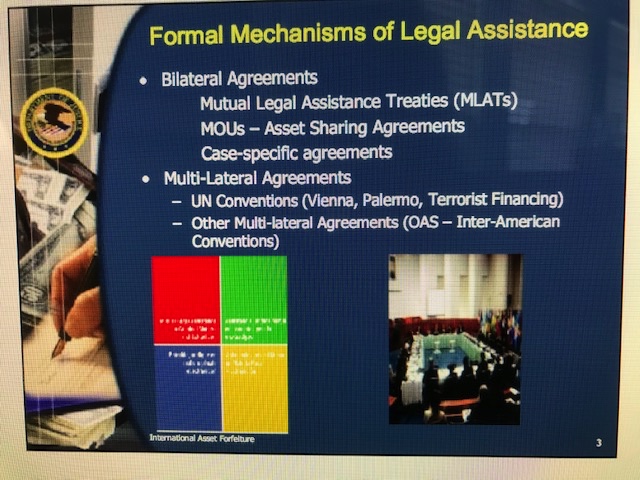
This is an agreement between two or more countries for the purpose of gather and exchanging information in a effort to enforce laws and prosecute public or criminal cases that include witness statements, service of documents, forfeiture, illicit assets, terrorism, sanctions, freezing accounts, restraining orders, judgement, subpoenas, transfers of financial instruments, security, regulations and disclosures. Most of the time these cases are a result of transnational organized crime, tax evasions or money-laundering. Other cooperative international agencies include Europol, Interpol repatriation organizations including the FBI and the United Nations.

So Nancy, with assistance of some in the Senate, the Treasury Department and the Trump White House, Trump is doing the right thing by following the law, draining the swamp and asking for continued foreign cooperation in fraud cases. Hold your powder everyone, this will get very interesting.

China’s Prison Labor Camps Proven

Primer:

The United States gives foreign aid to China. Actually, that is against the law. Hello Pelosi and Schiff. Oh but wait, it is all justified as money to counter those abuses. Anyone trust that actually or has anyone followed that money?

It is packaged this way: U.S. foreign assistance efforts in the PRC aim to promote human rights, democracy, and the rule of law; support sustainable livelihoods, cultural preservation, and environmental protection in Tibetan areas; and further U.S. interests through programs that address environmental problems and pandemic diseases in China. The United States Congress has played a leading role in determining program priorities and funding levels for these objectives. These programs constitute an important component of U.S. human rights policy toward China. Among major bilateral aid donors to China, the United States is the largest provider of nongovernmental and civil society programming, according to data compiled by the Organization for Economic Cooperation and Development.

Based on what abuses Beijing is applying to the freedom fighters in Hong Kong coupled with that of the prison labor camps (500 of them) of the Uighurs, having a trade agreement between the United States and China is an arguable quest at best or is it?

Uyghur Turk exposes torture in Chinese prison

The Uighur internment camps are actually prison labor camps for the Chinese Belt Road Initiative.

A classified blueprint leaked to a consortium of news organizations shows the camps are instead precisely what former detainees have described: Forced ideological and behavioral re-education centers run in secret.

The classified documents lay out the Chinese government’s deliberate strategy to lock up ethnic minorities even before they commit a crime, to rewire their thoughts and the language they speak.

The papers also show how Beijing is pioneering a new form of social control using data and artificial intelligence. Drawing on data collected by mass surveillance technology, computers issued the names of tens of thousands of people for interrogation or detention in just one week.

The documents were given to the International Consortium of Investigative Journalists by an anonymous source. The ICIJ verified them by examining state media reports and public notices from the time, consulting experts, cross-checking signatures and confirming the contents with former camp employees and detainees.

They consist of a notice with guidelines for the camps, four bulletins on how to use technology to target people, and a court case sentencing a Uighur Communist Party member to 10 years in prison for telling colleagues not to say dirty words, watch porn or eat without praying.

The documents were issued to rank-and-file officials by the powerful Xinjiang Communist Party Political and Legal Affairs Commission, the region’s top authority overseeing police, courts and state security. Much more detail here from Associated Press.

After bloody race riots rocked China’s far west a decade ago, the ruling Communist Party turned to a rare figure in their ranks to restore order: a Han Chinese official fluent in Uighur, the language of the local Turkic Muslim minority.

Now, newly revealed, confidential documents show that the official, Zhu Hailun, played a key role in planning and executing a campaign that has swept up a million or more Uighurs into detention camps.

Published in 2017, the documents were signed by Zhu, as then-head of the powerful Political and Legal Affairs Commission of the Communist Party in the Xinjiang region. A Uighur linguist recognized Zhu’s signature scrawled atop some of the documents from his time working as a translator in Kashgar, when Zhu was the city’s top official.

“When I saw them, I knew they were important,” said the linguist, Abduweli Ayup, who now lives in exile. “He’s a guy who wants to control power in his hands. Everything.”

Zhu, 61, did not respond to repeated requests for comment.

Long before the crackdown and despite his intimate familiarity with local culture, Zhu was more hated than loved among the Uighurs he ruled.

He was born in 1958 in rural Jiangsu on China’s coast. In his teens, during China’s tumultuous Cultural Revolution, Zhu was sent to Kargilik county, deep in the Uighur heartland in Xinjiang. He never left.

Zhu joined the Party in 1980 and moved up Xinjiang’s bureaucracy, helming hotspot cities. By the 90s, he was so fluent in Uighur that he corrected his own translators during meetings.

“If you didn’t see him, you’d never imagine he’s Han Chinese. When he spoke Uighur, he really spoke just like a Uighur, since he grew up with them,” said a Uighur businessman living in exile in Turkey, who declined to be named out of fear of retribution.

The businessman first heard of Zhu from a Uighur friend who dealt with the official while doing business. His friend was impressed, describing Zhu as “very capable” — a Han Chinese bureaucrat the Uighurs could work with. But after years of observing Zhu oversee crackdowns and arrests, the businessman soon came to a different conclusion.

“He’s a crafty fox. The really cunning sort, the kind that plays with your brain,” he said. “He was a key character for the Communist Party’s policies to control Southern Xinjiang.”

Ayup, the linguist, met Zhu in 1998, when he came to inspect his township. He was notorious for ordering 3 a.m. raids of Uighur homes, and farmers would sing a popular folk song called ‘Zhu Hailun is coming’ to poke fun at his hard and unyielding nature.

“He gave orders like farmers were soldiers. All of us were his soldiers,” Ayup said. “Han Chinese controlled our homeland. We knew we needed to stay in our place.”

Months after a July 5, 2009 riot left hundreds dead in the region’s capital of Urumqi, Zhu was tapped to replace the city’s chief. Beijing almost always flew in officials from other provinces for the job, in part as training for higher posts. But central officials on a fact-finding mission in Urumqi concluded that Zhu, seen as tougher than his predecessor, needed to take charge.

“They were super unhappy,” said a Uighur former cadre who declined to be named out of fear of retribution. “It had never happened before, but because locals said he was outstanding at maintaining stability, he was snatched up and installed as Urumqi Party Secretary.”

Upon appointment, Zhu spent three days holed up in the city’s police command, vowing to tighten the government’s grip. Police swept through Uighur neighborhoods, brandishing rifles and rounding up hundreds for trial. Tens of thousands of surveillance cameras were installed.

But instead of healing ethnic divisions, the crackdown hardened them. Matters came to a head in April 2014, when Chinese President Xi Jinping came to Xinjiang on a state visit. Just hours after his departure, bombs tore through an Urumqi train station, killing three and injuring 79.

Xi vowed to clamp down even harder.

In 2016, Beijing appointed a new leader for Xinjiang — Chen Quanguo. Chen, whose first name means “whole country”, had built a reputation as a hard-hitting official who pioneered digital surveillance tactics in Tibet.

Zhu was his right-hand man. Appointed head of the region’s security and legal apparatus, Zhu laid the groundwork for an all-seeing state surveillance system that could automatically identify targets for arrest. He crisscrossed the region to inspect internment centers, police stations, checkpoints and other components of an emerging surveillance and detention apparatus.

After Chen’s arrival, Uighurs began disappearing by the thousands. The leaked documents show that Zhu directed mass arrests, signing off on notices ordering police to use digital surveillance to investigate people for having visited foreign countries, using certain mobile applications, or being related to “suspicious persons”. State television shows that Zhu continued on his relentless tour of Xinjiang’s camps, checkpoints, and police stations, personally guiding the mass detention campaign.

Zhu stepped down last year after turning 60, in line with traditional practice for Communist Party cadres of Zhu’s rank. Chen remains in his post.

“Chen Quanguo came in the name of the Party,” said the Uighur businessman. “Zhu knows how to implement, who to capture, what to do.”

Syrian Henchmen Financial Sanctuary in Moscow

2011: Hillary Clinton declared that Bashir al Assad was a reformer.

Primer:

Rami Makhlouf: Wealthy, powerful cousin of Syria’s president

Makhlouf, 45, is Syria’s richest man and a member of what was described during U.S. Senate Committee on Foreign Relations hearings as a powerful “mafia” that also includes Syrian president Bashar Al-Assad, Makhklouf’s cousin. Before his country plunged into civil war, Makhlouf was allegedly worth $5 billion thanks to his control of monopolies and semi-monopolies in the air travel, telecommunications, real estate, oil and construction sectors. Makhlouf is on U.S. sanctions lists and is a known beneficiary of corruption.

***

Several Makhlouf family members, close cousins and accomplices of Syrian dictator Bashar al-Assad, have purchased tens of millions of dollars’ worth of properties in Moscow’s prestigious skyscraper district.

Headed by al-Assad’s uncle, Mohammed Makhlouf, the Makhloufs are considered to be Syria’s richest and second most important family. Before 2011, they controlled 60 percent of the Syrian economy, ostensibly acquired through years of corruption and intimidation.

GlobalWitness:

Our exposé of the Makhloufs’ properties is rare supporting evidence that lends substance to rumours of regime money being funnelled out of Syria throughout the war. Information about the regime’s assets and finances is notoriously scarce due to the terror fostered by al-Assad’s apparatus at home and abroad.

Our investigation further shows that the loans secured against some of the properties could be for the purposes of laundering money from Syria into Moscow. This opens the possibility that the money could then be moved into other jurisdictions, such as the EU, where members of the family are sanctioned.

Of the newly-revealed Moscow property purchases, the largest amount was bought by Hafez Makhlouf, one of Bashar al-Assad’s first cousins.

Hafez is accused of overseeing the killings and torture of detainees and protestors. Most of Hafez’s purchases were arranged using an opaque Lebanese loan structure that bears several hallmarks of money laundering, possibly with the purpose of moving the money beyond Russia.

Russia has been a key ally of the al-Assad family over their almost 50-year rule. It intervened on their side of the war in Syria in 2015, turning it in their favour through airstrikes and land offensives on opposition-controlled territory.

Reports of Russian banks aiding the Syrian regime surfaced in 2012 and 2013, after Western sanctions hit and the more powerful family members were stripped of European visas and their EU and Swiss bank accounts were frozen. Now it seems that the Syrian regime has been using Moscow as an alternative safe haven, and possibly a potential gateway for its ill-gotten gains to enter the wider financial system.

Hafez Makhlouf, who purchased US$22.3 million worth of property in Moscow’s ‘City of Capitals’ towers, was head of the Damascus ‘Section 40’ of Syria’s infamous General Intelligence Directorate until late 2014. This is the Syrian agency charged with quelling internal dissent, formerly and popularly known as the State Security service. As Damascus is the capital, this was already an important role, but Hafez appears to have had a great deal more authority than this official title reflects.

Testimony collected by Syrian human rights groups about Hafez’s Section 40 and its command branch, the Al-Khatib Branch, as well as wider testimony collected by journalists about the systemic use of torture by Syria’s intelligence services, points to how Hafez would have potentially overseen the detention of  thousands of Syrians and their subsequent abuse, and, in some cases, even murder.

Moreover, multiple regime defectors have since testified, in a 2019 book by journalist Sam Dagher, that Hafez was a hard-line member of Bashar al-Assad’s inner circle and one of his most influential advisers. According to the testimony, Hafez was one of two main advocates for crushing the demonstrations in 2011. Dagher’s book includes testimony from witnesses who saw Hafez shooting civilians in Douma and giving shoot-to-kill orders on hundreds of peaceful protestors in Daraa and Homs.

Makhlouf Family Tree Diagram english  When buying the Moscow office space in 2016, Hafez Makhlouf’s Russian-registered property companies took out loans using 11 of the properties as collateral. The complex structure of these loans disguises Hafez’s connection to the funds. This is characteristic of money laundering and could have been designed to establish money flows between Russia and Syria which would appear unconnected to Hafez, raising the possibility that the ultimate aim is to move the money out of Russia.
The loans were provided to Hafez’s Russian companies by a Lebanese company called Nylam SAL Offshore. The company is classified as ‘offshore’ in Lebanon; while Lebanese ‘offshore’ companies do not hide their owners like offshore companies in so-called secrecy jurisdictions like the British Virgin Islands, these companies do benefit from enhanced banking secrecy. The exact amount loaned by Nylam is unknown.

In 2018, two years after the property purchases, Hafez, the sole shareholder of his three Russian companies, passed his shares to Briana SAL Offshore, a Lebanese company with identical shareholders, directors and address as Nylam. Russian corporate records for the Russian property companies contain details about Briana because it is a shareholder. These records show that Briana states its country of business as Syria.

Russia’s biggest bank, Sberbank, provided banking services for at least one of the Russian property companies formerly owned by Hafez and now owned by Briana, a Russian corporate database shows.

As the loans from Nylam to Hafez’s Russian companies were international (coming into Russia from Lebanon), it is feasible that they were transacted in US dollars, which is the commonly used international currency. If that were the case, the money could have transited through Sberbank’s SWIFT payment system, which, according to anti-money laundering expert Graham Barrow, could risk breaching the terms of the US sanctions against Hafez Makhlouf.

The convoluted nature of the loans taken against the properties should have raised red flags with Sberbank, but it is unclear what due diligence was carried out on the loans.

Sberbank’s dealings with the Makhloufs are part of a broader pattern of major Russian banks helping the Syrian regime. In 2012 and 2013, both Reuters and Wall Street Journal reported that the al-Assad regime held accounts at Gazprombank and VTB, two of Russia’s largest banks, which, like Sberbank, have extensive international correspondent banking relationships. More here.

Deaths Rise in Libya Due to Russians

Whatever vision that Hillary Clinton and the Obama administration had to Libya is now best described as a Russian operation where death and destruction manifests.

As Fox News Anchor, Bret Baier says each night, ‘beyond our borders’ there is a very ugly nasty world that is hardly if at all reported.

From the United Nations Mission in Libya:

17 Oct 2019

How bad it is really? What about Russia?

Russia dominated Syria’s war. Now it’s sending mercenaries to Libya photo

TRIPOLI, Libya — The casualties at the Aziziya field hospital south of Tripoli used to arrive with gaping wounds and shattered limbs, victims of the haphazard artillery fire that has defined battles among Libyan militias. But now medics say they are seeing something new: narrow holes in a head or a torso left by bullets that kill instantly and never exit the body.

It is the work, Libyan fighters say, of Russian mercenaries, including skilled snipers. The lack of an exit wound is a signature of the ammunition used by the same Russian mercenaries elsewhere.

The snipers are among about 200 Russian fighters who have arrived in Libya in the last six weeks, part of a broad campaign by the Kremlin to reassert its influence across the Middle East and Africa.

After four years of behind-the-scenes financial and tactical support for a would-be Libyan strongman, Russia is now pushing far more directly to shape the outcome of Libya’s messy civil war. It has introduced advanced Sukhoi jets, coordinated missile strikes, and precision-guided artillery, as well as the snipers — the same playbook that made Moscow a kingmaker in the Syrian civil war.

Related image

The Russians have intervened on behalf of the militia leader Khalifa Hifter, who is based in eastern Libya and is also backed by the United Arab Emirates, Egypt, Saudi Arabia and, at times, France. His backers have embraced him as their best hope to check the influence of political Islam, crack down on militants and restore an authoritarian order.

Mr. Hifter has been at war for more than five years with a coalition of militias from western Libya who back the authorities in Tripoli. The Tripoli government was set up by the United Nations in 2015 and is officially supported by the United States and other Western powers. But in practical terms, Turkey is its only patron.

The new intervention of private Russian mercenaries, who are closely tied to the Kremlin, is just one of the parallels with the Syrian civil war.

The Russian snipers belong to the Wagner Group, the Kremlin-linked private company that also led Russia’s intervention in Syria, according to three senior Libyan officials and five Western diplomats closely tracking the war.

In both conflicts, rival regional powers are arming local clients. And, as in Syria, the local partners who had teamed up with the United States to fight the Islamic State are now complaining of abandonment and betrayal.

The United Nations, which has tried and failed to broker peace in both countries, has watched as its eight-year arms embargo on Libya is becoming “a cynical joke,” as the United Nations special envoy recently put it.

Yet in some ways, the stakes in Libya are higher.

More than three times the size of Texas, Libya controls vast oil reserves, pumping out 1.3 million barrels a day despite the present conflict. Its long Mediterranean coastline, just 300 miles from Italy, has been a jumping-off point for tens of thousands of Europe-bound migrants.

And the open borders around Libya’s deserts have provided havens for extremists from North Africa and beyond. Read on.

President Trump, As Long as You are Declassifying…

Providing declassification authority to AG William Barr on all things Russia investigation is a great thing. Patriotic Americans need to understand all the abuses of power that were applied by Democrat operatives since your nomination.

Then as long as there is the matter of Israel and Iran that continues to fester and maintain a political as well as militant component, there are at least two suggestions noted below that will for sure be favorable to your foreign policy and will likely have some positive outcomes for domestic policy.

Let’s go back to 2016 and 2017 shall we? Congressman Louis Gohmert of Texas was part of a hearing where then Eric Holder was the witness. At one point, Gohmert demanded that Holder declassify and release the Holyland Foundation trial documents. ALL OF THEM. tic toc…

Since then, Gohmert is still ringing the bell. He continues to plea for more attention to the Muslim Brotherhood and CAIR so that a legitimate status can be attached to black list those organizations.

So as long as Congresswomen Ilhan Omar and Rashida Tlaib continue the path to attack Israel, consider Gohmert’s presentations.

In both House floor presentations, Congressman Gohmert lays out a cogent argument and rightly so. You can bet that ‘The Squad’ and Speaker Pelosi would certainly feel the political pain. The media? Yes, popcorn ready.

Now, on the Iran component. To remind the reader, there was once a DEA mission called Operation Cassandra. This was a multiple agency investigation with major opportunities to indict so many both at home and abroad. This mission to continue to completion was killed by President Obama because it would have complicated the Obama/Kerry quest to see the JCPOA through to the end. Frankly, Operation Cassandra had many piece parts including Bowe Bergdahl and the Afghanistan thing. Then should also take a long look at Bruce Ohr at the DoJ and his work assignments at the time.

January 7th, 2018 Operation Cassandra Is Awan Contra - YouTube (in full disclosure, I have done several interviews with former DEA Special Agent, Derek Maltz on Operation Cassandra)

For some basic details on Operation Cassandra, note below in part:

In its determination to secure a nuclear deal with Iran, the Obama administration derailed an ambitious law enforcement campaign targeting drug trafficking by the Iranian-backed terrorist group Hezbollah, even as it was funneling cocaine into the United States, according to a POLITICO investigation.

The campaign, dubbed Project Cassandra, was launched in 2008 after the Drug Enforcement Administration amassed evidence that Hezbollah had transformed itself from a Middle East-focused military and political organization into an international crime syndicate that some investigators believed was collecting $1 billion a year from drug and weapons trafficking, money laundering and other criminal activities.

Over the next eight years, agents working out of a top-secret DEA facility in Chantilly, Virginia, used wiretaps, undercover operations and informants to map Hezbollah’s illicit networks, with the help of 30 U.S. and foreign security agencies.

They followed cocaine shipments, some from Latin America to West Africa and on to Europe and the Middle East, and others through Venezuela and Mexico to the United States. They tracked the river of dirty cash as it was laundered by, among other tactics, buying American used cars and shipping them to Africa. And with the help of some key cooperating witnesses, the agents traced the conspiracy, they believed, to the innermost circle of Hezbollah and its state sponsors in Iran.

They followed cocaine shipments, tracked a river of dirty cash, and traced what they believed to be the innermost circle of Hezbollah and its state sponsors in Iran.

But as Project Cassandra reached higher into the hierarchy of the conspiracy, Obama administration officials threw an increasingly insurmountable series of roadblocks in its way, according to interviews with dozens of participants who in many cases spoke for the first time about events shrouded in secrecy, and a review of government documents and court records. When Project Cassandra leaders sought approval for some significant investigations, prosecutions, arrests and financial sanctions, officials at the Justice and Treasury departments delayed, hindered or rejected their requests.

Pros of Buying Drugs at https://canadianbestpills.com/buy-tadapox-online-cheap/ Brick-and-Mortar Pharmacies
When it comes to buying drugs at physical drugstores, you may enjoy a number of privileges such as the ones listed below:
You can always be sure that you are dealing with a certified service provider whose products are licensed and effective posing no risks to your health;
You have a chance to consult a certified pharmacist to get exactly what you need without any risk of getting a wrong product;

The Justice Department declined requests by Project Cassandra and other authorities to file criminal charges against major players such as Hezbollah’s high-profile envoy to Iran, a Lebanese bank that allegedly laundered billions in alleged drug profits, and a central player in a U.S.-based cell of the Iranian paramilitary Quds force. And the State Department rejected requests to lure high-value targets to countries where they could be arrested.

Of course there is more Mr. President. However, if you order release of just these two files in full on a well timed schedule it will play well in your favor and be an excellent counter-measure against the Pelosi lead House, the media, restoring some law and order and give a huge lift to John Bolton and Mike Pompeo’s good work.