
Trump Team Better Keep on Eye on Hillary, She is Plotting

Hillary Clinton Says the Women’s Marches Were ‘Awe-Inspiring’

Clinton, 69, who was the first-ever female presidential nominee for a major political party and won the popular vote, tweeted about the peaceful rallies on Saturday, January 21. “Thanks for standing, speaking & marching for our values @womensmarch. Important as ever. I truly believe we’re always Stronger Together,” she wrote to her more than 12 million followers. “Scrolling through images of the #womensmarch is awe-inspiring. Hope it brought joy to others as it did to me.”

Protesters walk during the Women's March on Washington, with the U.S. Capitol in the background, on Jan. 21, 2017.Protesters walk during the Women’s March on Washington, with the U.S. Capitol in the background, on Jan. 21, 2017. Mario Tama/Getty Images

Hillary ClintonVerified account @HillaryClinton 18h18 hours ago 

Scrolling through images of the is awe-inspiring. Hope it brought joy to others as it did to me.

**** Some of her closets political allies also echoed the same sentiments. Read more here.

Related reading: Opposing Trump Admin, When Documents Matter

Hillary Clinton plots her next move

The Democrat has been studying election presentations, including reports on where she underperformed.

Politico: LITTLE ROCK, Ark. — In a series of private meetings and phone calls at their home in Chappaqua, in New York City and in Washington, Bill and Hillary Clinton are slowly starting to puzzle through their political future, according to over a dozen people who have spoken directly with them, and nearly two dozen other Democrats who have been briefed on their thinking.

The recently vanquished candidate has told some associates she’s looking at a spring timeline for mapping out some of her next political steps. Still recovering from her stunning loss, a political return is far from the top of Clinton’s mind, with much of her planning focused around the kinds of projects she wants to take on outside the partisan arena, like writing or pushing specific policy initiatives.

Just as the Democratic Party feels its way through a landscape without either Clinton looming over its future for the first time in nearly a quarter century, Clinton herself is working through the uncertainty surrounding how to best return to the fold.

There have been no conversations about starting her own political group but Clinton has spoken with leaders of emerging Democratic-leaning organizations about their work, and has discussed possible opportunities to work with Organizing For Action, former President Barack Obama’s initiative. Among the potential political priorities she has mentioned to associates are building pipelines for young party leaders to rise and ensuring that a reconstructed Democratic National Committee functions as an effective hub that works seamlessly with other party campaign wings.

The one-time secretary of state has been in contact with a range of ex-aides, studying presentations as she tries to better understand the forces behind her shocking November defeat.

Included among those presentations has been a series of reports pulled together by her former campaign manager Robby Mook and members of his team, who have updated her not just on data and polling errors, but also on results among segments of the electorate where she underperformed, according to Democrats familiar with the project.

“She understands that a forensic exam of the campaign is necessary, not only for her, but for the party and other electeds, and for the investors in the campaign,” said a close Hillary Clinton friend in Washington who, like several others, declined to speak on the record because their conversations with one or both Clintons were private. “People want to know that their investment was treated with respect, but that their mistakes wouldn’t be repeated.”

For his part, Bill Clinton has spent considerable time poring over precinct-level results from the 2016 race while meeting with and calling longtime friends to rail against FBI Director James Comey’s late campaign intervention and Russia’s involvement, say a handful of Democrats who have spoken with him.

“Many Democratic politicians have been personally influenced or share direct ties to President Clinton, Secretary Clinton, or both. That history goes back decades,” said Mack McLarty, Bill Clinton’s first White House chief of staff and a lifelong friend, predicting their eventual return to the scene. “And, despite the grave disappointment, resilience is in the Clintons’ DNA. So, while I certainly don’t expect to see them trying to assert their authority, I think there will be natural and welcome opportunities for them to engage.”

Wary of the complex political moment as Donald Trump assumes the presidency and supporters of Bernie Sanders assert themselves more forcefully within the Democratic Party, however, the Clintons have been letting the political discussions come to them, rarely bringing it up unprompted in their conversations, and for the moment focusing more on other projects.

Bill Clinton, for example, has dived back into his work with the Clinton Foundation, while Hillary Clinton — spotted recently resuming her social life on Broadway and at trendy dinners in New York and Washington — is considering doing some writing.

For weeks leading up to Trump’s swearing in, the constant refrain among friends and former aides who are struggling with the question of their next political step has been, “Let’s get through the inauguration first.” The Clintons have been careful not to step into the party-shaping territory now occupied by Obama as the most recent Democratic president. And that posture is unlikely to change until at least late February, as the couple studiously stays away from a race for the DNC chairmanship that is widely seen as a Clinton-Sanders proxy fight.

Still, party leaders and friends alike expect them to jump back into the political fundraising and campaigning circuit in some form by the 2018 midterms — and perhaps in time for 2017’s two gubernatorial elections in New Jersey and Virginia. A number of Hillary Clinton’s most prominent 2016 supporters are likely to need the help soon, including Florida Sen. Bill Nelson, Miami Beach Mayor Philip Levine and Orlando attorney John Morgan — both likely gubernatorial candidates in 2018 — as well as Ohio Sen. Sherrod Brown, Pennsylvania Sen. Bob Casey, and New Jersey governor hopeful Phil Murphy.

“I would be surprised [to see Bill Clinton step away from politics] only because he has so many friends who are still involved, who he’s worked with for so many years,” said Skip Rutherford, the dean of the University of Arkansas’ Clinton School of Public Service and the founding president of the Clinton Foundation. “Many of the people who are involved in the political world got their starts in the Clinton world, so there’s a whole base of people who are connected to both Clintons.”

“If someone they knew was running for the Senate or the Statehouse or City Hall, it would be out of character for them not to be supportive,” added McLarty.

But before that lies a set of more immediate concerns that includes determining the fate of Hillary Clinton’s campaign email list and figuring out which new Democratic efforts — if any — to support.

“On a personal level, I lost a race in 2014 and it was on a much, much smaller scale than what she lost. But I know there’s a time of healing that has to happen. So on a personal level I know she just needs to get away for a while,” said former Democratic Arkansas Senator Mark Pryor.

There’s no obvious model for the pair to follow in the months and years ahead: Bill Clinton has been uniquely involved in electoral politics in his post-presidency, and recent losing nominees have either returned to their Senate day jobs — like John Kerry and John McCain — or continued to flirt with another presidential run — like Mitt Romney.

But neither Clinton is likely to run for office again, never mind the New York City mayoral rumors that Hillary Clinton’s friends routinely laugh off.

“The Democratic Party does need new blood, new faces, and I don’t think Bill or Hillary Clinton would ever want to get back and run for anything — I don’t think a team of mules could drag them to do that,” said Pryor.

Their current political standing within the party is somewhat precarious, defined by a mixture of admiration for the family balanced with frustration, and in some cases, anger. Many supporters of Sanders, for instance, are still licking their wounds from the bruising primary, and have seized the post-election moment to gain power in local Democratic party committees across the country — often by dismissing the more establishment-oriented Clintonian way of doing business.

And some Clinton supporters in the states are irritated by the lack of a formal, public-facing autopsy from her campaign since the absence of even a preliminary acknowledgment of fault has made it harder for the party to raise money on a local level — donors feel burned.

“There’s huge annoyance in the states,” said one swing-state party leader. “People assume they’re done, and they’re more powerful if they take that back seat. [For now] there’s short-term fatigue, but it will settle into respect.”

Clinton allies have been careful not to engage in direct fights with detractors that could turn into referenda on the family’s legacy, but national leaders acknowledge some lingering post-election tension.

“The problem with circular firing squads is everyone gets hit. I don’t think there’s any room in the party right now for a circular firing squad. The party has a long way to go in order to regain its proverbial political footing across the country,” said interim DNC chair Donna Brazile — a Bill Clinton campaign advisor in 1992 and 1996 — adding that Hillary Clinton’s victory over Trump in the popular vote underscores the potential use of promoting her as a surrogate for the next crop of candidates.

Not relying on Clinton, she said, would be “like taking your running back and placing them on the sideline just because you lost the season. As Democrats, we need to keep everyone on the roster — to recruit, raise funds, and more — even if they are no longer part of the starting lineup.”

The ongoing competition to lead the DNC makes the situation all the more delicate as the couple monitors the situation from New York: the candidates for chair rarely mention either Clinton, sensing a level of impatience with them among voting members of the committee and elected officials who want to see a younger generation of Democrats take power.

“New ideas and new approaches and new direction, that’s really needed right now,” said Ohio Rep. Tim Ryan, a prominent Clinton supporter during the campaign who challenged Nancy Pelosi’s House leadership position after the election. Ryan said the Clintons would remain useful to the party moving forward, but “it’s just the natural cycle of political parties, and I think Republicans have done a better job than we have in trying to engage young voices to get into the mix.”

For the moment, the Clintons’ closest political allies are counseling a “wait-and-see” approach when it comes to the nature of their public-facing role. Well acquainted with fluctuating public perceptions after three decades of sine curve-style approval ratings, they are watching Trump’s numbers closely, aware that their own popularity could rebound — especially when the Trump administration runs up against popular pieces of Bill Clinton’s White House and Hillary Clinton’s State Department legacies.

Whatever role they choose, however, their shadow will continue to loom over the party’s infrastructure. A number of the major left-leaning organizations that are relaunching in opposition to Trump are run by operatives who are closely associated with the Clintons, including the Priorities USA super PAC run by Guy Cecil, the Center for American Progress under Neera Tanden, and the network of liberal groups steered by David Brock.

Outside Washington, meanwhile, Democrats are considering ways Clinton could emerge as a prominent potential ally for local-level officials. For example, a major problem faced by Democratic state parties in red states is the reluctance of national party leaders to travel and help them raise money, due to those state’s lack of relevance in national races. But such a fundraising role would be natural for Clinton, said multiple Democrats who are piecing together the party’s map ahead.

“They believe in the party and they want to leave this party in a better position than where they found it, and I think [they and the Obamas] have an obligation to the party, because the party has given them so much,” said South Carolina Chairman Jaime Harrison, a candidate to lead the national committee. “If I’m DNC chair, that’s one of the first calls I’m going to make, to ask them to play that ambassador role.”

Colorado Gov. John Hickenlooper, who was considered for Clinton’s running-mate position last summer, said Hillary Clinton — like her husband — will have much to offer as a party elder, a sentiment repeated by up-and-coming liberals and veteran moderates alike. “Thirty-four states have both their House and Senate in Republican hands, so there’s a larger discussion [to be had]. It involves not just policy, but it involves funding, and she’s going to be a respected voice who’s been in just about every situation imaginable.”

So while the Clintons’ short-term priorities remain apolitical, their allies and the people surrounding them are skeptical that can last too long.

Predicted former Pennsylvania governor and DNC chair Ed Rendell, a longtime family friend: “I’m certain Trump will screw up enough that by the fall of ’18, Hillary’s numbers will be way up again.”
Hey Donald, You Ready for these Political Ambushes?

There is historically to be a smooth transition of power. So far that has hardly been the case. While most Democrats say that Donald Trump won the most important seat in the free world, others are out there saying not so much.

Draining the swamp could be a rather easy political mission in DC due to many progressive powerbrokers being so unabashed at revealing who they are. Sure there are a number of them that refuse to attend the inauguration which is shameful. What they plan to do in that time period is in many cases even more shameful. Exactly what are they boycotting anyway?

This is going to be a wild ride and the left is making it worse beginning with cabinet nominees and future legislation.

Related reading: ACLU Demands That Body Cams Are Turned Off During Inauguration While They Intend To Record Police

****

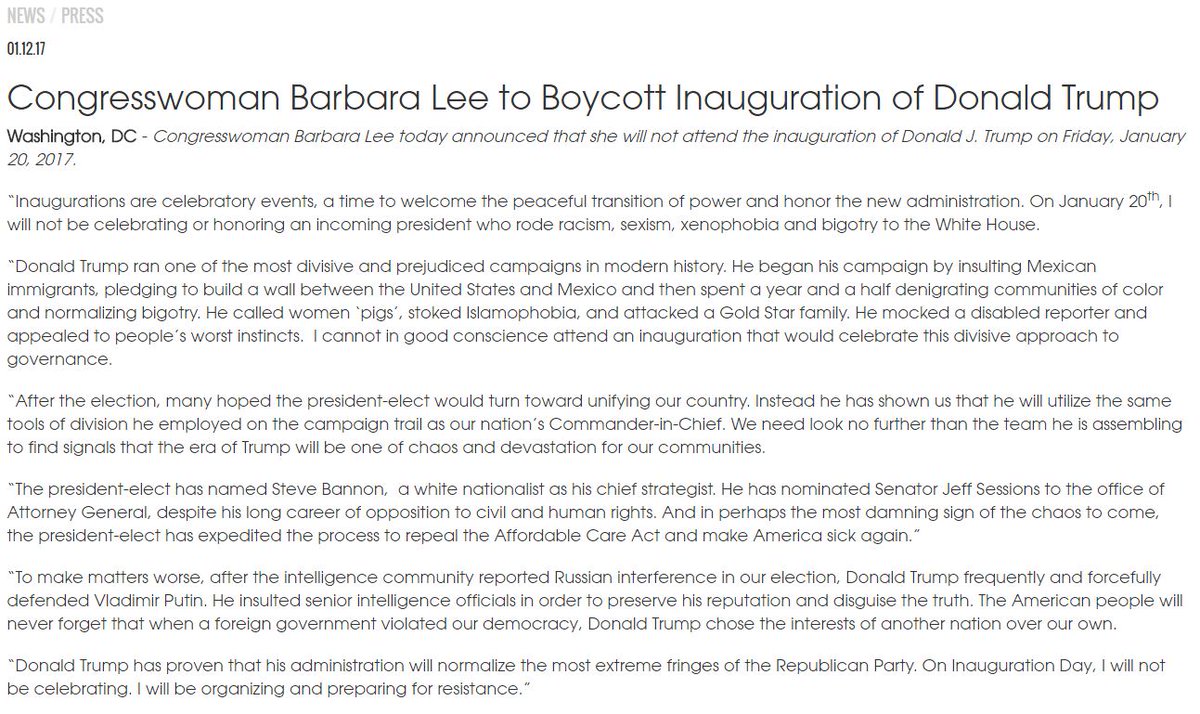
The boycott movement began with Georgia Rep. John Lewis, a civil rights icon, who said he did not view Trump as a “legitimate president” because of allegations that Russia attempted to sway the election in Trump’s favor. After Trump responded with several highly critical tweets about Lewis, Democrats rallied behind Lewis, and as of Saturday night, 17 members of Congress have announced they will not attend.

None of the Democrats who are boycotting is part of the House leadership for the party. All except one of those who are received at least 64 percent of their district’s vote in the November election.

Arizona Rep. Raúl Grijalva


“My absence is not motivated by disrespect for the office or motivated by disrespect for the government that we have in this great democracy, but as an individual act, yes, of defiance at the disrespect shown to millions and millions of Americans by this incoming administration, and the actions we are taking in this Congress,” Grijalva said on the House floor Friday, per CNN.

California Rep. Barbara Lee

But it will be worse than just boycotting January 20th. Sure there are countless protests planned and protests permits have been approved. So, what else you ask?
****

From the National Law Journal: The day after Donald Trump is sworn in as the 45th president the United States, hundreds of attorneys and activists are slated to gather in Washington to strategize on how best to resist “bad government” and coordinate pro bono efforts to protect civil rights.

They will spend two days meeting and discussing issues such as gerrymandering, human rights, better policing and U.S. Supreme Court confirmations during the so-called Rise Above conference. It’s scheduled to coincide with the Jan. 21 Women’s March on Washington.

Rise Above is co-sponsored by two fledging nonprofit groups formed in the wake of Trump’s election: the grassroots government accountability organization RISE When We Fall and the attorney-centric Lawyers for Good Government. They hope to create a “pro bono army to be on the front lines protecting our country and our values,” according to an announcement of the event.

The conference combines networking opportunities, an expo of nonprofit organizations, talks from experienced leaders intended to inspire attendees and a slew of panel discussions of specific legal and activism topics.

“One of the things that’s very important to us is to create a starting point,” said Traci Feit Love, a former DLA Piper associate who is the founder of Lawyers for Good Government. “Some people who are relatively new to activism are trying to figure out, ‘Where do we go from here? How do we approach the issues? What do we prioritize?'”

Some legal heavy hitters are on the agenda. SCOTUSBlog founder Tom Goldstein is scheduled to speak, as are Southern Poverty Law Center co-founder Joe Levin and newly-elected Rep. Jamie Raskin, D-Maryland, who previously taught Constitutional Law at American University Washington College of Law.

Love got the idea for what would become Lawyers for Good Government the day after the election, following a fruitless search to connect with like-minded lawyers in Facebook. The election results had given her a sense of urgency.

“As I was putting my 8-year-old daughter to bed the night of the election, it hit me what had just happened and what it might mean for the country,” she said. “It was a punch in the gut to me and, I think, a lot of other people.”

Love decided to create her own lawyer activist Facebook group called Lawyers of the Left, thinking that 200 or so might join. Within a week, membership swelled past 100,000. Love quickly concluded that lawyers inspired to fight back against Trump’s agenda needed more than just an online gathering place, and she created Lawyers for Good Government using the online lawyer community that coalesced immediately after the election as the foundation for the new effort.

“Everyone was asking, ‘What can we do?'” she said. “No one wanted to just talk about things. It felt like a responsibility to figure out how to help this group of people make the biggest impact.”

Rise Against will be the group’s first foray into live events, though the nearly $600 full ticket price has generated some criticism. Love said Monday that the group retooled parts of the conference in response to concerns that the high cost would shut out some would-be attendees. Organizers did away with a formal evening gala and priced tickets to the networking event at $20 to $40. But staging a large event during the busy inaugural weekend was expensive, and the two host groups lacked established budgets to subsidize costs. Tickets sales were needed to cover the bulk of event, which is being held at the Lincoln Theatre and the Mayflower Hotel, she said. Love is expecting about 1,000 attendees.

“I think one of the most important things this conference can do for us is create both personal relationships and that sense of connection that can sustain a movement beyond the initial energy,” Love said. “What’s likely to happen, due to human nature, is months go by and everyone starts to refocus on their day-to-day lives. We need to ensure that we can sustain the level of energy required to keep an eye on the new administration and Congress.”


Orbis, From the FIFA Scandal to the Trump Intel Dossier

It was not John McCain. It was not the FBI.

Christopher Steele, a former Moscow based MI6 spy has an investigative outside company called Orbis Business Intelligence of which still collaborates with Western leaders and political operatives. Orbis was hired by FusionGPS which in turned is hired by U.S. based political operatives for intelligence which is often packaged into opposition research, an extremely common tactic in DC. Orbis Business Intelligence does have a good history as it broke the corruption scandal on FIFA which was later turned over to the Department of Justice where Loretta Lynch in fact did prosecute those involved.

Gathering intelligence on people, playbooks, legislation is then often repackaged for causes and media is always included. The Trump dossier was crafted last summer and traveled many circles for several months. The dossier was appended to the intelligence briefing(s) given to both Obama and Donald Trump on the matter of Russian penetration into the election cycle.

It could be suggested that the White House had/has media operatives that released the dossier to late comers in media that included other CNN contacts and BuzzFeed.

Christopher Steele dispatched an emissary carrying the report to John McCain. McCain could not validate or substantiate the material contained in the report and turned it over to the FBI for further action. The FBI already had the report.

We cant know all the dates and details leading up to the Trump dossier release, yet there are other suggestions that should be injected including the fact that media had possession of the dossier for many months and some chose not to release it as others did.

Enter two other possible political operatives, Van Jones and David Brock. There is a Trump war room and it is fully functional already.

Hillary Clinton’s allies aren’t done campaigning against Donald Trump. 

Liberal PAC American Bridge, launched by Clinton ally David Brock, on Wednesday announced the leadership team for a new anti-Trump project called the “Trump War Room.” The group tapped Shripal Shah, a former Clinton campaign staffer and alumnus of the Democratic National Committee, to run the outfit. 

“The Trump War Room is set to be the research and communications powerhouse that will fight Trump at every turn,” American Bridge said in a statement. 

“The Trump War Room will continue to put a spotlight on all the different ways that Trump’s decisions are driven not by the national interests of the American people, but by Trump’s own personal self-interests that could put our national security in jeopardy.” More here from FNC.

Last summer too, Van Jones launched yet another political operation called ‘Megaphone Strategies’. He is not bashful by any measure mobilizing anti Trump soldiers for search and destroy objectives of the new Trump administration.

AdWeek’s Fishbowl DC blog reports, quoting Jones:

Everywhere we look, we discover courageous people finding ways to break down barriers and solve tough problems. We need to hear their voices, and we need to elevate their work,” said Van Jones of the reason behind the firm’s creation, which will offer strategy, publicity, media training and event/social justice campaign planning services.

Megaphone’s clients include Vote.org, the ACORN-affiliated Working Families Party, and Demand Progress.

Van Jones was behind much of the mission to challenge the electoral college process. He remains connected to the Obama team even though he resigned as the green czar. One must keep a close eye on progressive/Marxist officials as the Obama administration looks for post presidency jobs.

Obama delivered his farewell speech in Chicago on Tuesday night. He clearly stated he would remain involved in his coded message to his followers. Obama is continuing his climate change agenda, social justice and refugee operations. (selected parts are below)

If I had told you eight years ago that America would reverse a great recession, reboot our auto industry, and unleash the longest stretch of job creation in our history — (applause) — if I had told you that we would open up a new chapter with the Cuban people, shut down Iran’s nuclear weapons program without firing a shot, take out the mastermind of 9/11 — (applause) — if I had told you that we would win marriage equality, and secure the right to health insurance for another 20 million of our fellow citizens –- (applause) — if I had told you all that, you might have said our sights were set a little too high. But that’s what we did. (Applause.) That’s what you did.

You were the change. You answered people’s hopes, and because of you, by almost every measure, America is a better, stronger place than it was when we started.

But for all the real progress that we’ve made, we know it’s not enough. But we’re not where we need to be. And all of us have more work to do. (Applause.) If every economic issue is framed as a struggle between a hardworking white middle class and an undeserving minority, then workers of all shades are going to be left fighting for scraps while the wealthy withdraw further into their private enclaves. (Applause.) If we’re unwilling to invest in the children of immigrants, just because they don’t look like us, we will diminish the prospects of our own children — because those brown kids will represent a larger and larger share of America’s workforce. (Applause.) And we have shown that our economy doesn’t have to be a zero-sum game. Last year, incomes rose for all races, all age groups, for men and for women.

This is going to be a wild ride for the next 4 years. Ensure you can remain securely fastened in your seat belt.


Additional Details: Hillary Emails, V. FBI, V State and Sidney

New Clinton email files detail FBI-State tussle over Benghazi message

Politico: Newly-released records about the Hillary Clinton email investigation shed new light on an early dispute between the FBI and the State Department over the classification of an email discussing the aftermath of the 2012 Benghazi attacks.

The 299 pages of internal FBI records, apparently released over the weekend on the FBI’s Freedom of Information Act page, describe the bureau’s reaction to State’s protest of an FBI decision to classify a November 2012 State email discussing arrests in the Benghazi attacks.

The email was the first from Clinton’s private account and server to be publicly identified as “SECRET,” fueling arguments that Clinton and State had been careless in handling sensitive information.

Notations applied to the message when it was reviewed in 2015 show it was classified because of the potential impact on U.S. relations overseas. However, the newly-disclosed FBI communications messages show one official there argued that the message should actually be classified based on its potential to disclose intelligence “sources and methods”—a designation that could have raised red flags with the press and on Capitol Hill.

“The redaction lists ‘interference with foreign relations as the rationale.’ The crux of States [sic] argument is they know better what will impact foreign relations and there is no longer a government in place” in Libya, the unidentified FBI official wrote to Michelle Jupina, the FBI Assistant Director for Records Management. “The more appropriate rationale is sources and methods. While the email does not name the particular official, this might be deduced and, given the threat of violence in the region, any surmise could be fatal for whoever cooperated with us. State will say no one will know if it is redacted, but that is not how classification works.”

The message shows Deputy Secretary of State for Management Patrick Kennedy intervened with the FBI to dispute the classification at least three times: in a May 14, 2015, call to International Operations Division chief Brian McCauley, at an in-person meeting at the State Department five days later and in a phone conversation with the head of FBI’s Counterterrorism Division, Michael Steinbach.

The unnamed FBI author of the message to Jupina said Kennedy summoned various officials to State to discuss the review of 55,000 of Clinton emails requested under FOIA. At that meeting, Kennedy asked the FBI representative and a Justice Department FOIA official to “stay behind to discuss the FBI determination” on classification in the first batch of Clinton emails, the FBI email says.

An email from Steinbach said he turned down Kennedy’s request that the information be withheld solely under a FOIA provision for protection of law enforcement sources, rather than by classifying it.

“I explained to Mr. Kennedy that to only exempt for (b)(7)(D) was not appropriate as the information in the two portions in question was classified at the Secret/NOFORN level,” Steinbach wrote.

Even after that decision, the FBI got another high-level contact on the issue from State that same day, with Secretary of State John Kerry’s chief of staff Jon Finer calling Jim Rybicki, then-deputy chief of staff to FBI Director James Comey.

“Finer…stated that he was not attempting to change [Steinbach’s] classification decision, and said that he just wanted to make sure that FBI leadership was aware of the decision and the procedural process and media attention it would likely trigger,” Rybicki wrote in an email to several colleagues. “I relayed back to the State Department that leadership is aware of the review process and decision.”

Rybicki said Finer asked if the FBI could classify the information rather than State doing so at FBI’s request. When the email was released, State officials said they were withholding it at FBI’s request.

State Department spokesman John Kirby said on Monday that the new records demonstrate the department’s longstanding contention that it did not feel the specific document needed to be upgraded and that there were discussions among agencies about the issue.

“Classification is an art, not a science, and individuals with classification authority sometimes have different views. We have an obligation to ensure determinations as they relate to classification are made appropriately,” Kirby said in a statement.

He added, “With respect to Mr. Finer, the material recently released by the FBI makes clear that he did not contact them to change the classification of the email. On the contrary, this was routine contact to ensure appropriate leadership in both agencies were prepared to respond to questions. As is well known and was discussed publicly at the time, the State Department did upgrade the document at the request of the FBI when we released it back in May 2015.”

Some indications of the FBI-State dispute appeared in records released in October, leading then-Republican presidential nominee Donald Trump to argue on the campaign trail that Kennedy had proposed a trade-off where State would increase FBI staffing levels overseas if State withdrew its claim that the Benghazi-related email was classified.

The notion of such a quid pro quo apparently originated with a records official at the FBI, but Kennedy flatly denied it. In addition, McCauley said he did not believe Kennedy was proposing such a trade-off, although the pair did discuss both issues in a single phone call.

While the classification dispute over the Benghazi-related message appears to have been heavily litigated, it would wind up being just the tip of the iceberg. In a statement in July, Comey said 110 emails in Clinton’s account were classified at the time they were sent, with eight email chains considered “Top Secret” at the time they were sent and 36 chains containing “Secret”-level information. None of those messages was properly marked as classified, he said.

The newly-released FBI emails and memos also contain some other details about the Clinton email probe that have not been previously reported or received little notice:

–The Secret Service rebuffed the FBI’s initial request for assistance in the investigation, according to a memo which suggests some tensions between the two law enforcement agencies.

At a July 28, 2015, meeting, a Secret Service official “advised that his management told him that any FBI request for information or assistance related to this matter would need to come via written request from the Department of Justice to the Department of Homeland Security, which would then forward the request to the USSS,” an FBI memo said. After consulting with Secret Service managers about the requested assistance, the official “refused to identify [to the FBI] the specific USSS manager(s) to whom he spoke.”

The FBI eventually obtained information on the Secret Service’s assistance to former President Bill Clinton with security issues related to his computer server, which eventually became the one hosting Hillary Clinton’s much-discussed private account.

–The FBI apparently took a week to notify the Justice Department after receiving a formal referral from the Intelligence Community Inspector General about the Clinton email matter in July 2015. A memo from Deputy FBI Director Mark Giuliano says the FBI got the referral on July 6, formally opened its full investigation on July 10, and first advised Deputy Attorney General Sally Yates on July 13.

–The investigation itself was treated as classified at its outset, but was declassified in August 2015. Internal FBI memos say it was determined that an initial batch of emails from Clinton’s account released by State under FOIA contained “Top Secret” information. The memo declassifying the investigation says that information was deemed not to be so sensitive that it could not be discussed more widely. “No previously unknown sources or informants were revealed in the identified material…. No sensitive sources or methods were disclosed.”

–The email investigation was also designated as “sensitive” and its records were closely-held at the FBI because of Clinton’s status as a political candidate.

–The FBI obtained a special “one-time” approval to show Clinton confidant Sidney Blumenthal a copy of one of his own emails to Clinton about the political situation in Kyrgyzstan. A January 5, 2016, FBI memo says the email has “since been deemed to contain classified FBI information.” The “SECRET” portion of the April 2010 message relates to what Blumenthal called an “ongoing criminal investigation.”

–An internal FBI profile of longtime Bill Clinton aide Justin Cooper derived information from a publication of the conservative watchdog group, Judicial Watch. The group had tracked Cooper’s links to Teneo Holdings, a consulting firm founded by individuals with close ties to the Clintons.

Budget Reconciliation to Repeal Obamacare

The Democrats under the lead of Senate Minority Leader Chuck Schumer are complaining that the Republicans have no alternative plan to replace Obamacare. Nancy Pelosi is telegraphing the same thing and Barack Obama is headed to the Hill on Wednesday in an attempt to work his side of the aisle in Congress to save his signature law.

 CNN

In part from CNN: Democrats are pointing to two new provisions added in the rules package that they say are designed to help the GOP effort to repeal Obamacare.

One change would allow exceptions to the rule instituted by House Republicans in their recent budget plan that limits votes on any legislation that increases the federal deficit by $5 billion over a specific period. Republicans typically require any proposal that adds to the deficit has to be fully offset with cuts to other programs.
“This rule is a set-up to overturn the Affordable Care Act,” House Minority Leader Nancy Pelosi maintained on Tuesday.
Democrats also say that another change dealing with committee oversight could open up federal entitlement programs like Medicare and Social Security to potential funding cuts. The new GOP rule directs certain committees to draft recommendations for shifting these programs from the mandatory side of the federal ledger to the discretionary side. While Democrats admit this is “inside baseball” they say that if it’s implemented it could mean Congress would decide funding details for all of these programs as annual spending bills, potentially removing the automatic funding stream they now receive.

The Republicans have worked for several years on alternate solutions and kept them under wraps until a new Congress was seated. It must be known that no user of Obamacare will be left without coverage one the law is repealed as an item on the table is to give Obamacare subscribers several months and perhaps up to a year to go back into the private market for coverage with the use of subsidies and or block grants issues to the states.

***

Sen. Mike Enzi (R., Wyo.), chairman of the Senate Budget Committee, introduced a budget resolution on Tuesday that would repeal the Affordable Care Act, otherwise known as Obamacare.

The resolution utilizes the reconciliation process to repeal elements of the health care law, since Republicans do not have a 60-seat majority that would allow them to overcome a Democratic filibuster. Reconciliation could be used to repeal parts of Obamacare with only 51 votes, similar to how Democrats used the reconciliation process to amend tax and spending provisions contained in Obamacare in 2010.

Republicans can use reconciliation to “fast-track” repeal and send legislation to President-elect Donald Trump’s desk as soon as possible. More here.

*** There are two other items regarding Obamacare that remain in question and will require diligence by conservatives.

They include: The lawsuit against Obama, Burwell and Treasury for funding subsidies and insurance provider bailouts from Treasury without the advise and consent of Congress. The other item is the severability clause, which stated if one part of the law goes away in any form, the law in full collapses.

Speaker Ryan put out this statement today:

WASHINGTON—Today, House Speaker Paul Ryan (R-WI) released the following statement after the Obamacare repeal resolution was introduced in the Senate:

“This is the first step toward relief for Americans struggling under Obamacare. This resolution sets the stage for repeal followed by a stable transition to a better health care system. Our goal is to ensure that patients will be in control of their health care and have greater access to quality, affordable coverage. Today we begin to deliver on our promise to the American people.”


  1. Repeal Is Relief
  2. Obamacare Has Failed the American People
  3. How Obamacare Is Getting Worse
  4. The Tools It Takes to Repeal Obamacare
  5. A Stable Transition to a Better Health Care System