An affordable price is probably the major benefit persuading people to buy drugs at www.americanbestpills.com. The cost of medications in Canadian drugstores is considerably lower than anywhere else simply because the medications here are oriented on international customers. In many cases, you will be able to cut your costs to a great extent and probably even save up a big fortune on your prescription drugs. What's more, pharmacies of Canada offer free-of-charge shipping, which is a convenient addition to all other benefits on offer. Cheap price is especially appealing to those users who are tight on a budget
Service Quality and Reputation
Although some believe that buying online is buying a pig in the poke, it is not. Canadian online pharmacies are excellent sources of information and are open for discussions. There one can read tons of users' feedback, where they share their experience of using a particular pharmacy, say what they like or do not like about the drugs and/or service. Reputable online pharmacy canadianrxon.com take this feedback into consideration and rely on it as a kind of expert advice, which helps them constantly improve they service and ensure that their clients buy safe and effective drugs. Last, but not least is their striving to attract professional doctors. As a result, users can directly contact a qualified doctor and ask whatever questions they have about a particular drug. Most likely, a doctor will ask several questions about the condition, for which the drug is going to be used. Based on this information, he or she will advise to use or not to use this medication.
The Justice Department on Tuesday announced plans to appeal a judge’s ruling that blocked President Donald Trump from shuttering a program that gave protections and work permits to some people who entered the U.S. illegally as children.
In a ruling last week, San Francisco-based U.S. District Court Judge William Alsup ordered the administration to resume accepting renewal applications for the Deferred Action for Childhood Arrivals program, better known as DACA. More here from Politico.
In part, highlights:
The Department has also implemented historic efforts to step up international cooperation. For the first time ever, DHS established a clear baseline for what countries must do to help the United States confidently screen travelers and immigrants from their territory. Every country in the world is now required to meet high security standards and to help us understand who is coming into our country.
As required under President Trump’s Executive Order Protecting the Nation from Foreign Terrorist Entry into the United States (EO 13780), all foreign governments have been notified of the new standards, which include the sharing of terrorist identities, criminal
history information, and other data needed to ensure public safety and national security, as well as the requirement that countries issue secure biometric passports, report lost and stolen travel documents to INTERPOL, and take other essential actions to prevent identity fraud.
***
Visa Waiver Program
We are also looking at ways to further strengthen the Visa Waiver Program (VWP). First and foremost, the VWP is a security partnership program. It mandates high and consistent standards from partner countries in the areas of national security, law enfor
cement, and immigration enforcement to detect and prevent terrorists, criminals, and other potentially dangerous individuals from traveling to the United States —
while still facilitating legitimate travel and tourism.
Currently, 38 countries participate in the VWP, which allows their citizens to travel to the United States for business or tourism for stays of up to 90 days after applying and being approved through the Electronic System for Travel Authorization (ESTA). In return, these countries must comply with program requirements to enter into information
-sharing protocols that enable the relay of information concerning known and suspected terrorists and criminals; consistent and timely lost and stolen passport information reporting; and robust border and travel document
screening. As a result of these program requirements, countries have adopted new laws, policies, and practices that strengthen our mutual security.
The Visa Waiver Program Improvement and Terrorist Travel Prevention Act of 2015,
combined with Secretarial action, have strengthened the VWP’s security provisions over the past two years.
VWP countries are now required to issue high -security electronic passports (e-
passports); implement information sharing arrangements to exchange terrorist identity information; establish mechanisms to validate e-passports at each key port of entry; report all lost and stolen passports to INTERPOL or directly to the United States no later than 24 hours after the country becomes aware of the loss or theft; and screen international travelers against the INTERPOL Stolen and Lost Travel Documents (SLTD) database and notices. As with other operational activities of DHS, a full discussion of the privacy impact of these initiatives and how we mitigate the risk to personal privacy is available on our website.
Since enactment of the Visa Waiver Program Improvement and Terrorist Travel Prevention Act, DHS has realized an increase in the sharing of terrorist identity information. Several countries have increased the frequency of their reporting of lost and stolen passports —VWP countries account for over 70 percent of the almost 73 million lost and stolen travel documents reported to INTERPOL. All VWP countries are now issuing and using for travel to the United States fraud-resistant e-passports that meet or exceed the ICAO standards. Over 70,000 ESTA applicationshave been denied, cancelled or revoked under enforcement of the VWP Improvement Act’seligibility restrictions for VWP travel.
Border Security
In compliance with Executive Order 13767: Border Security and Immigration Enforcement
Improvements, DHS has conducted a comprehensive study of the security of the southern border that addresses all of the elements that provide an integrated solution for the Nation. Our first priority is to expand on our existing southern border wall system and close legal loopholes that encourage and enable illegal immigration and create a corresponding backlog in the courts. We currently have an immigration court backlog of more than 650,000 cases pending before the Department of Justice’s Executive Office for Immigration Review. We also have a massive asylum backlog with more than 270,000 pending cases before U.S. Citizenship and Immigration Services (USCIS).
Recognizing the unsustainability of the asylum case backlog, USCIS has implemented efficiency measures designed to reduce adjudication times. Similarly, the Department of Justice has taken action to reduce unwarranted case continuances in immigration courts, which helps reduce the backlog while affording aliens full and fair hearings. To further
reduce the “pull factors” and restore integrity to our immigration benefits adjudication process, we must tighten case processing standards, including the “credible
-fear” standard, impose and enforce penalties for fraud, and ensure applicants are fully vetted before they are allowed access to the United States.
In addition, visa-overstays account for roughly 40 percent of all illegal immigration in the
United States. In FY 2016, more than 628,000 aliens overstayed their visas. By increasing
overstay penalties and expanding ICE’s enforcement tools, we can help ensure that foreign
workers, students, and visitors respect the terms of their temporary visas. We need Congress to authorize the Department to raise and collect fees from immigration benefit applications to fund additional enhancements to our immigration system called for by the President’s Executive Orders.
Enforcing Immigration Laws
We are also prioritizing the enforcement of our immigration laws in the interior of our country.
There are nearly one million aliens with final orders of removal across the country
—meaning these removable aliens were afforded due process of law, had their
day in court, and were ultimately ordered removed by a judge — yet they remain in our nation and ICE only has 6,000 Deportation Officers to arrest and remove them. The Administration looks to strengthen law enforcement by hiring 10,000 more ICE officers and agents, and supports the request from the Department of Justice to hire 300 more federal prosecutors.
To further protect our communities, we must end so-called “sanctuary” jurisdictions. Hundreds of state and local jurisdictions across the country that do not honor requests from ICE to hold criminal aliens who are already in state and local custody. Instead, they allow them back into their communities, where they are allowed to commit more crimes. This also poses a greater risk of harm to ICE officers, who must locate and arrest these criminals in public places, and increases the likelihood that the criminal aliens can resist arrest or flee. Rather than enhancing public safety, sanctuary jurisdictions undermine it.
The only “sanctuary” these jurisdictions create is a safe haven for criminals. States and localities that refuse to cooperate with federal authorities should be ineligible for funding from certain grants and cooperative agreements.
Authorizing and incentivizing states and localities to enforce immigration laws would further help ICE with its mission and make all communities safer.
In FY 2017, 1,761 criminal illegal aliens were released from ICE custody because of a 2001
Supreme Court decision that generally requires ICE to release certain removable aliens with final orders of removal—including violent criminals—
within 180 days, if they have not been removed and there is no significant likelihood of removal in the reasonably foreseeable future. Legally insupportable judicial interpretations of the law regarding the detention and removability of criminal aliens have eroded ICE’s authority to keep aliens in custody pending removal.
Pursuant to this Executive Order, USCIS announced it will take a more targeted approach to combatting fraud and abuse in the employment -based visa programs, including the H-1B program. To help end H-1B petitioner fraud and abuse, USCIS has established a Targeted Site Visit and Verification Program (TSVVP). Targeted site visits allow USCIS to focus its resources where fraud and abuse of certain programs are more likely to occur. TSVVP initially focused on H-1B petitions filed by companies that are H-1B dependent (as defined by statute), employers petitioning for H-1B workers who will be placed off -site at another company’s location, or cases where USCIS cannot validate the H-1B petitioner’s business information through commercially -available data.
USCIS has also taken great strides to improve transparency with the public about employment -based immigration programs. The agency has published new data on its website to give the public more information regarding the use of nonimmigrant workers in the H-1B, H-2B, and L nonimmigrant programs. Information about the use and legal authority for employment authorization documents has also been published.
Most low-skilled immigration into the United States occurs legally through our
immigrant-visa system, which, unlike many other countries’ systems, prioritizes family
-based chain-migration. Each year, the United States grants lawful permanent resident status (greencards) to more than one million people; two-thirds of that total is based on a person having a sponsoring relative in the United States, regardless of the new immigrant’s skills, education, English language proficiency, or ability to successfully assimilate. This system of chain-migration has accounted for more than 60 percent of immigration into the United States over the past 35 years. We must end chain-migration, and limit family -based green cards to spouses and the minor children of U.S. citizens and lawful permanent residents.
We must also eliminate the “diversity visa” lottery. Every year, through this lottery, 50,000
green cards are awarded at random to foreign nationals. Many of these lottery beneficiaries have absolutely no ties to the United States, no special skills, and limited education. The random lottery program has not been adopted by other countries and does not adequately serve our national interest. Full opening summary here.
Reading through the summary below, it begs the question once again: Did Iran demand Obama remove troops from Iraq in order to advance the talks on the nuclear agreement? It also adds a similar question: Did Iran demand the same in Afghanistan?
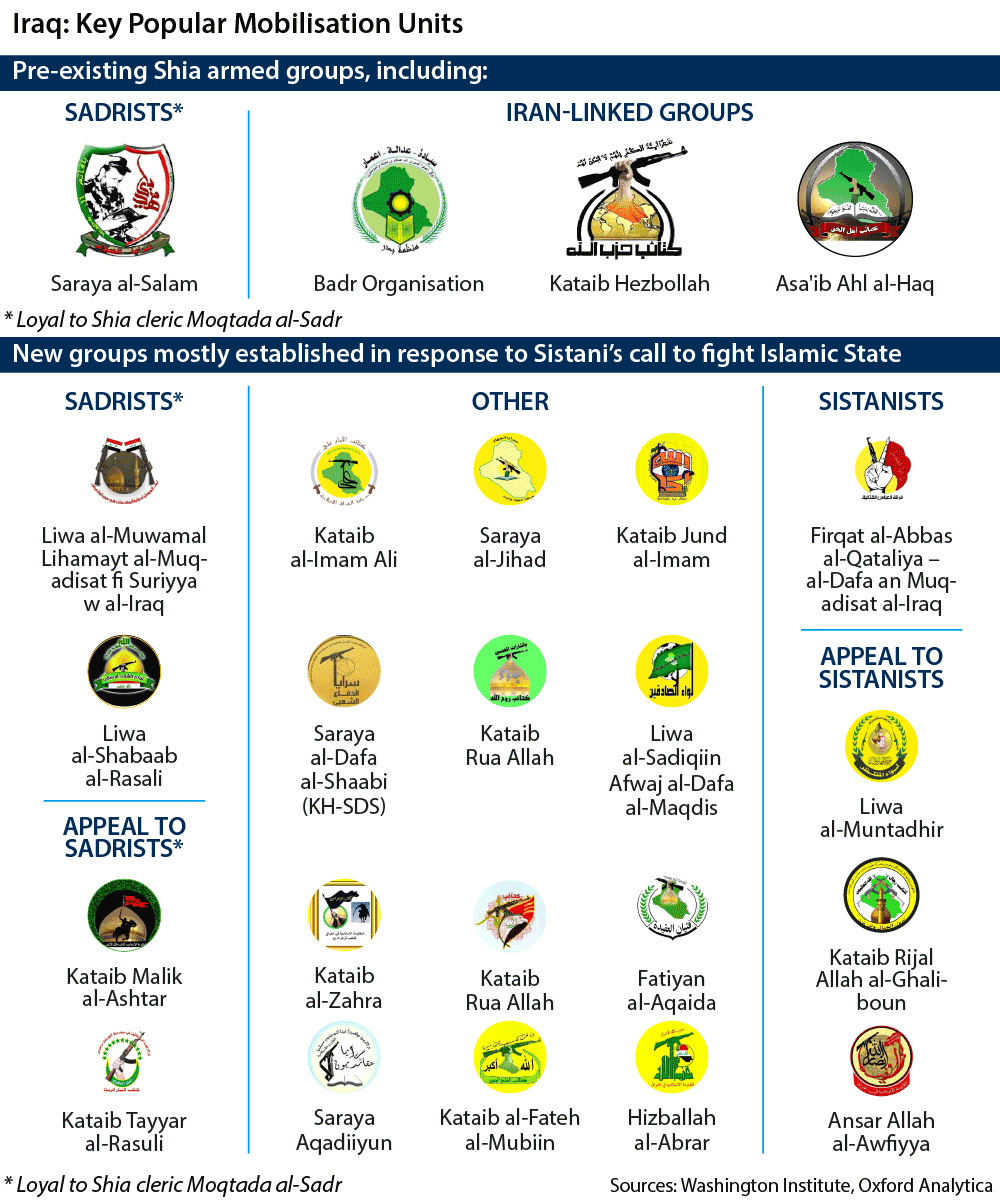
With the relationship between military intervention and domestic public support in mind, the comparison of forces between Iran and the United States depends more on willingness to use those forces than the capabilities they represent. On the surface, Iran faces the overwhelming power projection of the United States, along with the conventional superiority of US and Gulf Cooperation Council military forces. Despite this disparity, Iran is able to use a suite of conventional, unconventional, and proxy forces to deter potential aggressors, compete with regional peers, and influence states it considers vital to its national security. Along these lines, Iran attempts to circumvent American military strengths against which the Iranian military would lose, in favor of asymmetric concepts including its ballistic missile program; anti-access, area denial tactics; and support to proxy groups.
These three methods hinge on a competition of resolve between Iran and its rivals to incur the costs of conflict: the former two affect the cost calculation of potential adversaries and the latter displays Iran’s willingness to assume more risk than its opponents in pursuit of its political ends abroad. Determining the interests for which Iran is willing to incur high costs is essential if the United States expects to “neutralize Iranian malign influence,” a priority identified in the 2017 National Security Strategy. This comes as the US public decidedly prefers intervention in the form of airstrikes and Tomahawk cruise missiles rather than ground troops who could actually influence partner forces determined to counter that Iranian influence.
Balance of Power in the Middle East
Kenneth Waltz quipped that “power begs to be balanced” while defending the notion that proliferation of nuclear weapons technology to Iran would stabilize the Middle East. For Waltz and other theorists who espouse a realist view of international politics, the Middle East faces a two-pronged challenge to future stability based on the distribution of power among states therein. First, Israel’s possession of nuclear weapons under “strategic ambiguity” makes the relationship between Israel and other states in the region inherently imbalanced and therefore prone to conflict. Second, US abandonment of its “dual containment” strategy in favor of aggressive interventionist policies in the wake of the September 11 terrorist attacks destroyed Iraq as a major Middle East power and the regional bipolar balance between Iraq and Iran as a consequence.
According to realists’ view, even distributions of power promote stability and peace as the cost-benefit analysis of war yields little chance of positive gains against an adversary of similar strength, whereas uneven distributions of power increase the uncertainty of intentions between states who assess war as a likely result of a zero-sum security competition. In this latter scenario, weaker states tend to balance against stronger rivals by increasing political, military, and economic power through either internal means or alliance formation. As Stephen Walt further points out in his work “Alliance Formation and the Balance of Power,” this balancing behavior is most likely when states assess a rival as having not only the capability of attacking, but also the intention of doing so. Furthermore, situations where states face an overwhelming power differential are particularly vexing because the prospects of successfully balancing are so grim.
There is, however, a difference between possessing military power and actually using it, especially when doing so involves risks to domestic political support and stability. Whereas William Wohlforth in his article on unipolarity predicts that no state would bother attempting to balance against the clear and unambiguous military and economic superiority of the United States, the aftermath of the wars in Iraq and Afghanistan have led potential rivals to reassess US willingness to use its insurmountable ability to project and sustain military force. Therefore, rather than competing with the entire US military, Iran must make foreign policy decisions based on the military forces it expects the United States and its partners to use regionally. When the fight is between proxies and special operations forces, Iran’s prospects for balancing against its regional rivals and expanding its influence are less daunting and even optimistic.
Iran’s Play in Syria
Iran has been on a trajectory of increasing commitment to Syria since an uprising nearly deposed the regime of Bashar al-Assad starting in 2011. Unwilling to lose a longstanding ally and mechanism of supporting proxy groups in Lebanon and Palestine, Iran has relied upon the Islamic Revolutionary Guards Corps (IRGC), especially the externally oriented Quds Force, to support the Syrian regime. Originally founded to defend the Islamic revolution in Iran from internal and external threats, the IRGC has expanded in scope as the political and military mechanism of choice for Iran to expand its influence in the Middle East. Beyond sending its own forces, Iran has used the IRGC to lead foreign fighters and has directed the deployment of Lebanese Hezbollah fighters to Syria by the thousands. Iran’s model for applying force in the Middle East plays to its asymmetric strengths, while exploiting the perceived weaknesses of the United States and its allies, which Iran regards as risk averse, sensitive to casualties, and reliant on technological superiority and regional bases from which to project power. Iran has displayed not only a willingness to assume risk by deploying IRGC operatives to contested and denied areas, but has also been sustaining casualties in its campaign in Syria.
These casualties have varied in number, nationality, and military unit since the beginning of Iranian intervention in Syria, which speaks to Iranian resolve to support the Assad regime. The Washington Institute for Near East Policy has done extensive research on Iranian media reporting of casualties in Syria. At first, the majority of those killed under the direction of Iran were Lebanese and Afghan, due to extensive Hezbollah deployments and IRGC recruitment of Afghan Shi’a to fight in Syria. Iranian casualties however, tended to be high-ranking IRGC members such as its deputy commander, Gen. Hossein Hamedani, who was killed in October 2015 near Aleppo. This indicates that IRGC operatives were training, advising, and leading Syrian units and foreign fighters, rather than their own military formations of lower-ranking Iranian soldiers.
As the civil war continued and foreign fighters could no longer sustain the tempo of operations, Iran began committing its own forces in 2015, including lower-ranking soldiers from IRGC units like the 2nd Imam Majtaba Brigade, 7th Vali Asr Division, and 2nd Imam Sajjad Brigade. These units are from the IRGC Ground Forces, whose security mandate is more internally focused than that of the Quds Force. This indicates not only a shift from a training and advisory mission to a more direct role in the fighting, but also a commitment of a larger portion of the Iranian armed forces to the fight in Syria. As a result, Iranian fatalities skyrocketed. However, Iran has given no indication of war weariness in the face of mounting human and economic costs of its unconventional fight in Syria, with even the semiofficial Fars news agency openly reporting IRGC casualties.
Domestic Backlash in Iran
Iran is no stranger to internal protests over domestic politics and foreign affairs. The Green Movement of June 2009 protesting the disputed re-election of Mahmoud Ahmadinejad showed that Iranian authorities cannot simply ignore public opinion and revealed a true power struggle between the government and the opposition. While the lasting effects of the Green Movement on the relationship between public opinion and Iranian decision-making are unclear, polling leading up to the signing of the Joint Comprehensive Plan of Action indicated vast public support in Iran for a deal, often in contrast with the public statements of Ayatollah Khamenei against it.
Recent massive public protests against Iranian macroeconomic conditions including high inflation and high unemployment have further displayed the Iranian government’s exposure to domestic political backlash for its policies. President Hassan Rouhani was reelected in 2017 by wide margins on a platform of economic hope in the wake of sanctions relief under the nuclear deal. However, inbound investment that results from improving economic relationships tends to benefit large conglomerates often owned by the IRGC like Khatam al-Anbiya, which has large stakes in the oil, transportation, and construction industries. Meanwhile, unemployment among youth and inflation remain high, as Iranian economic policies have not promoted growth that would create jobs for most Iranian citizens. As novelist Suzanne Collins’ character President Snow said in The Hunger Games: “Hope. It is the only thing stronger than fear. A little hope is effective. A lot of hope is dangerous. A spark is fine, as long as it’s contained.” Iranians have a lot of hope about their economic future; failure to deliver might lead to disaster, especially as Iran announces vast increases in military spending with an extra $7.5 billion to the IRGC (15 percent increase), $2.7 billion to the Iranian army (25 percent increase), and a separate $72 million subsidy directly to Khatam al-Anbiya.
Cost Calculation in Foreign Policy
Iran’s willingness to incur the costs of an aggressive foreign policy is not uniform across the Middle East. Iran views the outcome of the Syrian civil war as critical to its national interests and is therefore willing to expend physical and economic costs to sustain the Assad regime. However, Iran is reticent to suffer Syria-type casualties in places like Yemen, where Iran has limited its intervention to Lebanese Hezbollah fighters and high-ranking IRGC operatives leading Houthi militias. This is reminiscent of the “train, advise, and assist” mission that marked the initial phases of Iranian intervention in Syria. As a result, Iran has only sustained forty-four fatalities over the past two years of fighting in Yemen and has not publicized those deaths. This is problematic for Iran as Saudi Arabia and the United Arab Emirates show no signs of wavering in support of the government of Abdrabbuh Mansur al-Hadi, despite international backlash against the air campaign.
Conflicts like those in Yemen and Syria display the gruesome truth of the competition between the United States and Iran in the Middle East; namely, it boils down to a question of who wants it more. While the United States has shown its willingness to incur human and economic costs in Iraq and Afghanistan over the past fifteen years, it is not clear whether the American people would support another effort of similar size and scope in the near term. In fact, according to Gallup, American support for the ongoing campaign in Syria has reached historic lows when compared to other conflicts over the past thirty-five years. Furthermore, US Central Command, charged with leading military operations across the Middle East and Central Asia, is preparing to shift its priority back to Afghanistan—this as Iran shows no intention of decreasing its presence in either Iraq or Syria.
This is not to say that the United States cannot achieve its foreign policy goals vis-à-vis Iran in the Middle East without incurring high costs; it means that the United States will need to enable partners who are willing to do so. However, merely funding and providing material support to partner forces does not guarantee that they will act according to US national interests. That more elusive objective depends on the influence that sponsors have over proxies and still involves accepting a degree of risk. Although varying in scope depending on the target country, Iran exposes its IRGC operatives to the inherent dangers of the battlefield and shares that risk with its partners. Combined with what is often an ideological connection with proxies, this shared danger does much to influence the forces with which Iran partners. In contrast, the United States rarely exposes its special operations forces in the same way. In Iraq and Syria especially, the United States has largely demanded that its proxies assume the vast majority of the tactical risk, which negatively affects the perception of American resolve to accomplish its stated objectives.
Even overwhelming military force is only a useful deterrent if adversaries believe a state has the resolve to use it. American reticence to use the breadth of its military strength to counter Iranian influence in the Middle East has reduced the competition to irregular forces and both state and nonstate partners. In this realm, displaying resolve is still vitally important. Although recent protests indicate Iran is not immune to domestic backlash, Iran has shown a willingness to use and lose its special operations forces in external operations. The United States risks losing influence in the Middle East and control of its partner forces if it is not willing to expose its own special operations forces in a similar way. In the end, the competition between the United States and Iran in the Middle East comes down to resolve.
3. Throughout the Class Periods, and in violation of California law, Google employees
who expressed views deviating from the majority view at Google on political subjects
raised in the workplace and relevant to Google’s employment policies and its business, such as “diversity” hiring policies, “bias sensitivity,” or “ social justice,” were/are singled out, mistreated, and systematically punished and terminated from Google, in violation of their legal rights.
4. Google’s open hostility for conservative thought is paired with invidious
discrimination on the basis of race and gender, barred by law. Google’s management goes to extreme—and illegal—lengths to encourage hiring managers to take protected categories such as race and /or gender into consideration as determinative hiring factors, to the detriment of Caucasian and male employees and potential employees at Google.
5. Damore, Gudeman, and other class members were most racized, belittled, and punished
for their heterodox political views, and for the added sin of their birth circumstances of being
Caucasians and/or males. This is the essence of discrimination —Google formed opinions about and
then treated Plaintiffs not based on their individual merits, but rather on their membership in groups
Yup that commie phrase we have come to know well…white privilege…in the case of Google it was ‘white male privilege’.
Google Punished Gudeman for His Views on Racism and Discrimination
88. After being reported to Google, Google HR spoke with Gudeman in or around
September 2015 regarding his posts.
89. Google HR discussed Gudeman’s viewpoints on race and/or gender equality, and his
political viewpoints. Google HR chastised him for attempting to stand up for Caucasian males and his conservative views.
90. At the end of the HR meeting, Gudeman was issued a verbal warning.
91. Gudeman complained to his colleagues about the lack of fairness that conservatives
received at Google, and the leeway Google provided for liberals to express their thoughts and opinions without repercussions.
92. After the 2016 presidential election, many employees at Google began to panic, having
expected a different outcome fully in line with their political views.
The Corporate Internal Blacklist
131. Google’s management-sanctioned blacklists were directed at specific Google
employees who tactfully expressed conservative viewpoints in politically-
charged debates. In one case, Jay Gengelbach, a L6 SWE Manager, publicly bragged about blacklisting an intern for failing to change his conservative views.
133. Kim Burchett (“Burchett”), a L7 SWE Manager, proposed creating an online
companywide blacklist of political conservatives inside Google. She was kind enough to suggest to her readership that they might deserve “something resembling a trial” before being added.
134. On August 7, 2015, another manager, Collin Winter, posted threats directed at a Google employee as a result of raising concerns of harassment and discrimination
to Urs Holzle. Winter stated: “I keep a written blacklist of people whom I will never allow on or near my team, based on how they view and treat their coworkers. That blacklist got a little longer today.”
135.
Also on August 7, 2015, another manager, Paul Cowan, reshared Collin Winter’s threat
to express his agreement with it and to indicate that he had also blacklisted Google employees with perceived conservative views. Cowan stated: “If you express a dunderheaded opinion about religion, about politics, or about ‘social justice’, it turns out I am allowed to think you’re a halfwit… I’m perfectly within my rights to mentally categorize you in my dickhead box… Yes, I maintain (mentally, and not (yet) publicly) [a blacklist]. If I had to work with people on this list, I would refuse, and try to get them removed; or I would change teams; or I would quit.”
Heck you can read the 161 page lawsuit here complete with screen captures of internal employee chats with each other. Swell place eh?
Former White House strategist’s longtime benefactors, billionaires Robert Mercer and his daughter Rebekah, are distancing themselves from him
Whew….okay so now what? Well after two cease and desist orders, that book ‘Fire and Fury’ hit the bookshelves early as the publisher dismissed the order.
So, what will Bannon do now? Will he stay at Breitbart, look for other benefactors and launch another similar political media operation?
Well, it seems Bannon has made some other interesting contacts with very deep pockets. Back in October of 2017, the Chinese fugitive tycoon Guo Wengui on Tuesday posted photographs on Twitter of himself meeting former White House chief strategist Steve Bannon twice in less than a week.
In the post, the billionaire businessman, who is wanted in China on corruption charges, said he first met Bannon for lunch in Washington on Thursday after attending an event at the National Press Club. The second meeting came on Tuesday, when Bannon and his team visited Guo’s home in New York for a 3½-hour dinner.
The post was accompanied by four photographs of the two men. It did not say what they talked about, but said Bannon had agreed for the images to be posted on the social media site. According to unnamed sources cited by the Financial Times last month, Wang and Bannon met for about 90 minutes at the party’s headquarters in Zhongnanhai. The report said Wang asked Bannon, who left U.S. President Donald Trump‘s administration in mid-August, about economic nationalism and populist movements – the subject of Bannon’s speech at an investor conference in Hong Kong in mid-September.
The Chinese government has made various attempts to discredit Guo, who is wanted in connection with several alleged crimes including bribery, fraud and rape. He is also the subject of an Interpol red notice that Beijing requested in April.
While speaking at the National Press Club event on Thursday, Guo said China had sent dozens of spies to the U.S., but his claims were later dismissed by the Chinese Ministry of Public Security.
As well as visiting China, Bannon last month travelled to the United Arab Emirates, where he met the crown prince of Abu Dhabi, Sheikh Mohammed bin Zayed Al Nahyan, The New York Times reported.
Chinese financial magazine Caixin reported in July that Guo had been introduced to bin Zayed in 2013, and that the prince had helped him to raise $3 billion for a fund jointly held by Guo and Abu Dhabi authorities. More here.
*** Could this bring a new headache for the Trump White House or throw more sand in the diplomatic gears between the United States and China?
Again back in October….
On Sunday, the Wall Street Journal published a gripping account of fugitive billionaire Guo Wengui’s time in the United States and efforts by Chinese security services to apprehend him. The story is well worth the read and sheds light on how agents with China’s Ministry of State Security (MSS) — the country’s foreign and domestic intelligence arm — attempted to retrieve Guo in New York City, where he currently resides. (Guo has lived outside China since 2015.)
Guo, who also goes by Miles Kwok, is something of a celebrity in the China-watching world for the spectacular allegations he’s gradually unveiled and levied against many in China’s top leadership. Even without verification or corroboration, Guo’s perception as a once-in-the-loop politico in China has won him many friends stateside. He claims to have worked closely with Chinese intelligence and to have intimate knowledge of the personal and financial dealings of the Chinese Communist Party’s top elites.
The Chinese government’s heavy-handed attempts to censor him thrust him into prominence. Earlier this year, an hours-long Voice of America interview with Guo was cut short, reportedly after receiving a request from the Chinese foreign ministry. Since that interview, Voice of America clarified that it had not verified several claims Guo made and it did not endorse them. Guo had alleged, among other things, that Wang Qishan, China’s powerful anti-corruption czar, had taken a large interest in HNA Group, a powerful conglomerate. That claim resulted in a defamation suit against Guo by HNA Group.
Many of Guo’s claims have been impossible to verify via open sources, but he remains widely popular because there is enough of a degree of plausibility to many of his allegations to keep observers interested. Moreover, the Chinese government hasn’t simply written off Guo as a disgruntled billionaire with a score to settle. The concerted effort to retrieve and silence him lends credence to the idea that at least some of what Guo either knows or has already revealed has deeply irked China’s leadership. (Indeed, even if everything Guo was alleging was false, the Chinese Communist Party would hardly have wanted these rumors emerging just months before the soon-to-conclude 19th Party Congress.)
What’s so remarkable about the Journal‘s story is the detail it provides on the MSS’ efforts within the United States to contact Guo and the U.S. response. The latter is in some ways the more interesting component of the story. While President Donald Trump appeared positively disposed toward the Chinese government and was eager to help China out by deporting Guo — the U.S. and China don’t have an extradition treaty — his staff tried to stay his hand by pointing out that Guo belonged to Trump’s Mar-a-Lago club!
What’s more, the Guo story contains all the hallmarks of a tough interagency problem. The Journal outlines the tug-of-war between the State Department and the Federal Bureau of Investigation on the matter of the MSS agents who had been operating outside of the confines of their visa in the United States. State, unsurprisingly, preferred to take a softer approach to avoid kicking up a diplomatic hornet’s nest at a time when the United States is seeking Chinese cooperation on issues ranging from North Korea to trade policy.
What’s clear for now is that the Guo Wengui saga is far from over. Indeed, following the conclusion of the 19th Party Congress and Trump’s upcoming trip to China, he could turn into a more serious flashpoint in U.S.-China ties. In the meantime, Guo has started associating with ardent anti-China voices in the United States, including former White House Chief Strategist Steve Bannon. By all appearances, Guo’s role in the story of U.S.-China relations in the Trump era may have just begun. Hat-tip
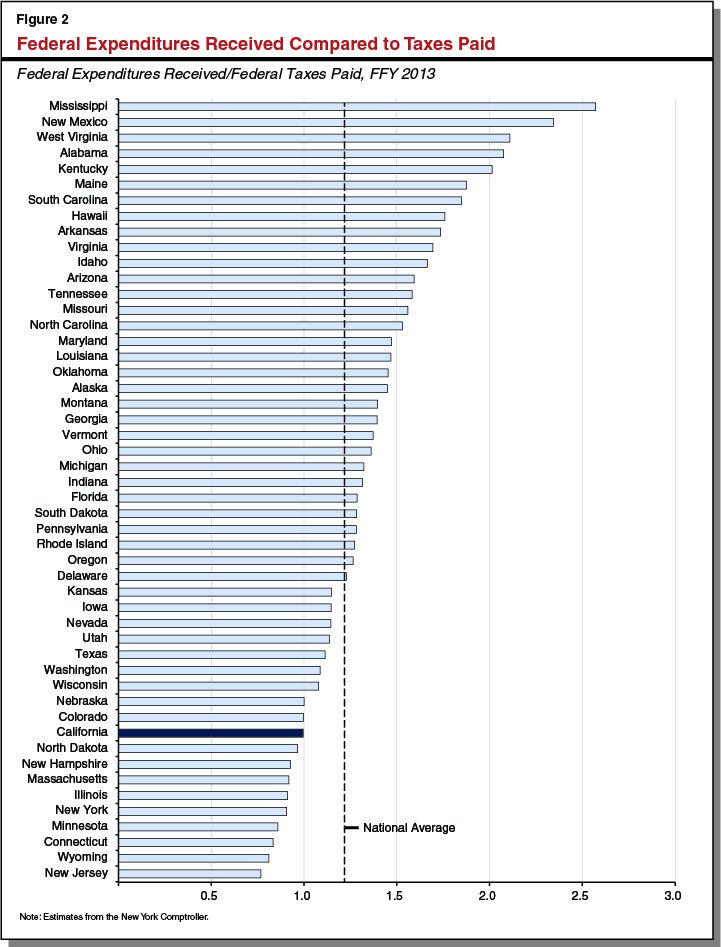
Federal dollars going to California could or should be considered foreign aid. Why? Read on…
The federal government spends some $367.8 billion a year on California. That’s an average of about $9,500 for every woman, man and child in the state.
In truth, the money isn’t spread out evenly. About 56 cents of every federal dollar spent in California, according to the analysis, goes to health or retirement benefits — Social Security, Medicare and money for low-income residents’ health care through the Medi-Cal program.
Defense contracts are the next biggest slice of the pie, followed by paychecks to military and civilian government employees. From there, federal spending gets sprinkled among a number of programs run by the state government. Gov. Jerry Brown’s recent budget plan pegged those funds at a total of $105 billion, equivalent to about 58% of state taxpayer dollars to be spent in the fiscal year that begins on July 1.
So, now that California is officially a sanctuary state under SB54, effective January1, 2018, those illegals, felons and those plotting threats with regard to national security can freely travel anywhere, this is not just a California problem.
Last year, when President Donald Trump issued an executive order to cut funding from counties that limit cooperation with U.S. immigration authorities, Santa Clara County stood to lose $1.7 billion in federal funding. After fighting the order, a federal judge ruled in favor of the county. Now that the entire state is following the same guidelines, some leaders argue it could strengthen their position in future legal battles.
Not everyone is onboard, however. Some California sheriff’s departments have criticized the new sanctuary state law, saying it will lead to broad roundups that could lead to collateral arrests. More here.
Prohibits state and local law enforcement from holding illegal aliens on the basis of federal immigration detainers, or transferring them into federal custody, unless they’ve been convicted in the last 15 years for one of a list of 31 crimes, or are a registered sex offender: if not, they may only be held with a warrant from a federal judge.
Prohibits state and local law enforcement from asking anyone about their immigration status.
Prohibits state and local law enforcement from sharing any information with federal immigration authorities that is not available to the general public.
Prohibits state and local law enforcement from using any of their money or personnel to “investigate, interrogate, detain, detect, or arrest persons for immigration enforcement purposes”.
Prohibits state and local law enforcement from allowing federal immigration authorities to use space in their facilities.
Limits how and when state and local law enforcement can contract with federal immigration authorities.
Grants discretion to state and local law enforcement to cooperate even less with federal immigration authorities than the bill authorizes them to, but not more
Is near-universally recognized and described by both its supporters and opponents as a sanctuary state bill: protects illegal aliens at the expense of citizens, will increase illegal immigration to California, and sends the message that illegal aliens are welcome everywhere in the state.
***
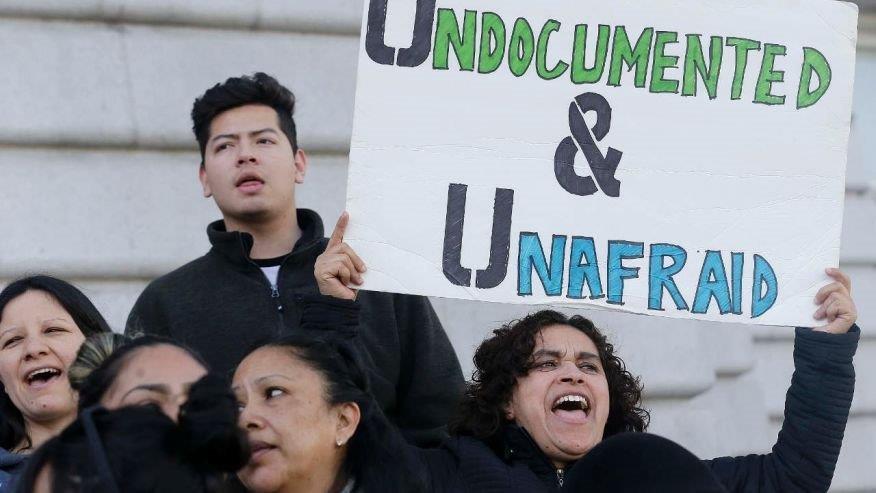
State Senate Leader Kevin de Leon, the author of the bill, has argued that public safety will be undermined if the law isn’t passed. It is estimated that more than 2 million undocumented people live in California — with hundreds of thousands from Asia as well as Latin America — and advocates say many will be scared to interact with official institutions if they fear that will put them on federal immigration agents’ radar. They say individuals might not report violent crimes to police, might not send their kids to school or might not seek medical care at the local hospital. And there is some evidence to back that up: Earlier this year, the Los Angeles Police Department said that Latino communities were reporting fewer instances of sexual assault and domestic violence because of concerns about deportation under Trump. More here.
***
California Democratic state Senate president Kevin de León intends to enter California’s 2018 Senate race against Sen. Dianne Feinstein, three sources with knowledge of his plans say.
De León has begun calling labor leaders and elected officials to inform them of his plans, the sources said, and is expected to soon announce his campaign against Feinstein, a giant of California Democratic politics who has held the office since 1992.
The 50-year-old de León, who represents Los Angeles and is seen as a leading Latino voice in Democratic politics, is likely to campaign aggressively against President Donald Trump. He began signaling he could oppose Feinstein in late August, after she said Trump could “be a good president” and that he “can learn and change.” Feinstein later clarified that she is “under no illusion that it’s likely to happen and will continue to oppose his policies.” More here.
So who is this de Leon character? That is a challenge to determine and he has not been fully forthcoming on his own history. Check it out here.
De León was the first and only person in his family to graduate from high school and attend college. He started out at the University of California Santa Barbara, but it was a challenge. He had moxie but no organizational skills, no practice at taking notes or studying for a test. He didn’t last long.
He couldn’t go back home and tell his mother of his failure. Instead, he went to work for One Stop Immigration Center, a nonprofit in Los Angeles that helps undocumented immigrants fill out paperwork and teaches them English, history and organizing.
Then, the Attorney General for California is Javier Beccera. He is a loyal and dedicated supported of the Dream Act and will defend all cases against California becoming a sanctuary state. Meanwhile, remember that whole Pakistani IT case in Congress under Debbie Wasserman Schultz?
Enter again Javier Beccera.
Now-indicted former congressional IT aide Imran Awan allegedly routed data from numerous House Democrats to a secret server. Police grew suspicious and requested a copy of the server early this year, but they were provided with an elaborate falsified image designed to hide the massive violations. The falsified image is what ultimately triggered their ban from the House network Feb. 2, according to a senior House official with direct knowledge of the investigation.
The secret server was connected to the House Democratic Caucus, an organization chaired by then-Rep. Xavier Becerra. Police informed Becerra that the server was the subject of an investigation and requested a copy of it. Authorities considered the false image they received to be interference in a criminal investigation, the senior official said.
On Jan. 24, 2017, Becerra vacated his congressional seat to become California’s attorney general. “He wanted to wipe his server, and we brought to his attention it was under investigation. The light-off was we asked for an image of the server, and they deliberately turned over a fake server,” the senior official said.
“They were using the House Democratic Caucus as their central service warehouse … It was a breach. The data was completely out of [the members’] possession. Does it mean it was sold to the Russians? I don’t know,” the senior official said.
Capitol Police considered the image a sign that the Awans knew exactly what they were doing and were going to great lengths to try to cover it up, the senior official said. The House Sergeant-at-Arms banned them from the network as a result.
The senior official said the data was also funneled offsite via a Dropbox account, from which copies could easily be downloaded. Authorities could not immediately shut down the account when the Awans were banned from the network because it was not an official account. More here.
One last item…don’t forget to keep Eric Holder in the whole mix regarding California.
The California Senate is throwing its support behind Chicago in a lawsuit against the Justice Department over its plan to withhold federal money from “sanctuary cities,” which limit collaboration between state and local authorities with federal immigration agents.
Former U.S. Atty. Gen. Eric H. Holder Jr. and his firm, Covington & Burling, on Thursday filed a friend-of the-court brief on behalf of the state Senate in the federal case, saying sanctuary jurisdictions have policies consistent with federal law.
U.S. Atty. Gen. Jeff Sessions, Holder says, does not have the constitutional authority to mandate that cities, counties or states participate in federal immigration efforts as a condition to receive their federal public safety awards.
The lawsuit, filed last month by Chicago Mayor Rahm Emanuel and city officials, asks a judge to block the Trump administration from enforcing three new conditions it included in petitions for Edward Byrne Memorial Justice Assistance Grant money. The city uses the grant to buy police cars and other equipment, and to fund an anti-violence program.
Holder, who was said to have filed the brief pro-bono, was temporarily hired by the Senate and Assembly to serve as outside counsel to offer advice on the state’s legal strategy against the incoming administration. On Friday, a Covington & Burling spokeswoman said the firm remains “engaged with the California Senate on an ongoing basis.”
In the brief, Holder said the California Legislature has a particular interest in the Chicago case as it weighs Senate Bill 54, which seeks to limit state and local law enforcement agencies from using resources to question, detain and provide information on immigrants illegally in the country.
Covington & Burling analyzed the legislation this year and concluded that “states have the power over the health and safety of their residents and allocation of state resources.”