Davos: Europe’s Social Breakdown, Begins with Immigration

And all the signals are beginning to apply to the United States….fair warning.

Davos/World Economic Forum

Davos Boss Warns Refugee Crisis Could Be Precursor to Something Much Bigger

Bloomberg: As the crash in commodities prices spreads economic woe across the developing world, Europe could face a wave of migration that will eclipse today’s refugee crisis, says Klaus Schwab, executive chairman of the World Economic Forum.

“Look how many countries in Africa, for example, depend on the income from oil exports,”Schwab said in an interview ahead of the WEF’s 46th annual meeting, in the Swiss resort of Davos. “Now imagine 1 billion inhabitants, imagine they all move north.”

Whereas much of the discussion about commodities has focused on the economic and market impact, Schwab said he’s concerned that it will also spur “a substantial social breakdown.”

That fits into what Schwab, the founder of the WEF, calls the time of “unexpected consequences” we now live in. In the modern era, it’s harder for policy makers to know the impact of their actions, which has led to “erosion of trust in decision makers.”

“First, we have to look at the root causes of this,” Schwab said. “The normal citizen today is overwhelmed by the complexity and rapidity of what’s happening, not only in the political world but also the technological field.”

That sense of dislocation has fueled the rise of radical political leaders who tap into a rich vein of anger and xenophobia. For reason to prevail, Schwab said, “we have to re-establish a sense that we all are in the same boat.”

The theme for this year’s meeting is the Fourth Industrial Revolution, which the WEF defines as a “fusion of technologies that is blurring the lines between the physical, digital, and biological spheres.”

While that presents huge opportunities, Schwab warns that technological innovation may result in the loss of 20 million jobs in the coming years. Those job cuts risk “hollowing out the middle class,” Schwab said, “a pillar of our democracies.”

At the same time, Schwab argues, trends like the sharing economy and the changes wrought by technology mean economists must adapt the tools they use to assess well-being. “Many of our traditional measurements do not work anymore,” he said.

After decades watching the ebbs and flows of the global economy, Schwab said the current anxiety is “not new” for him. But he said that as the world gets ever more interconnected, the consequences of such turmoil could become more grave. This week’s WEF meeting, he said, will offer policy makers “the first opportunity after the markets have come down to look at the situation and coordinate.”

Davos facts for this year:

CNNMoney: Around 2,500 participants from more than 100 countries, including 40 heads of state, attend the gathering in Switzerland, formally known as the World Economic Forum annual meeting. This year, the theme is “Mastering the Fourth Industrial Revolution.”

It takes place in the mountains. Way up. At 1,560 meters (5,120 feet) above sea level, Davos is Europe’s highest town. Its population is just over 11,000 and the average temperature in January is -5°C/23°F.

Why in such a remote, cold place? Tradition. Also, it’s much easier to secure a little town wedged between the mountains than a conference center in a big city — remember, 40 heads of states are coming.

Only once was the meeting held outside of Davos: In 2002, in New York, as a gesture of solidarity after the 9/11 terrorist attacks.

Davos is safe. The organizers don’t release specific information, but it is estimated that around 5,000 Swiss troops, police and security personnel guard the town.

Davos is pricey. The ticket is around $20,000 and that’s just the tip of the iceberg. Travel can cost thousands, and a night in a medium-range hotel is around $600. Add to it wining, dining, and essential accessories like snow boots, and the total bill can add up to around $40,000.

Davos is green. The town’s CO2 levels fall on average up to 30% during the annual meeting, thanks to controls on vehicle emissions and the use of electric transport.

Besides the skiing, what’s it all about? Meetings. Hundreds of them. With major companies, countries and media represented, there is hardly a better opportunity to schmooze and make deals. But the forum is not about big public announcements. Meetings are informal and take place behind closed doors.

Who is coming this year? Nearly everyone who matters in the world of business. Bill Gates will be there, as will Mary Barra, Satya Nadella, Jack Ma, Eric Schmidt, Sheryl Sandberg and dozens of other CEOs.

The IMF chief Christine Lagarde will be in Davos, with ECB President Mario Draghi and the governors of 10 national central banks.

The U.S. will be represented by Joe Biden and John Kerry. Loretta Lynch, the U.S. Attorney General, is also coming, as is Penny Pritzker, the Secretary of Commerce.

The King and Queen of Jordan will be there, as will Bono, Leonardo DiCaprio, Yao Chen and will.i.am.

They’ll all be closely followed by around 250 journalists, including a posse from CNN.

And the no-shows? Neither Barack Obama nor Vladimir Putin are coming to Switzerland. German Chancellor Angela Merkel is also sitting it out this year.

Iran Implementation Day and Iran’s Connection to Islamic State

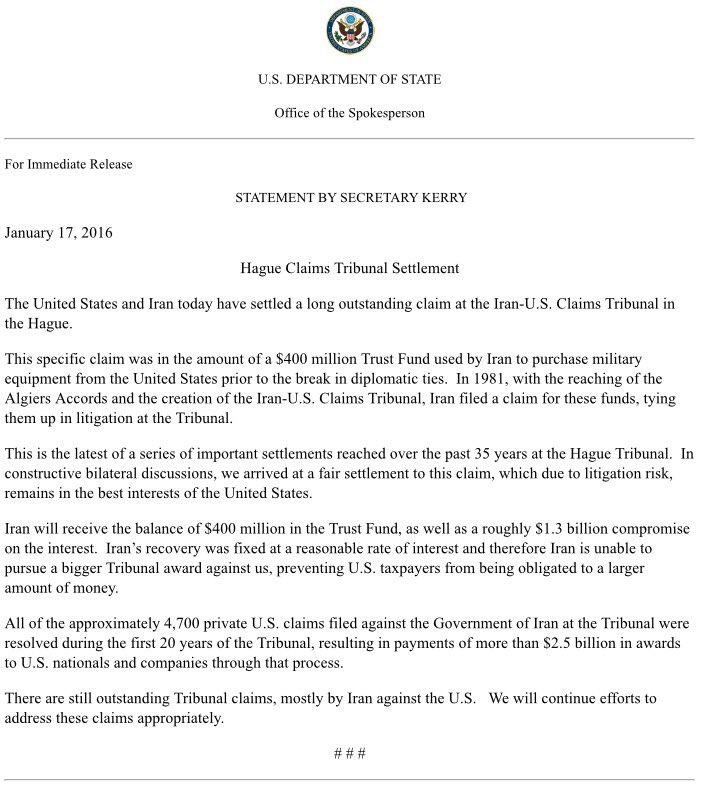
The money to Iran is already moving.

Embedded image permalink

This is going to be a long read, but an important one such that history is included, details of diplomacy is included and described implications are described. Imagine what the next president of the United States will have to deal with, but more, imagine what Iran may do in the immediate coming months with $100 billion dollars, which by the way is bigger than Iran’s current economic value.

Iran Is More Deeply Tied to ISIS Than You Think

As the West continues to partner with Iran to “degrade and ultimately destroy” the Islamic State, it is worth remembering that one of Iran’s highest-ranking terrorists was instrumental in founding Al-Qaeda, and that the split between Shia and Sunni jihadis is murky at best.

Iranian operative Imad Mughniyeh was instrumental in the training, development, and support of Hezbollah, Hamas, and al-Qaeda – and thus its offshoot, the Islamic State.

The power vacuum Mughniyeh created helped to further Iran’s geopolitical agenda. (This is a very long, detailed and important read, don’t miss the whole summary)

In part from the WSJ: The head of the Treasury Department’s Office of Terrorism and Financial Intelligence is in Europe to discuss joint counterterrorism finance efforts and where things stand with the global agreement on Iran’s nuclear program. Talks on the former will be straightforward enough, but the latter could get bumpy.

Over the past few months, investors from Europe and Asia have gone to Tehran in droves, searching for post-sanction deals and bolstering Iranian hopes that the lifting of international sanctions will draw significant investment. Some in Europe have described Iran “as ‘an El Dorado’ and potential ‘bonanza.’ ” The chief of Iran’s central bank has cited the country’s “unique geographical advantage,” its “sense of timeliness and discipline,” and “very good history of being a trade partner.” In October, he predicted that “Iran will be a very favored destination for many international investors.”

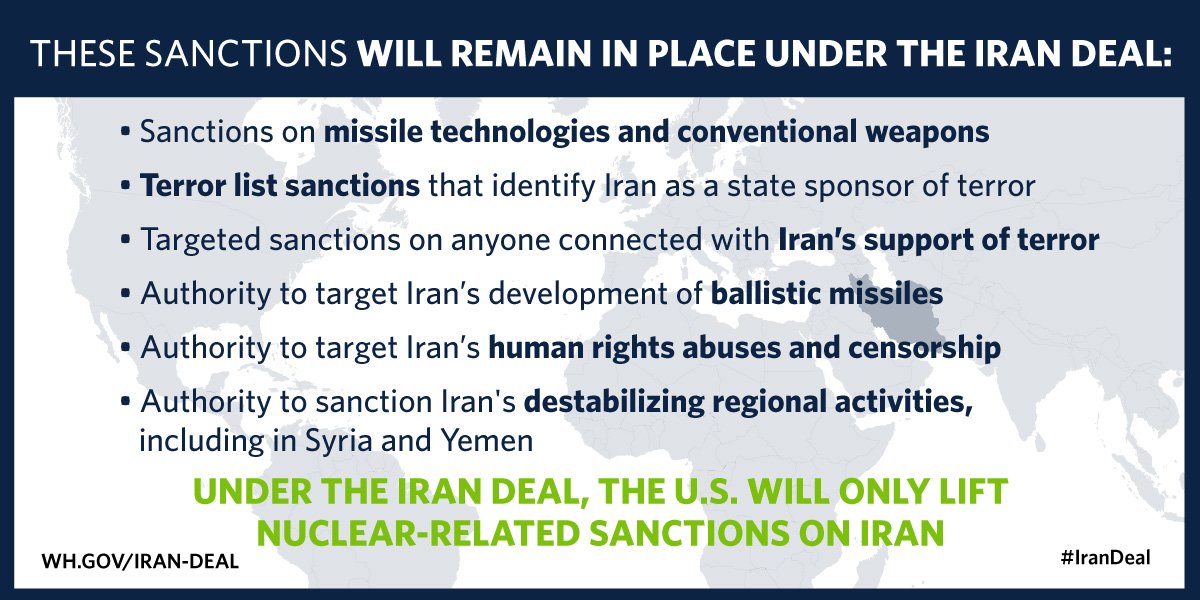
But Treasury officials bear mixed news: The U.S. is preparing to meet its commitments on sanctions relief tied to implementation of the nuclear deal. Still, many U.S. sanctions tied to Iran’s support for terrorism, human rights abuses, and other negative behaviors remain in place.

And within days of the Iranian central banker’s comments in October, the Financial Action Task Force, which sets global standards on countering money laundering and terrorist financing, issued another searing rebuke of Iran’s “strategic deficiencies.” Only Iran and North Korea, the task force said, present such “on-going and substantial money laundering and terrorist financing” risks that the international community should apply active “counter-measures” to protect the global financial system.

The task force said that as sanctions are being lifted under the nuclear agreement, it “remains particularly and exceptionally concerned about Iran’s failure to address the risk of terrorist financing and the serious threat this poses to the integrity of the international financial system.” It repeated its long-standing call for financial institutions to “give special attention to business relationships and transactions with Iran, including Iranian companies and financial institutions.” The full story is here.

From the White House:

Embedded image permalink

From the Treasury Department in part:

Implementation Day Statement:

On July 14, 2015, the P5+1 (China, France, Germany, Russia, the United Kingdom, and the United States), the European Union, and Iran reached a Joint Comprehensive Plan of Action (JCPOA) to ensure that Iran’s nuclear program will be exclusively peaceful.  October 18, 2015 marked Adoption Day of the JCPOA, the date on which the JCPOA came into effect and participants began taking steps necessary to implement their JCPOA commitments.  Today, January 16, 2016, marks Implementation Day of the JCPOA.  On this historic day, the International Atomic Energy Agency (IAEA) has verified that Iran has implemented its key nuclear-related measures described in the JCPOA, and the Secretary State has confirmed the IAEA’s verification.  As a result of Iran verifiably meeting its nuclear commitments, the United States is today lifting nuclear-related sanctions on Iran, as described in the JCPOA.
In connection with reaching Implementation Day, today the Department of the Treasury’s Office of Foreign Assets Control (OFAC) issued several documents.  Specifically, OFAC posted to its website: Guidance Relating to the Lifting of Certain Sanctions Pursuant to the Joint Comprehensive Plan of Action on Implementation Day; Frequently Asked Questions Relating to the Lifting of Certain U.S. Sanctions Under the Joint Comprehensive Plan of Action (JCPOA) on Implementation Day; General License H: Authorizing Certain Transactions relating to Foreign Entities Owned or Controlled by a United States Person; and a Statement of Licensing Policy for Activities Related to the Export or Re-Export to Iran of Commercial Passenger Aircraft and Related Parts and Services. The aforementioned documents are effective today, January 16, 2015.
***

Political Challenges to the Iran Deal in Tehran and Washington

By Aniseh Bassiri Tabrizi and Timothy Stafford
The Iran deal remains at the mercy of a volatile and unpredictable political climate, both in Tehran and Washington. This could well overwhelm it in the coming year.

Ticking the Boxes: Tehran’s Road to ‘Implementation Day’

By Aniseh Bassiri Tabrizi
To make the deal successful, intensive co-ordination between domestic actors in Iran will be required to implement these highly technical processes.

The Devil is in the Detail: The Financial Risks to the Economic Success of the Iran Deal

By Emil Dall, Andrea Berger and Tom Keatinge
Over the last decade, the US and EU have constructed a complex network of sanctions in response to Iran’s nuclear programme, ensuring the near-total isolation of Iran from global markets. On ‘implementation day’, this network starts to be disassembled and reintegration begin.

Iran Implementation Day Recommendations

The signatories to the Iran nuclear deal should move to entrench processes that will enable the agreement to outlast the individuals that put it in place. By this time next year, a new US president will have been sworn in, and presidential elections in Iran will only be just months away. Time must be used wisely.

Senator Session’s Book on Immigration and Green Cards

Under Barack Obama, the United Nations is also the headquarters of who can claim a new identity, that of an American. The same does for Europe, the world is one big global citizen, loyal to nothing and fully borderless.

Hat tip to Chuck and Daily Caller:

Jeff Sessions Releases Book Of Charts Putting Immigration And Green Card Issuances Into Shocking Perspective

Alabama Sen. Jeff Sessions released a book of graphs and charts on Wednesday that helps put the U.S.’s relaxed immigration policies in shocking perspective.

“Record-breaking visa issuances propelling U.S. to immigration highs never before seen,” is the sub-title to the Republican immigration hawk’s “chart book.”

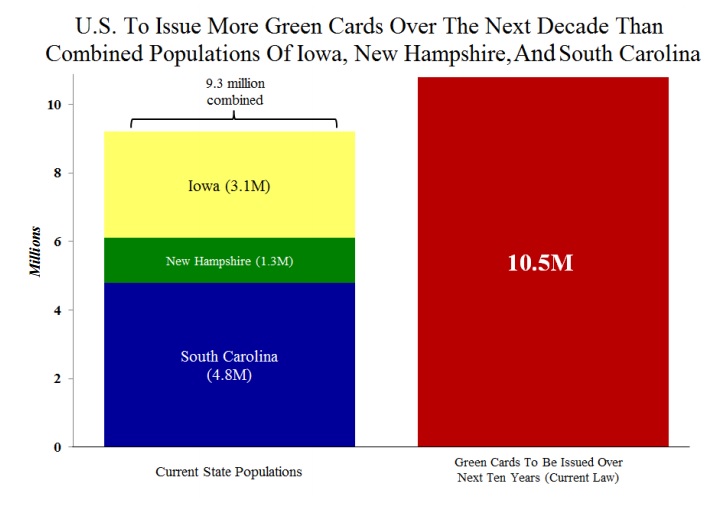
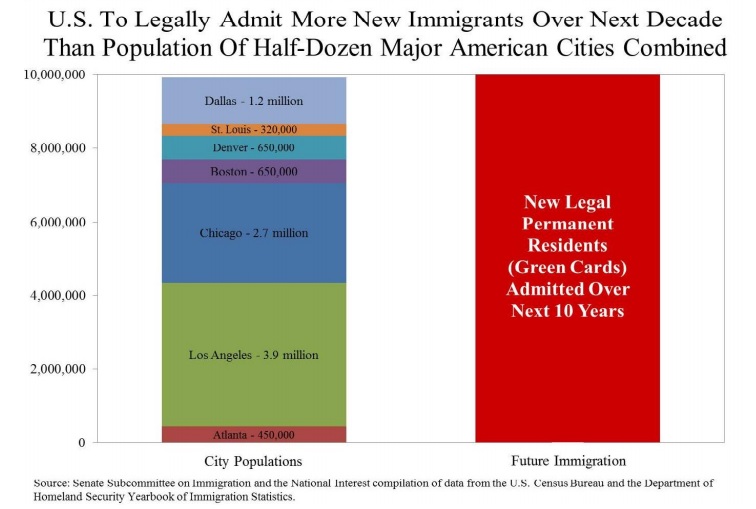
Sessions, who chairs the Senate Subcommittee on Immigration and the National Interest, asserts that the federal government will legally add 10 million or more “new permanent immigrants over the next 10 years.”

He also cites polls showing that a “stark” majority of Americans want lawmakers to reduce immigration rates, not increase them. Polls from Gallup and Fox show that Americans support an immigration reduction to an increase by a 2-to-1 margin.

Sessions’s chart book is aimed at providing readers an easy-to-understand frame of reference for immigration flows and green card issuances, past and present.

In one chart, Sessions compares the number of green cards that will be issued in the next decade to the population of the first three presidential primary states — Iowa, New Hampshire, and South Carolina.

Alabama Sen. Jeff Sessions "Chart Book"

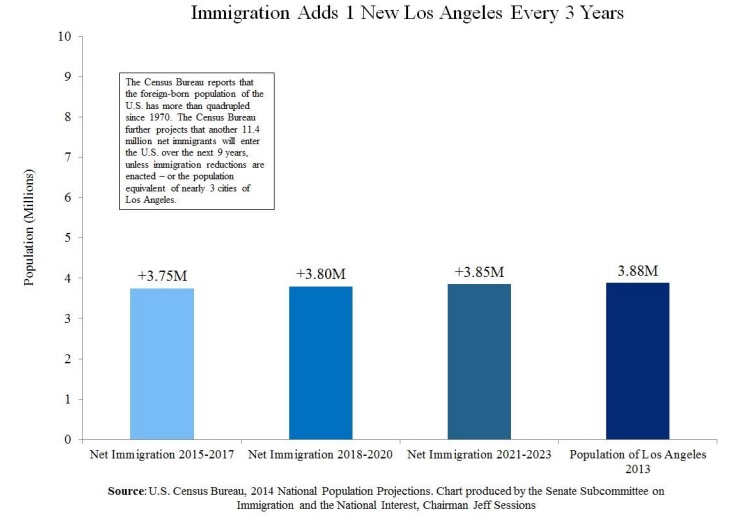
Another chart entitled “Immigration Adds 1 New Los Angeles Every 3 Years,” which is based on U.S. Census Bureau statistics and population projections, shows that the 11.4 million immigrants will enter the U.S. over the next nine years. “Unless immigration reductions are enacted,” the immigration population will increase in size equal to the population of Los Angeles — 3.9 million — every three years, Sessions notes.

sessions2 The number of green card issuances that can be expected over the next decade is also the equivalent of the combined population of seven of the largest cities in the U.S., including Los Angeles, Chicago, and Dallas, St. Louis, Denver, Boston, and Atlanta, Sessions notes.

sessions3

Other charts include one which shows that the U.S.’s immigration population will grow to more than 700 percent of 1970 levels by 2060.

By then, the U.S. will have 78.2 million foreign-born residents, according to the U.S. Census Bureau. In 1970, that number was 9.6 million.

And another chart takes aim at immigration from majority-Muslim nations. The U.S. has issued 680,000 green cards to migrants from those nations in the last five years, reports Sessions, citing statistics from the Department of Homeland Security.

Sessions’s “chart book” also includes stats on welfare usage rates for Middle Eastern refugees. According to a 2013 report from the Office of Refugee Resettlement, 91.4 percent of refugees from the Middle East are on food stamps. Nearly 70 percent — 68.3 percent to be exact — receive cash welfare assistance.

Other charts compare the U.S.’s immigrant population to other nations’.

“America Has 10 Million More Foreign-Born Residents Than The Entire European Union” and “U.S. Has 6 Times More Migrants Than All Latin American Nations Combined” provide the numbers.

While the U.S. has 45.8 million residents who were born outside of the U.S., the entire European Union has 35 million, according to a United Nations database. That despite the fact that the combined population of EU countries is 60 percent larger than the population of the U.S.


Prisoner Swap with Iran, So Far 4 for 7 and Counting

1:35 PM, EST Update:

The names of those who had Interpol red notices lifted by the State Department, the Department of Justice and the White House:

Mohammad Abbas Mohammadi, Kurosh Taherkhani, Sajjad Farhadi, Seyed Ahmad Abtahi, Gholamreza Mahmudi, Hamid Arabnezhad, Ali Mo’attar, Mohammad Ali She’rbaaf, Amin Ravan, Behruz Dowlatzadeh, Said Jamili, Jalal Salami, Matin Sadeghi, Alireza Mo’azami-Gudarzi.

***

Today, Barack Obama issued at least 3 pardons to Iranians in U.S. prisoners for violating Iran sanctions. Likely, there are other prisoners that will be part of a future swap in coming days.

Switzerland facilitated Iran-U.S. prisoner swap, Iran’s UN ambassador tells state TV.

Confirmed: Hamid Arabnejad, CEO of Mahan, which delivers weapons to Assad daily, to be taken off Interpol list as part of swap.

America does not do prisoner swaps, at least until Barack Obama, where it has become and epidemic. Further, we still don’t know the status of former DEA/FBI operative Robert Levinson who was last heard from in 2011 and was kidnapped on Kish Island, as the Iranians continue to say they never heard of him.

The State Department has dropped Interpol ‘red notices’ on several others, those names have not been formally announced but several included those involved in the AIMA bombing in Buenos Aries, Argentina.

August, 2015: BUENOS AIRES, Argentina (JTA) — An international arrest warrant for Iran’s former defense minister in the AMIA Jewish center bombing will not be lifted under the Iran nuclear deal, U.S. officials said.

Ahmad Vahidi is still being sought in connection with the deadly 1994 bombing of the Buenos Aires center and nothing will change under the agreement between Iran and the world powers reached last month, according to the State Department.

“Nothing in the recently concluded Joint Comprehensive Plan Of Action, or JCPOA, on Iran’s nuclear program has an impact on or removes the Red Notice for General Vahidi issued by Interpol, in relation to the 1994‎ bombing in Argentina,” the State Department said in a statement Friday, two days after Argentine Foreign Minister Hector Timerman asked Secretary of State John Kerry about Vahidi’s status in a letter. “And we continue to urge the international community and Argentine authorities to do whatever is necessary to hold the AMIA bombers accountable for that atrocity.

Along with Vahidi, Iran’s Revolutionary Guards Corps and its officials remain sanctioned in the United States because they were listed for reasons outside the scope of the agreement, the statement said.

Timerman’s letter also was sent to European Union foreign affairs chief Federica Mogherini.

The Wall Street Journal reported last week that “the E.U.’s planned delisting of Tehran’s former minister of defense, retired Brig. Gen. Ahmad Vahidi, is among a group of Iranian military officers, nuclear scientists and defense institutions set to be rehabilitated internationally in the wake of the nuclear accord.”

The State Department added in its response that “our secondary sanctions will also stay in force, which means that foreign banks and companies could be exposed to sanctions if they engage in transactions with these listed individuals.”

Since Vahidi is not listed under any nuclear-related activities, the State Department said, he will remain on the Interpol list for eight more years.

Timerman, who is Jewish, in February asked Kerry to include the AMIA attack in the negotiations with Iran, but the attack was not part of the talks.

March of 2015:

Interpol won’t lift warrants for 6 Iranians in AMIA bombing

Arrest orders to remain active despite Tehran’s participation in probe of 1994 terror attack

The above position of not lifting the red notices has been declared null and void by Barack Obama as of January 16, 2016 in the larger mission of additional prisoner swaps.

VIENNA (AP) — The latest developments as Iran and world powers prepare to implement a landmark deal reached last year to curb Iran’s nuclear activities in exchange for the lifting of international sanctions (all times local).

5:30 p.m.

U.S. and Iranian officials say Iran is releasing four detained Iranian-Americans in exchange for seven Iranians held or charged in the United States.

The major diplomatic breakthrough was announced Saturday as the implementation of a landmark nuclear deal appeared imminent.

U.S. officials say the four Americans, including Washington Post reporter Jason Rezaian, former Marine Amir Hekmati and pastor Saeed Abidini, were to be flown from Iran to Switzerland on a Swiss plane and then brought to a U.S. military base in Landstuhl, Germany, for medical treatment.

In return, the U.S. will either pardon or drop charges against seven Iranians — six of whom are dual citizens — accused or convicted of violating U.S. sanctions. The U.S. will also drop Interpol “red notices” — essentially arrest warrants — on a handful of Iranian fugitives it has sought.

___

5:10 p.m.

There are conflicting reports about the identities of the four prisoners released by Iran.

Iranian state TV on Saturday announced that four prisoners holding dual Iranian-American citizenship were released, without elaborating. The announcement fueled speculation that Jason Rezaian, the jailed Washington Post bureau chief, was among them.

An official close to Iran’s judiciary told The Associated Press that the prisoners included Rezaian, former U.S. Marine Amir Hekmati and pastor Saeed Abedini. The official spoke on condition of anonymity because he was not authorized to speak to the media.

It was unclear who the fourth person was. Iranian state TV later reported it was Siamak Namazi, the son of a politician from the era of the shah, while the official IRNA news agency said it was Nosratollah Khosravi. The accounts could not be reconciled immediately.

— Ali Akbar Dareini in Tehran, Iran

4 p.m

A source close to Iran’s judiciary is telling The Associated Press that four Iranian-Americans have been freed from prison in Iran: Washington Post bureau chief Jason Rezaian as well as Amir Hekmati, Saeed Abedini and Siamak Namazi.

The source, who spoke on condition of anonymity because he was not authorized to speak to the media, said the four were freed Saturday in exchange for the release of seven Iranians held in U.S. prisons. He didn’t name the Iranians but said the seven have already arrived in Tehran.

He says “authorities at the top had agreed to free the four Iranian-Americans only after the Iranian prisoners land in Tehran.”

— Ali Akbar Dareini in Tehran

3:45 p.m.

A source close to Iran’s judiciary is confirming to The Associated Press that jailed Washington Post bureau chief Jason Rezaian is one of four dual-national prisoners freed today by Iran’s government.

Iranian state television announced the release of the four prisoners on Saturday but gave no names.

The source spoke on condition of anonymity since he was not authorized to publicly speak to the media.

— Ali Akbar Dareini in Tehran

3:30 p.m.

Iranian state television says the government has freed four dual-nationality prisoners.

The report Saturday did not identify the prisoners but it comes amid speculation that jailed Washington Post bureau chief Jason Rezaian, a dual Iran-U.S. citizen convicted of espionage in a closed-door trial in 2015, could be among them.

The report by the semi-official ISNA news agency quotes a statement from the Tehran prosecutor’s office as saying the inmates were freed “within the framework of exchanging prisoners,” without elaborating.

The U.S. would not immediately confirm the Iranian report. But the family of one of the U.S prisoners received unofficial word from Iran that their relative was being released today, according to a person close to that family.

___

11:20 a.m.

The EU’s top diplomat has met with Iran’s foreign minister for talks on implementing the nuclear deal between Tehran and six world powers, as the U.N. atomic agency works on a report certifying that Iran has met its commitments under the accord.

U.S. Secretary of State John Kerry will join Federica Mogherini of the European Union and Iranian Foreign Minister Mohammad Javad Zarif in Vienna, the headquarters of the U.N’s International Atomic Energy Agency, later Saturday.

IAEA certification that Iran is honoring its obligations would trigger sanctions relief for Iran worth an estimated $100 billion.

Under the July 14 deal between Iran and six world powers, Tehran Iran agreed to crimp programs it could use to make nuclear weapons in return for an end to international nuclear-related sanctions

Iran says it has no interest in such arms.

___

11:15 a.m.

Iranian hard-liners are accusing moderate President Hassan Rouhani of “burying” the country’s nuclear program as Tehran and world powers are on the verge of implementing a historic nuclear accord.

Under the front-page headline “Nuclear Burial,” Hard-line daily Vatan-e-Emrooz on Saturday criticized the removal of the core of Iran’s only heavy water reactor, which was filled in with cement earlier this week as one of the final steps under the agreement.

The Javan daily says filling in the reactor is “hurting national pride.”

It says the Iranian people hope that the “bitterness of filling the Arak reactor with cement will be accompanied with the sweetness of filling their table,” referring to the lifting of crippling international sanctions.

Iran’s Foreign Minister Mohammad Javad Zarif earlier said that the imminent release of a U.N. compliance report would trigger “Implementation Day,” with Iran receiving billions in sanctions relief in return for limiting its nuclear activities.

___

10:40 a.m.

Iran’s foreign minister says an imminent compliance report by the U.N. nuclear agency will trigger the implementation of the historic nuclear accord reached with world powers last year, bringing a “good day” for Iran.

Mohammad Javad Zarif says the report will mark “Implementation Day,” when world powers provide Iran with billions of dollars in sanctions relief in exchange for it curbing its nuclear program.

Speaking in Vienna on Saturday, where he was to meet with U.S. Secretary of State John Kerry and top EU diplomat Federica Mogherini, Zarif called for greater cooperation to fight the “terrorism and extremism” that has engulfed the Middle East. His comments were broadcast on state TV.

******

WaPo: The full story of Jason Rezaian: On July 22, 2014, Iranian authorities crashed into the Tehran home of Washington Post Iran correspondent Jason Rezaian and arrested him and his wife, Yeganeh Salehi, also a journalist. Rezaian was taken to Iran’s infamous Evin Prison, where he was put in solitary confinement for months, without a word of explanation to his family or to the outside world. Salehi, an Iranian citizen, was released on bail last fall.

Iran has said it will release Post correspondent Jason Rezaian, according to Iranian media.

Along with Rezaian, three other detained Americans are being released in a swap for seven people imprisoned or charged by the United States.

Rezaian’s incarceration was the longest, by far, for a Western journalist in Iran since the 1979 revolution that brought Ayatollah Ruhollah Khomeini to power.

Throughout his captivity, the 39-year-old California native has been subjected to grueling interrogations and repeated deprivations, forced to stay for weeks in a bare cell without a mattress or even a toilet, family members said after they were allowed to speak with him.

Rezaian has been periodically deprived of medicine for his high blood pressure, family members said, and his physical condition has deteriorated, with dramatic weight loss, back pain and chronic eye and groin infections.

Top U.S. officials, including President Obama and Secretary of State John F. Kerry, have repeatedly demanded Rezaian’s release, echoing similar calls by other Western governments, human rights groups and Washington Post leadership, which has asserted the correspondent’s innocence.

July 25, 2014 : Iran confirms that Rezaian has been detained.

July 29, 2014: Wendy Sherman, undersecretary of state for political affairs, tells the Senate Foreign Relations Committee that the United States formally called for the immediate release of Rezaian, his wife and two other U.S. citizens detained the same night.

Aug. 6, 2014 : Iran’s deputy foreign minister, Hassan Ghashghavi, says the detention is “an internal matter” and says the country does not acknowledge Rezaian’s U.S. citizenship.

Aug. 20, 2014:A photojournalist who worked with Rezaian and Salehi and also was detained is released on bail.

Sept. 17, 2014: In an interview with NPR, Iranian Foreign Minister Mohammad Javad Zarif says Rezaian is “facing interrogation in Iran for what he has done as an Iranian citizen” but declines to name any crime. He says Iran’s judiciary “has no obligation to explain to the United States why it is detaining one of [Iran’s own] citizens.”

Douglas Jehl, The Post’s foreign editor, responds in a statement that Rezaian and his wife are “fully accredited journalists, and we remain mystified by their detention and deeply concerned about their welfare.”

Ali Rezaian, Jason’s older brother, says in a statement: “Neither I nor my mother have been permitted any communication with Jason. We remain concerned about their health and implore the Iranian authorities to release them in compliance with Iran’s existing laws and constitution.”

Oct. 5, 2014: Ali Rezaian says Salehi was released on bail during the previous week and was permitted one visit with her husband.

Dec. 6, 2014: After nearly five months of detention, Rezaian is charged after a 10-hour court proceeding that is closed to the public. He is denied legal representation and is accompanied by a government-appointed Farsi translator. He is denied bail.

Dec. 11, 2014: Mary Rezaian appears on video and pleads for her son’s release.

Jan. 14, 2015: Jason Rezaian’s case is transferred to a branch of the Revolutionary Court, which is closely aligned with Iranian intelligence services.

Feb. 1, 2015:Judge Abolghassem Salavati is picked to preside over the trial, according to the International Campaign for Human Rights in Iran. He is one of six judges who are leading a crackdown on journalists and political activists in Iran, according to human rights groups. He formally charges Rezaian, then prohibits his chosen attorney from representing him.

Feb. 8, 2015: At a Munich Security Conference session, Washington Post columnist David Ignatius asks Zarif, the Iranian foreign minister, about Rezaian. “I hope that he will be cleared of the charges in a court of law,” Zarif answers, “and that will be a good day for me.”

Much more to his story is found here.

 

Newton Schwartz, Esq. Files First Lawsuit Against Cruz

Schwartz-v-Cruz-complaint

Hat tip to J. Christian Adams, he found that Schwartz actually has a history of behavior violations with regard to BAR Associations. Click here to read the documents. Further, Schwartz is a Bernie Sanders supporter.

January 14, 2015, Newton Schwartz filed the first lawsuit against Ted Cruz challenging his legal ability to be president of the United States. This matter was a core and heated exchange during the last Fox Business Republican debate between Donald Trump and Ted Cruz.