DHS is Not Deporting Visa Overstays

The numbers are staggering but just for the time period of 2015, 482,000 are residing in the United States illegally. This number is clearly worse than those numbers coming in from the southern border.

DHS admits it’s not deporting most visa overstays

WashingtonExaminer: A pair of Department of Homeland Security officials told the Senate Wednesday that the government does not search for most of the people who overstay their temporary visas, a day after DHS said that nearly 500,000 people were still in the U.S. after having overstayed their visas last year.

“I didn’t mean to imply that we’re actually out monitoring them,” Craig Healy, an assistant director at U.S. Immigration and Customs Enforcement, told Sen. Jeff Sessions, R-Ala., during Senate Judiciary subcommittee panel. Healy said that they review the universe of people who overstayed their visas and “prioritize” the deportation of people who went on to commit other crimes.

Their exchange came at the outset of a hearing on the federal government’s failure to implement a biometric system to track entries into and exits from the country, as required by a 2004 law. A Customs and Border Patrol official said the program couldn’t be implemented without causing “gridlock” at U.S. airports, a response that failed to allay bipartisan concern that the lack of this system is an ongoing national security threat.

“The biometric exit system is still not off the ground and that is unfortunate, very unfortunate, because it is a matter of national security,” New York Senator Chuck Schumer, the Democratic leader-in-waiting, said during the hearing.

John Wagner, deputy assistant commissioner of field operations for U.S. Customs and Border Patrol, said the program couldn’t be implemented without causing two-hour delays when boarding airplanes. “It’s the placement of the technology and how you collect it to ensure that the person actually departed the United States,” Wagner said. “There’s no zone to do that.”

These answers frustrated Democratic lawmakers who otherwise disagree with Sessions and other immigration hawks the issue of border security and deportations. “It’s hard for me to envision that we can’t figure out where to get a space to do this at an airport or seaport,” said Senator Al Franken, D-Minn. “If you can’t solve it in 11 or 12 years, how can we know it will ever be solved?”

DHS’s report saying hundreds of thousands of people remained in the United States after having overstayed their visas drew complaints from both parties, but Sessions in particular.

“That is a population of individuals that is larger than any city in Iowa, New Hampshire, or South Carolina,” Sessions said. Healy replied that about 3,000 of the people who had overstayed their visas were under investigation, a statistic Sessions cited to argue that President Obama’s team has made no effort to implement the system or to deport people who overstay their visas, as long as those people “keep their nose clean” and do nothing to draw the attention of law enforcement or counterterrorism officials.

He said the lack of a biometric exit system was part of a broader failure by the Obama administration to implement federal immigration law.

“Our executive branch is on strike against the will of the American people,” Sessions said. “Simply put, there is no border at all if we don’t enforce our visa rules.”

****

Hold on, there is more…

Administration eases visa rules for travelers visiting terror hotspots

FNC: The Obama administration on Thursday eased visa rules for certain European travelers who have visited terror hotspots in the Middle East and Africa, triggering a backlash from congressional lawmakers who sought the restrictions for security reasons.

Moments after the announcement, two key Republicans declared the administration is “blatantly breaking the law” – a law that President Obama signed – by implementing the changes.

“This is not a difference of opinion over statutory interpretation, it is a clear contradiction of the law and the agreement we reached with the White House,” House Homeland Security Committee Chairman Michael McCaul, R-Texas, and Rep. Candice Miller, R-Mich., author of the bill, said in a statement.

The revised requirements announced Thursday pertain to changes passed by Congress in the Visa Waiver Program.

Lawmakers had sought new restrictions to tighten up the program – which allows visa-free travel for residents of eligible countries — in order to prevent Europeans who have joined ISIS from entering the United States. Under the newly passed Visa Waiver Improvement and Terrorist Travel Prevention Act of 2015, nationals of Iraq, Iran, Syria and Sudan as well as other travelers who have visited those countries since Mar. 1, 2011 now must apply for a visa in order to travel to the U.S.

The administration implemented those changes Thursday — but with some changes of its own.

Under the revised requirements, some Europeans who have traveled to those four countries in the last five years may still be allowed to travel to the United States without obtaining a visa if they meet certain criteria.

The administration announced it will use its waiver authority — granted to it in the legislation — to give waivers to travelers who traveled to the terror hotspots as journalists, for work with humanitarian agencies or on behalf of international organizations, regional organizations and sub-national governments on official duty.

Further, an additional waiver was announced for people who have traveled to Iran “for legitimate business-related purposes” since the conclusion of the Iran nuclear deal in July. The administration offers waivers for individuals who have traveled to Iraq for business as well.

Republicans reacted angrily to the waivers, saying the Obama administration had exploited the limited authority and has compromised national security.

“President Obama and his administration’s decision to abuse their limited waiver authority and allow scores of people who have traveled to or are dual nationals of countries like Iraq and Syria flies in the face of reason and congressional intent,” House Judiciary Committee Chairman Bob Goodlatte, R-Va., said in a statement.

“The Obama Administration is essentially rewriting the law by blowing wide open a small window of discretion that Congress gave it for law enforcement and national security reasons,” Goodlatte said.

Under the visa program itself, citizens of 38 countries, mostly in Europe, are generally allowed to travel to the United States without applying for a visa. But they still have to submit biographical information to the Electronic System for Travel Authorization, or ESTA.

The Homeland Security Department said waivers for some ESTA applicants will be granted on a “case-by-case” basis. Those travelers who are denied visa-free travel can still apply for visa through a U.S. embassy in their home country.

The new restrictions had previously been criticized by the Iranian government which suggested the U.S. might be violating the nuclear deal by penalizing legitimate business travel to the country.

Airlifting Italian Goats into Afghanistan?

Lawmakers to Pentagon: Goats, Carpets and Jewelry Helped Afghanistan How?

At a Senate hearing this week, lawmakers questioned whether a Pentagon business task force had accomplished anything worthwhile.

ProPublica: Is it true that rare Italian goats were airlifted to Afghanistan?

Did Defense Department employees go to carpet tradeshows in Europe? How about on jewelry-related trips to India?

These might seem like unusual questions for the Pentagon, but lawmakers at a hearing Wednesday were trying to figure out how, exactly, a task force spent about $638 million on economic development in Afghanistan.

And more importantly, as Sen. Kelly Ayotte, R-N.H., put it: “Was it worth it?”

The readiness subcommittee of the Senate Armed Services Committee didn’t get many answers.

“That’s the big question, and it’s the right one,” was all Brian McKeon, principal deputy undersecretary of defense for policy, could offer.

During two hours of questioning, he provided few specifics, allowing, “It’s a little early to say” whether the now-defunct Task Force for Business and Stability Operations had been successful.

The task force — a “very unusual animal” McKeon called it — was led by civilian business experts and aimed to develop the Afghan economy by jumpstarting the private sector.

The committee called the hearing after the Special Inspector General for Afghanistan Reconstruction, or SIGAR, published several damning reports about wasteful spending by the task force. It operated mostly outside the traditional bounds of government bureaucracy — and, SIGAR said, without much oversight.

John Sopko, the inspector general, testified that, so far, his agency has found that the Pentagon’s task force had a “scattershot approach to economic development” and there was no “credible evidence showing” that its efforts worked.

The task force was initially launched in Iraq before moving to Afghanistan in 2010. But even in Iraq, it was beset with problems, Sopko told the subcommittee. These issues were detailed in at least three official reports. The Pentagon and task force members should have learned from their experience in Iraq, he said, but they repeated the same mistakes.

His conclusions echo a yearlong ProPublica investigation into Afghanistan reconstruction that found a widespread failure to apply lessons from Iraq was in part to blame for upwards of $17 billion in waste.

McKeon put up little defense of the task force beyond disputing SIGAR’s estimated $43 million cost of a controversial natural gas station and claims that his office had been uncooperative.

He said he was “skeptical that the Department of Defense is the natural home” for economic development efforts.

Lawmakers agreed. Sen. Tim Kaine, D-Va., the ranking minority member on the subcommittee, said it was a job better suited for the U.S. Agency for International Development.

McKeon said his office was struggling to come up with answers about the task force’s activities, because it shut down in March and most of its employees left the Defense Department — an argument the lawmakers found unpersuasive.

McKeon was unable to answer even the most basic questions about how all the money was spent.

The Pentagon, for the most part, had records for how money was spent by industry sector, but not necessarily for how support costs broke down for all the individual projects, he said. (Although, those goats? The task force spent $6 million bringing in nine blond ones from Italy and building a farm in an attempt to launch a thriving cashmere industry, according to SIGAR. This project hasn’t been evaluated yet for effectiveness.)

Questioning at the hearing didn’t get any easier from there, and, McKeon had, at times, an almost painful lack of information. Clearly uncomfortable and stuck with a limited script, he reiterated several times that he hadn’t been in charge of the task force, since he only took over the job in 2014.

Ayotte, who chairs the subcommittee, asked if there were metrics to judge the projects.

“I haven’t seen metrics,” McKeon said.

Then Ayotte asked why the task force eschewed living on a military base and opted instead for private villas and security that cost $150 million — a decision that ate up nearly 24 percent of all the money spent?

“We’re still digging” for an answer on that, McKeon said, but he added that he thought those arrangements were necessary to show businesses that they could operate safely in Afghanistan.

So, Ayotte asked, did any contracts result “because we spent $150 million on villas?”

“I wouldn’t make that claim,” McKeon said.

Later in the hearing, Sen. Claire McCaskill, D-Mo., said the entire concept behind the villas defied common sense. The need to spend millions on security just to keep employees safe couldn’t possibly entice businesses to set up shop.

“Do you see the fallacy of the logic there?” she asked.

The subcommittee asked SIGAR to do a full financial audit of all the task force activities since the Pentagon could provide so few details.

The senators were also concerned with how the Pentagon stonewalled SIGAR’s inquiries on the task force.

SIGAR and the Pentagon had been in a public tiff over access to records and the Pentagon’s insistence that documents be reviewed in a special “reading room.” Despite claiming the reading room was required to safeguard information in general, the Pentagon only restricted task force documents in that way.

But ahead of the hearing, the Pentagon reversed course and handed over a 100-gigabyte hard drive last week that it said contained all the task force information SIGAR had requested.

However, Sopko said “the data provided is substantially inadequate” and forensic accountants are examining it to see if anything was manipulated. McKeon said he was committed to providing SIGAR with all they needed.

Much of the hearing was spent bickering about the actual cost of the compressed natural gas station, which has few customers and is barely being used. Part of the problem: The average Afghan would have to spend more than a year’s salary to convert a car to run on compressed gas.

McKeon did not defend the gas station as a concept, but rather the reported cost.

Last year, SIGAR said it cost $43 million, including $30 million on overhead. This week the Pentagon disputed that number, saying the real cost was under $10 million.

The question comes down to overhead cost, which the Pentagon has been unable to accurately calculate because of poor recordkeeping, Sopko said. He defended SIGAR, saying it reported the best number it had at the time, which came from the Pentagon itself and hadn’t been disputed by the Defense Department until the day before the hearing.

It was unclear by the end of the hearing how much the gas station actually cost or whether anyone would be able to make that determination.

McCaskill had little patience for the cost debate.

“I don’t care if it was $2.9 million or $200 million,” she said. The project was “dumb on its face.”

She said she wanted to know who had “made the brilliant decision that this was a good idea to put a natural gas station in Afghanistan,” so she could “find out what the person was on that day.”

Perspective: The Real Violation of Hillary with SAP on Her Server

Humm, was Hillary ever in a SCIF?

(Sensitive Compartmented Information Facility)

The smoking gun?  

TheHill: Special Access Programs (SAP) is a game changer.  It is now undeniably clear that the results of the FBI investigation will be the end of one of two things:  Hillary’s bid for the White House or the legitimacy of the FBI—at least when it comes to prosecuting cases on the mishandling of classified material.

In 2006, a Special Forces Operational Detachment Alpha (ODA) from my company was deployed to Afghanistan.  Theirs was a particular mission that differed from the combat missions the typical ODAs were conducting at that time.  Everyone on that team maintained a Top Secret Sensitive and Compartmented Information (TS/SCI) clearance and was “read-on” to their special program.  A few months into their deployment, their Intelligence Sergeant lost a thumb-drive that possessed classified information.  A week later the thumb drive was found for sale at a local bazaar.

In response to the events, Col. Ken Allard (ret.) stated, “You’ve got a situation in which the U.S. is going to be forced to change an awful lot of its operational techniques.”

Beyond the compromise of classified information, a lot did change.  New protocols for the handling of classified material were established, and the transportation of classified material on thumb drives was strictly forbidden.  The knee jerk reaction even went as far as to disable USB ports on our work computers—in case we forgot.

Since then I’ve deployed to several locations where, at times, we operated in small teams with only non-secure cellphones with which to communicate.  We often found ourselves with a lot of information that needed to be sent up in reports, but due to the nature of our mission we were forced to sit on it for a few days until we were able to type it up and send it through a secure medium.  I’d be lying if I said we didn’t concoct elaborate plans with “foolproof” ways to communicate the information over non-secure channels, but in the end, no one was willing to take the risk of our “fail-safes” failing.

As more information from Hillary Clinton’s server has been made available, it is clear that the contents of the server contained Imagery Intelligence (IMINT), Human Intelligence (HUMINT), and Signal Intelligence (SIGINT).  Understanding that much of the information has been retroactively classified, there are a few facts that are tough to grasp—at least from the perspective of an intelligence practitioner.

First, when imagery that is classified SECRET//NOFORN (no foreign national) is viewed, regardless of the absence of classification markings, it is distinctly evident. Second, any documents that contain or reference HUMINT is always classified SECRET, and if specific names of sources or handlers are mentioned, they are at a minimum SECRET//NOFORN.  Third, SIGINT is always classified at the TS level.  It’s not uncommon for some SI to be downgraded and shared over SECRET mediums, however, it is highly unlikely that a Secretary of State would receive downgraded intelligence.  Finally, SAP intelligence has been discovered on Clinton’s private server, and many are now calling this the smoking gun.  SAP is a specialized management system of additional security controls designed to protect SAR or Special Access Required.  SAR has to do with extremely perishable operational methods and capabilities, and only selected individuals who are “read on” or “indoctrinated” are permitted access to these programs.  The mishandling of SAP can cause catastrophic damage to current collection methods, techniques and personnel.

In other words, if you have worked with classified material for more than a day, it seems highly implausible that someone could receive any of the aforementioned over an un-secure medium without alarm bells sounding.  However, reading about a Special Access Program on an unclassified device would make anyone even remotely familiar with intelligence mess their pantsuit.

With more damming information being released almost weekly now, it’s interesting that during last Sunday’s Democratic debate, Clinton resoundingly stated: “No one is too big for jail.”Although the context was referencing bank CEOs and Hedge fund managers, the obvious correlation left many scratching their heads and wondering—did Hillary Clinton just say, “I dare you” to the FBI?”

DeChristopher is a 9-year veteran of the United States Army Special Forces.  He holds an M.A. in Strategic Security Studies from National Defense University’s College of International Security Affairs with a concentration in Irregular Warfare.  He currently works as an Independent Intelligence Consultant.

***

The State Department Inspector General who investigated the Hillary server, had security clearance but to complete the assignment to investigate deeper the issues and data on the server, he had to go through and additional process to get the highest security clearance. It must also be mentioned that some top intelligence community professionals are now part of the investigation and they are in fact stationed to do nothing but investigate the actual communications and determine what was, should have been classified even though ‘some’ communications had designations removed.

****

FNC: Some of Hillary Clinton’s emails on her private server contained information so secret that senior lawmakers who oversee the State Department cannot read them without fulfilling additional security requirements, Fox News has learned.

The emails in question, as Fox News first reported earlier this week, contained intelligence classified at a level beyond “top secret.” Because of this designation, not all the lawmakers on key committees reviewing the case have high enough clearances.

A source with knowledge of the intelligence review told Fox News that senior members of the Senate Foreign Relations Committee, despite having high-level clearances, are among those not authorized to read the intelligence from so-called “special access programs” without taking additional security steps — like signing new non-disclosure agreements.

These programs are highly restricted to protect intelligence community sources and methods.

As Fox News previously reported, a Jan. 14 letter from Intelligence Community Inspector General I. Charles McCullough III to senior lawmakers said an intelligence review identified “several dozen” additional classified emails — including specific intelligence from “special access programs” (SAP).

That indicates a level of classification beyond even “top secret,” the label previously given to two emails found on her server, and brings even more scrutiny to the Democratic presidential candidate’s handling of the government’s closely held secrets.

Fox News is told that the reviewers who handled the SAP intelligence identified in Clinton’s emails had to sign additional non-disclosure agreements even though they already have the highest level of clearance — known as TS/SCI or Top Secret/Sensitive Compartmented information. This detail was first reported by NBC News.

This alone seems to undercut the former secretary of state’s and other officials’ claims that the material is “innocuous.”

In an interview with NPR, Clinton claimed the latest IG finding doesn’t change anything and suggested it was politically motivated.

“This seems to me to be, you know, another effort to inject this into the campaign, it’s another leak,” she said. “I’m just going to leave it up to the professionals at the Justice Department because nothing that this says changes the fact that I never sent or received material marked classified.”

Despite Clinton’s claims, it is the content that is classified; the markings on the documents do not affect that.

A former Justice Department official said there is another problem — warnings from State Department IT employees and others that she should be using a government account.

“If you have a situation where someone was knowingly violating the law and that they knew that what they were doing was prohibited by federal law because other people were saying, you’re violating the law, knock it off, and they disregarded that advice and they went ahead, that’s a very difficult case to defend,” Thomas Dupree said.

Saudi Document Enumerates 58 Iranian Violations of International Law

Via IMRA: The Saudi Foreign Ministry yesterday presented a document that it says includes Iranian violations of international laws and a record of acts committed by Tehran such as spreading sedition, unrest and turmoil in the region in order to undermine its security and stability since the beginning of the revolution in 1979.

The document mentioned the “Iranian regime’s record of supporting terrorism and extremism in the region and the world” which amounted to 58 Iranian violations of international laws and norms.

An official source at the Saudi Foreign Ministry said that the Kingdom has exercised a policy of constraint during this period despite it and other countries in the region suffering from Iran’s hostile policies.

The source explained that these Iranian policies are based on what is stated in the introduction of the Iranian constitution and the instructions of Khomeini upon which Iranian foreign policy is based; the principle of exporting the revolution in flagrant violation of the sovereignty of countries and interference in their internal affairs in the name of “supporting vulnerable and helpless people”.

The source added that Iran’s foreign policy depended on the recruitment of militias in Iraq, Lebanon, Syria and Yemen, and that it also depended on Iran’s support of terrorism through the provision of safe havens in its country, planting terrorist cells in a number of Arab countries and even being involved in terrorist bombings and the assassinations of opponents abroad. The source also enumerated “the continuing Iranian violations on diplomatic missions and attempts to assassinate foreign diplomats”.

****

Closing the Deal: Images from Iran Negotiations and Implementation Day

By: Glen Johnson, Deputy Assistant Secretary of State

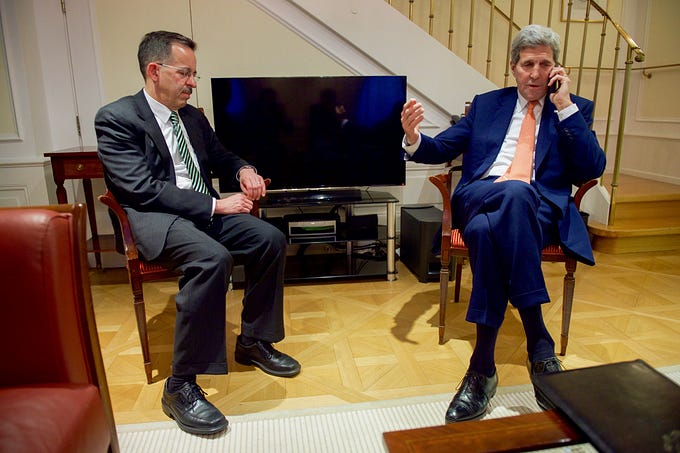
U.S. Secretary of State John Kerry traveled to London, U.K., and Vienna, Austria, from January 14–16, 2016, as he worked to resolve final sticking points on the implementation of the Joint Comprehensive Plan of Action (JCPOA), a July 2015 multilateral agreement ensuring that Iran’s nuclear program remains exclusively peaceful.

At the same time, he was deeply involved in parallel negotiations to secure the release of Americans unjustly held in Iran.

After meeting in London with Saudi Foreign Minister Adel al-Jubeir and former British Prime Minister Tony Blair about issues in the Middle East, the Secretary flew to Vienna on the morning of January 16 for a final round of talks with Iranian Foreign Minister Javad Zarif and others involved in the conversations.


Toting a shopping bag and a copy of his draft remarks, Secretary Kerry walked to his plane at London Stansted Airport. (State Department Photo)

En route to Vienna, Secretary Kerry called Swiss Foreign Minister Didier Burkhalter about the pending transfer by the Swiss Air Force of U.S. nationals who were being unjustly held in Iran. (State Department Photo)

The first thing Secretary Kerry saw at Vienna International Airport as he emerged from his Air Force jet was an Iran Air jetliner parked across the tarmac. (State Department Photo)

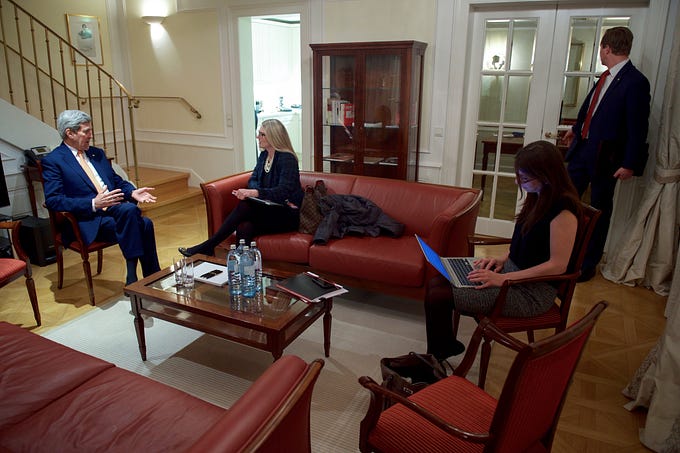
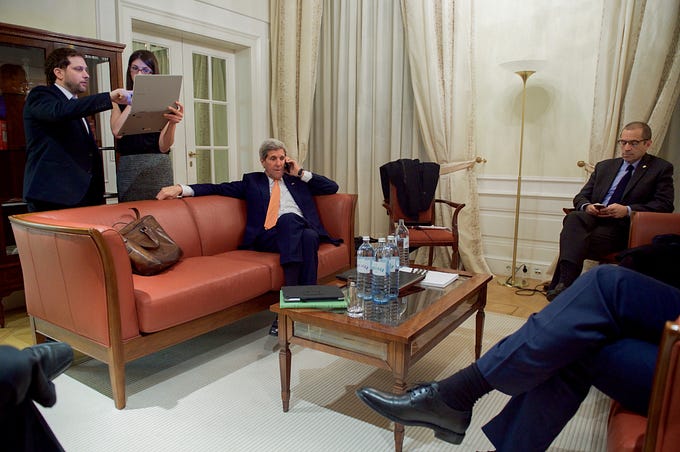
Secretary Kerry drove directly to the Palais Coburg Hotel in Vienna, where the Iranian delegation was staying, and where the two sides held marathon negotiations in July that led to the JCPOA. The Secretary met first with Ambassador Stephen Mull, U.S. Lead Coordinator for Iran Nuclear Implementation, and other advisers from the State and Energy departments and the White House. (State Department Photo)

A half-hour later, Secretary Kerry and his team sat down with Foreign Minister Zarif in the Coburg’s Blue Salon, where the two sides did most of their negotiating last July. (State Department Photo)

Secretary Kerry and Ambassador Mull then called International Atomic Energy Agency (IAEA) Director General Yukiya Amano, to discuss the agency’s work in drafting a report examining whether Iran had met the requirements in the JCPOA to qualify for sanctions relief from the international community. (State Department Photo)

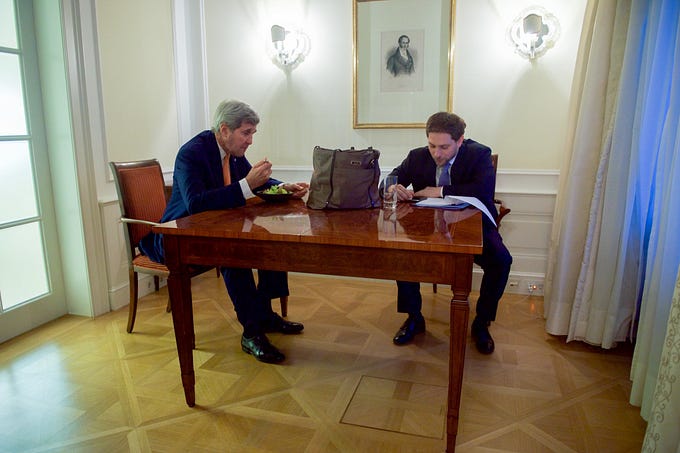
Over a late lunch of salad and spaghetti, Secretary Kerry joined State Department Chief of Staff Jon Finer as he participated in a call briefing reporters about the day’s developments. (State Department Photo)

Secretary Kerry also chatted with State Department Senior Adviser Marie Harf, who handled communications duties for the Iran talks, during a lull in the meetings. (State Department Photo)

Secretary Kerry and Foreign Minister Zarif occupied nearby rooms at the Palais Coburg, which meant that on different occasions, each man showed up at the other’s room, seeking an impromptu meeting. This occurred in Zarif’s quarters. (State Department Photo)

As Secretary Kerry returned a phone call, Chief of Staff Finer spoke with State Department Speechwriter Stephanie Epner, who worked through multiple drafts of the Secretary’s final comments as negotiations evolved. (State Department Photo)

As deliberations on final preparations for Implementation Day continued into the evening, Secretary Kerry and Foreign Minister Zarif walked down one floor for an unscheduled visit with European Union High Representative for Foreign Affairs Federica Mogherini. They surprised an EU staffer by knocking on the door and asking to speak to her boss.
(State Department Photo)

Later in the evening, Secretary Kerry and Chief of Staff Finer split a pizza between calls. (State Department Photo)

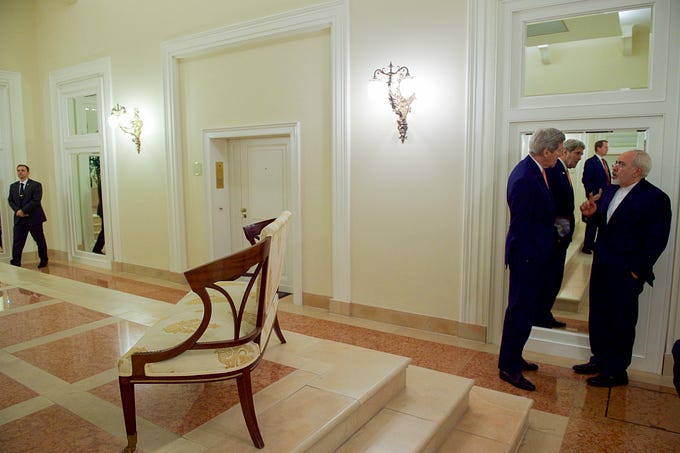
At 8:51 p.m., the talks moved into their decisive phase: Secretary Kerry and Foreign Minister Zarif spoke in a quiet lobby, before returning to the Secretary’s room for a final huddle with other ministers. (State Department Photo)

At 8:54 p.m., High Representative Mogherini (in person, third from left) and French Foreign Minister Fabius (by phone) joined the meeting in Secretary Kerry’s room to work through final details. (State Department Photo)

Secretary Kerry spoke first, before placing the call on speakerphone so the other two ministers could speak with Foreign Minister Fabius. (State Department Photo)

High Representative Mogherini, representing the European Union, offered a wording suggestion as the ministers read through the final joint statement. At 9:22 p.m., the group reached agreement, setting in motion the final implementation of the JCPOA. (State Department Photo)

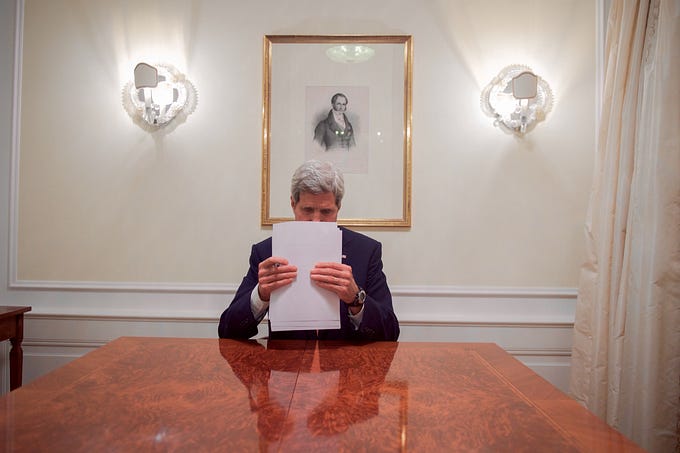
In return for Iran implementing a series of steps to constrain its nuclear program as outlined in the JCPOA, the United States agreed to lift nuclear-related sanctions. Secretary Kerry had to sign a series of waivers and certificates to provide for this sanction relief. (State Department Photo)

After finalizing the agreement and making good on the promise of sanctions relief, Secretary Kerry and Foreign Minister Zarif headed to the Vienna International Center, a U.N. complex where the international media awaited, for press statements about the day’s activities. But before they began speaking, the Secretary asked the foreign minister to personally intervene to resolve a miscommunication about whether the wife and mother of detained American Jason Rezaian, a Washington Post reporter, would be allowed to leave Tehran with their husband and son.
(State Department Photo)

Secretary Kerry paid a courtesy call on IAEA Director General Amano and his staff while visiting the Vienna International Center, thanking them for the Agency’s work in issuing their JCPOA compliance report, and encouraging them to uphold the strict inspection regime spelled out in the July 2015 agreement. (State Department Photo)

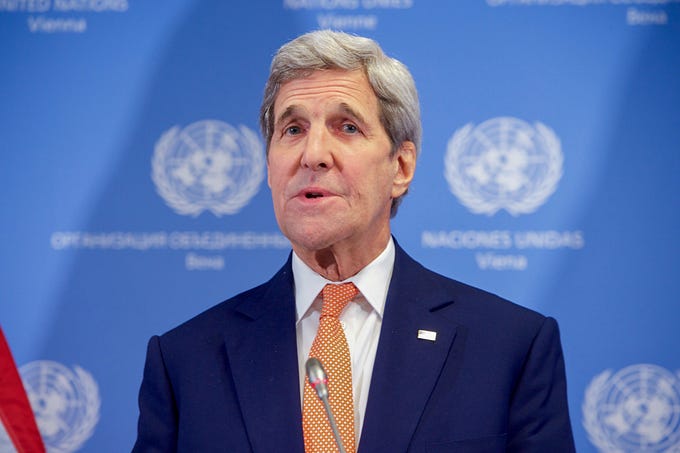
Secretary Kerry walked to the podium to deliver his statement to the international media. (State Department Photo)

Secretary Kerry delivering his statement. (State Department Photo)

Reporters listen as Secretary Kerry delivers his statement. (State Department Photo)

After rushing back the airport to avoid exceeding the allowable workday for his Air Force flight crew, Secretary Kerry placed one more call from his cabin to Foreign Minister Zarif to help resolve the situation related to Rezaian and his family members. (State Department Photo)

Following a nearly 10-hour flight, Secretary Kerry invited his traveling press corps back to his cabin after their plane landed at 3 a.m. at Andrews Air Force Base in Camp Springs, Maryland. He spent nearly a half-hour reflecting on and answering questions about the prior day’s developments. (State Department Photo)

All photos were taken by Deputy Assistant Secretary of State for Strategic Communications Glen Johnson, Secretary Kerry’s traveling photographer, and are courtesy of the U.S. Department of State.


Snapshot: U.S. Terror Report

Last year saw the deadliest Islamist jihad attacks in America since 9/11 and in Europe since 2004, according to the January Terror Threat Snapshot released by House Homeland Security Committee Chairman Michael McCaul (R-Texas).

“The heinous ISIS-linked attack on a policeman in Philadelphia [earlier this month] is a grim reminder of the Islamist terror threat we face today,” McCaul said in releasing this month’s terror snapshot. “ISIS and al Qaeda terrorists are expanding their networks and carving out sanctuaries abroad, while their supporters and operatives have been plotting terror attacks in the West.”

McCaul said Obama’s “strategy to defeat ISIS and other Islamist extremists … is out of touch with reality …”

According to the Snapshot, “Islamist terrorists have been attempting to infiltrate the United States as authorities have uncovered jihadists who were resettled in America through the refugee resettlement program. Two refugees from Iraq resettled in the US were recently arrested on terror-related charges linked to ISIS.”

Additionally, the Snapshot stated, “The United States faces an unprecedented terror threat level at home due to the continued failure to destroy ISIS. Law enforcement authorities have arrested nearly 80 individuals in ISIS-related cases in the United States since 2014 – 62 in 2015 alone. There have been 21 ISIS-linked plots to launch attacks in the homeland. Over 80 percent of the post-9/11 homegrown Islamist extremist cases in the United States have occurred or been disrupted since 2009.”

Islamist terrorists returning to the West from Syria are also “a surging threat,” the snapshot added, noting legislation recently signed into law “will enhance the security of the Visa Waiver Program in order to prevent terrorists from entering the United States.”

The Full SnapShot Report from the Homeland Security Congressional Committee is here.

Recent Developments

• January 7: ISIS supporter Edward Archer ambushed and fired 13 shots at a Philadelphia police officer using s stolen police firearm before being arrested. Archer pledged allegiance to ISIS.

• January 7: Sacramento, California-based Islamist extremist Aws Mohammed Younis al Jayab was arrested after lying to authorities about traveling to Syria and fighting alongside terrorist organizations between November 2013 and January 2014. Al Jayab, an Iraqi refugee of Palestinian descent who was resettled in the U.S. from Syria in October 2012, communicated his intention to join terror organizations in Syria over social media. He said he had joined the ranks of Ansar al Islam, a foreign terrorist organization and had communications with an ISIS supporter.

• January 6: Houston, Texas-based ISIS supporter Omar Faraj Saeed al Hardan was arrested for attempting to support ISIS. Hardan, an Iraqi refugee of Palestinian descent who was resettled in the U.S. from Iraq in November 2009, lied to authorities regarding his automatic machine gun training and had associated with ISIS since 2014 and with al Qaeda’s Syrian affiliate Jabhat al Nusra in 2013 and 2014.

• December 30: Rochester, New York-based ISIS supporter Emanuel Lutchman planned to attack a restaurant on New Year’s Eve before being arrested. Lutchman said he received direction from an ISIS operative overseas and also expressed his desire to travel to join ISIS. He recorded a video pledging allegiance to ISIS leader Abu Bakr al Baghdadi and claiming responsibility for the planned attack.

• December 17: Harrisburg, Pennsylvania-based ISIS supporter Jalil Ibn Ameer Aziz was arrested for advocating for violence against Americans through social media and facilitating the travel of ISIS recruits overseas. Aziz was storing high-capacity weapon magazines and ammunition in his residence. He used at least 57 Twitter accounts in support of ISIS’s messaging and reposted a list of the names and personal information of 100 American service members with the intent of inciting attacks against them.


• December 11: Edgewood, Maryland-based ISIS supporter Mohamed Elshinawy was arrested after communicating electronically with ISIS operatives based overseas and accepting funds he believed were from ISIS for the purpose of launching an attack inside the United States. Elshinawy pledged allegiance to ISIS leader al Baghdadi in February 2015 and received $8,700 he believed was sent from ISIS operatives through Western Union and PayPal.

• December 11: Minneapolis, Minnesota-based ISIS supporter Khaalid Adam Abdulkadir was arrested when he threatened law enforcement authorities after the FBI publically announced the arrest of ISIS recruit Abdirizak Warsame near Minnesota. Abdulkadir had previously communicated with at least two other ISIS-linked recruiters and former Minnesota-area residents.

• December 9: Eagan, Minnesota-based ISIS supporter Abdirizak Mohamed Warsame was arrested after plotting to join ISIS overseas and facilitating the travel of other individuals in a broader ISIS recruitment network operating from Minnesota. The network began watching Islamist extremist propaganda in 2014 after which it began plotting to send members to join ISIS overseas.

• December 2: Two ISIS-linked terrorists, U.S.-born Syed Rizwan Farook and Pakistani national Tashfeen Malik, attacked a holiday party for local government workers at the Inland Regional Center in San Bernardino, California, killing 14 people. Farook’s friend, Enrique Marquez Jr., was later arrested for purchasing the rifles used in the attack and for conspiring with Farook to plot an attack in 2011-2012. The attackers posted a pledge of allegiance to ISIS’s leader on Facebook.

ISIS TERROR ATTACK PLOTS AGAINST THE WEST

ISIS dramatically expanded its war with a concerted campaign to target the West in 2015.

By the numbers

• There have been 72 ISIS-linked plots to attack Western targets, including 20 inside in the United States, since 2014.3 The number of ISIS-linked attack plots grew by nearly three times from 2014 (20) to 2015 (50).4


Recent Developments

• January 7: ISIS supporter Edward Archer ambushed and fired 13 shots at a Philadelphia police officer using s stolen police firearm before being arrested. Archer pledged allegiance to ISIS.

• January 7: An attacker wielding a meat cleaver was shot after attempting to storm a Paris police station. The man was carrying a reproduction of ISIS’s flag and a claim of responsibility for the planned attack.