An affordable price is probably the major benefit persuading people to buy drugs at www.americanbestpills.com. The cost of medications in Canadian drugstores is considerably lower than anywhere else simply because the medications here are oriented on international customers. In many cases, you will be able to cut your costs to a great extent and probably even save up a big fortune on your prescription drugs. What's more, pharmacies of Canada offer free-of-charge shipping, which is a convenient addition to all other benefits on offer. Cheap price is especially appealing to those users who are tight on a budget
Service Quality and Reputation
Although some believe that buying online is buying a pig in the poke, it is not. Canadian online pharmacies are excellent sources of information and are open for discussions. There one can read tons of users' feedback, where they share their experience of using a particular pharmacy, say what they like or do not like about the drugs and/or service. Reputable online pharmacy canadianrxon.com take this feedback into consideration and rely on it as a kind of expert advice, which helps them constantly improve they service and ensure that their clients buy safe and effective drugs. Last, but not least is their striving to attract professional doctors. As a result, users can directly contact a qualified doctor and ask whatever questions they have about a particular drug. Most likely, a doctor will ask several questions about the condition, for which the drug is going to be used. Based on this information, he or she will advise to use or not to use this medication.
In 2014, this site posted a summary of Russia’s push into Nicaragua and Cuba for covert operations. It is important to note that with continued deference by the Obama administration to Russia for all things terror, Russia officially received that ‘reset’ button as a green light and the Kremlin under Putin has been aggressive.
During one of the Republican debates, then candidate Marco Rubio and Donald Trump were in a one on one heated discussion over the Cuba policy. Rubio also mentioned during the debate the signals intelligence operation that Russia has in Cuba known as Lourdes.
Cuba has been a puppet and proxy for Russia going back to the Kennedy administration and since the relationship has continued.
As the United States military has been in sequestration, the normal 10 year competitive edge over adversaries such as Russia and China has waned substantially. Russia has formally announced a new creation, 1,616MPH Supersonic MIG-29M.
Nominee Trump has overtly on several occasions sided with Moscow and has spoken on his lack of loyalty and necessity of NATO. Foreign policy leaders in Washington DC and within the NATO membership are emphatically pushing back and questioning this reasoning. This post is not so much about Trump’s pro Kremlin policy as it is more to the notion of real and building threats with Moscow.
We cant officially know Hillary’s policy on Russia going forward because she has a personal server, a failed reset button and does not have press conferences. Her mission as president is all about social justice issues which is in keeping with the DNC platform.
Talking Points Memo has done some remarkable work in uncovering that reasoning and it comes down to debt to the oligarchs. <– This is an excellent summary and a must read.
Beyond that, it is important to determine what Russia is doing and the reader must remember some frequent and recent events where Russia has not only challenged U.S. military assets with dangerous flyby’s but when Barack Obama was in Cuba during the normalizing relations meeting and baseball game, Russia was there too.
So, let’s go deeper…..facts are funny things that cannot be disputed. (full citations are noted below the summary)
FPRI: Two Western media outlets reported on 23 June that Russia was engaged in building a signals intelligence[1] (SIGINT) base in Nicaragua as “part of a recent deal between Moscow and Managua involving the sale of 50 T-72 Russian tanks.”[2] The reports came shortly after the 14 June expulsion of some United States Homeland Defense personnel by the Nicaraguan government. The United States State Department claimed Nicaragua expelled three officials with diplomatic passports. The Nicaraguan government claimed it expelled two Homeland Defense officials who were in the country performing work related to counterterrorism without first notifying Nicaraguan authorities.[3]
One published report stated that the third American was “performing what could be construed as espionage-related activities on the construction of the Grand Interoceanic Canal.”[4] The reference is to the Nicaraguan trans-isthmus shipping channel under construction by the Chinese infrastructure firm, HK Nicaragua Canal Development Investment Group. The report identified the person in question as “Evan Ellis,” an “expert in China-Latin America relations at the US Army War College.”[5]
The coincidence of the two reports—suspicions of a covert Russian SIGINT base in Nicaragua and the Nicaraguan government’s sudden expulsion of Americans—no doubt is intriguing in itself. What the reports failed to make clear, however, is that the sale of Russian tanks to Nicaragua was discussed openly for some time. So what is happening?
GLONASS: Russia’s GPS
At the root of American suspicions of SIGINT activities in Nicaragua is Russia’s Global Navigation Satellite System. Commonly known as GLONASS—the transliterated acronym of Global’naya navigatsionnaya sputnikovaya sistema—it is operated by Russia’s Aerospace Defense Forces or “VKO” (Voyska Vozdushno-Kosmicheskoy Oborony), which resides within the Defense Ministry. GLONASS is analogous to the United States’ Global Positioning System or “GPS,” the satellite-based navigation system operated by the United States Defense Department.
GLONASS is a legacy of the Soviet period. Its first operational satellites went into service in December 1983. GLONASS survived the Soviet Union’s dissolution to reach full operational status in December 1995, with 24 satellites in three different orbital planes. By 2002, however, only eight remained in operation, as satellites were failing in orbit and Russia was unable to launch new ones. A May 2007 Presidential Decree granted free unrestricted international access to GLONASS, which in February 2009 was declared the legal property of the Russian Federation.
Despite a 2004 promise to have eighteen operational satellites by 2007 (the minimum number needed)—and another one in December 2009, when Russian space agency’s (ROSCOSMOS ) Anatoly Permnov promised then-Prime Minister Putin a full (24) operational satellite constellation in 2010—GLONASS did not regain full operational capability until December 2011. In May 2016, Russian Defense Minister Dmitry Rogozin announced that the Collective Security Treaty Organization—a regional mutual defense alliance comprised of Russia, Belarus, Armenia, Kazakhstan, Kyrgyzstan, Tajikistan, and Uzbekistan—would henceforth use GLONASS.[6] In December 2015, the Russian Space Systems Association[7] certified GLONASS on behalf of the Russian Defense Ministry.
Defense Minister Rogozin—speaking after a December 2014 meeting in Havana with Raul Castro, who chairs Cuba’s State Council and the Council of Ministers—called a recently enacted United States law barring GLONASS monitoring stations on American territory “unconstructive and shameless,”[8] referring to a provision in the 2014 National Defense Authorization Act (NDAA).[9] In May 2012, Russia asked for approval to locate GLONASS signal quality monitoring sites in the United States, one of 30 countries approached at the time to host monitoring stations.[10] Russia threatened to respond in kind to the 2014 NDAA prohibition—there were GPS stations in Russia at the time—but settled in the end for implementing a delayed relay between GPS stations and satellites, ostensibly eroding the military and intelligence value of GPS positioning data.[11] While GPS remains operational inside Russia today, Russia acted on Mr. Rogozin’s promise to place monitoring stations “in other countries.” GLONASS, he predicted, “may soon outstrip the American GPS”:
“They’ve lost what they had on Russian territory, and they’ll get a network of GLONASS navigation systems surrounding the United States, so it won’t be GPS breathing down our necks but instead we’ll be breathing down the neck of GPS.”[12]
GLONASS Comes to Latin America
The accuracy of GLONASS—just like the American GPS and any other Global Navigation Satellite System (GNSS) including the European Union’s Galileo and China’s Beidou—depends upon a network of reference stations located around the globe to detect and correct any changes in satellite orbits. GLONASS monitoring stations are operated by ROSCOSMOS, which in February 2013 established its first site in Latin America, located at the University of Brasilia Centre for Technological Development. In July 2014, ROSCOSMOS entered into an agreement with the Agência Espacial Brasileira to open two more monitoring stations, one at the Federal University of Santa Maria in Rio Grande do Sul; and the other at the Federal University of Pernambuco’s Technological Institute in Recife.[13]
That same month, Russia’s ambassador to Nicaragua, Nikolay Vladimir, confirmed reports that the two countries had agreed to build a GLONASS monitoring site in the Managua area “within two years.”[14] It would join the 19 monitoring stations inside Russia, plus the one in operation in Brazil and three others in Antarctica. In August 2015, the Instituto Nicaragüense de Telecomunicaciones y Correos (“Nicaraguan Institute of Telecommunications & Mail” aka TELCOR) signed an agreement authorizing construction of the GLONASS monitoring site. The Nicaraguan National Assembly had already authorized the project in April. Nicaragua gained access to GLONASS’ full constellation of 24 satellites (plus four reserves).[15] One published report stated that “the satellites will be handled by Russian specialists around the clock, while a team of Nicaraguans is trained to use them.”[16]
A year earlier in August 2014, the Russian government announced a “framework agreement” with Cuba to collaborate in “the peaceful uses of space.” It included an agreement in principle to build a GLONASS monitoring station on the island, something that had been discussed since at least 2010.[17] One report suggested cryptically that the two sides needed additional time to reconcile what it called “different regulations” over “information exchanges” before the agreement could come into force.[18]
The discussion reconvened in Moscow in April 2015[19] and again in late October 2015, when now Deputy Prime Minister Rogozin reiterated, “We are planning to discuss with our Cuban friends the construction of a GLONASS monitoring station on Cuban territory.”[20] The Russian government’s official October 2015 announcement of a final agreement declared, “Russia is returning to Cuba.”[21]
Is Russian SIGINT Returning to Cuba?
Russia undoubtedly is engaged in intelligence-gathering activities in the Caribbean and Central America including SIGINT. As Diana Villiers Negroponte of the Woodrow Wilson International Center noted:
“The day before the U.S. delegation was due to start normalization talks in Havana, a Russian warship docked in Havana. The Meridian-class intelligence ship with a crew of approximately 200 had visited Havana in February and March 2014.”[22]
While the Russian government steadfastly denied it—speaking in Brasilia on 17 July 2014, President Putin said “Russia is capable of solving problems related to its defense capabilities without this element [Lourdes]”[23]—the Russian daily Kommersant reported the previous day that the Russian and Cuban governments had agreed in principle to reopen the Soviet-era Lourdes signal intelligence station located south of Havana that Russia shuttered in 2001.[24] Mr. Putin is said to have agreed to write off some USD 32 billion in debt owed the Russian government by Cuba, amounting to some 90 percent of the Cuban government’s total indebtedness to Russia.
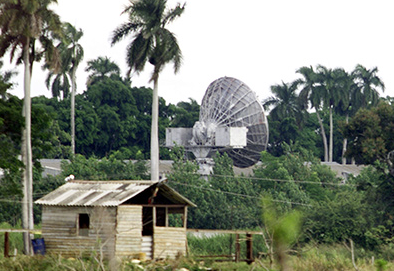
Russian SIGINT Site at Lourdes, Cuba (Source: Lenta.ru)[25]
The Soviet Union began building its Lourdes SIGINT site in July 1962 and it became fully operational in 1967. Lourdes went on to become the locus of perhaps the most significant intelligence collection effort directed at the United States during the Cold War. It was jointly operated by Russian military intelligence[26] and the Federal Agency for Government Communications,[27] and Cuba’s main intelligence directorate, respectively.[28] Russia’s Foreign Intelligence Service, the SVR (Sluzhba vneshney razvedki), also operated a communications center there, which it used to communicate with agent networks in North and South America. According to Kommersant, the Russian government contemplated using a re-opened Lourdes facility to communicate with Russian naval surface and subsurface vessels. It quoted former SVR director and current Russian First Deputy Foreign Minister Vyacheslav Trubnikov:
“Lourdes gave the Soviet Union the ability to see the entire western hemisphere. From this perspective its loss impacted our knowledge of what was happening in the region. For a Russia that today must defend its legitimate rights and place in the world, it [the Lourdes SIGINT site] is no less valuable than it was to the USSR.”[29]
A year later, however, some Russian officials publicly questioned the Lourdes site’s usefulness. On the one hand, Sergey Naryshkin[30] welcomed the Cuban government’s interest in the Russia-led defense alliance, the Collective Security Treaty Organization, regarding which Mr. Naryshkin’s deputy in the State Duma, Vasily Likhachyov, said, “Today, it seems to me, this political offer takes on a geopolitical character in the interest of strengthening Cuban national security.”[31] At the same time, however, Andrei Klimov, who was deputy head of the Federation Council’s International Affairs Committee, had this to say:
“Military-technical and military-political cooperation with Cuba is a possibility. I can confirm this as the man who negotiated with them. But to enter the same river twice seems to me unproductive. The world is changing and realigning, so I don’t think we need to go back to Cuba like it’s the 1980s. If we’re talking about having a military and technical presence, our current methods allow us to achieve the same end through different means—it’s more efficient than having a SIGINT center there”[32]
Ten months later, the Interfax news agency asked the Foreign Ministry’s Latin American Department director, Aleksandr Shchetinin, “Are there plans to reopen the Lourdes radar center in suburban Havana that was abandoned in 2002?” He responded, “The Lourdes base was closed, and we don’t anticipate any steps to reopen it.”[33] The Interfax interviewer then queried, “Earlier, Sergei Lavrov and other Russian officials have stated that Russia could establish logistics bases in various parts of the world. Are there any plans to establish such bases in Latin America?” Mr. Shchetinin gave this carefully worded answer:
“The question of establishing logistics sites for the Russian Navy—it’s a matter for negotiation, something that’s entirely normal, low-key, reasonable. It’s related to the need for port calls to refuel, to rest crews, to replenish food supplies, and so on. When it’s deemed appropriate to discuss these needs, conversations take place with individual Latin American countries.”[34]
Russian Dreams of a Caribbean Footprint
Past statements by Russian government officials and other indicators give some basis to think that the agreement to permit a GLONASS site in Nicaragua may also allow Russian naval vessels to use Nicaraguan port facilities. Contemporary reports of Russian ambitions in Nicaragua if true are nothing new. Asked in 1984, ‘What do you see as the greatest security threat in Central America?’ United States Ambassador Deane R. Hinton[35] replied:
‘The greatest security threat is the possibility that in a state such as Nicaragua with Soviet and Cuban ties, you’re going to end up with Soviet submarine bases.’[36]
The Latin American proxy war between the United States and the Soviet Union came full force to Nicaragua when the Sandinista regime assumed power in 1979. The country can claim the dubious distinction, in one assessment, “as one of the hottest battlegrounds of the Cold War.”[37]
Starting in the early 1980s, the Soviet Union began exploring a permanent naval and naval air presence in Nicaragua. With its Cuban partner, the Soviet Union constructed a military airbase at Punta Huerte, Nicaragua,[38] in partial exchange for granting Soviet naval reconnaissance aircraft refueling and overflight rights. The Soviet objective was to conduct air reconnaissance missions along the coast of the western United States similar to existing Soviet air reconnaissance along the eastern United States.[39] The Soviets had the option to base reconnaissance aircraft at Punta Huerte, or to have Soviet aircraft based at San Antonio de los Baños, Cuba, overfly Nicaraguan airspace to the Pacific.
Some American intelligence analysts believed that the Soviets intended to establish a military “center of gravity”[40] in the Caribbean Basin, using Nicaragua to augment Soviet bases in Cuba. The 1984 Kissinger Report concluded that Cuba was “a hemispheric base for Soviet nuclear-capable aircraft and submarines.”[41] The Soviet Union could quickly exercise its Nicaraguan option by obtaining access to sites there and upgrading them as required, reserving the option of a purpose-built infrastructure for later.
Indeed, overflight rights in Nicaraguan airspace allowed Soviet naval air assets to conduct reconnaissance missions up and down the United States’ western coastline. Intelligence analysts cautioned that American national security interests would be severely jeopardized should the Soviets gain “access to Nicaraguan facilities,” since this would mean that they “for the first time…[have] the option of establishing a permanent air and naval presence in the eastern Pacific and along the U.S. west coast.”[42] While these analysts qualified that “Soviet naval access is currently limited by harbor depth and inadequate facilities,” in Nicaragua, “this will change,” they warned, “within the next three to five years with the completion of the port development program.”[43] In the end it was the Soviet Union’s collapse that brought the effort to an abrupt end.
While advising that “there are no known submarine facilities existing or under construction in Nicaragua,”[44] American intelligence analysts identified two Nicaraguan seaports—the Caribbean port of El Bluff and the Pacific port of Corinto—as sufficiently developed to allow Soviet blue water naval forces on a limited basis, subject to further modification and deepening. Specific to Soviet submarines already known to operate in the Caribbean, dredging Nicaragua’s “El Bluff facility…[to] an eventual depth of 20 meters…would provide access to virtually any ship in the Soviet fleet, including nuclear submarines…”[45]. Of greater immediate concern was the belief that:
“As an intermediate measure, or to avoid the costs of constructing a permanent base, the Soviet Navy could move to establish a protected anchorage in Nicaraguan territorial waters, an option which they have employed frequently in the past when shore-based facilities have not been available. This alternative would allow the Soviets to sidestep the problem of harbor depth. In the parlance of the Soviet fleet, such an anchorage is known as a “floating rear,” and might feature a repair ship, a destroyer or submarine tender, a barracks ship, a supply barge, and even a floating dry dock.”
“Floating bases of this type…[have] provided the Soviets with an expedient means of sustaining a naval presence in areas where they might not otherwise have access to the necessary logistical support. Such a facility could be established relatively quickly and might be expected to generate less political fallout than the establishment of a more permanent naval presence ashore.”[46]
Since the Soviet Navy had used floating rear-type configurations in several Cuba harbors, this concern was well founded.
To “the possibility that Moscow might attempt to use Nicaragua…as an expedient base for cruise-missile submarines (SSGNs) or even Yankee-class SSBNs,” there were “at least two cases which might serve as a precedent for such an action,” one of which was “the Soviet attempt to build a nuclear submarine base at Cienfuegos, Cuba, during the early 1970s.”[47] Regarding the Cienfuegos “precedent”‘:
“There is an important difference between the cases of Cuba and Nicaragua. The 1962 accords prohibiting the placement of offensive weapons in Cuba, though invoked at the time of the Cienfuegos incident, would not apply to the deployment of Soviet nuclear-capable forces in Nicaragua.”[48]
Nonetheless, American intelligence analysts believed that the Soviet Union would approach “any move in this direction cautiously”:
“It is unlikely that Moscow would risk provoking a potentially dangerous incident over this issue— perhaps leading to a replay of the Cuban missile crisis—by attempting to present the United States with an obvious challenge.”
“The promise of Soviet caution seems to be borne out by their behavior during the Cienfuegos incident, where Soviet probing to determine the limits of the 1962 accord was carried out in a responsible, if carefully orchestrated manner. The Soviets tested the limits of U.S. tolerance by sending, in sequence, a conventional attack boat, nuclear-powered cruise-missile submarine, and a diesel-powered ballistic-missile submarine into the Cuban ports of Cienfuegos, Antilla, and Havana. In all, some seven nuclear-capable Soviet submarines visited Cuban ports.”[49]
While as of February 1989 there were “no known submarine facilities existing or under construction in Nicaragua,”’[50] the Pacific seaport of Corinto “could accommodate limited numbers of Soviet missile or attack submarines, together with submarine support ships.” Regarding the principal port facilities “on the Atlantic/Caribbean side of Nicaragua,” the conclusion regarding El Bluff was “probably not submarines’; and Rama, “not submarines.”[51] However, “Soviet reconnaissance planes flying out of Punta Huerte”—an airfield constructed in 1982 “with Cuban assistance”—”would be able to fly missions along the U.S. Pacific Coast just as they now reconnoitre the U.S. Atlantic coast from Cuba.”[52]
Fast forward to August 2014, when Nicaraguan Army commander (General de Ejército) General Julio César Avilés [Castillo] announced that Nicaragua was acquiring “new naval and air assets” from Russia to patrol Nicaraguan maritime territory in the Caribbean.[53] The Nicaraguan navy and the Russian FSKN have conducted joint interdiction operations in the Caribbean since 2014.[54] During a February 2016 ceremony in which outgoing Russian Ambassador Nikolay Vladimir was awarded the Order José de Marcoleta by President Daniel Ortega, Mr. Vladimir disclosed that Russia was helping to “modernize” Nicaraguan military and national police “defensive” and “transport” aircraft as well as facilities at the Augusto C. Sandino airport.[55]
Is Nicaragua’s GLONASS Site a Covert Russian SIGINT Base?
Sergey Aksyonov writes in a recent commentary published in Russkaya Planeta:
“The first alarm bells sounded for the United States in February 2014, when [Russian Defense Minister Sergei] Shogu delivered a bombshell about Russia’s global military plans during a visit to Nicaragua. ‘In addition to Vietnam and Cuba, we plan to increase the number of military bases in countries such as Venezuela, Nicaragua, Seychelles, Singapore, and others.’ He explained why. ‘We maintain active air patrols. But to do so, we need refueling bases. […] Obviously, it makes sense to take advantage of geography when deciding where to locate a military base. In the case of Nicaragua, it’s its proximity to the United States.”[56]
When the recent reports appeared alleging that Russia was building a SIGINT base in Nicaragua under the guise of a GLONASS monitoring station, a Russian Foreign Ministry spokesperson quickly dismissed it, saying, “it’s difficult to comment on a science fiction fantasy.”[57] This, Mr. Aksyonov writes, was the exact right response:
“It’s necessary in this situation for Russia to buy time. Time to put the reconnaissance center into operation and to implement a security plan. It seems the responsible authorities are already doing this. American media revelations provoked an immediate response from the Russian Foreign Minister, which is a ‘cover’ story. ‘The Russian Federation in fact is cooperating on GLONASS with a number of Latin American countries, on the basis of absolutely open and transparent agreements,’ he declared. That’s right, every agency of the Russian government must do its job—the military its job, the diplomats their job.”[58]
The online Russian newspaper Vzglyad writes that the American media report:
“[G]ives no information on the intelligence center’s location in Nicaragua or when it was finished [but] only that the site is disguised as a navigation satellite tracking station of the Russian GLONASS system, which is about to finish construction…It is worth pointing out that the Russian GPS site in Nicaragua was opened by Defense Minister Sergei Shoigu on 23 February 2015. It is that site, apparently, which the U.S. media had in mind.”[59]
It quotes Boris Martynov, who is Deputy Director of the Russian Academy of Sciences’ Institute of Latin American Studies, who said he is inclined to see the report as baseless speculation, stating Russia had “nothing left in Latin America” after closing its the Soviet-era intelligence center in Lourdes, Cuban in 2000.
“Moreover, there’s an effort now to bring up again old information about Russia The United States woke and realized it was losing its grip on Latin America. So in this sense it’s not surprising. It’s just an effort to sway opinion.”[60]
In April, the FSLN[61] leader in Nicaragua’s National Assembly, Edwin Castro, announced that the Nicaraguan government had agreed to purchase 50 surplus Russian T-72B1 tanks[62] at a stated cost of USD 80 million. The tanks “will be used by the Nicaraguan Army in the fight against drug trafficking.”[63] The first twenty tanks completed their refurbishment in late April 2016.[64] “Russian support has been resolute and selfless, and it has attached great importance to Nicaragua because it understands the problem with drug trafficking” and how “drugs end up to Europe and Asia,” said Mr. Ortega, while suggesting that Russia’s cooperation has been “extraordinary” in recent years.[65]
Mr. Aksyonov speculates about a connection between the tank purchase and the GLONASS site:
“The size of Nicaragua’s purchase demonstrates the equipment’s significance to Managua. The amount it paid Russia—9 million dollars—exceeds the country’s annual defense budget. It is ironic that some experts wonder whether such an old-fashioned approach to defense as building up the armored component of the Nicaraguan Army is inappropriate. If the United States decides to ‘close’ the Russian tracking center, it will act through a foreign proxy. One of Nicaragua’s neighbors, for example. Everyone knows that traditionally, Central American countries are heavily influenced by Washington, and that present-day Panama’s territory was taken from Columbia by armed force just for the sake of building a ship canal. So organizing such an attack [on the Nicaraguan GLONASS site] would not be difficult. Maybe this scenario is unfolding already. In connection with Nicaragua’s tank purchase, Costa Rica has already expressed interest in escalating the arms race.”[66]
What Does the Future Hold?
Regional reaction so far has been sharply critical. Costa Rican President Luis Guillermo Solis called the tank purchase “inappropriate and unjustified,” with Foreign Affairs Minister Manuel Gonzalez adding that it raises the specter “of a regional arms race”[67] in Central America. Speaking in Managua, Cardinal Leopoldo Brenes added, “No tanks were needed in Nicaragua.” President Ortega in early May clamped down on further discussion of Russian tanks, ordering Nicaraguan government officials not to speak about it. “Only the President and the Army of Nicaragua are empowered to address issues of national security,” Mr. Ortega declared.[68]
So, does Russia intend to use the Nicaraguan GLONASS site for SIGINT? That question cannot be answered definitively on the basis of the open-source information available today. Several aspects of what is known invite speculation—the on again, off again reopening of the Soviet-era Lourdes SIGINT site, located just 155 miles from the United States; Russian technicians operating the GLONASS site in Nicaragua; and renewed Russian interest in establishing a Caribbean basin naval presence, to mention just three. Each is interesting; none of course is probative. So, too, is Russia’s direct support for the Nicaraguan government’s counter-trafficking operations, and China’s role in the construction of a new trans-isthmus canal in Nicaragua.[69]
For some final conjecture, we return to Mr. Aksyonov’s Russkaya Planeta commentary:
“Here’s what Russia needs to have a full-fledged military presence in the region. The main opponent of constructing a new ship canal [across Nicaragua] is the United States. After all, the Panama Canal has been under its de facto control for a century. Panama tried five times to regain control of the canal, but to no avail. The last time, Washington accused its leader, Manuel Noriega, of drug trafficking, and took him out of the country with a bag on his head and threw him into an American prison. So Russia should be fully prepared to challenge United States hegemony in Latin America. The number one priority is to know everything that’s going on in the region. For this, it needs a signals intelligence center.”
The translation of all source material is by the author unless noted otherwise.
[1] Signals intelligence (SIGINT) is traditionally considered to be one of the most important and sensitive forms of intelligence. One of the better definitions comes from the United States Air Force Intelligence Targeting Guide [Air Force Pamphlet 14-210. Intelligence. 1 February 1998]: “SIGINT is a category of intelligence comprising, either individually or in combination, all communications intelligence (COMINT), electronics intelligence (ELINT), and foreign instrumentation signals intelligence, however transmitted. It is derived from foreign communications and electronics signals in two principal categories: COMINT, which is derived from the intercept of foreign communications; and ELINT, which is derived from the analysis of foreign noncommunications and electromagnetic radiation emitted from other than nuclear detonations or radio-active sources.” The United States Army Field Manual FM 2-0 [17 May 2004] adds a third SIGINT category called FISINT, or “Technical information and intelligence derived from the intercept of foreign electromagnetic emissions associated with the testing and operational deployment of non-US aerospace, surface, and subsurface systems. Foreign instrumentation signals include but are not limited to telemetry, beaconry, electronic interrogators, and video data links.” By one assessment at least, “Russia continues to maintain one of the most sophisticated SIGINT programs in the world.” {Interagency OPSEC Support Staff (1996). Intelligence Threat Handbook rev. May 1996. UNCLASSIFIED (Washington, D.C.: Interagency OPSEC Staff) 3-1.
[2] See: “Is Moscow preparing for new Cold War? Russia agrees to build spy base in Nicaragua and prepares to deploy missiles on Polish border.” The Daily Mail [published online 23 June 2016].
http://www.dailymail.co.uk/news/article-3656494/Is-Moscow-preparing-new-Cold-War-Russia-agrees-build-spy-base-Nicaragua-prepares-deploy-missiles-Polish-border.html. Last accessed 25 June 2016. See also: “Moscow Building Spy Site in Nicaragua.” Washington Free Beacon [published online 23 June 2016]. http://freebeacon.com/national-security/moscow-building-spy-site-nicaragua/. Last accessed 25 June 2016.
[3] “Nicaragua explica a EE.UU. caso de los funcionarios expulsados.” El Nuevo Diario [published online in Spanish 16 June 2016]. http://www.elnuevodiario.com.ni/nacionales/395534-nicaragua-explica-ee-uu-caso-funcionarios-expulsad/Last accessed 25 June 2016.
[4] “Expulsa Nicaragua a 3 funcionarios de EE.UU. y crece tensión.” Telesurtv.net [published online in Spanish 17 June 2016]. http://www.telesurtv.net/news/Expulsa-Nicaragua-a-3-funcionarios-de-EE.UU.-y-crece-tension-20160617-0003.html. Last accessed 25 June 2016.
[5] A faculty roster posted on the United States Army War College Strategic Studies Institute website reads, “Dr. R. Evan Ellis is a research professor of Latin American Studies at the Strategic Studies Institute, U.S. Army War College, with a research focus on the region’s relationships with China and other non-Western Hemisphere actors.” GLONASS like all Global Navigation Satellite Systems http://strategicstudiesinstitute.army.mil/pubs/people.cfm?authorID=580. Last accessed 24 June 2016.
[6] “Rogozin: ODKB budet ispol’zovat’ vozmozhnosti GLONASS i sozdast SP po remontu tekhniki.” TASS [published online in Russian 20 May 2016]. http://tass.ru/armiya-i-opk/3299393. Last accessed 25 June 2016.
[7] The Russian Space Systems Association was formerly part of the United Rocket and Space Corporation Russian transl.: Ob’yedinennaya raketno-kosmicheskaya korporatsiya), a government-owned corporation formed in August 2013. The United Rocket and Space Corporation was merged into the Federal Space Agency in December 2015 to form the ROSCOSMOS State Corporation for Space Activities aka “ROCOSMOS”.
[8] Rogozin: GLONASS skoro mozhet operedit’ GPS.” TASS [published online in Russian 20 December 2014]. http://tass.ru/kosmos/1662068. Last accessed 25 June 2016.
[9] Section 1602(b) of the 2014 National Defense Authorization Act prohibits the President from authorizing or permitting “the construction of a global navigation satellite system ground monitoring station directly or indirectly controlled by a foreign government” on United States territory unless the Secretary of Defense and the Director of National Intelligence, respectively, “jointly certify” to Congress that any such ground station “will not possess the capability or potential to be for the purpose of gathering intelligence in the United States or improving any foreign weapon system.” They may jointly grant a waiver to that requirement if certain conditions are met. See: https://www.congress.gov/113/plaws/publ66/PLAW-113publ66.pdf. Last accessed 25 June 2016.
[10] “Russians Consider IGS as Congress Moves to Limit GLONASS, Foreign GNSS Monitoring Stations on U.S. Soil.” Inside GNSS [published online in Russian 16 December 2013]. http://www.insidegnss.com/node/3830. Last accessed 25 June 2016.
[11] Gary Bearden (2015). “Washington Should Reconsider Russian Satellite Navigation” Real Clear Defense [published online 30 September 2015]. http://www.realcleardefense.com/articles/2015/09/30/washington_should_reconsider_russian_satellite_navigation_108525.html. Last accessed 25 June 2016.
[13] “Russia Installs Glonass Satellite Station in Brazil.” Satellite Today [published online 17 July 2014]. http://www.satellitetoday.com/regional/2014/07/17/russia-installs-glonass-satellite-station-in-brazil/. Last accessed 25 June 2016.
[14] “Glonass funcionará en dos años en Nicaragua.” El Nuevo Diario [published online in Spanish 18 July 2014]. http://www.elnuevodiario.com.ni/politica/325066-glonass-funcionara-dos-anos-nicaragua/. Last accessed 25 June 2016.
[15] “Nicaragua y Rusia firman implementación de Glonass
Plazo.” El Nuevo Diario [published online in Spanish 20 August 2015]. http://www.elnuevodiario.com.ni/politica/368042-nicaragua-rusia-firman-implementacion-glonass/. Last accessed 25 June 2016.
[17] “Na Kube predlozhili postroit’ stantsii GLONASS.” Lenta.ru [published online in Russian 18 June 2014]. https://lenta.ru/news/2014/06/18/glonass/. Last accessed 25 June 2016.
[18] “Rusia instalará en Cuba una estación de ‘corrección y monitoreo’ de satélites.” Diario de Cuba [published online in Spanish 13 May 2014]. http://www.diariodecuba.com/cuba/1399996235_8560.html. Last accessed 25 June 2016.
[19] “Kuba i Rossiya segodnya obsudyat vopros razmeshcheniya nazemnoy stantsii GLONASS.” Vestnik GLONASS [published online in Russian 23 April 2015]. http://vestnik-glonass.ru/news/vo_vlasti/kuba-i-rossiya-segodnya-obsudyat-vopros-razmeshcheniya-nazemnoy-stantsii-glonass/. Last accessed 25 June 2016. Another report gave details of a 5-year agreement under which Russia and Cuba “will discuss the construction of ground stations on the island.” See: “Cuba-Russia Agree on 5-Year Plan.” Havana Times [published online 26 April 2015]. http://www.havanatimes.org/?p=110867. Last accessed 25 June 2016.
[20] “Rogozin: Rossiya planiruyet sozdat’ tsentry kalibrovki signala GLONASS na Kube.” TASS [published online in Russian 22 October 2015]. http://tass.ru/politika/2370648. Last accessed 25 June 2016.
[21] https://rg.ru/2015/10/22/kuba-site-anons.html. Last accessed 25 June 2016.
[22] Russian Engagement in the Western Hemisphere.” Testimony before the House Foreign Affairs Committee, Subcommittee on Western Hemisphere, 22 October 2015 by Diana Villiers Negroponte, JD, Ph.D., Public Policy Scholars, Woodrow Wilson International Center for Scholars. http://docs.house.gov/meetings/FA/FA07/20151022/104073/HHRG-114-FA07-Wstate-NegroponteD-20151022.pdf. Last accessed 27 June 2016.
[23] “Putin oproverg informatsiyu o razmeshchenii rossiyskogo radara v kubinskom Lurdese.” TASS [published online in Russian 17 July 2014]. http://tass.ru/politika/1322847. Last accessed 26 June 2016.
[24] “Imeyushchiy ushi da vnov’ uslyshit: Rossiya vozvrashchayet na Kubu svoy tsentr radioperekhvata.” Kommersdant [published online in Russian 16 July 2014]. http://www.kommersant.ru/doc/2525998. Last accessed 26 June 2016.
[25] “MID oproverg soobshcheniya o vosstanovlenii tsentra elektronnoy razvedki na Kube.” Lenta.ru [published online in Russian 25 March 2016]. https://lenta.ru/news/2016/03/25/lurdes/. Last accessed 28 June 2016.
[26] More commonly known as the “GRU” for its transliterated Russian acronym (Glavnoye razvedyvatel’noye upravleniye), it was the main foreign military intelligence main agency of the Soviet Army General Staff; and in the post-Soviet period, the Russian Federation Armed Forces General Staff.
[27] More commonly known as “FAPSI” for its transliterated Russian acronym (Federal’noye Agentstvo Pravitel’stvennoy Svyazi i Informatsii), it was the Soviet-era equivalent of the United States National Security Agency. FAPSI was part of the KGB, the main Soviet era security agency (Komitet gosudarstvennoy bezopasnosti), and was responsible for signal intelligence and the security of governmental communications. FAPSI was abolished by presidential decree in March 2003 and its functions were divided between the Federal Security Service (aka “FSB” for Federal’naya sluzhba bezopasnosti Rossiyskoy Federatsii) and the Defense Ministry. The name if its FSB component is the Special Communications and Information Service (Sluzhba spetsial’noy svyazi i informatsii, Spetssvyaz’ Rossii) also known as the Spetssvyaz.
[28] The Cuban government’s main state intelligence agency is the Dirección de Inteligencia (aka “DI” or “G2”) or Intelligence Directorate. It was established under the Cuban Interior Ministry in late 1961 and until 1989 was known as the Dirección General de Inteligencia (“DGI”) or General Intelligence Directorate.
[30] Mr. Naryshkin chairs the State Duma and the Collective Security Treaty Organization’s Parliamentary Assembly. The State Duma—its full name is the “State Duma of the Federal Assembly of the Russian Federation” (Predsedatel’ Gosudarstvennoy Dumy Federal’nogo sobraniya Rossiyskoy Federatsii)—is the lower house of the Federal Assembly of Russia (Federalnoye Sobraniye), the upper house of which is the Federation Council (Sovét Federátsii).
The Collective Security Treaty Organization (CSTO) is a regional mutual defense alliance, the members of which are Russia, Belarus, Armenia, Kazakhstan, Kyrgyzstan, Tajikistan, and Uzbekistan. It was formed in 2002 after several former Soviet republics rejected the May 1992 Treaty on Collective Security (“Tashkent Treaty”), a Russian initiative intended to provide a regional security structure within the CIS. At the time, Russian Defense Minister Sergei Ivanov spoke of the CSTO as a potential Eurasian partner for NATO.
[31] “Rossiya mozhet vozrodit’ voyennuyu bazu na Kube.” Izvestia [published online in Russian 8 May 2015]. http://izvestia.ru/news/586277. Last accessed 28 June 2016.
[32]Ibid. Mr. Klimov agreed that it made sense to cooperate with the Cuban government to allow Russian naval vessels to be serviced there.
[33] “Aleksandr Shchetinin: Dopingovyy skandal ne meshayet podgotovke k priyemu rossiyskikh sportsmenov v Rio-de-Zhaneyro.” Interfax.ru [published online in Russian 25 March 2016]. http://www.interfax.ru/interview/500355. Last accessed 28 June 2016.
[35] Hinton was a career Foreign Service officer who served in Guatemala (1954-1969), and later as U.S. Ambassador to El Salvador (1981-1983), Costa Rica (1987-1990), and Panama (1990-1994).
[36] Dean R. Hinton 1984). “Democracy Under Fire: An Interview with Ambassador Deane R. Hinton.” The Fletcher Forum. 8:1, 1.
[37] Jussi M. Hanhimäki & Odd Arne Westad (2003). The Cold War: A History in Documents and Eyewitness Accounts. (London: Oxford University Press) 379.
[38] CAPT Steven N. Bishop, USAF (1986). A Historical Study of the Effectiveness of U.S. Security Assistance to Panama, Costa Rica, and Nicaragua. (Wright-Patterson AFB: USAF Institute of Technology) 91.
[39] Gordon McCormick, Edward Gonzalez, Brian Jenkins & David Ronfeldt (1988). Nicaraguan Security Policy: Trends and Projections. AD-A213-820 Report R-3532-PQ&E. (Santa Monica, CA: RAND) 51. http://www.dtic.mil/dtic/tr/fulltext/u2/a213820.pdf. Last accessed 25 September 2013.
[40]Ibid., viii. This report was prepared by RAND’s Trends in the Caribbean Basin project at the request of the US Secretary of Defense to “forecast what developments might occur in the second decade of the Sandinista revolution (1989-1999) that could affect U.S. security planning.” Ibid., iii.
[41] Interestingly, the 1984 Kissinger Report refers to “the submarine base in Cienfuegos,” Cuba, as an established fact. The “hemispheric base” was a theme of Dr. Kissinger’s for at least a decade and a half: he referred in a 22 February 1971 telephone conversation about the deployment of Soviet ballistic missile submarines “into or from Cuba’ to ‘the business of the hemisphere.” See: United States National Security Council (1971). “Memorandum of Telephone Conversation, 22 February 1971. U.A. Johnson/Kissinger (secure phone).” http://nsarchive.chadwyck.com.libproxy.kcl.ac.uk/quick/displayMultiItemImages.do?Multi=yes&queryType=quick&QueryName=cat&&ResultsID=140C6292CC2&QueryName=cat&ItemNumber=15&ItemID=CKA04970. Last accessed 27 September 2013.
[44] United States Department of Defense (1989). “Soviet Bloc Military Equipment Supplied to Nicaragua (Jul 1979-Dec 1988),” 3. Non-classified report c. February 1989. http://nsarchive.chadwyck.com.libproxy.kcl.ac.uk/quick/displayMultiItemImages.do?Multi=yes&queryType=quick&QueryName=cat&&ResultsID=140BC2AE369&QueryName=cat&ItemNumber=1&ItemID=CNI03145. Last accessed 25 September 2013.
[53] “Ejército de Nicaragua gestiona con Rusia armamento para vigilar los espacios marítimos.” El Espectador [published online in Spanish 15 August 2014]. http://www.elespectador.com/noticias/elmundo/ejercito-de-nicaragua-gestiona-rusia-armamento-vigilar-articulo-510939. Last accessed 25 June 2016.
[54] “Ejército de Nicaragua condecora al jefe antidroga de Rusia por su cooperación.” Terra [published online in Spanish 11 September 2014]. http://noticias.terra.com.mx/mundo/latinoamerica/ejercito-de-nicaragua-condecora-al-jefe-antidroga-de-rusia-por-su-cooperacion,8fea9c21b6768410VgnCLD200000b2bf46d0RCRD.html . Last accessed 25 June 2016. Russia’s Federal Drug Control Service is known by its transliterated Russian acronym, FSKN (Federal’naya sluzhba Rossiyskoy Federatsii po kontrolyu za oborotom narkotikov).
[55] “Embajador de Rusia: Gobierno de Nicaragua adquirió aeronaves rusas.” La Prensa [published inline in Spanish 9 February 2016]. http://www.laprensa.com.ni/2016/02/09/nacionales/1983254-embajador-de-rusia-gobierno-de-nicaragua-adquirio-aeronaves-rusas. Last accessed 25 June 2016.
[56] “SSHA ispugalis’ rossiyskogo razvedtsentra v Nikaragua.” Russkaya Planeta [published online in Russian 24 June 2016]. http://rusplt.ru/society/nikaragua-rossiya-sbor-dannyih-26675.html. Last accessed 28 June 2016.
[57] “Rossiyskiy razvedtsentr v Nikaragua vstrevozhil Pentagon.” Vzglyad [published online in Russian 23 June 2016]. http://vz.ru/world/2016/6/23/817635.html. Last accessed 25 June 2016.
[61] FSLN in the acronym of Nicaragua’s governing political party Frente Sandinista de Liberación Nacional, the members of which are commonly referred to as Sandinistas.
[62] According to open source reports, the fifty T-72B1 main battle tanks purchased by the Fuerzas Armadas de Nicaragua Nicaraguan (“Nicaraguan Armed Forces”) are surplus vehicles that recently underwent maintenance and armament upgrades at the 61st Armor Repair Facility in Strelna. The T-72B1 is nicknamed “the White Eagle” for its stock color (photo source: http://www.tehnoomsk.ru/node/2053).
[63] “Tanques rusos “contra narcos” en Nicaragua.” La Prensa [published online in Spanish 30 April 2016]. http://www.laprensa.com.ni/2016/04/30/politica/2027577-tanques-rusos-contra-narcos-en-nicaragua. Last accessed 25 June 2016.
[64] “Rossiya nachala postavku Nikaragua tankov T-72B1.” Vzglyad [published online in Russian 25 April 2016]. http://www.vz.ru/news/2016/4/25/807327.html. Last accessed 25 June 2016.
[65] “Ortega: Rusia armará al Ejército: El Presidente inconstitucional alega que hay que modernizar al ejército y justifica que ya hubo bases de EE.UU. en Nicaragua.” La Prensa [published online in Spanish 4 June 2014]. http://www.laprensa.com.ni/2014/04/06/nacionales/189866-ortega-rusia-armara-al-ejercito. Last accessed 25 June 2016.
[67] “Glava MID Kosta-Riki: Rossijskie tanki v Nikaragua—militarizaciâ regiona! Politika Prezident Kosta-Riki «opečalen» postavkoj tankov iz Rossii v Nikaragu.” Regnum [published online in Russian 29 April 2016]. https://regnum.ru/news/polit/2126896.html. Last accessed 25 June 2016. The article points out that as a result of a “large Nicaraguan diaspora,” than 287,000 Nicaraguans now live in Costa Rica, and that this figure may reach as high as 800,000 people if the full weight of illegal immigration is taken into account. It also referenced a December 2015 International Court of Justice decision recognizing Costa Rican sovereignty over a 2.5-square-kilometer disputed territory on its border with Nicaragua, and ordering Nicaragua to compensate Costa Rica for damage caused to its territory. [http://www.ticotimes.net/2015/12/16/hague-court-calero-island-belongs-costa-rica. Last accessed 25 June 2016]
[68] “Ortega ordena callar sobre compra de 50 tanques rusos.” La Prensa [published online in Spanish 1 May 2016]. http://www.laprensa.com.ni/2016/05/01/nacionales/2027898-daniel-ortega-ordena-callar-sobre-compra-de-50-tanques-rusos. Last accessed 25 June 2016.
[69] This latter factor, while well outside the scope of this essay, may have significant bearing on the outcome of Nicaragua’s November 2016 presidential election. There is been widespread, continuous speculation that the Hong Kong Nicaragua Development Group—the company building the canal—is in financial trouble. As the aforementioned Dr. Evan Ellis of the United States Army War College wrote, this and other factors might challenge Russian reliance on the Sandinista government as the lynchpin of its strategy in the Caribbean Basin. See: “Russian Influence in Latin America.” The Cipher Brief [published online 5 January 2016]. https://www.thecipherbrief.com/article/russian-influence-latin-america. Last accessed 28 June 2016.
In part from Time: Kerry raised the question of Turkey’s NATO membership, suggesting that anti-democratic behavior by Erdogan could imperil the country’s place in the alliance. “NATO also has a requirement with respect to democracy,” Kerry said, and added said NATO would “measure” Turkey’s actions in days to come. “Obviously, a lot of people have been arrested and arrested very quickly,” Kerry said. “The level of vigilance and scrutiny is obviously going to be significant in the days ahead. Hopefully we can work in a constructive way that prevents a backsliding.”
Turkey’s membership in the NATO alliance is a matter of major strategic importance to the U.S., and talk of the country being ousted caught some experts by surprise in the U.S. Amb. Bryza of the Atlantic Council said Kerry’s comments were being taken as threats in Turkey, and that it was an “extreme misinterpretation that we would kick them out of NATO.” Much more detail here.
Turkish hackers claim credit for Library of Congress attack
FCW: A hacking group called the Turk Hack Team is taking credit for a shutdown of the Library of Congress website and hosted systems including Congress.gov, the Copyright Office, Congressional Research Service and other sites.
The group claimed credit on an online message board where users go for updates on the availability of websites.
The attack was launched July 17, in the midst of Turkey’s response to the military coup targeting the elected government of President Recep Tayyip Erdogan. Prominent Turkish officials have accused the U.S. of fomenting the coup; Secretary of State John Kerry issued a stern denial of such accusations.
The Turk Hack Team is not considered at the level of a nation-state sponsored group or an advanced persistent threat, former U.S. CERT director Ann Barron-DiCamillo told FCW. They’re more of a “middle-tier, hacktivist” type group, she said. They’ve gone after targets for perceived slights to Turkey’s honor in the past, including an April 2015 hack on the Vatican website made in response to comments from Pope Francis characterizing the 1915 massacres of Turkish Armenians as a genocide.
The group has not gone after U.S. targets in the past, but Baron-DiCamillo, currently partner and CTO at Strategic Cyber Ventures, said U.S. officials would likely be on the lookout for more hacktivist activity emanating from Turkey. “This is the first kind of visible activity generated post-coup, but it doesn’t mean it’s going to be the last,” she said.
Library of Congress CIO Bernard Barton said on July 20 that the attack had been successfully thwarted.
“This was a massive and sophisticated DNS assault, employing multiple forms of attack, adapting and changing on the fly,” he wrote in a blog post. “We’ve turned over key evidence to the appropriate authorities who will investigate and hopefully bring the instigators of this assault to justice.”
Congress is not covered by the Federal Information Security Management Act and is not required to report cyber incidents to the Department of Homeland Security.
Spokesperson Gayle Osterberg told FCW that the Library of Congress reports all cyber-related criminal activity to the FBI.
DHS is aware of the incident but is not involved in the investigation or mitigation of the attacks, according to an agency source.
DDOS attacks can be expensive to deal with, requiring network operators to obtain specialized routing services from their internet service providers. They can also potentially front for other attacks, or test systems to see what kind of defenses are in place.
Mostly, Barron-DiCamillo said, they are “distracting, causing pain to both users and customers, but not impacting back-end systems and more critical data.”
It is possible the hackers imagined that the Congress.gov and LOC.gov domains represented a more critical target than they actually are. Congress.gov is mostly a public-facing information warehouse that is not integral to the legislative function of the House and Senate. Most of the complaints about the site being down came from librarians and researchers looking to execute catalog searches.
The outage also affected the Congressional Research Service, the in-house think tank for Congress. CRS reports, available only to members and staff, are not published elsewhere except on an ad hoc basis legislators and public interest groups that obtain the odd document. A bill introduced by Rep. Mike Quigley (D-Ill.) just days before the hack would open up CRS reports to the public, and have the effect of creating a backup site for the material on the Government Publishing Office website.
This sounds like selective investigations, prosecutions and collaborated witch hunts which all add up to an offshore shadow NSA and new type of Interpol. Is this something else that also will be under the purview of the United Nations? Hello Google?
Photo: Leaksource
Photo: Security Affairs
WSJ: The Obama administration is working on a series of agreements with foreign governments that would allow them for the first time to serve U.S. technology companies with warrants for email searches and wiretaps—a move that is already stirring debates over privacy, security, crime and terrorism.
Brad Wiegmann, a senior official at the Justice Department, discussed the administration’s efforts during a public forum on Friday at a congressional office building in Washington, D.C. The first such agreement is being assembled with the U.K., he said.
Word of the plans came one day after a federal appeals court ruled that federal warrants couldn’t be used to search data held overseas by Microsoft Corp. MSFT -0.07 % , dealing the agency a major legal defeat.
The court’s decision in favor of Microsoft could prove to be a major barrier to the Obama administration’s proposed new rules to share data with other nations in criminal and terrorism probes, which would be sharply at odds with the ruling. It might lead some companies to reconfigure their networks to route customer data away from the U.S., putting it out of the reach of federal investigators if the administration’s plan fails.
The Justice Department has indicated it is considering appealing the Microsoft ruling to the Supreme Court.
Meanwhile, Justice Department officials are pressing ahead with their own plan for cross-border data searches.
Under the proposed agreements described by Mr. Wiegmann, foreign investigators would be able to serve a warrant directly on a U.S. firm to see a suspect’s stored emails or intercept their messages in real time, as long as the surveillance didn’t involve U.S. citizens or residents.
Such deals would also give U.S. investigators reciprocal authority to search data in other countries.
“They wouldn’t be going to the U.S. government, they’d be going directly to the providers,’’ said Mr. Wiegmann. Any such arrangement would require that Congress pass new legislation, and lawmakers have been slow to update electronic privacy laws.
That U.K. agreement, which must be approved by the legislatures of both countries, could become a template for similar deals with other countries, U.S. officials said.
Mr. Wiegmann said the U.S. would strike such deals only with nations that have clear civil liberties protections to ensure that the search orders aren’t abused.
“These agreements will not be for everyone. There will be countries that don’t meet the standards,’’ he said.
Greg Nojeim, a privacy advocate at the Center for Democracy and Technology, criticized the plan. He said it would be “swapping out the U.S. law for foreign law’’ and argued that U.K. search warrants have less stringent judicial protections than U.S. law.
British diplomat Kevin Adams disputed that, saying the proposal calls for careful judicial scrutiny of such warrants. Privacy concerns over creating new legal authorities are overblown, he added.
“What is really unprecedented is that law enforcement is not able to access the data they need,’’ Mr. Adams said. The ability to monitor a suspect’s communications in real time “is really an absolutely vital tool to protect the public.’’
While Thursday’s court decision represented a victory for Microsoft, which strives to keep data physically near its customers, it may not be viewed as a positive development for all internet companies, said University of Kentucky law professor Andrew Woods. Yahoo Inc., YHOO -0.63 % Facebook Inc. FB -0.37 % and Alphabet Inc. GOOGL -0.02 % ’s Google operate more centralized systems. They didn’t file briefs in support of Microsoft’s position in the case, he noted.
Mr. Woods warned that increased localization of data could have the unintended consequence of encouraging governments to become more intrusive.
“If you erect barriers needlessly to states getting data in which they have a legitimate interest, you make this problem worse,’’ he said. “You increase the pressure that states feel to introduce backdoors into encryption.”
Microsoft President and Chief Legal Officer Brad Smith said the company shares concerns about the “unintended consequences” of excessive data localization requirements.
“But rather than worry about the problem, we should simply solve it” through legislation, Mr. Smith said. Microsoft supports the proposed International Communications Privacy Act. That legislation would, among other provisions, create a framework for law enforcement to obtain data from U.S. citizens, regardless of where the person or data was located.
Companies and governments generally agree that the current legal framework for cross-border data searches is far too slow and cumbersome. Though major tech firms don’t always agree on the particular changes they would like to see, the industry has long sought to get clearer rules from the U.S. and other governments about what their legal obligations are.
A coalition of the country’s largest tech companies, including Microsoft, Facebook and Google, created a group called Reform Government Surveillance that is pushing for updating data-protection laws. The group has said it was “encouraged by discussions between the U.S. and the U.K.”
Thursday’s ruling could lead some Microsoft rivals that offer email, document storage, and other data storage services, but which haven’t designed systems to store data locally, to alter their networks, said Michael Overly, a technology lawyer at Foley & Lardner in Los Angeles.
Google, for example, stores user data across data centers around the world, with attention on efficiency and security rather than where the data is physically stored. A given email message, for instance, may be stored in several data centers far from the user’s location, and an attachment to the message could be stored in several other data centers. The locations of the message, the attachment and copies of the files may change from day to day.
“[Internet companies] themselves can’t tell where the data is minute from minute because it’s moving dynamically,” Mr. Overly said.
The ruling could encourage tech companies to redesign their systems so that the data, as it courses through networks, never hits America servers.
A person familiar with Google’s networks said that such a move wouldn’t be easy for the company.
Paging Mr. Kerry, paging Mr. Obama, paging Ben Rhodes..paging anyone, pick up on line 4.
Do we have to rely on Angela Merkel of Germany to get the truth?
In 2015: The number two man at the CIA said today he has a “high degree of confidence” that if Iran cheats on the newly-signed, controversial nuclear deal, the U.S. intelligence community would catch them in the act.
“Our assessment of the provisions that are in the JCPOA (Joint Comprehensive Plan of Action) that provide the real-time, persistent access to the cleared sites, as well as a mechanism for getting scheduled access to suspicious sites, combined with other capabilities and information that we have available to us, gives us a reasonably high degree of confidence that we would be able to detect Iran if it were trying to deviate from the requirements that they’ve signed up to in the JCPOA,” David Cohen, Deputy Director of the Central Intelligence Agency said at the Aspen Security Forum today. “So I think our assessment is that the JCPOA gives us a good ability to detect Iranian deviation from the limitations on enrichment and the other specific elements in the JCPOA.”
When referring to access to Iranian sites, Cohen was presumably referring to the access provided to International Atomic Energy Agency inspectors, as stipulated in the agreement, not access by the CIA. More here from ABC.
***** So….under Obama and Kerry, is the CIA allowed to track Iranian actions and report cheating and violations?
*****
Iran cheats on nuclear deal
Elliott Abrams is a senior fellow for Middle East Studies at the Council on Foreign Relations. This piece is reprinted with permission and can be found on Abrams’ blog “Pressure Points.”
Hayom: The greatest imminent danger in last year’s nuclear deal, the Joint Comprehensive Plan of Action, was always that Iran would cheat — taking all the advantages of the deal, but then seeking to move forward more quickly toward a nuclear weapon — and that the Obama administration would be silent in the face of that cheating.
This was always a reasonable prospect, given the history of arms control agreements. Those who negotiate such agreements wish to defend them. They do not wish to say, six or 12 months and even years later, that they were duped and that the deals must be considered null and void.
Last week, Germany’s intelligence agency produced a reportdetailing Iranian cheating. Here is an excerpt from the news story:
“Germany’s domestic intelligence agency said in its annual report that Iran has a ‘clandestine’ effort to seek illicit nuclear technology and equipment from German companies ‘at what is, even by international standards, a quantitatively high level.’ The findings by the Federal Office for the Protection of the Constitution, Germany’s equivalent of the FBI, were issued in a 317-page report last week.
“German Chancellor Angela Merkel underscored the findings in a statement to parliament, saying Iran violated the United Nations Security Council’s anti-missile development regulations. ‘Iran continued unabated to develop its rocket program in conflict with the relevant provisions of the U.N. Security Council,’ Merkel told the Bundestag. … The German report also stated, ‘It is safe to expect that Iran will continue its intensive procurement activities in Germany using clandestine methods to achieve its objectives.’
“According to an Institute for Science and International Security July 7 report by David Albright and Andrea Stricker, Iran is required to get permission from a UN Security Council panel for ‘purchases of nuclear direct-use goods.’
“While the German intelligence report did not say what specifically Iran had obtained or attempted to obtain, the more recent report said dual use goods such as carbon fiber must be reported. Iran did not seek permission from the U.N.-affiliated panel for its proliferation attempts and purchases in Germany, officials said.”
Here is a summary of that report by the Institute for Science and International Security:
“The Institute for Science and International Security has learned that Iran’s Atomic Energy Organization recently made an attempt to purchase tons of controlled carbon fiber from a country. This attempt occurred after Implementation Day of the Joint Comprehensive Plan of Action. The attempt to acquire carbon fiber was denied by the supplier and its government. Nonetheless, the AEOI had enough carbon fiber to replace existing advanced centrifuge rotors and had no need for additional quantities over the next several years, let alone for tons of carbon fiber. This attempt thus raises concerns over whether Iran intends to abide by its JCPOA commitments. In particular, Iran may seek to stockpile the carbon fiber so as to be able to build advanced centrifuge rotors far beyond its current needs under the JCPOA, providing an advantage that would allow it to quickly build an advanced centrifuge enrichment plant if it chose to leave or disregard the JCPOA during the next few years. The carbon fiber procurement attempt is also another example of efforts by the P5+1 to keep secret problematic Iranian actions.”
So Iran isn’t only being more aggressive since the signing of the JCPOA — in Iraq and Syria, for example, or in cyber attacks on the United States — but is also cheating on the deal. And what is the reaction from the Obama administration, and other cheerleaders for the JCPOA? Nothing.
John Kerry famously said, “Iran deserves the benefits of the agreement they struck.” They do not deserve to be allowed to cheat. Kerry said in April when asked if Iran would “stick to the key terms of this deal for the next 20 years” that “I have faith and confidence that we will know exactly what they’re doing during that period of time. And if they decide to try to cheat, we will know it, and there are plenty of options available to us. That I have complete faith and confidence in.”
That’s nice. But now we know they are cheating, and the option the administration appears to have chosen is silence: just ignore the problem. When asked about the German intel report and the Institute for Science and International Security report, the State Department spokesman replied, “We have absolutely no indication that Iran has procured any materials in violation of the JCPOA.”
Needless to say this kind of response will only encourage Iran to cheat more, secure in the knowledge that Obama administration officials will not call them out on it, nor choose any serious one of the “plenty of options” it says it has. This means that Iran’s breakout time will diminish, and the danger to its neighbors and to the United States will grow and grow.
From “Pressure Points” by Elliott Abrams. Reprinted with permission from the Council on Foreign Relations.
Researchers Found a Hacking Tool that Targets Energy Grids on the Dark Web
Motherboard: A sophisticated piece of government-made malware, designed to do reconnaissance on energy grid’s system ahead of an eventual cyberattack on critical infrastructure, was found on a dark web hacking forum.
Cybersecurity researchers usually catch samples of malicious software like spyware or viruses when a victim who’s using their software such as an antivirus, gets infected. But at times, they find those samples somewhere else. Such was the case for Furtim, a newly discovered malware, caught recently by researchers from the security firm SentinelOne.
SentinelOne’s researchers believe the malware was created by a team of hackers working for a government, likely from eastern Europe, according to a report published on Tuesday.
Hacking forums, of course, are home to a lot of malicious data and software. But they are usually not places where sophisticated government-made hacking tools get exchanged.
Udi Shamir, chief security officer at SentinelOne, said that it’s normal to find reused code and malware on forums because “nobody tries to reinvent the wheel again and again and again.” But in this case, “it was very surprising to see such a sophisticated sample” appear in hacking forums, he told Motherboard in a phone interview.
“This was not the work of a kid. […] It was cyberespionage at its best.”
Shamir said that the malware, dubbed Furtim, was “clearly not” made by cybercriminals to make some money but for a government spying operations.
Furtim is a “dropper tool,” a platform that infects a machine and then serves as a first step to launch further attacks. It was designed to target specifically European energy companies using Windows, was released in May, and is still active, according to SentinelOne.
Another interesting characteristic is that Furtim actively tries to avoid dozens of common antivirus products, as well as sandboxes and virtual machines, in an attempt to evade detection and stay hidden as long as possible. The goal is “to remove any antivirus software that is installed on the system and drop its final payload,” SentintelOne’s report reads.
Security experts believe that critical infrastructure, such as the energy grid, is highly vulnerable to cyberattacks, and believe a future conflict might start with taking down the power using malware. While it might sound far-fetched, at the end of last year, hackers believed to be working for the Russian government caused a blackout in parts of Ukraine after gaining access to the power grid using malware.
It’s unclear who’s behind this cyberespionage operation, but Shamir said it’s likely a government from Eastern Europe, with a lot of resources and skills. The malware’s developers were very familiar with Windows; they knew it “to the bone,” according to him.
“This was not the work of a kid,” he said. “It was cyberespionage at its best.”
****
The dropper’s principle mission is to avoid detection; it will not execute if it senses it’s being run in a virtualized environment such as a sandbox, and it also can bypass antivirus protection running on compromised machines.
The sample also includes a pair of privilege escalation exploits for patched Windows vulnerabilities (CVE-2014-4113 and CVE-2015-1701), as well as a bypass for Windows User Account Control (UAC), which limits user privileges.
“It escalates privileges after all these checks and registers a hidden binary that it drops onto the hard drive that runs early in the boot process,” SentinelOne senior security researcher Joseph Landry said. “It will go through and systematically remove any AV on the machine that it targets. Then it drops another payload to the Windows directory and runs it during login time.” More from ThreatPost