Cyberwar: The new Forever Battle, Indicators of Compromise

The United States is in the midst of the most resounding policy shift on cyber conflict, one with profound implications for national security and the future of the internet. The just-released U.S. Cyber Command “vision” accurately diagnoses the current state of cyber conflict and outlines an appropriate new operational model for the command: since cyber forces are in “persistent engagement” with one another, U.S. Cyber Command must dive into the fight, actively contesting adversaries farther forward and with more agility and operational partnerships.

The vision, however, ignores many of the risks and how to best address them. Most importantly, the vision does not even recognize the risk that more active defense – in systems and networks in other, potentially friendly nations – persistently, year after year, might not work and significantly increases the chances and consequences of miscalculations and mistakes. Even if they are stabilizing, such actions may be incompatible with the larger U.S. goals of an open and free Internet. More here including the critique of the report.

US Cyber Command gets unified military command status ...

*** Meanwhile we know all too well about Russia and China’s cyber espionage, yet when proof surfaces by hacking into their documents for evidence….both countries begin another denial session. And Trump invited Putin to a bi-lateral meeting at the White House? Any bi-lateral meeting should take place outside the United States in a neutral location like Vanuatu or the Canary Islands….

TheTimes: Russian attempts to fuel dissent and spread disinformation have been exposed by a cache of leaked documents that show what the Kremlin is prepared to pay for hacking, propaganda and rent-a-mob rallies.

Hacked emails sent by Moscow-linked figures outline a dirty-tricks campaign in Ukraine, which was invaded on the orders of President Putin in 2014. Experts said that they exposed the dangers faced by Britain and its allies because Russia used the same weapons of disinformation, bribery and distortion to attack the West.

Bob Seely, a Tory MP and expert on Russian warfare, said his analysis of the leaks, which comprise thousands of emails and a password-protected document related to the conflict in Ukraine, revealed a “shopping list of subversion”.

“There is overwhelming evidence that the tools and techniques of Russian covert conflict are being used in and against the UK, the US and the EU,” he added. “In the wake of the Skripal poisoning it’s more important than ever that we understand these methods.”

The cost and extent of tactics were disclosed in a third tranche of the so-called Surkov leaks, named after Vladislav Surkov, a Kremlin spin-master said by some to be Mr Putin’s Rasputin.

Two previous tranches, published online by Ukrainian Cyber Alliance, a hacker activist collective, were said to include emails from an account linked to Mr Surkov. He has been closely involved with the management of Donetsk and Luhansk People’s Republics, two Russian-controlled “statelets” in Ukraine established by pro-Moscow separatists.

The latest publication appears to contain emails found in accounts linked to Inal Ardzinba, Mr Surkov’s first deputy, and to a Ukrainian Communist party leader. They suggest that the Kremlin paid local groups and individuals in Ukraine that were willing to advance its aim to fracture the country.

One set of correspondence from October 2014, which appears to have been sent by a Russian politician to Mr Ardzinba, contained proposals to fund cyberoperations, including hacking email accounts for between $100 and $300. A wider plan to “troll opponents”, “demotivate enemies” on social media, and amass the personal data of targeted individuals in Ukraine’s second largest city, Kharkiv, was priced at $130,500.

The Russian foreign ministry has denied in the past that Mr Ardzinba has had anything to do with propaganda in Ukraine. According to Mr Seely, the leaks appear to reveal plans to plant new historical and philosophical ideas. The emails also include an event and two books that would claim that an area of Ukraine had Russian heritage.

Other proposals included the orchestration of anti-Ukraine, pro-Russia rallies. These involved the transport of “sportsmen” trained in martial arts to agitate at the rallies, bribes to local media to feature the protests and bribes to police to turn a blind eye. A month of rallies in Kharkiv was priced at $19,200. It included 100 participants, three organisers and two lawyers. It is unclear if the rallies took place, though others orchestrated by the Kremlin did happen, the research said. Moves to get 30 ex-communist figures elected to local government were floated in June 2015, at $120,460, the leaks said.

The Kremlin has claimed in the past that the Surkov leaks are fabricated and in the information war between Ukraine and Russia falsehoods may have been planted. However, the authors of correspondence in the first two tranches confirmed their authenticity. They were supported by the Atlantic Council, an international affairs think tank, after an analysis of metadata.

In their analysis of the third tranche, Mr Seely and his co-researcher Alya Shandra, managing editor of an English-language Ukrainian news website, say the leaks are “very likely to be authentic”. Ms Shandra and Mr Seely plan to publish their report with the Royal United Services Institute.

Peter Quentin, a research fellow at the Royal United Services Institute, said: “There is no reason to believe these leaks are any less credible than the previous tranches. This third tranche certainly seems to fit with the trend of well-documented subversion by Russian activists in the region.”

China and Russia Military Collaboration Against the West

Imagine the conversations in meetings between respective military officers of these two countries. As the United States has very little in the way of remote espionage in China and due to the expulsion of U.S. diplomatic personnel from Russia, the U.S. has even less intelligence officers in and around Russia….so, what could be coming that we may soon miss?
CHINA’S EVOLVING OVERSEAS ACCESS
China is expanding its access to foreign ports to pre-position the necessary logistics support to regularize and sustain deployments in the “far seas,” waters as distant as the Indian Ocean, Mediterranean Sea, and Atlantic Ocean. In late November, China publicly confirmed its intention to build military supporting facilities in Djibouti “to help the navy and army further participate in United Nations peacekeeping operations (PKO), carry out escort missions in the waters near Somalia and the Gulf of Aden, and provide humanitarian assistance.” This Chinese initiative both reflects and amplifies China’s growing geopolitical clout, extending the reach of its influence and armed forces.
China’s expanding international economic interests are increasing demands for the PLAN to operate
in more distant seas to protect Chinese citizens, investments, and critical sea lines of communication
(SLOC).
China most likely will seek to establish additional naval logistics hubs in countries with which it has a
longstanding friendly relationship and similar strategic interests, such as Pakistan, and a precedent for hosting foreign militaries. China’s overseas naval logistics aspiration may be constrained
by the willingness of countries to support a PLAN presence in one of their ports.
So far, China has not constructed U.S. – style overseas military bases in the Indian Ocean. China’s leaders may judge instead that a mixture of preferred access to overseas commercial ports and a limited number of exclusive PLAN logistic facilities—probably collocated with commercial ports—
most closely aligns with China’s future overseas logistics needs to support its evolving naval requirements.
Preferred access would give the PLAN favored status in using a commercial port for resupply,
replenishment, and maintenance purposes. A logistics facility would represent an arrangement in
which China leases out portions of a commercial port solely for PLAN logistics operations.
Such a logistics presence may support both civilian and military operations. China’s current naval logistics footprint in the Indian Ocean is unable to support major combat operations in South Asia. A greater overseas naval logistics footprint would better position the PLAN to expand its participation in non-war military missions, such as non-combatant evacuation operations (NEO), search-and-rescue (SAR), humanitarian assistance/disaster relief (HA/DR), and sea lines of communication (SLOC) security. To some extent, a more robust overseas logistics presence may also enable China to expand its support to PKO, force protection missions, and counterterrorism initiatives.
For example, in 2015, the PLAN’s naval escort task forces performing counterpiracy escort duties in the Gulf of Aden were able to utilize Djibouti and Oman for basic resupply and replenishment. The 156 page report is here.
*** http://www.combataircraft.net/wp-content/uploads/sites/5/2016/03/CA-Mar-12-Pic-12-1.jpgElectronic attack J-16
A dedicated electronic warfare (EW) version of the Shenyang J-16 fighter completed its maiden flight on December 18 last year. The first images of the aircraft — sometimes described as the J-16D or even J-16G — reveal several changes compared to the standard J-16 fighter-bomber: most obviously, two large EW pods on the wingtips that are very similar in appearance to the AN/ALQ-218 tactical jamming receivers used by the Boeing EA-18G Growler. The aircraft also features a new, shorter radome and the standard 30mm cannon and the optical sensor in front of the starboard side of the windshield have been removed. In addition, several conformal dielectric EW arrays can be seen around the fuselage, front section (behind the radome), and intakes. Photo
In the wake of Russia’s demonstrations of advanced electromagnetic spectrum and communications jamming capabilities, most recently displayed in their incursion into Ukraine, China also is upping its game in this space, demonstrating similar capabilities in the Pacific.

The U.S. Department of Defense, in an annual report to Congress on China’s military and security developments, assessed that the country is placing greater importance upon EW, on par with traditional domains of warfare such as air, ground and maritime.

“The [People’s Liberation Army] sees EW as an important force multiplier, and would likely employ it in support of all combat arms and services during a conflict,” the 2016 report asserts. “The PLA’s EW units have conducted jamming and anti-jamming operations, testing the military’s understanding of EW weapons, equipment, and performance. This helped improve the military’s confidence in conducting force-on-force, real-equipment confrontation operations in simulated EW environments.”

According to the report, China’s EW weapons include “jamming equipment against multiple communication and radar systems and GPS satellite systems. EW systems are also being deployed with other sea- and air-based platforms intended for both offensive and defensive operations.”More here.

***
Collaboration on Satellites
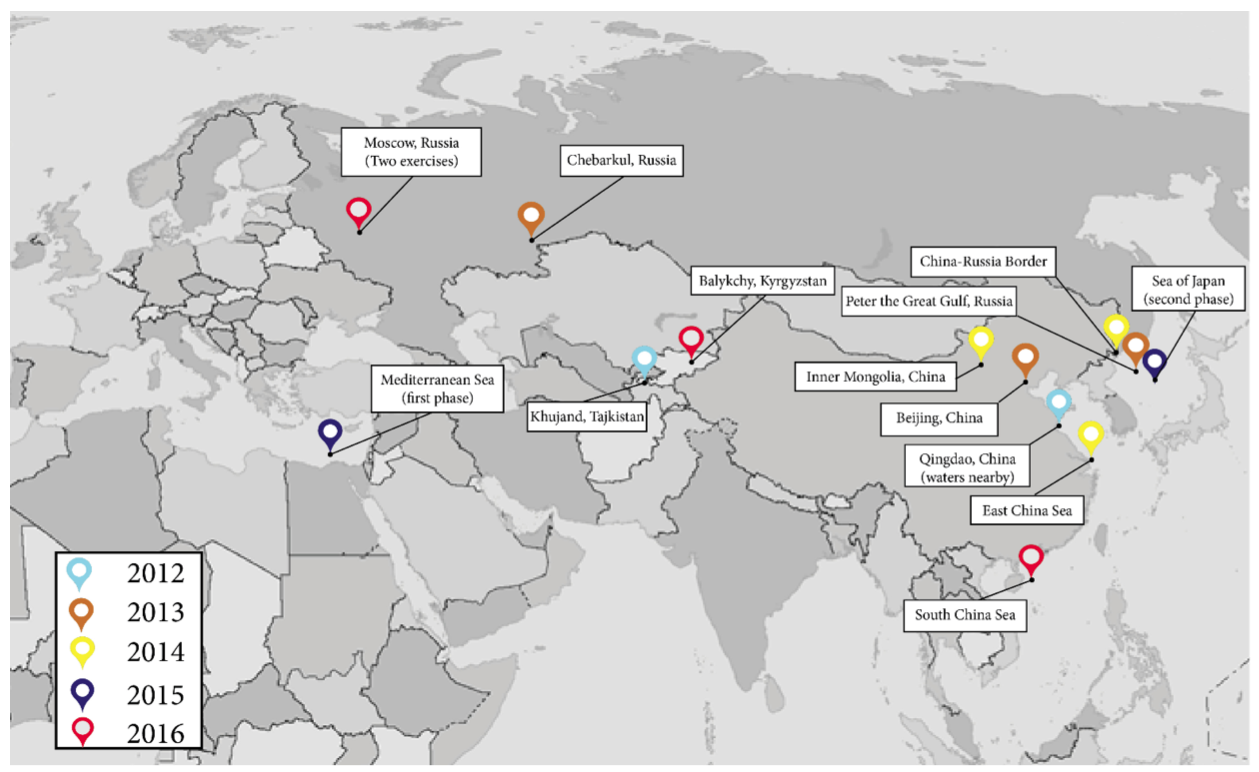
….uh huh…. Joint military operation locations:
Before Russia and China began their recent series of bilateral exercises, the key tie between Moscow and Beijing was arms sales and military technology cooperation — totaling about $26 billion from 1992 to 2006 — according to estimates cited in the report.

Moscow sold Beijing, “export versions of the Su-27 and Su-30 fighter, the S-300 SAM defense system, Sovermennyy-class guided missile destroyer, and Kilo-class diesel-electric submarine,” the report said, citing data from the Stockholm International Peace Research Institute.
Fears of China copying Russian systems led to a drop off in arms sales between the two countries – especially higher end weapon systems. Chinese arms manufactures are notorious for taking, modifying and reproducing weapon designsMore here.

Russia and China are planning to merge their satellite tracking systems, RT.com is reporting.

The giant system will be able to cover most of an area including China, Kazakhstan, Kyrgyzstan, Russia, Tajikistan, Uzbekistan, India and Pakistan. according to RT, the Russian-funded news outlet.

The two nations will reportedly negotiate terms of the merger in May during a conference in China.

Russia and China will be able to share data on positions of navigation satellite groups and to improve efficiency in a real-time environment, RT reported.

The merger was initiated by Chinese officials.

“If the project is implemented, it will allow for an improvement in accuracy for both systems,” a spokesman for the Russian Federal Space Agency, Roscosmos was quoted.

Japan and India are getting set for their own regional navigation satellite systems, RT reported. The system is expected to be operational by the end of the year.


Schiff Never Complained when Obama Normalized Relations with Putin

Remember, under the Obama administration, rogue nations such as Iran and Cuba were placed as among the world’s good actors. Hillary went to Russia with a ‘reset button’ and gave Moscow more authority and power in regions of major conflict. Yet it is Congressman Adam Schiff and his friendly democrat friends that are continuing to whine about Trump’s interactions with Russia or Russians.

So, Obama set the table on the friendly approach to Medvedev and Putin and Russian aggression around the world has more than threatened equilibrium, it is deadly.

Have you wondered why Bashir al Assad has not been brought before a global tribunal for war crimes?

UNITED NATIONS – Russia and China on Thursday vetoed a U.N. Security Council resolution referring the Syrian crisis to the International Criminal Court for investigation of possible war crimes, prompting angry responses from the proposal’s supporters who said the two countries should be ashamed.

This is the fourth time Russia and China have used their veto power as permanent council members to deflect action against the government of President Bashar Assad. The 13 other council members voted in favor of the resolution.

More than 60 countries signed on to support the French-drafted measure, in a dramatic demonstration of international backing for justice in the conflict which has sent millions fleeing and killed more than 160,000, according to activists. More here.

*** That is right, Russia has veto power and they have used it since at least 2014. Does it even make sense that Russia is part of the Security Council in the first place? Nope…

As the United States continues to fight against the Taliban in Afghanistan, who has been supplying the Taliban with weapons? Yup…Russia. You see, Russia has training operations with real fighting equipment and when the training is complete, they leave the high tech equipment behind and tell the Taliban to come get it.

Did Adam Schiff or Maxine Waters get on TV and demand impeachment over Obama’s relationship with Moscow? Nah….

While not a fan at all of MSNBC, Richard Engle however did an exceptional reporting piece on Putin including who else was to be assassinated by poison, including Christopher Steele of the Trump dossier.

So, in solidarity with Britain, the Trump administration took aggressive action in expelling several Russian diplomats (read spies) as did at least almost three dozen other countries. Trump also closed the Russian diplomatic post in Seattle. What was going on there was terrifying and it is questionable on why Obama did not order it closed in December of 2016. Read below for what the FBI knew and yet was unable to take action due to the Obama White House.

Escalating tit for tat, US orders Russian consulate closed ... Russian post in Seattle

Among the 27 countries that have retaliated for what is believed to be a Kremlin-ordered chemical-weapon attack on an ex-Russian intelligence officer and his daughter in Britain earlier this month, the United States took by far the most dramatic steps: ousting 60 diplomats in total, including 15 suspected intelligence operatives based at Russia’s United Nations Mission alone—the most significant action of its type since the Reagan administration. (The move prompted Russia, on Thursday, to announce the expulsion of 60 U.S. diplomats and the closure of the U.S. consulate in Saint Petersburg.) But it was the Trump administration’s announcement of the shuttering of Russia’s consulate in Seattle that turned heads. Why Seattle? What was going on there? Would the closure matter?

While Seattle is an important city for Russian intelligence collection efforts domestically, its consulate’s profile has generally been quieter than San Francisco’s or New York’s, according to two former U.S. intelligence officials who asked to remain anonymous but have knowledge of Russian activities in these areas. But the closure of the consulate is noteworthy nonetheless: Along with the administration’s shuttering of the San Francisco consulate in 2017, Russia will now lack a diplomatic facility west of Houston, or any diplomatic presence on the West Coast for the first time since 1971. Russian intelligence officers—at least those under diplomatic cover—will no longer operate in easy proximity to America’s two great tech capitals. Indeed, at least in Seattle, suspected Russia spies have already been caught attempting to infiltrate local tech companies.

“Certainly, there were enough issues that were important to the Russians in Seattle—the naval bases, Microsoft, Boeing, Amazon,” says John Sipher, a former CIA officer who worked closely with the FBI on counterespionage issues. “There was always nervousness within the national security agencies that the sheer number of ethnic Russians in these industries was something the Russians could take advantage of. I don’t know if closing Seattle was a strategic choice; nonetheless, the concentration of high-tech and military resources makes it a sensible target.”

After the closure of the Russian consulate in San Francisco, former senior U.S. intel officials told me that facility had, for decades, functioned as the primary hub for Russian intelligence-gathering in the Western United States. It featured key classified communications systems, and was a crucial collection center in Russia’s long-running effort to map out America’s fiber-optic cable network.

One of the two anonymous former intelligence officials I spoke with called Seattle a top-five U.S. city for Russian counterintelligence work, but a “smaller operation” than San Francisco. Seattle did not have the same type of communications facilities as San Francisco, the two former officials said. In fact, Russian diplomats used to regularly drive a van with protected diplomatic information from San Francisco to Seattle, said a second official, though the frequency of those trips decreased over time, when U.S. officials suspected the Russians had begun to move their communications to encrypted channels online.

Still, the Seattle area has some rich espionage targets. Firms like Boeing and Microsoft have long been of interest to Russian operatives, the former intel officials said. So have the many military bases in the area, including, pre-eminently, Naval Base Kitsap, located just across the Puget Sound from Seattle and home to eight nuclear-armed submarines. Administration officials have openly cited the Seattle consulate’s proximity to Boeing, and sensitive military bases, as reasons for its closure.

Because there is a seven-hour float from Kitsap to these nuclear-armed submarines’ dive point, the two former officials said, there are numerous opportunities to track the subs’ movements—a longstanding concern for U.S. intelligence and military officials. Knowing when a submarine is headed out to sea or how many submarines are running patrols at a given time, and potentially identifying new technologies on these vessels, are all valuable pieces of intelligence, these officials said. Moreover, U.S. intel officials have worried that in a worst-case-scenario—actual armed hostilities between the two countries—information gleaned from Russian operatives in the Pacific Northwest could be used to identify “choke points.” For instance, they might know the ideal places to fire a rocket-propelled grenade at a fishing boat in a narrow channel, which could prevent military vessels from deploying.

In the past, suspected intel operatives based at Russia’s Seattle consulate were observed engaging in the same sorts of behavior as their counterparts in San Francisco, the two former intel officials said, including tracking down potential fiber-optic nodes (as part of Russia’s long-term effort to map where data were being transferred), or Cold War-era intelligence-collection sites, in Northwestern forests. U.S. officials also believed Russian operatives were traveling to remote beaches in the area in order to “signal,” or cryptically transmit and receive data, with interlocutors offshore. (There was a specific beach in Oregon these individuals would favor, the two former officials said.)

More recently, however, these activities appeared to die down, these individuals said, an event one of the former intel officials attributes to Edward Snowden’s 2013 disclosures, which some in the intelligence community believe led Russia to overhaul its strategies for domestic intelligence-gathering. Generally, this person said, Seattle seemed like a “proving ground” for junior Russian intelligence officers, a place to send less-experienced operatives to acclimate them to the United States. After Snowden, U.S. intel officials started seeing more “travelers” in the Seattle area—suspected intelligence operatives working under both diplomatic and nonofficial cover—flying in remotely to meet with individuals, the two former officials said.

The biggest Russia-related concern in Seattle was “cyber-related activities,” which were separate from the consulate, the two former officials said—including those of the local Kaspersky Labs affiliate. In July 2017, U.S. officials banned Moscow-based Kaspersky, which produces anti-virus software, from being used on any government computers, over fears about the company’s connections to Russian intelligence. U.S. counterintelligence officials were concerned that Kaspersky was being used as a tool for Russian covert communications, the two former officials said, and were also examining whether individuals affiliated with Kaspersky were actual engaging in cyber-espionage domestically. “As a private company, Kaspersky Lab does not have inappropriate ties to any government, including Russia, and the company has never helped, nor will help, any government in the world with its cyber espionage efforts,” a spokesperson for Kaspersky said. “The U.S. government actions against Kaspersky Lab lack sufficient basis, are unconstitutional, have been taken without any evidence of wrongdoing by the company, and rely upon subjective, non-technical public sources, such as uncorroborated and often anonymously sourced media reports, related claims, and rumors, which is why the company has challenged the validity of these actions in federal court.“

“Was Kaspersky looking at Microsoft or Boeing as opportunities to exploit? Was it just business development? Or were they actually engaged in trying to penetrate these enterprises?” asked one of the former officials. “The suspicions on Kaspersky have pretty much been borne out … when you look at the recent U.S. government decision, and what has been publicly reported on what the Israelis have been able to find out.” In 2017 the New York Times reported that Israeli intelligence had hacked into a Russian espionage operation, observing Russian operatives using back doors in Kaspersky software to scan for, and purloin, U.S. intelligence documents.

Russia’s interest in Microsoft is also well-documented. In 2010, U.S. officials deported Alexey Karetnikov, a 23-year-old Russian national, from the Seattle area, where he had been working at Microsoft as a software tester. U.S. officials believed he was actually a Russian intelligence officer, and linked him to the ring of 10 “illegals”—Russian deep-cover operatives who had been living in the United States—that U.S. officials had arrested and deported earlier that year. Two of those undercover operatives, Michael Zottoli and Patricia Mills (whose real names are Mikhail Kutsik and Natalia Pereverzeva), had lived in Seattle for years, even starting a family there. In Seattle, Kutsik worked at a telecommunications firm, and both operatives took finance classes at the University of Washington. In a 2017 article in Seattle Met Magazine, Kutsik and Pereverzeva’s former investments professor said he believed the Russians were interested in his class because many of his students went on to work for Amazon, Boeing or Microsoft. Kutsik, Pereverzeva and Karetnikov were not known to have been coordinating their activities with the Seattle consulate, one of the former officials said.

Even as Russian espionage continues to migrate outside consular facilities—to travelers, and individuals working locally under nonofficial cover—it is “no coincidence” that both shuttered diplomatic outposts were on the West Coast, said one of the former officials. No matter when—or if—these two consulates are reopened, Russian interest in the West Coast is likely to continue far into the foreseeable future.

Where is Adam Schiff now?


Russia Expels Western Diplomats then Announces High Tech Weapons

“U.S. ambassador to Russia Jon Huntsman has been summoned to our ministry, where my deputy Sergei Ryabkov is briefing him on the tit-for-tat steps against the U.S.,” Lavrov said, according to the state-run Tass Russian News Agency.

“They include the expulsion of the same number of diplomats and our decision to withdraw consent to the work of the Consulate General in St. Petersburg.” More here.

Russia to Expel U.S. Diplomats, Close St. Petersburg ... photo

Meanwhile….

Robotics, artificial intelligence, and a willingness to strike the enemy’s non-military targets will figure in the country’s future strategies.

The U.S. military isn’t alone in its plans to pour money into drones, ground robots, and artificially intelligent assistants for command and control. Russia, too, will be increasing investment in these areas, as well as space and information warfare, Russian Army Gen. Valery Gerasimov told members of the Russian Military Academy of the General Staff last Saturday. In the event of war, Russia would consider economic and non-military government targets fair game, he said.

The comments are yet another sign that the militaries of the United States and Russia are coming more and more to resemble one another in key ways — at least in terms of hyping future capabilities. The chief of the General Staff said the Russian military is already developing new drones that could perform strike as well as reconnaissance missions. On the defensive side, the military is investing in counter-drone tech and electromagnetic warfare kits for individual troops.

The Russians are building an “automated reconnaissance and strike system,” he said, describing an AI-drive system that sounds a bit like the Maven and Data to Decision projects that the United States Air Force is pursuing. The goal, according to Gerasimov, was to cut down on the time between reconnaissance for target collection and strike by a factor of 2.5, and to improve the accuracy of strike by a factor of two. The Russian government is developing new, high-precision strike weapons for the same purpose. “In the future, precision weapons, including advanced hypersonics, will allow for the transfer the fundamental parts of strategic deterrence to non-nuclear weapons,” he said.

Sam Bendett, a research analyst at the Center for Naval Analyses, says the moves signal that the Russian military is trying to push fighting further away from its borders, thus growing the area to which it can deny access, or at least appear to do so. “Russia’s current force composition is aiming at short-range, short-duration conflict where its forces can overwhelm the adversary close to Russian borders. The new technology Gerasimov discusses would allow Russia to conduct deep-strikes within enemy territory, thus ‘pushing’ the actual fighting far from Russian borders and Russian vulnerability to Western precision-guided weapons,” he said.

What would Gerasimov hit with those weapons? In his talk, the Russian general said that enemy economic and non-military aspects of government could be on the list of potential targets. “The objects of the economy and the state administration of the enemy will be subject to immediate destruction, in addition to the traditional spheres of armed struggle, the information sphere and space will be actively involved,” he told the audience.

Says Bendett, “the use of such technologies is especially important given the type of war Moscow intends to fight. Gerasimov stated that potential adversary’s economic targets, as well as government’s ability to govern, will be fair game. Striking deep into enemy territory can be accomplished more easily by unmanned systems—whether armed with EW, various sensors or strike components … All this also depends on the Russian military-industrial complex’s ability to properly marshal the needed resources in an organized fashion in order to field this technology.”

One other explanation for the tough talk: Russia is hardly an even match for the United States in terms of either military spending or capability. The recently announced $61 billion increase in the U.S. military budget over last year’s budget (bringing the total to $700 billion) is greater than the entire Russian military budget, which sits around $46 billion. That number represents about 2.86 percent of Russian GDP. In December, Putin said that the government would “reduce” future expenditures.

“Gerasimov is, like anyone in a senior military post, a lobbyist as much as a soldier, and at a time when the Russian defense budget is going to continue to shrink, he is doing what he can both to maintain it as high as possible and also to tilt procurement away from older-fashioned metalwork — which is really a way for the Kremlin to subsidise the defence industries rather than what the military want — and towards advanced communications, reconnaissance and targeting capabilities,” said Mark Galeotti, the head of the Center for European Security at UMV, the Institute of International Relations, Prague.

According to Bendett, Russian government leaders are “hedging against impending geopolitical and economic uncertainty by trying to keep their military budget within certain parameters. The [Ministry of Defense] has been talking repeatedly about the rising share of new military tech in service of the Russian military, slowly phasing out older systems in favor of new ones. So the high-tech approach that Gerasimov outlined — space-based weapons, ‘military robots’ — is the next evolutionary stage in Russian military’s evolution to a more high-tech, sophisticated forces capable of rapid strike.”

Gerasimov also took a moment to denounce what he claimed were Western attempts to destabilize the Russian government through information and influence warfare and other subtle tactics. The charge may strike Western audiences as brazenly hypocritical given the Kremlin’s on-going attempts to sow misinformation to global audiences through social media, email theft and propaganda campaigns. But it’s an old talking point for Gerasimov.

Said UMV’s Galeotti: “At a time when the Kremlin is demonstrably worried about what it sees as Western ‘gibridnaya voina‘ [or hybrid war] being waged against it — we don’t have to accept their premises to acknowledge that the Russians genuinely believe this — he is staking out the military’s claims to being relevant in this age. And his answer, as in his infamous 2013 article, and as played out in the first stage of Zapad [the major wargame Russia executed in Belarus last summer] is that the military will deploy massive firepower to smash any foreign incursions meant to instigate risings against Moscow.”

Why Did Trump Hire McMaster in the First Place?

Much has been written about Trump’s now former National Security Counsel advisor H.R. McMaster who at one time was General Petraeus’ ‘go-to’ tank operations expert in Iraq. The 3-star general from the outset never really gelled in a cohesive policy relationship with President Trump and the chatter for months in DC was that his time at the White House was going to be short.

McMaster Worked at Think Tank Backed by Soros-Funded Group ...

Question is who recommended McMaster to Trump in the first place and who did the background investigation such that Trump accepted and confirmed him to lead the National Security Council?

“After 34 years of service to our nation,” the lieutenant general said, “I am requesting retirement from the U.S. Army effective this summer, after which I will leave public service.” A White House official told VOA that the president and McMaster had mutually agreed upon McMaster’s resignation, after discussing it for some time. The official said the president asked McMaster to stay on until mid-April to ensure a smooth transition, and McMaster agreed. A graduate of the U.S. Military Academy, known as West Point, McMaster earned a Silver Star for leadership during the Persian Gulf War when, as a cavalry commander, he led a small contingent of U.S. tanks to destroy 80 Iraqi tanks and other vehicles. More here.

Well, the Daily Caller did some remarkable deeper work on McMaster spelling out how Trump never should have brought him on board in the first place. The other question remains on why the Pentagon did not advise McMaster on terminating his outside relationship especially with some rogue nations.

  • Outgoing National Security Advisor H.R. McMaster worked for a foreign-based think tank for 11 years before assuming his post
  • The think tank has ties to Russia, China, the Uranium One deal and Bahrain
  • Career armed forces officers spoke out against the arrangement

Outgoing National Security Advisor Lt. Gen. H.R. McMaster served for more than a decade as a consultant to the London-based International Institute for Strategic Studies, a foreign-based think-tank that has received funding from hostile foreign governments to include Russia and China, according to a Daily Caller News Foundation investigation.

The career soldier ended his employment at the International Institute for Strategic Studies (IISS) in February 2017 after President Donald Trump tapped him to serve as his national security adviser following the resignation of former National Security Adviser Michael Flynn.

McMaster is planning to leave the NSC in April, to be replaced by former U.N. Ambassador John Bolton, according to The Wall Street Journal.

The outgoing NSC official said in a statement, he was “requesting retirement from the U.S. Army effective this summer after which I will leave public service.”

The general, who did not leave the Army to assume his NSC post, was one of only two White House national security chiefs who retained active duty status while working at the White House. The other general was Gen. Colin Powell.

McMaster never publicized his decade-long outside consultant work with the foreign-based think tank that often supported a globalist agenda opposed by Trump. IISS often espoused foreign and military policies that served as the centerpiece of the Obama presidency, including support for the former president’s Iran nuclear deal.

While his 11 years at the institute were never part of his official military biography, former military officers who learned of it were harshly critical of his unusual moonlighting.

Veteran military officers expressed disbelief at McMaster’s consulting work at a foreign-based think tank that receives funding from hostile governments. They called the arrangement “unethical” and “unprecedented.”

IISS operates offices in the Bahrain, Singapore and Washington, D.C. It generally reflects a globalist “realist” Eurocentric view of foreign and military postures that’s at odds with Trump’s foreign policy. The think-tank was a major advocate of former President Barack Obama’s nuclear deal with Iran.

IISS receives funding from friendly Western sources such as aerospace firms and even the British army, but is also has received funding from the Russian Federation, China’s Ministry of Foreign Affairs, as well as the governments of Azerbaijan, Turkey, Qatar, Pakistan, Saudi Arabia and Bahrain, according to the IISS website.

During McMaster’s time at IISS, the think tank also received $700,000 from George Soros’s Open Society and $140,000 from Ploughshares, the pacifist organization that aggressively pushed for Obama’s Iran nuclear deal.

The organization’s council — its board of directors — also is filled with people who have ties to the Kremlin, to the Qatari emir who has been accused of supporting terrorists, to people associated with the Uranium One scandal, and with a Russian investment bank that paid former President Bill Clinton $500,000 for a single speech.

“This is bizarre,” retired Army Lt. Gen. William “Jerry” Boykin said in an interview with TheDCNF. “If that kind of information was available to The Trump administration before they selected him, the question is: Would they have selected him for this very job?”

The Army told TheDCNF that from 2006 when he first joined IISS as a “senior research associate” until he left in 2017, he did file annual financial disclosure forms notifying the Army of payments he received from the institute.

McMaster’s office did not respond to a DCNF request for his current financial disclosure form, which he was required to submit in 2017 as a White House employee.

Retired Rear Adm. James “Ace” Lyons, who served 35 years in the Navy, including a stint as commander of the Pacific Fleet, told TheDCNF McMaster’s consulting role at the think tank was “absurd.”

“It is really absurd that an active duty military officer, particularly one of flag rank, is a consultant to a foreign organization that is taking money and contributions from questionable countries that are known enemies of the United States,” Lyons told TheDCNF in an interview. “This to me seems to be outside the bounds of what we’re committed to. This is atrocious.”

“I’ve never seen this kind of thing before,” said Boykin, a 36-year veteran who served as under secretary for defense intelligence for President George W. Bush.

Boykin said he was convinced any commanding officer would have rejected McMaster’s proposed consulting work at IISS. “I cannot believe that the ethics people of the U.S. Army would approve of him doing that, and I can’t believe that any responsible person he worked for in the Army would have agreed to that.”

William J. Sharp, a public affairs civilian attached to U.S. Army Headquarters, told TheDCNF the Army accepted McMaster’s proposed consulting work at IISS without any prior approval because they regarded the think tank as not falling under the category of a “prohibited source.”

The term “prohibited source” relates to a company that seeks a business or other formal contractual relationship from the Department of Defense. Using that limited standard, the Army concluded IISS was not a prohibited source and McMaster did not need to obtain prior approval from military superiors.

“IISS is not a prohibited source for Army personnel,” Sharp told TheDCNF in an email. “Therefore, LTG McMaster was not required to obtain approval prior to consulting for IISS.”

“I’m surprised at this,” Boykin said. “I find this in my view and in my experience of 36 years to be unprecedented, and I would love to see an authorization. And if it’s an open-ended authorization — if there’s one at all — then I would be willing to bet you it was an error on the part of whoever provided that authorization. You just can’t do this on your own,” he told TheDCNF.

Retired Special Forces Col. James Williamson told TheDCNF he considered it “very unusual” for an active duty officer to serve for a decade at any educational institution. “It’s very unusual for a general officer on active duty to have that type of affiliation over that timespan,” he said. “I’ve had friends that have gone to Harvard or the Fletcher School at Tufts, but they’re U.S.-based.” He said most terms were for a short duration — usually six months to a year.

In fact, the military approves and even encourages active duty officers to seek temporary assignments with American educational institutions and think tanks. But those assignments are very short and rarely extend for more than a year.

Williamson said active duty military officers have plenty of private sector and think tank opportunities after they leave military service. “We have other people who served in London, but they’re not on active duty. They’re retired officers and there’s no problem with that,” he said.

Williamson, a counter terrorism specialist who served with NATO and U.S. Southern Command, said he regarded McMaster’s work as posing a basic “conflict of interest” in light of funding from hostile governments. That funding “would almost make it a de facto conflict of interest in my eyes.”

Retired U.S. Air Force Col. James Waurishuk, who also worked at the NSC, agreed. “I would be concerned about the work he’s doing and how it applies in relation to a think-tank that’s taking money from perhaps adversarial foreign governments. That would be of concern to me,” he said.

Williamson also shared the same view and added that even working at a London think tank poses problems. “Even our closest allies don’t have the same agendas and priorities that we do,” he said.

During his 11 years with IISS, the group promoted McMaster’s activities. A review of previous IISS websites by TheDCNF shows he was highlighted between six and 10 times each year.

IISS praised McMaster when he joined the Trump White House. Jonathan Stevenson, an Obama NSC official who also is a senior fellow at IISS, wrote a fawning opinion piece about McMaster in The New York Times. He called him a “compelling choice: a scholar-warrior” and “both a proven cavalry officer and a formidable defense intellectual.” Stevenson wrote McMaster could save Trump, and the general’s appointment, “should augur at least a fleeting period of stability at the dysfunctional National Security Council.”

Igor Yurgen has been on the IISS Council since 2010. He is chairman of Rennaissance Capital Group, which awarded Bill Clinton $500,00 in speaking fees.

Russia Today, a pro-Kremlin news organization, once described Yurgen as “one of Russia’s most influential experts close to [former] President Dmitry Medvedev.”

“He is remarkably skilled at combining public, business and political careers,” according to RT.

Another council member is Michael Rich, an executive vice president of the RAND Corp. But significantly, he is co-chair of the board of overseers of a project called the RAND Qatar Policy Institute.

The Qatar Policy Institute is also part of the Qatar Foundation, started by Qatar’s former emir, Sheikh Hamad Bin Khalifa Al Thani, and his wife, Sheikha Moza bint Nasser.

Saudi Arabia and the Persian Gulf states accuse Qatar of supporting Islamic terrorism. Al Thani has supported the Taliban in Afghanistan, Hamas in the Gaza Strip, militias in Libya, and the Muslim Brotherhood, The New York Times reported in 2014. The Emir personally traveled in 2012 to the Gaza Strip, where he received a hero’s welcome as he pledged to work with the terrorist group Hamas. Al Thani also founded Al Jazeera, the pro-Muslim Brotherhood television news channel.

Badr Jafar, another current council member, is the son of Hamid Jafar, who founded the biggest private equity firm in the Middle East, North Africa and South Asia. Badr is the CEO of Crescent Enterprises who, with his father Hamid Jafar, engineered an oil exploration partnership between their Emirates-based company, Crescent Petroleum with the Boris Kovalchuk, CEO of the Russian company of Inter Rao UES.

News agencies in the United Arab Emirates hailed the 2010 financial deal between Crescent and Moscow. “Russian state news agencies began their coverage of the recent high-level meeting in Moscow between Crescent officials, the Russian prime minister, Vladimir Putin, and the Iraqi former prime minister Dr Ayad Allawi by linking the names of Hamid Jafar and Mr Putin,” according to the National Business report.

Russian President Vladimir Putin decreed that all shares of Inter Rao UES be transferred to the Russian state-owned atomic energy agency called Rosatom. Kovalchuk is a Kremlin confidant who served as a vice president of Rosatom. Americans know about Rosatom because of its purchase of Uranium One, which was made possible by then Secretary of State Hillary Clinton’s support for the Russian acquisition.

While McMaster was a consultant at IISS the organization was a strong, unwavering supporter of President Obama’s nuclear deal with Iran.

Mark Fitzpatrick, its director for non-proliferation and disarmament was the most outspoken IISS director for the nuclear deal calling it in 2015 a “a potential game changer in many ways, opening a path to better relations with Iran that has been closed for more than 35 years.” Fitzpatrick said the deal “makes it demonstrably less likely Iran will become nuclear-armed now and in the future.”

IISS also entered domestic American politics by defending the Democratic Party during the 2016 presidential campaign. It flatly stated following the release of emails from the Democratic National Committee it “revealed no evidence of significant wrongdoing within the Democratic Party.”

IISS also has been criticized for the secrecy of its activities and its routine denial of visas for reporters seeking to attend its overseas events, particularly its annual event in Bahrain where human right groups accuse the government of silencing critics and keeping journalists away.

BahrainWatch, a human rights group published an investigation in December 2016 claiming that even well known American journalists have been barred from its Bahrain conferences called the “Manama Dialogue.”

“New York Times journalist Nicholas Kristof has openly called for an invitation since 2011, though his media visa was once again rejected last year. Wall Street Journal journalist Yaroslav Trofimov was also denied a visa.

Waurishuk concluded that McMaster’s relationship with IISS raises too many alarms.

“There’s too many red flags that kind of go up,” he said.

Neither IISS Washington nor IISS London returned repeated queries about McMaster.