
Sweden Tells 4.8 Million Homes to Prepare for War

Those that take heed and prepare are left to help a country survive. Sweden is a member of the European Union. Question is what is the EU Headquarters in Brussels response to this? So far, silence.

It is all due to Russia, Crimea and Ukraine especially Kaliningrad. Roughly 220 miles of ocean separates Sweden from the heavily militarized Russian port of Kaliningrad. The country’s long, narrow shape leaves it vulnerable to air assault from multiple sides. And Sweden, along with neighboring Finland, are in the unique position as the only non-NATO aligned nations on the Baltic Sea.

The United States Army performs with Aurora 17.

 Aurora 17

Hence, the nation spent the Cold War years preparing to fend for itself against a great power invasion, drawing up plans for how to mobilize the entirety of the civilian population and infrastructure to defend its territory. And then the Soviet Union collapsed, a new era of peace dawned and those plans were left to fall fallow.

Sweden Advises Its Citizens to Prepare Wet Wipes and Tinned Hummus in the Event of War

Sweden has not gone to war with another country for over two centuries, but that hasn’t stopped the government from reissuing an emergency manual from World War II that advises citizens on how best to cope with hypothetical hostilities.

The newly updated 20-page pamphlet, entitled Om krisen eller kriget kommer (‘If crisis or war comes”), offers strategies for handling everything from cyber attacks and terrorism to climate change, food shortages and fake news.

“What would you do if your everyday life was turned upside down?” the English language version of the manual begins.

Since supplies could run low during a crisis, the leaflet provides checklists of what to stock up on, including mineral water, wet wipes and tinned hummus. It also offers tips on where to find bomb shelters, what to do without access to ATMs, cellphones or the internet, and how to spot propaganda.

** Very interesting. has sent a pamphlet with instructions on how to “be prepared for war” to 4.8million homes. Random quote: “If Sweden is attacked … we will never give up. All information to the effect that resistance is to cease is false.”

“Although Sweden is safer than many other countries, there are still threats to our security and independence,” the brochure says. “If you are prepared, you are contributing to improving the ability of the country as a whole to cope with a major strain.”

The illustrated instructions went online Monday and are being sent to all 4.8 million households in the country in the first such public awareness campaign since 1961. The handbook was last updated for government officials’ use during the Cold War, according to the Guardian.

The newly minted pamphlets do not specify an attacker, but their release comes amid escalating security concerns following Russia’s annexation of Crimea in 2014. Sweden has accused Moscow of repeatedly infringing on its airspace and territorial waters — claims the Kremlin dismisses as “Russiaphobia.”

Sweden began increasing its military spending in 2016, reversing years of cuts. It also reinstated the military draft last year, citing Russian assertiveness as one of the justifications, and is considering joining NATO.

In the event of a “heightened state of alert,” the pamphlet emphasizes the expectation that everyone can be marshaled for Sweden’s “total defense.”

“If Sweden is attacked by another country, we will never give up,” the publication reads. “All information to the effect that resistance is to cease is false.”

***

Similar leaflets were first distributed in neutral Sweden in 1943, at the height of the second world war. Updates were issued regularly to the general public until 1961, and then to local and national government officials until 1991.

“Society is vulnerable, so we need to prepare ourselves as individuals,” said Dan Eliasson of the Swedish civil contingencies agency, which is in charge of the project. “There’s also an information deficit in terms of concrete advice, which we aim to provide.”
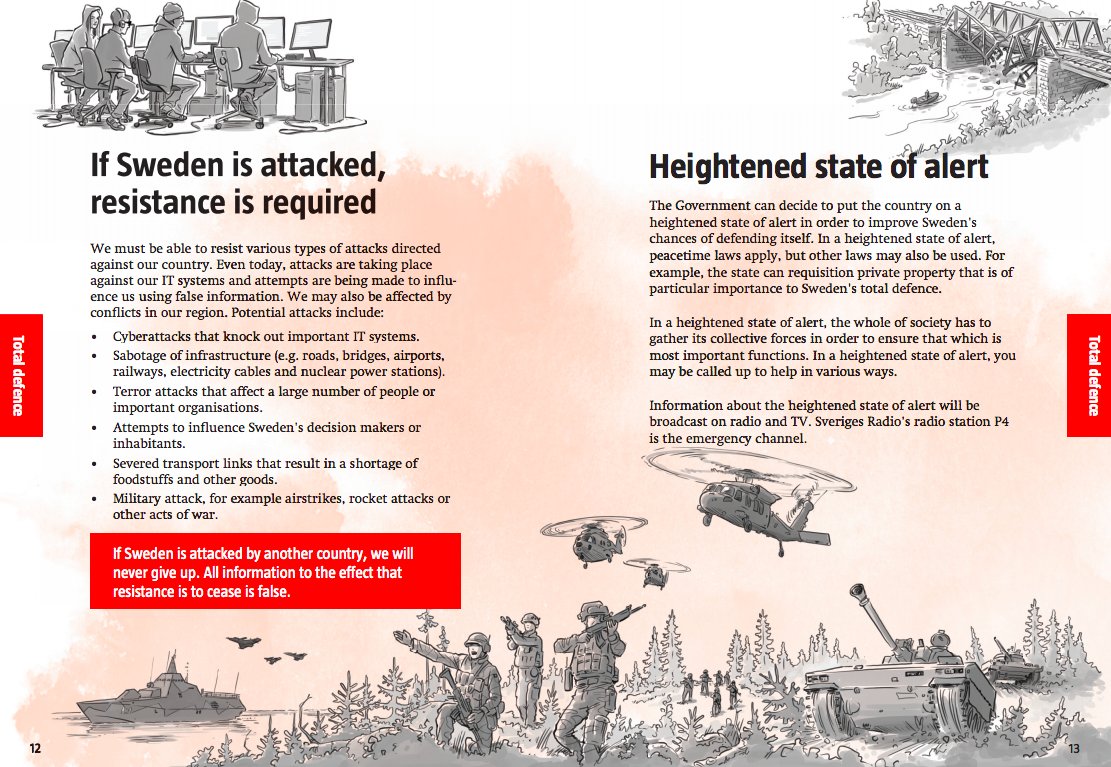

A Swedish cold-war era defence leaflet.

U.S. Iran Strategy Announced by SecState Pompeo

This speech/policy sets the table for the North Korea talks with President Trump. Further, it advances the mission on countering militant Islam not only in the region but globally. Europe has to decide on corporate business relationship with Iran versus human rights along with worldwide terrorism at the hands of Hezbollah and the Iranian Revolutionary Guard Corps.

Since 2014, a broad range of organizations, from medical companies such as GE Healthcare to aerospace firms such as Lufthansa Technik, as well as educational institutions such as Harvard University, have obtained permission and waivers to operate in Iran.

Other U.S. institutions that were permitted to do business in Iran include: General Electric Medical and Aviation Divisions, Bausch & Lomb, Boston Scientific, Smithsonian Institute, HSBC, Philips North America, University of California San Diego, University of Wisconsin, Loyola University, New York University, BNP Paribas S.A., American Pulp and Paper and Intelsat Corporation to list a few. More here.

(Reuters) – The United States on Monday demanded Iran make sweeping changes — from dropping its nuclear program to pulling out of the Syrian civil war — or face severe economic sanctions as the Trump administration hardened its approach to Tehran.

Iran dismissed Washington’s ultimatum and one senior Iranian official said it showed the United States is seeking “regime change” in Iran.

Weeks after President Donald Trump pulled out of an international nuclear deal with Iran, his administration threatened to impose “the strongest sanctions in history,” and vowed to “crush” Iranian operatives abroad, setting Washington and Tehran further on a course of confrontation.

U.S. Secretary of State Mike Pompeo demanded sweeping changes that would force Iran effectively to reverse the recent spread of its military and political influence through the Middle East to the shores of the Mediterranean Sea.

If Washington sees tangible shifts in Iran’s policies, it is prepared to lift sanctions, Pompeo said.

“The sting of sanctions will only grow more painful if the regime does not change course from the unacceptable and unproductive path it has chosen for itself and the people of Iran,” Pompeo said in his first major speech since becoming secretary of state.

“These will be the strongest sanctions in history by the time we are done,” he added.

Pompeo took aim at Iran’s policy of expansion in the Middle East through support for armed groups in countries such as Syria, Lebanon and Yemen.

He warned that the United States would “crush” Iranian operatives and proxies abroad and told Tehran to pull out forces under its command from the Syrian civil war where they have helped President Bashar al-Assad gain the upper hand.

Iran’s president summarily dismissed Pompeo’s demands.

“Who are you to decide for Iran and the world?,” the semi-official ILNA news agency quoted Hassan Rouhani as saying.

“The world today does not accept America to decide for the world, as countries are independent … that era is over … We will continue our path with the support of our nation.”

Tension between the two countries has grown notably since Trump this month withdrew from the 2015 nuclear agreement aimed at preventing Tehran from obtaining a nuclear weapon.

A senior Iranian official said Pompeo’s remarks showed that the United States was pushing for “regime change,” a charged phrase often associated with the U.S. invasion of Iraq in 2003 and the overthrow of President Saddam Hussein.

Pompeo warned that if Iran fully resumed its nuclear program Washington would be ready to respond and said the administration would hold companies doing prohibited business in Iran to account.

“Our demands on Iran are not unreasonable: give up your program,” Pompeo said, “Should they choose to go back, should they begin to enrich, we are fully prepared to respond to that as well,” he said, declining to elaborate.

Pompeo said Washington would work with the Defense Department and allies to counter Iran in the cyberspace and maritime areas.

The Pentagon said it would take all necessary steps to confront Iranian behavior in the region and was assessing whether that could include new actions or doubling down on current ones.

Related reading: 2015 France Opened Trade Office in Iran for 150 French companies

Related reading: May 2018 UK Updated the Trade Policy with Iran

Related reading: ‘Made in Germany’ has a very good reputation in Iran

NAMING NAMES

Pompeo said if Iran made major changes, the United States was prepared to ease sanctions, re-establish full diplomatic and commercial relations and support the country’s re-integration into the international economic system.

Any new U.S. sanctions will raise the cost of trade for Iran and are expected to further deter Western companies from investing there, giving hardliners, including the Islamic Revolutionary Guard Corps, an opportunity to cement their grip on power.

Iran’s ruling elite are mindful of recent protests sparked by economic hardship, which is, in part, their calculation for working with the Europeans on ways to salvage the nuclear deal.

Pompeo’s speech did not explicitly call for regime change but he repeatedly urged the Iranian people not to put up with their leaders, specifically naming Rouhani and Foreign Minister Mohammad Javad Zarif.

“At the end of the day the Iranian people will get to make a choice about their leadership,” Pompeo said.

Suzanne Maloney, deputy director of the Brooking Institution think tank’s foreign policy program, said Pompeo’s speech did indeed amount to a strategy of regime change.

“There is only one way to read it and that is that Trump administration has wedded itself to a regime-change strategy to Iran, one that is likely to alienate our allies. One with dubious prospects for success,” she said.

The administration’s approach “explicitly puts the onus on the Iranian people to change their leadership or face cataclysmic financial pressure,” said Maloney who has advised the State Department on Iran in the Bush administration between 2005-2007.

Lebanese analyst Ghaleb Kandil, who has close ties to the pro-Iran Hezbollah group, said Washington’s demands have previously not worked.

“These are conditions that were tested in previous phases of American pressures, before the nuclear deal, when Iran was in more difficult circumstances than it is in these days, and it did not surrender to these conditions or accept them,” said Kandil.

Pompeo outlined 12 U.S. demands for Iran including to stop uranium enrichment, never to pursue plutonium reprocessing and to close its heavy water reactor.

It also had to declare all previous military dimensions of its nuclear program and to permanently and verifiably abandon such work, he said.

Pompeo’s demand that Tehran stop uranium enrichment goes even further than the nuclear deal. Iran says its nuclear work has medical uses and will produce energy to meet domestic demand and complement its oil reserves.

Washington’s regional allies, the Gulf and Israel, who were strong critics of the deal, praised the administration’s position on Monday.

European parties to the nuclear deal – France, Britain and Germany – are working to find a way to keep the nuclear pact in effect after Washington’s exit.

Speaking ahead of Pompeo’s speech, British Foreign Secretary Boris Johnson said it would be difficult for the United States and its allies to deal with all the issues they had with Iran at the same time.

“If you try to pull all of those into a giant negotiation, a new jumbo Iran negotiation, a new treaty…that seems to be what they envisage and I don’t see that being very easy to achieve in anything like a reasonable timescale, Johnson said in Argentina.

Gordon Chang is Right, Recall Chinese Diplomats

Today, May 20, Steve Mnuchin, Treasury Secretary announced the tariffs are on hold, pending some kind of a tentative agreement. Really Steve? This as the North Korea Kim/Trump talks are on shaky ground. China wants North Korea to have nuclear weapons, period.

China is a Leninist state. I spent a month on the mainland, I saw it.

A threat to the United States? Yes. To allies? Yes

China has overtly weaponized those pesky island with a H-6 bomber aircraft landing on Woody Island. Did President Xi share any of this with President Trump at that confab at Mar A Lago? The matter of the South China Sea and those disputed waters and island is hardly any new threat. It goes back to at least 2014 and President Obama was briefed often on the building Chinese aggression. There was a temporary Asia Pivot by Obama but it was merely a gesture in retrospect. That Asia Pivot hardly raised any eyebrows in Beijing.

The reason to recall diplomats and expel others from the United States? At least the first one, laser attack on our U.S. airmen.

8 May 2018 The two airmen reported symptoms of dizziness and seeing rings. Pointing lasers at aircraft is extremely dangerous. It can temporarily blind pilots, and in the United States it’s a federal offense. While the pilots are expected to make a full recovery, the incident raises questions about how far the United States will allow China to push it without pushing back.

But first let’s back up. What’s everyone doing in Djibouti, a tiny country in eastern Africa? America has a base in Djibouti because of its proximity to Yemen, a terrorist incubator. The 4,000 U.S. troops stationed there are tasked with conducting counter-terrorism operations in the region.

Djibouti - China Naval Base photo

What about China? Well, that’s a little more opaque. China opened its Djibouti base last August, claiming that its purpose is to help with anti-piracy patrols and other peacekeeping missions. It’s supposedly a logistics base, but here’s the thing: China doesn’t have foreign military bases anywhere in the world — except in Djibouti, eight miles from the U.S. base.

But is worse…anyone paying attention outside of Gordon Chang and Steven Mosher? Yes thankfully, Congress is. FINALLY

Suggest you watch this video, consider how much of it, if not all of it was stolen from the United States.

So, let us consider some of these items shall we?

  1. Why are we giving China access to our defense contractors? Additionally, there are cyber part operations and hacks of the F-22 and F-35.
  2. Who is challenging the BRI, Belt Road Initiative?
  3. The South China Sea is part of the Blue Water Territory. China is building a navy to be twice the size of that of the United States. That includes up to 12 nuclear powered carrier battle groups.
  4. No one challenged China on the Scarborough Shoal achievement, that is the new China model for hegemony.
  5. China wants all telecom advances developed by the United States for it’s fiber-liked command centers and is getting them. China wants to lead on 5G, then there is outer-space.
  6. China and Russia have an alliance on military, missile and hybrid tactics to alter the balance of global power.
  7. Then there was the China Argentina issue with the Falklands, again.
  8. China has instituted national re-education program. The program is a hallmark of China’s emboldened state security apparatus under the deeply nationalistic, hard-line rule of President Xi Jinping. It is partly rooted in the ancient Chinese belief in transformation through education – taken once before to terrifying extremes during the mass thought reform campaigns of Mao Zedong, the Chinese leader sometimes channeled by Xi.
  9. A significant Chinese operation is debt-trapping. Sri Lanka and the Philippines are already falling due to this.
  10. China forcing Venezuela to give up Blanquilla Island over debt.
  11. If you look at the Qing Dynasty, that is President Xi’s vision and Taiwan is an important key to that achievement. China Wants to Build a Massive Underwater Tunnel to Taiwan and to own/control Taiwan by 2020.
  12. OBOR, One Belt, One Road is a sophisticated trade strategy on a global scale and it threatens currency stability, port security, transportation channels and debt.


President Trump and ZTE

There has to be an explanation for President Trump’s interest in saving jobs at ZTE.

In Concession, Trump Will Help China's ZTE 'Get Back Into ... photo

Could it be part of a trade issue with China to ensure China continues pressure on North Korea? Could it be to keep American intellectual property protected in some obscure plot where China continues to steal intelligence to eventually control all 5G?

The 2019 NDAA includes a provision to prohibit ZTE and Huawei use in the United States.

Reuters: “I hope the administration does not move forward on this supposed deal I keep reading about,” Republican Senator Marco Rubio said. Bilateral talks between the world’s two biggest economies resume in Washington this week.

The Wall Street Journal has reported Beijing would back away from threats to slap tariffs on U.S. farm goods in exchange for easing the ban on selling components to ZTE.

“They are basically conducting an all-out assault to steal what we’ve already developed and use it as the baseline for their development so they can supplant us as the leader in the most important technologies of the 21st century,” Rubio said at a Foreign Relations Committee hearing on Asia policy.

Trump had taken to Twitter on Sunday with a pledge to help the company, which has suspended its main operations, because the penalties had cost too many jobs in China. It was a departure for a president who often touts “America First” policies.

The Commerce Department in April found ZTE had violated a 2017 settlement created after the company violated sanctions on Iran and North Korea, and banned U.S. companies from providing exports to ZTE for seven years.

U.S. companies are estimated to provide 25 percent to 30 percent of components used in ZTE’s equipment, which includes smartphones and gear to build telecommunications networks.

The suggestion outraged members of Congress who have been pressing for more restrictions on ZTE. Some U.S. lawmakers have alleged equipment made by ZTE and other Chinese companies could pose a cyber security threat.

“Who makes unilateral concessions on the eve of talks after you’ve spent all this time trying to say, correctly in my view, that the Chinese have ripped off our technology?” Senator Ron Wyden, the senior Democrat on the Senate Finance Committee, which oversees trade policy, told Reuters.

Wyden, who is also on the Intelligence Committee, was one of 32 Senate Democrats who signed a letter on Tuesday accusing Trump of putting China’s interests ahead of U.S. jobs and national security.

The company has denied wrongdoing.

Republican Representative Mac Thornberry, chairman of the House Armed Services Committee, said at a Bloomberg event on Tuesday he did not expect lawmakers would seek to remove a ban on ZTE technology from a must-pass annual defense policy bill making its way through Congress.

“I confess I don’t fully understand the administration’s take on this at this point,” Thornberry said. “It is not a question to me of economics, it is a question of security.”

Consider:

Axios: President Trump’s desire to help save ZTE could set the tone for the treatment of another Chinese telecom company that’s under investigation for sanctions violations, Axios’ Erica Pandey writes.

The backdrop:

  • ZTE has been found guilty of breaking U.S. law three times, including violating sanctions by selling equipment with American parts to Iran and North Korea.
  • The Pentagon has banned the sale of ZTE and Huawei phones at retail stores on military bases, citing concerns that the companies are using their devices to spy on military personnel.
  • ZTE and Huawei are both key players in China’s race to dominate 5G and the future of mobile communication. The Chinese Communist Party is painting U.S. moves against the Chinese phone makers as efforts to knock China out of the 5G race.

Between the lines: “Ross had a color wheel of approaches [on ZTE] ranging from a handslap to breaking them as a company,” says Chris Johnson, a former CIA China analyst who’s now at the Center for Strategic and International Studies.

  • The Chinese might have stomached a slap on the wrist, but by banning American companies from selling parts to ZTE, Ross served up a punishment harsh enough to halt operations. China in turn made ZTE a top trade priority and used its massive leverage to potentially sway the president.

Why it matters: China could use Trump’s apparent pivot on ZTE as a stepping stone to free Huawei. Or the ZTE case could be a lesson for the U.S. in negotiating with China.

How the ZTE deal could fare:

  • “The U.S. and China are closing in on a deal that would give China’s ZTE Corp. a reprieve from potentially crippling U.S. sanctions in exchange for Beijing removing tariffs on billions of dollars of U.S. agricultural products, said people in both countries briefed on the deal,” the Wall Street Journal’s Lingling Wei and Bob Davis report.
  • Steven Mnuchin is leading the U.S. in negotiating a deal that puts the brakes on actions against ZTE in exchange for China buying down its trade surplus, reports Axios’ Jonathan Swan.
  • China’s trade negotiator, Liu He, is in DC today. Axios contributor Bill Bishop hears that Liu will arrive “with an open checkbook to buy down the deficit but that progress on anything structural will be much harder.”

The bottom line: Taking the toughest possible approach to China might not be the smartest when the Asian power is stronger than ever and prepared to fight back.


Trump Kim Talks now in Jeopardy, Developing

The United States and South Korea do military drills often and Kim Jung Un was well aware of those planned stating the drills were a rehearsal for an invasion. Further, North Korea has canceled talks with South Korea. The Kim regime is making yet another demand stating the United States must be careful about deliberations and the summit itself due to the ‘ruckus’ over the drills.

This all comes from the conclusion of the meeting that North Korea has with China.

Meanwhile:

Sperimentazione allertamento test nucleare ...

That nuclear test site that North Korea has declared inoperable and where media has been invited to see the dismantling of the site and tunnels may not be the only site and no one is speaking of other sites but should be. Why? Well Iran refuses to declared PMD (possible military dimension) sites that are part of the nuclear development plan. Since Iran and North Korea have long collaborated on nuclear programs, it stands to reason North Korea has other sites as well.

***

Ahead of the April 27 inter-Korean summit, NGA published a separate assessment that North Korea had started dismantling significant components and structures associated with nuclear test observation at Punggye-ri.


The North’s decision not only came before Kim Jong-un’s first meeting with South Korean President Moon Jae-in at Panmunjom, but also before the first-ever U.S.-North Korea summit meeting, scheduled for June 12 in Singapore.

Satellite imagery published by 38 North on Monday, May 14, provides open source corroboration of significant changes near the northern, western, and southern portals leading into the underground tunnel network that composes the Punggye-ri test site.

North Korea watchers Jeffrey Lewis and Dave Schmerler of the Monterey Institute of International Studies have also observed the dismantling of structures around the Punggye-ri test site. Lewis and his team created a 3D model offering an impression of the horizontal tunnel network at the Punggye-ri test site.

North Korea’s work to dismantle structures at the test site comes ahead of its announced intention to invite journalists and experts from China, Russia, South Korea, the United States, and the United Kingdom to observe the site’s dismantlement between May 23 and May 25.

A report published over the weekend by the country’s outward-facing state media, the Korean Central News Agency, said that the event would be to “ensure transparency of discontinuance of the nuclear test (sic).” U.S. President Donald Trump called Kim’s move a “very smart and gracious gesture” in a tweet.

The same report specified the process for the site’s disabling, which would include the collapsing of tunnels — presumably with explosives — and the removal of observation and research facilities. U.S. intelligence assessments suggest that much of the latter work will have been completed prior to the arrival of foreign observers.

The DIA and NGA assessments leave open the possibility that North Korea’s planned modifications to the test site next week could significantly extend the period of time necessary to restore Punggye-ri to a usable state.

Following Kim’s announcement that the Punggye-ri site will be shut down, international observers, including the Comprehensive Nuclear Test-Ban Treaty Organization’s (CTBTO) executive secretary, Lassina Zerbo, welcomed the announcement. Kim has not specified whether the CTBTO will be invited to verify the closure of the nuclear test site.

North Korea is the only country known to have conducted full-yield tests of nuclear weapons in the 21st century. Kim Jong-un has not expressed an interest in signing the Comprehensive Test-Ban Treaty, which has yet to enter into force.

With six nuclear tests, North Korea likely has a useful set of data that it can use to continue refining its nuclear weapons designs. The U.S. intelligence community has, with consensus, determined as of mid-2017 that North Korea is capable of mounting compact nuclear weapons atop its larger ballistic missiles, including its intercontinental-range ballistic missiles that threaten the continental United States.

In the same report to the Workers’ Party of Korea’s 7th Central Committee where Kim first acknowledged that Punggye-ri’s mission had come to an end, that North Korean leader, for the first time, publicly acknowledged that North Korea had conducted sub-critical nuclear weapons testing.

North Korea has not made any concessions on its sub-critical testing program, which will likely continue at its Nuclear Weapons Institute. Continued sub-critical testing would allow North Korea to maintain its existing weapons and refine their performance.

RCD: With the location and date of the forthcoming summit between President Donald Trump and Kim Jong‑un now fixed, speculation has turned to what sort of agreement might be achievable. US National Security Advisor John Bolton recently suggested that the ‘Libyan model’ of nuclear disarmament—from 2003–2004—might offer a framework that could be applied to North Korea in 2018.

The suggestion received what might kindly be called a mixed reception, not least because the North Koreans believe that Muammar al-Qaddafi was a fool to abandon his nuclear program. Still, I’d like to explore the Libyan case here because it offers one of the few examples of ‘denuclearisation’ that we have.

True, the two cases are markedly dissimilar: Libya, unlike North Korea, had made relatively little progress towards nuclear weapons when its leadership took the strategic decision to abandon the program. The Libyans had no nuclear weapons. Yes, they had a small number of centrifuges—some still in their original packing—and a quantity of uranium hexafluoride (the feedstock for a centrifuge enrichment cascade).

More ominously, they had a nuclear weapon design, apparently obtained from the A.Q. Khan network—although some Libyans claimed that the design was a ‘bonus’ intended as a reward for their other purchases.

But when US officials appeared before the US Senate Foreign Relations Committee in early 2004 to talk about the disarmament effort, senators were at least as interested in the detailed picture of the nuclear black market that the Libyan program revealed as they were in the program itself. While a raft of fascinating material about the program had suddenly spilled forth, it was the procurement trail, stretching from Libya to Pakistan and Malaysia, that the committee chairman, Senator Richard Lugar, referred to as ‘the treasure trove’.

While North Korea’s current indigenous capabilities are far stronger than Libya’s were 15 years ago, one suspects there would be similar interest in Washington today about Pyongyang’s proliferation links.

Further, there are some aspects of the Libyan model that the current US administration might want to replicate in any deal with North Korea. Two of those aspects concern access and relocation. US and British experts were given extraordinary access to the Libyan weapons of mass destruction (WMD) program. See the statements made in 2004 by Paula DeSutter, the US Assistant Secretary of State for Verification and Compliance, to two congressional committees (here and here) and, separately, in an interview with Arms Control Today:

The Libyans said, ‘We are no longer going to have a nuclear weapons program.’ They invited the United States and the United Kingdom in. They gave the United States and the United Kingdom access to all facilities that we requested to see. They were willing to permit any tests that we wanted to conduct. They were willing to have their centrifuge program removed … They have been very forthcoming.

In the chemical weapons area, we assisted them in drafting their declaration to the OPCW [Organization for the Prohibition of Chemical Weapons]. They had the OPCW technical secretariat come in. On one occasion they said, ‘You know, we really hadn’t told the others that came before, but there are some other munitions we need to show you.’ They took us to a facility that we almost certainly would not have been able to identify independently and showed us the unfilled munitions there. That is transparency. That is the kind of access that we are given when a country has made a strategic commitment. They volunteer information.

Some sources suggest that the procedure was not quite as straightforward as that passage of text implies. William Tobey, for example, argues that Libyan commitment and transparency varied on a day-to-day basis, at least in the early months. (See Tobey’s five-part series in the Bulletin of the Atomic ScientistsPart 1Part 2Part 3Part 4 and Part 5, and his 2017 assessment of intelligence and policy cooperation in the Libyan disarmament case.)

It was because of that variability that the Americans wanted to relocate key parts of the WMD program quickly. The most proliferation-sensitive parts of the program—equipment and documents—were airlifted to the Oak Ridge National Laboratory in Tennessee. The nuclear weapon design documents, revealed to the Americans on 20 January, were flown out of the country two days later.

During the night of 25–26 January 2004, an American C-17, its insignia painted over, landed at an air base near Tripoli, loaded its cargo—including advanced centrifuge rotors, five Scud‑C missile guidance sets and two tons of uranium hexafluoride—and took off again. Later, in March 2004, another 1,000 tons of materials and equipment were loaded aboard a US ship, the Industrial Challenger, its insignia again painted over, and taken to America.

Is that what President Trump is going to propose to Kim Jong‑un? Media sources say that the US has asked North Korea to ‘discard’ the data from its nuclear weapon development program and allow its nuclear scientists to emigrate. Of course, the manner—and direction—in which that data might be discarded is a non-trivial issue.

And emigration would, of course, be a humane solution to an intractable problem: that even after the weapons are gone and the data has been discarded, the knowledge of how to make nuclear weapons and their delivery vehicles will still exist in the minds of North Korea’s scientists. I don’t imagine, though, that Washington wants those scientists heading to the Middle East. Russia and China might be acceptable destinations. People say that Tennessee is nice this time of year.

As was the case with the Libyan deal, the US is also arguing that this is an opportunity for North Korea to abandon not merely its nuclear program, but all of its WMD. Still, nuclear weapons and ballistic missiles seem likely to be the core of any deal.

On ballistic missiles, a key US objective in 2003–2004 was to ensure that Libya’s missile program was compliant with the thresholds set out in the Missile Technology Control Regime—namely, that its missiles were limited in their range to a maximum of 300 kilometres and in their payload to a maximum of 500 kilograms.

In short, the Libyan model sets high standards in relation to the exposure of proliferation linkages; provision of access to sites, personnel and materials; relocation of key items; and acceptance of international standards on WMD. Can an agreement with Pyongyang meet those standards? Frankly, it seems unlikely.

The Libyan model, after all, had one driver that might not be equally compelling in the North Korean case: the strategic commitment by the leadership to put aside WMD. Because of that commitment, the model unfolded quickly and the verification hurdles proved surmountable.

A similar level of strategic commitment on Kim Jong‑un’s part is what the Americans are hoping to find in Singapore on 12 June. The Trump administration is certainly signallingthat this is their desired approach.