
Govt Report on Prevention of Nationwide Cyber Catastrophe

A good first step for sure, however there needs to be a government-wide decision on cyber attacks being an act of war and how to respond.

***

The Cyberspace Solarium Commission’s proposes a strategy of layered cyber deterrence. Our report consists of over 80 recommendations to implement the strategy. These recommendations are organized into 6 pillars:
  1. Reform the U.S. Government’s Structure and Organization for Cyberspace.
  2. Strengthen Norms and Non-Military Tools.
  3. Promote National Resilience.
  4. Reshape the Cyber Ecosystem.
  5. Operationalize Cybersecurity Collaboration with the Private Sector.
  6. Preserve and Employ the Military Instrument of National Power.

Click here to download the full report.

A much-anticipated government report aimed at defending the nation against cyber threats in the years to come opens with a bleak preview of what could happen if critical systems were brought down.

“The water in the Potomac still has that red tint from where the treatment plants upstream were hacked, their automated systems tricked into flushing out the wrong mix of chemicals,” the Cyberspace Solarium Commission wrote in the opening lines of its report.

“By comparison, the water in the Lincoln Memorial Reflecting Pool has a purple glint to it. They’ve pumped out the floodwaters that covered Washington’s low-lying areas after the region’s reservoirs were hit in a cascade of sensor hacks,” it continues.

So begins the report two years in the making from a congressionally mandated commission made up of lawmakers and top Trump administration officials, pointing to the vulnerabilities involved with critical systems being hooked up to the internet.

The report, which includes more than 75 recommendations for how to prevent the cyber doomsday it spells out, and the commission that made it were both mandated by the 2019 National Defense Authorization Act (NDAA).

The commissioners, who include co-chairmen Sen. Angus King (I-Maine) and Rep. Mike Gallagher (R-Wis.), highlight a range of issues to address, but zero in on election security as “priority.”

“The American people still do not have the assurance that our election systems are secure from foreign manipulation,” King and Gallagher wrote in the report. “If we don’t get election security right, deterrence will fail and future generations will look back with longing and regret on the once powerful American Republic and wonder how we screwed the whole thing up.”

The focus on shoring up election security, and the agreed-upon recommendations for how to do this, sets the report apart from the approach to the subject on Capitol Hill, where it has been a major issue of contention between Republicans and Democrats since Russian interference in the 2016 presidential election.

Beyond election security, the commissioners call for overarching government reform to address cyber vulnerabilities. Chief among these is calling on the White House to issue an updated national strategy to address cyber threats and to establish a national cybersecurity director position to coordinate efforts.

In terms of congressional action, commissioners recommend that Congress create cybersecurity committees in both the House and Senate, establish a Bureau of Cybersecurity Statistics, and establish an assistant secretary position at the State Department to lead international efforts around cybersecurity.

“While cyberspace has transformed the American economy and society, the government has not kept up,” commissioners wrote in calling for reforms.

The commission also zeroed in on “imposing costs” to adversaries who attempt to attack the U.S. online. In order to do so, it recommended that the Department of Defense conduct vulnerability assessments of its weapons systems, including nuclear control systems, and that it make cybersecurity preparedness a necessity.

The Cybersecurity and Infrastructure Security Agency, the Department of Homeland Security’s cyber agency, would be empowered as the “lead agency” at the federal level.

The report’s recommendations were debated on and pinpointed by a group of high-ranking commissioners who also included FBI Director Christopher Wray, Deputy Secretary of Defense David Norquist, Transportation Security Administration Administrator David Pekoske, Sen. Ben Sasse (R-Neb.), and Rep. James Langevin (D-R.I.).

Langevin said in a statement on Wednesday that the report is intended to shore up the nation’s cyber “resiliency for years to come.”

“Our charge in drafting this report was to prevent a cyber event of significant national consequence, and we know that the short- and long-term recommendations we crafted will better position us to realize the promise of the Internet, while avoiding its perils,” Langevin said. “The sooner our recommendations are implemented, the better positioned the country will be to prevent and respond to incidents that can disrupt the American way of life.”

The report’s recommendations may soon have real-world consequences on Capitol Hill.

Rep. John Katko (R-N.Y.), the ranking member on the House Homeland Security Committee’s cyber panel, told The Hill this week that there “definitely will be some legislation” stemming from the report’s recommendations, and that hearings would likely be held.

Katko noted that he had talked with Senate Homeland Security Committee Chairman Ron Johnson (R-Wis.) about the Senate also taking action around the report.

“This report screams of the need for bipartisan action on this, and I hope that we can leave the politics out of it, and I hope we can attack these problems quickly and effectively,” Katko said.

Rep. Cedric Richmond (D-La.), the cyber subcommittee’s chairman, opened a hearing on Wednesday by praising the report’s recommendations and saying he looked forward to working to “codifying” the ideas alongside House Homeland Security Committee Chairman Bennie Thompson (D-Miss.).

Industry groups also reacted positively to the report’s recommendations. Tom Gann, the chief public policy officer of cybersecurity firm McAfee, told The Hill in a statement that he agreed with most of the report’s findings and hoped that they are “acted upon with speed.”

Protect Our Power, a nonprofit with the goal of protecting the electric grid, also praised the report.

“These are compelling recommendations, echoing issues we have highlighted for several years now, and action is long overdue,” Jim Cunningham, executive director of the group, said in a statement. “Without a reliable supply of electricity before, during and following a disabling cyberattack, none of our critical infrastructure can function.”

While there may be legislative action soon – and praise from industry groups – both Gallagher and King emphasized in the report that their main aim was for it to open the eyes of Americans to the dangers posed by cyberattacks on critical systems.

“The status quo is inviting attacks on America every second of every day,” the co-chairmen wrote. “We all want that to stop. So please do us, and your fellow Americans, a favor. Read this report and then demand that your government and the private sector act with speed and agility to secure our cyber future.”

Lebanon is Tail-Spinning into Default

BEIRUT (Reuters) – Lebanon announced it cannot meet its debt payments and halted a March 9 bond payment of $1.2 billion on Saturday, setting the heavily indebted state on course for a sovereign default as it grapples with a major financial crisis.

In a televised address to the nation, Prime Minister Hassan Diab said foreign currency reserves had hit a “critical and dangerous” level and were needed to meet basic needs. He called for “fair” negotiations with lenders to restructure the debt.

Lebanon to default on debt payments amid financial crisis ... source

The default will mark a new phase in a crisis that has hammered the economy since October, slicing around 40% off the value of the local currency, denying savers free access to their deposits and fuelling unemployment and unrest.

The crisis is seen as the biggest risk to Lebanon’s stability since the end of the 1975-90 civil war.

“How can we pay creditors abroad when the Lebanese cannot get their money from their bank accounts?” Diab said. “Our debt has become greater than Lebanon can bear, and greater than the ability of the Lebanese to meet interest payments.”

The long-brewing crisis came to a head last year as capital inflows slowed and protests erupted over decades of state corruption and bad governance.

“We are paying the price for the mistakes of the past years. Must we bequeath them to our children?” Diab said.

The Lebanese had “lived a dream that was a delusion as though things were just fine, while Lebanon was drowning in more debt”, he said.

There has been no sign of a bailout from foreign states that aided Lebanon in the past. Western governments insist Beirut first enact long-delayed reforms to fight waste and corruption.

Diab was appointed in January with backing from the Iran-backed group Hezbollah and its allies. Former prime minister Saad al-Hariri, a traditional ally of the West and Gulf Arab states, stayed out of the government.

NOT PRODUCTIVE ENOUGH

Diab, a little-known academic when he became prime minister, said corruption had drained the state while also criticizing economic policies adopted since the war. Lebanon was importing 80% of its needs and was not productive enough, he said.

Lebanon: near the Central Bank, new demonstrations against ...

He took aim at a banking system that drew capital to the country with dollar interest rates five to 10 times greater than those offered abroad.

“We do not need a banking sector four times the size of our economy. We will have to come up with a plan to restructure the banking sector,” he said.

The gross public debt has reached around 170% of gross domestic product, meaning Lebanon is close to being the world’s most heavily indebted state, he added.

Citing the World Bank, Diab said more than 40% of people could soon find themselves under the poverty line. Lebanon has a population of around 6 million, including about 1 million Syrian refugees.

Lebanon has a total of some $31 billion in dollar bonds that sources told Reuters on Friday the government would seek to restructure.

A set of Lebanon’s bond holders are to step up efforts to form a creditor group in the coming days, one of the members of the group said.

“From what we understand the government wants to be reasonable and so do most creditors. They understand the country is in a difficult situation,” the member said.

Lebanon’s public debt is worth about $89.5 billion, with around 37% of that in foreign currency.

Lebanon has sought technical but not financial assistance from the IMF, though many analysts believe that the only way for the country to secure financial support would be through an IMF program.

“Watch now if bondholders can block any deal,” said Nick Eisinger, principal, fixed income emerging markets at Vanguard, which holds some Lebanese debt but has been underweight in the market for a long time.

“It’s unclear how quick they can go down the restructuring route or get a deal because they need reforms first or at the same time,” he said.

Banks began restricting cash withdrawals and transfers abroad four months ago. Diab indicated the controls could soon be standardized, saying a draft law would “regulate the relationship between the banks and their customers, for it to become more fair and just”.

AG Sessions Lawsuit and Big Win for President Trump

A 3 judge panel…unanimous decision by the way.

The program began in 2006. The Federal government created a grant assistance program for states, local and tribal governments to reduce crime and violence….let that sink it. It is called the Byrne Memorial Justice Assistance Grant Program….let that sink in….justice.

This would have been easy to argue in court actually to stop the violators from receiving the grants. Just understand the simple premise —>

BJA helps to make American communities safer by strengthening the nation’s criminal justice system: Its grants, training and technical assistance, and policy development services provide state, local, and tribal governments with the cutting edge tools and best practices they need to reduce violent and drug-related crime, support law enforcement, and combat victimization.

BJA is a component of the Office of Justice Programs, U.S. Department of Justice, which also includes the Bureau of Justice Statistics, National Institute of Justice, Office of Juvenile Justice and Delinquency Prevention, Office for Victims of Crime, and Office of Sex Offender Sentencing, Monitoring, Apprehending, Registering, and Tracking.

  FILE – In this Tuesday, March 20, 2018 file photo, Attorney General Jeff Sessions, left, speaks during a roundtable talks on sanctuary cities hosted by President Donald Trump, third from right, in the Roosevelt Room of the White House, in Washington. The Trump administration can withhold millions of dollars in law enforcement grants to force states to cooperate with U.S. immigration enforcement, a federal appeals court in New York ruled Wednesday, Feb. 26, 2020 in a decision that conflicted with three other federal appeals courts. (AP Photo/Manuel Balce Ceneta)
Anyway…

(AP) — The Trump administration can withhold millions of dollars in law enforcement grants to force states to cooperate with U.S. immigration enforcement, a federal appeals court in New York ruled Wednesday in a decision that conflicted with three other federal appeals courts.

The ruling by the 2nd U.S. Circuit Court of Appeals in Manhattan overturned a lower court’s decision ordering the administration to release funding to New York City and seven states — New York, Connecticut, New Jersey, Washington, Massachusetts, Virginia and Rhode Island.

The states and city sued the U.S. government after the Justice Department announced in 2017 that it would withhold grant money from cities and states until they gave federal immigration authorities access to jails and provide advance notice when someone in the country illegally is about to be released.

Before the change, cities and states seeking grant money were required only to show they were not preventing local law enforcement from communicating with federal authorities about the immigration status of people who were detained.

At the time, then-Attorney General Jeff Sessions said: “So-called ‘sanctuary’ policies make all of us less safe because they intentionally undermine our laws and protect illegal aliens who have committed crimes.”

In 2018, the Justice Department imposed additional conditions on the grant money, though challenges to those have not yet reached the appeals court in New York.

The 2nd Circuit said the plain language of relevant laws make clear that the U.S. attorney general can impose conditions on states and municipalities receiving money.

And it noted that the U.S. Supreme Court has repeatedly observed that the federal government maintains broad power over states when it comes to immigration policies.

In the past two years, federal appeals courts in Chicago, Philadelphia and San Francisco have ruled against the federal government by upholding lower-court injunctions placed on the enforcement of some or all of the challenged conditions.

“While mindful of the respect owed to our sister circuits, we cannot agree that the federal government must be enjoined from imposing the challenged conditions on the federal grants here at issue,” the 2nd Circuit three-judge panel said in a decision written by Judge Reena Raggi.

“These conditions help the federal government enforce national immigration laws and policies supported by successive Democratic and Republican administrations. But more to the authorization point, they ensure that applicants satisfy particular statutory grant requirements imposed by Congress and subject to Attorney General oversight,” the appeals court said.

The Justice Department praised the decision, issuing a statement calling it a “major victory for Americans” and saying it recognizes that the attorney general has authority to ensure that grant recipients are not thwarting federal law enforcement priorities.

The department added that the ruling’s effect will be limited because other courts have ruled the other way, giving the plaintiffs in the New York case the opportunity to point to those as reasons to ignore the new conditions.

Cody Wofsy, a staff attorney with the American Civil Liberties Union, called the decision a “real outlier,” saying he believed the 2nd Circuit was the nation’s first court to side with the Trump administration on the issue.

“Over and over, courts have said the Department of Justice doesn’t have authority under governing statutes to impose these conditions,” he said. “These conditions are part of the administration’s attempts to bully, cajole and coerce state and local governments into participating in federal immigration enforcement activities.”

Under the Constitution’s federalism principles and the 10th Amendment, Wofsy said, states and municipalities “are entitled to decline to become part of the administration’s deportation force.”

The appeals rulings pertain to the issuance of the Edward Byrne Memorial Justice Assistance Grant Program.

US Navy Seizes Iran Ship with SAMs on Board

Our turn eh? Hummm, the same say that the Senate votes to limit the President’s war power measures on declaring war with Iran, this event from last week hits the headlines. By the way, President Trump has never indicated he would go to war with Iran with or without Congressional approval so that whold bi-partisan measure in the Senate was just a formality…gesture.

The Senate passed a war powers resolution Thursday that constrains President Donald Trump’s ability to authorize military strikes against Iran.

The resolution from Democratic Sen. Tim Kaine received bipartisan support. It passed 55–45 with eight Republicans voting with Democrats in favor. However, Trump has signaled he will veto the resolution, and there are not enough votes in Congress to override the veto.

Kaine introduced the resolution in early January after escalating tensions with Iran culminated in an American strike killing Iranian general Qassem Soleimani and Iran responding by firing missiles at two American bases in Iraq. The administration gave Congress a briefing to justify the strike after the fact, which didn’t satisfy Democrats and infuriated two administration allies, Republican Reps. Mike Lee and Rand Paul.

“The nation should not be at war without a vote of Congress,” said Kaine Wednesday. “Even if he chooses to veto it and we can’t override, the will of both bodies and the public they represent, that could be a factor in his decision making.” h/t

Anyway, back to the SAMs…surface to air missiles…

U.S. Warship in Arabian Sea Seizes Suspected Iranian Weapons

***

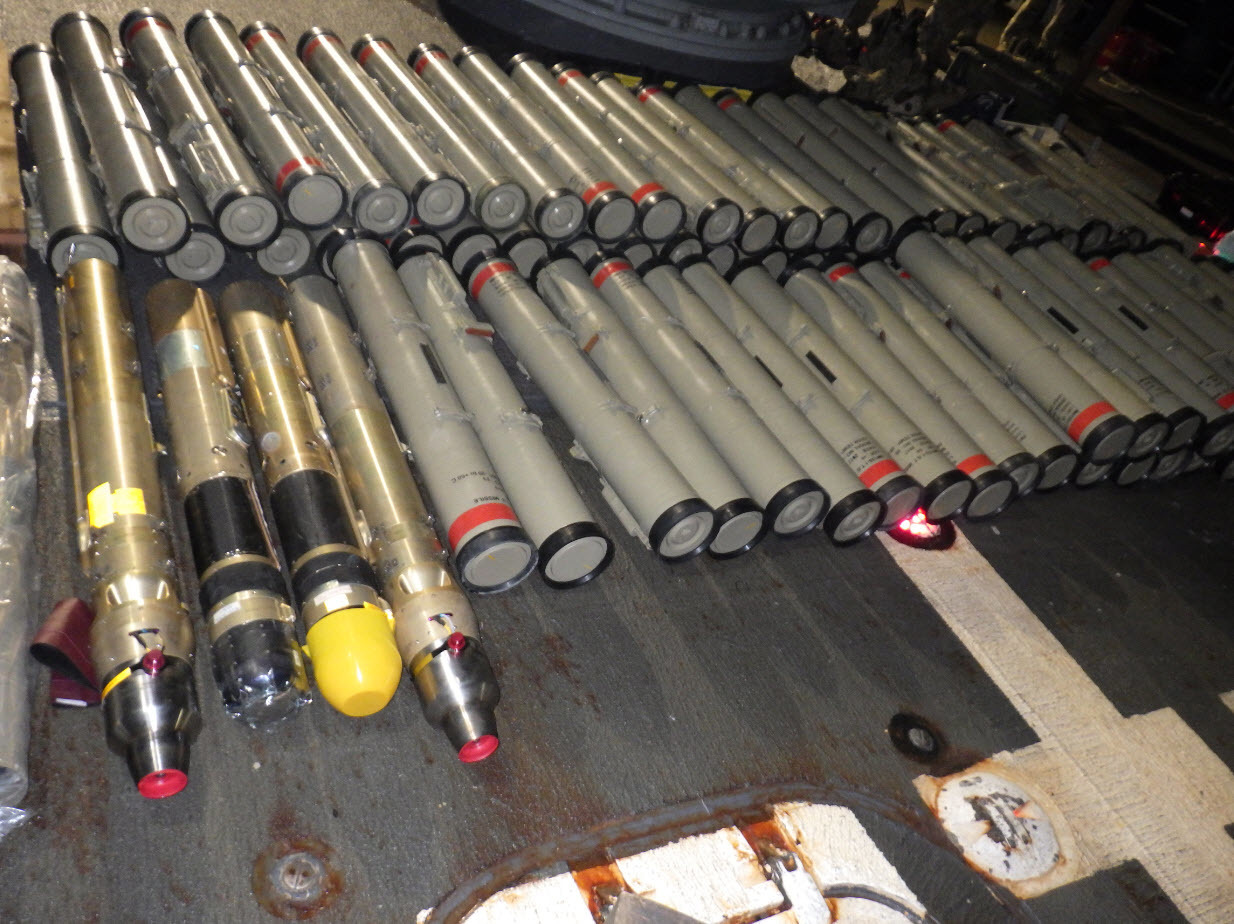
Ticonderoga-class guided-missile cruiser USS Normandy (CG-60) seized a cache of Iranian-made anti-tank missiles and other munitions aboard a dhow in the Arabian Sea over the weekend.

Normandy stopped the dhow while conducting maritime security operations over the weekend, in accordance with international law, according to a statement released Thursday by U.S. Central Command.

The seized weapons include:

  • 150 Dehlavieh anti-tank missiles, which are Iranian-made version of the Russian Kornet anti-tank missiles
  • Three Iranian-made surface-to-air missiles
  • Thermal imaging weapon scopes
  • Components for manned and unmanned aerial and surface vessels

The CENTCOM statement noted that many of the munitions seized over the weekend by Normandy are similar to weapons and components seized in November by the crew of Arleigh Burke-class guided-missile destroyer USS Forrest Sherman (DDG-98).

The weapons included 358 surface-to-air missile components and ‘Dehlavieh’ anti-tank guided missiles (ATGM), intended for the Houthis in Yemen, aboard a stateless dhow during a maritime interdiction operation in the U.S. Fifth Fleet area of operations on Feb. 9, 2020. US Navy Photo

The weapons seized by Forrest Sherman were determined to be destined for Houthi rebels fighting in Yemen, according to CENTCOM. Houthi rebels have been fighting Saudi Arabian forces in Yemen for five years. The force has used unmanned aerial and surface vessels to attack Saudi Arabian forces in the past, using equipment that U.S. military experts say comes from Iran.

The shipment of weapons seized over the weekend would violate a United Nations Security Council resolution prohibiting the “direct or indirect supply, sale, or transfer of weapons to the Houthis,” the CENTCOM statement notes.

Meet the Billion Dollar Boondoggle Act

It would be ironic if the report itself came in $1 billion over budget and five years behind schedule.

(Really? Behind schedule and over budget and it has to be $1 billion? Your thoughts?) It is a start however introduced by 2 Republicans, Rep. Mike Gallagher (R-WI8) and Sen. Joni Ernst (R-IA).

What is a billion dollars? | Sam Diacont

Context

A number of taxpayer-funded projects are taking significantly longer or costing significantly more than originally projected. Prominent examples include everything from the current 2020 Census to NASA space missions, plutonium cleanup sites to New York City subway construction.

What the bill does

The Billion Dollar Boondoggle Act would require an annual public report detailing all federal projects that are running at least $1 billion over budget or at least five years behind schedule.

(That would likely include President Trump’s proposed border wall, for which U.S. Customs and Border Protection last week increased its original cost estimate up to $11 billion.)

The report would be compiled by the Office of Management and Budget (OMB). It would feature such components as both the original and current estimated costs of the projects, and supposed explanations justifying the increased expenses or late arrivals.

The Senate version was introduced last February 26 as bill number S. 565, by Sen. Joni Ernst (R-IA). The House version was introduced a month later last March 27 as bill number H.R. 1917, by Rep. Mike Gallagher (R-WI8).

What supporters say

Supporters argue the legislation allows for better management of misused and mishandled money allocated funded by American taxpayers.

“There are far too many taxpayer-funded projects that are billions of dollars over budget and years behind schedule,” Sen. Ernst said in a press release. The bill “will require the disclosure of the cost and timeline of these federal projects, bringing overdue accountability and transparency to the process, which will allow us to identify problems before they become a bottomless pit of taxpayer dollars.”

“Mismanagement of multibillion-dollar government projects should not be treated like business as usual,” Rep. Gallagher said in a separate press release. “It’s our job in Congress to be responsible stewards of taxpayer dollars, and this bill provides much-needed transparency of large-scale projects so we can get to the bottom of a problem before it becomes a bottomless pit of money.”

GovTrack Insider was unable to locate any explicit statements of opposition.

Odds of passage

The Senate version has attracted five cosponsors: four Republicans and one Democrat. It passed the Senate Homeland Security and Governmental Affairs Committee on November 6, and now goes for a potential vote by the full chamber.

The House version has attracted 12 cosponsors: eight Republicans and four Democrats. It awaits a potential vote in either the House Budget or Oversight and Reform Committee.