Pigs Fly, the UN Finally Admitted Global Sex Violence/Trafficking

Related reading: Child Sex Tourism
Alaska Man Receives Prison Term for Crimes Committed in Cambodia

Remarks at a UN Security Council Open Debate on Women Peace and Security: Sexual Violence in Conflict

Ambassador Michele J. Sison
U.S. Deputy Representative to the United Nations
U.S. Mission to the United Nations
New York City
June 2, 2016

AS DELIVERED

Thank you very much, Monsieur le Président, for chairing and organizing this open debate and for including the perspectives of civil society in our discussion. And thank you, also, Mr. Secretary-General, for your briefing and your leadership on this critical issue.

Special Representative Bangura, Special Rapporteur Giammarinaro, and Ms. Davis, thank you, as well, for your statements.

This Council has long recognized that sexual and gender-based violence not only abuses and violates the human rights of its victims, but also undermines the security, livelihood, and health of nations by suppressing survivors’ participation in civic, social, political, and economic life.

We have put in place many tools for countering conflict-related sexual violence inflicted by state and non-state armed groups, for improving accountability and bringing perpetrators to justice, and for documenting violations against marginalized groups of victims – including women and girls, men and boys, ethnic and religious minorities, and LGBTI individuals. But we must do a better job making use of these tools.

We commend Special Representative Bangura for her energetic efforts to translate the Council’s resolutions into real, on-the-ground action. Her work with the national militaries of the Democratic Republic of Congo and with armed groups on both sides of the conflict in South Sudan to help develop structures to hold perpetrators accountable for their actions has been particularly noteworthy. We also applaud her efforts to support the investigation of the 2009 Stadium Massacre in Guinea.

In addition to the Special Representative’s efforts, we value the work done by the Team of Experts on Rule of Law and Sexual Violence in Conflict, which has assisted countries in the areas of investigations and prosecution, in strengthening legal frameworks, and in ensuring protection of victims and witnesses.

However, significant challenges remain in countering sexual violence in conflict – especially when it comes to holding non-state armed groups and their partners and associates accountable for their crimes.

In resolution 2242, the Council recognized the nexus between sexual violence, terrorism, violent extremism – which can be conducive to terrorism. We have seen steady growth in the use of sexual violence against women and men, girls and boys, by terrorists not only in Iraq and Syria, but also in Somalia, Nigeria, and Mali. Non-state armed groups like ISIL use sexual violence in a pre-meditated and systemic way to recruit fighters, raise money, and intimidate and demoralize communities in order to consolidate their hold over territory.

Resolutions 2199 and 2253 not only strongly condemn such acts by ISIL, al-Qaida, and their associates, but also work to strengthen accountability by encouraging all state and non-state actors with evidence to bring it to the attention of the Council.

The 1267 Committee represents a vital tool for us to punish perpetrators, since any individual who makes funds or other financial and economic resources available to ISIL and other terrorist groups in connection with sexual violence is eligible for designation in the 1267 sanctions regime.

We must make full use of these tools, as noted by Special Rapporteur Giammarinaro, we also need to do more to protect displaced women and girls whose heightened vulnerability puts them at increased risk of sexual violence and trafficking.

Over the past year, we’ve seen the continuation of mass migration from Syria, Iraq, and the Horn of Africa. Reports of smugglers demanding sex as “payment of passage” are rampant, and part of a global surge in human trafficking. And with reference to Ms. Davis’ intervention, that’s why last month at the World Humanitarian Summit in Istanbul, the United States announced an additional $10 million dollar contribution to the “Safe from Start” Initiative to prevent and respond to gender-based violence in emergency situations.

The United States urges all Member States to condemn these crimes and those who commit them; to properly document the horrors, so that one day those responsible can be held accountable; to commit to ending the conflicts that provide an ideal climate for human traffickers; and to commit to eradicating the groups that use human trafficking and conflict-related sexual violence as a weapon of war. Member States must also work to ensure that labor practices – such as charging workers recruitment fees that can lead to debt bondage – do not contribute to human trafficking. We must teach people how to actually see the victims of trafficking. We must also make our resources for victims more victim- and survivor-centered, incorporating victims and survivors into the policy-making process to yield better solutions.

A further challenge, of course, is the lack of global documentation of the phenomenon of sexual and gender-based violence against all vulnerable communities, including those which are too often forgotten in this discourse: LGBTI individuals, as well as men and boys. These individuals are not only at a heightened risk of facing harassment, abuse, sexual violence by armed groups due to discriminatory social norms and attitudes, but they also face a strong stigma against reporting abuses.

We commend the Secretary-General for highlighting the victimization of men and boys; the UN and Member States must more fully embrace a gender-inclusive approach in sexual violence and gender-based violence programming. There is scant documentation with little understanding of the patterns, prevalence, and severity of conflict-related sexual and gender-based violence against males as compared to sexual and gender-based violence against girls and women.

In addition, the absence of targeted services for male victims not only fails to address the needs of boys and men, but could also contribute to the problem of underreporting. Now bilateral efforts to counter conflict-related sexual violence and to improve accountability and documentation, of course, are also crucial.

In 2014, the United States launched the “Accountability Initiative” to support the development of specialized justice sector mechanisms to improve access to justice for survivors of sexual and gender-based violence. We remain committed to strengthening efforts to protect all people from harm, exploitation, discrimination, abuse, gender-based violence, and trafficking, and we must hold perpetrators accountable – especially in conflict-affected environments as all of the speakers have noted to us.

The United States has also committed nearly $40 million for support to victims of sexual violence in conflict, including in Nigeria, where the United States supports UN agencies, community groups, and local non-governmental organizations that provide health care services, including appropriate psychosocial counseling for women and children who have survived Boko Haram’s horrific campaign.

However, we recognize that support programs are not enough. To combat sexual violence in conflict, women must have a seat at the table in resolving conflicts. Empowered women provide powerful antidotes to violent extremism and have critical contributions to make at every level of our struggle against sexual violence in conflict. We also need women in uniform to rebuild trust between law enforcement and communities; female corrections officers and female counselors to reach out to female inmates who are on the path to radicalization; and women legislators to support more inclusive public policies that address the unique grievances that drive individuals to terrorism.

As Secretary of State Kerry has said, fighting the scourge of sexual violence requires all of these tools, including UN Security Council resolutions, better reporting, and support to survivors. It especially requires holding criminals accountable, and ending impunity. Instead of shaming the survivors, we must punish the perpetrators, and we must be ready to support and empower the survivors as they work to rebuild their lives.

Thank you, Mr. President.

Prepare for Biden, Kerry or even Bloomberg?

The Hillary camp is in full implosion and they are panicked over Bernie. There major ad buys in place in California where Hillary is trailing Sanders. If Sanders does win California….her camp officially breaks. But wait, there is more. There are at least 3 investigations going on in Hillary’s realm, the Foundation, Benghazi and lastly the email/server scandal.

So, the text messages are flying, the phone calls are burning the DC wires and meetings behind closed doors are underway…..now what? A hybrid brokered Democrat conventions? But there is a big push to remove the DNC Chair, Debbie Wasserman Schultz.

It is quite curious how Obama has maintained his distance in the Democrat election cycle.  Could there be a Sanders Warren ticket?

*****

Democratic pollster Doug Schoen has penned an op-ed in the Wall Street Journal predicting that Hillary Clinton could be denied the Democratic Party nomination if Sen. Bernie Sanders (I-VT) wins the June 7 California primary.

Breitbart: According to Schoen, a loss for Clinton would not only demonstrate her weakness as a national candidate, but could also turn the tide of opinion in the embattled Democratic National Convention and among wavering “superdelegates” — party bigwigs with an independent vote.

Specifically, Schoen argues, Sanders could seize the opportunity to change the convention rules to force superdelegates to cast their ballot for whichever candidate won their state. (In many states, Sanders won delegates at the ballot box, only to lose to Clinton overall because of her superdelegate lead.)

In addition, he says, Vice President Joe Biden may be eager to enter the fray.

Schoen writes:

A Sanders win in California would powerfully underscore Mrs. Clinton’s weakness as a candidate in the general election. Democratic superdelegates—chosen by the party establishment and overwhelmingly backing Mrs. Clinton, 543-44—would seriously question whether they should continue to stand behind her candidacy.

There is every reason to believe that at the convention Mr. Sanders will offer a rules change requiring superdelegates to vote for the candidate who won their state’s primary or caucus. A vote on that proposed change would almost certainly occur—and it would function as a referendum on the Clinton candidacy. If Mr. Sanders wins California, Montana and North Dakota on Tuesday and stays competitive in New Jersey, he could well be within 200 pledged delegates of Mrs. Clinton, making a vote in favor of the rules change on superdelegates more likely…

Mr. Biden would be cast as the white knight rescuing the party, and the nation, from a possible Trump presidency. To win over Sanders supporters, he would likely choose as his running mate someone like Sen. Elizabeth Warren who is respected by the party’s left wing.

(Read Schoen’s full article here.)

In addition, Schoen writes, Clinton faces increasing pressure from the FBI investigation into her personal e-mail server and apparent conflicts of interest involving her family foundation and her performance as Secretary of State.

****

Hillary and her team are in a panic and should be. California Governor Jerry Brown endorsed Hillary, but is that enough?

The Democratic front-runner changed her schedule for this week, canceling a Thursday event in New Jersey in order to be in California on the days leading up to next Tuesday’s election there. Polling last week showed a race that’s almost tied.

And on the republican side, presumptive GOP presidential nominee Donald Trump has released the names of the veteran’s charities he donated to after recent pressure from the media.

In addition to touting endorsements from the state’s Asian-American lawmakers, Clinton’s campaign is running targeted ads and conducting voter outreach in Mandarin, Cantonese, Vietnamese and Korean.

Brown repeated Clinton’s claim that she has an insurmountable lead in the race to claim a majority of delegates to the Democrats’ convention in July.

In a written statement, the governor stopped just short of saying Sanders should step aside.

“For her part, Hillary Clinton has convincingly made the case that she knows how to get things done, and has the tenacity and skill to advance the Democratic agenda”, said Gov.

Obviously, the general election contest has only recently begun in earnest.

Hillary Clinton, with her long experience, especially as Secretary of State, has a firm grasp of the issues and will be prepared to lead our country from day one”.

Even though she will likely secure the nomination in New Jersey, which also goes to the polls June 7, Clinton has banked on the support of non-white Americans. The Clintons strongly denounced the accusations.

But now Brown will be summarily dismissed like Tom Hayden, Dolores Huerta, Planned Parenthood, John Lewis, Barney Frank, and an ever-growing list of progressives who are written off as shills, sell-outs, know-nothings, and don’t-matters, all because they have chosen to support Hillary over Bernie. Brown and Bill Clinton fought an acrimonious presidential primary battle in 1992. Bernie Sanders, she often tried not to feed liberal suspicions that she is a hawk. “Our country faces an existential threat from climate change and the spread of nuclear weapons. Following a rally in Oakland on Monday, Sanders appeared in the stands at Oracle Arena to watch the Golden State Warriors complete their come-from-behind, Game 7 victory over the Oklahoma City Thunder in the Western Conference finals. However, that has not stopped Sanders’ campaign in California, even though he has acknowledged there is only a “narrow path” remaining for him to claim the party’s nomination. Because as our colleague Dante Chinni writes, the moment Sanders exits the race, her poll numbers against Trump will increase. More here.

Is My Daddy an Angel?

Here’s how a little girl who lost her Marine dad taught the Chairman of the Joint Chiefs of Staff the full cost of war

Memorial Day 

General Dempsey talking to the troops in Iraq. (Photo: CBS News)

General Dempsey talking to the troops in Iraq. (Photo: CBS News)

Mighty: Like most general officers commissioned right after the Vietnam War ended, Gen. Martin Dempsey’s firsthand experience of dealing with combat losses came relatively late in his career. During the summer of 2003, then-Major General Dempsey was commanding “Task Force Iron” in Iraq when the post-invasion lull ended and the insurgency began going after American troops.

“We started taking casualties,” Gen. Dempsey recounted. “And during the morning briefing, after we talked about the high-level mission items and what we called ‘significant incidents,’ we’d flash up the names of the fallen and have a moment of silence.

“The names were up there on the screen and then, whoosh, they were gone,” he said. “After about two or three weeks of the same thing, I became really uncomfortable with that. One minute it was there and real, and then the next minute it was somebody else’s problem.”

Gen. Dempsey attended a number of the memorial services held at the forward operating bases downrange for those killed in action.

“They were both heart wrenching and inspirational,” the general said about the services. “To see the love that these soldiers had for each other made me take my responsibilities that much more seriously.”

But as he greeted the battle buddies of the fallen, Gen. Dempsey wasn’t sure what to say to them that would help at those moments. “I had nothing,” he said. “I mean, I’d say, ‘hang in there’ or ‘we’re really sorry about what happened’ . . . I felt so superficial.”

Then it hit him one morning after he was just waking up in his quarters in Baghdad. “A phrase was echoing in my head,” he remembered. “Make it matter.”

He did two things immediately after that: First, he had laminated cards made for every soldier who had been killed to that point. The cards were carried by all the general officers in theater as a constant physical reminder of the human cost of the war. In time the number of casualties became so great that it was impractical to carry the cards at all times, so he had a mahogany box engraved with “Make it Matter” on the top and put all but three of the cards inside of it. He would constantly rotate the three he carried in his pocket with the ones in the box.

Second, from that point forward when he would address the soldiers in units that had experienced losses, he’d simply say, “Make it matter.”

“They knew exactly what I meant,” Gen. Dempsey said.

****

Five years after Gen. Dempsey’s introduction to the challenges a two-star leader faces during periods of significant combat losses, Marine Corps Major David Yaggy, a veteran of three combat deployments, was an instructor flying in the rear cockpit of a Navy T-34C trainer on a cross-country flight between Florida and South Carolina when the airplane went down in the hills of Alabama. Yaggy and his flight student at the controls in the front cockpit were both killed in the crash.

The day of that crash is burned into the memory of Maj. Yaggy’s widow, Erin. She first heard from a realtor friend that a helicopter had gone down, and she immediately went online and saw a report that, in fact, a T-34 had crashed in Alabama. Fearing the worst, she put her 18-month-old daughter Lizzy in a stroller and went for a walk, in denial and hoping to avoid any officials who might show up to tell her that her husband had been killed.

During the walk, she received a phone call from her cousin. “Where are you?” she asked.

“I’m at your house,” he replied. That was all he said.

Erin ran home pushing the stroller, in her words, “like a crazy person.” When she arrived she caught a glimpse of a uniform, and she broke down, hysterical. “That didn’t go so well,” she said.

She had a long period of vacillating between shock, anger, and sorrow. “I felt like other people wanted me to cry,” she said. “I was like, ‘I don’t want permission to cry, I just want him here.”

Lizzy Yaggy visiting the Arlington National Cemetery gravesite of her father. (Photo: Erin Yaggy)

Lizzy Yaggy visiting the Arlington National Cemetery gravesite of her father. (Photo: Erin Yaggy)

The sister of the flight student killed with Erin’s husband convinced her to get involved with Tragedy Assistance Program for Survivors, and she wound up making the short trip from Baltimore to Washington DC to attend her first Good Grief Camp — the organization’s signature gathering — when Lizzy was four years old.

****

General Dempsey had just taken over as Chief of Staff of the U.S. Army when his aide briefed him that he was scheduled to address the TAPS Good Grief Camp attendees gathered in a hotel ballroom across the interstate from the Pentagon. Although the general had heard of TAPS and was armed with the requisite three-by-five cards filled with talking points provided by his staff, when he got there he realized he wasn’t fully ready for what he was walking into.

“I walked into this room with 600 kids all wearing big round buttons with images of their parents, and I knew I was ill-prepared,” Gen. Dempsey said. “It was emotionally overwhelming. It’s hard enough meeting a single family that’s had a loss. It’s another thing altogether meeting 600 families.”

Gen. Dempsey started his appearance with a question-and-answer session, and after a couple of innocent ones like “do you have your own airplane?” and “do you like pizza?” a little girl dramatically shifted the mood by asking, “Is my daddy an angel?”

“I was stunned,” Gen. Dempsey recalled. “How do you answer that question?”

Lizzy Yaggy greets Gen. Dempsey during TAPS Good Grief Camp. (Photo: Erin Yaggy)

Lizzy Yaggy greets Gen. Dempsey during TAPS Good Grief Camp. (Photo: Erin Yaggy)

The general thought for a few moments before calling an audible of sorts. Fearing that he could well break down if he tried to talk he decided to attempt something else.

“I knew I could sing through emotion instead of trying to speak,” he said.

So he answered that, of course, her father was an angel — like the fathers of everyone there — and that the entire group should sing together because singing is joyful and the fact that their fathers were angels should bring them great joy.

Then he launched into the Irish classic, “The Unicorn Song,” including a lesson in the proper hand gestures required during the chorus. Soon the entire room was singing.

After his appearance, General Dempsey asked Bonnie Carroll, the founder of TAPS, if he could meet the little girl who’d asked the question and her family, so Bonnie introduced him to the Yaggys. The general was immediately struck by Lizzy’s spark, and, as Erin put it, Lizzy was drawn to the man with lots of silver stars on his Army uniform who’d raised her spirits by singing with all of the kids.

“His timing was perfect,” Erin said. “Before [General Dempsey’s singalong], Lizzy had just said, ‘I don’t want to talk about daddy being dead anymore.’ Her attitude changed after she met General Dempsey.”

****

At the following year’s Good Grief Camp, they began what blossomed into a tradition: Lizzy introduced him as the keynote speaker.

“She stood up and said, ‘this is General Dempsey.  We love him, and he loves to sing, and he makes us feel good,’” the general recalled. “And she finished with, ‘and now my friend, General Dempsey.’” With that, once again, General Dempsey had to fight back tears as he faced hundreds of military survivors.

Lizzy introducing Gen. Dempsey at the TAPS Gala for the first time. (Photo: Erin Yaggy)

Lizzy introducing Gen. Dempsey at the TAPS Gala for the first time. (Photo: Erin Yaggy)

General Dempsey and his wife Deanie stayed in touch with the Yaggys, exchanging email updates and Christmas cards. The third year Lizzy introduced the general he’d taken over as Chairman of the Joint Chiefs of Staff, the Pentagon’s senior-most position. Before they got on stage together she gave him a little box with an angel-shaped medallion in it, saying, “You’re my guardian angel.”

The general was deeply moved and wanted to return the gesture, but all his aide had in his possession was a ballcap with the numeral “18” on the front of it, signifying the 18th CJCS. He wrote in black ink on the bill: “To Lizzy — From your chairman friend. Martin E. Dempsey.”

“It was so cute to see her wearing that hat for the rest of the night,” Deanie Dempsey said. “Here was this little girl in this long green dress with a ballcap on.”

“She wore that hat all the time after that,” Erin said. “She even took it to bed with her.”

Lizzy wearing her favorite hat, a gift from the 18th CJCS. (Photo: Erin Yaggy)

Lizzy wearing her favorite hat, a gift from the 18th CJCS. (Photo: Erin Yaggy)

The entire time General Dempsey served as the chairman he only had two things on his desk in the Pentagon: The mahogany “Make it Matter” box full of the laminated cards that profiled those who were killed under his command in Iraq and the guardian angel medallion Lizzy gave him.

****

When it came time for the general to retire, the Pentagon’s protocol apparatus sprang into action — after all, a Chairman of the Joint Chiefs of Staff change of command is like the Super Bowl of military ceremonies. As the officials were coordinating all the moving parts, including the details surrounding President Obama’s attendance, they were surprised to learn who the outgoing chairman wanted to introduce him. They pushed back, but the general was insistent.

The day arrived and at the appropriate moment in the event, a little girl on the dais confidently strode by the dignitaries and political appointees and the President of the United States and stood on the box positioned behind the podium just for her.

And without any hesitation, Lizzy Yaggy delivered her remarks to the thousands in attendance, and finished with, “Please welcome my friend, General Dempsey . . .”

Lizzy hugging now-retired Gen. Dempsey at this year's TAPS Good Grief Camp in DC. (Photo: TAPS.org)

Lizzy hugging now-retired Gen. Dempsey at this year’s TAPS Good Grief Camp in DC. (Photo: TAPS.org)

What Obama Did Not Mention in Hiroshima

Obama started off his speech by saying death fell from the sky. Sigh…. What is more interesting is part of his speech in both audio and text that has been published has been edited already. The sentence that has been removed by most sites is this:

“Let all the souls here rest in peace, for we shall not repeat the evil,” the president said. “We come to ponder the terrible force unleashed in the not so distant past. We come to mourn the dead.”

Evil?

Well there are some facts that the Obama White House protocol office and speechwriters clearly don’t know about that day Japan surrendered, where General McArthur crafted a well organized day demonstrating the full might of the United States and her military in the face of the Japanese aboard our battleship.

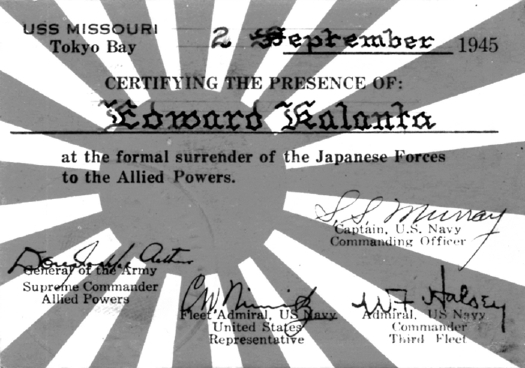
Every one of the Missouri’s crew received a card like this for taking part in the surrender in Tokyo Bay almost 59 years ago.

Every one of the Missouri’s crew received a card like this for taking part in the surrender in Tokyo Bay almost 59 years ago.

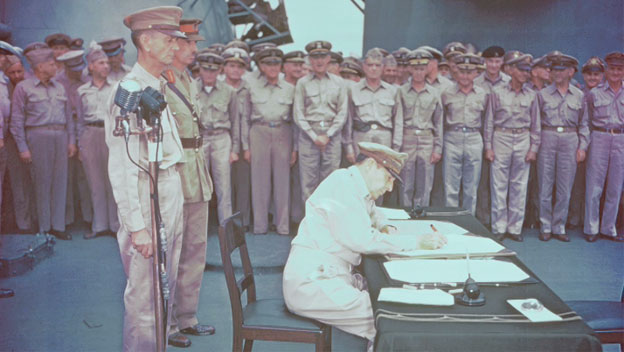
Tokyo Bay at the signing of the surrender by Japan:  

Douglas MacArthur Receives the Japanese Surrender

Tokyo Bay : 2 September 1945

Japan’s formal capitulation to the Allies climaxed a week of historic events as the initial steps of the occupation program went into effect. The surrender ceremony took place aboard the Third Fleet flagship, U. S. S. Missouri, on the misty morning of Sunday, 2 September 1945. As the Missouri lay majestically at anchor in the calm waters of Tokyo Bay, convoys of large and small vessels formed a tight cordon around the surrender ship, while army and navy planes maintained a protective vigil overhead. This was the objective toward which the Allies had long been striving-the unconditional surrender of the previously undefeated military forces of Japan and the final end to conflict in World War II.

The decks of the Missouri that morning were crowded with the representatives of the various United Nations that had participated in the Pacific War. Outstanding among the Americans flanking General MacArthur were Admirals Nimitz and Halsey, and General Wainwright who had recently been released from a Manchurian internment camp, flown to Manila, and then brought aboard to witness the occasion. Present also were the veteran staff members who had fought with General MacArthur since the early dark days of Melbourne and Port Moresby.

Shortly before 0900 Tokyo time, a launch from the mainland pulled alongside the great United States warship and the emissaries of defeated Japan climbed silently and glumly aboard. The Japanese delegation included two representatives empowered to sign the Instrument of Surrender, Mamoru Shigemitsu, Minister of Foreign Affairs and Gen. Yoshijiro Umezu of the Imperial General Staff, in addition to three representatives from the Foreign Office, three representatives from the Army, and three representatives from the Navy.68

As Supreme Commander for the Allied Powers, General MacArthur presided over the epoch-making ceremony, and with the following words he inaugurated the proceedings which would ring down the curtain of war in the Pacific:

We are gathered here, representatives of the major warring powers, to conclude a solemn agreement whereby peace may be restored. The issues, involving divergent ideals and ideologies, have been determined on the battlefields of the world and hence are not for our discussion or debate. Nor is it for us here to meet, representing as we do a majority of the people of the earth, in a spirit of distrust, malice or hatred. But rather it is for us, both victors and vanquished, to rise to that higher dignity which alone befits the sacred purposes we are about to serve, committing all our peoples unreservedly to faithful compliance with the understandings they are here formally to assume.

It is my earnest hope, and indeed the hope of all mankind, that from this solemn occasion a better world shall emerge out of the blood and carnage of the past-a world dedicated to the dignity of man and the fulfillment of his most cherished wish for freedom, tolerance and justice.

The terms and conditions upon which surrender of the Japanese Imperial Forces is here to be given and accepted are contained in the instrument of surrender now before you ….69

The Supreme Commander then invited the two Japanese plenipotentiaries to sign the duplicate surrender documents: Foreign Minister Shigemitsu, on behalf of the Emperor and the Japanese Government, and General Umezu, for the Japanese Imperial General Headquarters. He then called forward two famous former prisoners of the Japanese to stand behind him while he himself affixed his signature to the formal acceptance of the surrender: Gen. Jonathan M. Wainwright, hero of Bataan and Corregidor and Lt. Gen. Sir Arthur E. Percival, who had been forced to yield the British stronghold at Singapore.

General MacArthur was followed in turn by Admiral Nimitz, who signed on behalf of the United States, and by the representatives of the other United Nations present: Gen. Hsu Yung-Chang for China, Adm. Sir Bruce Fraser for the United Kingdom, Lt. Gen. Kuzma N. Derevyanko for the Union of Soviet Socialist Republics, Gen. Sir Thomas A. Blarney for Australia, Col. L. Moore-Cosgrave for Canada, Gen. Jacques P. LeClerc for France, Adm. Conrad E. L. Helfrich for the Netherlands, and Air Vice-Marshall Leonard M. Isitt for New Zealand.

The Instrument of Surrender was completely signed within twenty minutes. (Plate No. 132) The first signature of the Japanese delegation was affixed at 0904; General MacArthur wrote his name at 0910; and the last of the Allied representatives signed at 0920. The Japanese envoys then received their copy of the surrender document, bowed stiffly and departed for Tokyo. Simultaneously, hundreds of army and navy planes roared low over the Missouri in one last display of massed air might.

In signing the Instrument of Surrender, the Japanese bound themselves to accept the provisions of the Potsdam Declaration, to surrender unconditionally their armed forces wherever located, to liberate all internees and prisoners of war, and to carry out all orders issued by the Supreme Commander for the Allied Powers to effectuate the terms of surrender.

On that same eventful day, the Supreme Commander broadcast a report to the people of the United States. Having been associated with Pacific events since the Russo-Japanese war, General MacArthur was able to speak with the authority of long experience to forecast a future for Japan:

We stand in Tokyo today reminiscent of our countryman, Commodore Perry, ninety-two years ago. His purpose was to bring to Japan an era of enlightenment and progress by lifting the veil of isolation to the friendship, trade and commerce of the world. But, alas, the knowledge thereby gained of Western science was forged into an instrument of oppression and human enslavement. Freedom of expression, freedom of action, even freedom of thought were denied through supervision of liberal education, through appeal to superstition and through the application of force. We are committed by the Potsdam Declaration of Principles to see that the Japanese people are liberated from this condition of slavery. It is my purpose to implement this commitment just as rapidly as the armed forces are demobilized and other essential steps taken to neutralize the war potential. The energy of the Japanese race, if properly directed, will enable expansion vertically rather than horizontally. If the talents of the race are turned into constructive channels, the country can lift itself from its present deplorable state into a position of dignity….70

Immediately following the signing of the surrender articles, the Imperial Proclamation of capitulation was issued. The Proclamation, the draft of which had been given to General Kawabe at Manila, read as follows:

Accepting the terms set forth in the Declaration issued by the heads of the Governments of the United States, Great Britain and China On July 26th 1945 at Potsdam and subsequently adhered to by the Union of Soviet Socialist Republics, We have commanded the Japanese Imperial Government and the Japanese Imperial General Headquarters to sign on Our behalf the instrument of surrender presented by the Supreme Commander for the Allied Powers and to issue General Orders to the Military and Naval forces in accordance with the direction of the Supreme Commander for the Allied Powers.

We command all Our people forthwith to cease hostilities, to lay down their arms and faithfully to carry out all the provisions of the Instrument of Surrender and the General Orders issued by the Japanese Imperial Government and the Japanese Imperial General Headquarters hereunder.71

Plate No. 132, Surrender Document

Plate No. 132, Surrender Document More here.

1. Although the formal surrender of Japan did not occur until September 2, 1945 aboard the U.S.S. Missouri, the occupation of that nation began five days earlier when a team of 150 American personnel arrived at Atsugi airfield on August 28. They were originally supposed to arrive on August 25 but a Japanese delegation in Manila informed the Americans that several more day were needed to ensure that military resistors to the surrender could be disarmed. They were correct since a few days before the Americans arrived, Japanese pilots took off from Atsugi airfield and dropped leaflets on Tokyo and other cities urging resistance by the civilians. Fortunately those pilots were gone, along with any resistance, by the time the Americans arrived at Atsugi.

2. The surrender ceremony aboard the U.S.S. Missouri on September 2 was carefully planned…except for one small but very important detail. The fancy British mahony table brought aboard the Missouri for the surrender was too small for the two large documents that had to be signed. In desperation, an ordinary table from the crew’s mess was drafted as a replacement. It was covered by a green coffee-stained tablecloth from a wardroom. After the 2 surrender documents were signed on the table, it was returned to the mess and was being set for lunch until the ship’s captain and others realized it was an historical object and removed for posterity.

3. There were 280 allied warships in Tokyo Bay when the surrender took place but no aircraft carriers. They were out at sea as a reserve force just in case the Japanese changed their minds.

4. There was a thick cover of low dark clouds over Tokyo Bay during the 20 minute surrender ceremony. Unfortunately, 2000 planes were scheduled to fly over the bay the moment the ceremony finished. However, at the last moment the clouds suddenly parted, as if in a Hollywood movie production, and the sun burst through allowing all aboard the U.S.S. Missouri to view the mightiest display of air power ever seen.

5. When Emperor Hirohito announced over the radio the acceptance of the allied terms of surrender on August 15 (Tokyo time), very few Japanese listening to him understood what he was saying because he was using formal formal court language not used by the general populace. It wasn’t until the radio announcers followed up by describing what he said that the public understood what he meant.

6. After Emperor Hirohito made his surrender announcement, the Japanese public ran through a gamut of emotions…anger, despair, sadness, and relief. However, one Japanese person had a very different thought on his mind…how to make money off the surrender. He was Ogawa Kikumatsu, a book editor. Ogawa was on a business trip when the surrender was announced on the radio. He immediately returned to Tokyo by train and while traveling he began thinking of how to take advantage of the impending occupation.. By the time he reached Tokyo, he had his idea…to publish a guide booklet of Japanese phrases translated into English with the aid of phonetics. It took less than three days for Ogawa and his team to prepare the 32 page booklet and it was published exactly a month after the surrender. Its first run of 300,000 copies sold out immediately and by the end of 1945, 3.5 million copies had been sold.