An affordable price is probably the major benefit persuading people to buy drugs at www.americanbestpills.com. The cost of medications in Canadian drugstores is considerably lower than anywhere else simply because the medications here are oriented on international customers. In many cases, you will be able to cut your costs to a great extent and probably even save up a big fortune on your prescription drugs. What's more, pharmacies of Canada offer free-of-charge shipping, which is a convenient addition to all other benefits on offer. Cheap price is especially appealing to those users who are tight on a budget
Service Quality and Reputation Although some believe that buying online is buying a pig in the poke, it is not. Canadian online pharmacies are excellent sources of information and are open for discussions. There one can read tons of users' feedback, where they share their experience of using a particular pharmacy, say what they like or do not like about the drugs and/or service. Reputable online pharmacy canadianrxon.com take this feedback into consideration and rely on it as a kind of expert advice, which helps them constantly improve they service and ensure that their clients buy safe and effective drugs. Last, but not least is their striving to attract professional doctors. As a result, users can directly contact a qualified doctor and ask whatever questions they have about a particular drug. Most likely, a doctor will ask several questions about the condition, for which the drug is going to be used. Based on this information, he or she will advise to use or not to use this medication.

3 Corporations Take on Obamacare, Pelosi Mute

Maybe between Amazon, a tech company, JP Morgan, an investment company and Berkshire Hathaway, a financial think tank and provider could solve the corruption within government healthcare first…Just last year:

The Justice Department charged more than 400 people across the country in a major crackdown on health care fraud, officials said Thursday. The accused individuals cost the federal government $1.3 billion in false Medicare and Medicaid billings, according to authorities

The investigation focused on opioid-related crimes as the government continues to try to address the public health crisis that has been sweeping the country. Many of the health care providers charged had billed Medicaid and Medicare for drugs that were never purchased, while others took advantage of addicts by giving out unnecessary opioid prescriptions for cash or charging for false treatments, according to the Justice Department. More here.

It is pathetic that the FBI has an exclusive division to investigate and prosecute healthcare/government fraud.

The FBI is the primary agency for exposing and investigating health care fraud, with jurisdiction over both federal and private insurance programs. Health care fraud investigations are considered a high priority within the Complex Financial Crime Program, and each of the FBI’s 56 field offices has personnel assigned specifically to investigate health care fraud matters. Our field offices proactively target fraud through coordinated initiatives, task forces and strike teams, and undercover operations.

The Bureau seeks to identify and pursue investigations against the most egregious offenders involved in health care fraud through investigative partnerships with other federal agencies, such as Health and Human Services-Office of Inspector General (HHS-OIG), Food and Drug Administration (FDA), Drug Enforcement Administration (DEA), Defense Criminal Investigative Service (DCIS), Office of Personnel Management-Office of Inspector General (OPM-OIG), and Internal Revenue Service-Criminal Investigation (IRS-CI), along with various state Medicaid Fraud Control Units and other state and local agencies. On the private side, the FBI is actively involved in the Healthcare Fraud Prevention Partnership, an effort to exchange facts and information between the public and private sectors in order to reduce the prevalence of health care fraud. The Bureau also maintains significant liaison with private insurance national groups, such as the National Health Care Anti-Fraud Association, the National Insurance Crime Bureau, and private insurance investigative units. More here.

Another pathetic item is during 2017, when the House repealed Obamacare and the Senate failed to do so….no one spoke to the whole fraud component which is in fact costing the taxpayers billions…..BILLIONS.

Image result for obamacare BBC

So, will these companies come to the rescue for their own employees or perhaps lay the groundwork for total repeal?


“The ballooning costs of health care act as a hungry tapeworm on the American economy,” Berkshire Hathaway (brk-b) chairman and CEO Warren Buffett said in a statement. “Our group does not come to this problem with answers. But we also do not accept it as inevitable.”

Amazon, Berkshire Hathaway, and J.P. Morgan Chase are forming a not-for-profit health care venture to lower health care costs for their U.S. employees, the companies announced Tuesday morning, sparking a slide in the shares of a host of health care-related companies. The initial focus of the independent company will be on technology that will provide their U.S. employees and their families with simplified and high-quality health care at accessible costs, the companies said.

Drug distributors Cardinal Health(cah, -2.80%), AmerisourceBergen(abc, -2.73%) and McKesson(mck, -1.64%) were all down nearly 3%. Health insurers also fell, with the 6.2% drop in UnitedHealth(unh, +0.06%) the steepest.

The move comes amid growing speculation that Amazon is likely to enter the prescription drug business and that has sent tremors through the pharmaceutical supply chain.

“The health care system is complex, and we enter into this challenge open-eyed about the degree of difficulty,” Jeff Bezos, Amazon (amzn, +0.69%) founder and CEO, said in the statement. “Success is going to require talented experts, a beginner’s mind, and a long-term orientation.”

The effort is in its early planning stages, the companies said, and the initial formation of the company would be led by Todd Combs, an investment officer of Berkshire Hathaway; Marvelle Sullivan Berchtold, a managing director of J.P. Morgan Chase; and Beth Galetti, a senior vice president at Amazon.

“Our people want transparency, knowledge and control when it comes to managing their health care,” said Jamie Dimon, chairman and CEO of J.P. Morgan Chase(jpm, +0.48%). “The three of our companies have extraordinary resources, and our goal is to create solutions that benefit our U.S. employees, their families and, potentially, all Americans.”

“The ballooning costs of health care act as a hungry tapeworm on the American economy,” Berkshire Hathaway (brk-b) chairman and CEO Warren Buffett said in a statement. “Our group does not come to this problem with answers. But we also do not accept it as inevitable.”  Drugstore operators CVS Health(cvs, -1.85%) and Walgreen Boots Alliance (wba, -1.10%) as well as pharmacy benefits manager Express Scripts Holding(esrx, -0.13%) dropped between 4.5% to 6% in premarket trading. Hat-tip Forbes.

Maybe Obama, Pelosi and the rest of the Democrats should have consulted with Watson…

Watson Health value-based care offerings deliver innovation designed to help drive value for providers and health care organizations as those providers and organizations work to manage population health, deliver more efficient care, engage patients and consumers, and optimize business performance – through the power of data-driven insights.

Is IBM part of the problem or the solution?

Watson Health offers end-to-end solutions for providers and organizations pursuing greater value in healthcare by offering solutions such as the following.

  • Providers
    Robust data integration and aggregation, risk-stratified analytics, performance measurement reporting, care management and patient engagement tools.
  • Health plans
    Analytics utilized by health plans to: identify consumer insights and support acquisition marketing, support care management, empower consumers for more informed decisions, and execute risk score optimization and compliance reporting.
  • Employers
    Flexible delivery of tools to help employers increase value of benefits and programs and provide employees with personalized, relevant information to help them understand their benefits.
  • Pharmaceutical and bio-tech
    Studies based on real-world evidence to help pharmaceutical and bio-tech companies understand the market landscape. Health economics and outcomes research combined with stakeholder research and engagement and management tools.

In today’s value-based healthcare environments, costs and revenues often depend on how fast and how effectively you can identify and engage at-risk patients, members and employees. Our solutions help you gain insight from your data to stratify your populations, design targeted programs, close care gaps and align with quality measures and initiatives.

  • Outcomes: Leverage insights, outcomes and economics through solutions, expertise and partnerships.
  • Essential connections: Vastly improve your understanding of your members, stakeholders, patients or employees, to gain essential knowledge and data to breakdown silos.
  • Confidence: Provide greater evidence and clarity to help you make informed decisions.


UN Declaration, Regular, Constant Global Migration = Insurgency

Berlin A new series launched by the Global Migration Data Analysis Centre (GMDAC) of IOM, the UN Migration Agency, aims to summarize the existing evidence on migration in an accurate and accessible fashion, to support discussions and any follow-up activities of the Global Compact for Safe, Orderly and Regular Migration.

Note the words orderly and regular….if the United Nations and peacekeeping operations as well as the aid, education, construction and protection campaigns were successful, migration would not be required especially in non-war torn countries. Right? Or how about all these other global human interest organizations….they failing too? Those like the Clinton Foundation or hey how about the Gates Foundation, which is a private foundation founded by Bill and Melinda Gates. It was launched in 2000 and is said to be the largest private foundation in the US, holding $38 billion in assets, improving lives from Seattle to South Africa….ahem.

Image result for global migration

Check here for the largest 10 organizations…. if all this work and money and resources were effective, then why the migration at all?

More here.

The New York Declaration

For the first time on 19 September 2016 Heads of State and Government came together to discuss, at the global level within the UN General Assembly, issues related to migration and refugees. This sent an important political message that migration and refugee matters have become major issues in the international agenda. In adopting the New York Declaration for Refugees and Migrants, the 193 UN Member States recognized the need for a comprehensive approach to human mobility and enhanced cooperation at the global level.

What are the aims of the global compact for migration?

The global compact is framed consistent with target 10.7 of the 2030 Agenda for Sustainable Development in which member States committed to cooperate internationally to facilitate safe, orderly and regular migration and its scope is defined in Annex II of the New York Declaration. It is intended to:

  • address all aspects of international migration, including the humanitarian, developmental, human rights-related and other aspects;
  • make an important contribution to global governance and enhance coordination on international migration;
  • present a framework for comprehensive international cooperation on migrants and human mobility;
  • set out a range of actionable commitments, means of implementation and a framework for follow-up and review among Member States regarding international migration in all its dimensions;
  • be guided by the 2030 Agenda for Sustainable Development and the Addis Ababa Action Agenda; and
  • be informed by the Declaration of the 2013 High-Level Dialogue on International Migration and Development.

The development of the global compact for migration – an open, transparent and inclusive process

The Modalities Resolution for the intergovernmental negotiations of the global compact for safe, orderly and regular migration outline the key elements and timeline of the process. The global compact will be developed through an open, transparent and inclusive process of consultations and negotiations and the effective participation of all relevant stakeholders, including civil society, the private sector, academic institutions, parliaments, diaspora communities, and migrant organizations in both the intergovernmental conference and its preparatory process.


Trump’s EO Halting Insurance Subsidies Comes from Boehner

photo

CNBC: The Trump administration will immediately stop making critically important payments to insurers who sell Obamacare health plans, a bombshell move that is expected to spike premium prices and potentially lead many insurers to exit the marketplace.

The decision to end the billions of dollars worth of so-called cost-sharing reduction (CSR) payments came after months of threats by President Donald Trump to do just that. The news came only hours after Trump signed an executive order that Obamacare advocates said could badly harm the individual insurance marketplaces.

Advocates, along with insurers, health-care provider groups, patient groups and officials in many states, have expressed concerns for months that the cost-sharing reimbursements would be cut off by Trump.

Senate Minority Leader Chuck Schumer, D-N.Y., sharply criticized Trump in a series of Twitter posts late Thursday.

Two months ago, the Congressional Budget Office estimated that individual health plan premiums would be 20 percent higher than originally projected if the payments ceased. It also projected that premiums would be 25 percent higher than they otherwise would be by 2020, and that the federal deficit would be increased by almost $200 billion if the subsidies ended.

The payments, worth $7 billion or so to insurers this year and up to $10 billion or more next year, reimburse insurers for discounts in out-of-pocket health costs they give to low-income Obamacare customers. The discounts must be offered by law.

However, congressional Republicans successfully challenged in a lawsuit the Obama administration’s decision to make the reimbursement payments to insurers without getting the express budgetary authorization from Congress.

Now, both California Attorney General Xavier Becerra and New York State Attorney General Eric Schneiderman said they would file lawsuits seeking to prevent Trump from ending the subsidies.

The two were part of a group of 18 state attorneys general who were given permission this year to intervene in the pending appeal of the federal court decision that had ruled the payments were illegal given their lack of congressional authorization.

*** While the democrats are crying sabotage, they refuse to tell you that there is a legal ruling that says this funding is illegal. The Obama administration via the Treasury Department essentially stole money from various government agencies to subsidize insurance providers since Congress did not appropriate the funds.

In part it played out this way:

When House Republicans first came up with the idea to take the president to court nearly two years ago, they planned to sue the administration over a completely different part of Obamacare. Then-Speaker John Boehner was, as usual, facing pressure from conservatives who were frustrated at Obama’s liberal use of executive authority and their inability to derail the hated health-care law. So he and his leadership team hatched a plan to file a lawsuit accusing the president and his administration of exceeding their authority by unilaterally delaying the implementation of the employer mandate in Obamacare. The requirement that businesses with more than 50 employees provide insurance to their workers had long been a big target for Republicans and one of the more contentious policies in the law. It was the middle of the mid-term congressional campaigns, and Republicans suspected the administration was delaying the mandate to put off the political pain of compliance until after the election.

“The president changed the health-care law without a vote of Congress, effectively creating his own law by literally waiving the employer mandate and the penalties for failing to comply with it,” Boehner said in a statement at the time. “That’s not the way our system of government was designed to work. No president should have the power to make laws on his or her own.” The irony was that House Republicans had repeatedly assailed the employer mandate as a jobs killer, and yet here they were suing to force the administration to implement it faster. Read more here.

Charlie’s Parents End the Fight for his Life

Charlie Gard case: Parents withdraw application to bring sick baby to US

FNC: With tears streaming down their faces, the parents of terminally ill baby Charlie Gard on Monday withdrew their application seeking to take the child to the United States for an experimental medical treatment, with the couple’s lawyer announcing “the window of opportunity has been lost.”

Attorney Grant Armstrong said at London’s High Court it was too late for the 11-month-old child to receive treatment. Recent medical tests revealed Charlie has irreversible muscular damage.

“It’s too late for Charlie,” Armstrong said. “The damage has been done.”

Charlie’s parents, Chris Gard and Connie Yates, cried in the courtroom as the lawyer announced the news — their last bid to seek permission to take their child to the U.S. for treatment.

“As Charlie’s devoted and loving parents we have decided that it’s no longer in Charlie’s best interests to pursue treatment and we will let our son go and be with the angels,” Yates said in court.

The couple was expected to present new evidence in court on Monday, but they arrived in court to say the dragged out case has wasted “time. A whole lot of wasted time.”

“Had Charlie been given the treatment sooner he would have had the potential to be a normal, healthy little boy,” Yates said, referencing the recent medical test that ultimately led to the couple’s decision to withdraw.

“I only wanted to give him a chance at life,” Yates said. “We will always know in our hearts that we did the very best for Charlie and I hope that he is proud of us for fighting in his corner.”

Charlie, who was born on Aug. 4, 2016, suffers from a rare genetic condition, Mitochondrial DNA depletion syndrome. He has brain damage and is unable to breathe on his own. Doctors at Great Ormond Street Hospital, where Charlie has been treated since last October, have been locked in a prolong court battle, claiming more treatment would only cause pain to the child. They have argued to switch off Charlie’s life support to allow him to die peacefully.

But Charlie’s parents dispute the claim and have argued that their child should receive every possible treatment until his death.

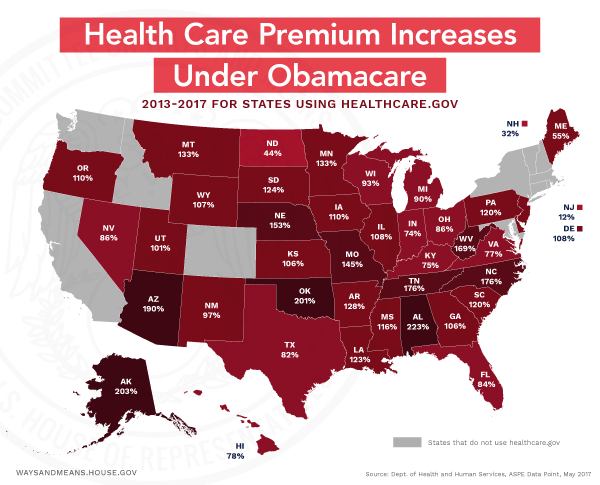
Obamacare Rising Costs Here and Details of New Proposal

Brady: “Obamacare is imploding, and we’re just seeing prices skyrocket”

Our health care system continues to deteriorate under Obamacare. Americans are facing fewer choices, higher costs, and less access to the care they need. Just look at the news from last week:

  • Premiums have more than doubled under Obamacare. According to data from the previous Administration, millions of Americans are now paying twice as much—on average $3,000 more—for insurance on the individual marketplaces than they were in 2013.
  • 25 more counties will have zero Obamacare insurance options. The last Obamacare insurer in parts of Missouri, Blue Cross Blue Shield of Kansas City, announced its decision to withdraw from Obamacare’s individual marketplace in 2018. That leaves hundreds of thousands more Americans with few, if any, places to turn for coverage.

Describing the urgent need to repeal and replace Obamacare, economist Stephen Moore wrote in The Washington Times:

“If we stay with Obamacare, within a few years tens of millions will have no insurance at all that is even remotely affordable. Aetna, Humana, and other major insurers in just recent months have fled Obamacare. The Titanic has hit the iceberg and it is rapidly sinking … Here’s a prediction: by the end of the year we could have nearly half the country without insurers if this spiral continues.”

House Republicans took action to rescue the American people from this failing law by passing the American Health Care Act, which the Congressional Budget Office confirmed:

  • Lowers average premiums in the individual marketplace by 4 to 30 percent or more, depending on the state.
  • Delivers nearly $1 trillion of relief from Obamacare taxes.
  • Provides individuals and families freedom to choose a health care plan that is right for them.Obamacare keeps wreaking havoc across the country:
    • Major insurers continue to abandon the individual insurance market in different states, making it more difficult for Americans to access coverage.
    • Humana and Aetna announced they would withdraw from Obamacare’s individual exchanges entirely in 2018.
    • The last remaining insurer in Iowa could exit the exchanges next year—leaving families in 94 out of 99 counties without a single insurer to turn to for their coverage.
    • Connecticut, Maryland, New York, Oregon, and Virginia have already projected double-digit premium rate increases for next year.

    As Ways and Means Republicans explain, Obamacare’s latest failures underscore the urgent need for the American Health Care Act—legislation passed by the House to fix our broken health care system:

    On Delivering Relief from Obamacare

    Rep. Diane Black (R-TN), Budget Committee Chairman, in RealClearPoliticsObamacare is a disaster, and in Tennessee, its collapse is creating dire circumstances for our citizens. Massive premium increases are making insurance unaffordable for more and more Tennesseans and rising deductibles are making it harder to get health care, even for those who have insurance. Doing nothing is not an option. Congress has taken the first step to keep our promise of repealing and replacing Obamacare.” 

    Rep. Kevin Brady (R-TX), Ways and Means Committee Chairman, in the Conroe Courier“Although this is just the first step, it is a giant pivot in the right direction so that Americans no longer have to struggle under the $1 trillion in tax hikes brought on by Obamacare. Under the bill, Americans, especially small businesses, will no longer be forced to buy healthcare they do not want or cannot afford.” 

    Rep. Jackie Walorski (R-IN) in the South Bend Tribune“Obamacare came with a lot of promises. But these promises were broken, and now many Hoosiers face higher premiums, fewer options, and a collapsing system … [AHCA] rescues Americans from the instability of Obamacare and begins a stable transition to a better system. It will lower premiums and strengthen markets so patients have real options they can actually afford. It will empower patients, not bureaucrats, to make health care decisions.”

    On Protecting Patients with Pre-Existing Conditions

    Rep. Erik Paulsen (R-MN) in the Minneapolis Star Tribune“Nothing in this bill would allow an insurance company to deny someone coverage, including to those with a preexisting condition. Nothing would allow an insurance company to cancel someone’s insurance policy should they become sick. Despite claims from opponents, the bill does not classify sexual assault as a preexisting condition. For those who maintain continuous coverage, the bill does not allow insurance companies to charge an individual more simply because they have a preexisting condition. It’s also worth noting that this bill includes $138 billion to assist states in making sure everyone, including those with preexisting conditions, has access to high-quality, affordable health care.” 

    Rep. Adrian Smith (R-NE) in the Grand Island Independent“I firmly believe we can protect access to care for those with preexisting conditions while lowering costs for the millions of Americans currently facing premiums and deductibles they cannot afford. Passing the American Health Care Act in the House was the first step, and we will continue our work in Congress to revive the health care marketplace.”

    Rep. Jackie Walorski (R-IN) in the South Bend Tribune“This bill maintains critical protections for patients with pre-existing conditions. I have always said any replacement must protect these patients, and we make sure no one can be denied coverage due to a pre-existing condition. States can obtain a waiver of some individual and small group insurance regulations to help lower premiums or increase the number of people with coverage, as long as they implement plans—such as high risk pools—to ensure affordable coverage for those with costly medical conditions. Under these waivers, insurers can only charge high-risk patients more if they have a two-month lapse in coverage, and the bill dedicates $8 billion to help patients in such situations.” 

    On Putting the American People Back in Control of Their Care

    Rep. Carlos Curbelo (R-FL) in the Miami Herald“I made a promise that I would fight for better healthcare for our country, for a market-based system where Americans, not special interests, are in control and can make the best healthcare choices for themselves and their families. The legislation before Congress today gets us closer to such a system.”

    Rep. Erik Paulsen (R-MN) in the Minneapolis Star Tribune“[This debate] is about Nyla, a recently widowed mother of four who saw her premiums jump to $1,000 per month with a $13,000 deductible… this debate is about Taryn, who, after being diagnosed with a brain tumor, suddenly had her plan canceled when her insurer pulled out of the market … [AHCA] is aimed at addressing many of the shortcomings of the ACA by stabilizing insurance markets and beginning to bring down premiums. Rather than the one-size-fits-all Washington approach, we can empower states and consumers to take control of their own health care outcomes.”

    CLICK HERE to read Ways and Means Committee Chairman Brady’s statement on the AHCA.

    CLICK HERE to read a summary of the AHCA.

    CLICK HERE to read the section-by-section description of the AHCA.