An affordable price is probably the major benefit persuading people to buy drugs at www.americanbestpills.com. The cost of medications in Canadian drugstores is considerably lower than anywhere else simply because the medications here are oriented on international customers. In many cases, you will be able to cut your costs to a great extent and probably even save up a big fortune on your prescription drugs. What's more, pharmacies of Canada offer free-of-charge shipping, which is a convenient addition to all other benefits on offer. Cheap price is especially appealing to those users who are tight on a budget
Service Quality and Reputation Although some believe that buying online is buying a pig in the poke, it is not. Canadian online pharmacies are excellent sources of information and are open for discussions. There one can read tons of users' feedback, where they share their experience of using a particular pharmacy, say what they like or do not like about the drugs and/or service. Reputable online pharmacy canadianrxon.com take this feedback into consideration and rely on it as a kind of expert advice, which helps them constantly improve they service and ensure that their clients buy safe and effective drugs. Last, but not least is their striving to attract professional doctors. As a result, users can directly contact a qualified doctor and ask whatever questions they have about a particular drug. Most likely, a doctor will ask several questions about the condition, for which the drug is going to be used. Based on this information, he or she will advise to use or not to use this medication.

Mass Graves Covered up in Iran

Iran: Road to be built over individual and mass graves

The families of political dissidents who were forcibly disappeared and extrajudicially killed in Ahvaz, southern Iran, in the 1980s are suffering untold mental anguish and distress as the authorities are destroying the individual and mass graves of their loved ones. They are afraid of facing further persecution if they speak out.

***

Amnesty International reports that Iran’s regime is destroying a mass grave of the victims of the 1988 massacre. According to estimates from the opposition, these victims number in the 10s of 1000s (the vast majority from the MEK).

Meanwhile:

The Trump administration must now prepare for near-term Iranian terrorist attacks against the U.S. homeland, because the leader of Iran’s revolutionary guards, or IRGC, external action force gave a very aggressive speech on Thursday.

Addressing followers in the ancient city of Hamedan (a location probably chosen as a metaphor of Iranian durability), Qassem Soleimani warned Americans, “We are closer to you than what you think. You should know that I am your foe. The Quds Force alone and not all the Armed Forces is enough to be your rival. You are aware of Iran’s power in asymmetric war.”

Soleimani means for his words to be taken as references to terrorist attacks. In specific terms, IRGC modus operandi and tactical capability render “closer to you than what you think” and “asymmetric war” as references to Quds force attack cells and cyber-strike teams in the U.S. homeland, South America, and Europe.

But Soleimani wasn’t done there.

Again emphasizing “We are so close to you in places that you might not even think of,” Soleimani declared “You should know that there is not even a single night that we don’t think of destroying you.” Soleimani also drew a sharp reference to his role subjecting U.S. forces in Iraq to explosively formed penetrator attacks, stating “”have you forgotten when you had provided adult-size diapers for your battle tank crews?” EFP attacks killed hundreds of Americans and wounded many more.

Soleimani loved the EFPs for their brutality. In David Finkel’s The Good Soldiers, we hear about U.S. Army Specialist Joshua Reeves, whose vehicle was hit by an EFP in Baghdad. Reeves “wasn’t breathing, his eyes weren’t moving, his left foot was gone, his backside was ripped open, his stomach was filling with blood …” Reeves died the same day that his wife had told him that she had given birth.

And in a reference to Iranian martyrdom ideology, deeply vested in the revolution’s theological appropriation of the Battle of Karbala, Soleimani concluded, “We are thirsty for martyrdom and annihilation of arrogant powers.”

He wants the U.S. to know the IRGC will proudly die for their cause.

The U.S. may now have to help them on that course, because the U.S. must respond deliberately to this speech.

First off, President Trump should recognize that the Iranians aren’t playing around here. Soleimani has the pedigree to render very bloody terrorist attacks into action. He also has no qualms about massacring U.S. civilians (the Quds force nearly blew up a Washington, D.C., restaurant in 2011) and recently tried to blow up a Paris conference attended by U.S. officials. Indeed, Soleimani’s words exemplify why we argued this week that Trump must be more focused in his red-line warnings to Iran.

But what specifically should be done?

Both Trump and Secretary of State Mike Pompeo should take the lead in warning that any terrorist attacks on the U.S. will result in two immediate effects.

First, aggressive U.S. military strikes on IRGC infrastructure belonging to the Quds force and the IRGC at large. Pompeo’s role is important here because the former CIA director took a tough line against the IRGC, and Soleimani knows he means business.

Second, the U.S. should make clear that Soleimani and his senior leadership figures will be personally targeted. While some, like former Obama administration official Tommy Vietor, believe such threats would be outrageous, it is important that the Iranian hardliners know any terrorist attacks will not meet a standard fare response. They must know that the U.S. will metaphorically gut them if they come for our citizens. If Soleimani and his cadre do not understand that U.S. deterrent posture, they will kill innocent Americans. Evidencing their willingness to up the ante, the Quds Force directed Houthi rebel forces in Yemen to target cargo vessels passing through the Red Sea on Wednesday.

But the Trump administration should also be clear about where this is heading. As it attempts to destabilize the Iranian regime with economic pressure, the Iranian regime is showing that it will not go down without a fight.

Ultimately, Qassem Soleimani’s threats should be taken very seriously. He is a skilled commander with significant terrorist capabilities and an ideologically vested hatred for America. He must be dealt with as such.


About that Time Obama Gave an AQ Affiliate Grant Money

There has been lots of chatter about removing the security clearance access of John Brennan and a few others. No one has asked about Hillary’s or…..Obama’s. There has been lots of chatter of impeachment, traitor and treason….but when it comes to aiding and supporting the enemy….check this out.

Grant money is a gift….by the way.

Islamic Relief Agency Admits Illegal Funds Transfer to ...

Islamic Relief Agency Admits Illegal Funds Transfer to ... story and photo, more detail here.

The Middle East Forum has discovered that the Obama administration approved a grant of $200,000 of taxpayer money to an al-Qaeda affiliate in Sudan — a decade after the U.S. Treasury designated it as a terrorist-financing organization. More stunningly, government officials specifically authorized the release of at least $115,000 of this grant even after learning that it was a designated terror organization.

The story began in October 2004, when the U.S. Treasury Department’s Office of Foreign Assets Control (OFAC) designated the Khartoum-based Islamic Relief Agency (ISRA), also known as the Islamic African Relief Agency (IARA), as a terror-financing organization. It did so because of ISRA’s links to Osama bin Laden and his organization Maktab al-Khidamat (MK), the precursor of al-Qaeda.

According to the U.S. Treasury, in 1997 ISRA established formal cooperation with MK. By 2000, ISRA had raised $5 million for bin Laden’s group. The Treasury Department notes that ISRA officials even sought to help “relocate [bin Laden] to secure safe harbor for him.” It further reports that ISRA raised funds in 2003 in Western Europe specifically earmarked for Hamas suicide bombings.

The 2004 designation included all of ISRA’s branches, including a U.S. office called the Islamic American Relief Agency (IARA-USA). Eventually it became known that this American branch had illegally transferred over $1.2 million to Iraqi insurgents and other terror groups, including, reportedly, the Afghan terrorist Gulbuddin Hekmatyar. In 2010, the executive director of IARA-USA and a board member pled guilty to money-laundering, theft of public funds, conspiracy, and several other charges.

ISRA’s influence also spread to Washington. Former U.S. congressman Mark Siljander (R., Mich.) pled guilty in 2010 to obstruction of justice and acting as an unregistered foreign agent after prosecutors found that IARA-USA had paid him $75,000 — using misappropriated USAID grant money — to lobby the government, in an attempt to remove the charity from the government’s terror list.

Despite this well-documented history, the U.S. Agency for International Development (USAID) in July 2014 awarded $723,405 to World Vision Inc., an international evangelical charity, to “improve water, sanitation and hygiene and to increase food security in Sudan’s Blue Nile state.” Of these funds, $200,000 was to be directed to a sub-grantee: ISRA.

Responding to a Middle East Forum (MEF) inquiry, a USAID official explains that World Vision had alerted it in November 2014 to the likelihood of ISRA being on the terror list. USAID instructed World Vision to “suspend all activities with ISRA” and informed the State Department, OFAC, and USAID’s Office of the Inspector General. USAID and World Vision then waited for OFAC to confirm whether ISRA was designated or not.

USAID emails obtained by the Middle East Forum reveal that in January 2015, World Vision was growing unhappy while waiting for OFAC’s assessment. Mark Smith, World Vision’s senior director of humanitarian and emergency affairs, wrote to USAID, stating that the Islamic Relief Agency “had performed excellent work” for World Vision in the past, and that “putting contractual relationships in limbo for such a long period is putting a significant strain” on World Vision’s relationship with the Sudanese regime. Smith also revealed that World Vision had submitted a notice to OFAC indicating its “intention to restart work with [ISRA] and to transact with [ISRA]” if OFAC did not respond within a week.

World Vision’s statement stunned USAID officials, who complained that World Vision’s behavior “doesn’t make sense.” USAID official Daniel Holmberg emailed a colleague: “If they actually said that they wanted to resume work with ISRA, while knowing that it was 99% likely that ISRA was on the list then I am concerned about our partnership with them, and whether it should continue.”

On January 23, OFAC confirmed that ISRA was a sanctioned entity and denied World Vision “a license to engage in transactions with [ISRA].” Mark Smith and World Vision’s country program director in Sudan expressed their disappointment, stating that they were in discussions with ISRA as well as the Sudanese regime’s Humanitarian Aid Commission, which regulates the activities of international charities in Sudan.

Despite OFAC’s ruling, in February, World Vision wrote to OFAC and Obama-administration official Jeremy Konyndyk (who then served as director of USAID’s Office of U.S. Foreign Disaster Assistance) to apply to OFAC for a new license from USAID to pay ISRA “monies owed for work performed.” According to Larry Meserve, USAID’s mission director for Sudan, World Vision argued that if they did not pay ISRA, “their whole program will be jeopardized.”

While World Vision waited for a decision, on February 22, a pro-regime Sudanese newspaper, Intibaha, reported that the Sudanese political leaders had requested that World Vision be expelled from Sudan’s Blue Nile state. USAID disaster operations specialist Joseph Wilkes and World Vision’s Mark Smith speculated that this was “punishment” for the cancellation of the grant with ISRA, which a USAID official noted is “well connected with the [Sudanese] government.”

Then, incredibly, on May 7, 2015 — after “close collaboration and consultations with the Department of State” — OFAC issued a license to a World Vision affiliate, World Vision International, authorizing “a one-time transfer of approximately $125,000 to ISRA,” of which “$115,000 was for services performed under the sub-award with USAID” and $10,000 was “for an unrelated funding arrangement between Irish Aid and World Vision.”

An unnamed World Vision official described the decision as a “great relief as ISRA had become restive and had threatened legal action, which would have damaged our reputation and standing in Sudan.” Senior USAID official Charles Wanjue wrote to colleagues: “Good news and a great relief, really!” In August 2015, USAID official Daniel Holmberg even told a State Department official that he had been approached by the executive director of ISRA, and requested guidance on helping ISRA remove itself from the U.S. government’s terror list.

Obama-administration officials knowingly approved the transfer of taxpayer dollars to an al-Qaeda affiliate, and not an obscure one but an enormous international network that was often in the headlines.

How was this prominent terror funder initially approved to receive American taxpayer funds ten years after it had been placed on the “Specially Designated Nationals and Blocked Persons” terror list?

Existing measures to prevent the payment of government monies to designated terrorist organizations include: first, a requirement that all grantees and sub-grantees of U.S.-government grants register for a Data Universal Numbering System (DUNS) number; and second, a requirement that all government vendors register with the government’s System for Award Management (SAM) database. A designated organization should not be able to acquire a DUNS number, and any designation is explicitly recorded in the SAM database with a note that the designated organization is excluded from government grants.

However, ISRA was in fact assigned a DUNS number — as recorded at the government’s USAspending.gov website — which matched no organization in the government’s SAM database. The only listings for “Islamic Relief Agency” or “ISRA” in the SAM database are the designated Sudanese al-Qaeda affiliate and its branches.

Whoever approved this grant to ISRA either failed to check the government’s database of designated groups or did so and then chose to disregard it. Both explanations are alarming. And neither answer explains how ISRA acquired a DUNS number.

Most important: Now we know that the government deliberately chose to transfer at least $115,000 to ISRA after confirming that it was on the terror-designation list. In other words, an al-Qaeda front received taxpayers’ money with the apparent complicity of public officials.

It is no secret that the Obama administration sought to downplay the threat of Islamism, and even to coopt some Islamist movements to promote its agenda. In its foreign policy, the administration expressed support for Mohamed Morsi’s Muslim Brotherhood government in Egypt, while domestically, the White House invited Islamists to design the government’s Countering Violent Extremism program. It is difficult to argue that these efforts were the product of anything but great naïveté and political dogma. Is it possible that this combination extended to deliberately funding an al-Qaeda affiliate?

Congress must investigate this question and, more broadly, where USAID is sending taxpayers’ money, for ISRA might not be the only example. The House’s Foreign Affairs, Oversight, and Financial Services Committees, along with the Senate Finance Committee, must examine how a designated group came to qualify for government monies, why OFAC and the State Department authorized the transfer of funds after learning of ISRA’s terror ties, and which bureaucrat or political appointee was responsible for this mess.

Asked to comment, current State Department spokesperson Heather Nauert told National Review: “As this occurred under the prior Administration, the current Secretary of the State, Secretary of Treasury, and USAID Administrator had no involvement in decisions surrounding this award or subsequent license.”

The American people need to know how their dollars funded an al-Qaeda affiliate. They need to know how deep this problem runs.

*** Millions upon millions come to mind shrink-wrapped on pallets on un-marked airplanes to Tehran comes to mind actually.

About Those Sonic Weapons in China and Cuba

When it comes to Cuba and China, getting any real cooperation is for the most part impossible. The matter of U.S. diplomatic personnel in both countries being affected with several health issues due to some kind of sonic weapon is a scandal few mention anymore. Actually is it any less important than the attacks on our posts in Benghazi, not to diminish the tragic deaths? The use of sonic weapons is an attack on our sovereign territory.

Let’s go deeper.

In a page taken from a Cold War-era playbook, existing evidence clearly suggests that sonic weapons are being used to attack American diplomatic officials in Cuba and China. The U.S. should operate as if this is a provocation that crosses a number of red lines, and it should consider stronger retaliatory actions against both governments.

More than 20 news sources in recent months have dubbed these incidents as a “mystery” or “perplexing.” No news source has been willing to recognize it as a strategic, deliberate action against our diplomatic officials. Thus, the only “mystery” is why the U.S. has not been more aggressive in pushing back against and increasing the consequences for the perpetrators, most likely official elements in China and Cuba. Fear of damaging the “normalization project” between the U.S. and Cuba should not encourage denial of what appears to be deliberate, hostile actions.

LRAD Long Range Acoustic Devices UK distributor Vitavox

In late 2016, U.S. diplomats in Cuba reported serious medical ailments related to incidents that occurred over several months and initially appeared to be linked to sonic attacks. Many of the victims reported strange sounds that were incapacitating and led to a series of medical symptoms, including hearing loss, cognitive issues, temporary imbalance, even mild traumatic brain injuries. Several victims have undergone rehabilitation and every victim is anticipated to return to work eventually. Nonetheless, these patients likely will need to be monitored for the rest of their lives, to determine the full impact of these attacks.
In June, U.S. officials in China faced similar attacks that affected at least one diplomat. Secretary of State Mike Pompeo said the incident was “similar” and “entirely consistent” with what happened in Cuba.

There are studies that have proposed possible explanations based on experiments, but these tests were limited and did not account for potential physiological damage. A University of Michigan study examined whether ultrasound could be the potential cause of the incidents in Cuba. This experiment led to various possible explanations including ultrasonic emitters – intended for eavesdropping – that produced audible tones that inadvertently may have harmed U.S. diplomats.

The incidents in Cuba targeted 24 government officials and their spouses in specific hotel rooms or private residences; some individuals reported that shifting even a few feet within the room made the auditory sensations cease. Medical examiners have recognized that, while these symptoms could come from viral infections, given the pattern of injuries it is likely the result of a “non-natural cause.” There are some technologies from the Cold War era that could be the source, and intelligence officials are investigating that possibility.

Given the similarities in the attacks and the lack of robust research and development efforts in Cuba, it is plausible that the technology was given to Cuba by the Chinese. China has recently become interested in non-lethal weapons, having developed a weapon known as the Poly WB-1, a long-range pain beam that can be used to break up protests or riots.

China has strong diplomatic and economic ties to Cuba, is Cuba’s number one trading partner, whereby Cuba imported $1.8 billion in goods from China in 2015; President Xi has visited Cuba on several occasions between 2014 and 2015. China has much deeper ties to Latin America and the Caribbean than 15 years ago; it is very plausible that China has military and intelligence links with Cuba. As recently as March 2017, China’s former Defense Minister, Chang Wanquan, met with Leopoldo Cintra Frias, Cuba’s Head of Revolutionary Armed Forces with the hope of improving military cooperation.

The U.S. expelled 15 Cuban Embassy officials – roughly 60 percent of the Cuban Embassy staff – after the 2016 attack, though the diplomatic positions of these individuals remain a mystery. Likewise, the U.S. pulled around 60 percent of its 54 personnel from the U.S. Embassy in Cuba, removing all “nonessential personnel.” The incident in China has not yet led to any expulsion of Chinese Embassy officials although, following these most recent attacks, Secretary Pompeo has called for a taskforce to investigate the possible causes.

Congress held a hearing on the incident in January. House Foreign Affairs Committee Chairman Ed Royce (R-Calif.) and Ranking Member Eliot Engel (D-N.Y.) wrote a letter to the heads of the National Institutes of Health and the Centers for Disease Control, calling upon them to investigate the matter.

If these investigations prove what appears to be the case – strategic and deliberate hostile actions – then, clearly, much stronger action is needed.

These recent incidents follow decades of low-level harassment of U.S. Embassy staff overseas. Many U.S. diplomats in Cuba have reported incidents of suspicious behavior, invasion of privacypoisoning of family pets, and other forms of harassment similar to attacks used in Russia on U.S. diplomats.

Given the continued provocations, it is time to admit that these governments see us as adversaries and are likely taking actions against us. China certainly does, given the recent leak of a Chinese memo in February revealing China’s aim to surpass U.S. military strength. Likewise, Cuba does not want normalization of relations; for many years the dictatorship under both Castros has aimed at protecting “the revolution,” and a recent speech by Cuba’s newly appointed dictator, Miguel Diaz-Canel, suggests he does not want normalization either.

We need to address this diplomatically and consider a variety of options, including possibly expelling senior Cuban and Chinese diplomats, until what are very likely purposeful attacks on our personnel stop. We cannot have a normal relationship if we are being abused. We should recognize that this is part of standard operating procedures of both countries, and we need to increase the consequences.

Daniel Runde is a Senior Vice President and William A. Schreyer Chair in Global Analysis at the Center for Strategic and International Studies. He previously worked for the U.S. Agency for International Development, the World Bank Group, and in investment banking, with experience in Africa, Asia, Europe, Latin America, and the Middle East.

*** Bring the Noise • Proper Ear Protection in Summit City ...

The LRAD sound cannon is one of the better-known acoustic weapons designed to disperse crowds or disable a hostile target. It emits bursts of loud, irritating sounds that can discourage violent behavior.

Aside from being annoyed from an ear walloping, those targeted can also experience effects like headaches and nausea.

Sound as ammo

Since acoustic weapons use sound, these weapons deliver what could be described as “invisible” attacks.

One interesting twist in acoustic weaponry is Raytheon’s research into a “sonic shield.” Towards the end of 2011, Raytheon filed a very interesting patent for this weapon.

Both shield and weapon

The Sonic Shield looks and functions like the riot shield that military and law enforcement use – but this shield is also a weapon.

Typically, acoustic weapons use sound against a target’s sense of hearing. But rather than target the ear, this acoustic weapon targets the lungs.

It would unleash this invisible “ammo” in a way that can cause the sensation of suffocation. So if you were a target, you would suddenly have a sense of suffocation but have no idea what was causing it – because the beam can not be seen.

The user can choose the intensity and unleash the invisible acoustic “ammo” at a level meant to warn and deter through to one intended to “temporarily incapacitate.”

Blasting wall of sound

According to the patent, Raytheon also aimed for a bunch of shields to be able to coordinate and work together to deliver a wall of sound.

The networked shields would provide a powerful combined beam. One shield could be designated as the lead or “master” shield, with the others being subserviant. The master shield would direct and coordinate the beam patterns.

A team of shields would deliver a more sophisticated beam with better power, range than the capabilities of a single shield.

For example, they could be used to create a more effective perimeter in a large riot scenario when trying to contain a dangerous situation.

How does it work?

The sonic shield looks and functions like a riot shield. It is a fortified “shell” with one side for the user and the other to face the target.

There is an acoustic horn as well as a sonic pulse generator built into the physical shell of the shield. This sonic pulse generator creates the acoustic pulses that blast out through the horn directed at the target.

When the user fires, the shield triggers the sonic pulse generator to generate a shot. The shot can include a burst of multiple pulses at a repetition rate fixed (or varied) for each of three settings: Warn, Stun or Incapacitate.

The shield could also be equipped with a sensor that measures the distance to the target. If the target moves, then the weapon could automatically adjust to maintain the same pressure. More here.

***

In fact, LRAD, which is 33 inches in diameter and looks like a giant spotlight, has been used by the U.S. military in Iraq and at sea as a non-lethal force. In these settings, operators can use the device not only to convey orders, but also as a weapon.
When in weapon mode, LRAD blasts a tightly controlled stream of caustic sound that can be turned up to high enough levels to trigger nausea or possibly fainting. The operators themselves remain unaffected since the noise is contained in its focused beam.
“We’ve devised a system with a multiplicity of individual speakers that are phased so sound that would normally go off to the side or up or down, cancels out, while sound directly in front is reinforced,” Norris explained. “It’s kind of like the way a lens magnifies a beam of light.” The Department of Defense gave Norris and his team funding to develop LRAD following the 9/11 attacks. The concept is to offer an intermediate tool to warn and ward off attacking combatants before resorting to force.

The Demand for Ortega to Step Down

In recent weeks, the Ortega regime has killed an estimated 350 innocent citizens. Anyone besides Senator Rubio paying attention?

OEA condena violaciones de derechos humanos en Nicaragua ...

Thousands of people marched yesterday in Nicaragua to demand that President Daniel Ortega step down. The demonstrations over proposed benefit cuts, which began three months ago, are expected to continue today.

Human rights groups say about 300 people have been killed during the protests, many by police.

U.S. Senator Marco Rubio has warned that deadly clashes in Managua could lead to civil war, and worsen the immigration crisis in the U.S.

CBS News correspondent Manuel Bojorquez reports an eerie quiet during much of the day in the capital city of Managua, as people stay home and business owners close up shop for their own safety.

But after the calm, the sounds of protest pierce the air, and the fear of bloody confrontations returns.

Within minutes of arriving in the capital, Bojorquez encountered an anti-government protest and the sound of mortar fire.

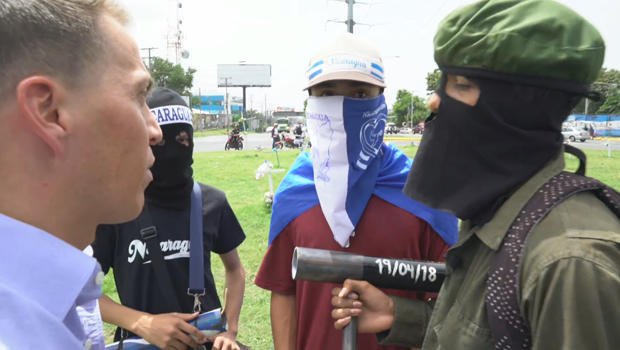
Several young men – masked and holding homemade mortar launchers – told Bojorquez they fire the mortars to warn fellow demonstrators when pro-government forces are near.

They told Bojorquez that they were willing to risk their lives: “The fear is gone,” one said.

manuel-bojorquez-nicaragua-protestors.jpg

Masked protesters in Managua, Nicaragua.

CBS News

The fear was gone on April 19 – that’s the day protests started over proposed cuts to social security benefits. Government forces are accused of killing more than 40 people that week. Hundreds have been killed since then, some even attacked while hiding in a church.

The uprising continues to intensify against President Ortega, whom demonstrators say has turned into a dictator and should step down. But Ortega remains defiant, insisting the protesters are being influenced by outside forces and blaming them for initiating the violence.

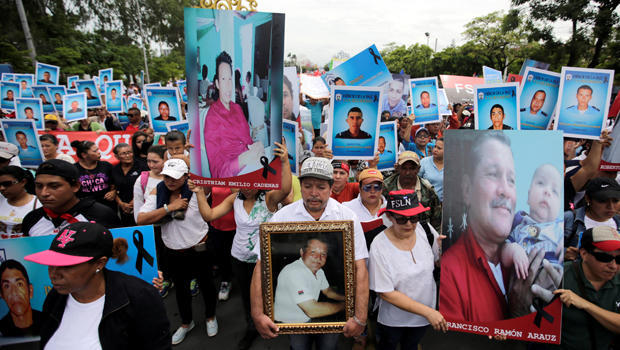
Ortega supporters hold pictures of dead police officers at demonstration in Managua

Supporters of Nicaragua’s President Daniel Ortega hold pictures of dead police officers, who lost their lives during recent protests, at a demonstration in Managua, Nicaragua July 21, 2018.

JORGE CABRERA/REUTERS

In the neighborhood of Monimbo, which had been a stronghold of the opposition, barricades built using cobblestones from the streets can still be seen. It was the site of a bloody confrontation with police last week. At this point, it’s still not clear how many people were killed.

One woman feared being identified on camera, but wanted to let Bojorquez know one thing: her neighborhood was not backing down – that Monimbo had lost the battle, but not the war.

Several international organizations have called on the Nicaraguan government to end the violent suppression of protests and for President Ortega to allow early elections next year. He refuses to back down, which means the protests are likely to continue.

*** Is Russia behind some of this? More Western hemisphere chaos coming to the United States? Let’s go back to 2016 and 2017:

The Russian government is building an electronic intelligence-gathering facility in Nicaragua as part of Moscow’s efforts to increase military and intelligence activities in the Western Hemisphere.

The signals intelligence site is part of a recent deal between Moscow and Managua involving the sale of 50 T-72 Russian tanks, said defense officials familiar with reports of the arrangement.

The tank deal and spy base have raised concerns among some officials in the Pentagon and nations in the region about a military buildup under leftist Nicaraguan leader Daniel Ortega.

Disclosure of the Russia-Nicaraguan spy base comes as three U.S. officials were expelled from Nicaragua last week. The three Department of Homeland Security officials were picked up by Nicaraguan authorities, driven to the airport, and sent to the United States without any belongings. More here.

Putin vs. McFaul, DHS, Browder and Why

It all comes down to the Magnitsky Act. In short Vladimir Putin is furious over this law and other countries are slowly setting it as law as well, most recently it appears, Spain.

When President Trump met with Putin in Helsinki, that was part of the discussion, repeal the law or apply waivers and allow Moscow access to key people, such as Bill Browder, a British citizen, former Ambassador McFaul, a few DHS investigators and two others, a fellow named Parker and other named Otto.  Finally the Trump White House said NYET.

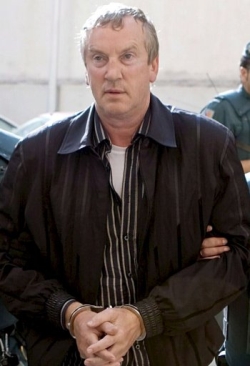
It was in May that Bill Browder, who actually is attending the 2018 Aspen Security Forum was arrested in Spain and almost immediately released due to some major confusion over a Red Notice launched by Russia, one of many times. Why was Browder in Spain? Likely helping authorities there with international crime/money laundering by Russian operatives.

What is that case about exactly? Well it is an extension of the reach of the Magnitsky Act.

As Jamestown reported in February of 2018:

On February 19, after a decade of investigations, Spanish prosecutors finally launched a major trial against notable members of the Russian mafia operating in the Iberian country. All in all, sufficient evidence was collected against 18 persons (cases, however, were opened against 27 alleged members of the Russian mafia and their supporters), of whom 6 are Spanish nationals charged with falsification of documents and auxiliary support. The culprits have been accused of money laundering and the “creation of a criminal community in Spain” (Elmundo.es, February 19). The legal process promises to become one of the most resonant recent cases related to the Russian mafia abroad. The accused are said to belong to the so-called Tambovskaya-Malyshevskaya organized criminal group (OPG)—one of the most formidable Russian mafia operations that emerged in St. Petersburg, in the late 1980s (Elmundo.es, June 13, 2008). Available information on the case suggests that the potential impact of the current investigation might turn out to be much more far-reaching than initially anticipated.

  Gennady Petrov (Source: OCCRP)

The Russian mafia has had a long history in Spain. Indeed the current case against members of the Tambovskaya-Malyshevskaya OPG is a continuation of an investigation that Spanish law enforcement initiated in 2008. That year, Spanish prosecutors and the Spanish police (Civil Guard or Guardia Civil, in Spanish) carried out a special operation, code-named “Troika,” against Russian criminals residing in Spain, which resulted in the arrest of several prominent members of the Russian mafia, notably including Gennady Petrov and Alexander Malyshev. The two men were apprehended in their mansions, located in Mallorca and Malaga. After the wave of arrests, investigators named 500 Spanish bank accounts that had been used for money laundering. In the final analysis, Spanish authorities manged to seize €12 million (then worth $18.4 million) in various accounts (Lenpravda.ru, June 16, 2008).

Petrov and Malyshev built their criminal careers (and accumulated most of their financial capital) in Russia. But when their criminal enterprise started to be marginalized in the late 1990s, they were forced to flee Russia and settled in Spain, where they acquired luxurious residential properties. However, they manged to escape justice under various pretexts and eventually returned to Russia (Russiangate.com, August 16, 2017).

Spanish police has revealed that Petrov alone owns financial assets in Spain worth close to €50 million ($62 million). Additionally, Spanish prosecutors allege that Petrov and the other defendants in the current trial have accumulated their wealth from criminal activities such as assassinations, arms and drug smuggling, extortion, abductions for ransom, and the falsification of documents (Elmundo.es, February 19, 2018). In the course of the investigation, prosecutors also ascertained that, over the years, members of the Russian mafia created hundreds of companies that were allegedly selling property in different regions of Spain, primarily in Alicante, Barcelona, Malaga and Mallorca. The real purpose of these companies, however, was to launder funds collected from drug and arms smuggling as well as to “buy up valuable contacts.” After passing through Spanish banks, the laundered money subsequently went to accounts in Liechtenstein or ended up in Panama (and the other way around).

The established criminal network in Spain also developed further close ties with Russian domestic criminal circles. For example, Petrov’s son, Anton, is considered to be a member of the same criminal society. Under his umbrella, dozens of companies are currently operating in St. Petersburg, among them the large jewellery company “585.” According to a ranking published in 2016 by the magazine Delovoy Peterburg, Petrov’s son was the 26th richest Russian billionaire, with a fortune worth 37 billion rubles ($650 million) (Novyj vzglyad, August 17, 2017).

The current Spanish legal case could shed additional light on the ties between Russian political elites and Russian organized crime abroad. It is curious to note that Spanish prosecutors specifically mentioned the name Vladislav Reznik as a person allegedly tightly related to the criminal group established by Petrov and Malyshev. Reznik chairs the St. Petersburg–based insurance company Rus, is the chairman of the State Duma Committee on Finances, and is a former chairman of the Moscow-based insurance firm Rosgosstrakh (RSG). He has been wanted by Spanish law enforcement since 2016. Considered by Spanish authorities to be one of the most important figures who contributed to expanding the Russian mafia to Spain, he is accused of laundering over $62 million. Yet, until now, he has managed to escape justice (Elmundo.es, June 1, 2015).

Spanish prosecutors have also ascertained the existence of apparent connections between Reznik and Herman Gref, the current CEO and chairman of Russia’s Sberbank. The list of figures named in the Spanish authorities’ indictment also includes such well-known persons as Ilya Taber (a member of the Vyborg OPG), Anatoly Serdyukov (the former minister of defense of Russia), Viktor Zubkov (former Russian prime minister), Boris Gryzlov (former speaker of the Russian parliament) and Leonid Reiman (former minister of communications and information technologies of Russia and a financial tycoon) (Meduza.io, February 19, 2018).

According to Spanish officials, Petrov was closely related to Reznik, whose main responsibilities boiled down to the “corruption of high officials [and] obtaining of classified information in the highest Russian governmental bodies and agencies.” Case materials additionally mention 78 telephone conversations between Petrov and Nikolay Akulov, the former deputy chief of the Federal Drug Control Service of the Russian Federation, who is also wanted by Spanish prosecutors (Svoboda.org, March 31, 2016). On top of that, case materials detail the rapid career growth of Alexander Bastrykin (the head of the Investigative Committee of Russia), allegedly thanks to Petrov’s “advocacy” on his behalf (Openrussia.org, December 2, 2015). Petrov, in turn, was acting through the former top-ranking official from the Investigative Committee of Russia, Igor Sobolevsky (Newtimes.ru, November 30, 2015).

At this point it would be premature to make any far-reaching conclusions. Yet, even if a fraction of the materials presented by Spanish prosecutors turns out to be correct, this will, once again, demonstrate not only the corrupt nature of Russian political elites but also testify to the scale of ties between Russian criminal (and political) circles located in Russia and Russian mafia structures abroad. Given Western economic sanctions (actual and potential), this channel could be activated to avoid or diminish the potential impact of the United States and/or European Union’s economic sanctions directed against Russian elites.

Just in case you need more evidence, here is part ONE of the deeper dive on details. As a sample:

Gennady Petrov: Petrov (also known as Gennadios Vasilevich Petrov) is the “chief” of a criminal group having a clear pyramidal structure. Other gang members are under his ferule. They had named him “chief”, “boss”, “leader”, or “principal”. In the framework of his functions, Petrov had maintained close ties with representatives of the Russian political, economic, judicial, and police authorities, as well as with members of the international organized crime with the purpose to implement joint projects. With the assistance of lawyers, managers, and confidants, he has created in Spain a network of companies in order to cash out monetary funds obtained by the criminal group. In Russia, he maintains close ties with high-ranked officials in the political, criminal, and law enforcement spheres.

If you can stand it, here is part TWO and here is part THREE.

In summary, when Natalia Veselnitskya met with Manafort and others at Trump Tower, the Magnitsky Act was the basis of the meeting. Don’t shoot the messenger here but facts and context matter.

Included in the documents released by the Senate Judiciary Committee on Wednesday is a one-page document submitted by Paul Manafort, the former campaign chairman for Donald Trump’s 2016 effort. Manafort was serving in that role on June 9, 2016, when he joined Donald Trump Jr. and campaign adviser Jared Kushner in a meeting with a Kremlin-linked attorney who had promised incriminating information about Hillary Clinton.

Those notes, apparently taken on Manafort’s phone, are as follows.

In full:

  • Bill browder
  • Offshore — Cyprus
  • 133m shares
  • Companies
  • Not invest — loan
  • Value in Cyprus as inter
  • Illici
  • Active sponsors of RNC
  • Browder hired Joanna Glover
  • Tied into Cheney
  • Russian adoption by American families

In the absence of other context, the notes are cryptic and include words that certainly seem to wave red flags. “Offshore,” “Illici[t]” — even an apparent mention of former vice president Richard B. Cheney.