An affordable price is probably the major benefit persuading people to buy drugs at www.americanbestpills.com. The cost of medications in Canadian drugstores is considerably lower than anywhere else simply because the medications here are oriented on international customers. In many cases, you will be able to cut your costs to a great extent and probably even save up a big fortune on your prescription drugs. What's more, pharmacies of Canada offer free-of-charge shipping, which is a convenient addition to all other benefits on offer. Cheap price is especially appealing to those users who are tight on a budget
Service Quality and Reputation
Although some believe that buying online is buying a pig in the poke, it is not. Canadian online pharmacies are excellent sources of information and are open for discussions. There one can read tons of users' feedback, where they share their experience of using a particular pharmacy, say what they like or do not like about the drugs and/or service. Reputable online pharmacy canadianrxon.com take this feedback into consideration and rely on it as a kind of expert advice, which helps them constantly improve they service and ensure that their clients buy safe and effective drugs. Last, but not least is their striving to attract professional doctors. As a result, users can directly contact a qualified doctor and ask whatever questions they have about a particular drug. Most likely, a doctor will ask several questions about the condition, for which the drug is going to be used. Based on this information, he or she will advise to use or not to use this medication.
Mallory, who had top secret security clearance, worked as a CIA officer, and was stationed in Iraq, China and Taiwan.
Mallory is a self-employed consultant with GlobalEx, LLC. and resides in Leesburg, Virginia. According to the criminal complaint, he graduated from Brigham Young University in 1981 with a bachelor’s degree in political science.
Shortly thereafter, Mallory worked full-time in a military position for five years. Once he left that job, he continued his military service as an Army reservist and worked as a special agent for the State Department Diplomatic Security Service for three years (1987-1990).
A single reference buried deep within hundreds of pages of court filings in the case of convicted CIA turncoat Kevin Mallory reveals the name of a Shanghai-based “executive search firm” that bears the hallmarks of a classic espionage front, former intelligence operatives from the U.S. and Russia tell The Daily Beast.
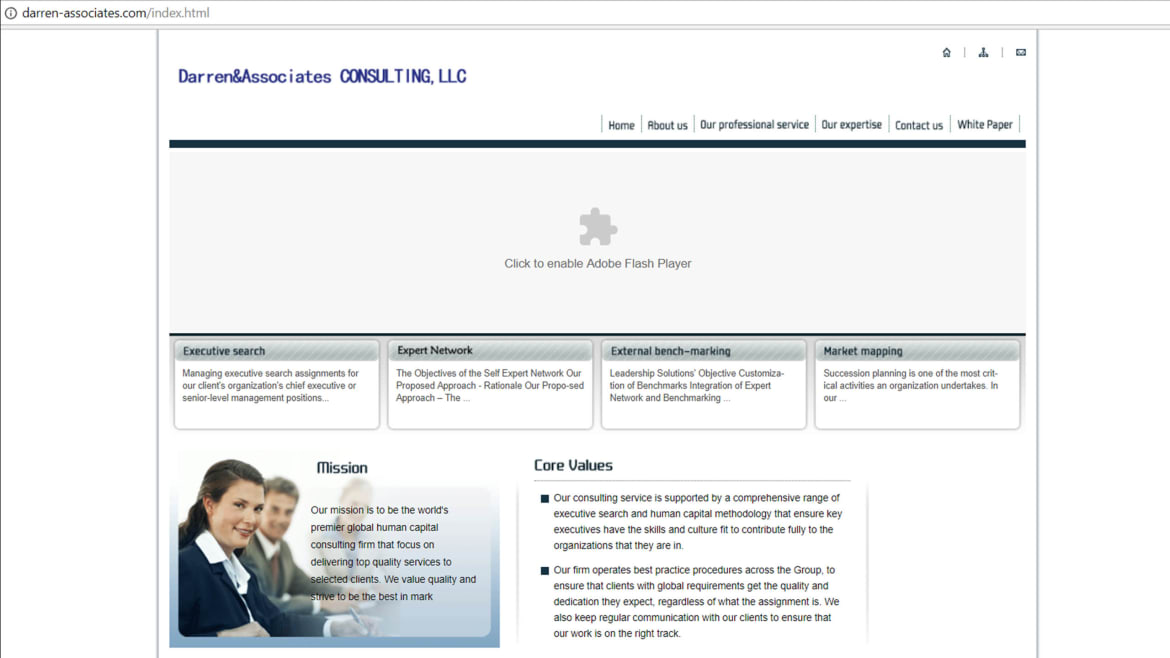
The U.S. government’s evidence against Mallory, who was found guilty Friday of espionage-related charges, included a photograph of a business card belonging to alleged Chinese Ministry of State Security (MSS) agent Richard Yang, who presented himself as a corporate headhunter. Prosecutors said he was one of Mallory’s handlers. According to court documents, the picture was taken at Darren & Associates, a supposed corporate recruiter with no listed phone number or executives and an address that traces back to a rent-by-the-hour space on Shanghai’s Hubin Road.
Darren & Associates’ connection to the Mallory case has not been previously reported. The firm has been in business for either “around 40 years,” as its website claims, or since 2014, as stated on its LinkedIn page. The job networking site lists no actual former or current employees, and the company has a near-zero web presence, which is highly unusual for an organization that describes itself as a successful global enterprise.
“Clearly this is phony,” said former KGB sleeper agent Jack Barsky. “The first thing you do to figure out how real [a company is] is look at their website, and this is just not the footprint of a solid company.”
“Clearly this is phony… The first thing you do to figure out how real [a company is] by looking at their website, and this is just not the footprint of a solid company.”
— former KGB sleeper agent Jack Barsky
It’s a “flimsy mechanism for them to use,” agreed former CIA officer Christopher Burgess. “To me, this is what someone would put up so that their business contact isn’t naked. But what it doesn’t do is talk about who they are, where they are, doesn’t give you names, and their mission is so general that it can cover anything.”
Richard Yang subsequently introduced Mallory to an associate, Michael Yang, who claimed to be affiliated with the Shanghai Academy of Social Sciences (SASS). It has a close relationship with the Shanghai State Security Bureau (SSSB), a sub-component of the Ministry of State Security, according to the FBI. The Shanghai security bureau “uses SASS employees as spotters and assessors,” says one court filing, and “FBI has further assessed that SSSB intelligence officers have also used SASS affiliation as cover identities.”
Chinese think tanks like the Shanghai academy “can be used to invite someone over who is either a person of interest or a source,” Peter Mattis of the Jamestown Foundation’s China Program told Bethany Allen-Ebrahimian and Elias Groll of Foreign Policy last year. “That person comes over and gives a talk, and they’ll be met and have meetings with the local state security element or the People’s Liberation Army.”
via Facebook
Others are based in the U.S., they pointed out. The China Institute of Contemporary International Relations describes itself as a “comprehensive research institution” but is also “an official numbered bureau of the Ministry of State Security, functioning rather like the CIA’s Open Source Center.”
Darren & Associates, the erstwhile headhunting firm, seems rather less sophisticated. Either the MSS was “too lazy” to create a more realistic front company, or they thought “no one would give a shit about this Mallory guy and no one would be checking it,” said a former Russian FSB officer now living in the U.S. under the pseudonym “Jan Neumann.”
But U.S. authorities did care, and Mallory’s scheme unraveled in 2017 when he was selected for secondary screening at Chicago’s O’Hare Airport after a trip to China. Although he said he had nothing to declare, customs officers found $16,500 in cash on him.
““An individual like Mallory, with 20-plus years of high-end intelligence community engagement should have known better than [to use] this weak cover story that the Chinese gave him.”
— former CIA officer Christopher Burgess
“An individual like Mallory, with 20-plus years of high-end intelligence community engagement should have known better than [to use] this weak cover story that the MSS gave him,” said Burgess. “He should have picked up the phone and called the FBI and said, ‘Hey, these people say they’re legitimate businesspeople, and I don’t think they are.’ And he should have done that years ago.”
The details of exactly what Mallory gave up have yet to be publicly revealed, and probably won’t ever be, said Burgess. But according to prosecutors, Mallory gave away the most precious secrets of all—the names of U.S. agents in China.
A CIA information review officer said in court last year that the documents Mallory gave to the Chinese contained sensitive intelligence, analysis, and the names of assets that “could reasonably be expected to cause the loss of critical intelligence and possibly result in the lengthy incarceration or death of clandestine human sources.”
”It’s a betrayal in the truest sense of the term,” former CIA Inspector General Frederick Hitz told The Daily Beast.
FBI analysts further determined that Mallory “had completed all of the steps necessary to securely transmit at least four documents…one of which contained unique identifiers for human sources who had helped the U.S. government.”
Some of these files were stored on a Toshiba SD card, which Mallory concealed in aluminum foil and hid in his bedroom closet.
“We overlooked it twice,” FBI Special Agent Melinda Capitano testified Thursday.
“What made you think to open it?” the prosecutor asked.
“Usually in my training, small bits of foil like this contain drugs,” Capitano replied.
via PACER
The foil-wrapped SD card found in Mallory’s home.
Mallory’s defense team claims that the documents were worthless and that he was actually operating as an independent, self-directed counterintelligence officer of sorts to reel in the Chinese agents so he could eventually turn them into U.S. authorities. Burgess calls that “hogwash.” Mallory wasn’t freelancing in counterintelligence, he “was all-in” as an asset, in Burgess’ opinion.
“He was responsive to tasking, he used covert communications to reduce face-to-face interactions with his PRC contact,” said Burgess. “If I was validating a source, those are all indications that I have a good one.”
“He’s throwing something at the wall to see if it sticks,” laughed former Defense Intelligence Agency officer Ray Semko. “Just as long as they get one fool [on the jury] to believe it.”
Mallory’s attorney, Geremy Kamens, declined a request for comment.
Mallory, his wife, and one of his three kids lived in a four-bedroom, four-bathroom, 7,100-square foot house in Leesburg, Virginia, complete with a home theater and two fireplaces. He paid $1.15 million in 2005, a lot of money for a guy prosecutors said earned only $25,000 in the three years—all of it from his Chinese handlers.
He also has three adult children from a previous marriage. A court filing said Mallory had $50,000 in credit card debt, and about $2,500 in cash and investments. His wife, Mariah Nan-Hua Mallory, drives a school bus and earns roughly $9,000 a year.
In a motion previously filed with the court arguing against Mallory’s release pending trial, prosecutors said he had “demonstrated a pattern of dishonesty.”
“The defendant says and does anything he wishes to suit his particular needs, which seem largely to be finding an easy path out of his financial hardship, by betraying his government,” the motion stated.
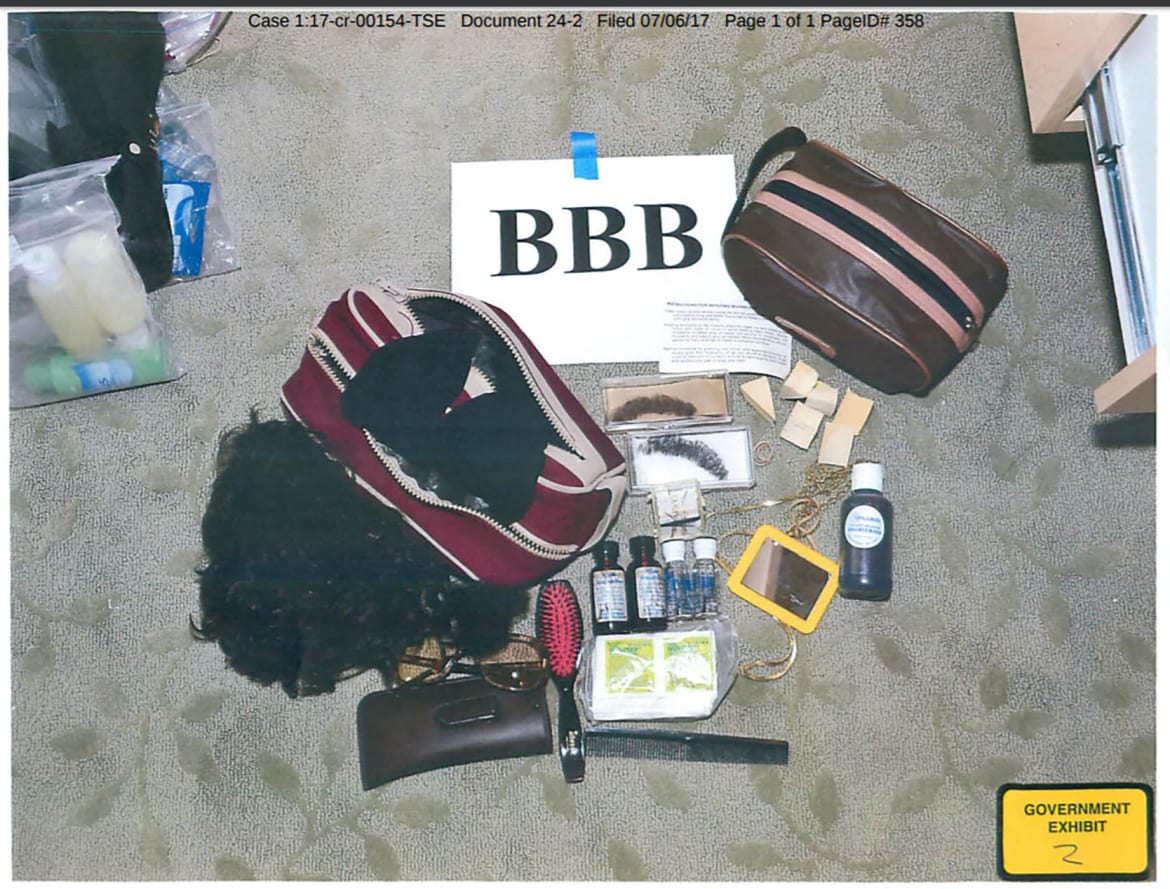
A disguise kit found by FBI agents during a search of Mallory’s home.
However, Patsy Harrington, a real estate broker and close friend of Mallory’s who sold him his home, insists that Mallory is being totally mischaracterized.
“He is a loyal serviceman that was hurt in the line of duty in the Middle East, he’s a wonderful family man and a devoted Mormon with a wonderful wife and three highly accomplished grown children,” Harrington told The Daily Beast. “He’s a good man. I was a single mom and he was wonderful to me. He’s much better than 97 percent of the human beings I know.”
A LinkedIn recommendation from Min Xu, an associate professor at Central China Normal University describes Mallory as “a very faithful, honest, loyal, serious but kind, helpful, contagious person, very nice to everyone around, I will always remember his timely help and the warmth he gave to us when we were in trouble. He is really an amazing man.”
In fact, the Chinese agents who targeted Mallory initially reached out to him on LinkedIn. It’s a virtual goldmine for those looking to identify members of the “cleared community,” said Christopher Burgess, who has been contacted by people he assumed were foreign intelligence operatives more times than he can count.
via PACER
Yet Chinese intelligence isn’t only interested in people with active security clearances. Anyone with access or influence can potentially be of value, and everyone from professors to scientists to journalists have received overtures from foreign spy services.
National security reporter Garrett Graff was targeted on LinkedIn by Evgeny Buryakov, a Russian SVR operative posing as a New York City investment banker. And a Chinese agent used LinkedIn to reach out to journalist Nate Thayer last year.
“On the day I received my first message from Chinese intelligence agents from the Ministry of State Security, they, of course, didn’t say they were Chinese spies,” Thayer wrote on his blog. “The note was from ‘Frank Hu,’ a ‘project assistant’ from Shanghai Pacific & International Strategy Consulting Co, saying he had found me on the Internet and was writing to ‘seek potential cooperation opportunities.’”
Predictably, there is no “Shanghai Pacific & International Strategy Consulting Co,” which doesn’t even maintain a rudimentary Darren & Associates-style website. “Hu” told Thayer the company was “a consulting firm, specializing in independent policy analysis and advisory services. We strive to help our clients properly assess political dynamics, risks and opportunities in countries and regions they operate in.”
“In terms of human source operations, the PRC ‘services’ are not all that sophisticated,” an intelligence community source told Thayer, “until they get you on their turf. So don’t go there–to Shanghai, that is–for any reason.”
Of course, there is no such thing as a foolproof system in espionage, and breaches like Mallory’s will surely happen again.
As Joseph Wippl, a 30-year veteran of the CIA’s National Clandestine Service, told The Daily Beast, “It’s part of the business.”
Maryland’s Internet Crimes Against Children Task Force yielded 56 arrests in Maryland — 21 of which were arrested by Maryland State Police investigators during “Operation Broken Heart,” a nationwide, three-month initiative targeting offenders of child sexual exploitation.
The Maryland Internet Crimes Against Children Task Force was one of 61 task forces included in the Operation Broken Heart initiative. Members from the Maryland ICAC worked throughout March, April and May, initiating 426 investigations. Investigators executed 149 search warrants with 56 arrests. There were also public outreach sessions, which reached nearly 780 people.
More Than 2,300 Suspected Online Child Sex Offenders Arrested During Operation “Broken Heart”
The Department of Justice today announced the arrest of more than 2,300 suspected online child sex offenders during a three-month, nationwide, operation conducted by Internet Crimes Against Children (ICAC) task forces. The task forces identified 195 offenders who either produced child pornography or committed child sexual abuse, and 383 children who suffered recent, ongoing, or historical sexual abuse or production of child pornography.
The 61 ICAC task forces, located in all 50 states and comprised of more than 4,500 federal, state, local and tribal law enforcement agencies, led the coordinated operation known as “Broken Heart” during the months of March, April, and May 2018. During the course of the operation, the task forces investigated more than 25,200 complaints of technology-facilitated crimes against children and delivered more than 3,700 presentations on Internet safety to over 390,000 youth and adults.
“No child should ever have to endure sexual abuse,” Attorney General Jeff Sessions said. “And yet, in recent years, certain forms of modern technology have facilitated the spread of child pornography and created greater incentives for its production. We at the Department of Justice are determined to strike back against these repugnant crimes. It is shocking and very sad that in this one operation, we have arrested more than 2,300 alleged child predators and investigated some 25,200 sexual abuse complaints. Any would-be criminal should be warned: this Department will remain relentless in hunting down those who victimize our children.”
The operation targeted suspects who: (1) produce, distribute, receive and possess child pornography; (2) engage in online enticement of children for sexual purposes; (3) engage in the sex trafficking of children; and (4) travel across state lines or to foreign countries and sexually abuse children.
The ICAC Program is funded through the Department’s Office of Juvenile Justice and Delinquency Prevention (OJJDP). In 1998, OJJDP launched the ICAC Task Force Program to help federal, state, and local law enforcement agencies enhance their investigative responses to offenders who use the Internet, online communication systems or computer technology to exploit children. To date, ICAC Task Forces have reviewed more than 775,000 complaints of child exploitation, which resulted in the arrest of more than 83,000 individuals. In addition, since the ICAC program’s inception, more than 629,400 law enforcement officers, prosecutors and other professionals have been trained on techniques to investigate and prosecute ICAC-related cases.
The USCIS is authorized to cancel any Certificate of Citizenship or Naturalization in cases where evidence provided to government documents is proven false.
Just 5 days ago: U.S. Citizenship and Immigration Services (USCIS) assisted in an investigation that led to U.S. District Judge Virginia M. Hernandez Covington sentencing Enite Alindor, also known as Odette Dureland, to five months in federal prison. The 55-year-old woman was sentenced for making false statements in a matter relating to naturalization and citizenship and for procuring naturalization as a U.S. citizen. As part of her sentence, the court also entered an order de-naturalizing her, thus revoking her July 2012 naturalization as a U.S. citizen. A federal jury had found her guilty on March 1, 2018.
According to court documents, Alindor, a citizen of Haiti, applied for asylum with the Immigration and Naturalization Service (INS) in Miami in 1997. After the INS denied that application, the United States Immigration Court ordered her to be removed from the United States. Shortly thereafter, Alindor presented herself to the INS as Odettte Dureland and filed for asylum protection under that new identity. She concealed the fact that she had previously applied for status in the United States as Enite Alindor, and she concealed the fact that she was under a final order for removal from the United States. USCIS personnel, unaware of the Alindor identity and order of removal, approved Dureland for citizenship in July 2012, and she was naturalized as a U.S. citizen under that name in July 2012.
Iyman Faris is set to be released from prison in 2020 after serving 17 years behind bars for terrorism-related charges stemming from a plot to destroy the Brooklyn Bridge. By the time he gets out, American authorities hope, he will no longer be able to call the U.S. his home.
The Justice Department has filed a lawsuit to try to strip the Pakistan-born Faris of his citizenship, which he obtained in 1999, saying it’s an affront to allow him to continue to be an American citizen.
It’s just the type of case authorities say they expect to pursue more frequently under President Trump and Attorney General Jeff Sessions.
“The attorney general and the administration are focused on enforcing all immigration laws, especially when it comes to this pinnacle level of citizenship,” said one Justice Department official, who spoke on the condition of anonymity.
AG Sessions is holding true to his mission on immigration.
(AP) — The U.S. government agency that oversees immigration applications is launching an office that will focus on identifying Americans who are suspected of cheating to get their citizenship and seek to strip them of it.
U.S. Citizenship and Immigration Services Director L. Francis Cissna told The Associated Press in an interview that his agency is hiring several dozen lawyers and immigration officers to review cases of immigrants who were ordered deported and are suspected of using fake identities to later get green cards and citizenship through naturalization.
Cissna said the cases would be referred to the Department of Justice, whose attorneys could then seek to remove the immigrants’ citizenship in civil court proceedings. In some cases, government attorneys could bring criminal charges related to fraud.
Until now, the agency has pursued cases as they arose but not through a coordinated effort, Cissna said. He said he hopes the agency’s new office in Los Angeles will be running by next year but added that investigating and referring cases for prosecution will likely take longer.
“We finally have a process in place to get to the bottom of all these bad cases and start denaturalizing people who should not have been naturalized in the first place,” Cissna said. “What we’re looking at, when you boil it all down, is potentially a few thousand cases.”
He declined to say how much the effort would cost but said it would be covered by the agency’s existing budget, which is funded by immigration application fees.
The push comes as the Trump administration has been cracking down on illegal immigration and taking steps to reduce legal immigration to the U.S.
Immigrants who become U.S. citizens can vote, serve on juries and obtain security clearance. Denaturalization — the process of removing that citizenship — is very rare.
The U.S. government began looking at potentially fraudulent naturalization cases a decade ago when a border officer detected about 200 people had used different identities to get green cards and citizenship after they were previously issued deportation orders.
In September 2016, an internal watchdog reported that 315,000 old fingerprint records for immigrants who had been deported or had criminal convictions had not been uploaded to a Department of Homeland Security database that is used to check immigrants’ identities. The same report found more than 800 immigrants had been ordered deported under one identity but became U.S. citizens under another.
Since then, the government has been uploading these older fingerprint records dating back to the 1990s and investigators have been evaluating cases for denaturalization.
Earlier this year, a judge revoked the citizenship of an Indian-born New Jersey man named Baljinder Singh after federal authorities accused him of using an alias to avoid deportation.
Authorities said Singh used a different name when he arrived in the United States in 1991. He was ordered deported the next year and a month later applied for asylum using the name Baljinder Singh before marrying an American, getting a green card and naturalizing.
Authorities said Singh did not mention his earlier deportation order when he applied for citizenship.
For many years, most U.S. efforts to strip immigrants of their citizenship focused largely on suspected war criminals who lied on their immigration paperwork, most notably former Nazis.
Toward the end of the Obama administration, officials began reviewing cases stemming from the fingerprints probe but prioritized those of naturalized citizens who had obtained security clearances, for example, to work at the Transportation Security Administration, said Muzaffar Chishti, director of the Migration Policy Institute’s office at New York University law school.
The Trump administration has made these investigations a bigger priority, he said. He said he expects cases will focus on deliberate fraud but some naturalized Americans may feel uneasy with the change.
“It is clearly true that we have entered a new chapter when a much larger number of people could feel vulnerable that their naturalization could be reopened,” Chishti said.
Since 1990, the Department of Justice has filed 305 civil denaturalization cases, according to statistics obtained by an immigration attorney in Kansas who has defended immigrants in these cases.
The attorney, Matthew Hoppock, agrees that deportees who lied to get citizenship should face consequences but worries other immigrants who might have made mistakes on their paperwork could get targeted and might not have the money to fight back in court.
Cissna said there are valid reasons why immigrants might be listed under multiple names, noting many Latin American immigrants have more than one surname. He said the U.S. government is not interested in that kind of minor discrepancy but wants to target people who deliberately changed their identities to dupe officials into granting immigration benefits.
“The people who are going to be targeted by this — they know full well who they are because they were ordered removed under a different identity and they intentionally lied about it when they applied for citizenship later on,” Cissna said. “It may be some time before we get to their case, but we’ll get to them.”
The Chinese are relentless in all parts of the world.
It may not have looked like much of a match — or a showdown for that matter — but when Australia’s largest warship HMAS Adelaide arrived at the Fijian port of Suva on Saturday, it had an interesting neighbour.
Chinese fishing boat believed to be carrying wide range of surveillance equipment
Fiji tipped off Australian Navy about Chinese spy ship expected to dock next to HMAS Adelaide
China has a strong commercial and military presence in the South Pacific
A Chinese ship fitted with communications equipment docked alongside the new Canberra-class landing helicopter dock.
The Royal Australian Navy suspects the Chinese vessel is a spy ship, which deliberately arrived at the same time to carry out surveillance on the Australians.
HMAS Adelaide and other Australian warships visiting Fiji will “take the appropriate security precautions”, but the surveillance craft is “just another ship”, Captain Jim Hutton, Commander of the Navy’s Joint Task Group 661, said.
Deputy Chief of Navy Rear Admiral Mark Hammond also played down concerns about the presence of the Chinese vessel.
“That’s a space surveillance ship, it’s a scientific ship,” he told reporters on board HMAS Adelaide.
ABC News understands the primary purpose of the Chinese ship is to track satellite launches from out on the ocean, but it does have the capability to also collect intelligence on other naval vessels.
Australia’s High Commissioner to Fiji John Feakes also revealed the skipper of the Chinese vessel had even been invited to an on-board reception, although it is not clear whether the offer was accepted.
Australia’s Navy, like every navy around the world, is well-versed in these sorts of nautical games.
“If you’re in the Navy you presume that anytime that a fishing vessel or even merchant fleets of nations like China are around that they may have a dual purpose,” ANU academic and retired Australian Naval Commodore Richard Menhinick said.
“You just presume that they may well be tasked by government for other activities.”
China’s looking for South Pacific foothold
Chinese presence — both commercial and military — is common in the South Pacific.
Beijing sees economic opportunity in the region and economic imperatives commonly herald other strategic interests.
Agriculture and aquaculture projects in Vanuatu, Fiji, Tonga and other Pacific nations have been given significant help by the Chinese over the years, as have roads, ports and other infrastructure.
Media player: “Space” to play, “M” to mute, “left” and “right” to seek.
When you have more than 1.3 billion people back home to feed, finding secure food supplies are critical.
As China grows, Mr Menhinick said it was not surprising that the nation’s presence in the Pacific was also increasing.
“China’s a rising power… economic power’s always led and the military’s followed, and the Chinese economic interest in the south-west Pacific has increased substantially over the last fifteen year,” he said.
But Australia and its strategic partners are anxious China does not use its presence to jeopardise regional structures — political, economic and diplomatic.
Now a visiting US General has given the strongest public indication yet that his nation would like Australia to join in naval and air patrols to challenge Beijing’s claims in the South China Sea.
Asked whether joint American-Australian patrols would be welcomed by America, the commander of US Marines in the Pacific, Lieutenant General David Berger gave an enthusiastic response.
“Obviously that’s Australia’s decision, would we welcome that? Absolutely yes,” Lt Gen Berger said.
Meanwhile, all eyes are on Singapore….but in advance of the talks between the United States and North Korea in Singapore, there was a LOT of nefarious activity.
Independent: Hackers from China and Russia are targeting South Korea with cyber espionage attacks ahead of the summit between the US and North Korea, a leading security firm has claimed.
The foreign ministry and financial institutions were identified as potential targets by, US cyber security firm FireEye.
The company’s analysts noted the timing of the attacks and said they expected the intensity of the operations to increase in the build up to the historic meeting between US President Donald Trump and North Korean Chairman Kim Jong-un.
“South Korea has frequently been the target of cyber espionage. Though the biggest threat is North Korea actors. [FireEye] believes that China- and Russia- [based hackers] also target South Korea,” Ben Read, a cyber espionage analyst at the firm, told The Independent.
“With the heightened attention to inter-Korean relations in the lead up to a potential Trump–Kim meeting, we expect this targeting to continue at an increased pace.”
Scheduled to take place on 12 June in Singapore the leader are expected to discuss the denuclearisation of North Korea.
It will be the first meeting between a sitting US president and leader of North Korea.
Some experts have suggested that a formal end to the Korean War – more than six decades after the 1950-1953 conflict – could be declared.
Although an armistice was signed, no peace treaty has ever been signed to formally end the war.
The two hacking groups identified by the FireEye researchers were TempTick and Turla, both of which are suspected of being state-sponsored operations.
TempTick has previously been involved in attacks on Chinese dissident organisations, as well as Japanese public and private sector institutions. It has been active since 2009.
The earliest known attacks linked to the group known as Turla are from 2006.
FireEye researchers noted: “They consistently target governments worldwide in search of information that can inform Russian government decision making.”
74 Arrested in Coordinated International Enforcement Operation Targeting Hundreds of Individuals in Business Email Compromise Schemes
42 Alleged Fraudsters Arrested in the United States
Federal authorities announced today a significant coordinated effort to disrupt Business Email Compromise (BEC) schemes that are designed to intercept and hijack wire transfers from businesses and individuals, including many senior citizens. Operation Wire Wire, a coordinated law enforcement effort by the U.S. Department of Justice, U.S. Department of Homeland Security, U.S. Department of the Treasury and the U.S. Postal Inspection Service, was conducted over a six month period, culminating in over two weeks of intensified law enforcement activity resulting in 74 arrests in the United States and overseas, including 29 in Nigeria, and three in Canada, Mauritius and Poland. The operation also resulted in the seizure of nearly $2.4 million, and the disruption and recovery of approximately $14 million in fraudulent wire transfers.
BEC, also known as “cyber-enabled financial fraud,” is a sophisticated scam often targeting employees with access to company finances and businesses working with foreign suppliers and/or businesses that regularly perform wire transfer payments. The same criminal organizations that perpetrate BEC also exploit individual victims, often real estate purchasers, the elderly, and others, by convincing them to make wire transfers to bank accounts controlled by the criminals. This is often accomplished by impersonating a key employee or business partner after obtaining access to that person’s email account or sometimes done through romance and lottery scams. BEC scams may involve fraudulent requests for checks rather than wire transfers; they may target sensitive information such as personally identifiable information (PII) or employee tax records instead of, or in addition to, money; and they may not involve an actual “compromise” of an email account or computer network. Foreign citizens perpetrate many BEC scams. Those individuals are often members of transnational criminal organizations, which originated in Nigeria but have spread throughout the world.
“Fraudsters can rob people of their life’s savings in a matter of minutes,” said Attorney General Sessions. “These are malicious and morally repugnant crimes. The Department of Justice has taken aggressive action against fraudsters in recent months, conducting the largest sweep of fraud against American seniors in history back in February. Now, in this operation alone, we have arrested 42 people in the United States and 29 others have been arrested in Nigeria for alleged financial fraud. And so I want to thank the FBI, nearly a dozen U.S. Attorneys’ Offices, the Secret Service, Postal Inspection Services, Homeland Security Investigations, the Treasury Department, our partners in Nigeria, Poland, Canada, Mauritius, Indonesia, and Malaysia, and our state and local law enforcement partners for all of their hard work. We will continue to go on offense against fraudsters so that the American people can have safety and peace of mind.”
“This operation demonstrates the FBI’s commitment to disrupt and dismantle criminal enterprises that target American citizens and their businesses,” said FBI Director Christopher A. Wray. “We will continue to work together with our law enforcement partners around the world to end these fraud schemes and protect the hard-earned assets of our citizens. The public we serve deserves nothing less.”
“The Secret Service remains committed to aggressively investigating and pursuing those responsible for cyber-enabled financial crimes,” said U.S. Secret Service Director Randolph “Tex” Alles. “Although the explosive expansion of the cyber domain has forced us to develop innovative ways of conducting these types of investigations, our proven model remains the same.”
“FinCEN has been a leader in the fight against BEC and other cyber-enabled crime,” said FinCEN Director Kenneth A. Blanco. “Since 2014, working with our domestic and international partners, our Rapid Response Program has helped recover over $350 million stolen from innocent Americans. We must continue to be smarter, quicker, and better than the criminals that we face every day. Today’s action is a victory, but it will take vigilance, time, and resources to take this fight into the future. In defense of the victims of these crimes, we are ready for the challenge.”
“The U.S. Postal Inspection Service has a long history of successfully investigating complex fraud and corruption cases,” said Chief Postal Inspector Guy Cottrell. “We are proud to work alongside our fellow law enforcement partners in major efforts, such as Operation Wire Wire, to target those individuals who take advantage of the American public for illegal profits. Anyone who engages in deceptive practices like this should know they will not go undetected and will be held accountable, regardless of where they are. Postal Inspectors will continue to work tirelessly to protect our customers from fraud.”
A number of cases involved international criminal organizations that defrauded small to large sized businesses, while others involved individual victims who transferred high dollar funds or sensitive records in the course of business. The devastating effects these cases have on victims and victim companies, affect not only the individual business but also the global economy. Since the Internet Crime Complaint Center (IC3) began keeping track of BEC and its variant, Email Account Compromise (EAC), as a complaint category, there has been a loss of over $3.7 billion reported to the IC3. BEC and EAC is a prevalent scam and the Justice Department along with our partners will continue to aggressively pursue and prosecute the perpetrators, including money mules, regardless of where they are located.
Money mules may be witting or unwitting accomplices who receive ill-gotten funds from the victims and then transfer the funds as directed by the fraudsters. The money is wired or sent by check to the money mule who then deposits it in his or her own bank account. Usually the mules keep a fraction for “their trouble” and then wire the money as directed by the fraudster. The fraudsters enlist and manipulate the money mules through romance scams or “work-at-home” scams.
Starting in January 2018, this coordinated enforcement action targeted hundreds of BEC scammers. In addition, law enforcement agents executed over 51 domestic actions including search warrants, money mule warning letters, and asset seizure warrants totaling nearly $1 million. Local and state law enforcement partners on FBI task forces across the country, with the assistance of multiple District Attorney’s Offices, charged 15 alleged money mules for their role in defrauding victims. These money mules were employed by the fraudsters to launder their ill-gotten gains by draining the funds into other accounts that are difficult to trace.
Among those arrested on federal charges in BEC schemes include:
Following an investigation by the FBI and the U.S. Secret Service, 23 individuals were charged in the Southern District of Florida with laundering at least $10 million from proceeds of BEC scams, including eight people charged in an indictment unsealed last week in Miami. These eight defendants are alleged to have conspired to launder proceeds from numerous BEC scams, totaling at least approximately $5 million, including approximately $1.4 million from a victim corporation in Seattle, as well as various title companies and a law firm.
Following an investigation led by the FBI with the assistance of the IRS Criminal Investigation, Gloria Okolie and Paul Aisosa, both Nigerian nationals residing in Dallas, Texas, were charged in an indictment filed on June 6 in the Southern District of Georgia. According to the indictment, they are alleged to have victimized a real estate closing attorney by sending the lawyer a spoofing email posing as the seller and requesting that proceeds of a real estate sale in the amount of $246,000 be wired to Okolie’s account. They are charged with laundering approximately $665,000 in illicit funds. The attorney experienced $130,000 in losses after the bank was notified of the fraud and froze $116,000.
Adeyemi Odufuye aka “Micky,” “Micky Bricks,” “Yemi,” “GMB,” “Bawz” and “Jefe,” 32, and Stanley Hugochukwu Nwoke, aka Stanley Banks,” “Banks,” “Hugo Banks,” “Banky,” and “Jose Calderon,” 27, were charged in a seven-count indictment in the District of Connecticut in a BEC scheme involving an attempted loss to victims of approximately $2.6 million, including at least $440,000 in actual losses to one victim in Connecticut. A third co-conspirator Olumuyiwa Yahtrip Adejumo, aka “Ade,” “Slimwaco,” “Waco,” “Waco Jamon,” “Hade,” and “Hadey,” 32, of Toledo, Ohio, pleaded guilty on April 20 to one count of conspiracy to commit wire fraud. Odufuye was extradited from the United Kingdom to the United States and on Jan. 3, pleaded guilty to one count of conspiracy to commit wire fraud and one count of aggravated identity theft. Nwoke was extradited to the United States from Mauritius on May 25, marking the first extradition in over 15 years from Mauritius. His case is pending.
Richard Emem Jackson, aka Auwire, 23, of Lagos, Nigeria, was charged in an indictment filed on May 17 in the District of Massachusetts with two counts of unlawful possession of a means of identification as part of a larger fraud scheme. According to the indictment, on two occasions in 2017, Jackson is alleged to have possessed the identifications of two victims with the intent to commit wire fraud conspiracy. In another case being prosecuted in the District of Massachusetts, a 25-year-old Fort Lauderdale, Florida man was indicted in federal court in Boston on June 6 on one count of money laundering conspiracy. According to the indictment, the individual was part of a conspiracy that engaged in wire fraud. It is alleged that in early 2018, the defendant’s co-conspirators gained access to email accounts belonging to a Massachusetts real estate attorney and sent emails to recipients in Massachusetts that “spoofed” the real estate attorney’s account in an attempt to cause the email recipient to transfer nearly $500,000, which was intended to be used for payment in connection with a real estate transaction, to a shell account belonging to a money mule recruited and controlled by the defendant.
The BEC scam is related to other forms of fraud such as:
“Romance scams,” which lull victims to believe that their online paramour needs funds for an international business transaction, a U.S. visit or some other purpose;
“Employment opportunities scams,” which recruits prospective employees for work-from-home employment opportunities where employees are required to provide their PII as new “hires” and then are significantly overpaid by check whereby the employees wire the overpayment to the employers’ bank;
“Fraudulent online vehicle sales scams,” which convinces intended buyers to purchase prepaid gift cards in the amount of the agreed upon sale price and are instructed to share the prepaid card codes with the “sellers” who ignore future communications and do not deliver the goods;
“Rental scams” occur when renters forward a check in excess of the agreed upon deposit for the rental property to the victims and request the remainder be returned via wire or check and back out of the rental agreements and ask for a refund; and
“Lottery scams,” which involves persons randomly contacting email addresses advising them they have been selected as the winner of an international lottery.
The cases were investigated by the FBI, U.S. Secret Service, U.S. Postal Inspection Service, U.S. Immigration and Customs Enforcement’s Homeland Security Investigations, the U.S. Department of the Treasury Financial Crimes Enforcement Network (FinCEN) and IRS Criminal Investigation. U.S. Attorney’s Offices in the Districts of Central California, Connecticut, Eastern Virginia, Massachusetts, Nebraska, New Jersey, Southern Florida, Southern Georgia, Southern Texas, Eastern Pennsylvania, Eastern Washington, Western Pennsylvania, Western Tennessee, Western Washington, Utah, and elsewhere have ongoing investigations some of which have resulted in arrests in Nigeria. The Justice Department’s Computer Crime and Intellectual Property Section, Money Laundering and Asset Recovery Section and Office of International Affairs of the Criminal Division provided assistance. District Attorney’s Offices of Caddo Parrish in Shreveport, Louisiana; Harris County, Texas and Los Angeles are handling state prosecutions. Additionally, private sector partners and the Nigerian Economic and Financial Crimes Commission, Canadian law enforcement including the Toronto Police Service, the Mauritian Attorney-General and the Commissioner of Police, Polish Police Central Bureau of Investigation, Indonesian National Police Cyber Crimes Unit, and the Royal Malaysia Police provided significant assistance.
This operation, which was funded and coordinated by the FBI, serves as a model for international cooperation against specific threats that endanger the financial well-being of each member country’s residents. Attorney General Sessions expressed gratitude for the outstanding efforts of the participating countries, including law enforcement actions that were coordinated and executed by the Economic and Financial Crimes Commission (EFCC) in Nigeria to curb business email compromise schemes that defraud businesses and individuals alike.
Victims are encouraged to file a complaint online with the IC3 at bec.ic3.gov. The IC3 staff reviews complaints, looking for patterns or other indicators of significant criminal activity, and refers investigative packages of complaints to the appropriate law enforcement authorities in a particular city or region. The FBI provides a variety of resources relating to BEC through the IC3, which can be reached at www.ic3.gov.

 photo
photo