Mexican Gulf Cartels Surveillance Systems

From Breitbart:

The former Tamaulipas governor Eugenio Hernandez Flores was charged on May 27, 2015 on two counts, money laundering and crimes against the United States.

MCALLEN, Texas — The U.S. federal government has formally announced that yet another former governor from Mexico has now become a fugitive sought by the U.S. Drug Enforcement Administration.
The U.S. Attorney’s Office for the Southern District Of Texas announced Friday morning that former Tamaulipas governor Eugenio Hernandez Flores has been charged with money laundering and money laundering conspiracy charges.

As previously reported by Breitbart Texas, Hernandez has been implicated in money laundering through a series of civil forfeiture cases accusing him of laundering bribe money that he received for government favors, as well as from Mexican drug traffickers including Los Zetas.

Hernandez, who was the governor from 2005 to 2010, is the second Tamaulipas governor to be criminally charged in the U.S. on money laundering charges connected to taking money from Mexican drug cartels. Tomas Yarrington Ruvalcaba, who served as governor before Hernandez, is currently facing money laundering and drug trafficking charges for his alleged role in helping the Gulf Cartel, Los Zetas and other Mexican cartels.

It gets worse as Breitbart publishes the following:

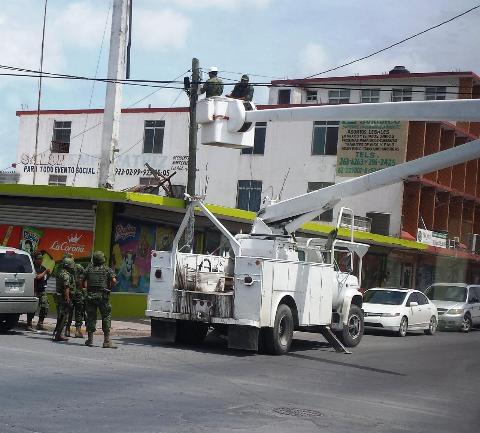
Mexican authorities take down a complex surveillance system made up of a range of <a href=home security cameras, set up by the Gulf Cartel in the border city of Reynosa” width=”398″ height=”359″ />

REYNOSA, Tamaulipas – Once again, Mexican authorities have dismantled a complex video surveillance system set up by the Gulf Cartel in order to keep tabs on authorities, their rivals and their future victims.  Breitbart Texas reported on the discovery and destruction of a similar system in May.

This time, authorities seized 39 video surveillance cameras set up around the city under orders from the criminal organization, information provided to Breitbart Texas by the Tamaulipas government revealed.

The seizure began on Tuesday evening, when state police officers spotted two men setting up one of the cameras in the Doctores (Doctor’s) neighborhood. Once in police custody, the two men told authorities that they had just finished setting up another 38 cameras around the city, the information provided by authorities revealed.

Under police guard, the two men took the authorities to the various spots where they had set up the cameras so that officers could take them down. The police did not release the names of the two suspects because the investigation into the cameras remains ongoing.

As previously reported by Breitbart Texas, last month Mexican authorities had discovered a sophisticated surveillance network in which the Gulf cartel placed video cameras in at least 52 different spots around the city. Some of the cameras worked wirelessly and would be controlled remotely.

At the time, Mexican officials confirmed to Breitbart Texas that the Gulf Cartel used the surveillance network in an effort to try to stay one step ahead of law enforcement, as well as to track their victims.

What has Stopped Detention and Deportation

Barack Obama has selectively issued waivers on countless laws, one with real consequences is deportations. Then in August of 2013, the federal court, noted the 9th circuit ruled in a case Rodrigues v. Robbins that long-term detention without due process required immediate bond hearings. As a result, detention and deportations laws and procedures have been turned upside down.

Enforcement? What Enforcement?

by Mark Krikorian
Three recent items highlight the continuing collapse of interior immigration enforcement under Obama.
The first is information pried out of DHS by Senators Grassley and Sessions: One hundred twenty-one convicted criminals who faced deportation orders between 2010 and 2014 were never removed from the country and now face murder charges, according to Immigration and Customs Enforcement (ICE). Just to be clear, these were convicted criminals, in ICE custody, who had been ordered deported but were instead released back into U.S. communities, and then went on to murder Americans. Most were released simply because the administration didn’t want to detain them. Only for two dozen does the administration have any excuse at all, saying that they had to be released because their home countries wouldn’t take them back. And even that’s no excuse, for two reasons: the Supreme Court decision Obama’s people point to (Zadvydas v. Davis) limiting open-ended detention beyond six months of any criminal aliens whose countries won’t take them back has significant wiggle room in it – wiggle room the administration refuses, in this one and only instance, to take advantage of.
And second, the law requires the State Department to impose visa sanctions on countries that won’t take their own citizens back, a requirement Secretaries Clinton and Kerry have simply ignored. Some of the blood of these 121 murdered Americans (whose names we don’t know, presumably because ICE is protecting their murders’ privacy rights) is on the hands of this administration, which chose to release the convicted criminal aliens back into the United States rather than keep them in detention.
If that’s not depressing enough, Maria Sachetti at the Boston Globe has done yeoman’s work in uncovering hundreds of immigrant sex criminals whom ICE let go because of the same Supreme Court ruling – without even making sure they were registered with local authorities as sex offenders. Here’s what happened in several instances after their release by ICE: Immigration officials tried to deport Luis-Leyva Vargas, 47, to Cuba after he served three years in a Florida prison for unlawful sex with a teen. In 2008, officials released him. Two years later, he kidnapped an 18-year-old in Rockingham County, Va., at knifepoint and raped her. Now he is serving a 55-year prison sentence. Felix Rodriguez, a 67-year-old sex offender convicted of raping children as young as 4 in the 1990s, was freed in 2009, also because Cuba would not take him back. Months later, he fatally shot his girlfriend in Kansas City. He pleaded guilty and is serving 10 years in a Missouri prison. Andrew Rui Stanley, convicted in 2000 of multiple counts of sodomizing a child when Stanley was 14, was released in 2009 after Brazil failed to provide a passport needed to send him home. For the next two years, he viciously abused three children in St. Louis and now, at age 31, will be in prison for the rest of his life. None of these sickening crimes should have been allowed to occur. An administration that took public safety seriously would find ways to detain criminals until they could be deported, and apply whatever pressure was needed to get their native countries to comply. But this is not that administration. And finally, on a less grisly note, my colleague Jessica Vaughan has uncovered data showing a collapse in worksite enforcement.
In effect, as the Washington Times headline put it, “Obama gives free pass to businesses that hire illegals.” From 2013 to 2015, the number of ICE audits of employer records (to check the work eligibility of employees) dropped 86 percent; arrests of crooked employers dropped 73 percent; and fines collected dropped 51 percent. It seems that once it became clear that Sen. Rubio’s amnesty/immigration-surge bill was not going to reach his desk, Obama called a halt to the (limited) show of worksite enforcement he had ordered up to persuade skeptical Republican House members that he could be trusted to enforce the provisions of Rubio’s amnesty/immigration-surge bill. The fact that he cut back so drastically on enforcement when it was no longer politically useful is proof that such skepticism was warranted.
And finally, as evidence of this administration’s true priorities, USCIS is broadcasting “DACA Renewal Tips” out of a concern that some recipients of Obama’s lawless version of the DREAM Act amnesty may not renew their two-year work permits (presumably to avoid paying the fee, since they that there won’t be any enforcement consequences from reverting to illegal status).

Welfare Use by Immigrant Households with Children

Some studies speak for themselves. This one is chilling. It demonstrates failure, lack of control and management as well as a continued monetary magnet that wont soon or ever go away.


A Look at Cash, Medicaid, Housing, and Food Programs

by: The Center for Immigration Studies

Thirteen years after welfare reform, the share of immigrant-headed households (legal and illegal) with a child (under age 18) using at least one welfare program continues to be very high. This is partly due to the large share of immigrants with low levels of education and their resulting low incomes — not their legal status or an unwillingness to work. The major welfare programs examined in this report include cash assistance, food assistance, Medicaid, and public and subsidized housing.

Among the findings:

  • In 2009 (based on data collected in 2010), 57 percent of households headed by an immigrant (legal and illegal) with children (under 18) used at least one welfare program, compared to 39 percent for native households with children.
  • Immigrant households’ use of welfare tends to be much higher than natives for food assistance programs and Medicaid. Their use of cash and housing programs tends to be similar to native households.
  • A large share of the welfare used by immigrant households with children is received on behalf of their U.S.-born children, who are American citizens. But even households with children comprised entirely of immigrants (no U.S.-born children) still had a welfare use rate of 56 percent in 2009.
  • Immigrant households with children used welfare programs at consistently higher rates than natives, even before the current recession. In 2001, 50 percent of all immigrant households with children used at least one welfare program, compared to 32 percent for natives.
  • Households with children with the highest welfare use rates are those headed by immigrants from the Dominican Republic (82 percent), Mexico and Guatemala (75 percent), and Ecuador (70 percent). Those with the lowest use rates are from the United Kingdom (7 percent), India (19 percent), Canada (23 percent), and Korea (25 percent).
  • The states where immigrant households with children have the highest welfare use rates are Arizona (62 percent); Texas, California, and New York (61 percent); Pennsylvania (59 percent); Minnesota and Oregon (56 percent); and Colorado (55 percent).
  • We estimate that 52 percent of households with children headed by legal immigrants used at least one welfare program in 2009, compared to 71 percent for illegal immigrant households with children. Illegal immigrants generally receive benefits on behalf of their U.S.-born children.
  • Illegal immigrant households with children primarily use food assistance and Medicaid, making almost no use of cash or housing assistance. In contrast, legal immigrant households tend to have relatively high use rates for every type of program.
  • High welfare use by immigrant-headed households with children is partly explained by the low education level of many immigrants. Of households headed by an immigrant who has not graduated high school, 80 percent access the welfare system, compared to 25 percent for those headed by an immigrant who has at least a bachelor’s degree.
  • An unwillingness to work is not the reason immigrant welfare use is high. The vast majority (95 percent) of immigrant households with children had at least one worker in 2009. But their low education levels mean that more than half of these working immigrant households with children still accessed the welfare system during 2009.
  • If we exclude the primary refugee-sending countries, the share of immigrant households with children using at least one welfare program is still 57 percent.
  • Welfare use tends to be high for both new arrivals and established residents. In 2009, 60 percent of households with children headed by an immigrant who arrived in 2000 or later used at least one welfare program; for households headed by immigrants who arrived before 2000 it was 55 percent.
  • For all households (those with and without children), the use rates were 37 percent for households headed by immigrants and 22 percent for those headed by natives.
  • Although most new legal immigrants are barred from using some welfare for the first five years, this provision has only a modest impact on household use rates because most immigrants have been in the United States for longer than five years; the ban only applies to some programs; some states provide welfare to new immigrants with their own money; by becoming citizens immigrants become eligible for all welfare programs; and perhaps most importantly, the U.S.-born children of immigrants (including those born to illegal immigrants) are automatically awarded American citizenship and are therefore eligible for all welfare programs at birth.
  • The eight major welfare programs examined in this report are SSI (Supplemental Security Income for low income elderly and disabled), TANF (Temporary Assistance to Needy Families), WIC (Women, Infants, and Children food program), free/reduced school lunch, food stamps (Supplemental Nutrition Assistance Program), Medicaid (health insurance for those with low incomes), public housing, and rent subsidies.

Introduction

Concern that immigrants may become a burden on society has been a long-standing issue in the United States. As far back as colonial times there were restrictions on the arrival of people who might become a burden on the community. This report analyzes survey data collected by the Census Bureau from 2002 to 2009 to examine use of welfare programs by immigrant and native households, particularly those with children. The Current Population Survey (CPS) asks respondents about their use of welfare programs in the year prior to the survey,1 so we are examining self-reported welfare use rates from 2001 to 2009. The findings show that more than half of immigrant-headed households with children use at least one major welfare program, compared to about one-third of native-headed households. The primary reason immigrant households with children tend to have higher overall rates is their much higher use of food assistance programs and Medicaid; use of cash assistance and housing programs tends to be very similar to native households.

Why Study Immigrant Welfare Use?

Use of welfare programs by immigrants is important for two primary reasons. First, it is one measure of their impact on American society. If immigrants have high use rates it could be an indication that they are creating a net fiscal burden for the country. Welfare programs comprise a significant share of federal, and even state, expenditures. Total costs for the programs examined in this study were $517 billion in fiscal year 2008.2 Moreover, those who receive welfare tend to pay little or no income tax. If use of welfare programs is considered a problem and if immigrant use of those programs is thought to be high, then it is an indication that immigration or immigrant policy needs to be a adjusted. Immigration policy is concerned with the number of immigrants allowed into the country and the selection criteria used for admission. It is also concerned with the level of resources devoted to controlling illegal immigration. Immigrant policy, on the other hand, is concerned with how we treat immigrants who are legally admitted to the country, such as welfare eligibility, citizenship requirements, and assimilation efforts.

The second reason to examine welfare use is that it can provide insight into how immigrants are doing in the United States. Accessing welfare programs can be seen as an indication that immigrants are having a difficult time in the United States. Or perhaps that some immigrants are assimilating into the welfare system. Thus, welfare use is both a good way of measuring immigration’s impact on American society and immigrants’ adaptation to life in the United States.

Read on if you dare by clicking here.

Honduran President at WH, Where is the Money?

Juan Carlos Hernandez has been a busy man reaching out to the White House several times since 2014. He is after money and he is likely getting it.

Hernandez has a big problem that the White House and the State Department are overlooking….it is called corruption and Hondurans know it well. Earlier this month, the protests began against the president and the with some amazement the United Nations anti-corruption body actually uncovered corruption in Guatemala but not so much in Honduras. Hondurans are calling for the resignation of Hernandez and the country has one of the highest murder rates globally for 2014.

Honduras is a key country in the matter of the DACA insurgency of people coming across our southern border in 2014. The matter was so bad that both Obama and Biden spoke to President Hernandez on the phone in 2014 on humanitarian issues and that those fleeing the country are not eligible for the DACA program.

Still desperate, President Hernandez was in the United States and had important time allotted to him at the State Department that was part of a 2 day program titled ‘Americas Society and Council of the Americas’ where the charter is to cover items including LGBT rights, economic development and the rule of law.

At the core of the corruption charges against President Hernandez is social security embezzlement. In 2014, yet another Honduran official was arrested for stealing more than $330 million in public money from a health pension fund.

Under Hillary Clinton at the State Department and with collaboration with the World Bank loans for more than a billion dollars have been pledged and then the United States augmented those dollars with 200 and 300 million going separately to countries in the region. With all this monetary infusion, why no clean up in corruption or a global cocaine network or an exodus of Hondurans?

Well at 3:00 PM, on June 17, 2015, President Hernandez just left the White House again.

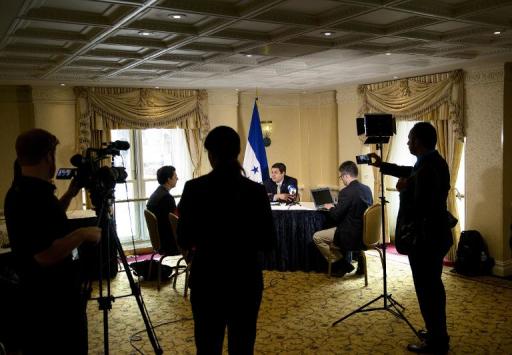
President of Honduras Juan Orlando Hernandez speaks to reporters on June 17, 2015 in Washington, DC

In part from AFP news: Hernandez has come to Washington to meet with the new secretary general of the Organization of American States, Luis Almagro, and with US Vice President Joe Biden to discuss the development plan.

President Barack Obama has asked Congress for one billion dollars for the initiative but Republicans in Congress have expressed reservations.

– Taking responsibility –

To overcome those misgivings Honduras will disclose details of the plan to leaders of the two chambers, Hernandez said.

A Central American region that is prosperous and peaceful “is a tremendous investment for the American people”, the president said.

“I would hope that the leaders in Washington would understand that,” he added.

Still, the American aid is only symbolic.

Passing the package, he said, would mean Washington acknowledges that a huge part of the problem is Americans’ appetite for drugs like cocaine that are produced in South America and smuggled through destitute nations like Honduras, El Salvador and Guatemala to reach the streets of the United States.

“In the end, it is not so much the money. It is the message that the United States takes responsibility for generating violence and migration as a result of drug trafficking in the region,” he said.

Obama and DHS Fully Compromised our Security

Getting into America just got easier….

Easier? Yes and while no one is talking about it but I got a tip from an insider. Did you hear the announcement by Jeh Johnson? This program already exists.

It might be a lot easier – and faster – for international travelers to fly into the United States soon.

The U.S. Department of Homeland Security said Friday it will seek approval to put pre-clearance centers at 10 airports in nine foreign countries.

If negotiations are successful, those centers will allow travelers to go through U.S. Customs and Border Protection clearance before they get on their airplane headed to the United States. Once landed, they would not have to be rescreened.

Here’s what Homeland Security Secretary Jeh Johnson said in the DHS announcement:

“A significant homeland security priority of mine is building more preclearance capacity at airports overseas. We have this now in 15 airports. I am pleased that we are seeking negotiations with 10 new airports in nine countries.

“I want to take every opportunity we have to push our homeland security out beyond our borders so that we are not defending the homeland from the one-yard line. Preclearance is a win-win for the traveling public. It provides aviation and homeland security, and it reduces wait times upon arrival at the busiest U.S. airports.”

The U.S. will enter talks with officials in Belgium, the Netherlands, Norway, Spain, Sweden, Turkey and the United Kingdom in Europe, as well as Japan and the Dominican Republic.

The 10 airports would be Brussels Airport, Belgium; Punta Cana Airport, Dominican Republic; Narita International Airport, Japan; Amsterdam Airport Schipol, Netherlands; Oslo Airport, Norway; Madrid-Barajas Airport, Spain; Stockholm Arlanda Airport, Sweden; Istanbul Ataturk Airport, Turkey; and London Heathrow Airport and Manchester Airport in the United Kingdom.

“These countries represent some of the busiest last points of departure to the United States – in 2014, nearly 20 million passengers traveled from these ten airports to the U.S.,” DHS said.

For travelers to Dallas/Fort Worth International Airport, the pre-clearance would be available on flights from London Heathrow (American Airlines and British Airways); Amsterdam (KLM Royal Dutch Airlines); Tokyo Narita (American); Madrid-Barajas (American); and Punta Cana (Sun Country Airlines).

Officials from trade group Airlines for American and from American and JetBlue Airways quickly praised the DHS effort.

“U.S. airlines drive $1.5 trillion in economic activity, and by improving the passenger experience for visitors or those returning to the United States, while improving security, we can build on that,” A4A President and chief executive Nick Calio said. “The addition of these pre-clearance airports will help increase safety and security while improving the passenger experience with shorter wait times and quicker connections on arrival in the U.S.”

“Expanding air preclearance is a tremendous step forward for improving the overall travel experience for our customers and welcoming more visitors to the United States,” AA chief operating officer Robert Isom said. “Preclearance eases the congestion at our U.S. gateway airports and ensures our customers get to their destinations faster.”

In addition to the three airports served by American from its D/FW hub, the pre-clearance centers would go to four other airports served by American out of other U.S. airports – Manchester, Amsterdam, Punta Cana and Brussels.

JetBlue passengers would benefit from the Punta Cana pre-clearance center.

“We believe that in addition to the need for an increase in CBP staffing at key U.S. gateway airports, more preclearance facilities like the ones being proposed around the globe are an important tool to enhance our nation’s security and reduce the number of travelers clearing Customs stateside — and that ultimately reduces wait times for travelers on all airlines,” JetBlue president and CEO Robin Hayes said.

United also thanked DHS for the proposal.

“We have worked closely with U.S. Customs and Border Protection and support developments that provide more convenience for our customers,” the carrier said in a statement. “We thank Secretary Johnson and his team at the Department of Homeland Security and CBP for their engagement with United and the airline industry, and we look forward to partnering with them on this initiative to facilitate travel and reduce wait times.”

U.S. Travel Association president Roger Dow issued this statement:

“When the experience for the international traveler improves, the U.S. economy improves, and again this administration deserves praise for pressing ahead with innovative policies that simultaneously bolster national security and streamline the customs entry process.

“Customs preclearance is a program that has proven itself effective, and extending it to these key travel markets will undoubtedly boost visitation. As a bonus, adding preclearance facilities will further relieve pressure on the customs entry process here on our shores, improving the system generally.

“Evolving policies such as these are a big reason why we surpassed a record 74 million international visitors to the U.S. last year, and are well on pace to reach 100 million visitors annually by 2021. With overseas visitors spending an average of $4,300 per person, per trip, that’s just good economic sense.”

Customs and Border Protection currently staffs 15 centers in six countries: Dublin and Shannon in Ireland; Aruba; Freeport and Nassau in the Bahamas; Bermuda; Calgary, Toronto, Edmonton, Halifax, Montreal, Ottawa, Vancouver and Winnipeg in Canada; and Abu Dhabi in the United Arab Emirates.

This is a ‘preclearance system’.  Please read the full description here.

In 2013, there was a Customs and Border Patrol hearing on this matter in the House of Representatives. Essentially, we cant control security within our borders now we are extending them globally and relying on foreign governments and security services? That did not work out at all in Benghazi. Here is the testimony and it is a must read.