Soviet/Russia, What Needs to be Defined

Glasnost and Perestroika

During an interview in 1989 Mikhail Gorbachev is quoted as saying “I detest lies” (1.). It was this yearning for the truth that lead him to introduce the policy of glasnost literally openness in English. The liberal press exploited this leeway and continuously challenged its boundaries. Glasnost. Hardliners tried to retain their grip on people’s minds by frequent attacks on the radicals in the conservative press. Prada the flagship Communist Party newspaper thundered “that extremists and nationalists were hiding their true face behind a mask of commitment to perestroika (2.).

Today, Russia is full of contradictions and this is precisely what Vladimir Putin demands.

There is very little change from the previous Soviet Union to Russia today. The former USSR suffered financially and brought down the Kremlin while the remake of Russia is full of starts and stops. World leaders know very well that Russia today operates with the old KGB model while straddling two governing standards, that of communism and that of controlled capitalism.

This is where the Russian mafia, collusion by oligarchs and the Kremlin as well as countries that are forced to interact with Russia get caught up in the web of thuggish and deadly scandals including Europe, the Baltics and the West.

Spending time with those pesky Wikileaks cables tells us some proven histories. In one cable from January 2010, Spanish prosecutor Jose “Pepe” Grinda Gonzales claimed that in Russia, Belarus and Chechnya “one cannot differentiate between the activities of the Government and OC (organised crime) groups”.

On the heels of the Soviet loyalists shooting a commercial aircraft out of the sky killing all on board over the Russian/Ukrainian borders, Putin still refuses to come clean with any explanation as evidence mounts his people under his orders are guilty. This leads to foreign state leaders seeking tangible consequences for this action against Russia and Putin. To date, many Russian oligarchs have fled the country due to selective prosecution and prison by the Kremlin and those that have remained in Russia are pressing the panic button for what sanctions are still to come as a result of the downed aircraft.

Countries are boxed in by having to do business with Russia for obvious reasons that included existing agreements like in the case of France already in the pipeline and most especially for oil and gas energy resources but most of all will Putin continue his threatening annexing of other Baltic States?

The British government set up a judicial inquiry Tuesday into the strange death eight years ago of former KGB officer and Russian dissident Alexander Litvinenko, who authorities believe was slipped a lethal dose of radioactive polonium in his tea at a London hotel, possibly at the behest of the Kremlin.

Litvinenko was not the only person in the old KGB who was publically blowing the whistle but he was the most aggressive. If anyone within the Kremlin, any businessman, any dissenter challenges Putin, the thug personality comes out and the result is prison or even deadlier.

Then there is the case of money laundering and how Putin controls the oligarchs, his loyalists and his adversaries. Yet, Putin himself is well known among elitist circles are being a money-launderer himself and all global leaders just look the other way. Very little is written about Putin’s own secret money-laundering schemes for obvious reasons. So one only need to investigate SPAG. There is even a documentary on how Putin was up to his chin in money laundering where the road to Germany began in Columbia.


‘PUTIN, it turns out, may be a less than perfect pitchman for his anticorruption campaign. New revelations are focusing attention on a murky episode from his past in St. Petersburg, a city known to many Russians as the country’s “criminal capital.” The indictment of a onetime business associate in Western Europe on charges of money laundering and fraud is raising serious questions about Putin’s former role in the affairs of a mysterious Russo-German property-development firm. The company, called the St. Petersburg Real Estate Holding Company (known by its German acronym, SPAG), has not been charged and denies any wrongdoing, but U.S. and European intelligence officials suspect it is linked to the laundering operations of Russian mobsters and Colombian drug dealers. Until he was inaugurated as president, Putin was on SPAG’s advisory board and, according to U.S. and European intelligence officials as well as a SPAG director, he spent more time on its affairs than the Kremlin will now admit. Since then Putin has also maintained a close relationship with the onetime head of SPAG’s Russian operations, Vladimir Smirnov.’

In summary, the Russian mafia, the thug network is world-wide by design and even includes our Southern border and it even goes into Chicago, at least.

More than 200 years ago, the renowned Russian historian Nikolai Karamzin summed up the situation in his country in two words: “They steal.”

They still do, and the news in Russia lately has been dominated by one high-profile corruption scandal after another. Allegations of wrongdoing have reached high into the defense and agriculture ministries and the Russian space program, among other institutions. Nearly nine in 10 Russians say corruption is the nation’s biggest problem.

All the theft, corruption, lies ad fraud has a leader that approves, Vladimir Putin. Glasnost and Perestroika be damned.


Illegal Alien Process, Background and Military Component

I have read countless documents, court rulings, studies and interviews as the matter of the incursion at the Southern border has many moving parts. I will make this easy for the reader.

CRS Insights Unaccompanied Alien Children: A Processing Flow Chart

Lisa Seghetti, Section Research Manager (lseghetti@crs.loc.gov, 7-4669)

July 16, 2014 (IN10107)

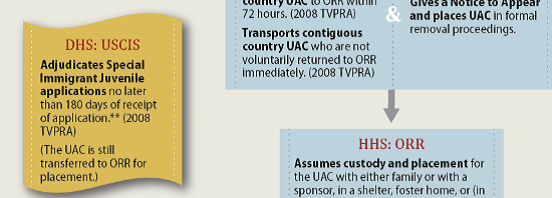
Within the Departments of Homeland Security and Health and Human Services, several agencies are involved in apprehending, processing, placing, and repatriating unaccompanied alien children (UAC). Customs and Border Protection (CBP) apprehends, processes, and detains the majority of UAC arrested along U.S. borders. Immigration and Customs Enforcement (ICE) physically transports UAC from CBP to the Department of Health and Human Services Office of Refugee Resettlement (ORR) custody. ORR is responsible for detaining and sheltering UAC who are from non-contiguous countries and those from contiguous countries (i.e., Canada and Mexico) for whom there is a concern that they may be victims of trafficking or have an asylum claim, or who do not desire to return to their country voluntarily, while they wait for their claim to be processed or for an immigration hearing. U.S. Citizenship and Immigration Services (USCIS) is responsible for the initial adjudication of asylum applications and processes trafficking petitions filed by UAC. The Executive Office for Immigration Review (i.e., immigration courts) in the U.S. Department of Justice conducts the immigration proceedings that determine whether the UAC is allowed to remain in the United States or is deported to his or her home country. If a UAC is ordered removed or chooses to voluntarily depart from the United States, ICE is responsible for returning the alien to his/her home country. For an overview on this topic, see CRS Report R43599, Unaccompanied Alien Children: An Overview.

Figure 1.Unaccompanied Alien Children

A Processing Flow Chart  Full graphic can be seen here.

ICE flow chart

But as Governor Perry deploys 1000 National Guard on parts of the Texas border, what does that mean and what will/can they do?

The Secretary of the Department of Homeland Security (DHS) is charged with preventing the entry of terrorists, securing the borders, and carrying out immigration enforcement functions. U.S. Customs and Border Protection (CBP), a component of DHS, has primary responsibility for securing the borders of the United States, preventing terrorists and their weapons from entering the United States, and enforcing hundreds of U.S. trade and immigration laws. Within CBP, the U.S. Border Patrol’s mission is to detect and prevent the illegal entry of aliens across the nearly 7,000 miles of Mexican and Canadian international borders and 2,000 miles of coastal borders surrounding Florida and Puerto Rico.

Although the military does not have primary responsibility to secure the borders, the Armed Forces generally provide support to law enforcement and immigration authorities along the southern border. Reported escalations in criminal activity and illegal immigration, however, have prompted some lawmakers to reevaluate the extent and type of military support that occurs in the border region. On May 25, 2010, President Obama announced that up to 1,200 National Guard troops would be sent to the border to support the Border Patrol. Addressing domestic laws and activities with the military, however, might run afoul of the Posse Comitatus Act (PCA), which prohibits use of the Armed Forces to perform the tasks of civilian law enforcement unless explicitly authorized. There are alternative legal authorities for deploying the National Guard, and the precise scope of permitted activities and funds may vary with the authority exercised.

 Justice Scalia wrote the opinion in the case of Flores v. Reno the basis for where we are today with processing, shelters, detention and deportation.

The Flores-Reno settlement agreement, Homeland Security Act of 2002, and the Trafficking Victims Protection Reauthorization Act (TVPRA) are the guiding principles when dealing with UACs.

 The number of UACs in the Rio Grande Valley/Harlingen Field Office geographical area has seen an increase of 367.6 percent since fiscal year 2011.

 Most UACs are Other Than Mexican (OTM) nationals, which causes significant increases in processing time (administrative/criminal casework) and requirements for long term detention.

 The amount of time and resources needed to provide humanitarian care is extensive and increases with escalating UAC numbers.

 ORR tries to place apprehended UACs as close to the referring location as possible to minimize travel requirements for CBP and ICE.

 The HHS ORR Intake Center operates 24-7 but makes UAC referral placements from 9 a.m. – 9 p.m. each day.

 Each morning the HHS ORR Intake Center has approximately 30-90 initial placement referral requests pending from the previous night.

 The national discharge rate of UACs is approximately 80-90 per day.

 There are approximately 5,000 beds available in the HHS ORR network that service approximately 25,000 UACs annually.

 Each agency uses different data systems to manage UACs.


Ukraine Then and Now and How

Sadly, the world witnessed a tragedy when almost 300 people perished at the border of Ukraine and Russia. Almost immediately there was looting by murders, thugs, arms smugglers, well just the exact model of terrorists.

The media continues to call these people in the Donetsk region of Ukraine ‘pro-Russian separatists. They are exactly not that. They are ‘Soviet Loyalists’, the old Soviet Union Tzarists that use precisely the same tactics commonly applied by KGB operatives. What is worse, not only has Putin assigned these people to Eastern Ukraine, but most were chosen for these specific tactics.

Ukraine territory going back to the 1700’s lived under two rules and struggles for control by both the Russian and Poles/Austrians. After the second World War, Eastern Ukraine slowly and fully assumed Soviet culture.

One the KGB faded with the break-up of the Soviet Union, the FSB was created along with GRU, the intelligence wing of the Kremlin and the Spetsnaz, hostile special forces were expanded. It is also noted that most of Eastern Europe and the Baltic States are all ruled by Communist parties. Authoritarian politics still exists. There are 29 post Communist countries but the remnants within rule has not eroded including religion, educationally,  civil liberties and even economically. These conditions leave major opportunities for fraud, corruption, conflicts of interest and activism.


Now it is also important to understand the history of the Eastern Ukraine region and why it is so easy for Putin to annex the area into his control.

  • The Donetsk was founded by a Welsh businessman who built a coal industry and a large steel business forming an industrial center.
  • During the Soviet days, Donetsk was actually named Stalin/Stalino, at one point the city was even named Trotsk, after Leon Trotsky.
  • There are 430 streets in the Donetsk and Luhansk named for Vladimir Lenin.
  • In the 1920-30’s Donetsk Oblast advanced and constructed a city wide water and sewage system and began exploring gas as an energy resource.
  • In 1939, Soviet annexation took place under a secret clause of the Molotov-Ribbentrop Pact which included the Ukrainian Soviet Socialist Republic.
  • The Nazi invasion for the most part destroyed the city and it was this time that an estimated 3000 Jews died and 100,000 people were killed in concentration camps.
  • Nikita Khrushchev later renamed the city Donetsk due to the Donets river.
  • Sometime later gangs took over the region and assumed control of industry and it was then that living conditions became so bad for residents that revolutions took place most recently the Rose Revolution in 2004 then the Orange Revolution in 2004.
  • At one point in 1994, Ukraine was the third largest nuclear power, which it inherited from the Soviet Union on a pledge not to use military force as an independent nation. Ukraine signed the Budapest Memorandum on security assurances that included signatories of U.S., Russia and the U.K..
  • The Budapest Memorandum was actually a mutual agreement where Ukraine would be protected by the West against an invasion by Russia. This document is binding by International law.
  • Nuclear weapons were also held in Belarus and Kazakhstan. These were removed by Russia in 1992.
  • The United States paid the largest part of the expense in removing the weapons from the region, delivering them to Russia, this included ICBM’s, silos, strategic bombers.
  • During these revolutions, philanthropist George Soros funded NGO’s training participants in the fueling of the revolutions and was quickly targeted by Ukraine and Russian leadership and it was at this time the anti-American attitudes were re-born.
  • Soros tried once again to do the same in 2010 using the Arab Spring as a newer model and for the most part failed.
  • There are over 100 ethnic groups in the Donetsk region, yet Russian is the common language.
  • In the Donetsk Oblast, the highest proportion of people claimed allegiance to Soviet Identity.
  • The Party of Regions (Soviet culture) was established in 2001 which has deep historical ties to Communist Party of Ukraine (KPU).
  • For some order and restoration, Ukraine in 2004 declared her intention of seeking NATO membership and the United States took advantage to build a relationship with Ukraine especially during the Iraq war making use of resources.
  • It was this time that once again Ukraine as a total become a larger divided house between pro-Western supporters versus that of the Eastern side of Ukraine that remained anti-West.

Russia today seeing the past weaknesses of Ukraine and the faithful loyalty of the Eastern region to the old Soviet model, it was with east that Putin was able to install his propaganda, military and fighters to begin his expansion of Soviet territory beyond his successful annexation of Crimea.


Ukraine has been a divided country that has been desperate in objectives attempting to satisfy ethnic groups for peaceful, economic, political and security standards. When this country or any country is experiencing split cultures, histories, religions, industries, separations, fraudulent political strife it is ripe for the take-over as witnessed in Crimea and Eastern Ukraine.

The Russian oligarchs have long invested in the energy resources in Ukraine and have bought influence there for the sake of lasting loyalty. For Putin to install his hostilities and proxy armies into Eastern Ukraine was an easy feat due mostly to attitudes, culture and historical ethnicity. These are Putin’s old school tactics he was once personally a part of and he and his ilk from the old Soviet Union have employed all the familiar characteristics where making it new again with aggressions such as employing Spetsnaz teams in Eastern Ukraine to shoot down commercial airlines.

Question is now, who will forcefully challenge Putin with on his next quest, there is no more global leadership and certainly none coming from the United States where the legacy of America has always been to provide some offensive measures to keep stability, equilibrium and a less messy world.

For further reading on the subject:

http://www.brookings.edu/research/papers/2011/05/trilateral-process-pifer

http://www.academia.edu/2041738/Post-Soviet_Authoritarianism_The_Influence_of_Russia_in_its_Near_Abroad_


The Personal Lives of ISIS leadership

While the United States is deep with scandalapalooza especially at the southern border, there are other foreign policy conditions and wars being waged. Yes, we must remember Sudan, Nigeria, Syria, Afghanistan and Iraq.

We have come to know little about ISIS except that al Baghdadi is running a caliphate in Iraq unimpeded.

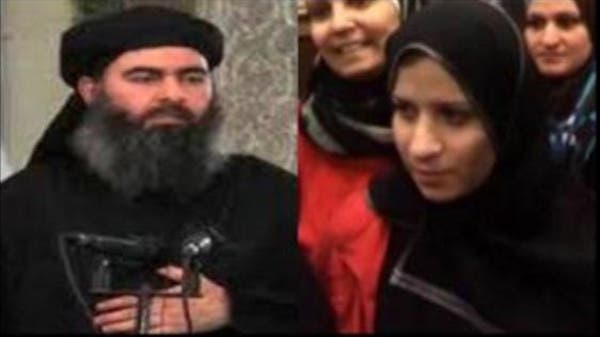
al Baghdadi and his family have a long history that included al Nusra and al Qaeda. So now we find out who al Baghdadi is married to and we know what she looks like.

Photos surface of ISIS leader Baghdadi’s wife

By Staff writer | Al Arabiya News
Thursday, 17 July 2014

Photos of the wife of Abu Bakr al-Baghdadi, the leader of the Islamic State of Iraq and Syria, have surfaced online, offering a glimpse into the private life of the so-called ‘caliph.’

Knowledge of Saja Hamid al-Dulaimi came to the fore shortly after the release in March of a group of nuns who were kidnapped months earlier in the historic Syrian town of Maaloulah.

An online video at the time of the release showed the nuns being transported by masked gunmen waving the banner of the Nusra Front, an al-Qaeda affiliate. Activists said the nuns were freed in exchange for the release of women prisoners held by President Bashar al-Assad’s government.


According to media reports, Dulaimi’s identity was first revealed by Abu Maan al-Suri, a Nusra Front member who said Baghdadi’s wife had been among the detained female prisoners who were released.

Dulaimi, according to al-Suri, had been detained alongside her two sons and smaller brother.

Details about her early life are sketchy.

Dulaimi’s first husband was an Iraqi named Fallah Ismail Jassem, a leading member of the Rashideen Army who was gunned down by the Iraqi army in the province of Anbar in 2010, according to media reports.

There are also unconfirmed reports that suggest Saja al-Dulaimi may have worked as a hair dresser. Others say she may have worked as a seamstress in Anbar province and Al-Amryiah in Baghdad.

Dulaimi’s family allegedly all adhere to the ideology of ISIS, including her father Ibrahim Dulaimi, a so-called ISIS “emir” in Syria who was reportedly killed in September 2013 during an operation against the Syrian army in Deir Attiyeh.

Her sister, Duaa, was allegedly behind a suicide attack that targeted a Kurdish gathering in Arbil, according to some reports.

Then there is the real cabinet assignments of ISIS.

By Staff writer | Al Arabiya News
Friday, 11 July 2014

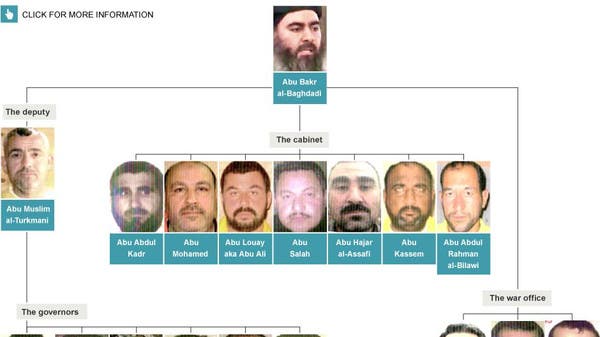
Abu Bakr al-Baghdadi, the self-proclaimed leader of the Islamic State of Iraq and Syria (ISIS), has reportedly formed a cabinet to be in charge of his newly established “caliphate.”

Documents published by The Telegraph newspaper this week revealed for the first time in details the structure of the group, which has claimed universal authority throughout the Muslim world, declaring Baghdadi its caliph.

The British newspaper published an infograph that explains the leadership arrangement under Baghdadi, based on documents seized from an ISIS member’s house following a raid by the Iraqi army.


According to the illustration, Baghdadi appointed a “deputy to the emir. ” Fadel Abdullah al-Hiyali, nicknamed Abu Muslim al-Turkmani, serves as Baghdadi’s deputy and is in charge of overseeing Iraqi provinces under ISIS.

The spearhead also formed a “war office” to oversee warehouses and “martyrs.”

One of this department’s members is “in charge of operations using improvised explosive devices (IEDs) and rigging bombs,” the newspaper reported.

The ISIS chief has also selected a group of ministers for an array of tasks.

One minister was put in charge of prisoners and detainees, while another is responsible for managing the financial issues of Iraqi provinces under ISIS.

Cabinet member Abdullah Ahmed al-Meshedani, also called Abu Kassem, is tasked with managing “the arrival of foreign and Arab jihadists” and is in charge of “overseeing the running of guesthouses for them.”

“He is also reportedly a ‘transporter of suicide bombers’,” The Telegraph said.

Six ISIS members were also reportedly tasked with overseeing the Iraqi provinces of Baghdad, Anbar, Salaheddin, Kirkuk, and provinces along the state’s borders.

Baghdadi sent out a public message earlier this month after ISIS proclaimed a “caliphate” on the territory it has captured.

ISIS militants and their allies among Iraq’s Sunni Muslim minority have seized large swathes of Iraq over the past weeks in a battle with forces loyal to Prime Minister Nouri al-Maliki.

The so called “Caliphate” aims to connect Muslim countries separated by modern-day borders.

Cease Fire Agreement, Not so Much

Since the start of Operation Protective Edge, over 1,081 rockets have been fired towards Israel. Of them 845 hit Israel and 191 have been intercepted by the Iron Dome missile defense system. The IDF has targeted over 1,576 terror targets, with both naval and aerial capabilities.

Barack Obama praises this agreement, yet it has no teeth and is one-sided. Remember there was a cease fire agreement on November of 2012.

Egypt proposes cease-fire between Israel, Hamas

JERUSALEM — Egypt presented a cease-fire plan Monday to end a week of heavy fighting between Israel and Hamas militants in the Gaza Strip that has left at least 185 people dead, and both sides said they were seriously considering the proposal.

The late-night offer by Egypt marked the first sign of a breakthrough in international efforts to end the conflict.

Hamas’ top leader in Gaza confirmed there was “diplomatic movement,” while Israel’s policy-making Security Cabinet was set to discuss the proposal early Tuesday. Arab foreign ministers discussed the plan Monday night at an emergency meeting in Cairo, and U.S. Secretary of State John Kerry was expected in the region Tuesday.

Egypt’s Foreign Ministry announced the three-step plan starting at 9 a.m. (0600 GMT, 2 a.m. EDT) with a cease-fire to go into effect within 12 hours of “unconditional acceptance” by the two sides. That would be followed by the opening of Gaza’s border crossings and talks in Cairo between the sides within two days, according to the statement.

Gaza’s crossings should be opened for people and goods “once the security situation becomes stable,” according to a copy of the proposal obtained by The Associated Press.

Israel launched the offensive July 8, saying it was a response to weeks of heavy rocket fire out of Hamas-ruled Gaza. The Health Ministry in Gaza said 185 people, including dozens of civilians, have been killed, and more than 1,000 people wounded.

There have been no Israelis killed, although several have been wounded by rocket shrapnel, including two sisters, ages 11 and 13, who were seriously hurt Monday. Ahead of the Egyptian announcement, there appeared to be no slowdown in the fighting, with Hamas for the first time launching an unmanned drone into Israeli airspace that was shot down.

The violence followed the kidnappings and killings of three Israeli teenagers in the West Bank last month, as well as the subsequent kidnapping and killing of a Palestinian teenager in an apparent revenge attack, along with Israeli raids against Hamas militants and infrastructure in the West Bank.

Israeli officials have said the goal of the military campaign is to restore quiet to Israel’s south, which has absorbed hundreds of rocket strikes, and that any cease-fire would have to include guarantees of an extended period of calm.

Hamas officials say they will not accept “calm for calm.” The group is demanding an easing of an Israeli-Egyptian blockade that has ground Gaza’s economy to a standstill and that Israel release dozens of prisoners who were arrested in a recent West Bank crackdown following the abductions of the Israeli youths.

With the death toll mounting, both sides have come under increasing international pressure to halt the fighting.

Egypt Foreign Minister Sameh Shukri said there is “no alternative but return to the truce” of November 2012, and added that Egypt contacted all the parties, including the Palestinian leadership, different Palestinian factions, and Israeli authorities in addition to Arab and international parties. Such contacts led to shaping up the proposal which called for cease-fire.

“Egypt stresses the international responsibility toward what is happening in Palestine,” he said.

In a speech broadcast on Al-Jazeera, Ismail Haniyeh, a Hamas leader in Gaza, confirmed there was “diplomatic movement.”

“The problem is not going back to the agreement on calm because we want this aggression to stop,” he said. “The siege must stop and Gaza people need to live in dignity.”

An Israeli official said Prime Minister Benjamin Netanyahu would convene his Security Cabinet on Tuesday morning to discuss the proposal. He spoke on condition of anonymity because he was not authorized to talk to the media.

Naftali Bennett, a member of the Security Cabinet, said he would oppose the proposal, calling it “good for Hamas and bad for Israel.”

“A cease-fire at the present time shows the government’s weakness,” he said in a statement. “A cease-fire now will create a bigger campaign against the south of the country and more rocket attacks in another year.”

Egypt, the first Arab state to reach peace with Israel, often serves as a mediator between Israel and Hamas.

In the 2012 fighting, Egypt’s then-President Mohammed Morsi brokered a cease-fire, leveraging the influence his Muslim Brotherhood held with Hamas, its ally.

That deal included pledges to ease the blockade — promises that Hamas says were never kept. The blockade has greatly restricted movement through Gaza’s Rafah crossing with Egypt — the territory’s main gateway to the outside world — while Israel has restricted the flow of many goods, particularly much-needed construction materials, into Gaza. Israel says Hamas can use things like metal and concrete for military purposes.

Hamas has seen its position further weakened by last year’s military coup in Egypt that ousted Morsi. Egypt’s new leaders have cracked down on Hamas by nearly shuttering a network of smuggling tunnels along the border that were Hamas’ key economic lifeline — and supply route for its weapons.

Hamas seized control of Gaza in 2007 from the rival forces of Palestinian President Mahmoud Abbas. With the economy stagnant and Hamas unable to pay the salaries of its thousands of civil servants, the group recently agreed to back a unity government under Abbas’ leadership. But Hamas remains in firm control of Gaza.

Israel and Hamas, which is considered a terrorist group by the West, have battled many times. In the latest round, Israel carried out more than 1,300 airstrikes, along with attacks by naval gunships and artillery forces. Hamas fired hundreds of rockets into Israel.

Israeli military officials say the airstrikes knocked out roughly a third of Hamas’ rocket supply and delivered a blow to the group. It says that roughly 90 of the dead were wanted militants, and it has accused Hamas of using civilians as human shields.

A Hamas drone launched Monday into Israel marked the Islamic militant group’s latest effort to catch the Israeli military off-guard. But like the others, it had little impact on the battlefield.

Israel shot down the drone — named Ababil for a protective flock of birds mentioned in the Quran. Still, the drone represented a new level of sophistication for Hamas, and Israel said it was taking the threat seriously.

It was the first time Hamas has launched a drone into Israel, though military officials say they knew the group has had the technology for some time. Israeli airstrikes in the past have targeted what were believed to be drone facilities in Gaza.

“Hamas is trying everything it can to produce some kind of achievement, and it is crucial that we maintain our high state of readiness,” Israeli Defense Minister Moshe Yaalon said. “The shooting down of a drone this morning by our air defense system is an example of their efforts to strike at us in any way possible.”

The hundreds of rockets fired by Hamas disrupted life across Israel. But a new Israeli rocket-defense system has intercepted dozens of projectiles headed toward major cities.

Looking to gain an edge, Hamas has employed tactics not seen before. It has fired rockets deeper than ever into Israel, including weapons it has developed and manufactured in Gaza. Last week, Hamas sent a team of scuba divers on an infiltration mission, but Israel quickly detected the frogmen and killed them outside an army base.

Isaac Ben-Israel, a retired Israeli air force general and a former head of the Israeli space agency, said the Hamas drone was similar to aircraft sent by Hezbollah guerrillas in Lebanon during a 2006 war.

He said the drone’s capabilities were limited. But “looking to the future, these technologies are becoming more and more available,” he told Channel 10 TV.

Associated Press writers Karin Laub in Gaza City, Gaza Strip, Yousur Alhlour and Ian Deitch in Jerusalem, and Ibrahim Barzak in Amman, Jordan, contributed to this report.

Text:  Courtesy of Jerusalem Post

Agreement of Understanding For a Ceasefire in the Gaza Strip

1: (no title given for this section)

A. Israel should stop all hostilities in the Gaza Strip land, sea and air including incursions and targeting of individuals.

B. All Palestinian factions shall stop all hostilities from the Gaza Strip against Israel including rocket attacks and all attacks along the border.

C. Opening the crossings and facilitating the movements of people and transfer of goods and refraining from restricting residents’ free movements and targeting residents in border areas and procedures of implementation shall be dealt with after 24 hours from the start of the ceasefire.

D. Other matters as may be requested shall be addressed.

2: Implementation mechanisms:

A. Setting up the zero hour for the ceasefire understanding to enter into effect.

B. Egypt shall receive assurances from each party that the party commits to what was agreed upon.

C. Each party shall commit itself not to perform any acts that would breach this understanding. In case of any observations Egypt as the sponsor of this understanding shall be informed to follow up.