An affordable price is probably the major benefit persuading people to buy drugs at www.americanbestpills.com. The cost of medications in Canadian drugstores is considerably lower than anywhere else simply because the medications here are oriented on international customers. In many cases, you will be able to cut your costs to a great extent and probably even save up a big fortune on your prescription drugs. What's more, pharmacies of Canada offer free-of-charge shipping, which is a convenient addition to all other benefits on offer. Cheap price is especially appealing to those users who are tight on a budget
Service Quality and Reputation Although some believe that buying online is buying a pig in the poke, it is not. Canadian online pharmacies are excellent sources of information and are open for discussions. There one can read tons of users' feedback, where they share their experience of using a particular pharmacy, say what they like or do not like about the drugs and/or service. Reputable online pharmacy canadianrxon.com take this feedback into consideration and rely on it as a kind of expert advice, which helps them constantly improve they service and ensure that their clients buy safe and effective drugs. Last, but not least is their striving to attract professional doctors. As a result, users can directly contact a qualified doctor and ask whatever questions they have about a particular drug. Most likely, a doctor will ask several questions about the condition, for which the drug is going to be used. Based on this information, he or she will advise to use or not to use this medication.

If You Don’t Think the FBI is Busy, N Korea Investigation

Frankly, $11 million is not much considering what North Korea and the Kim regime are doing in the illicit activity realm.
Meanwhile Kim issued yet another threat to President Trump:

FNC: President Trump is pictured looking out over a Guam graveyard cluttered with crosses in a photoshopped image from the newest propaganda film — and grim warning — from North Korea.

The regime followed the video with a statement posted through its KCNA news agency, saying Trump “spouted rubbish” and frequently tweeted about “weird articles of his ego-driven thoughts” and attacking South Korea’s “puppy-like” Defense Minister Song Young-moo for “pinning hope on that mad guy.”

But the picture of a graveyard believed to be in Guam may be the most rattling in the video, given dictator Kim Jong Un’s repeated threats to strike the U.S. territory with a missile. The video also features Vice President Pence engulfed in flames. More here.

FOR IMMEDIATE RELEASE
Tuesday, August 22, 2017

United States Files Complaints to Forfeit More Than $11 Million From Companies That Allegely Laundered Funds To Benefit Sanctioned North Korean Entities

            WASHINGTON – The United States filed two complaints today seeking imposition of a civil money laundering penalty and to civilly forfeit more than $11 million from companies that allegedly acted as financial facilitators for North Korea, announced U.S. Attorney Channing D. Phillips, Michael DeLeon, Special Agent in Charge of the FBI’s Phoenix Field Office, and Michael J. Anderson, Special Agent in Charge of the FBI’s Chicago Field Office.


The actions, filed in the U.S. District Court for the District of Columbia, represent two of the largest seizures of North Korean funds by the Department of Justice. One complaint seeks $6,999,925 associated with Velmur Management Pte Ltd., a Singapore-based company. The other seeks $4,083,935 from Dandong Chengtai Trading Co. Ltd., also known as Dandong Zhicheng Metallic Material Co., Ltd., a company in Dandong, China.


The lawsuits follow a similar complaint, filed in June 2017, seeking more than $1.9 million from Mingzheng International Trading Limited, a company based in Shenyang, China.


The complaints allege that the companies have participated in schemes to launder U.S. dollars on behalf of sanctioned North Korean entities. According to the complaints, the companies participated in financial transactions in violation of the International Emergency Economic Powers Act (IEEPA), the North Korean Sanctions and Policy Enhancement Act of 2016, and federal conspiracy and money laundering statutes. Today’s complaints are the first filed actions based on the 2016 North Korean Sanctions and Policy Enhancement Act.


“These complaints show our determination to stop North Korean sanctioned banks and their foreign financial facilitators from aiding North Korea in illegally accessing the United States financial system to obtain goods and services in the global market place,” said U.S. Attorney Phillips. “According to the complaints, these front companies are supporting sanctioned North Korean entities, including North Korean military and North Korean weapons programs. Working with our law enforcement partners, we will vigorously enforce vital sanctions laws.”


“The complaints allege that these companies are assisting North Korea in evading sanctions, which is in direct conflict with our national security interests,” said Special Agent in Charge DeLeon, of the FBI’s Phoenix Field Division. “We will continue to use the necessary resources to expose these types of actions and investigate those who utilize the U.S. banking systems for illegal activities.”


**


U.S. v. Velmur Management Pte., Ltd. (Velmur) and Transatlantic Partners Pte. Ltd. (Transatlantic)


This complaint alleges that Velmur and Transatlantic Partners Pte. Ltd. (Transatlantic) laundered United States dollars on behalf of sanctioned North Korean banks that were seeking to procure petroleum products from JSC Independent Petroleum Company (IPC), a designated entity. The complaint also seeks a civil monetary penalty against Velmur and Transatlantic for prior sanctions and money laundering violations related to this scheme.


According to the complaint, designated North Korean banks use front companies, including Transatlantic, to make U.S. dollar payments to Velmur. The complaint relates to funds that were transferred through four different companies and remitted to Velmur to wire funds to JSC Independent Petroleum Company (IPC), a Russian petroleum products supplier. On June 1, 2017, the Department of the Treasury’s Office of Foreign Asset Controls (OFAC) designated IPC. The designation noted that IPC had a contract to provide oil to North Korea and reportedly shipped over $1 million worth of petroleum products to North Korea.


The United Nations Panel of Experts reported in 2017 on the methods used by North Korean banks to evade sanctions and continue to access the international banking system. Specifically, despite strengthened financial sanctions, North Korean networks are adapting by using greater ingenuity in accessing formal banking channels. This includes maintaining correspondent bank accounts and representative offices abroad which are staffed by foreign nationals making use of front companies. These broad interwoven networks allow the North Korean banks to conduct illicit procurement and banking activity.


An FBI investigation revealed that Velmur’s and Transatlantic’s activities mirror this money laundering paradigm. Specifically, companies identified in the complaint and Transatlantic act as front companies for designated North Korean banks.


The government is seeking to forfeit $6,999,925 that was wired to Velmur in May 2017. The U.S. dollar payments, which cleared through the U.S., are alleged to violate U.S. law, because the entities were surreptitiously making them on behalf of the designated North Korean Banks, whose designation precluded such U.S. dollar transactions. The government also is seeking imposition of a monetary penalty commensurate with the millions of dollars allegedly laundered by Velmur and Transatlantic.


**


U.S. v. Dandong Chengtai Trading Co., Ltd. (Dandong Chengtai), also known as Dandong Zhicheng Metallic Material Co., Ltd.


This complaint alleges that Dandong Chengtai and associated front companies controlled by Chi Yupeng, a Chinese national, comprise one of the largest financial facilitators for North Korea. According to the complaint, Dandong Chengtai conspired to evade U.S. economic sanctions by facilitating prohibited U.S. dollar transactions through the United States on behalf of the North Korean Workers’ Party, a sanctioned entity.


The complaint further alleges that the North Korean government relies on exports of coal as its primary means of obtaining access to foreign currency, and that the North Korean military controls the amount of coal produced and its subsequent export. The North Korean government uses proceeds of coal sales to fund its weapons of mass destruction program and missile programs. Coal generates more than $1 billion in revenue per year for North Korea. The investigation revealed that Dandong Chengtai is one of the largest importers of North Korean coal in China, and has continued to engage in illicit U.S. dollar transactions related to its coal sales to benefit North Korea.


The complaint alleges that Dandong Chengtai facilitated wire transfers denominated in U.S. dollars for purchases of goods that are well outside the scope of a mineral trading company. Financial records reveal that purchases of bulk commodities such as sugar, rubber, petroleum products, and soybean oil, among others, were in fact destined for North Korea.


As reported in findings by the Treasury Department and the United Nations Panel of Experts, North Korean financial facilitators frequently establish and maintain offshore U.S. dollar accounts for the purposes of remitting wire transfers denominated in U.S. dollars on behalf of sanctioned North Korean entities. These broad interwoven networks allow sanctioned North Korean entities to conduct illicit procurement and banking activity.


The government is seeking to forfeit $4,083,935 that Dandong Chengtai wired on June 21, 2017 to Maison Trading, using their Chinese bank accounts. The investigation revealed that Maison Trading is a front company operated by a Dandong Chengtai employee. These U.S. dollar payments, which cleared through the United States, are alleged to violate U.S. law, because the recent North Korean sanctions law specifically barred U.S. dollar transactions involving North Korean coal and the proceeds of these transactions were for the benefit of the North Korea Worker’s Party, whose designation precluded such U.S. dollar transactions.


This case relates to a previously unsealed opinion from Chief Judge Beryl A. Howell of the U.S. District Court for the District of Columbia, which found that probable cause existed to seize funds belonging to Dandong Chengtai.


**


The claims made in the complaints are only allegations and do not constitute a determination of liability.


The FBI’s Phoenix Field Office is investigating the case involving Velmur Management Pte Ltd. and Transatlantic Partners Pte., Ltd. The FBI’s Chicago Field Office is investigating the case involving Dandong Chengtai Trading Co. Ltd. Both investigations are being supported by the FBI Counterproliferation Center.


            Assistant U.S Attorneys Arvind K. Lal, Zia M. Faruqui, Christopher B. Brown, Deborah Curtis, Ari Redbord, and Brian P. Hudak, all of the U.S. Attorney’s Office for the District of Columbia, are prosecuting both cases. Paralegal Specialist Toni Anne Donato and Legal Assistant Jessica McCormick are providing assistance.

More Details for The Pro-Russia, Pro Assange Crowd

Is Sean Hannity getting something wrong here with his support of Congressman Rohrabacher and Julian Assange? If Assange is on the right side of the debate, why has he been held up in the protection of the Ecuador Embassy in Britain? Assange is working diligently to get out of his isolation and wants a seat at the White House press pool….yet he is also a financial crook too.

The FBI warned Rep. Dana Rohrabacher, R-Calif., in 2012 that Russian spies were attempting to recruit him as an “agent of influence,” according to a new report.

Rohrabacher was made aware of Moscow’s attempts during a meeting with an FBI agent in a secure room at the Capitol. Rohrabacher was made aware of Moscow’s attempts during a meeting with an FBI agent in a secure room at the Capitol.

Law enforcement did not believe Rohrabacher was working with or paid by the Russians, but feared he was targeted, a former U.S. official told the New York Times.

The California Republican said the meeting with the agent focused on contact he had with a person of the Russian Foreign Ministry. “They were telling me he had something to do with some kind of Russian intelligence,” Rohrabacher said.

The GOP lawmaker said the FBI agent warned him that Russia “looked at me as someone who could be influenced.”

Reps. Mike Rogers, R-Mich., and C.A. Dutch Ruppersberger, D-Md., who both served on the House Intelligence Committee, were also at the meeting.

Rohrabacher has been a staunch defender of Russia for years, and House Majority Leader Kevin McCarthy, R-Calif., joked last year about Rohrabacher’s closeness to Moscow in a recording leaked to the Washington Post this week.

“There’s two people I think Putin pays: Rohrabacher and Trump,” McCarthy said. The majority leader said Wednesday he was making a joke.

The FBI is currently investigating ties between President Trump’s associates and Russia. Reporters have also documented previously undisclosed meetings between those with ties to Trump and Russians.

Rohrabacher, though, has defended Trump and tried to lessen the possibility that Russia meddled in the 2016 election.

“Did they try to influence our election? We have tried to influence their elections and everybody’s elections,” Rohrabacher told the Los Angeles Times in March. “The American people are being fed information that would lead them to believe that we need to be in a warlike stance when it comes to Russia.”

( a long but important read) Now for Mike Pompeo at CIA regarding Julian Assange and Wikileaks:

Director Pompeo Delivers Remarks at CSIS

Remarks as Prepared for Delivery by Central Intelligence Agency Director Mike Pompeo at the Center for Strategic and International Studies

April 13, 2017/ CIA


Good afternoon, it is a great pleasure to be here at the Center for Strategic and International Studies, home to some of the sharpest minds that Washington has to offer. I am honored to deliver my first public remarks as CIA Director at such a distinguished institution.

Let me start today by telling you a story.

He was a bright, well-educated young man. He was described as industrious, intelligent, and likeable, if inclined toward impulsiveness and impatience.

At some point, he became disillusioned with intelligence work and angry at his government. He left government and decided to devote himself to what he regarded as public advocacy—exposing the intelligence officers and operations he had sworn to keep secret.

He appealed to Agency employees to send him “leads, tips, suggestions.” He wrote in a widely circulated bulletin: “We are particularly anxious to receive, anonymously if you desire, copies of US diplomatic lists and US Embassy staff.”

That man was Philip Agee, one of the founding members of the magazine Counterspy, which in its first issue in 1973 called for the exposure of CIA undercover operatives overseas. In its September 1974 issue, Counterspy publicly identified Richard Welch as the CIA Chief of Station in Athens. Later, Richard’s home address and phone number were outed in the press in Greece.

In December 1975, Richard and his wife were returning home from a Christmas party in Athens. When he got out of his car to open the gate in front of his house, Richard Welch was assassinated by a Greek terrorist cell. At the time of his death, Richard was the highest-ranking CIA officer killed in the line of duty.

Richard led a rich and honorable life, one that is celebrated with a star on the Agency’s Memorial Wall. He is buried at Arlington National Cemetery and remains dearly remembered by his family and colleagues.

Meanwhile, Agee propped up his dwindling celebrity with an occasional stunt, including a Playboy interview. He eventually settled down as the privileged guest of an authoritarian regime—one that would have put him in front of a firing squad without a second thought had he betrayed their secrets as he betrayed ours.

Today, there are still plenty of Philip Agees in the world, and the harm they inflict on U.S. institutions and personnel is just as serious today as it was back then.

They don’t all come from the Intelligence Community, share the same background, or use precisely the same tactics as Agee, but they are certainly his soulmates.

Like him, they choose to see themselves in a romantic light—as heroes above the law, saviors of our free and open society. They cling to this fiction, even though their disclosures often inflict irreparable harm on both individuals and democratic governments, pleasing despots along the way.

The one thing they don’t share with Agee is the need for a publisher. All they require now is a smart phone and internet access. In today’s digital environment, they can disseminate stolen US secrets instantly around the globe to terrorists, dictators, hackers and anyone else seeking to do us harm.

* * * *

Our nation’s first line of defense against complicated and fast-moving threats like these is the US Intelligence Community. I feel deeply privileged—and still a bit amazed—that as CIA Director, I get to be a part of this great group of men and women. I’m the son of a machinist from Orange County, California. I had never been east of the Mississippi until college, spending most of my summers working on the family farm in Winfield, Kansas.

To be entrusted with leading the greatest intelligence organization in the world is something that I still can’t wrap my head around. And just as I did at West Point, I feel that I stand on the shoulders of giants, atop a long tradition of courage, ingenuity, and dedication.

After I was nominated for this post by President Trump, I talked with nearly every living former CIA Director. They spoke of the need to call things as you see them, and of the apolitical nature of the job. Above all, they spoke of their admiration and respect for our workforce. From what I’ve seen so far, they were spot on in their assessment.

* * * *

I am today surrounded by talented and committed patriots. These are men and women who signed up for a life of discretion and impact—for a career in service to their country.

These officers have sworn an oath to uphold the Constitution. They have signed secrecy agreements. They quietly go about their work and try not to get too worked up over the headlines, including the fanciful notion that they spy on their fellow citizens via microwave ovens. But they are not at liberty to stand up to these false narratives and explain our mission to the American people.

Fortunately, I am. In my first meeting with CIA’s workforce, I promised that I would serve them and the American people—both at home and abroad—with the same passion and vigor that I displayed as a tank platoon leader in the Army, a business owner in Kansas, and a Congressman representing my constituents back home.

That is the reason I chose to speak here today.

As a policy, we at CIA do not comment on the accuracy of purported intelligence documents posted online. In keeping with that policy, I will not specifically comment on the authenticity or provenance of recent disclosures.

But the false narratives that increasingly define our public discourse cannot be ignored. There are fictions out there that demean and distort the work and achievements of CIA and of the broader Intelligence Community. And in the absence of a vocal rebuttal, these voices—ones that proclaim treason to be public advocacy—gain a gravity they do not deserve.

It is time to call these voices out. The men and women of CIA deserve a real defense. And the American people deserve a clear explanation of what their Central Intelligence Agency does on their behalf.

* * * *

First and foremost, we are an intelligence organization that engages in foreign espionage. We steal secrets from foreign adversaries, hostile entities, and terrorist organizations. We analyze this intelligence so that our government can better understand the adversaries we face in a challenging and dangerous world.

And we make no apologies for doing so. It’s hard stuff and we go at it hard.

Because when it comes to overseas threats, CIA is aggressive in our pursuit of the information we need to help safeguard our country. We utilize the whole toolkit at our disposal, fully employing the authorities and capabilities that Congress, the courts, and the Executive Branch have deemed lawful and appropriate, and consistent with our American ideals.

We do these things because it’s our job. It’s what we signed up to do. And if we didn’t, we’d have a tough time justifying our budget to the American taxpayer.

One of the few heartening things to come out of the disclosures debate is the realization that much of America does understand the important role we play. As the CEO of a security research firm recently noted, CIA appears to be doing “exactly what we pay them to do—exploit specific targets with limited attacks to support our national interests.”

Our mission is simple in concept yet difficult in practice. We work to provide the best information possible to the President and his administration so that they can advance our national interests and protect our country.

It is a mission that CIA has carried out for years, quietly and effectively. Our accomplishments generally remain classified, but a few special ones are known to the world.

For example, CIA has been a crucial player in the global campaign against nuclear proliferation. We’ve helped unravel the nuclear smuggling network used by A.Q. Khan, assisted in exposing a covert nuclear facility in Syria, and gathered intelligence—with the help of our liaison partners—that persuaded Libya to abandon its nuclear program.

CIA has also been at the cutting edge of incredible technological innovation throughout our history. We led efforts to develop the U-2 aircraft and orbiting satellites—endeavors that allowed us to surveil activities in rival states that were otherwise closed to us.

We’ve pushed back the boundaries of the possible in ways that have benefitted both the security and welfare of the American public. For example, when we needed long-lasting power sources for certain operational missions, in the 1960s our scientists helped to develop the lithium-ion battery—technology that ultimately has powered pacemakers and cell phones alike. More recently, CIA investment in a technology venture in 2003 led to the development of what we know today as Google Earth.

My first few months on the job have only reaffirmed for me that this innovative spirit is very much alive and well at CIA.

* * * *

So I’d now like to make clear what CIA doesn’t do. We are a foreign intelligence agency. We focus on collecting information about foreign governments, foreign terrorist organizations, and the like—not Americans. A number of specific rules keep us centered on that mission and protect the privacy of our fellow Americans. To take just one important example, CIA is legally prohibited from spying on people through electronic surveillance in the United States. We’re not tapping anyone’s phone in Wichita.

I know there will always be skeptics. We need to build trust with them. But I also know firsthand, from what I saw as a member of a Congressional oversight committee and from what I see now as Director, that CIA takes its legal restrictions and responsibilities with the utmost seriousness. We have stringent regulations, an engaged and robust Office of the General Counsel, and an empowered and independent Office of Inspector General to make sure of that.

Moreover, regardless of what you see on the silver screen, we do not pursue covert action on a whim without approval or accountability. There is a comprehensive process that starts with the President and consists of many levels of legal and policy review and reexamination. Let me assure you: When it comes to covert action, there is oversight and accountability every step of the way.

I inherited an Agency that has a real appreciation for the law and for the Constitution. Despite fictional depictions meant to sell books or box-office tickets, we are not an untethered or rogue agency. So yes, while we have some truly awesome capabilities at our disposal, our officers do not operate in areas or against targets that are rightfully and legally off-limits to us.

At our core, we are an organization committed to uncovering the truth and getting it right. We devote ourselves to perfecting our tradecraft. We work hard to maintain truly global coverage, operating in austere, far-flung areas that demand both expeditionary capabilities and spirit. We spend hours upon hours collecting information, and poring over reports and data. We experiment and innovate so we can dominate our adversaries in both the physical and cyber realms.

And sure—we also admit to making mistakes. In fact, because CIA is accountable to the free and open society we help defend, the times in which we have failed to live up to the high standards our fellow citizens expect of us have been catalogued over the years, even by our own government. These mistakes are public, to an extent that I doubt any other nation could ever match. But it is always our intention—and duty—to get it right.

* * * *

And that is one of the many reasons why we at CIA find the celebration of entities like WikiLeaks to be both perplexing and deeply troubling. Because while we do our best to quietly collect information on those who pose very real threats to our country, individuals such as Julian Assange and Edward Snowden seek to use that information to make a name for themselves. As long as they make a splash, they care nothing about the lives they put at risk or the damage they cause to national security.

WikiLeaks walks like a hostile intelligence service and talks like a hostile intelligence service. It has encouraged its followers to find jobs at CIA in order to obtain intelligence. It directed Chelsea Manning in her theft of specific secret information. And it overwhelmingly focuses on the United States, while seeking support from anti-democratic countries and organizations.

It is time to call out WikiLeaks for what it really is – a non-state hostile intelligence service often abetted by state actors like Russia. In January of this year, our Intelligence Community determined that Russian military intelligence—the GRU—had used WikiLeaks to release data of US victims that the GRU had obtained through cyber operations against the Democratic National Committee. And the report also found that Russia’s primary propaganda outlet, RT, has actively collaborated with WikiLeaks.

Now, for those of you who read the editorial page of the Washington Post—and I have a feeling that many of you in this room do—yesterday you would have seen a piece of sophistry penned by Mr. Assange. You would have read a convoluted mass of words wherein Assange compared himself to Thomas Jefferson, Dwight Eisenhower, and the Pulitzer Prize-winning work of legitimate news organizations such as the New York Times and the Washington Post. One can only imagine the absurd comparisons that the original draft contained.

Assange claims to harbor an overwhelming admiration for both America and the idea of America. But I assure you that this man knows nothing of America and our ideals. He knows nothing of our third President, whose clarion call for life, liberty, and the pursuit of happiness continue to inspire us and the world. And he knows nothing of our 34th President, a hero from my very own Kansas, who helped to liberate Europe from fascists and guided America through the early years of the Cold War.

No, I am quite confident that had Assange been around in the 1930s and 40s and 50s, he would have found himself on the wrong side of history.

We know this because Assange and his ilk make common cause with dictators today. Yes, they try unsuccessfully to cloak themselves and their actions in the language of liberty and privacy; in reality, however, they champion nothing but their own celebrity. Their currency is clickbait; their moral compass, nonexistent. Their mission: personal self-aggrandizement through the destruction of Western values.

They do not care about the causes and people they claim to represent. If they did, they would focus instead on the autocratic regimes in this world that actually suppress free speech and dissent. Instead, they choose to exploit the legitimate secrets of democratic governments—which has, so far, proven to be a much safer approach than provoking a tyrant.

Clearly, these individuals are not especially burdened by conscience. We know this, for example, because Assange has been more than cavalier in disclosing the personal information of scores of innocent citizens around the globe. We know this because the damage they have done to the security and safety of the free world is tangible. And the examples are numerous.

When Snowden absconded to the comfortable clutches of Russian intelligence, his treachery directly harmed a wide range of US intelligence and military operations. Despite what he claims, he is no whistleblower. True whistleblowers use the well-established and discreet processes in place to voice grievances; they do not put American lives at risk.

In fact, a colleague of ours at NSA recently explained that more than a thousand foreign targets—people, groups, organizations—more than a thousand of them changed or tried to change how they communicated as a result of the Snowden disclosures. That number is staggering.

And the bottom line is that it became harder for us in the Intelligence Community to keep Americans safe. It became harder to monitor the communications of terrorist organizations that are bent on bringing bloodshed to our shores. Snowden’s disclosures helped these groups find ways to hide themselves in the crowded digital forest.

Even in those cases where we were able to regain our ability to collect, the damage was already done. We work in a business with budgetary and time constraints. The effort to earn back access that we previously possessed meant that we had less time to look for new threats.

As for Assange, his actions have attracted a devoted following among some of our most determined enemies. Following a recent WikiLeaks disclosure, an al Qa’ida in the Arabian Peninsula member posted a comment online thanking WikiLeaks for providing a means to fight America in a way that AQAP had not previously envisioned.

AQAP represents one of the most serious terrorist threats to our country and the world. It is a group that is devoted not only to bringing down civilian passenger planes, but our way of life as well. That Assange is the darling of terrorists is nothing short of reprehensible.

Have no doubt that the disclosures in recent years caused harm—great harm—to our nation’s security, and they will continue to do so over the long term. They threaten the trust we’ve developed with our foreign partners when trust is a crucial currency among allies. They risk damaging morale for the good officers of the Intelligence Community who take the high road every day. And I can’t stress enough how these disclosures have severely hindered our ability to keep all Americans safe.

No, Julian Assange and his kind are not the slightest bit interested in improving civil liberties or enhancing personal freedom. They have pretended that America’s First Amendment freedoms shield them from justice. They may have believed that, but they are wrong.

Assange is a narcissist who has created nothing of value. He relies on the dirty work of others to make himself famous. He is a fraud—a coward hiding behind a screen.

And in Kansas, we know something about false Wizards.

But I’m not the only one who knows what Assange really is. Even those who often benefit from Assange’s leaks have called him out for his overblown statements. The Intercept, which in the past has gleefully reported on unauthorized disclosures, accused WikiLeaks in late March of “stretching the facts” in its comments about CIA. In the same article, the Intercept added that the documents were “not worth the concern WikiLeaks generated by its public comments.”

* * * *

So we face a crucial question: What can we do about this? What can and should CIA, the United States, and our allies do about the unprecedented challenge posed by these hostile non-state intelligence agencies?

While there is no quick fix—no foolproof cure—there are steps that we can take to undercut the danger. First, it is high time we called out those who grant a platform to these leakers and so-called transparency activists. We know the danger that Assange and his not-so-merry band of brothers pose to democracies around the world. Ignorance or misplaced idealism is no longer an acceptable excuse for lionizing these demons.

Second, there are steps that we have to take at home—in fact, this is a process we’ve already started. We’ve got to strengthen our own systems; we’ve got to improve internal mechanisms that help us in our counterintelligence mission. All of us in the Intelligence Community had a wake-up call after Snowden’s treachery. Unfortunately, the threat has not abated.

I can’t go into great detail, but the steps we take can’t be static. Our approach to security has to be constantly evolving. We need to be as clever and innovative as the enemies we face. They won’t relent, and neither will we.

We can never truly eliminate the threat but we can mitigate and manage it. This relies on agility and on dynamic “defense in depth.” It depends on a fundamental change in how we address digital problems, understanding that best practices have to evolve in real time. It is a long-term project but the strides we have taken—particularly the rapid and tireless response of our Directorate of Digital Innovation—give us grounds for optimism.

Third, we have to recognize that we can no longer allow Assange and his colleagues the latitude to use free speech values against us. To give them the space to crush us with misappropriated secrets is a perversion of what our great Constitution stands for. It ends now.

And finally—and perhaps most importantly—we need to deepen the trust between the Intelligence Community and the citizens we strive to protect.

At CIA, I can assure you that we are committed to earning that trust every day. We know we can never take it for granted. We must continue to be as open as possible with the American people so that our society can reach informed judgments on striking the proper balance between individual privacy and national security.

As CIA Director, it is my sworn duty to uphold the Constitution and defend national security. And as somebody who practiced law, built businesses, and ran for public office to represent my neighbors and fellow citizens, I fully understand why nobody should have to blindly place their trust in government.

Granted, the intelligence arena can never be as transparent as other parts of government. Secrecy is essential to us because we have hardworking officers and foreign agents in harm’s way, doing dangerous work on behalf of our country.

But even if we can’t share everything with the people, we can share it with the President they elected and with the overseers they sent to Congress. Having served on the committee myself, I am a CIA Director who fully understands the imperative of oversight. Doing right by the American people is as important to me as carrying out our Agency’s mission. And I will hold our officers to the same standard.

But remember, these officers grew up loving this country and the ideals it represents. They are Americans just like you, devoted to their jobs, trying to do their best.

The men and women I work with at Langley are patriots, and I am honored to lead them. They have my trust. They have my faith. And as long as I’m lucky enough to have the best job in the world, I promise you that CIA will be tireless in our mission to keep our country safe and, yes, to get it right.

Thank you all very much.

Trump Makes Official a Cyber Command

In a statement, Trump said the unit would be ranked at the level of Unified Combatant Command focused on cyberspace operations. Cyber Command’s elevation reflects a push to strengthen U.S. capabilities to interfere with the military programs of adversaries such as North Korea’s nuclear and missile development and Islamic State’s ability to recruit, inspire and direct attacks, three U.S. intelligence officials said this month, speaking on the condition of anonymity. The Pentagon did not specify how long the elevation process would take.

Current and former officials said a leading candidate to head U.S. Cyber Command was Army Lt. Gen. William Mayville, currently director of the Pentagon’s Joint Staff. More here.

There has not only been resistance to this, but it appears one or more agencies are launching their own cyber departments.

The State Department quietly established a new office earlier this year within its Diplomatic Security Service to safeguard against and respond to cybersecurity threats.

The State Department officially launched the new office, called the Cyber and Technology Security (CTS) directorate, on May 28, a department official confirmed. The establishment of the directorate was first reported by Federal News Radio last week.

However:


At the direction of the president, the Defense Department today initiated the process to elevate U.S. Cyber Command to a unified combatant command.

“This new unified combatant command will strengthen our cyberspace operations and create more opportunities to improve our nation’s defense,” President Donald J. Trump said in a written statement.

The elevation of the command demonstrates the increased U.S. resolve against cyberspace threats and will help reassure allies and partners and deter adversaries, the statement said.  The elevation also will help to streamline command and control of time-sensitive cyberspace operations by consolidating them under a single commander with authorities commensurate with the importance of those operations and will ensure that critical cyberspace operations are adequately funded, the statement said.

Defense Secretary Jim Mattis is examining the possibility of separating U.S. Cyber Command from the National Security Agency, and is to announce his recommendations at a later date.

Growing Mission

The decision to elevate U.S. Cyber Command is consistent with Mattis’ recommendation and the requirements of the fiscal year 2017 National Defense Authorization Act, Kenneth P. Rapuano, assistant secretary of defense for homeland defense and global security, told reporters at the Pentagon today.

“The decision is a welcome and necessary one that ensures that the nation is best positioned to address the increasing threats in cyberspace,” he added.

Cybercom’s elevation from its previous subunified command status demonstrates the growing centrality of cyberspace to U.S. national security, Rapuano said, adding that the move signals the U.S. resolve to “embrace the changing nature of warfare and maintain U.S. military superiority across all domains and phases of conflict.”

Cybercom was established in 2009 in response to a clear need to match and exceed enemies seeking to use the cyber realm to attack the United States and its allies. The command is based at Fort George G. Meade, Maryland, with the National Security Agency. Navy Adm. Michael S. Rogers is the commander of U.S. Cyber Command and the National Security Agency director. The president has directed Mattis to recommend a commander for U.S. Cyber Command, and Rogers for now remains in the dual-hatted role, Rapuano said.

More Strategic Role

Since its establishment, Cybercom has grown significantly, consistent with DoD’s cyber strategy and reflective of major increases in investments in capabilities and infrastructure, Rapuano said. The command reached full operational capability Oct. 31, 2010, but it is still growing and evolving. The command is concentrating on building its Cyber Mission Force, which should be complete by the end of fiscal year 2018, he said.

The force is expected to consist of almost 6,200 personnel organized into 133 teams. All of the teams have already reached initial operational capability, and many are actively conducting operations. The force incorporates reserve component personnel and leverages key cyber talent from the civilian sector.

“This decision means that Cyber Command will play an even more strategic role in synchronizing cyber forces and training,  conducting and coordinating military cyberspace operations, and advocating for and prioritizing cyber investments within the department,”  Rapuano said.

Cybercom already has been performing many responsibilities of a unified combatant command. The elevation also raises the stature of the commander of Cyber Command to a peer level with the other unified combatant command commanders, allowing the Cybercom commander to report directly to the secretary of defense, Rapuano pointed out.

The new command will be the central point of contact for resources for the department’s operations in the cyber domain and will serve to synchronize cyber forces under a single manager. The commander will also ensure U.S. forces will be interoperable.

“This decision is a significant step in the department’s continued efforts to build its cyber capabilities, enabling Cyber Command to provide real, meaningful capabilities as a command on par with the other geographic and functional combat commands,” Rapuano said.

DreamHost/DistruptJ20 Warrant is an Outrage

The warrant is here.

The response delivered from DreamHost to the Justice Department is 60 pages and found here.

What is this Justice Department and Judge thinking? Of note, Jeff Sessions was not sworn in as Attorney General until February 9th. The warrant was signed off by John W, Borchert who was assigned to the Criminal Division’s Fraud Division.

The Electronic Frontier Foundation is aiding DreamHost as noted in this extensive blog post.

DreamHost is fighting DoJ request for 1.3M IP addresses of visitors to anti-Trump protest site

Web hosting service DreamHost is fighting a Department of Justice demand to scoop up all the IP addresses of visitors to an anti-Trump website. The website in question, disruptj20.org, organized participants of political protests against the current U.S. administration.

Blogging about its objections to the warrant yesterday, DreamHost’s general counsel describes it as “a highly untargeted demand that chills free association and the right of free speech afforded by the Constitution”.

DreamHost says it has not been able to see the affidavit pertaining to the warrant as those records are sealed. The search warrant can be found here.

In the warrant the DoJ demands that DreamHost hand over 1.3 million visitor IP addresses to the disruptj20.org website, along with contact information, email content, and photos of thousands of people.

“That information could be used to identify any individuals who used this site to exercise and express political speech protected under the Constitution’s First Amendment. That should be enough to set alarm bells off in anyone’s mind,” argues DreamHost.

“This is, in our opinion, a strong example of investigatory overreach and a clear abuse of government authority.”

The latest developments in what has been a months-long disagreement already, are that DreamHost has now filed arguments in opposition of the DoJ demand.

Its counsel will be attending a court hearing on the matter on August 18 in Washington, D.C.

DreamHost initially challenged the government to narrow the scope of the warrant but says instead the DoJ filed a motion in the Washington, D.C. Superior Court asking for an order to compel it to produce the records.

Also blogging about the issue yesterday, the Electronic Frontier Foundation accuses D.C. prosecutors of using “unconstitutional methods” to pursue their investigation into the J20 protests, aka the day President Trump was inaugurated.

“In just one example of the staggering overbreadth of the search warrant, it would require DreamHost to turn over the IP logs of all visitors to the [disruptj20.org] site. Millions of visitors — activists, reporters, or you (if you clicked on the link) — would have records of their visits turned over to the government. The warrant also sought production of all emails associated with the account and unpublished content, like draft blog posts and photos,” the EFF writes.

“No plausible explanation exists for a search warrant of this breadth, other than to cast a digital dragnet as broadly as possible. But the Fourth Amendment was designed to prohibit fishing expeditions like this. Those concerns are especially relevant here, where DOJ is investigating a website that served as a hub for the planning and exercise of First Amendment-protected activities.”

Next, Russia to Annex Belarus Under Zapad 2017?

Northern Fleet announces big-scale exercise

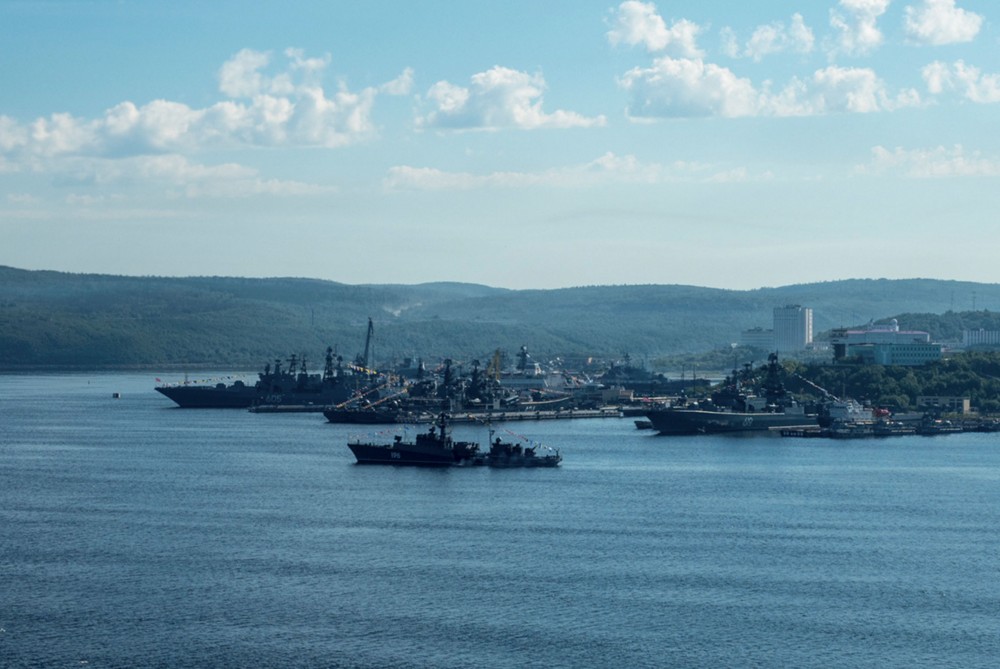
Ships set out from Northern Fleet headquarters in Severomorsk. Photo: mil.ru
It will include about 50 vessels and is held as a preparatory phase to the upcoming «Zapad-2017» drills.

The Northern Fleet, the most powerful of Russia’s five fleets, is unfolding a special exercise which includes key parts of fleet capacities.

The drills will be headed directly by Russian Navy Head Commander Vladimir Korolyev and will last «for several days», the Northern Fleet informs.

Included are about 50 ships, submarines and support vessels. Also aircrafts, helicopters from the Air Force and Air Defense will be deployed, a Navy representative says to Interfax.

The drills are held as several of the most powerful Northern Fleet vessels are on their way home after participation in a Navy parade outside St.Petersburg.  Among them are battle cruiser «Pyotr Veliky» and typhoon-class submarine «Dmitry Donskoy».

It is likely that the returning vessels will take part in the exercise.

In the course of the training, antisubmarine and anti-sabotage activities will be conducted along with navigational, hydrographical, anti-mine and search and rescue operations.

According to the Navy representatives, the exercise is held as a preparatory phase to the large-scale joint Russian-Belarus drills «Zapad-2017» scheduled for the period 14-20 September.

***

Russia Plans to Annex Belarus in Military Drill, Says Georgia’s Ex-President

Russia’s leadership is angling to annex its closest western neighbor during upcoming military drills, according to the former leader of Georgia. Mikheil Saakashvili made the comments on the anniversary of his own country’s brief conflict with Moscow that resulted in Russian troops cordoning off Georgia’s two northern regions.

Referring to the much anticipated joint Russian-Belarusian drill in the Baltic region, the former president said: “What we are seeing in Belarus, I think that Russia is planning to take and annex Belarus.” Saakashvili, who is a longtime critic of Russian President Vladimir Putin, spoke to told Baltic news agency BNS ahead of the drill, called Zapad and scheduled for September.

Lithuania, a NATO ally that borders with Russia, has expressed concern that the drill indicates a wider threat to the alliance, constituting a “simulated” attack. NATO has demanded that Russia allows for more transparency in the drill, nominally set to involve around 12,000 troops. However, Russia has previously sparked much bigger exercises to go in tandem with drills such as Zapad, upping the number of troops from the promised levels.

“During the drill, infrastructure will be brought in,” Saakashvili said. “In that sense the threat [from Russia] has not disappeared rather it only grows. It is just that until now Ukrainians have held it at its own borders [with Russia].”

Saakashvili was president of Georgia until 2013, when he lost the election and left the country for Ukraine. He was made a Ukrainian citizen and appointed as governor of Ukraine’s Odessa region in 2015 by Petro Poroshenko after the revolution that brought the pro-Europe, pro-West government to power.

His reputation as a hardline opponent of the Kremlin’s foreign policy and his imposing oratorical style made him popular quickly, and he was tipped to be the country’s next prime minister. But his often combative manner and vows to “clean up” corrupt Ukrainian institutions, put him at odds with established political figures. Ukraine stripped him of his citizenship in 2017 and he became a stateless person. He has dismissed it, and Georgia’s previous decision to strip him of citizenship, as political decisions by governments that have fallen out with him.

Despite enjoying Western support for his hawkish positions on Russia and for his campaigns against corruption, Saakashvili’s leadership of Georgia was not without its critics. The European Union criticized his decision-making during a 2008 political crisis that sparked a five day war with Russia. Under Saakashvili’s command, Georgian forces tried to restore control over two of its regions that have declared independence under Russian military sponsorship.

Belarus’s President Alexander Lukashenko has dismissed concerns that Zapad is anything but a routine defense drill. “We traditionally carry out these drills with Russia,” he said in July. Although strongly reliant on Russia in most regards, the Belarusian government has shown some signs of disagreement with its bigger partner in what the two countries symbolically call “the Union State.”

Despite a Kremlin push to deploy an airbase in Belarus, Minsk has resisted that initiative. The Union State relationship— a post-Soviet branding of Minsk and Moscow’s close relationship—looked in minor jeopardy earlier this year when Russia responded to Belarus’s looser visa-regime for Westerners by starting border checks between the two countries.

Photo

Photo

Jamestown has a more detailed summary, in part:

In the exercise scenario used for the Zapad series of exercises, there is undoubtedly a NATO dimension. This stems from Moscow’s response, opposition and complete rejection on political and legal grounds of the 1999 NATO bombing of Serbia. The events of 1999 loom large today in Russian strategic thinking and are also reflected in how the General Staff approaches the planning for a Zapad exercise. Consequently, while there is currently a Western preoccupation with the possibility of a Russian offensive operation against the Baltic States, in Moscow’s view the more likely scenario of conflict erupting on Russia’s periphery with NATO stems from an Allied intervention in Belarus. As a result, the Zapad 2017 exercise will place all operational and scenario activities under a defensive guise in response to foreign intervention, demanding a response to protect the Russia-Belarus Union State (Regnum, July 11).

Some Russian commentaries show awareness of the concern expressed by Alliance members about Zapad 2017 and its potentially aggressive rehearsal of operations against its members from Belarusian territory: these suggestions are, of course, the subject of much derision. However, there are indications of some features of the joint exercise that will come into play in September to which NATO must pay additional attention. The first is the extent to which Zapad 2017 will fine-tune joint operations carried out by the elite airborne and special forces units of Belarus and Russia. Such preparation occurred in early April, with these forces rehearsing joint operations in the Vitebsk Region in Belarus over an area of 12,000 square kilometers. The focus was on parachute landings, reconnaissance, and action to fix and locate enemy forces. During these tactical-level exercises, elite troops were also tasked with establishing the best areas to land the “main force” and coordinating air cover for these forces. On April 11–13, a parachute company from the 106th Airborne Division (Tula) relocated to Brest and, in close coordination with Belarusian counterparts as well as interior troops, worked on training tasks to block and defeat four groups of “illegal armed formations,” which had broken into strategically important facilities in the region (Nezavisimaya Voyennoye Obozreniye, June 16).

In a related preparation for Zapad 2017, in May, a one-week tactical exercise involved the electronic warfare (EW) forces of Belarus and Russia, using three training grounds in Brest and Vitebsk Regions. Whereas the elite and special forces tactical exercises had an alleged terrorist dimension, the joint EW exercises were clearly aimed against a conventionally armed opponent. They focused upon joint EW operations against a high-technology opponent operating in a “complex electronic environment.” The development of the joint force capabilities to protect the Union State is seen in Moscow as reflecting developments within modern local wars and armed conflicts. The EW component of Zapad 2017 will thus prove to be an integral part of the rehearsal of joint operations (Nezavisimaya Voyennoye Obozreniye, June 16).