An affordable price is probably the major benefit persuading people to buy drugs at www.americanbestpills.com. The cost of medications in Canadian drugstores is considerably lower than anywhere else simply because the medications here are oriented on international customers. In many cases, you will be able to cut your costs to a great extent and probably even save up a big fortune on your prescription drugs. What's more, pharmacies of Canada offer free-of-charge shipping, which is a convenient addition to all other benefits on offer. Cheap price is especially appealing to those users who are tight on a budget
Service Quality and Reputation Although some believe that buying online is buying a pig in the poke, it is not. Canadian online pharmacies are excellent sources of information and are open for discussions. There one can read tons of users' feedback, where they share their experience of using a particular pharmacy, say what they like or do not like about the drugs and/or service. Reputable online pharmacy canadianrxon.com take this feedback into consideration and rely on it as a kind of expert advice, which helps them constantly improve they service and ensure that their clients buy safe and effective drugs. Last, but not least is their striving to attract professional doctors. As a result, users can directly contact a qualified doctor and ask whatever questions they have about a particular drug. Most likely, a doctor will ask several questions about the condition, for which the drug is going to be used. Based on this information, he or she will advise to use or not to use this medication.

Starfish Prime, a Response to North Korea?

The United States knows all too well about an EMP. With regard to North Korea, the Kim regime has acknowledged it was active in EMP pursuits. The U.S. has EMP weapons developed by Boeing.

So what is Starfish Prime?

On July 9, 1962 — 50 years ago today — the United States detonated a nuclear weapon high above the Pacific Ocean. Designated Starfish Prime, it was part of a dangerous series of high-altitude nuclear bomb tests at the height of the Cold War. Its immediate effects were felt for thousands of kilometers, but it would also have a far-reaching aftermath that still touches us today.

In 1958, the Soviet Union called for a ban on atmospheric tests of nuclear weapons, and went so far as to unilaterally stop such testing. Under external political pressure, the US acquiesced. However, in late 1961 political pressures internal to the USSR forced Khrushchev to break the moratorium, and the Soviets began testing once again. So, again under pressure, the US responded with tests of their own.

It was a scary time to live in.

The US, worried that a Soviet nuclear bomb detonated in space could damage or destroy US intercontinental missiles, set up a series of high-altitude weapons tests called Project Fishbowl (itself part of the larger Operation Dominic) to find out for themselves what happens when nuclear weapons are detonated in space. High-altitude tests had been done before, but they were hastily set up and the results inconclusive. Fishbowl was created to take a more rigorous scientific approach. Read more here.

The Wall Street Journal published an item offering insight regarding North Korea and the threat of an EMP and the United States is not prepared for such a weapon in either a defensive or offensive posture without some exceptional consequence to life.

As South Korea performed some live fire drills in response to the last nuclear test by North Korea that measured a 6.3 on the Richter Scale, at issue is the immediate line of  an estimated thousands of rockets pointed at South Korea. It would take a robust offensive first strike to remove this border threat in cadence with other strike operations into the North Korea tunnel network where most of the weaponry is located.

Finally, South Korea’s leader has taken a more aggressive posture, leaning towards a military operation and this could bring the closer to Japan which is a positive indication where activities to neutralize North Korea is tantamount.

Tensions sharply escalated Sunday as the communist regime conducted what it claims to have been a test of a hydrogen bomb mountable on an intercontinental ballistic missile (ICBM). The test was only the latest in a recent series of saber-rattling, including two ICBM tests in July.

In its report to the legislature’s defense committee, the defense ministry said that it, in consultation with Washington, will seek to deploy a nuclear-powered aircraft carrier, strategic bombers and other powerful assets to the peninsula as a response to the North’s nuclear experiment.

It also unveiled its plan to stage unilateral live-fire drills involving Taurus air-to-surface guided missiles mounted on its F-15K fighter jets. The missile, with a range of 500 kilometers, is capable of launching precision strikes on the North’s key nuclear and missile facilities.

In his assessment of the sixth nuke test, Song said that the North is presumed to have reduced the weight of a nuclear warhead to below 500 kilograms. More here.

Adding more sanctions on China or those doing business with North Korea does not stop or deter North Korea at all. China knows precisely what North Korea is doing and has not moved to stop any of these missile or nuclear activity.

Photo

North Korea’s nuclear test occurred in Punggye-ri, the same site where a nuclear test occurred in January 2016, about 50 miles away from the border with China. Tremors were felt in the Chinese border city of Yanji, home to about 400,000 people, Chinese media reported.  The latest test occurred as China hosted the leaders of the BRICS (Brazil, Russia, India, China and South Africa) countries for their annual summit. China “strongly condemned” North Korea’s provocation and a draft communique from the BRICS summit quoted in Chinese state media “strongly deplored” North Korea’s nuclear test but called for a peaceful solution to the crisis. More here.

All the alleged professional continue to say the United States, Japan and South Korea have no good options with regard to North Korea, and there may be some truth to that given the descriptions as defined here.

What is left out of all conversations is the cyber abilities of the United States, knocking out North Korea’s space segments on existing satellites owned by China, Iran or Russia and lastly once again dusting off the files of Starfish Prime as described below:

Launched via a Thor rocket and carrying a W49 thermonuclear warhead (manufactured by Los Alamos Scientific Laboratory) and a Mk. 2 reentry vehicle, the explosion took place 250 miles (400 km) above a point 19 miles (31 km) southwest of Johnston Island in the Pacific Ocean. It was one of five tests conducted by the USA in outer space as defined by the FAI. It produced a yield equivalent to 1.4 megatons of TNT.

The Starfish test was one of five high altitude tests grouped together as Operation Fishbowl within the larger Operation Dominic, a series of tests in 1962 begun in response to the Soviet announcement on August 30, 1961 that they would end a three-year moratorium on testing.[2]

In 1958 the United States had completed six high-altitude nuclear tests, but the high-altitude tests of that year produced many unexpected results and raised many new questions. According to the U.S. Government Project Officer’s Interim Report on the Starfish Prime project:

“Previous high-altitude nuclear tests: YUCCA, TEAK, and ORANGE, plus the three ARGUS shots were poorly instrumented and hastily executed. Despite thorough studies of the meager data, present models of these bursts are sketchy and tentative. These models are too uncertain to permit extrapolation to other altitudes and yields with any confidence. Thus there is a strong need, not only for better instrumentation, but for further tests covering a range of altitudes and yields.”[3]   

More details here. 


3 More Russian Locations in U.S. Shuttered

Putin promises retaliation in growing diplomatic feud with US

Russian President Vladimir Putin plans to retaliate against the State Department’s latest rebuke of his policies, his spokesman warned.

“We regret the unconstructive stance taken by our counterparts in the United States and, of course, we cannot afford to leave unfriendly, and sometimes hostile steps towards us without retaliation,” Kremlin spokesman Dmitry Peskov said Thursday, according to state-run media.

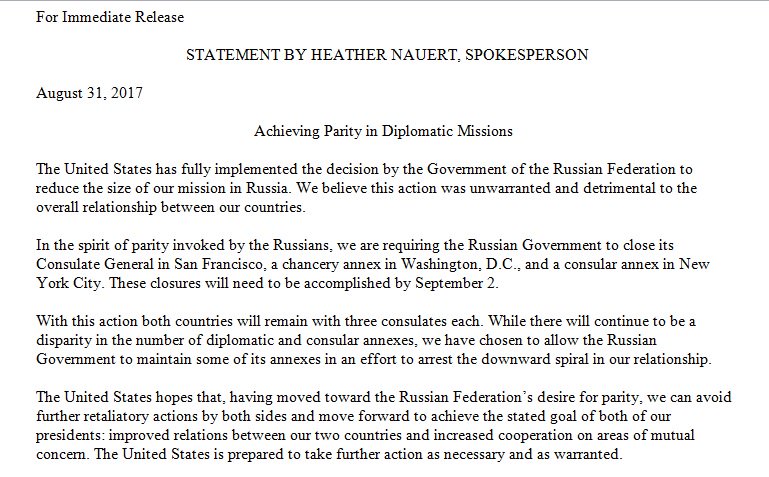
That statement suggests that the diplomatic feud will escalate following the State Department’s decision to close three Russian facilities in the United States. Secretary of State Rex Tillerson’s team justified that move as a response to Putin’s requirement that the United States cut hundreds of personnel operating in Russia. But the State Department called for an end to the tit-for-tat, saying that the two sides had reached “parity” in the fight.

Tillerson ordered the closure of Russia’s consulate general in San Francisco, as well as two other facilities in New York and Washington, D.C., respectively.

“While there will continue to be a disparity in the number of diplomatic and consular annexes, we have chosen to allow the Russian government to maintain some of its annexes in an effort to arrest the downward spiral of our relationship,” State Department spokeswoman Heather Nauert said Thursday.

The State Department said it had implemented the Putin team’s order to remove hundreds of U.S. personnel from Russia. Putin issued that requirement in response to Congress passing legislation that sanctions Russia on three fronts: the cyberattacks against the Democratic party and state election systems in 2016; the invasion of Ukraine; and Russia’s support for Syrian President Bashar Assad.

“The United States hopes that, having moved toward the Russian Federation’s desire for parity, we can avoid further retaliatory actions by both sides and move forward to achieve the stated down of both of our presidents: improved relations between our two countries and increased cooperation on areas of mutual concern,” Nauert said.

Russian diplomats maintain that the United States is to blame for the strained ties between the former Cold War rivals. “By tradition we are for good-natured relations with the United States,” Peskov said. “Moreover, we believe that these relations must be advanced in the interests of peace and global stability and in the interests of settling crucial world and regional problems.”

*** Meanwhile, this Dmitry Peskov cat is well know to the Trump orbit and described below.

Moscow (CNN) Kremlin spokesman Dmitry Peskov confirmed Wednesday he got an email from Michael Cohen, US President Donald Trump’s lawyer, asking for help moving a Moscow real estate deal forward, but said he did not respond and did not pass it to Russian President Vladimir Putin.

Peskov was responding to a question from CNN on a conference call with reporters.
Cohen — who was executive vice president of the Trump Organization at the time he sent the email — said Monday that he had contacted the Kremlin for assistance in mid-January 2016 about building a Trump Tower in Moscow when the mogul was running for president, but denied that the project was related to Trump’s campaign. But the revelation appears to contradict Trump’s vehement denials of any such business connections to Russia in the past.
Cohen told CNN on Monday his message to Peskov was “an email that went unanswered that was solely regarding a real estate deal and nothing more.”
Peskov confirmed that his office had located a copy of the email, which said the development deal wasn’t moving forward and requested support.


Hawaii, Missile Defense Test MRBM Success

Aegis BMD System Intercepts Target Missile

Aug. 30, 2017

The Missile Defense Agency and U.S. Navy sailors aboard the USS John Paul Jones (DDG 53) successfully conducted a complex missile defense flight test, resulting in the intercept of a medium-range ballistic missile (MRBM) target using Standard Missile-6 (SM-6) guided missiles during a test off the coast of Hawaii today.

Photo

John Paul Jones detected and tracked a target missile launched from the Pacific Missile Range Facility on Kauai, Hawaii with its onboard AN/SPY-1 radar, and onboard SM-6 missiles executed the intercept.

“We are working closely with the fleet to develop this important new capability, and this was a key milestone in giving our Aegis BMD ships an enhanced capability to defeat ballistic missiles in their terminal phase,” said MDA Director Lt. Gen. Sam Greaves. “We will continue developing ballistic missile defense technologies to stay ahead of the threat as it evolves.”

ddg 53 uss john paul jones rim-174 standard eram sm-6 missile     Photo

This test, designated Flight Test Standard Missile-27 Event 2 (FTM-27 E2), marks the second time that an SM-6 missile has successfully intercepted a medium-range ballistic missile target.

Aegis BMD is the naval component of the Ballistic Missile Defense System. MDA and the U.S. Navy cooperatively manage the Aegis BMD program. Additional information about all elements of the ballistic missile defense system can be found here.

*** Meanwhile in Nevada, testing of upgraded nuclear weapons components were performed.

WASHINGTON, D.C. – The Department of Energy’s National Nuclear Security Administration (DOE/NNSA) and U.S. Air Force completed two qualification flight tests of B61-12 gravity bombs August 8 at Tonopah Test Range in Nevada.

The non-nuclear test assemblies, which were dropped from an F-15E based at Nellis Air Force Base, evaluated the weapon’s non-nuclear functions and the aircraft’s capability to deliver the weapon.

These tests are part of a series over the next three years to qualify the B61-12 for service. The first qualification flight test occurred in March.

“The B61-12 life extension program is progressing on schedule to meet national security requirements,” said Phil Calbos, acting NNSA deputy administrator for Defense Programs. “These realistic flight qualification tests validate the design of the B61-12 when it comes to system performance.”

The flight test included hardware designed by Sandia and Los Alamos National Laboratories, manufactured by the Nuclear Security Enterprise plants, and mated to the tail-kit assembly section, designed by the Boeing Company under contract with the Air Force Nuclear Weapons Center.

The B61-12 consolidates and replaces four B61 bomb variants in the nation’s nuclear arsenal. The first production unit is scheduled to be completed by March 2020.

These activities are not exclusive to the nuclear threat posed by North Korea, but include other rogue nations such as Iran, Pakistan, Russia and those allied such that any weapons are transferred to another nation as in Syria or worse Venezuela.

The United States is not alone in these activities which does bring some comfort.

Theresa May refuses to rule out military action and cyber attacks over North Korea missile launches

Theresa May has refused to rule out using cyber warfare or even taking part in military action against North Korea if it does not stop firing missiles in “illegal” acts of provocation.

Mrs May arrived in Japan on Wednesday morning in the midst of an escalating crisis over Pyongyang’s latest missile launch, and will have lengthy discussions with Prime Minister Shinzo Abe about what can be done.

She arrived with a message for China’s President Xi Jinping, telling him in no uncertain terms that it is his responsibility to rein in Kim Jong-un.

She said China, which has the military might to remove Mr Kim from power if it chose to, must do “everything it can” to make North Korea desist from firing more missiles.

On Tuesday, Pyongyang launched a missile that flew over Japan before landing in the Pacific, triggering the national J-alert system which tells the Japanese population to take cover.

President Donald Trump has made it clear that all options remain on the table for dealing with North Korea, and during her overnight flight to Osaka Mrs May was asked four times by journalists if she would rule out joining military action against the Kim regime. Each time, she refused to address the question directly.

She also refused to rule out cyber warfare. Separately, a Whitehall source even raised the possibility that cyber warfare might already be in use, saying: “If we were doing that we certainly wouldn’t be telling you.”

Mrs May said: “The actions of North Korea are illegal, they are significant actions of provocation, it’s outrageous, that’s why we will be redoubling our efforts with our international partners to put pressure on North Korea to stop these illegal activities.

“China has a key role to play in this… I have said this to President Xi, I know others have as well, we think that China has that important role to play and we would encourage China to do everything it can to bring pressure to bear on North Korea to stop this.

“The UK is looking at the discussion around further sanctions and the sort of change that China can bring. We see China as being the key in this.”

During her three-day visit to Japan, Mrs May will become only the second foreign leader to attend a meeting of the country’s national security council, at which she will speak to Mr Abe and his advisers.

One of the key aims of the trip is to strengthen Britain’s cooperation with Japan over security and defence, and Mrs May will tomorrow board the aircraft carrier Izumo, the flagship of the Japanese Navy, where she will be briefed by Japanese and British military personnel.

She said: “It’s an important, long-standing relationship between the UK and Japan, they’re our closest partner in Asia and I’m looking forward to the opportunity to talk about a number of subjects – trade, of course, but also building on our defence and security co-operation.”

The Prime Minister’s visit came as  the United Nations condemned North Korea’s “outrageous” firing of a ballistic missile over Japan on Tuesday, demanding Pyongyang halt its weapons programme but holding back on any threat of new sanctions on the isolated regime.

US Ambassador Nikki Haley said “something serious has to happen” but didn’t specify what.

British Ambassador Matthew Rycroft suggested members need to look at further strengthening of sanctions. Read more here to include graphics and video.


Location of N Korea Missile Launch over Japan, What we Know

Why no country shot it down?

In part: While the US and Japan have conducted ballistic missile defense exercises and both have Aegis-equipped ships capable of shooting down some ballistic missiles, it would be extremely difficult for the US or Japan to intercept a North Korean intermediate or intercontinental ballistic missile in flight over Japan toward a target such as Guam. The Aegis system is capable of intercepting shorter-range missiles in mid-course with the SM-3 missile, and it also provides “terminal phase” defense with the SM-2 missile closer to the ballistic missile’s target. But it’s uncertain whether either system would be successful against a “pop up” attack with an ICBM.

The SM-3 Block IIA has an operational range of about 1,350 miles. But range isn’t the issue as much as the speed required to intercept. If a North Korean missile were fired to an altitude of over 500 kilometers, success in a shoot-down would depend greatly on how quickly the missile was tracked and the timing of an interceptor launch. Based on the time/distance envelopes for SM-2 and SM-3 missile intercepts calculated from Joan Johnson-Freese (a professor at the Naval War College and a lecturer at Harvard University) and Ralph Savelsberg (an assistant professor at the Netherlands Defence Academy), an Aegis defender would only have a few minutes to get off a shot at an ICBM launch from North Korea. Aegis-equipped destroyers and cruisers would have to be dangerously close to the North Korean coast to get a chance to strike an ICBM in “boost” phase as it rose and could be vulnerable to North Korean submarines if an actual attack were planned. Read more here.

***

North Korea has taken steps in recent months to disguise their missile-related activities, including fueling rockets inside structures, outside of aerial view.

There are three basic ways the U.S. gathers most of its foreign intelligence: collecting information from human spies; intercepting electronic communications; and observing what’s happening on the ground, mainly with satellites.

The National Security Agency, which hacks computers and intercepts email, has had some success pulling bits and bytes out of North Korea, former officials say, but North Korea is much less forgiving than most of its targets. That’s because most of the country is not connected to the internet and few people have cellphones. To the extent that the regime communicates electronically, it has made increasing use of encryption, experts say.

“If you look at that satellite picture [of Asia] of the lights at night from the satellite, there is one dark area with no lights on, and that is North Korea,” Coats told Congress. “Their broadband is extremely limited. So using that as an access to collection — we get very limited results.” More here.

N. Korea must be met with stronger action: U.S. experts

WASHINGTON, Aug. 29 (Yonhap) — North Korea must be met with stronger action if it is to be stopped from triggering a catastrophe on the Korean Peninsula, U.S. experts said Tuesday.

The firing of an intermediate-range ballistic missile over Japan earlier in the day was a rare hostile act that increased the chances of a military confrontation in the volatile region.

The United States and South Korea must take decisive action to demonstrate that the regime in Pyongyang will not be allowed to get away with any more provocations, and China, they noted, will have to play a key role in that effort.

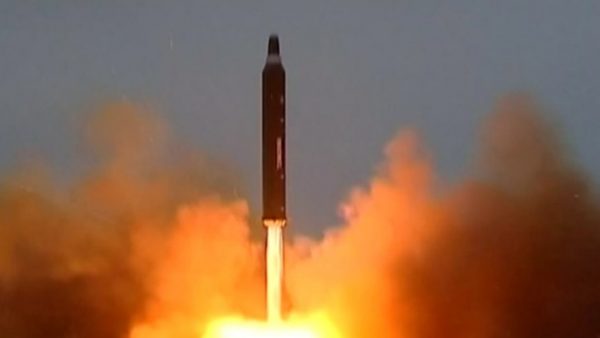
KCNA has released photos of the HS-12 launch that overflew Japan
“China has the power to increase the pressure on North Korea and must take steps towards doing so,” said Donald Manzullo, president of the Korea Economic Institute of America. “The longer China continues to refrain from using all of the leverage at its disposal to convince North Korea to return to talks, the more likely North Korea is to miscalculate.”

Beijing is Pyongyang’s only major ally and key benefactor. U.S. President Donald Trump and others have urged China to do more to rein in its wayward neighbor, but Beijing has refused to bear responsibility for the North Korean nuclear problem.

Bruce Bennett, a senior researcher at RAND Corp., said the latest launch could have resulted in part from a lack of action by the U.S. and South Korea against what was seen as a low-intensity provocation Saturday. North Korea launched three short-range ballistic missiles then.

“If the (U.S. and South Korea) fail to act seriously against (Tuesday’s) test, the North may feel that it can commit an even more serious provocation, while the exercises are ongoing, perhaps even another intercontinental ballistic missile test or a nuclear weapon test,” he said in an email.

Bennett was referring to the Ulchi Freedom Guardian military exercise currently under way between South Korea and the U.S. Analysts have said the back-to-back provocations were staged in response to the annual drills, which Pyongyang views as rehearsals for an invasion.

North Korea may also believe it has China’s backing because Beijing recently proposed the allies cancel their drills in exchange for a halt to North Korea’s missile and nuclear testing, he noted.

Robert Manning, a senior fellow at the Atlantic Council, said the U.N. Security Council is likely to adopt tougher sanctions against Pyongyang.

“There may be other steps Trump is considering to take unilaterally, whether cyber or kinetic. The key question is: How far is China prepared to go?” he said in a separate email. “But even if effective, sanctions will take time to have an impact — nine to 12 to 15 months. The danger is that this cycle of tensions rises to the point where the U.S. seeks more immediate results. That could be catastrophic.”

Media preview

The North Korean single stage Hwasong-12 is a liquid fueled IRBM of estimated 4500 km range.

The Hwasong-2 appears to be a stretched improved version of the Hwasong-10 IRBM and appears to be single staged.

The missile was first shown in the 2017 military parade and has conducted its first successful flight after three failures in May 2017 from a site near Kuosong, likely Panghyon Air Base, on a lofted short range trajectory of 787 km range and 2111 km apogee height, which hints to a maximum range of about 4500 km.

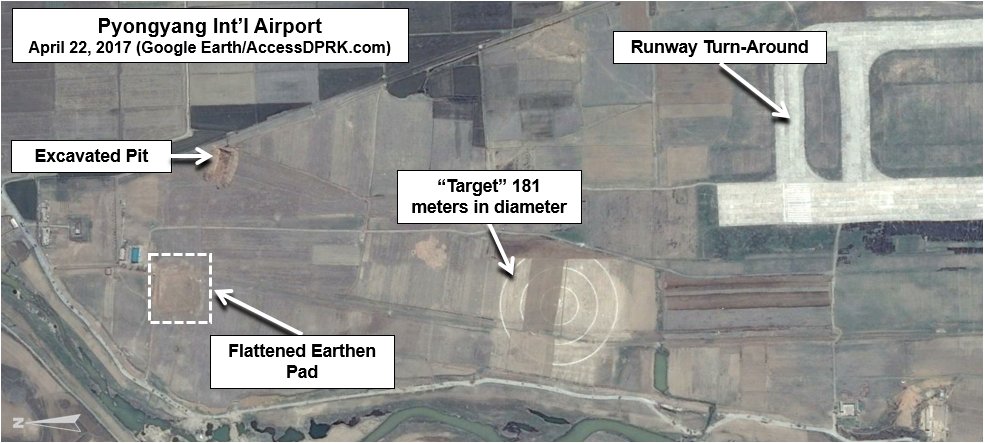
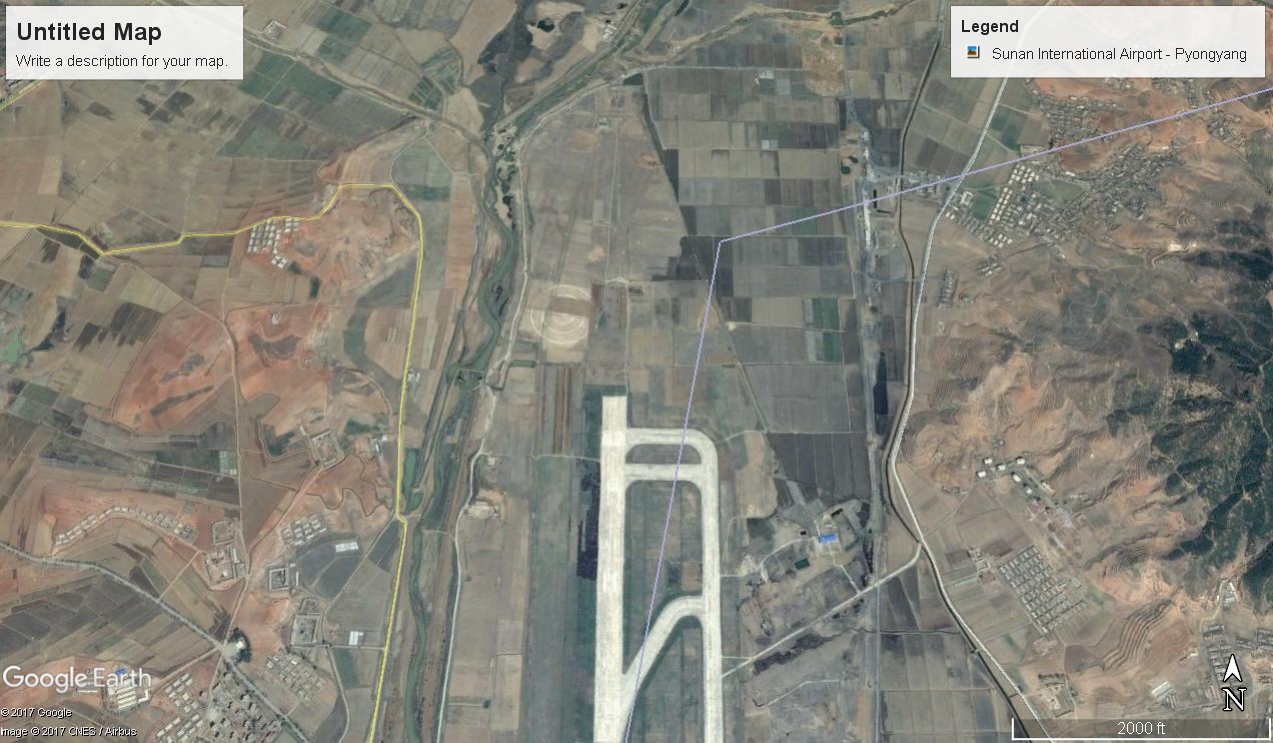
For more information regarding the DPRK airfields and what is underground at those airfields across the country, go here.

Chinese Operative(s) Working for N Korea in New York?

Primer:

Yesterday, this site published the FBI related story. If You Don’t Think the FBI is Busy, N Korea Investigation

Still, our State Department and White House appears to think that we can have honest dialogues with China regarding North Korea? Additionally, it was just reported a month ago that Beijing has a major spy network in the United States with up to 25,000 Chinese intelligence officers and 15,000 recruited agents.

Not feeling confident on this, are you? Perhaps some expulsions are in order…

Did Owner of Million-Dollar U.S. Home Help North Korea Evade Sanctions?

GREAT NECK, N.Y. — The five-bedroom house in New York’s Long Island suburbs — listed for nearly $1.3 million — boasts a southern exposure and proximity to a country club.

But here’s what’s more interesting: The seller, a Chinese national named Sun Sidong, has been linked by American security experts to a network of Chinese companies under Treasury sanctions for helping companies and individuals who support North Korea’s nuclear and ballistic missile programs.

According to Chinese corporate filings, Sun is the listed owner of Dandong Dongyuan Industrial Co., which has shared an email address with another Chinese company, Dandong Zhicheng Metallic Material Co., a coal exporter suspected of helping North Korea evade sanctions.

For the NBC video go here.

The coal company and “four related front companies” were targeted by a federal search warrant allowing prosecutors to secretly monitor their financial transactions at eight U.S. banks, seizing any funds stemming from illegal sanctions-busting, according to a May federal court ruling.

The ruling, by U.S. District Judge Beryl Howell of Washington, D.C., said the eight American financial institutions — Bank of America, Wells Fargo, BNY Mellon, Citibank, Deutsche Bank, HSBC, JP Morgan Chase, and Standard Chartered Bank — had already processed upwards of $700 million in prohibited transactions involving North Korea since 2009. The ruling does not allege any wrongdoing by any of the banks.

Image: The Great Neck, NY home purchased by Sun Sidong in December 2016.
The Great Neck, N.Y., home purchased by Sun Sidong in December 2016. Google Maps

On Tuesday, the Treasury’s Office of Foreign Assets Control (OFAC) sanctioned Dandong Zhicheng Metallic Material Co. and its primary shareholder in response to “attempted evasion of U.S. sanctions.”

That shareholder, a Chinese businessman named Chi Yupeng, was also named in a civil complaint filed Tuesday by the Justice Department seeking a money laundering penalty against the firm, as well as the seizure of $4 million in funds allegedly laundered for North Korea’s ruling party. The complaint alleges that front companies controlled by Chi Yupeng comprise one of the largest financial facilitators for North Korea.

Chi Yupeng hung up on NBC News several times when asked for comment.

The Justice Department also moved to seize nearly $7 million from a Singapore firm over similar allegations, and Treasury levied sanctions against a number of other Chinese and Russian entities — 16 in total — it accused of helping North Korea evade sanctions.

WATCH: At China-North Korea Border, Business as Usual Despite Sanctions

The government’s investigation was supported by the Center for Advanced Defense Studies (C4ADS), a non-profit U.S. think tank, as part of a new get-tough approach to North Korean sanctions that began in the Obama administration and is accelerating under President Trump, current and former U.S. officials say.

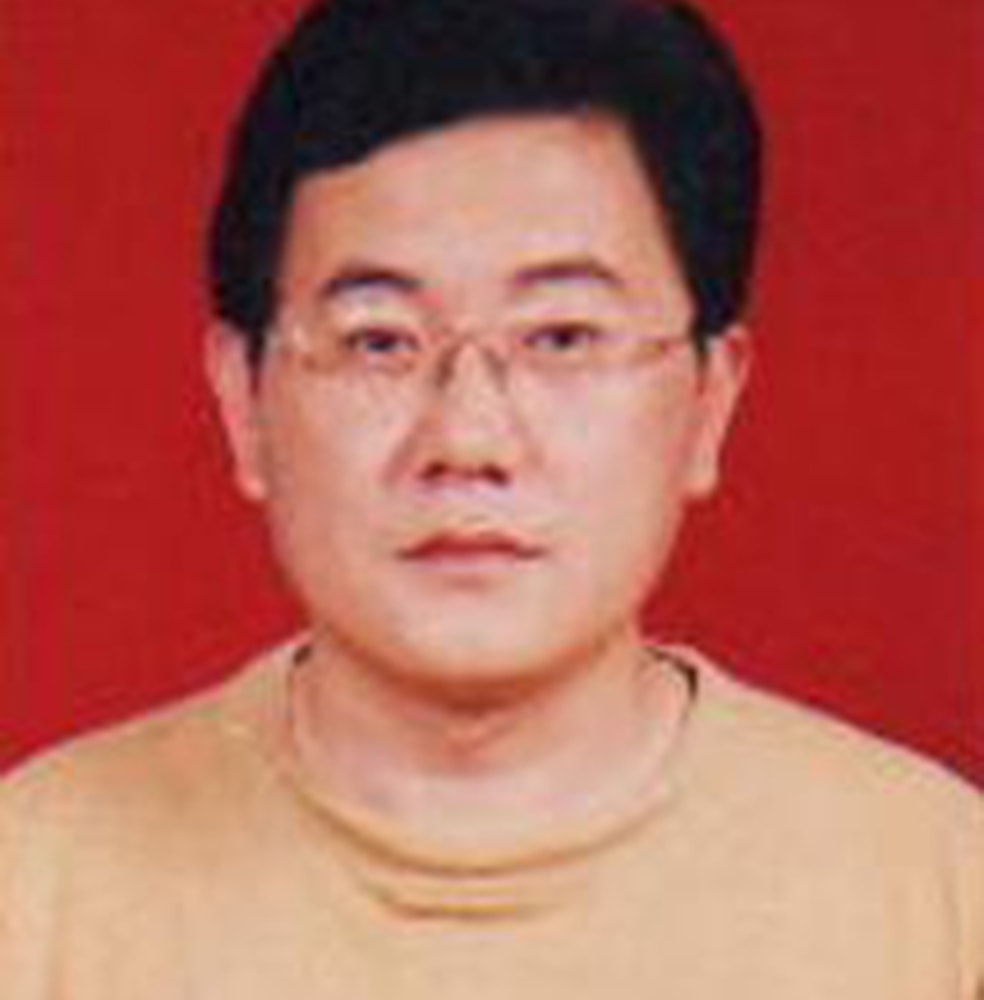
Image: Chi Yupeng
Chi Yupeng is the majority owner of Dandong Zhicheng Metallic Material Co. A civil complaint filed by the Justice Department Tuesday alleges that companies he controls helped North Korea evade sanctions. Bohai University

While it’s widely assumed that North Korea has for years been subjected to punishing international pressure as it defied the world and advanced toward a nuclear missile capability, the sanctions against North Korea have been full of holes, experts say — far less restrictive, for example, than the measures that brought Iran to the nuclear bargaining table.

Sun’s Great Neck house is an example of how the alleged sanction-busting networks can stretch around the globe, even to the luxe suburbs of Long Island. “The fact that you have somebody who’s engaged in trade that is potentially not just sanctioned, but dangerous, and that individual then invests in real estate in the United States reflects that there are holes in the system,” NBC News National Security Analyst Juan Zarate said.

The North Korea sanctions targeted specific military technology, “but what you didn’t see until quite recently are these kind of broader sanctions to go after the North Korean economy as a whole,” said Peter Harrell, who was the deputy assistant secretary for counter threat finance and sanctions in the State Department from 2012 to 2014.

The Friendship Bridge crosses the Yalu River and connects Dandong, China with Sinuiju, North Korea. David Lom / NBC News

Nor was there an aggressive enforcement effort against banks and individuals doing business with Pyongyang. As a result, the North Korean economy has grown steadily over the last decade, analysts say. And while the country as a whole remains extremely poor, the elite live relatively well amid a building boom of gleaming skyscrapers in the capital.

“Until February of 2016, U.N. sanctions against North Korea were strong on paper but poorly enforced, and U.S. sanctions against North Korea were comparatively weak — weaker than our sanctions against Belarus and Zimbabwe,” said Joshua Stanton, a North Korea expert and former Army officer.

Now, that is changing — though it may be too late. North Korea tested a missile that many experts say could strike the U.S. mainland, and American intelligence officials say the country may be months away from being able to mount a nuclear warhead on such a missile.

Still, aided by new sanctions imposed in the past year, the Trump administration is moving to increase economic pressure on North Korea, by targeting the Chinese companies that have for years helped the North fund its military activities.

“Justice is stepping it up by going after the Chinese banks,” said Anthony Ruggiero, a senior fellow at the Foundation for Defense of Democracies, who served as the nonproliferation advisor to the U.S. delegation to the 2005 Six-Party Talks on North Korea.

In June, the U.S. Treasury Department designated China’s Bank of Dandong — based in a city on the North Korean border that serves as a center of trade between the two countries — to be a “primary money laundering concern.” It said the small bank “acts as a conduit for illicit North Korean financial activity.” Two Chinese individuals were also targeted in the government’s action.

Last September, the Justice Department charged Dandong-based businesswoman Ma Xiaohong with evading sanctions and laundering millions of dollars for North Korea. Ma has not made a court appearance and her whereabouts are unclear.

Sen. Cory Gardner, R-Colo., recently introduced a bill that would cut off entities that do business in North Korea, including the top ten Chinese importers of North Korean goods, from using the American financial system.

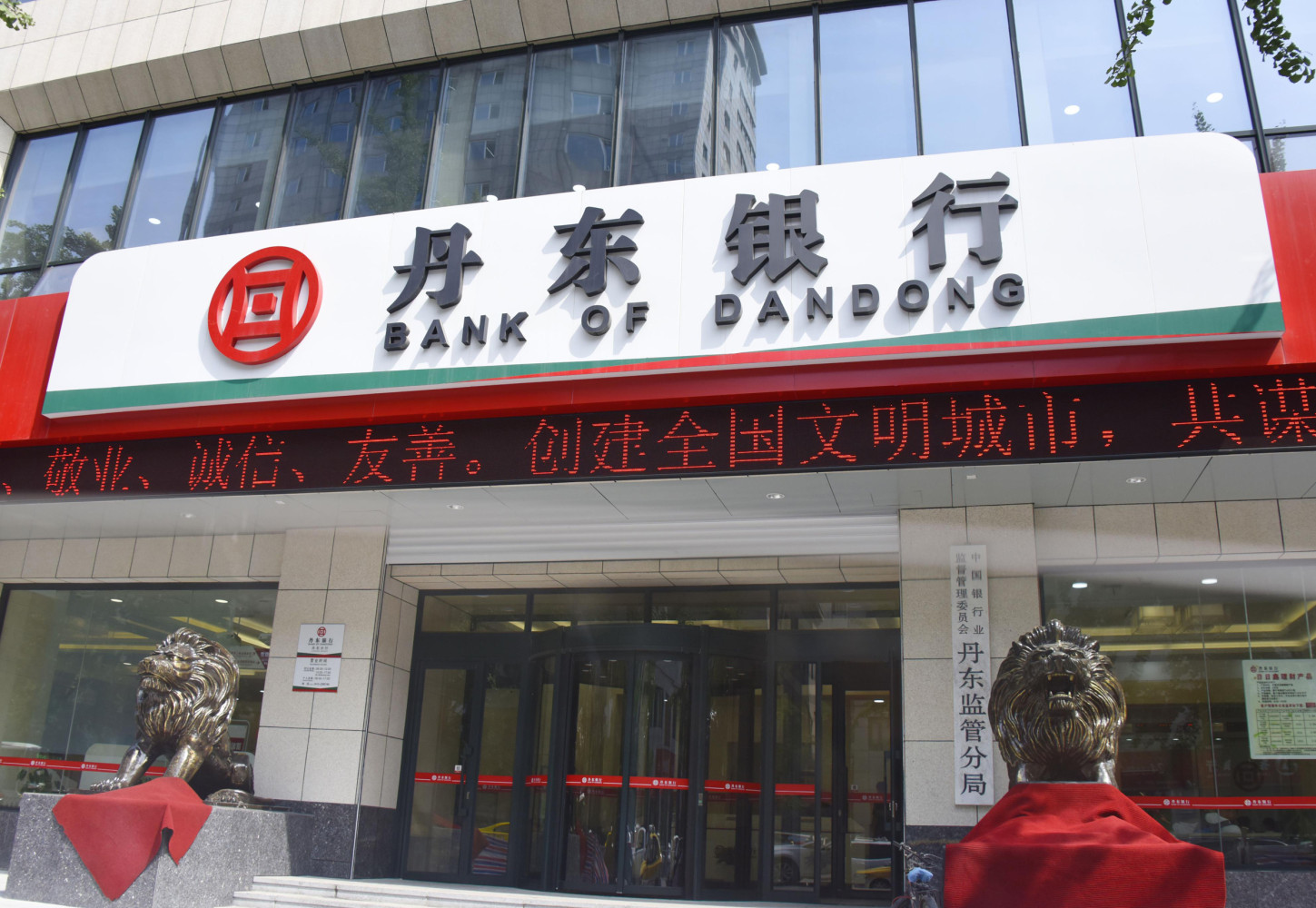
Image: This photo taken July 5, 2017 shows the Bank of Dandong, a Chinese bank accused of laundering money for North Korea.
This photo taken July 5, 2017 shows the Bank of Dandong, a Chinese bank accused of laundering money for North Korea. Kyodo

In August, the U.N. Security Council unanimously passed new sanctions meant to pressure Pyongyang’s export revenue. They crack down on North Korea’s primary exports — including iron, iron ore, coal, lead, lead ore and seafood — and target banks and joint ventures with foreign companies.

C4ADS, which focuses on international security, uses sophisticated software and business records to map links between companies involved with North Korea.

In June, the group published a report — titled “Risky Business” — naming Sun, who owns the Great Neck house, as part of a network that may be exporting technology that could be used in North Korea’s missile program.

Chinese business records cited by C4ADS show Sun owns 97 percent of Dandong Dongyuan Industrial Co. Ltd., a general-purpose trading firm whose businesses include the sale of automobiles, machinery, natural resources, and general household products, the report says. NBC News confirmed that the records show Sun as primary shareholder.

Related: North Korea Already Has a Devastating Weapon: Cyberattacks

Customs records indicate the firm has exported to three countries: North Korea, the Democratic Republic of the Congo, and the United States. From 2013 to 2016, the company sent $28 million worth of material to North Korea, the records show.

For example, Dandong Dongyuan Industrial Co. sent North Korea a shipment of radio navigational aid apparatus valued at nearly $800,000 in June 2016, the C4ADS report said. Experts at the James Martin Center for Nonproliferation Studies concluded that “this category might contain guidance devices for ballistic missiles.”

NBC News reviewed shipment data from Panjiva, which tracks global trade. It shows more than 60 shipments of items by Sun’s company to North Korea that fall into the category of “nuclear reactors, boilers, machinery and mechanical appliances; parts thereof.” This broad category is set by the country of origin, in this case the Chinese government. Experts say dual-use items like these help the Kim regime evade sanctions that are explicitly designed to prevent its nuclear capability.

“The danger with the export of dual-use items is that they appear to be legitimate. These are things that could be used for normal purposes,” Zarate said. “You have parties that are willing to export what are really dangerous items to a regime that has been sanctioned, and trying to use the cloak of legitimate commerce in order to do that.”

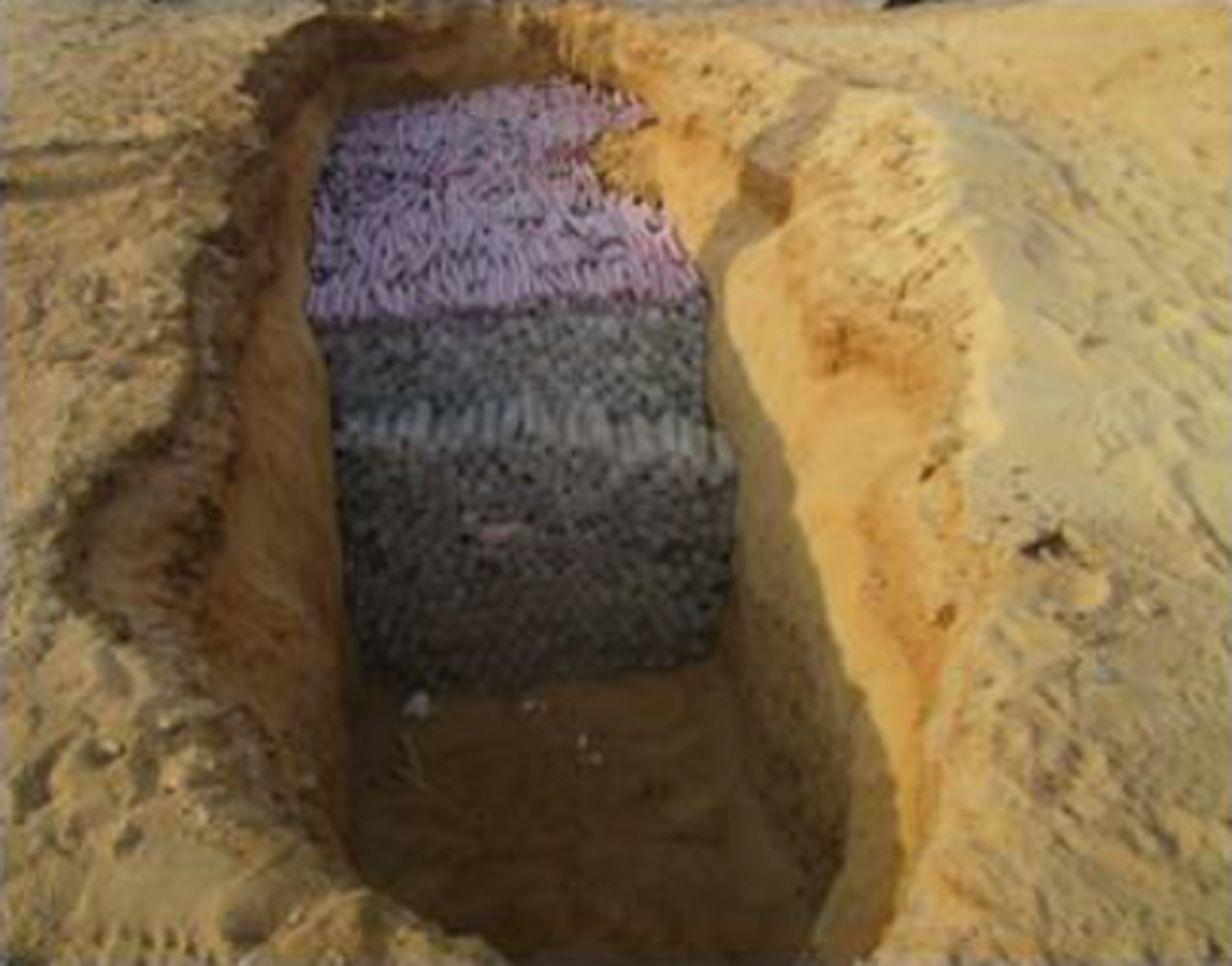
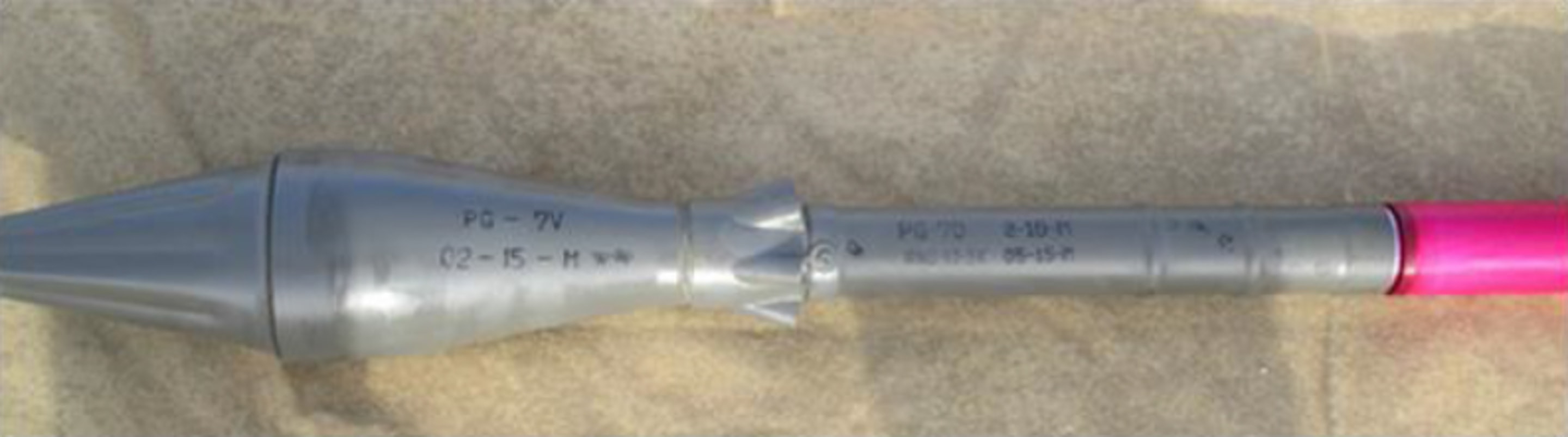
Image: Parts for approximately 30,000 rocket-propelled grenades, manufactured in North Korea and seized in Egyptian waters, hidden under 2,300 tons of iron ore.
Parts for approximately 30,000 rocket-propelled grenades, manufactured in North Korea and seized in Egyptian waters, hidden under 2,300 tons of iron ore. UN Security Council Panel of Experts

C4ADS also links Sun to a ship carrying arms from North Korea to an unknown destination. In August 2016, a cargo vessel flying a Cambodian flag was intercepted by Egyptian authorities entering the Suez Canal with parts for 30,000 rocket-propelled grenades aboard. The grenade parts were hidden under 2,300 tons of iron ore, which is one of the newly banned mineral exports targeted by the U.N.’s recent sanctions program.

According to shipping records reviewed by NBC News, one of Sun Sidong’s companies owned the vessel from April 2012 until August 2014, when ownership was transferred to a company controlled by Sun Sihong, who according to C4ADS is Sun’s sister.

In 2015, Sun registered a New York-based company called Dongyuan Enterprise USA. On March 2, it received a shipment of “used furniture” from Dandong Dongyuan Industrial Co., Sun’s Chinese company. Originally shipped from Dandong, the cargo traveled to the U.S. from Busan, South Korea, according to its bill of lading.

The real estate agent who brokered the sale of the Great Neck home to Sun recalled that the family was expecting furniture to arrive from China.

An assembled rocket-propelled grenade intercepted in the Jie Shun shipment. The ship’s bill of lading misidentified the parts as pieces of an underwater pump. UN Security Council Panel of Exp

Sun, whose U.S. company operates out of a New York City address he does not own, bought the Great Neck property near the country club for $1.1 million in December 2016.

The house is already on the market again. Sun’s U.S. real estate broker told NBC News that’s because Sun “doesn’t want to do business here.”

One lesson of Sun’s activities is that targeting a small number of key actors could put a severe dent in North Korean’s effort to evade sanctions, according to David Johnson, the executive director of C4ADS.

“The networks that perpetrate sanctions evasion for North Korea are limited, centralized, and vulnerable,” Johnson said. “That is, we can touch them, there are very few pressure points, and we can make a major impact.”