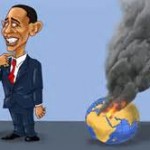
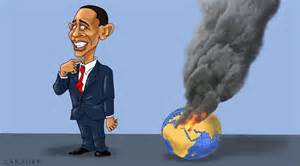
West Point Speech and Why

Barack Obama has hidden his concern for terror threats and most often he has re-labeled it as an ‘overseas contingency operation’.

Then only recently did he give a speech at West Point explaining his foreign policy which he was forced to do for at least two reasons, the recent kidnappings and deaths at the hands of Boko Harem and the immediate release only a few days after the speech of the Taliban 5 from Guantanamo.

Okay, so where does that leave America for the next several years as Barack Obama has forced the shrinking of the United States footprint globally? Well, Barack Obama’s lack of policy and leadership with allies point to the very real possibility of NATO crumbling itself. This leaves China and Russia and especially the entire Shiite and Sunni world in a race for the top slots of globally power rankings.

In context, the lack of will and the aversion to colonialism at the hands of Barack Obama, simply removed the United States from the short list of the keepers of peace globally in six short years, something that experts predict will take at least fifteen years to ever begin to reverse, others predict as much as forty years and that is only if there is a collection of Reagan prodigies on the horizon. Not much hope so far.

One of the topic intelligence analyst with a real and candid background for saying what must be said is Michael Vickers. Here he is in his own assessment. Take it for your deep consideration.

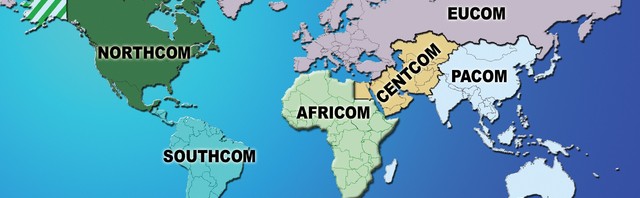
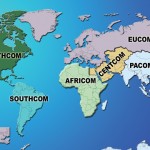
global map


WASHINGTON: If you want to understand why President Obama spoke so much about terrorism in his widely panned West Point speech, the head of Pentagon intelligence explained it pretty well today.

Click here to see the video of Vicker’s message.

Terrorism is and remains the top threat to the United States, Defense Undersecretary for Intelligence Mike Vickers said this morning at the Center for Strategic and International Studies. The most interesting, and some would say anomalous, threat assessment he offered: China comes in at number seven after Al Qaeda and its affiliates, the Syrian civil war, Russian “revanchism,” Iran, North Korea and what he called the “persistent volatility” across South Asia and the Middle East and North Africa.

That’s right, China appears to come seventh when the Intelligence Community is planning and advising President Obama and Defense Secretary Chuck Hagel. It makes sense when you consider the long-range goals China appears to have set itself and the absence of a direct confrontation — so far — between the two powers.

Now folks in the Intelligence Community may well tut tut and profess that they examine each situation as it occurs, but budgeting requires prioritization and here it is.

What does all this mean in aggregate to the Intelligence Community and the Pentagon? Vickers said, “[as] senior intelligence officials, we haven’t seen this range of challenges on an administration’s plate in our careers.” Not only is the range of threats geographically enormous and conceptually varied, they are, as Vickers noted, “these are highly asymmetric challenges.” In Pentagon parlance that means the United States military isn’t necessarily well prepared to cope with them. And there are a lot of them.

Is Mike Vickers arguing that the Intelligence Community needs to remain very well financed, even in this age of declining defense budgets? Sounds like!


War to Luxury to War

The Afghan villagers remember Bergdahl quite well mostly for the reason he was purposely heading into Taliban territory on a mission. While that State Department spokesperson is minimizing the words of the soldiers in Bergdahl’s unit, the State Department cannot ignore the words of the Afghanis.

“It was very confusing to us. Why would he leave the base?” said Jamal, an elder in the village of Yusef Khel, about a half-mile from the American military installation. (Like many Afghans, he goes by only one name). “The people thought it was a covert agenda – maybe he was sent to the village by the U.S.”

Locals remember Bergdahl walking through the village in a haze. They later told Afghan investigators that they had warned the American that he was heading into a dangerous area.

“They tried to tell him not to go there, that it is dangerous. But he kept going over the mountain. The villagers tried to give him water and bread, but he didn’t take it,” said Ibrahim Manikhel, the district’s intelligence chief.

So, let us turn to the home that the Taliban 5 left behind at Gitmo. Air conditioning, video games and recliners, soccer fields, first rate medical care and visitors were all part of the perks that the Gitmo detainees enjoyed. The Taliban 5 left this behind anxious to return to their jihad and Barack Obama aggressively and willingly delivered renewed inspiration and power to the enemy.

Military officials at the Guantanamo Bay detention facility are attempting to make force-feeding a little more fun for detainees. Some longterm hunger strikers can now kick back in a plush recliner — well, not literally, since their ankles are restrained by shackles — and play video games or watch TV while being tube fed a liquid nutritional supplement.

Detainees can choose from hundreds of video games and movies, said Milton, the Guantanamo librarian who doesn’t give out his last name. They can watch Tim Burton’s Alice in Wonderland or play Portal 2. But, say, Call of Duty: Ghosts isn’t available — Milton said the library doesn’t carry violent video games or movies.

The Taliban specifically asked several years ago for these 5 Gitmo detainees as they were to lead the U.S. paid Taliban headquarters location in Doha. At first even those on the ‘Afghan Good Enough’ team pushed back. The office later closed and now it has a new home in Qatar under the support and approval of al Thani and Barack Obama.

On the Taleban side, it was, significantly, their (officially closed, but apparently still active) political bureau in Qatar that played the key role in negotiations, as the Taleban’s official statement acknowledged. An interview (in Pashto) with office member, Nek Muhammad, highlighted the role of the head of the office, Tayyeb Agha, as chief negotiator in the talks. (1) He said they had originally intended to negotiate directly with the Americans, but then decided it was better to go through Qatar given the complexity of the issues. (This also allowed the White House to say it “doesn’t talk to terrorists.”) One other interesting detail in Nek Muhammad’s interview is his hint that Na’im Kuchi played a role in the handover. Kuchi, a former senior mujahedin and Taleban commander, was detained in Guantanamo, but ‘reconciled’ on his release in 2004 and is now a member of the High Peace Council, although not a particularly active one. Nek Muhammad said Bergdahl had been transferred to the Americans at 6.30 in the evening on Saturday 31 May in the Bati area of Alisher district of Khost province, “near the home of Sardar Na’im Kuchi.” If Kuchi did play a role in the transfer, it looks most likely to have been in his personal capacity and kept secret from the High Peace Council (as news of the deal did not leak).

In one sweeping week under Barack Obama, the American military and the coalition forces of our allies has been dismissed, the blood and treasure spent is regarded with full disdain by the Commander-in-Chief.

While there have been countless scandals during the Obama administration, the Taliban being granted a new ‘win’ in the war on terror by the White House, the real tragedy is Obama’s misplaced loyalty to the Muslim Brotherhood where he clearly loves something else rather than the very America who put him in office only to betray and violate us all.

Andy McCarthy supports the sentiment, Barack Obama crossed over and makes the case on why. No signing statement, where Barack Obama decidedly took excessive power to finesse the law that he signed will or should give him the protection he thinks he built.


Snowden, Truthful Spy

Each week there are media reports publishing additional nuggets with regard to the NSA, Edward Snowden and Obama administration policy alterations. Well at least something is coming out, where we can take these nuggets and go further.

Edward Snowden gave an interview about his job assignments and the fact they he did in fact attempt to raise some hard questions about what the NSA was doing without the knowledge or approval of common citizens.

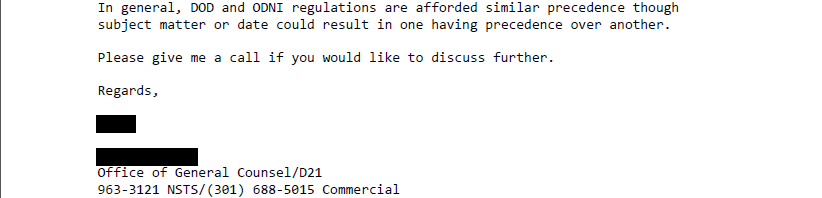
In the interview he did raise an issue that spoke to the fact he sent an email to the NSA’s Office of Legal Council questioning the legality of USSID18, which is spying on U.S. citizens. Interestingly, this has not been mentioned before where it appears he was in fact seeking a response from the lawyers about the law versus Executive Orders.

Senator Dianne Feinstein confirmed the email exchange of which to date there has been only one released.

On Thursday, the Office of the Director of National Intelligence posted on its website what it described as Snowden’s  only correspondence with NSA’s Office of General Counsel. The email does not refer to any concerns about NSA surveillance programs. In the email, Snowden asks about a training session and whether  presidential executive orders supersede federal laws.

The email was sent on April 5, 2013, at least three months after he first contacted documentary filmmaker Laura Poitras and four months after he contacted journalist Glenn Greenwald. Rick Ledgett, the NSA’s deputy director who is leading the internal investigation of Snowden’s leaks, told Vanity Fair the he first illegally downloaded documents in the summer of 2012.

Given the notion that Snowden did try to reach out in some form before he bailed out of the United States does add a new twist to the order of actions.
The_NSA_Is_Firing_Back-80d197ab2724e541a3edcdeb9acc6a49

See full story and email exchange here.

Now we need to look deeper at what USSID18 is.

DEPARTMENT OF DEFENSE

PROCEDURES GOVERNING THE

ACTIVITIES OF
DOD INTELLIGENCE COMPONENTS
THAT AFFECT UNITED STATES PERSONS

This DoD regulation sets forth procedures governing the activities of DoD intelligence components that affect United States persons. It implements DoD Directive 5240.1, and replaces the November 30, 1979 version of DoD Regulation 5240.1-R. It is applicable to all DoD intelligence components.

Executive Order 12333, “United States Intelligence Activities,” stipulates that certain activities of intelligence components that affect U.S. persons be governed by procedures issued by the agency head and approved by the Attorney General. Specifically, procedures 1 through 10, as well as Appendix A, herein, require approval by the Attorney General. Procedures 11 through 15, while not requiring approval by the Attorney General, contain further guidance to DoD Components in implementing Executive Order 12333 as well as Executive Order 12334, “President’s Intelligence Oversight Board”.

Accordingly, by this memorandum, these procedures are approved for use within the Department of Defense. Heads of DoD components shall issue such implementing instructions as may be necessary for the conduct of authorized functions in a manner consistent with the procedures set forth herein.

This regulation is effective immediately.

PROCEDURE 3. RETENTION OF INFORMATION
ABOUT UNITED STATES PERSONS

A. APPLICABILITY

This procedure governs the kinds of information about United States persons that may knowingly be retained by a DoD intelligence component without the consent of the person whom the information concerns. It does not apply when the information in question is retained solely for administrative purposes or is required by law to be maintained.

B. EXPLANATION OF UNDEFINED TERMS

The term “retention,” as used in this procedure, refers only to the maintenance of information about United States persons which ,an be retrieved by reference to the person’s name or other identifying data.

C. CRITERIA FOR RETENTION

1. Retention of information collected under Procedure 2. Information about United States persons may be retained if it was collected pursuant to Procedure 2.

2. Retention of Information Acquired Incidentally. Information about United States persons collected incidentally to authorized collection may be retained if:

a. Such information could have been collected intentionally under Procedure 2;b. Such information is necessary to understand or assess foreign intelligence or counterintelligence;

c. The information is foreign intelligence or counterintelligence collected from electronic surveillance conducted in compliance with this Regulation; or

d. Such information is incidental to authorized collection and may indicate involvement in activities that may violate federal, state, local, or foreign law.

3. Retention of information relating to functions of other DoD Components or non-DoD Agencies. Information about United States persons that pertains solely to the functions of other DoD Components or agencies outside the Department of Defense shall be retained only as necessary to transmit or deliver such information to the appropriate recipients.

4. Temporary retention. Information about United States persons may be retained temporarily, for a period not to exceed 90 days, solely for the purpose of determining whether that information may be permanently retained under these procedures.

5. Retention of other information. Information about United States persons other than that covered by subsections C.1. through 4., above, shall be retained only for purposes of reporting such collection for oversight purposes and for any subsequent proceedings that may be necessary.

D. ACCESS AND RETENTION

1. Controls on access to retained information. Access within a DoD intelligence component to information about United States persons retained pursuant to this procedure shall be limited to those with a need to know.

2. Duration of retention. Disposition of information about United States persons retained in the files of DoD intelligence components will comply with the disposition schedules approved by the Archivist of the United States for the files or records in which the information is retained.

3. Information acquired Prior to effective date. Information acquired prior to the effective date of this procedure may be retained by DoD intelligence components without being screened for compliance with this procedure or Executive Order 12333 (reference (a)), so long as retention was in compliance with applicable law and previous executive orders.

Read more here.

The question remains still on did Snowden and Greenwald cross the Rubicon? It launched a debate globally which is a huge benefit and we have come to learn more about the complicity of all internet tech companies hence. Let the roundtable discussions continue.



Stop With the al Qaeda Core Crap

Just because Usama bin Ladin is dead does not translate to al Qaeda being decimated, in fact nothing is farther from the truth.

It should make one wonder why the CTC (Counter Terrorism Center) has only released 17 of the documents from the trove of evidence taken from the bin Ladin Pakistan compound. It also should be the question on why drone strikes have suddenly stopped in Pakistan and moved to other locations such as Yemen.

On the heels of the Barack Obama West Point speech yesterday on the foreign policy doctrine, both the White House and the State Department announced a $5 billion global counter-terrorism fund. Ah, why now? Why was there at least a two year delay in placing Boko Harem on the FTO by Hillary Clinton? Why was there a major delay in placing Ansar al Sharia on the FTO, which was not done until January of this year given the proof of their attack on our two locations in Benghazi?


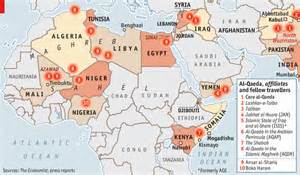
aq map

—–

A Map of All the Countries That Now Have Al-Qaeda Affiliated Terrorist Groups

The United Nations decided late last week to add Nigerian Islamist group Boko Haram to its list of terrorist organizations formally recognized as being associated with al Qaeda.

The UN said in its statement that Boko Haram—whose name loosely translates to “Western education is a sin”—has “maintained a relationship with the Organization of Al-Qaida [sic] in the Islamic Maghreb for training and material support purposes.”

Nigerian president Goodluck Jonathan has been referring to the group as a terrorist organization since last year and arresting members accordingly. But his country’s battles with Islamism have been launched onto the international stage since Boko Haram abducted hundreds of schoolgirls last month. This has put Nigeria on the map in a way Jonathan would have done best to avoid.

It has also put Nigeria on this particular map of countries with recognized al-Qaeda affiliates.

—–

Obama’s $5 Billion Counterterrorism Fund Already in Trouble in Congress

by Josh Rogin

President Obama’s Wednesday announcement that he wants $5 billion more next year to fight terrorism came as a complete surprise to the congressmen who will have to give him the money, and they reacted Wednesday with confusion and skepticism.

The new fund, if Congress goes along, would be added to the administration’s Pentagon budget request for the upcoming fiscal year, inside what’s known as the Overseas Contingency Operations fund. (That’s the cash that’s supposed to be used to help fight America’s wars, and is not considered part of the Defense Department’s core budget.) Experts and former officials warned that unless the administration comes to Congress with detailed plans of how the money will be spent and why those tasks can’t be completed inside the Pentagon’s already-huge budget, lawmakers are not likely to sign off on the idea. The total lack of administration outreach to Congress so far is not a good start.

At West Point, Obama said he was “calling on Congress to support a new Counter-Terrorism Partnerships Fund of up to $5 billion, which will allow us to train, build capacity, and facilitate partner countries on the front lines”—from Yemen to Libya to Syria to Mali.

Read more here.

Obama’s Doctrine is Vertigo

The quite rage began across country by experts when it comes to foreign policy as a result of Barack Obama’s speech at West Point. Omitting the fact that he included climate change as a major global threat, Barack Obama worked to defend his posture and to explain his own view on why America is in fact exceptional and not weak when it comes to enemies of the United States. He even took a shot at World War ll veterans and military leadership by saying they did not estimate the later conditions or damage of their strategic decisions during World War ll.

The United States has a historical and successful duty to provide equilibrium to the world. There have been some failures yet they were corrected, yet no other nation has stepped up across the globe where the duty has fallen to America. The globe calls us to duty now yet Barack Obama has vertigo when it comes to leading, being decisive and demonstrating power.

The reaction to the speech was broadly in agreement, such that Obama is not a war-time president much less does he see the world for what it is but rather for what he wants it to be. Just a small comparison of the West Point speech, see the two videos here.

US FP

Reaction to the President’s West Point Speech

At West Point, President Obama Binds America’s Hands on Foreign AffairsWashington Post Editorial

President Obama has retrenched U.S. global engagement in a way that has shaken the confidence of many U.S. allies and encouraged some adversaries. That conclusion can be heard not just from Republican hawks but also from senior officials from Singapore to France and, more quietly, from some leading congressional Democrats. As he has so often in his political career, Mr. Obama has elected to respond to the critical consensus not by adjusting policy but rather by delivering a big speech.

Obama’s Vision of U.S. as ‘Empowering Partners’Christian Science Monitor Editorial

Obama quoted President Kennedy about peace needing to be based upon “a gradual evolution in human institutions.” As more people and nations evolve toward shared ideals, the task of maintaining international order also becomes more of a shared one. The U.S., which was so instrumental as a military leader in the 20th century, can take on a new role in bringing nations and people closer.

America Can’t Ignore Military Muscle of Russia and ChinaWashington Examiner Editorial

President Obama told West Point’s graduating cadets Wednesday that “some of our most costly mistakes came not from our restraint, but from our willingness to rush into military adventures without thinking through the consequences.” Apparently the nation’s commander-in-chief is unaware of — or perhaps unconcerned by — the more pressing reality that bad things happen when America’s real and potential adversaries don’t fear U.S. strength.

Obama’s Unclear Foreign Policy Path – Richard N. Haass, Council on Foreign Relations

President Barack Obama has laid out a vision for U.S. foreign policy calling for the need to avoid both unnecessary military entanglements and isolationism. CFR President Richard N. Haass said the speech at West Point on May 28 appeared too focused on what the president opposed and less on what he favored. “It was an attempt to essentially carve out a form of involvement in the world that avoided any and every excess,” Haass said. “But with one or two exceptions, it didn’t provide any specifics.” Obama’s call for ramping up support for non-jihadist rebels in Syria is welcomed, Haass said.

Doubling Down on a Muddled Foreign Policy – John Bolton, Wall Street Journal

At West Point on Wednesday, President Obama told the graduating seniors that he had discovered a middle way in foreign policy between isolationism and military interventionism. To the White House, this was like “the dawn come up like thunder outer China,” in Kipling’s phrase. Others were less impressed, especially since it took five-plus years of on-the-job training to grasp this platitude. Of course the United States has options between war and complete inaction. Not since Nixon has a president so relished uncovering middling alternatives between competing straw men.

The Obama Defense – Michael O’Hanlon, Foreign Affairs

U.S. President Obama — increasingly accused of having a listless foreign policy that, in the eyes of some, made Russian President Vladimir Putin believe he could get away with stealing Crimea — is doing much better on the world stage than his critics allow. But he does still have to address one significant problem. If he does not, he will likely find himself increasingly harangued over a supposed decline in American influence and power on his watch. His West Point speech on May 28 will probably fix some of the problem, but not all of it.

Obama’s Foreign Policy Repeats Some Avoidable Mistakes – David Ignatius, Washington Post

President Obama’s measured defense of his foreign policy at West Point on Wednesday made many cogent points to rebut critics. Unfortunately, the speech also showed that he hasn’t digested some of the crucial lessons of his presidency.

Obama Just Accidentally Explained Why His Foreign Policy Hasn’t Worked – Elliott Abrams, Washington Post

At West Point today, President Obama marched out his army of straw men and continued his ungracious habit of taking credit for successful actions attributable to his predecessor. But at bottom, the policy he outlined will be of little comfort to our allies and to the cause of freedom in the world.

Obama at West Point: A Foreign Policy of False Choices – David Frum, The Atlantic

On the evidence of President Obama’s commencement address at West Point on Wednesday, he’d have made an outstanding State Department memo-writer. The president outlined a Washington policy debate occurring in three corners. Over in Corner 1 are those who believe in “a strategy that involves invading every country that harbors terrorist networks.” Huddled in Corner 2 are those who insist that “conflicts in Syria or Ukraine or the Central African Republic are not ours to solve.” Between these obviously stupid extremes is a sensible third way, which happens to coincide perfectly with the policy of the Obama administration.

What Obama Didn’t Explain in His Foreign Policy Speech at West Point – Doyle McManus, Los Angeles Times

President Obama’s foreign policy speech at West Point on Wednesday didn’t break any new ground, not even rhetorically. But it wasn’t intended to. It was meant as a rebuttal, an answer to critics who have harried Obama for months complaining that America’s adversaries (Russia, China and Syria, for example) are pursuing their goals with more success than the United States has found in stopping them. The criticisms have gotten under Obama’s skin. He gripes about them frequently, in public and in private. So, with a speech already promised for West Point’s graduation ceremony, he seized the opportunity for a longer, more considered version of his side of the argument.

Obama Says Goodbye to American Hubris – Peter Bergen, CNN News

What Obama did in his West Point speech was to chart a course that balances two natural, and contradictory, American national security impulses — isolationism and interventionism — and points to a hybrid approach that avoids some of the pitfalls of either of these strategic approaches.

Obama vs. His Imagined Critics – Max Boot, Commentary

In his much ballyhooed West Point address, President Obama employed what in the 1990s was known as “triangulation”–but not an effective or convincing form of triangulation, rather one that appears to be mainly rhetorical instead of policy oriented.

The New World Disorder – Richard Parker, McClatchy-Tribune

The president’s speech Wednesday at West Point was, as all of his speeches are, a fine speech. But it did not advance the ball. He did not move the locus of American attention and energy out of the Middle East and northern Africa, where he continued to focus on the fragments of the remnants of al-Qaida. For a president who correctly noted that “not every problem is a nail,” he focused chiefly on the nails of terrorism and the hammer of the judicious use of force.

Obama’s Small Ball Foreign Agenda – Steve Huntley, Chicago Sun-Times

A strategy of singles and doubles is how President Barack Obama recently characterized his foreign policy. Anyone looking for more than small ball in what the White House billed as a major speech at West Point on Wednesday was bound to be disappointed. No big agenda or ambitious goals were pronounced. It was more a steady as we go on the more modest role Obama has chartered for America in world affairs.

Obama’s Foreign Policy Speech Sounds Familiar – Michael Crowley, Time

Obama’s foreign policy address at West Point won’t satisfy his critics, but it might reassure anxious supporters. For all the hype, President Barack Obama’s foreign policy speech at West Point on Wednesday didn’t break much new ground.

The Goldilocks Speech – Eric Cantor, ABC News

Today’s address at West Point was a goldilocks speech. Trying to find the lukewarm bowl of porridge will not likely reassure those who worry about our lack of leadership, and will not concern those who fear its return.

Commentators Break Down Obama Foreign Policy Speech at West PointU.S. News & World Report Roundup

Views You Can Use: Staying the Course on Foreign Policy – Obama’s West Point speech didn’t break much ground.

Did Obama Make His Case?New York Times Debate

In his address to graduating West Point cadets on Wednesday, President Obama laid out his administration’s foreign policy goals. His speech was directed at his critics who have suggested “that America is in decline” and “has seen its global leadership slip away.” Did it work?

US Lawmakers React to Obama Speech at West Point – Michael Bowman, Voice of America

One of Barack Obama’s top congressional critics in foreign policy matters has responded forcefully to a speech in which the president mapped out his vision for U.S. engagement around the globe.