Boehner in Israel During Successful Missile Test

JERUSALEM (AP) – Israeli officials announced Wednesday that a joint U.S.-Israeli missile-defense system has successfully passed a new test and is expected to be operational next year – a development that would provide an important tool in protecting the country against Hezbollah militants in Lebanon.

The Defense Ministry said the David’s Sling system had successfully intercepted targets in a series of tests conducted with the U.S. Missile Defense Agency, calling it a “major milestone.”

“We believe that next year it’s going to be operational,” Defense Minister Moshe Yaalon told journalists at an appearance with visiting U.S. House Speaker John Boehner. With Boehner nodding in agreement, Yaalon said the project was an example of strong U.S.-Israeli relations.

David’s Sling is meant to counter medium-range missiles possessed by enemies throughout the region, most notably Hezbollah. The militant group, which battled Israel during a monthlong war in 2006, is believed to possess tens of thousands of rockets and missiles. The system also aims to protect against low-altitude cruise missiles fired from longer distances.

David’s Sling is part of what Israel calls a “multi-layer” missile defense system that includes the Arrow, which is being developed to intercept longer-range missiles from Iran, and the Iron Dome rocket-defense system, which is already operational.

The test was announced as world powers were trying to wrap up a nuclear agreement with Iran. Israel has objected to the emerging agreement, saying much of Iran’s nuclear infrastructure would remain intact. It also has said Iran’s continued development of long-range missiles is a sign of Iran’s bad intentions.

Iran says its nuclear program is for peaceful purposes only.

David’s Sling is being developed by Israeli defense company Rafael with American defense giant Raytheon as sub-contractor. Israel Aerospace Industries’ Elta subsidiary and Israeli defense contractor Elbit Systems are also involved in the project.

*** Meanwhile, it is important to understand what Saudi Arabia is doing

CAIRO — As America talks to Iran, Saudi Arabia is lashing out against it.
The kingdom, Iran’s chief regional rival, is leading airstrikes against an Iranian-backed faction in Yemen; backing a blitz in Idlib, Syria, by jihadists fighting the Iranian-backed Assad regime; and warning Washington not to allow the Iranian-backed militia to capture too much of Iraq during the fight to roll back the Islamic State, according to Arab diplomats familiar with the talks.
Through Egypt, a major beneficiary of Saudi aid, the kingdom is backing plans for a combined Arab military force to combat Iranian influence around the region. With another major aid recipient, Pakistan, Saudi Arabia is also expected to step up its efforts to develop a nuclear bomb, potentially setting off an arms race in the region.

All this comes just a few weeks after the death of King Abdullah and the passing of the throne to a new ruler, King Salman, who then installed his 34-year-old son Mohamed in the powerful dual roles of defense minister and chief of the royal court.
“Taking matters into our own hands is the name of the game today,” said Jamal Khashoggi, a veteran Saudi journalist and former adviser to the government. “A deal will open up the Saudi appetite and the Turkish appetite for more nuclear programs. But for the time being Saudi Arabia is moving ahead with its operations to pull the carpet out from underneath the Iranians in our region.”

With the approach of a self-imposed Tuesday night deadline for the framework of a nuclear deal between Iran and the Western powers, the talks themselves are already changing the dynamics of regional politics.

The proposed deal would trade relief from economic sanctions on Iran for insurance against the risk that Iran might rapidly develop a nuclear bomb. But many Arab analysts and diplomats say that security against the nuclear risk may come at the cost of worsening ongoing conflicts around the Middle East as Saudi Arabia and its Sunni Muslim allies push back against what they see as efforts by Shiite-led Iran to impose its influence — often on sectarian battle lines.

Unless Iran pulls back, “you will see more direct Arab responses and you will see a higher level of geopolitical tension in the whole region,” argued Nabil Fahmy, a veteran Egyptian diplomat and former foreign minister.

In Yemen, where a bombing campaign by a Saudi-led coalition killed dozens of civilians in an errant strike on a camp for displaced families, the Saudis accuse Iran of supporting the Houthi movement, which follows a form of Shiite Islam and recently came close to taking control of the country’s four largest cities. (Western diplomats say Iran has provided money to the group but does not control it.) In Bahrain, across a short causeway from Saudi Arabia, the kingdom and its allies accuse Iran of backing opposition from the Shiite majority against the Sunni monarchy.

And Iran has also cultivated clients in government in the great Arab capitals of Damascus, Baghdad and Beirut, the last through its proxy, Hezbollah.
Even if the proposed deal constrains Iran’s nuclear ambitions, the Saudis and their allies note, the pact would do nothing to stop Iran from projecting its influence through such local proxies and conventional arms. Sanctions relief from the deal could even revive the Iranian economy with a flood of new oil revenues.

“The Americans seem nonchalant about this, like, ‘This is your sectarian problem, you deal with it,’ ” Mr. Khashoggi said. “So the Saudis went ahead with this Yemen operation.”

Watching Secretary of State John Kerry pursue a deal in Lausanne, Switzerland, many in Saudi Arabia and other Arab states say their ultimate fear is that the talks could lead to a broader détente or even alliance between Washington and Tehran.
Washington is already tacitly coordinating with Iran in its fight against ISIS in Iraq. As a result, the American-led military campaign is effectively strengthening the Iranian-backed government in Syria by weakening its most dangerous foe, Arab diplomats and analysts say.
So they wonder what else Mr. Kerry is talking about with his Iranian counterpart, Mohammad Javad Zarif, “on those long walks together” in Lausanne, said Salman Shaikh, director of the Brookings Doha Center, in Qatar. “Is there something going on underneath the table?”
Easing the hostility between the United States and Iran would tear up what has been a bedrock principle of regional politics since the Iranian revolution and the storming of the American embassy in 1979. “But let’s not forget that we are still dealing with the Islamic Republic of Iran,” Mr. Shaikh said, reflecting the skeptical views of many in the Saudi Arabian camp.

“There is a disbelief in the Arab world that these negotiations are only about the nuclear file, and a frequent complaint here is that we are kept in the dark, we are not consulted,” said Gamal Abdel Gawad Soltan, a political scientist at the American University in Cairo. “The U.S. is much less trusted as an ally, as an insurance policy towards the security threats facing the governments in the region, and so those governments decide to act on their own.”
President Obama has argued that a verifiable deal is the best way to secure the Arab states because it is the most effective way to ensure that Iran does not obtain a nuclear bomb. Even military action to take out Iran’s nuclear facilities, the Obama administration argues, would set it back only temporarily.

To read the full summary from the NYT’s, go here.
 

Obama Advisor Pro Iran Lobby, Not Valerie

Obama Adviser on Iran Worked for Pro-Regime Lobby

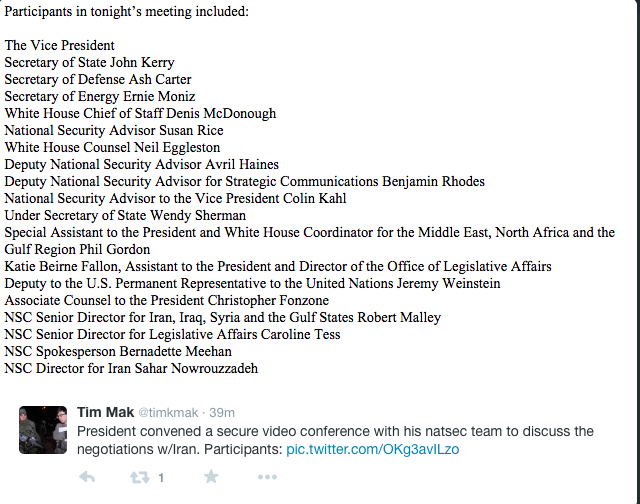
The White House released a list of its high-ranking officials who took part in a video conference with President Obama late Tuesday. Among them appears Sahar Nowrouzzadeh, who has formerly worked for the National Iranian-American Council.

The White House brief, which was disclosed by The Daily Beast, listed Sahar Nowrouzzadeh as the National Security Council Director for Iran. Nowrouzzadeh appears to be a former employee of the alleged pro-Tehran regime lobbying group, NIAC (National Iranian-American Council).

Screen Shot 2015-03-31 at 8.48.17 PM.png

Breitbart News has found that a person with the same name has previously written several publications on behalf of NIAC. According to what appears to be her LinkedIn account, Nowrouzzadeh became an analyst for the Department of Defense in 2005 before moving her way up to the National Security Council in 2014.
A NIAC profile from 2007 reveals that Sahar Nowrouzzadeh appears to be the same person as the one who is currently the NSC Director for Iran. The profiles indicate that she had the same double major and attended the same university (George Washington).

Critics have alleged that NIAC is a lobby for the current Iranian dictatorship under Ayatollah Khamenei. A dissident journalist revealed recently that NIAC’s president and founder, Trita Parsi, has maintained a years-long relationship with Iranian Foreign Minister, Javad Zarif.

NIAC was established in 1999, when founder Trita Parsi attended a conference in Cyprus that was held under the auspices of the Iranian regime. During the conference, Parsi reportedly laid out his plan to introduce a pro-regime lobbying group to allegedly counteract the influence of America’s pro-Israel and anti-Tehran regime advocacy groups.

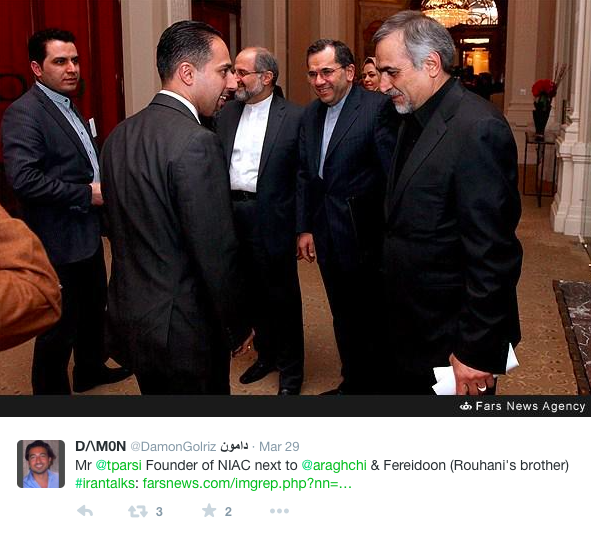
NIAC has been investing heavily in attempts to influence the talks in favor of an agreement with the state sponsor of terror. In recent days, its director, Trita Parsi, has been spotted having amiable conversation with Iranian President Hassan Rouhani’s brother.

Screen Shot 2015-03-31 at 2.22.52 PM.png

The possible revelations about the NSC Director’s apparent past with the alleged pro-regime group come as the U.S. has reportedly struck an agreement with Iran and the rest of the P5+1 world powers on Tehran’s nuclear weapons program.
***
So what else is not being addressed in the negotiations?

LAUSANNE, Switzerland — A top State Department official on Monday dismissed reports that Iran may be hiding key nuclear-related assets in North Korea and implied that she was unaware of the possibility, despite the publication this weekend of several articles by top analysts expressing alarm at the extent of nuclear cooperation between Tehran and Pyongyang.

Marie Harf, a spokeswoman for the State Department, dismissed as “bizarre” the reports, which described the transfer of enriched uranium and ballistic missile technology back and forth between the two rogue regimes.

The existence of an illicit Iranian nuclear infrastructure outside of the Islamic Republic’s borders would gut a nuclear deal that the administration has vowed to advance by Tuesday, according to these experts and others.

If Iran is not forced to disclose the full extent and nature of its outside nuclear work to the United States, there is virtually no avenue to guarantee that it is living up to its promises made in the negotiating room, according to multiple experts and sources in Europe apprised of the ongoing talks.

Gordon Chang, a North Korea expert who has written in recent days about Iran’s possible “secret program” there, described the State Department’s dismissal of these reports as naïve.

“Let me see if I get this straight: The country with the world’s most highly developed technical intelligence capabilities does not know what has been in open sources for years?” Chang said. “No wonder North Korea transfers nuclear weapons technology to Iran and others with impunity.”

“The North Koreans could go on CNN and say, ‘Hey, Secretary Kerry, we’re selling the bomb to Iran,’ and the State Department would still say they know nothing about it,” Chang said. “No wonder we’re in such trouble.”

Other Iranian experts specializing in the country’s military workings also have raised recent questions about Tehran’s collaboration with North Korea.

Ali Alfoneh and Reuel Marc Gerecht, both senior fellows at the Foundation for Defense of Democracies (FDD), have revealed that a nuclear reactor destroyed in Syria in 2007 by Israel was likely a North Korean-backed Iranian project.

Gerecht told the Free Beacon in a follow-up interview that key issues regarding Iran’s past military work and outside collaboration are being ignored in the negotiating room as diplomats rush to secure a tentative deal by Tuesday night.

“It certainly appears that the administration has backed away from [previous military dimensions] questions,” Gerecht said. “The plan appears to be to let the [International Atomic Energy Agency] continue its so far fruitless effort to gain access to sensitive sites, personnel, and paperwork, but to keep these questions out of the talks.”

“The administration is doing this because it fears the Iranians would walk out,” he added. “Any military work revealed by the Iranians would prove the Supreme Leader and [President] Rouhani liars.

Despite concerns from countries such a France over the issue, the United States has attempted to accommodate Iran, Gerecht said.

“The White House wants to believe that monitoring of known sites will be sufficient. It’s a bit mystifying given the Iranian track record and the CIA’s longstanding inability to penetrate the nuclear-weapons program (it’s just too hard of a target to do this reliably),” he explained. “But since they fear a breakdown, they bend their credulity in Iran’s favor. This has been the story of the negotiations from the beginning.”

Alfoneh also told the Free Beacon that Iran should be pressed by the United States to disclose the full extent of its nuclear relationship with North Korea.

“I certainly think the Islamic Republic should come clean concerning its past record of nuclear activities: Did the Islamic Republic ever try to build a nuclear weapon? If not, how are we to understand the opaque references to Tehran-Pyongyang nuclear cooperation in the 1990s?” Alfoneh said.

“As long as the Islamic Republic does not provide a clear record of its nuclear activities in the 1980s and 1990s, and as long as we do not know the full scope of Tehran-Pyongyang nuclear cooperation, there is always the risk of the two states renewing that cooperation, which in turn would jeopardize any agreement the Islamic Republic and the P5+1 Group may reach,” he said.

Another potential complication includes the ability of international inspectors to discern the extent of Iran’s nuclear work in Syria.

“Syria’s current chaos makes it virtually impossible for inspectors to do their job even if the Syrians were compliant,” according to Emanuele Ottolenghi, a onetime advisor to foreign ministries in Europe.

There is no way to determine whether Syria is housing any other nuclear sites on behalf of the Iranian, according to Ottolenghi, another senior fellow at FDD.

“Syria has covered up its nuclear activities after the 2007 [Israeli Air Force] raid on Deir al-Azour,” he said. “After four years of inconclusive efforts, the [International Atomic Energy Agency] ended up deferring the issue to the [United Nations Security Council] after declaring Syria in non-compliance.”

Hillary’s Server, a Rod Serling Drama


A hacker source employed a tool called “The Harvester” to search a number of data sources to look for references to the domain name Clintonemail.com. The source says it appears Clinton established multiple email addresses, including hdr@clintonemail.com, hdr18@clintonemail.com, hdr19@clintonemail.com, hdr20@clintonemail.com, and hrd21@clintonemail.com.

Other email addresses include h.clinton@clintonemail.com, Hillary@clintonemail.com, contact@clintonemail.com, and mau_suit@clintonemail.com.

It’s not clear whether Clinton used any or all of these email addresses. It’s also unclear whether her aides used them.

The Benghazi Panel: A House panel Tuesday formally requested Hillary Clinton to testify about the private server and email account she used while serving as secretary of state.

Rep. Trey Gowdy, chairman of the Select Committee on Benghazi, sent a request to Clinton’s personal attorney, David E. Kendall, requesting that Clinton appear before the committee no later than May 1 for a transcribed interview about the server and email.

The request comes after Kendall told Gowdy that the server had been wiped clean and that it would be impossible to recover the 30,000 emails Clinton deleted last year.

Gowdy, in his request to Kendall, also asked Clinton to “reconsider” her refusal to turn over the server to a neutral third party, which he called “highly unusual, if not unprecedented.” Gowdy’s letter to Hillary’s lawyer is here:

There is more breaking today:

The Associated Press reported today that former Secretary of State Hillary Clinton also used an iPad to send emails from her private account. This appears to undermine Clinton’s initial explanation that her decision to use a private email server was motivated by her desire to carry a single device (a BlackBerry).

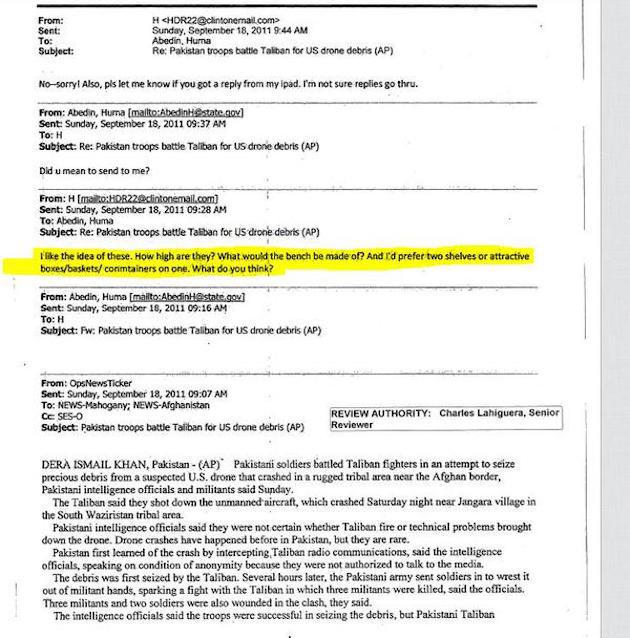
Emails obtained by the AP show that Clinton occasionally mixed up personal correspondence with work-related matters. For example, Clinton once responded to an email about drone strikes in Pakistan from senior aide Huma Abedin with a series of questions about interior decorating.

The Associated Press reported today that former Secretary of State Hillary Clinton also used an iPad to send emails from her private account. This appears to undermine Clinton’s initial explanation that her decision to use a private email server was motivated by her desire to carry a single device (a BlackBerry).

Emails obtained by the AP show that Clinton occasionally mixed up personal correspondence with work-related matters. For example, Clinton once responded to an email about drone strikes in Pakistan from senior aide Huma Abedin with a series of questions about interior decorating.

Hillary emailSo, now new questions need to be asked.

1. How many at State knew about the alias server?

2. Did the Accountability Review Board led by Pickering know about the offsite server and non-governmental email accounts?

3. Who decided where to apply the countless FOIA requests for Benghazi documents and why was the private server not included?

4. Patrick Kennedy, the Deputy Secretary of State, clearly omitted the procedures and government document laws with regard to Hillary, question is did she demand he look the other way and or why did he not report this or admit the condition during his congressional testimony?

5. With each unique email account on that server, were they assigned to different users at State, or in Hillary’s private spy-network or all of the above?

6. Is the White House about to give executive privilege to Hillary’s server and emails?

7. Is the Department of Justice taking over cases to represent some of the complicit government employees in the Hillary caper?

There is also something called the Executive Secretariat at the State Department, at it appears by description, it was used excessively by Hillary and her team. Where are those emails? Did the Secretariat Office get some kind of exemption from subpoenas and FOIA requests?

The Executive Secretariat (S/ES), comprised of the Executive Secretary and four Deputy Executive Secretaries, is responsible for coordination of the work of the Department internally, serving as the liaison between the Department’s bureaus and the offices of the Secretary, Deputy Secretary, and Under Secretaries. It also handles the Department’s relations with the White House, National Security Council, and other Cabinet agencies.

The Secretariat Staff (S/ES-S) works with the various offices of the Department in drafting and clearing written materials for the Secretary, Deputy Secretary, and Under Secretary for Political Affairs. This staff also is responsible for taking care of advance preparations for the Secretary’s official trips — domestic and international — and staffing the “mobile office” and keeping the Secretary’s schedule on track during the trip.
The Operations Center (S/ES-O) is the Secretary’s and the Department’s communications and crisis management center. Working 24 hours a day, the Operations Center monitors world events, prepares briefings for the Secretary and other Department principals, and facilitates communication between the Department and the rest of the world. The Operations Center also coordinates the Department’s response to crises and supports task forces, monitoring groups, and other crisis-related activities.


What About the P5+1 and Iran/North Korea

If you are inclined to read about the technical cooperation agreement between North Korea and Iran go here.


Ed Schroeder’s Military Intelligence Report: Does Iran Have Secret Nukes in North Korea?

In October 2012, Iran began stationing personnel at a military base in North Korea, in a mountainous area close to the Chinese border. The Iranians, from the Ministry of Defense and associated firms, reportedly are working on both missiles and nuclear weapons. Ahmed Vahidi, Tehran’s minister of defense at the time,denied sending people to the North, but the unconfirmed dispatches make sense in light of the two states announcing a technical cooperation pact the preceding month.

The P5+1—the five permanent members of the Security Council and Germany—appear determined, before their self-imposed March 31 deadline, to ink a deal with the Islamic Republic of Iran regarding its nuclear energy program, which is surely a cover for a wide-ranging weapons effort. The international community wants the preliminary arrangement now under discussion, referred to as a “framework agreement,” to ensure that the country remains at least one year away from being able to produce an atomic device.

The P5+1 negotiators believe they can do that by monitoring Tehran’s centrifuges—supersonic-speed machines that separate uranium gas into different isotopes and upgrade the potent stuff to weapons-grade purity—and thereby keep track of its total stock of fissile material.

The negotiators from the United States, the United Kingdom, France, Germany, Russia, and China are trying to get Tehran to adhere to the Additional Protocol, which allows anytime, anyplace inspections by the International Atomic Energy Agency, the U.N.’s nuclear watchdog. If Iran agrees to the IAEA’s intrusive inspections, proponents of the deal will claim a major breakthrough, arguing for instance that Iran will not be able to hide centrifuges in undisclosed locations.

There were so many North Korean nuclear and missile scientists, specialists, and technicians at Iran’s facilities that they took over their own coastal resort there.

But no inspections of Iranian sites will solve a fundamental issue: As can be seen from the North Korean base housing Tehran’s weapons specialists, Iran is only one part of a nuclear weapons effort spanning the Asian continent. North Korea, now the world’s proliferation superstar, is a participant. China, once the mastermind, may still be a co-conspirator. Inspections inside the borders of Iran, therefore, will not give the international community the assurance it needs.

The cross-border nuclear trade is substantial enough to be called a “program.” Larry Niksch of the Center for Strategic and International Studies in Washington, D.C., estimates that the North’s proceeds from this trade with Iran are “between $1.5 billion and $2.0 billion annually.” A portion of this amount is related to missiles and miscellaneous items, the rest derived from building Tehran’s nuclear capabilities.

Iran has bought a lot with its money. Mohsen Fakhrizadeh, thought to be Tehran’s chief nuclear scientist, was almost certainly in North Korea at Punggye-ri in February 2013 to witness Pyongyang’s third atomic test. Reports put Iranian technicians on hand at the site for the first two detonations as well.

The North Koreans have also sold Iran material for bomb cores, perhaps even weapons-grade uranium. The Telegraph reported that in 2002 a barrel of North Korean uranium cracked open and contaminated the tarmac of the new Tehran airport.

In addition, the Kim Jong Un  regime appears to have helped the Islamic Republic on its other pathway to the bomb. In 2013, Meir Dagan, a former Mossad director,charged the North with providing assistance to Iran’s plutonium reactor.

The relationship between the two regimes has been long-lasting. Hundreds of North Koreans have worked at about 10 nuclear and missile facilities in Iran. There were so many nuclear and missile scientists, specialists, and technicians that they took over their own coastal resort there, according to Henry Sokolski,  the proliferation maven, writing in 2003.

Even if Iran today were to agree to adhere to the Additional Protocol, it could still continue developing its bomb in North Korea, conducting research there or buying North Korean technology and plans. And as North Korean centrifuges spin in both known and hidden locations, the Kim regime will have a bigger stock of uranium to sell to the Iranians for their warheads. With the removal of sanctions, as the P5+1 is contemplating, Iran will have the cash to accelerate the building of its nuclear arsenal.

So while the international community inspects Iranian facilities pursuant to a framework deal, the Iranians could be busy assembling the components for a bomb elsewhere. In other words, they will be one day away from a bomb—the flight time from Pyongyang to Tehran—not one year as American and other policymakers hope.

The North Koreans are not the only contributors to the Iranian atom bomb. Iran got its first centrifuges from Pakistan, and Pakistan’s program was an offshoot from the Chinese one.

Some argue that China proliferated nuclear weapons through the infamous black market ring run by Dr. Abdul Qadeer Khan. There is no open source proof of that contention, but Beijing did nothing while Khan merchandised Chinese parts, plans, and knowhow—its most sensitive technology—from the capital of one of its closest allies. Moreover, Beijing did its best to protect the smuggler when Washington rolled up his network in the early part of last decade. The Chinese, for instance, supported General Pervez Musharraf’s controversial decision to end prematurely his government’s inquiry, which avoided exposing Beijing’s rumored involvement with Khan’s activities.

And there are circumstances suggesting that Beijing, around the time of Khan’s confession and immediate pardon in 2004, took over his proliferation role directly, boldly transferring materials and equipment straight to Iran. For example, in November 2003 the staff of the IAEA had fingered China as one of the sources of equipment used in Iran’s suspected nuclear weapons effort. And as reported in July 2007 by The Wall Street Journal, the State Department had lodged formal protests with Beijing about Chinese enterprises violating Security Council resolutions by exporting to Tehran items that could be used for building atomic weapons.

Since then, there have been continual reports of transfers by Chinese enterprises to Iran in violation of international treaties and U.N. rules. Chinese entities have been implicated in shipments of maraging steel, ring-shaped magnets, and valves and vacuum gauges, all apparently headed to Iran’s atom facilities. In March 2011, police in Port Klang seized two containers from a ship bound to Iran from China. Malaysian authorities discovered that goods passed off as “used for liquid mixing or storage” were actually components for potential atomic weapons.

In the last few years, there has been an apparent decline in Chinese shipments to Iran. Beijing could be reacting to American pressure to end the trade, but there are more worrying explanations. First, it’s possible that, after decades of direct and indirect illicit transfers, China has already supplied most of what Iran needs to construct a weapon. Second, Beijing may be letting Pyongyang assume the leading proliferation role. After all, the shadowy Fakhrizadeh was reported to have traveled through China on his way to North Korea to observe the North’s third nuclear test.

Fakhrizadeh’s passage through China—probably Beijing’s airport—suggests that China may not have abandoned its “managed proliferation.” In the past, China’s proxy for this deadly trade was Pakistan. Then it was China’s only formal ally, North Korea. In both cases, Chinese policymakers intended to benefit Iran.

In a theoretical sense, there is nothing wrong with an accommodation with the Islamic Republic over nukes, yet there is no point in signing a deal with just one arm of a multi-nation weapons effort. That’s why the P5+1 needs to know what is going on at that isolated military base in the mountains of North Korea. And perhaps others as well.

Cheryl Mills, the Firewall for Hillary’s SpyNet

Cheryl Mills: The Woman Who Knew Too Much?

The New York Times reports that Cheryl Mills, Hillary Clinton’s long-time henchwoman will not be joining the Presidential campaign now presumably in the final stages of formation. Why? Perhaps Mills is, to borrow a phrase from Alfred Hitchcock, the woman who knew too much.

Mills, who was the State Department’s counselor and chief of staff during the entirety of Hillary’s tumultuous tenure, is up to her waist in the Benghazi matter, where the overwhelming evidence is that Secretary of State Hillary Clinton put politics before the security and safety of U.S. citizens serving their country in that hell-hole.

Earlier this month, Judicial Watch obtained emails  through a federal lawsuit which contained multiple references to the, “so-called Benghazi Group. A diplomatic source told Fox News that was code inside the department for the so-called Cheryl Mills task force, whose job was damage control.”

Clearly Clinton, and Obama, were concerned about the “optics” and potential political fallout of the al-Qaeda 9/11 assault on the Benghazi consulate where four Americans were murdered less than 60 days from election day. The emails show Mills “running interference internally during the 2012 Benghazi terror attack.”

Specifically, Mills instructed then State Department spokesman Victoria Nuland “to stop answering reporter questions about the status of Ambassador Chris Stevens, who was missing and later found dead.” Nuland quickly demurred.

This is the same Nuland who objected to the original Benghazi talking points drafted by the CIA because they included references to the al Qaeda affiliate Ansar al-Sharia and to previous CIA warnings about terror threats in Benghazi. Nuland worried that any mention of the the CIA warnings “could be used by Members [of Congress] to beat the State Department for not paying attention to Agency warnings so why do we want to feed that? Concerned …”

Surely Nuland was given guidance by Mills.

Mills continued the cover-up by telling State Department employees to obstruct the 2013 congressional investigation. In June, 2013 Gregory Hicks, the former deputy chief of mission in Libya during the Benghazi attack, testified to Congress that Mills was “personally instructed to allow the RSO [Regional Security Officer], the acting deputy chief of mission, and myself to be personally interviewed by Congressman Chaffetz.”

In true Clinton form, Hicks said in a September 2013 interview that as a result of cooperating with Congress he was “punished” and “shunted aside, put in a closet,” not receiving a new assignment from State.

Like Nixon and his White House tapes, Hillary is now arguing that the e-mails are her personal property and she should decide what the American people get to read. While serving as secretary of State, Hillary Clinton no doubt sent and received countless emails pertaining to personal issues with no relevance to State Department issues via her private account. But Supreme Court precedent in the Nixon case seems clear: she doesn’t get to decide what to release and what not to.

What does this have to do with Ms. Mills? Mills is the trusted aide who reviewed the e-mail to decide which e-mails to erase. Mills joined Hillary in eschewing government e-mail so e-mails between her and her boss are illegally kept from public view  when they conducted public business.

Mills has another darker distinction. When the Palm Beach police seized the address book of convicted billionaire pedophile and friend of Bill, Jeffrey Epstein, they found the cell phone and personal e-mail address for Mills.

What did Hillary know of Epstein’s sexual abuse of underage girls? What did Hillary think Bill was doing when he and his now disaffected wingman Doug Band visited Epstein’s palatial Palm Beach home where neighbors say the POTUS partied until the wee hours with scores of women who were dropped off by limousine after the arrival of the presidential motorcade.

What did Hillary think Bill was doing on Epstein’s hedonistic island retreat where he was seen in the company of two 17 year-olds flown in from New York for the former Presidents amusement? Perhaps Mills can tell us.

Mills is a member of the Clinton Foundation’s Board of Directors, now under fire for taking millions from foreign governments, particularly those in the Middle East who oppress women and deny them the most basic human rights. Perhaps Mills has seen the e-mails that show the self-dealing nexus between Hillary’s stint at State and the avalanche  of cash the Clintons have scammed from foreign powers for a charity that spends more on luxury travel for the Clintons and a huge staff of political retainers than they do on charitable works to help actual people.

Pine not for Ms. Mills. As the Clintons demonstrated when they placed Epstein’s pedophilic pimp Ghislaine Maxwell in a job at a non-profit funded by the Clinton Foundation, the Clintons sometimes buy silence. Maxwell was granted immunity for her role in procuring underage girls for Epstein to molest. She was present when Bill partied in both Palm Beach and on Epstein’s orgy island, his private retreat in the carribean. Like Mills, Maxwell knows too much.

Or perhaps Mills should be concerned. Cheryl Mills figures into every scandal dogging Hillary Clinton and probably a few we don’t know about yet. As they did with James Carville, Dick Morris, Doug Band, and others the Clinton’s have no problem discarding staff when they are no longer useful. But sometimes, as in the case of former Clinton Security Chief Jerry Parks who knew chapter and verse on Bill Clinton’s sexual peccadilloes and whose brutal murder goes unsolved, those who know too much are silenced.

**** As an aside, my buddy Larry Klayman, at Freedom Watch filed a lawsuit against Hillary Clinton for operating a criminal enterprise, charges of racketeering.