
We need more feel-good stories than we think we do and here is one for you. History buffs and World War ll historians will love this one…
In full from the Military Times:
One man’s trash is the National Archives’ treasure.
After more than 80 years, an old logbook containing the initial descriptions of U.S. vessels after the Japanese attack on Navy Yard Pearl Harbor in 1941 was recovered, the National Archives recently announced. The logbook covers the 16 months before and after the attack that was the catalyst for the U.S. entry into World War II.
Its whereabouts can be traced back to the moment it was plucked from a trash bin in the 1970s at the old Norton Air Force Base in San Bernardino, California, by Oretta Kanady, The Washington Post first reported.
In an interview with the Post, Kanady’s son, Michael William Bonds, said she found it in the bin while working as a civilian employee and thought it looked interesting. She asked if she could have it, and it remained in her possession until her death in 2000. Bonds then inherited it.
“In the last few years, I’ve moved here, moved there, it’s just been in a box,” Bond’s told The Post. “I hadn’t really looked at it.” source is the Washington Post
The book is in good condition, and while it may not alter the basic understanding of the events of Pearl Harbor, where more than 2,400 sailors, Marines, soldiers and civilians were killed after Japanese war planes attacked U.S. military installations near Honolulu, it helps to verify the story of the day that lives in infamy.
“We have nothing, nor does the nation have anything similar to this,” Mitchell Yockelson, an investigative archivist at the National Archives, stated as the book was unveiled at the Archives facility in College Park, Maryland.
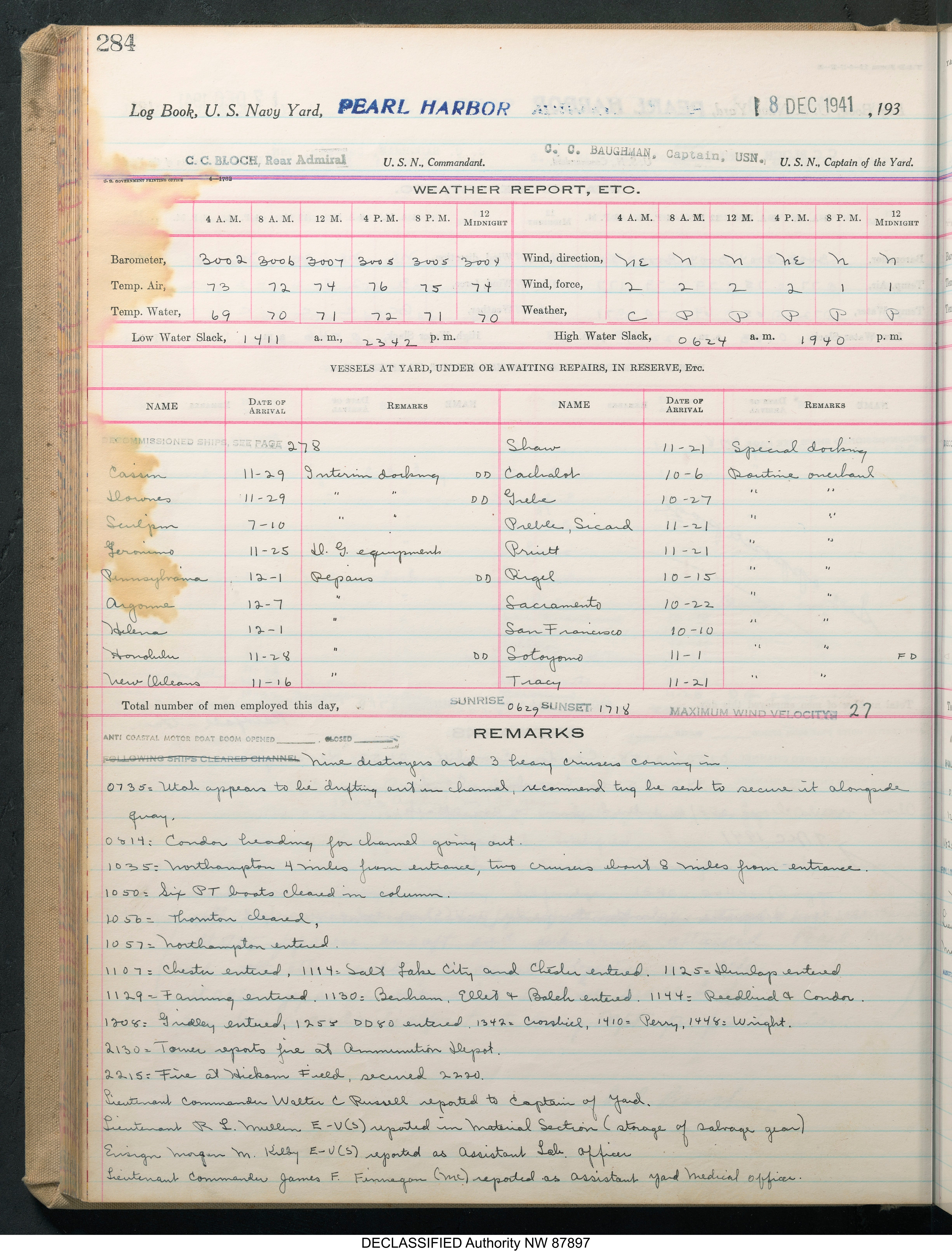
Logbooks, used by the Navy, were brief daily records of events and observations. In the case of “Log Book, U.S. Navy Yard Pearl Harbor,” it documented several of the ships that were at Navy installation the day of the Dec. 7 attack.
Dec. 5, 1941, records the arrival of the battleships Arizona and Oklahoma. Both were famously sunk just two days later.
On Dec. 8, one day after the attack that left the harbor — and a nation — reeling, the logbook recorded that at 07:35 that the damaged battleship USS Utah “appears to be drifting out in the channel, recommend tug be sent to secure it alongside quay.”
Other notations from that day include:
At 21:30: “Tower reports fire at ammunition depot.”
At 22:15: “Fire at Hickam field secured.”
Interestingly, the pages for Dec. 6 and 7, and into the 8th, have brown stains splattered across their sheets.
“That’s another question that we’ve been wondering” about, Yockelson said during the unveiling. “We like to think that maybe … somebody was so agitated at what went on that he spilled his thermos.”
A fully digitized copy of the logbook is available online.
It also shows the Pearl Harbor yard’s essential work in repairing Navy warships after the Japanese attack, putting cruisers and destroyers back in the fight after severe damage. Within six months, the yard had taken in and redelivered the damaged battleships Pennsylvania, Maryland, and Tennessee; cruisers Honolulu, Helena, and Raleigh; destroyers Helm and Shaw; and three auxiliaries, all fully repaired or patched up for transit for permanent repairs. More here.
