Jeff Sessions/FBI and MS-13

Four members of the violent, foreign MS-13 gang were convicted on federal racketeering charges, some of which involved murder.

Miguel Zelaya, 20-years-old, Luis Ordonez-Vega, 36-years-old, Jorge Sosa, 24-years-old and William Gavidia, 23-years-old, were all convicted on a count of conspiracy to commit racketeering, according to the Charlotte Observer:

Zelaya, who also goes by “Most Wanted” and “Ne Ne” is a member of MS-13’s “Coronados Little Cycos Salvatrucha” clique. On Dec. 18, 2013, he shot and killed Jose Orlando Ibarra, an associate of The Latin Kings, a rival gang, the release said.

Ordonez-Vega, also known as “Big Boy,” is a member of the Brentwood Locos Salvatrucha” clique, according to the news release. On June 6, 2013, Ordonez-Vega shot and killed Noel Navarro Hernandez in a strip mall parking lot in Charlotte, believing the victim was a member of a rival gang.

Sosa, who goes by “Koki” and “Loco” is a member of the “Charlotte Locotes Salvatrucha” clique. Prosecutors say he’s been involved in multiple gang-related crimes. In Feb. 2008, he flashed MS-13 gang signs at a rival gang member’s mother and pointed a gun at her while they were stopped in traffic. In June, 2013, he was involved in a gang-related shooting where he and another person followed victims in a neighborhood in Charlotte and opened fire with a high-caliber rifle, the release said.

All of the gang members are either immigrants or the children of immigrants in the U.S. and they are also facing state charges for their crimes.

“Today’s guilty verdicts underscore that even though gang membership may in some ways ‘protect’ gangsters from outsiders, it certainly won’t protect them from the vast reach of the US. Attorney’s Office and our law enforcement partners,” U.S. Attorney for the Western District of North Carolina Jill Westmoreland Rose said in a statement.

The MS-13 gang members were four of 37 who were charged with racketeering after an investigation into the criminal activity by the Organized Crime Drug Enforcement Task Force. Thirty of the other gang members charged with racketeering are either awaiting sentencing or have pleaded guilty to the charges.

According to the U.S. District Attorney, Ordonez-Vega and Zelaya were convicted on charges to murder in aid of racketeering. Those charges are connected to two separate murders. Meanwhile, Sosa was convicted for attempted murder in the aid of racketeering.

***

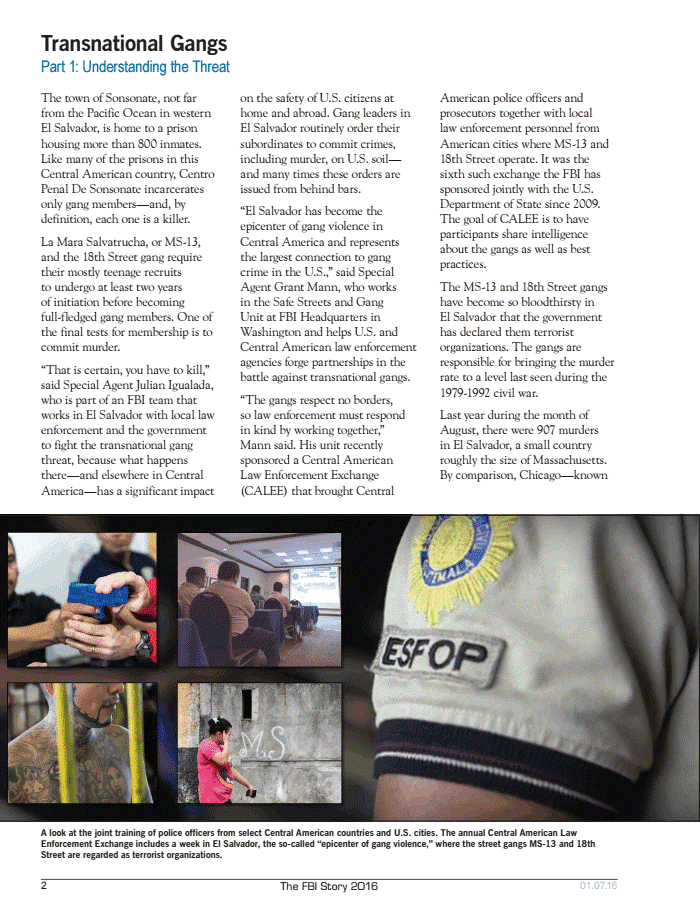
Image result for ms-13  InSightCrime

In 2015 the U.S. Treasury Department froze the assets of three members of the gang who were funneling funds back to higher-ups in El Salvador from prison. These actions were an attempt “disrupt” MS-13’s financial network by cutting off profits from illegal activities in the United States, the Treasury Department said. In 2012 the Obama administration designated MS-13 a transnational crime organization and implemented sanctions against six members in 2013.

While the U.S. government attempts to target MS-13’s earnings, targeting its culture is proving more difficult. The fierce loyalty among members is unique, Ron Hosko, former assistant director of the FBI’s Criminal Investigative Division, told FOX Business.

“They’re very cohesive and often directed by imprisoned bosses in El Salvador to recruit and expand in American communities. That tends to mean there’s an aggressive internal enforcement mechanism which equates to internal discipline involving physical violence and murder for disrespect or betrayal,” he said.

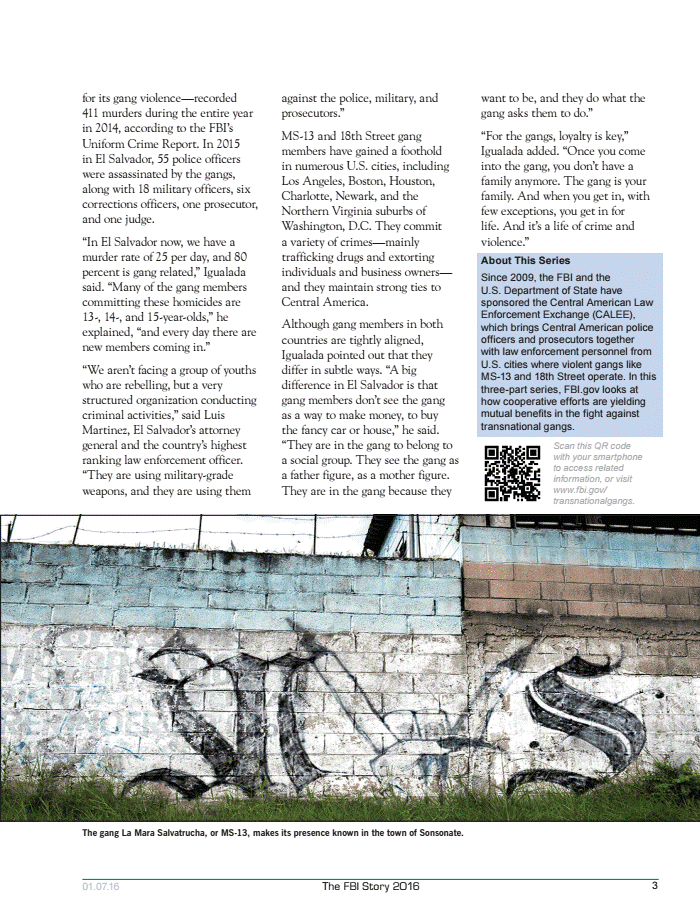
The FBI in El Salvador Because of MS-13:

CNN Reported Dossier Basis for Trump Surveillance, But…

The FBI last year used a dossier of allegations of Russian ties to Donald Trump’s campaign as part of the justification to win approval to secretly monitor a Trump associate, according to US officials briefed on the investigation.

The dossier has also been cited by FBI Director James Comey in some of his briefings to members of Congress in recent weeks, as one of the sources of information the bureau has used to bolster its investigation, according to US officials briefed on the probe.
This includes approval from the secret court that oversees the Foreign Intelligence Surveillance Act (FISA) to monitor the communications of Carter Page, two of the officials said. Last year, Page was identified by the Trump campaign as an adviser on national security. More here from CNN.
Okay, so everyone remains angry with James Comey right? Okay, well hold on….this could get complicated. We cant dismiss the notion that Obama and Susan Rice had a valid reason for their surveillance
actions, at least some as the below case was provided to the White House.
Enter Evigeniy Mikhailovich Bogachev.
Image result for evgeniy mikhailovich bogachev

U.S. v Evgeniy Mikhailovich Bogachev et al by Brian Ries on Scribd

Bogachev was a case from 2014 investigated by CrowdStrike and then later offered help to the FBI office in Omaha and later the FBI office in Pittsburgh finally after countless months, ran a global cyber operation and succeeded in stopping international bank thefts in the millions of dollars. Many Russian immigrants located in Brighton Beach were recruited to be mules going to domestic banks, opening accounts and later withdrawing funds, cleaning all traces of the stolen millions. It should be noted that CrowdStrike was the same firm the Hillary campaign hired to investigate intrusions.

Image result for evgeniy mikhailovich bogachev

Now it gets even more interesting.

The matter of Bogachev with his named operation of ‘Business Club’ and his global cyber operatives hacking with sophisticated bots, malware and remote servers came to the attention of the Russian Federation. They liked what the Bogachev Zeus operation had the ability to do. So, top Kremlin officials allowed the operation to continue without prosecution if they would work to gather intelligence on the global reaction to Putin annexing Crimea and moving in on Ukraine.

All of this came to the attention also of U.S. based private cyber professional where they studied the code, the IP addresses, the servers, the patterns, names and other common cyber traits. The DNC hack attributions are a dovetail to the ‘Business Club’ operation due to style, coding, networks, language and server locations.

In 2015, the Obama State Department issued sanctions and a $3 million dollar bounty on Bogachev who operated with the alias of ‘Slavik’. Russia of course is not only not cooperating but refuses to admit any such action was real and the evidence is not vetted. This is a usual response by top Russian officials.

An estimated $100 million was stolen via cyber operations by Slavik and computers infected with various versions of Zeus still exist while the FBI was able to seized all those known to their sting operation.

The FBI described the cyber sting operation as hand to hand combat with Bogachev and his operation on the Zeus case was deemed successful. It is unknown at this time who and where is he still operating. The summary of this operation was taken from the full article published by ‘Wired’ under the title ‘The Hunt for Russia’s Most Notorious Hacker’

Late last year, the DHS released a joint statement which read in part:

This activity by Russian intelligence services is part of a decade-long campaign of cyber-enabled operations directed at the U.S. Government and its citizens. These cyber operations have included spearphishing, campaigns targeting government organizations, critical infrastructure, think tanks, universities, political organizations, and corporations; theft of information from these organizations; and the recent public release of some of this stolen information.  In other countries, Russian intelligence services have also undertaken damaging and disruptive cyber-attacks, including on critical infrastructure, in some cases masquerading as third parties or hiding behind false online personas designed to cause victim to misattribute the source of the attack.  The Joint Analysis Report provides technical indicators related to many of these operations, recommended mitigations and information on how to report such incidents to the U.S. Government.

A great deal of analysis and forensic information related to Russian government activity has been published by a wide range of security companies.  The U.S. Government can confirm that the Russian government, including Russia’s civilian and military intelligence services, conducted many of the activities generally described by a number of these security companies.  The Joint Analysis Report recognizes the excellent work undertaken by security companies and private sector network owners and operators, and provides new indicators of compromise and malicious infrastructure identified during the course of investigations and incident response.  The U.S. Government seeks to arm network defenders with the tools they need to identify,, detect and disrupt Russian malicious cyber activity that is targeting our country’s and our allies’ networks.


Putin’s Think Tank Crafted 2016 U.S. election Interference – documents

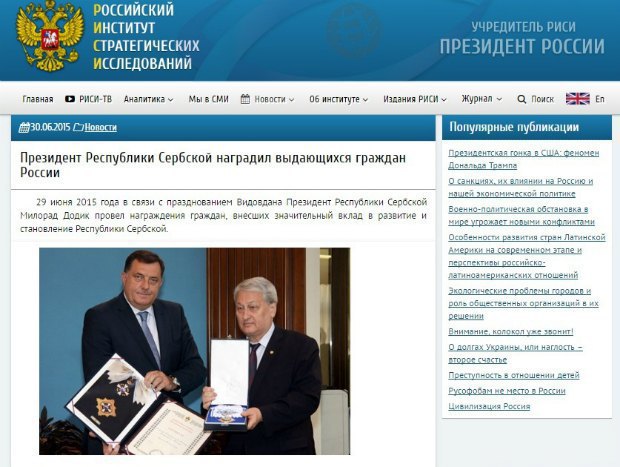
Image result for Russian Institute for Strategic Studies  Image result for Russian Institute for Strategic Studies

Reuters: A Russian government think tank controlled by Vladimir Putin developed a plan to swing the 2016 U.S. presidential election to Donald Trump and undermine voters’ faith in the American electoral system, three current and four former U.S. officials told Reuters.

They described two confidential documents from the think tank as providing the framework and rationale for what U.S. intelligence agencies have concluded was an intensive effort by Russia to interfere with the Nov. 8 election. U.S. intelligence officials acquired the documents, which were prepared by the Moscow-based Russian Institute for Strategic Studies [en.riss.ru/], after the election.

The institute is run by retired senior Russian foreign intelligence officials appointed by Putin’s office.

The first Russian institute document was a strategy paper written last June that circulated at the highest levels of the Russian government but was not addressed to any specific individuals.

It recommended the Kremlin launch a propaganda campaign on social media and Russian state-backed global news outlets to encourage U.S. voters to elect a president who would take a softer line toward Russia than the administration of then-President Barack Obama, the seven officials said.

A second institute document, drafted in October and distributed in the same way, warned that Democratic presidential candidate Hillary Clinton was likely to win the election. For that reason, it argued, it was better for Russia to end its pro-Trump propaganda and instead intensify its messaging about voter fraud to undermine the U.S. electoral system’s legitimacy and damage Clinton’s reputation in an effort to undermine her presidency, the seven officials said.

The current and former U.S. officials spoke on the condition of anonymity due to the Russian documents’ classified status. They declined to discuss how the United States obtained them. U.S. intelligence agencies also declined to comment on them.

Putin has denied interfering in the U.S. election. Putin’s spokesman and the Russian institute did not respond to requests for comment.

The documents were central to the Obama administration’s conclusion that Russia mounted a “fake news” campaign and launched cyber attacks against Democratic Party groups and Clinton’s campaign, the current and former officials said.

“Putin had the objective in mind all along, and he asked the institute to draw him a road map,” said one of the sources, a former senior U.S. intelligence official.

Trump has said Russia’s activities had no impact on the outcome of the race. Ongoing congressional and FBI investigations into Russian interference have so far produced no public evidence that Trump associates colluded with the Russian effort to change the outcome of the election.

Four of the officials said the approach outlined in the June strategy paper was a broadening of an effort the Putin administration launched in March 2016. That month the Kremlin instructed state-backed media outlets, including international platforms Russia Today and Sputnik news agency, to start producing positive reports on Trump’s quest for the U.S. presidency, the officials said.

Russia Today did not respond to a request for comment. A spokesperson for Sputnik dismissed the assertions by the U.S. officials that it participated in a Kremlin campaign as an “absolute pack of lies.” “And by the way, it’s not the first pack of lies we’re hearing from ‘sources in U.S. official circles’,” the spokesperson said in an email.

PRO-KREMLIN BLOGGERS

Russia Today and Sputnik published anti-Clinton stories while pro-Kremlin bloggers prepared a Twitter campaign calling into question the fairness of an anticipated Clinton victory, according to a report by U.S. intelligence agencies on Russian interference in the election made public in January. [bit.ly/2kMiKSA]

Russia Today’s most popular Clinton video – “How 100% of the 2015 Clintons’ ‘charity’ went to … themselves” – accumulated 9 millions views on social media, according to the January report. [bit.ly/2os8wIt]

The report said Russia Today and Sputnik “consistently cast president elect-Trump as the target of unfair coverage from traditional media outlets.”

The report said the agencies did not assess whether Moscow’s effort had swung the outcome of the race in Trump’s favor, because American intelligence agencies do not “analyze U.S. political processes or U.S. public opinion.” [bit.ly/2kMiKSA]

CYBER ATTACKS

Neither of the Russian institute documents mentioned the release of hacked Democratic Party emails to interfere with the U.S. election, according to four of the officials. The officials said the hacking was a covert intelligence operation run separately out of the Kremlin.

The overt propaganda and covert hacking efforts reinforced each other, according to the officials. Both Russia Today and Sputnik heavily promoted the release of the hacked Democratic Party emails, which often contained embarrassing details.

Five of the U.S. officials described the institute as the Kremlin’s in-house foreign policy think tank.

The institute’s director when the documents were written, Leonid Reshetnikov, rose to the rank of lieutenant general during a 33-year-career in Russia’s foreign intelligence service, according to the institute’s website [bit.ly/2oVhiCF]. After Reshetnikov retired from the institute in January, Putin named as his replacement Mikhail Fradkov. The institute says he served as the director of Russia’s foreign intelligence service from 2007 to 2016. [bit.ly/2os4tvz]

Reuters was unable to determine if either man was directly involved in the drafting of the documents. Reshetnikov’s office referred questions to the Russian institute.

On its website, the Russian institute describes itself as providing “expert appraisals,” “recommendations,” and “analytical materials” to the Russian president’s office, cabinet, National Security Council, ministries and parliament. [bit.ly/2pCBGpR]

On Jan. 31, the websites of Putin’s office [bit.ly/2os9wMr] and the institute [bit.ly/2oLn9Kd] posted a picture and transcript of Reshetnikov and his successor Fradkov meeting with Putin in the Kremlin. Putin thanked Reshetnikov for his service and told Fradkov he wanted the institute to provide objective information and analysis.

“We did our best for nearly eight years to implement your foreign policy concept,” Reshetnikov told Putin. “The policy of Russia and the policy of the President of Russia have been the cornerstone of our operation.”

(Reporting by Ned Parker and Jonathan Landay, additional reporting by Warren Strobel and Arshad Mohammed; Editing by David Rohde and Ross Colvin)

*** In part:

The wide range of scientific work is ensured by the structural subdivision of the

RISS into the Research Center of CIS countries, Center for Asia and the Middle

East Research, the Center for Euro-Atlantic Studies (‘geographical departments’),

Center for Economic Research, Centre for Defense Studies as well as the Humanitarian

Research Center (functional departments).8 The latter represents a

new department, introduced almost simultaneously with the Presidential Decree

of 2009 and it is preoccupied with “the contentious issues of the foreign relations

history and the role of the religious factor.”9 Its introduction has added a new task

of “counteracting the falsification of history in the post-Soviet space”10 to RISS

scientific activities which are determined by the need of the Russian government

to provide strategic interests in the post-Soviet space. Here, there is a serious element

of propaganda for Russian state interests. Upon the whole, we can conclude

that the Presidential Decree of 2009 has turned the RISS into a useful tool providing

abundant data and research for an appropriate “articulation of the strategic

directions of the state policy in the sphere of national security.”  Read more here.


Russian Bombers Near Kodiak, Alaska, Deconfliction Line Busy?

Again and again…  There was no cockpit-to-cockpit radio communication between the US and Russian pilots. So that ‘deconfliction’ line between the United States and Russia apparently goes to voicemail.

It was just a few days ago that Hawaii formally requested military emergency response operations due to the North Korea threat. Likely, the manner of which Russia maintains aggressive messaging, those two bombers were dispatched to test U.S. response and air defense systems.

FNC: A pair of Russian nuclear-capable bombers flew near Alaska Monday night, two U.S. officials told Fox News, coming as close as 100 miles from Kodiak Island — the first time since President Trump took office that Moscow has sent bombers so close to the U.S.

The two Russian Tu-95 “Bear” bombers flew roughly 280 miles southwest of Elmendorf Air Force Base, within the Air Defense Identification Zone of the United States.

The U.S. Air Force scrambled two F-22 stealth fighter jets and an E-3 airborne early warning plane to intercept the Russian bombers.

The American jets flew alongside the Russian bombers for 12 minutes, before the Russian bombers reversed course and headed back to their base in eastern Russia.

Last week in Moscow, Secretary of State Rex Tillerson said U.S.-Russian relations were at a “low point” while sitting next to Russian Foreign Minister Sergey Lavrov.

While Tillerson was in Moscow, three Russian bombers flew near the east coast of Japan, forcing the Japanese military to scramble 14 fighter jets at various times to intercept the bombers. A Russian spy plane also flew along Japan’s west coast.

The last time Russian bombers flew near the U.S. was July 4, 2015, when a pair of Russian bombers flew off the coasts of Alaska and California, coming as close as 40 miles to Mendocino, Calif.

Russian President Vladimir Putin called then-President Barack Obama to wish him a happy Independence Day while the bombers cruised the California coastline.

***

WaPo: Gen. Paul Selva recently became the first Pentagon official to state publicly that Russia has deployed a land-based cruise missile in direct violation of its treaty obligations to the United States. Selva, who serves as vice chairman of the Joint Chiefs of Staff, said in testimony before the House Armed Services Committee: “We believe that the Russians have deliberately deployed it in order to pose a threat to NATO.” He also noted — to the best of his knowledge — that “they do not intend to return to compliance.”

In other words, the Russians have calculated that it costs them more to fulfill their treaty commitments than to break them. The only proper response to this provocation is to increase the costs and change Russia’s calculation.

The agreement in question is the Intermediate-Range Nuclear Forces Treaty, which the Soviet Union and the United States signed in 1987 to eliminate an entire class of land-based missiles with a range of 500 to 5,500 kilometers. Reasons for the treaty date back to the late 1970s, when the Soviet Union deployed intermediate-range nuclear missiles to Europe, reducing warning times and threatening to divide Europe from North America. NATO responded by deploying U.S. intermediate-range nuclear missiles in 1983. The increased tensions ultimately led to arms-control negotiations and the landmark INF Treaty.

***

The Tu-95 is the worlds fastest propeller driven aircraft in the world today. The Tupolev Tu-95 (Russian: Туполев Ту-95; NATO reporting name: “Bear”) is a large, four-engine turboprop-powered strategic bomber and missile platform. First flown in 1952, the Tu-95 entered service with the Soviet Union in 1956 and is expected to serve the Russian Air Force until at least 2040.[1] A development of the bomber for maritime patrol is designated Tu-142, while a passenger airliner derivative was called Tu-114.

The aircraft has four Kuznetsov NK-12 engines, each driving contra-rotating propellers. It is the only propeller-powered strategic bomber still in operational use today. The tips of the propeller-blades move faster than the speed of sound, making it one of the noisiest military aircraft.[2] Its distinctive swept-back wings are at a 35° angle.

Design and development[edit]

A Tu-95MS in 2007.

A Tu-95 showing its swept wing and anti-shock bodies
The design bureau led by Andrei Tupolev designed the Soviet Union’s first intercontinental bomber, the 1949 Tu-85, a scaled up version of the Tu-4, a Boeing B-29 Superfortress copy.[3]

A new requirement was issued to both Tupolev and Myasishchev design bureaus in 1950: the proposed bomber had to have an un-refueled range of 8,000 km (4,970 mi)—far enough to threaten key targets in the United States. Other goals included the ability to carry an 11,000 kg (12.1 ton) load over the target.[citation needed]

The big problem for Tupolev was the engine choice: the Tu-4 showed that piston engines were not powerful enough to fulfill that role, while the fuel-hungry AM-3 jet engines of the proposed T-4 intercontinental jet bomber did not provide adequate range.[4] Turboprops offered more power than the piston engines and better range than jets available for the new bomber’s development at the time, while offering a top speed in between these two alternative choices.

Tupolev’s proposal was selected and Tu-95 development was officially approved by the government on 11 July 1951. It featured four Kuznetsov[5] coupled turboprops, each fitted with two contra-rotating propellers of four blades each, producing a nominal 8,948 kW (12,000 eshp) power rating. The then-advanced engine was designed by a German team of ex-Junkers prisoner-engineers under Ferdinand Brandner. In contrast, the fuselage was conventional: a mid-wing cantilever monoplane with 35 degrees of sweep, an angle which ensured the main wing spar passed through the fuselage in front of the bomb bay. Retractable tricycle landing gear was fitted, with all three gear strut units retracting rearwards, with the main gear units retracting rearwards into extensions of the inner engine nacelles.[citation needed]

The Tu-95/I, with 2TV-2F engines, first flew in November 1952 with test pilot Alexey Perelet at the controls.[6] After six months of test flights this aircraft suffered a propeller gearbox failure and crashed, killing Perelet. The second aircraft, Tu-95/II featured four of the 12,000 ehp Kuznetsov NK-12 turboprops which proved more reliable than the coupled 2TV-2F. After a successful flight testing phase, series production of the Tu-95 started in January 1956.[5]

A Tu-95MS simulating aerial refueling with an Ilyushin Il-78 during the Victory Day Parade in Moscow on 9 May 2008.
For a long time, the Tu-95 was known to U.S./NATO intelligence as the Tu-20. While this was the original Soviet Air Force designation for the aircraft, by the time it was being supplied to operational units it was already better known under the Tu-95 designation used internally by Tupolev, and the Tu-20 designation quickly fell out of use in the USSR.[citation needed] Since the Tu-20 designation was used on many documents acquired by U.S. intelligence agents, the name continued to be used outside the Soviet Union.[citation needed]

Initially the United States Department of Defense evaluated the Tu-95 as having a maximum speed of 644 km/h (400 mph) with a range of 12,500 km (7,800 mi).[7] These numbers had to be revised upward numerous times.[citation needed]

Like its American counterpart, the Boeing B-52 Stratofortress, the Tu-95 has continued to operate in the Russian Air Force while several subsequent iterations of bomber design have come and gone. Part of the reason for this longevity was its suitability, like the B-52, for modification to different missions. Whereas the Tu-95 was originally intended to drop free-falling nuclear weapons, it was subsequently modified to perform a wide range of roles, such as the deployment of cruise missiles, maritime patrol (Tu-142), and even civilian airliner (Tu-114). An AWACS platform (Tu-126) was developed from the Tu-114. An icon of the Cold War, the Tu-95 has served not only as a weapons platform but as a symbol of Soviet and later Russian national prestige. Russia’s air force has received the first examples of a number of modernised strategic bombers Tu-95MSs following upgrade work.

Due to N. Korea, Hawaii Calls for Emergency Response

CAMP H.M. SMITH, Hawaii The U.S. Pacific Command (USPACOM) detected and tracked what we assess was a North Korean missile launch at 11:42 a.m. Hawaii-Aleutian Standard Time, April 4. The launch of a single ballistic missile occurred at a land-based facility near Sinpo.

The missile was tracked until it landed in the Sea of Japan at 11:51 a.m.

Initial assessments indicate that the type of missile was a KN-15 medium-range ballistic missile (MRBM).

USPACOM is fully committed to working closely with our Republic of Korea and Japanese allies to maintain security.

The North American Aerospace Defense Command (NORAD) determined that the missile launch from North Korea did not pose a threat to North America.

Specialists Think North Korea Poses Nuclear Threat to Hawaii

Nuclear arms experts think North Korea already has, or soon will have, the ability to target Hawaii with a nuclear-tipped intercontinental ballistic missile with possibly about the same destructive force as the bombs dropped on Hiroshima and Nagasaki.

Warnings are mounting apace with that growing threat.

“North Korea’s unprecedented level of nuclear testing and ballistic missile development offers a sobering reminder that the United States must remain vigilant against rogue nation-states that are able to threaten the homeland,” Air Force Gen. Lori Robinson, who heads the North American Aerospace Defense Command, told a congressional committee Thursday.

In Hawaii a profusion of four-star military commands — including U.S. Pacific Command, which oversees U.S. military activity over half the globe — makes Oahu a strategic and symbolic target. The threat from an unpredictable North Korea, in turn, is prompting a revisitation of some old Cold War practices that until recently seemed laughable.

Duck and cover? Still there in the form of “shelter in place,” state officials say.

Nuclear fallout shelters? In 1981, Oahu had hundreds of them. The Prince Kuhio Building could hold 14,375 people — not because it has a secret underground bunker, but because its concrete parking structure could be used as shelter.

“Each one of those facilities had to be surveyed for how much concrete density [was present],” said Toby Clairmont, executive officer of the Hawaii Emergency Management Agency, the successor to Civil Defense. “And they had to be equipped, so they put medical kits in them, food, sanitary kits, all that kind of stuff.”

As time went on, funding for those provisions stopped, and the stocks were disposed of because they became too old, Clairmont said. In the majority of cases, existing fallout shelter markings are out of date and no longer applicable.

Alternatively, the U.S. military would try to shoot down an incoming North Korean ICBM with ground-based interceptors in Alaska and California, although the $36 billion system was rated by the Pentagon in December as having low reliability.

With the collapse of the Soviet Union, ICBMs in the late 1990s came off Hawaii Emergency Management’s threat list of mostly natural hazards. Terrorism was added, and in 2006 the state practiced for a half-kiloton explosion in Honolulu Harbor that resulted in up to 8,000 casualties with injuries or radiation.

A new threat

President Donald Trump, who met last week with Chinese President Xi Jinping in Florida, has warned that the United States might take unilateral action against North Korea unless China does more to rein in its pugnacious neighbor. He did not mention a pre-emptive first strike per se.

Such a first strike presumably would take out the fixed launch sites at Sohae and Tonghae, but North Korea is also believed to have road-mobile launchers that could survive to retaliate — if they actually work.

With North Korea emerging as a new threat, state Emergency Management Administrator Vern Miyagi said it’s time to update the previous plans.

“If you were to ask me what is the status of North Korea, and is [a missile attack] a high probability — no, it’s a low probability,” said Miyagi, a retired Army two-star general who served at the Pacific Command as senior adviser for military support to civil authorities operations and Reserve and National Guard affairs.

“But then, so, we have to keep a lookout for that [threat]. That’s why we’re talking about updating the plan. It’s an awakening. Maybe we should get involved with” fallout shelters again and identify where still-usable shelters are located, he said.

Fallout protection exists to some degree in any building, but it is most effective in heavy concrete buildings and underground structures, he said.

The agency does monthly tests with the Pacific Command using secure communications, Miyagi said. The advice in the event of a missile attack is still to duck and cover and “get into a substantial building,” he said.

“The bottom line in our plan right now is close coordination with Pacific Command, the military side, so that we understand what’s happening, and we can prepare for it with what we have — and what we have right now is very thin,” Miyagi said.

Looking for a solution

During the Cold War, the state envisioned moving hundreds of thousands of Oahu residents to the neighbor islands if things heated up with the Soviet Union. However, a North Korean ICBM could reach Hawaii in under 20 minutes with no warning, experts say.

Robinson, the North American Aerospace Defense commander, said 2016 was “one of North Korea’s most active years in terms of nuclear weapon and missile program development in pursuit of weaponizing a nuclear ballistic missile capable of reaching the United States.”

Riki Ellison, chairman of the nonprofit Missile Defense Advocacy Alliance, is among a growing number of voices calling for “operationalizing” the Aegis Ashore facility on Kauai in emergencies to be able to shoot down North Korean missiles. Right now, it’s used for missile defense testing only.

Ellison said the new SM-3 Block IIA missile, which is expected to have ICBM shoot-down capability, is a “critical asset required for the region and Hawaii.”

“For U.S. homeland defense, the emergency operational activation of the Aegis Ashore site, to include the AN/TPY-2 radar at the Pacific Missile Range Facility,” is needed in the short term, Ellison said in a release.

In 2015, Adm. Bill Gortney, then commander of North American Aerospace Defense, said, “Our assessment is that they [North Korea] have the ability to put … a nuclear weapon on a KN-08 [missile] and shoot it at the homeland.”

Jeffrey Lewis, director of the East Asia Nonproliferation Program and founding publisher of Arms Control Wonk.com, said the road-mobile KN-08 hasn’t been flight-tested yet.

“This is a very important caution because an ICBM that has never been tested is very unreliable,” he said in an email. If it works, it can probably hit targets throughout the U.S., he said.

North Korea claimed that its last nuclear test validated a standardized warhead of at least 10 kilotons for its long-range missiles, but it “may be significantly more than that,” Lewis added. Ellison, with the Missile Defense Advocacy Alliance, maintains North Korea might have a miniaturized warhead around 20 kilotons.

The atomic bomb dropped on Hiroshima in 1945 was 15 kilotons, while a 20-kiloton device was detonated over Nagasaki.

This article is written by William Cole from The Honolulu Star-Advertiser and was legally licensed via the Tribune Content Agency through the NewsCred publisher network.