
Russia v. United States: It is Getting Colder as Russia Destroys Aleppo

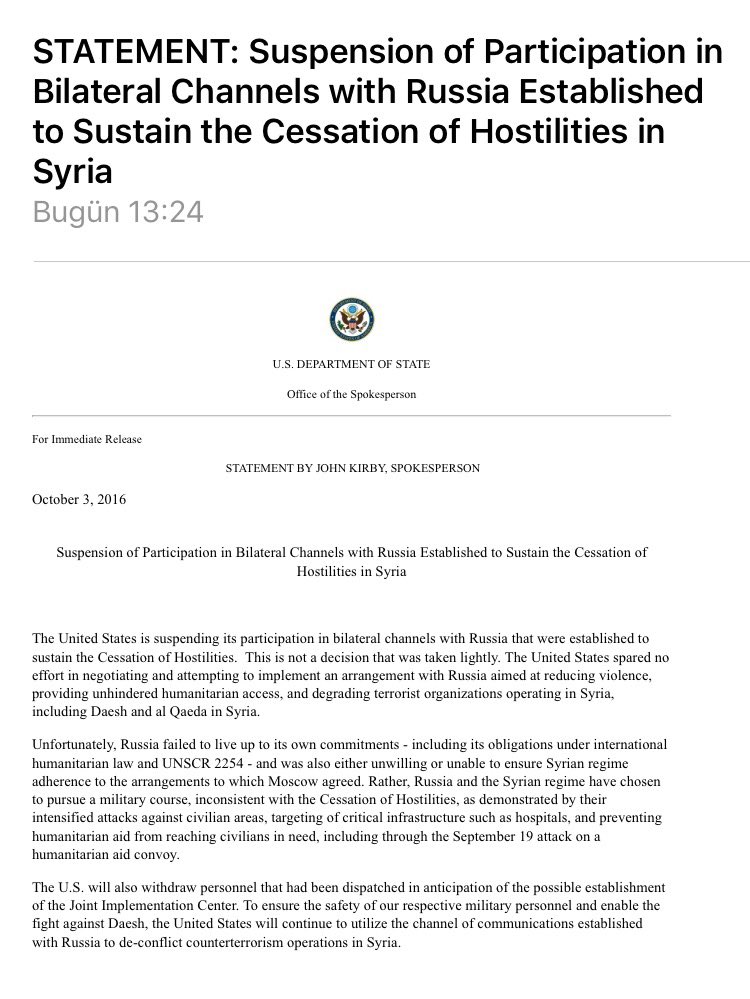
John Kerry announces the bi-lateral talks are over.
Russia’s response:

Указ Президента Российской Федерации от 03.10.2016 № 511 “О приостановлении Российской Федерацией действия Соглашения между Правительством Российской Федерации и Правительством Соединенных Штатов Америки об утилизации плутония, заявленного как плутоний, не являющийся более необходимым для целей обороны, обращению с ним и сотрудничеству в этой области и протоколов к этому Соглашению”

Translation: Decree of the President of the Russian Federation from 03.10.2016 # 511 “on the suspension by the Russian Federation Agreement between the Government of the Russian Federation and the Government of the United States of America on the disposition of plutonium designated as no longer required for defence purposes, and cooperation in this area and the protocols to this agreement”

If you can read Russian, the document is here.

This was signed in 2010 between Hillary Clinton and Sergei Lavrov.

MOSCOW (Reuters) – Russian President Vladimir Putin on Monday suspended an agreement with the United States for disposal of weapons-grade plutonium because of “unfriendly” acts by Washington, the Kremlin said.

A Kremlin spokesman said Putin had signed a decree suspending the 2010 agreement under which each side committed to destroy tonnes of weapons-grade material because Washington had not been implementing it and because of current tensions in relations.

The two former Cold War adversaries are at loggerheads over a raft of issues including Ukraine, where Russia annexed Crimea in 2014 and supports pro-Moscow separatists, and the conflict in Syria.

The deal, signed in 2000 but which did not come into force until 2010, was being suspended due to “the emergence of a threat to strategic stability and as a result of unfriendly actions by the United States of America towards the Russian Federation”, the preamble to the decree said.

It also said that Washington had failed “to ensure the implementation of its obligations to utilize surplus weapons-grade plutonium”.

The 2010 agreement, signed by Russian Foreign Minister Sergei Lavrov and then-U.S. Secretary of State Hillary Clinton, called on each side to dispose of 34 tonnes of plutonium by burning in nuclear reactors.

Clinton said at the time that that was enough material to make almost 17,000 nuclear weapons. Both sides then viewed the deal as a sign of increased cooperation between the two former adversaries toward a joint goal of nuclear non-proliferation.

“For quite a long time, Russia had been implementing it (the agreement) unilaterally,” Kremlin spokesman Dmitry Peskov told a conference call with journalists on Monday.

“Now, taking into account this tension (in relations) in general … the Russian side considers it impossible for the current state of things to last any longer.”

Ties between Moscow and Washington plunged to freezing point over Crimea and Russian support for separatists in eastern Ukraine after protests in Kiev toppled pro-Russian President Viktor Yanukovich.

Washington led a campaign to impose Western economic sanctions on Russia for its role in the Ukraine crisis.

Relations soured further last year when Russia deployed its warplanes to an air base in Syria to provide support for Syrian President Bashar al-Assad’s troops fighting rebels.

The rift has widened in recent weeks, with Moscow accusing Washington of not delivering on its promise to separate units of moderate Syrian opposition from “terrorists”.

Huge cost overruns have also long been another threat to the project originally estimated at a total of $5.7 billion.

Meanwhile what Russia is doing to Aleppo is beyond the definition of war crimes.

NBCNews: Russian-made cluster bombs — weapons that kill indiscriminately and inflict long-lasting damage — were used in an attack on at least one hospital in the ravaged Syrian city of Aleppo last week, a video obtained by NBC News appears to show.

The video shows two unexploded submunitions amid the rubble at the M10 hospital in rebel-held eastern Aleppo following a morning airstrike on Sept. 28. Several experts and sources independently identified the devices as Russian-made ShOAB 0.5 cluster submunitions, bomblets delivered by an air-delivered scattering device called the RBK-500. Both are known to be used by both the Russian and Syrian air forces.

However, it is difficult, even for specialists in unexploded ordnance disposal, to definitively identify such munitions in the field. The ShOAB 0.5 is visually similar to a U.S.-made series of bomblets.

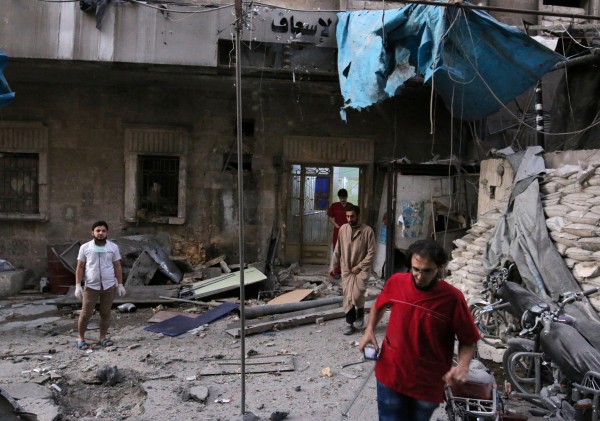
Image: Medics inspect the damage outside a field hospital after an airstrike in the rebel-held al-Maadi neighbourhood of Aleppo

Medics inspect the damage outside a field hospital after an airstrike in the rebel-held al-Maadi neighbourhood of Aleppo, Syria on Sept. 28, 2016. ABDALRHMAN ISMAIL / Reuters

The use of cluster bombs on the hospital — part of a larger series of strikes that also hit a second hospital and a nearby bakery — underscores the relentless brutality of Syria’s civil war, which lurched back into violence last month after the disintegration of a brief cease-fire. The casualties include hundreds of children killed or injured in Aleppo by a myriad of weapons falling on the city.

The hospitals were among the few facilities that remained to treat the hundreds of thousands of civilians caught up in the brutal new government offensive on eastern Aleppo. It is not clear whether the second hospital, called M2, was hit with cluster bombs.

NBC News visited both hospitals and spoke to medical staff there. Among the patients at M2 was a prematurely born infant struggling to survive: Miriam, born on Sept. 10 when her mother, seven months pregnant, went into labor during the airstrike.

“These kids are innocent, and they came into this world under very difficult circumstances, they came into this world during a war,” said Um Mohammad, the nurse who had been tending the children and infants in the hospital. Um Mohammad is a pseudonym, meaning “mother of Mohammad.”

At M2, the attack started at about 4:00 a.m., according to Dr. Mohammad Abu Rajab, a physician at the hospital who uses a pseudonym to avoid reprisals for his work in opposition-controlled areas.

“This has resulted in the hospital being taken out of service completely and indefinitely,” Abu Rajab said. “This was systematic and direct targeting of this hospital, which was home to pediatric and women’s health specialists.” A must read of the rest of the article here.
Obama Admin Admits No Plan B for Syria

Reuters: The United States called the assault on Aleppo by Syria and Russia “a gift” to Islamic State on Thursday, saying it was sowing doom and would generate more recruits for the militant group.

Moscow vowed to press on with its offensive in Syria, while U.S. officials searched for a tougher response to Russia’s decision to ignore the peace process and seek a military victory on behalf of Syrian President Bashar al-Assad.

United Nations aid chief Stephen O’Brien urged the 15-member U.N. Security Council to stop “tolerating the utter disregard for the most basic provisions of international humanitarian law.”

The sanctions program on Syria began in earnest under the Bush administration yet given the enormous death count and destruction, the last sanctions order by Barack Obama was:

On May 1, 2012, the President issued E.O. 13608 pursuant to, inter alia, IEEPA
and the NEA, finding that efforts by foreign persons to engage in activities
intended to evade U.S. economic and financial sanctions with respect to Syria
and Iran undermine United States efforts to address the national emergencies
declared in E.O. 13338, E.O. 12957, E.O. 12938, and E.O. 13224, and taking
additional steps pursuant to those national emergencies.

Given the violations, espionage aggressions and proven hacking by Russia, the Obama administration has not signed new sanctions on Russia. The most recent were those imposed during the Russia/Ukraine hostilities. So it stands to reason, there is no Plan B as noted below.


An Obama administration official painfully struggled to explain the ‘Plan B’ for Syria

A senior Obama administration official stumbled Thursday when pressed on the US plan to deal with the crisis in Syria, appearing unable to provide details about what comes next after a failed ceasefire.

BusinessInsider: Sen. Bob Corker, a Republican from Tennessee and the chair of the Senate Foreign Relations Committee, repeatedly pressed Deputy Secretary of State Antony Blinken during a committee hearing.

The US has been searching for a way to help resolve a five-year civil war between the regime of Syrian President Bashar al-Assad and rebel groups that has caused the deaths of hundreds of thousands of civilians and led to the proliferation of extremist groups like ISIS inside the country. But a ceasefire deal brokered with Russia earlier this month fell apart.

“I’d like to understand what Plan B is,” Corker said. “The mysterious Plan B that has been referred to since February, the mysterious Plan B that was supposed to be leverage to get Russia to quit killing innocent people, to get Assad to quit killing innocent people. Just explain to us the elements of Plan B.”

Blinken seemed unsure of the specifics of the so-called Plan B.

“In the first instance, Plan B is the consequence of the failure as a result of Russia’s actions of Plan A,” he said. “In that, what is likely to happen now is if the agreement cannot be followed through on and Russia reneges totally on its commitments, which it appears to have done, is this is going, of course, to be bad for everyone, but it’s going to be bad first and foremost…”

Corker cut him off, asking for more specifics.

“I want to hear about Plan B,” Corker said. “I understand all the context here.”

Blinken pressed on.

“I think, sir, this is important because Russia has a profound incentive in trying to make this work,” Blinken said. “It can’t win in Syria. It can only prevent Assad from losing. If this now gets to the point where the civil war actually accelerates, all of the outside patrons are going to throw in more and more weaponry against Russia. Russia will be left propping up Assad in an ever-smaller piece of Syria under constant assault…”

Corker cut in again.

“I understand that,” he said. “What is Plan B? Give me the elements of Plan B.”

Blinken tried again, but was still vague on details.

“Again, the consequences I think to Russia as well as to the regime will begin to be felt as a result of Plan A not being implemented because of Russia’s actions,” Blinken said. “Second, as I indicated, the president has asked all of the agencies to put forward options, some familiar, some new, that we are very actively reviewing. When we are able to work through these in the days ahead, we will have an opportunity to come back and talk about them in detail.”

Corker didn’t seem satisfied.

“OK, so let me just say what we already know,” he said. “There is no Plan B.”

This is a familiar criticism of the Obama administration’s Syria policy.

Mutasem Alsyofi of the Syrian Civil Society Declaration Initiative said in a statement last week that Secretary of State John Kerry wasn’t able to articulate a coherent plan for Syria when he met with a Syrian delegation in New York City.

“Kerry’s plan is to do more of the same — despite the repeated failure of US attempts to strike a deal with Russia,” Alsyofi said. “Syrians need a clear guarantee that the continued killing of civilians will be met with action to protect civilians. We do not need further failed agreements with Russia.”

The US recently worked with Russia to implement a ceasefire between the Assad regime and rebels in Syria, excluding extremist groups. But the deal — referred to as “Plan A” during Blinken’s testimony — fell apart before it was seen through to completion.

The Wall Street Journal reported on the administration’s “Plan B” for Syria earlier this year, citing unnamed US officials who described a covert operation to provide moderate rebels with more powerful weapons. Blinken did not mention such a program during his testimony.

Syrian opposition alliance enlists former Rep. Kingston

Sept. 30, 2016

An alliance of moderate Syrian political and military groups has enlisted Squire Patton Boggs lobbyists, including former Rep. Jack Kingston (R-Ga.), for advocacy support, according to a new lobbying disclosure.

The High Negotiations Committee of the Syrian Opposition, which released a new transition plan for the country earlier this month, is supported by numerous Western and Middle Eastern countries, including Turkey. The HNC reportedly excludes Syrian Kurds, who have exchanged blows with Turkey in recent years.

In addition to the end of the Assad regime, the coalition is reportedly working toward democratic elections, free press and a new constitution, among other issues.

Immigrants Buying Entry into U.S., are Some Terrorists?

…..even if they are corrupt and the money used has been laundered or financed by a terror organization…

Primer:

CIA Director: We ‘have to assume’ terrorist activity in US

‘Impossible to say’ if ISIS has cells here

(CNN) – The director of the CIA said Wednesday despite the government’s best efforts, the likelihood of terrorist activity in the United States is strong.

“So I think we have to assume there’s something here in the states,” said John Brennan, in an interview for CNN’s “Erin Burnett OutFront” that aired Wednesday night. “We have to be relentless in terms of going after them.”

Brennan, who was appointed to lead the CIA shortly before President Barack Obama’s second term, said “it’s impossible to say” whether ISIS has operatives or cells in the United States, and he credited the “tremendous advances in information sharing and interaction between federal officials” in making it difficult for terrorists to operate in the country.

He said he is confident that the US will be “able to remove other senior members” of ISIS, including the organization’s leader Abu Bakr al-Baghdadi.

“His time is limited,” Brennan said of al-Baghdadi. “It’s just a question of whether or not he is going to be removed this week, this month, next month or in the coming months.”

But still, Brennan said “you cannot assume there’s nobody in the homeland.”

“What you need to do is to be able to continue to uncover and use intelligence, what they might be doing here,” he said. More details here.

Immigrant Investor Program:

Progress Made to Detect and Prevent Fraud, but Additional Actions Could Further Agency Efforts

What GAO Found   Full report here.

Inspector General Report is here.

The Department of Homeland Security’s U.S. Citizenship and Immigration Services (USCIS) has recently taken steps intended to enhance fraud detection and mitigation activities for the Employment-Based Fifth Preference Immigrant Investor Program (EB-5 Program) and address previous GAO recommendations.

This includes actions such as conducting and planning additional risk assessments to gather additional information on potential fraud risks to the program. For example, USCIS is leveraging overseas staff to investigate potential fraud associated with unlawful sources of immigrant investor funds and is conducting a site visit pilot to help assess the potential risks of fraud among EB-5 program investments. USCIS is also taking steps to collect more information about EB-5 program investments and immigrant investors through new, revised forms and expanding its use of background checks, among other things, to help improve its ability to identify specific incidence of fraud. However, fraud mitigation in the EB-5 Program is hindered by a reliance on voluminous paper files, which limit the agency’s ability to collect and analyze program information. In its review of a nongeneralizable selection of files associated with EB-5 program regional centers and immigrant investors, GAO found that identifying fraud indicators is extremely challenging. For example, many of these files were several thousand pages long and would take significant time to review. According to USCIS documentation, the program anticipates receiving approximately 14 million pages of supporting documentation from its regional-center applicants and immigrant investor petitioners annually. Recognizing these limitations, USCIS has taken preliminary steps to study digitizing and analyzing the paper files submitted by petitioners and applicants to the program, which could help USCIS better identify fraud indicators in the program; however, these efforts are in the early stages.

USCIS has incorporated selected leading fraud risk management practices into its efforts but could take additional actions to help guide and document its efforts. GAO’s Fraud Risk Framework is a set of leading practices that can serve as a guide for program managers to use when developing efforts to combat fraud in a strategic, risk-based manner. USCIS’s actions align with two key components of the Fraud Risk Framework: (1) commit to combating fraud by creating an organizational culture and structure conducive to fraud risk management such as by providing specialized fraud awareness training; and (2) assess risks by planning and completing regular fraud risk assessments. However, USCIS has not developed a fraud risk profile, an overarching document that guides its fraud management efforts, as called for in the Fraud Risk Framework. Instead, USCIS’s risk assessments, spanning multiple years, were developed as separate documents and reports, and there is not a unifying document that consolidates and systematically prioritizes these findings. Without a fraud risk profile, USCIS may not be well positioned to identify and prioritize fraud risks in the EB-5 Program, ensure the appropriate controls are in place to mitigate fraud risks, and implement other Fraud Risk Framework components.

Why GAO Did This Study

Congress created the EB-5 visa category to promote job creation and capital investment by immigrant investors in exchange for lawful permanent residency and a path to citizenship. Participants must invest either $500,000 or $1 million in a business that is to create at least 10 jobs. Upon meeting program requirements, immigrant investors are eligible for conditional status to live and work in the United States and can apply to remove the conditional basis of lawful permanent residency after 2 years. In August 2015, GAO reported on weaknesses in certain USCIS fraud mitigation activities, and made two related recommendations.

GAO was asked to review actions taken by USCIS to address fraud risks in the EB-5 program since its August 2015 report. This report examines the extent to which USCIS (1) has taken steps to enhance its fraud detection and mitigation efforts; and (2) has incorporated selected leading fraud risk management practices into its efforts. GAO reviewed relevant program documentation and information; selected and reviewed a random, nongeneralizable sample of immigrant investor petitions and regional-center applications submitted between fiscal years 2010 and 2014; and compared USCIS’s actions against GAO’s Fraud Risk Framework.

What GAO Recommends

GAO recommends that USCIS develop a fraud risk profile that aligns with leading practices identified in GAO’s Fraud Risk Framework. The Department of Homeland Security concurred with GAO’s recommendation.

Russia Hacked 4 Voter Registration Systems

Russian Hackers Targeted Nearly Half of States’ Voter Registration Systems, Successfully Infiltrated 4

Think hackers will tip the vote? Read this first….

CSMonitorThe US election system is a massively complex tangle of technology. And some of it is insecure.

It’s rife with internet-based entry points, full of outdated infrastructure, cluttered with proprietary software from a random assortment of vendors, and lacks any standardized security safeguards.

In all, it’s a recipe for disaster. But if a malicious hacker really set out to manipulate the election, how would they actually do it and what could they really accomplish?

The most obvious target seems to be internet-enabled voting, currently used in 32 states. But, these systems aren’t what you think of when you hear “internet-enabled.”

They tend to be systems for distributing ballots that voters print out on paper, sign, and then email or fax back to the state authority for counting.

But emailing and faxing ballots introduces some problems. On a technical level, faxes and the emails used in internet voting aren’t encrypted.

That means states are passing ballots around the open internet. If an attacker is able to compromise any point along the way, they might intercept completed ballots.

Related reading: Hackers have attempted more intrusions into voter databases, FBI director says

So, not only does this system do away with any notion of secrecy, it also ignores any modern understanding of cryptographic security.

I’d much rather see online voting systems with built-in encryption. And that’s not a complex undertaking. Many websites currently use HTTPS, an encrypted protocol, to avoid leaking important things such as credit card numbers and passwords. That’s a good place to start for completed ballots.

Hard targets

But launching a full-scale attack on these systems wouldn’t be easy. First, attackers would need to target online voters (a small minority) who are scattered in various jurisdictions.

Then, once the vulnerable voters are identified, attackers would need to wait for the polling place to transmit those votes. While that kind of attack could work on one person, or a single location, it would be difficult to pull off at any meaningful scale.

Alternatively, an adversary could invent an entirely new population of phantom voters, register them to vote remotely, and stuff the ballot box with fake votes. That’s possible, but highly improbable.

So, what about servers

The easiest way to target servers that collect online ballots is with a distributed denial of service, or DDoS, attack that overwhelms a website with traffic. A totally compromised server could enable attackers to alter or destroy votes in a much sneakier way, and an attack like this could potentially avoid detection until after the election.

But this sort of attack would be pretty obvious to system maintainers, and I suspect polling administrators would quickly switch back to relying on the mail. Remember, online systems aren’t intended for use on Election Day, rather they merely collect absentee ballots.

On the bright side, however, this kind of attack appears possible for only five of the internet-enabled voting states. Only Alabama, Alaska, Arizona, North Dakota, and Missouri have a so-called internet portal.

And none of those states are battleground territories. So, regardless of their security posture, attacking these portals isn’t likely to sway the election. If Florida or Pennsylvania had one of these portals, I’d be more worried.

Voting machines

No electronic voting machine is bulletproof when it comes to cybersecurity. But if an adversary needs to physically visit voting machines in order to fiddle with results, then he or she would need a whole lot of bodies in a whole lot of polling places in order to make an impact.

Don’t get me wrong, attackers could rely on wireless networking or sophisticated antennas. But even with ideal placement and transmission power, bad guys would need to be within sight of a polling place to conduct practical attacks on a Wi-Fi-enabled voting machine.

While remote attacks are possible, it’s not like someone could affect voting from another country. They’d more likely need to be parked outside the polling place. So, although Wi-Fi voting machines are a terrible idea, they don’t appear to be an existential threat to democracy at the time being.

Voter information

Rather than attacking ballot-issuing and ballot-counting systems, attackers have more attractive targets. Voter records, for example, are tempting to cybercriminals since they contain enough personally identifiable information (PII) to kick off identity theft and identity fraud attacks at a much larger scale.

Unfortunately, some of these data sets have already been compromised. Almost 200 million voter records were accidentally leaked late in 2015, and the FBI warned in August that some state voter databases have also suffered breaches.

Altering voter registration records is a big deal since such attacks can affect voter turnout. While that’s not what’s being reported today, such an attack could not only nudge election results one way or another, but also raise serious questions about the integrity of the democratic process.

Even though rare, voter fraud has become a hot political issue. Any attack on voter records could trigger complaints about a rigged election and undermine confidence in the entire system.

Perceptions matter

Alarmingly, hacking elections may not involve the actual compromising of ballots or vote counting at all.

Just imagine that someone decided to take down a couple of voter information websites. Would this technically interfere with the election process? Maybe, if some people were trying to find the address for their polling place.

The obvious effect, though, would be to create the impression that the election is under attack, raising concerns about the credibility of the voting process and casting doubt on the results.

Solutions for securing the vote

Technology may be making elections more convenient and efficient, but that same technology can introduce new risks and it needs to be accounted for.

State election boards or commission should test their systems ahead of Election Day in November. They should even try attacking their own systems to discover what’s possible, and what can help defend their systems.

If you are a voter who is concerned about election hacking, local election officials should be able to tell you how they are dealing with potential cyberthreats. And if you really want to help, volunteer at the polls on Election Day.

National Strategy to Win the War Against Islamist Terror


Related reading: Foreign Terrorist Organizations, Bureau of Counterterrorism

Chairman McCaul Unveils Counterterrorism Strategy “A National Strategy to Win the War Against Islamist Terror”

Contains 100+ policy ideas and principles for fighting terrorism

WASHINGTON, D.C. – On the heels of Islamist terror attacks in the homeland this past weekend, House Homeland Security Committee Chairman Michael McCaul (R-TX) today unveiled his counterterrorism strategy, entitled A National Strategy to Win the War Against Islamist Terror. Chairman McCaul’s nonpartisan strategy contains over 100 policy ideas, recommendations, and principles for fighting terrorism.

The ideas put forward in the McCaul strategy were developed in consultation with an array of national security experts on both sides of the aisle. They are not “Republican” or “Democrat” ideas, but rather common-sense solutions for better protecting Americans.

Chairman McCaul: “As radical Islamist terror continues to sweep the globe, it has become clear that we are not winning the overall fight against it. There are now more terrorist foot soldiers and safe havens than any time in modern history, and our enemies have alarming momentum. They are reaching deep into the heart of the Western world—including our own communities—to spread their hateful ideology and perpetrate violent acts. Just this weekend we saw again that our homeland remains a terrorist target, and they have attacked our allies in places like Paris, Brussels, Nice, and beyond. Yet in recent years our strategy and policies have failed to roll back the threat, let alone contain it. That is why I’ve produced a new, national counterterrorism strategy aimed at reversing the tide of terror and protecting our great nation. The eyes of the world are now upon us, and American leadership is needed to defeat this evil.  My plan is a guidepost—for Congress and the next president—to do what is needed to win this generational struggle.”

National Strategy Social Media Release_Report


Overview of the Strategy

The McCaul strategy contains 100+ policy ideas and principles for fighting terrorism. Some are new, while others are abandoned policies we need to revive in order to protect America and its interests overseas against the surging terror threat.

The document is built around clear objectives: defend the homeland, defeat terrorists, and deny extremists the opportunity to re-emerge. It presents nine counterterrorism priorities, or “means,” needed to achieve the “ends” described above, including:

  1. Thwart attacks and protect our communities
  2. Stop recruitment and radicalization at home
  3. Keep terrorists out of America
  4. Take the fight to the enemy
  5. Combat terrorist travel and cut off financial resources
  6. Deny jihadists access to weapons of mass destruction
  7. Block terrorists from returning to the battlefield
  8. Prevent the emergence of new networks and safe havens
  9. Win the battle of ideas

This counterterrorism strategy is different than those that came before it. President Bush released a strategy for combating terrorism in 2003, and President Obama released one in 2011. Both are now outdated.

  • This strategy is written to keep pace with an evolving enemy. It proposes ways to fight terrorist propaganda online; counter homegrown radicalization; deal with terrorists’ use of encryption; and help communities better protect against IEDs, active shooter plots, and other changing terror tactics.
  • This strategy aims to bring our homeland security policies into the digital age. It proposes to improve the screening of foreign visitors, immigrants, and refugees using new technologies and better intelligence—including social media—to keep terrorists from infiltrating our country.
  • This strategy focuses on breaking the Islamist terror movement—not just defeating one group. Our nation’s last official counterterrorism strategy focused almost exclusively on al Qaeda, leaving us blind to the rise of ISIS. This plan is designed to go after Islamist terrorists, regardless of location or branding.

The bottom line is this: we cannot accept Islamist terror attacks as “the new normal.” We must defeat the perpetrators. The McCaul strategy makes clear that we are facing a long, generational struggle, but we should wage it with the same resolve we showed in defeating other totalitarian ideologies, including communism and fascism.

The full strategy is available, here.