C’mon RNC, Don’t Do it. Cohen is a Con Man

There were all Democrats at one point and Cohen does not have a good history with money.

Cohen, Trump’s lawyer and a Republican for less than a month, takes a top RNC finance role

Michael Cohen, a new Republican convert and personal lawyer to President Trump, will become the national deputy chairman for Republican National Committee’s finance leadership team.

The RNC announced Cohen, who became a Republican on March 9 after previously being a Democrat during his adult life, was in the new role on Monday. The Daily Beast first reported Cohen’s new role last week.

Cohen served as a spokesman for Trump during the campaign and raised “millions of dollars” for Trump’s campaign.

Cohen has also been the subject of controversy; he previously threatened a reporter with bodily harm for writing a negative story about Trump and having an awkward television interview where he denied Trump was trailing in the polls. He also surfaced in an unverified dossier as a possible link between Trump and the Russian government, but he has denied those claims.

GOP Chairwoman Ronna Romney McDaniel also announced Elliot Broidy and Louis DeJoy would serve in similar roles to Cohen and Brian Ballard, Bob Grand, Ron Weiser and Gordon Sondland will all serve as regional vice chairman for finance.

“Together this team will employ their extraordinary talent and understanding of Americans across the country to maintain and build upon our unprecedented fundraising success,” Romney McDaniel said.

*** Now it gets interesting: The investigative work below is remarkable. Meanwhile, we cannot overlook the facts widely reported on Carter Page, Paul Manafort, Felix Sater and joint meetings with Russian officials including the Russian Ambassador Sergey Kislyak.

We must also begin to admit there was and is evidence for questions, investigations, FISA warrants and surveillance.

Who is Mr.Cohen? Trump’s attorney received $350,000 for the Izmaylovskaya Criminal Group — Felshtinsky

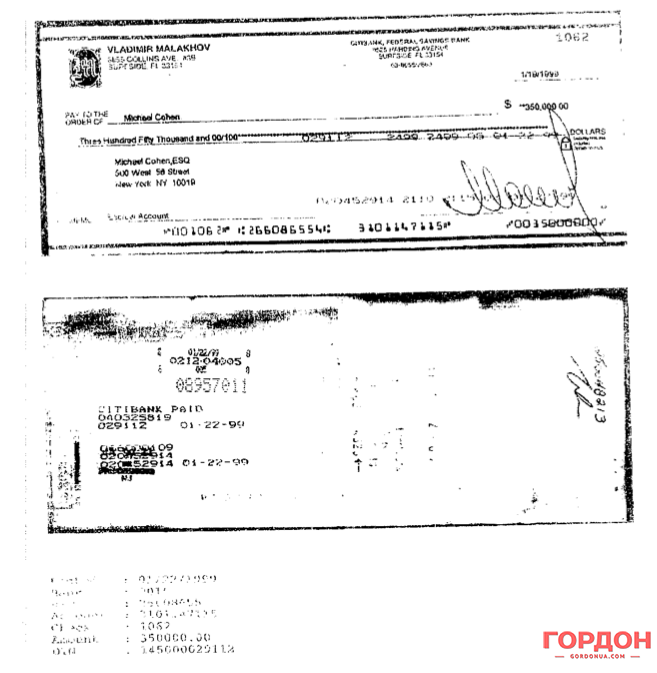
U..S. President Donald Trump’s personal attorney Michael Cohen received a check for $350,000 in 1999 for one of the leaders of the Izmaylovskaya Organized Crime Group. It was reported in an exclusive material for “GORDON” by Yuri Felshtinsky, a Russian American historian and the author of the book “Blowing up Russia: Terror from Within”. Based on more than a hundred archival records of American courts, which are open to the public in the US, the expert maintains that the Russian hockey player Vladimir Malakhov was used in the scheme, and the whole story was revealed accidentally because of a check, which became the subject of litigation. All the supporting documents are available in the editorial office.

Michael D. Cohen, President Donald Trump’s personal attorney, has been working for The Trump Organization since 2007 and is a member of the Trump World Tower Condominium Board and the Trump Park Avenue Condominium Board. He was involved in the recent attempt to implement the so-called peaceful Russian-Ukrainian plan developed by Felix Sater and Andrey Artemenko, which received extensive coverage in the world press. He has also been a confidant of the Russian organized criminality since at least 1999 and has been laundering money for Russian citizens having or suspected to have connections with the Russian mafia.

It follows from court materials of 2006-2011, which are kept in the U.S. court archives.

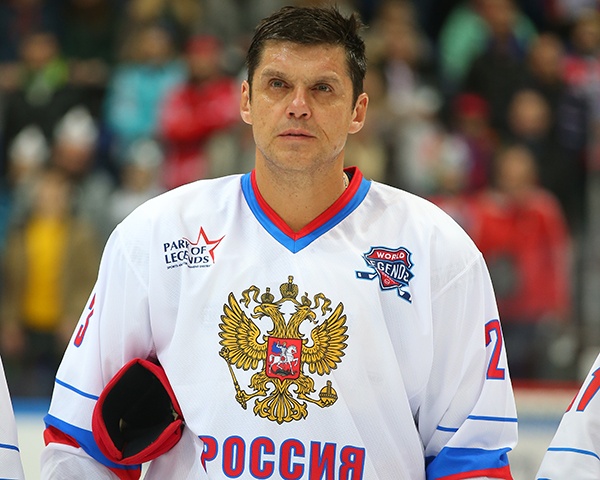
In particular, on 19 January, 1999 Michael Cohen received a check for $350,000 from the Russian hockey player Vladimir Malakhov, now living in Miami, who in 1999-2000 played for different clubs in Canada, New Jersey, and New York

A check for $350,000 written to Michael Cohen. Photo: Yuri Felstinsky

A check for $350,000 written to Michael Cohen. Photo Yuri Felstinsky


This check was deposited by Cohen to one of his attorney accounts, but, incidentally, it became the focus of litigation in 2006.

On 2 May, 2007, following a phone conversation, Michael Cohen received a letter from Marc D. Wolfe on this matter:

“The purpose of this letter is to summarize and confirm our conversation of this date, as well as the information that you have provided us over the past week regarding the above matter.

As you know, we are in possession of a check in the amount of $350,000 written to a “Michael Cohen” at the address of “Michael Cohen, Esq,. 500 West 56th Street, New York, N.Y. 10019”. You have reviewed a copy of the back and front of this check, as well as the first page of the Complaint (including case style), which we provided.

After such review, you have indicated that you did occupy this office as of the date of this check (1/19/99), and were the only Michael Cohen there at that time. Otherwise, you are completely unfamiliar with any aspect of this incident, including the identity of any of the parties to this lawsuit. You state that you never had any involvement in this transaction whatsoever. You also state that the endorsement on the back of the check is not your signature.

You also indicate that you are unfamiliar with the account numbers listed on the check, but have asked your accountant to ascertain whether you were affiliated with any of the accounts. Should this investigation reveal that you were affiliated one or more of these accounts, we would appreciate knowing whether this check was deposited into said account, and the ultimate disposition of the funds”.

In other words, Cohen mentioned in the phone conversation with Attorney Wolfe that he doesn’t know anything about the check, that the endorsement on the back of the check is not his signature, and that he was unfamiliar with the number of the account to which the check was deposited. In a nutshell, Cohen claimed to not have received $350,000.

Фото: cska-hockey.ru

Vladimir Malakhov, the writer of the check, played for the hockey teams of the USSR and Russia, as well as for Russian and American hockey clubs. Olympic champion, Stanley Cup winner. Фото: cska-hockey.ru

On 21 May, Cohen received another letter from Wolfe saying that Cohen had to make a deposition regarding the check. It followed from the letter that Cohen had already refused to make a deposition voluntarily so he had to be summoned to court:

“As I indicated in our prior conversations, it will be necessary for us to take your deposition in the above matter. […] As you have indicated that you will not voluntarily appear, we have begun the process of having a subpoena issued through the New York courts. For your information, we will also be requesting the production of documents relating to your bank records and more specifically to the check in question. 

We anticipate conducting the deposition in either July or August, and will be happy to schedule the deposition at a time and place that is most convenient to you. In this regard, please contact us at your earliest convenience to discuss scheduling. Should we not hear from you, we will be forced to pick a date and time and issue process accordingly”.

On June 6, 2007, the deposition was scheduled for 3 August at 1350 Broadway, Suite 1407, New York. Cohen was requested to produce the following documents:

  1. A copy of all records reflecting receipt of check no 1062, dated 1/19/1999, drawn on account of Vladmir Malakhov, account no. 3101147115 at Citibank, Federal Saving Bank, Sunrise, Florida, and payable to Michael Cohen in the amount of $350,000.00 , including but not limited to receipt(s), ledger card(s), trust account(s), office account(s), escrow account(s), client bill(s), client statements(s) and computerized accounting ledgers and records.
  2. Copies of all records pertaining to account 250048213 for the period January 19, 1999 through February 18, 1999, including but not limited to monthly statement(s).
  3. All correspondence, both received and sent, relating to check no 1062, dated 1/19/1999, drawn on account of Vladmir Malakhov, account no. 3101147115 at Citibank, Federal Saving Bank, Sunrise, Florida, and payable to Michael Cohen in the amount of $350,000.00
  4. All records related to the disbursement of proceeds from check no 1062, dated 1/19/1999, drawn on account of Vladmir Malakhov, account no. 3101147115 at Citibank, Federal Saving Bank, Sunrise, Florida, and payable to Michael Cohen in the amount of $350,000.00 deposited into account number 250048213, including but not limited to cancelled check(s), client ledger card(s), trust account ledger(s), escrow account ledger(s), wire transfer instructions, and correspondence.


Cohen delayed the deposition as much as possible resorting to various tricks. Eventually, he had to appear before the court on September 17, 2007 at the said address in New York. He testified by phone.

However, Cohen did not produce any records or documents and was very laconic answering the questions. He recognized having received a check for $350,000 from Malakhov in January 1999 and confirmed that he had clients from Russia in 1998-1999, but he indicated that he didn’t go to Russia during that period and, to the best of his knowledge, did not send money to Russia or Ukraine from his accounts. Below is Cohen’s testimony, partially abridged:

QUESTION: You are appearing here today as the result of a subpoena duces tecum which was served on you; is that correct?

ANSWER: Correct.

QUESTION: Exhibit A to the subpoena duces tecum requested four categories of documents for you to locate; is that correct?

ANSWER: That’s correct.

QUESTION: Did you perform a diligent search for those documents?

ANSWER: I did.

QUESTION: Did you locate any documents responsive to that subpoena?

ANSWER: No. […]

QUESTION: Can you tell me what type of law your practice included or what types of law your practice included in 1999?

ANSWER: My practice was 90 percent negligence with 10 percent defense. I was also in the Yellow Cab industry. It was defense of the Yellow Cabs that we were operating at the time, and property damage. […]

QUESTION: Mr. Cohen, we provided you with a copy of a check that was written in January of 1999 to you by Vladmir Malakhov. Do you have that check?

ANSWER: I do. […]

QUESTION: Mr. Cohen, do you recall receiving this check in 1999?

ANSWER: No.

QUESTION: The search that we discussed earlier, the documents requested on the subpoena duces tecum that was provided for you would have included records relevant to this check. I would like you to confirm that you, therefore, have been able to locate no records that are relevant to this check or related to this check?

ANSWER: Correct.

QUESTION: That would include any records of that check that had been deposited by you or anything else that you might have done with it?

ANSWER: Correct. […]

QUESTION: Mr. Cohen, do you recognize the signature on the check?

ANSWER: No.

QUESTION: You cannot say whether that is or is not your signature?

ANSWER: You asked me the signature. There are two signatures on this check.

QUESTION: I apologize. There is a signature that is the signature of the maker of the check on the front and there is also an endorsing signature on the back. Do you recognize that endorsing signature as your signature?

ANSWER: Yes. It could be.

QUESTION: You are not certain whether it is or not?

ANSWER: I don’t know but it could be.

QUESTION: Let me ask you, have you maintained proper records for your trust account at all times since being admitted to the New York bar?

ANSWER: I do. […]

QUESTION: Mr. Cohen, let me ask you what are some of the possible reasons that somebody would have sent a check to your trust account in 1999.

ANSWER: I have no idea. […]

QUESTION: You have no idea why somebody would send a check to your trust account?

ANSWER: I don’t know what this is about. It is from 1999. I have no recollection.

QUESTION: What would the possible reasons have been for your receiving a check addressed to your trust account in 1999? […] Is there any place else, anything else that a check written to your trust account could have represented?

ANSWER: At the time in 1999 I was acting counsel for a fund called the Ukrainian Capital Growth Fund which was also located at this address. […] Other than that, no. I don’t believe anything else.

QUESTION: Is it your testimony that it is possible that a check written to your trust account could have been written for the purpose of being deposited in the Ukrainian Growth Fund?

ANSWER: It is possible.

QUESTION: Did your law practice in 1999 include any other persons including partners, associates or employees?

ANSWER: No.

QUESTION: Other than the Ukrainian Growth Fund were you involved in 1999 in any other business besides the practice of law?

ANSWER: Yes.

QUESTION: What business was that?

ANSWER: The taxicab business in New York City.

QUESTION: That was separate from your practice of law?

ANSWER: Correct. It was — it was operated out of the same building.

QUESTION: What was your responsibility regarding the taxicab business?

ANSWER: I was a principal.

QUESTION: What did the business do?

ANSWER: Operated 260 Yellow Cabs in the City of New York.

QUESTION: I see. Could this check have been in any way related to that business?

ANSWER: […] Yes, it is possible.

QUESTION: Were there other people involved in the taxicab business? […]

ANSWER: Yes.

QUESTION: Who are those people?

ANSWER: I had only one partner. Simon Garber. […]

QUESTION: Did you ever go to Moscow in 1999?

ANSWER: No.

QUESTION: Did you go to Russia in 1999?

ANSWER: No.

QUESTION: Have you ever been to Russia or the Ukraine?

ANSWER: Yes.

QUESTION: Did you go in 1998?

ANSWER: No. […]

QUESTION: Do you recall if you had any Russian clients […]?

ANSWER: Yes.

QUESTION: In 1998 or 1999?

ANSWER: Did I have Russian clients?

QUESTION: Yes.

ANSWER: The answer — this would also include my negligence practice?

QUESTION: Yes. Russian clients, yes, sir.

ANSWER: The answer would be, yes.

QUESTION: Did there come times when you would have to send money in negligence cases or whatever cases to your clients in Russia outside the United States?

ANSWER: No.

QUESTION: Your testimony is you never wired any funds or sent any funds outside of the United States out of your trust account to Russian clients?

ANSWER: Correct.

QUESTION: […] Do you know why this check, number 1062 […] is made to the order of Michael Cohen as opposed to your law firm?

ANSWER: I don’t.

QUESTION: What does that say in the memo? Can you read that in the memo of that check?

ANSWER: It says, “Escrow account.”

QUESTION: Did you have escrow accounts for any sorts of clients in that time?

ANSWER: No.

QUESTION: Are trust accounts sometimes called escrow accounts in New York?

ANSWER: Yes.

QUESTION: Do you have any reason to believe that this was not deposited into your escrow account or your trust account?

ANSWER: I don’t understand your question.

QUESTION: This was deposited, according to the back of the check, into your trust account; is that right?

ANSWER: Correct.

QUESTION: Do you remember a negligence case or any sort of case involving Vladmir Malakhov?

ANSWER: No.

QUESTION: Your testimony is that you don’t know why a Vladmir Malakhov would write you a check for $350,000 in January of 1999?

ANSWER: I don’t recall why.

QUESTION: The Ukrainian Capital Growth Fund, were those funds commingled with your trust account at your law firm? […]

ANSWER: I do not believe we ever deposited any checks into my escrow account for Ukrainian Capital Growth Fund. It had its own account. […]

QUESTION: Again, does the name Vladmir Malakhov, it doesn’t ring a bell I believe you said earlier?

ANSWER: No.

QUESTION: Mr. Cohen, you indicated that […] you never sent any money outside of the United States to Russia or anywhere else; is that correct?

ANSWER: That would be correct. To the best of my knowledge that is correct.

QUESTION: […] Is it a correct statement that you never in any capacity sent money from one of your business accounts to Russia or the Ukraine?

ANSWER: In what year are we talking?

QUESTION: We are talking around the 1999 time; let’s say, between 1998 and 2000, just to be safe.

ANSWER: I would say, no.

QUESTION: Okay. Again, to just clarify, you testified that money that was deposited into your trust account could conceivably have gone to one of the other types of businesses or one of the other businesses that you were involved with; is that correct?

ANSWER: That is correct. […] It is correct to the extent I don’t recall this transaction.

QUESTION: Right. I am saying hypothetically, given what you know of your practice at the time or what you can recall of your practice at the time, that this is something that could have happened to money that went into your trust account, it could have gone to one of these other businesses that you told us about?

ANSWER: It could have.

QUESTION: Okay. I am also correct in understanding that you do not have any records at all with regard to the other accounts […]?

ANSWER: That is correct.

QUESTION: Do you keep lists of clients per year on your computer, like a client list, something like that, a data base?

ANSWER: I did have, yes.

QUESTION: Would you have a list of clients from, let’s say, 1998 and 1999?

ANSWER: No, sir.

QUESTION: […] You don’t know either why this check was sent to you and where these funds went ultimately out of your trust account; is that a fair statement, sir?

ANSWER: One more time please.

QUESTION: You don’t recall — this is kind of a summary question. You don’t recall why this check was written to you for $350,000 in 1999 and how these funds left your trust account in any way, shape or form?

ANSWER: Clearly Vladmir Malakhov had to have known somebody who I was affiliated to and the only person I can — and I mentioned my partner’s name, Simon Garber, who happens to also be Russian.[…] Somewhere along the line I was asked to hold somebody’s funds for whatever the purpose was, whether it was A, B or C, I don’t know the reasons and I can’t even begin to guess. […] I would probably — the only way I would have received any funds, whether it is $35 or $350,000, is I would have had to have received the same type of instructions from the same person who wrote the check in order to disburse the funds, otherwise, I would have sent it back to the writer. […] That is how I operated my account.

QUESTION: Did you ever ask your partner Simon about this check before this deposition?

ANSWER: I did not. […] Simon Garber is not an attorney. He is my partner in the taxi industry.

QUESTION: Is he still your partner or are you out of the taxi industry now?

ANSWER: I am out of the taxi industry.

QUESTION: Mr. Cohen, real quick. What was the name of the cab business that you were involved with in 1999?

ANSWER: Manhattan Maintenance, Inc.

QUESTION: […] There was no connection between your trust account and the taxicab company; you kept those accounts separate?

ANSWER: Absolutely.

***

As a result of Cohen’s examination, the court concluded as follows:

“Michael Cohen – the payee on the check — repeatedly stated that he has no personal knowledge and no records of any check of $350,000.00 made out to him or to his trust account in 1999. Mr. Cohen is also entirely unaware of  the identity of any of the parties or other witnesses in this lawsuit.  Mr. Cohen reiterated multiple times that he does not know Defendant Malakhov and does not understand why he would receive a $350,000.00 check from Defendant Malakhov”. 

In other words, Cohen refused to share any details of the transaction claiming that he did not know why he had been sent a check for $350,000; he did not remember how he used this money and did not remember who they were intended for and what happened to this $350,000; he was not familiar with and had never contacted Vladimir Malakhov, who wrote the check, though he would normally not have accepted (but did accept) a check for $350,000 from a stranger  and would have returned (but did not return) it to the writer.

 We will help Mr. Cohen recall what happened to the check for $350,000 back in 1999, who this money belonged to, and what happened to it then, relying on testimony of Mr. Cohen himself, who relaxed at the end of the examination and said,
“The only way I would have received any funds, whether it is $35 or $350,000, is I would have had to have received the same type of instructions from the same person who wrote the check in order to disburse the fund”.

Cohen’s only inaccuracy was that the person who gave him instructions regarding the disbursement of the funds was not the same person who wrote the check, it was not Malakhov.

$350,000 transferred to Michael Cohen was intended for one of the leaders of the Izmaylovskaya Organized Crime Group (OCG) Vitaly Yuryevich Buslaev nicknamed Buslay (born in 1965). The police records of 1996 describe him as follows:

The group has one leader – Oleg Ivanov, 55 years old, born in Kazan. However, the Izmaylovskaya OCG is not governed by leaders, as in other groups, but rather by “kingpins”. There were five of them – Victor Nestruev (“Boy”), Sergey Trofimov (“Trofim”), Vitaly Buslaev (“Buslay”), Anton Malevsky (“Anton”), and Aleksandr Derbyshev. Anton Malevsky was the most famous. It was partly because he had been detained by the police with arms several times, but he managed to evade responsibility. Some sources interpret it in such a way that Anton was taken “under the wing” of special services and started cooperating with them”.

Buslaev lived in Moscow. In the early 2000s, he worked for Private Security Company Vityaz-AK, which is often a legal disguise of criminal activities. At the same time, Buslaev was the director general of three companies: OOO (limited liability company) Bazagaza, ООО Dormidont Rielt, and OOO Legenda Project Group. In turn, Legenda Project Group owned ООО Great Hotel Moscow and ООО Great Hotel Suzdal. Great Hotel Moscow lies 200 meters from the Kremlin Troitskaya Tower. The hotel overlooks the Kremlin, and the territory of the hotel is guarded by the Federal Security Service of the Russian Federation. The owners of Legenda Project Group got the hotel from a confidant of the Rotenberg brothers, who are close to Putin. A partner of Legenda Project Group was the owner of Metropol Hotel Mikhail Slipenchuk, a billionaire and a member of the State Duma of the Russian Federation in 2011-2016, who has co-owned Great Hotel Moscow and Great Hotel Suzdal since 2015.

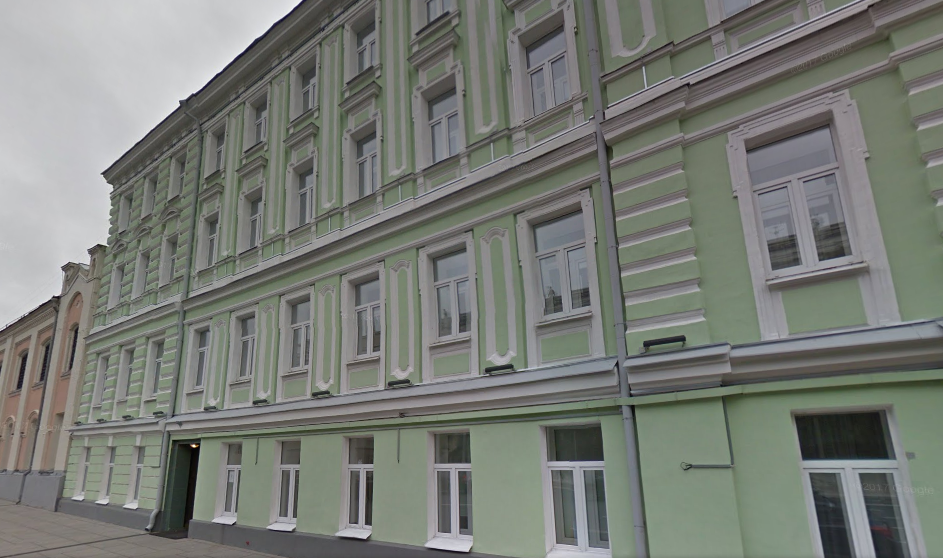
Отель Велий в Москве расположен на улице Моховой, 10. Фото: maps.google.com

Veliy Hotel in Moscow located at 10 Mokhovaya Street. Фото: maps.google.com
Buslaev’s name was also mentioned in relation to the murder of the journalist Georgiy Gongadze in Ukraine. However, apart from a mention of Buslaev’s name as a mastermind of the murder in a phone conversation, there has been no more evidence of his complicity in the crime and no new information has become available ever since.
Within Buslaev’s current activity, very much is linked to big business in Russia, big Russian businessmen and the Rotenberg brothers, Putin’s partners. However, back in 1996, Buslaev was only in the beginning of his way to the top. The money he wanted to spend on buying property in the USA – it’s hard to judge whether legal or illegal because any money in Russia was illegal then – belonged to Buslaev. In January that year, he came to Miami with his 22-year-old girlfriend Yulia Fomina and found property in the building at 16711 Collins Avenue, Miami Beach, Florida, which he bought a bit later for $473,900 in cash. The payments were made in 1996 in three instalments: $96,000 on 18 February, $48,000 on 18 April, and the rest $329,000 on 29 November, including $324,040.64 that was transferred to the account of Florida building owners by telex.

fotorcreated_02

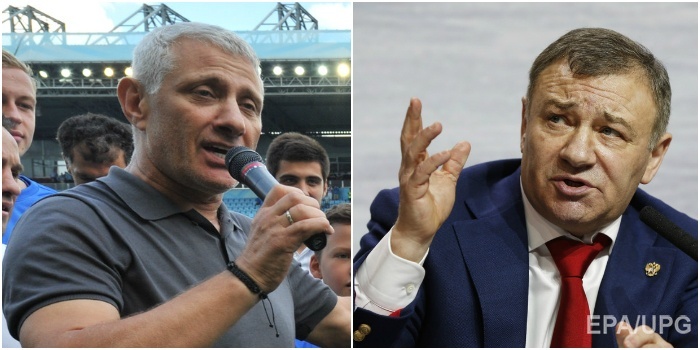
Boris and Arkady Rotenberg, Russian businessmen, who, according to the mass media, are Russian President Vladimir Putin’s close friends. Фото: EPA

Actually, the apartment had not been built yet. The multi-story building was under construction, but it was already advertised in Moscow. Many of Buslaev’s and Fomina’s friends bought uncompleted apartments in that building. In February 1996, Buslaev and Fomina returned to Moscow. According to Yulia, they had an accident then. Fomina was seriously injured because she went out of the car after the accident and was run down by a passing car. She spent almost a month in hospital. Buslaev was not injured. In March, Buslaev and Fomina came to the USA again and spent there five months until September 1996. It seems that Buslaev was hiding from something, which is why he stayed in the USA for so long.

Fomina came to the USA for the third time by herself around October 1996. Buslaev remained in Russia. The completed apartment in Florida was bought by him in the very end of November 1996, but Buslaev did not have a chance to live in it because he could not get an entry visa to the USA due to suspected connections with the Russian organized crime.

Yulia did not work in the U.S. and lived at the expense of Buslaev, who generously supported her. She had countless money. According to witnesses and Yulia herself, she lived a luxurious life. She had a two-car parking at her building in Miami. One car was an Aston Martin, and, as a rule, the other was a Mercedes. Yulia often went to Russia and Europe visiting, among others, Buslaev (according to her, they last met in 2004) and travelled in the USA. As Yulia testified on March 22, 2006, all her expenses were covered by “her friend” Aleksandr Varshavsky, Buslaev’s friend, a businessman working in car industry, with whom Buslaev had a system of mutual settlements. According to Yulia, Buslaev was also engaged in car industry. The relationships between Yulia Fomina and Varshavsky were so close that he became the only person whose phone number was indicated in the Emergency Resident Information.

According to Yulia’s testimony, she did not know how Buslaev transferred money to her because all her accounts and finances were managed by Varshavsky’s secretary Svetlana Gerus. All Yulia Fomina had to do was sign checks and not ask any questions. And she seems not to have been asking them.

ea_cat_sands_point_condo_04

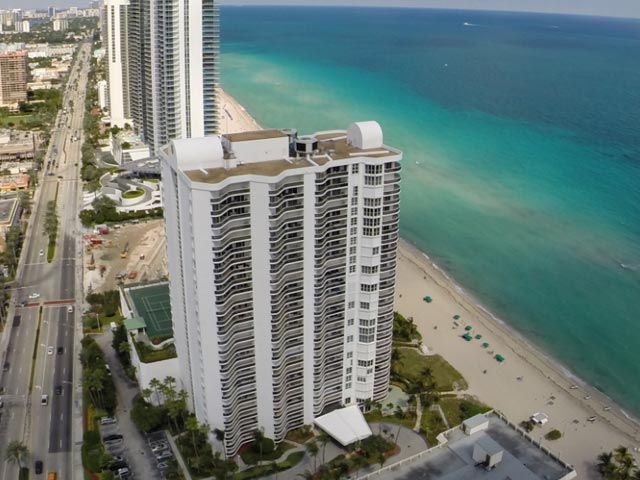
The house at 16711 Collins Avenue, Miami Beach, commissioned in 1996. Фото: miamiresidence.com

Some years later, these questions were asked by the U.S. prosecutor’s office to Varshavsky himself. Varshavsky owned at least two car businesses in the USA (Avilon Group and New York Motors) and a Mercedes and Ford dealer network in Moscow. In December 2013, a court in New Jersey initiated criminal case against Varshavsky accusing him of income concealment and tax evasion in 2008-2012. The transactions that gave rise to American investigators’ suspicions included the transfer of $30 million from Russia to the U.S. account of New York Motors on March 18, 2008; transfer of $7.2 million from Russia to the account of Avilon Group in 2009 for the purchase of a Bombardier jet; transfer of $22 million to the account of the same company in 2010 after the sale of the jet. On September 22, 2010, another $5 million was transferred to Varshavsky’s account in the USA from Moscow.

In June 2011, Varshavsky bought an apartment in a luxurious skyscraper at 25 Columbus Circle in New York for $20.5 million in cash ($24.3 were transferred to the account of his New York company for real estate transactions European Realty). It appears that Buslaev and Fomina’s friend Aleksandr Varshavsky was dealing with big money.

But then, in late 1998, there came the August crisis in Russia and the instability of the ruble, which dropped several-fold, and Buslaev needed dollars so he decided to mortgage the property purchased in Yulia’s name and get $350,000 out of the property. On January 4, 1999, Yulia Fomina signed documents acknowledging the receipt of a $455,030 loan from Malakhov and the transfer of the Miami condo into the ownership of Lyudmila Malakhova (Vladimir Malakhov’s wife) as a security of the loan. On 11 January, the documents were forwarded by her attorney to Malakhov’s agent Paul Theofanous

On 19 January, Malakhov sent a check for $350,000 to the indicated address to the American lawyer Michael Cohen. According to several witnesses, including Theofanous, the rest of the money (approximately $105,000) was given by Malakhov to Yulia Fomina and Buslaev in cash, though the parties to the transaction – both on Fomina’s and on Malakhov’s side – avoided answering questions about the cash during the litigation. It is clear why: the transfer of large amounts of money in cash could constitute a violation of the American tax legislation though Malakhov honestly earned his money as a hockey player. According to his tax returns, he earned $18,465,346 between 1999 and 2004.

Having given $350,000 to Cohen for Buslaev and additional money in cash to Fomina, Malakhov fulfilled his obligations towards Buslaev. Buslaev’s apartment remained as a security, and it couldn’t disappear. But how could Buslaev in Moscow get the money transferred to Cohen in New York?

When Cohen testified in 2007 that he did not know Malakhov and did not transfer money to Russia he probably told the truth, though he left room for maneuver by saying “to the best of my knowledge”. Cohen’s money laundering scheme was different. Indeed, money did not leave the USA. Cohen received money to one of his accounts, confirmed its receipt, and then the owner of the money (Buslaev in this case) received $350,000 in Russia from a different person, who had to get $350.000 out of Russia. After Buslaev’s confirmation that the money was received in Russia, Cohen released $350,000 to American accounts indicated by the client in Moscow. As a result of this simple transaction, Buslaev received absolutely clean $350.000, most likely in cash; Cohen transferred absolutely clean $350.000 received from the hockey player Malakhov to some other American accounts, where this money further stayed absolutely clean because they had not crossed the border and never raised suspicions of the U.S. Internal Revenue Service and the FBI. Mostprobably, Cohen did all this for an interest because it is unlikely that he did this for free.

Since Cohen refused to provide the court with any records, statements or documents, it remains to be guessed what interest he earned from laundering money, as what Attorney Cohen did was classical money laundering.

It is hard to say how numerous Michael Cohen’s clientele was. There have been many Russian natives among his friends since long ago. It is neither good nor bad in itself. But a person, who has recently become the American president’s personal attorney, finds himself in a special situation because he is obliged to give answers to many natural questions posed by the public and the U.S. law enforcement agencies.

Michael Cohen married the Ukrainian citizen Laura Shusterman. Laura’s father, Fima Shusterman, was born in1945 and has property and investments in the USA. Michael himself once tried to set up business with ethanol (alcohol) in Ukraine but seemed to hand over this business to his brother Bryan. Bryan was also married to a citizen of Ukraine, Oksana Oronova. Bryan’s businesses include the production of ethanol in Ukraine. On March 2, 2017, Oksana Oronova’s 69-year-old father Aleksandr Oronov, who was involved in organizing a meeting between the Ukrainian deputy Artemenko and Michael Cohen concerning Artemenko’s peaceful plan, which was handed to Michael Flynn, the then National Security Advisor of President Trump, was found dead in New York.

Epilogue

Buslaev and Fomina did not return the 1999 debt to Malakhov, and the Malakhovs had to sell the mortgaged property (the condo was sold for $415,000) to return the money. In 2006, Yulia Fomina tried to win back the apartment bought to her by Buslaev by court action; however, after spending several years (the litigation ended in 2011) and around $100,000, she lost the case. The legal costs were covered by her new friend Oleg Lazanovich, an emigrant from Kyiv and the owner of MBT Wine & Spirit (liquor business), who lives in Miami in the same building at 16711 Collins Avenue.

In March 2006, Vladimir Malakhov bought a new condo in Trump Place in Miami at 18101 Collins Ave. The apartment is valued at $1.5 million today.

On March 3, 2010, Malakhov brought an action against the American attorney Michael Cohen laying an accusation that the check for $350,000 written by him on January 19, 1999 was not transferred to anyone, but remained deposited on Cohen’s account. Malakhov claimed back $350,000 plus interests and legal costs.

On April 12, 2010, Malakhov suddenly withdrew his suit without any explanations, thus putting an end to this intriguing detective story about $350,000 received by Trump’s personal attorney suspected of illegal connections with Russia.
Obama/Rice Abuse of Surveillance Started During Iran Deal

Image result for obama surveillance israel VOA

The Guardian more than a year ago, validates the summary posted below.

US ‘spied on Binyamin Netanyahu during Iran nuclear deal talks’

Despite Barack Obama’s promise to curtail eavesdropping on allies in the wake of the Edward Snowden revelations about the scale and scope of US activities, the National Security Agency’s (NSA) surveillance included phone conversations between top Israeli officials, US congressmen and American-Jewish groups, according to the Wall Street Journal.

Further, we cannot eliminate any complicity that would include NSC advisor, Ben Rhodes.

Did the Obama Administration’s Abuse of Foreign-Intelligence Collection Start Before Trump?

One clue: The Russia story is a replay of how the former White House smeared pro-Israel activists in the lead-up to the Iran Deal

Tablet: The accusation that the Obama administration used information gleaned from classified foreign surveillance to smear and blackmail its political opponents at home has gained new traction in recent days, after reports that former National Security Adviser Susan Rice may have been rifling through classified transcripts for over a year that could have included information about Donald Trump and his associates. While using resources that are supposed to keep Americans safe from terrorism for other purposes may be a dereliction of duty, it is no more of a crime than spending all day on Twitter instead of doing your job. The crime here would be if she leaked the names of U.S. citizens to reporters. In the end, the seriousness of the accusation against Rice and other former administration officials who will be caught up in the “unmasking” scandal will rise or fall based on whether or not Donald Trump was actively engaged in a conspiracy to turn over the keys of the White House to the Kremlin. For true believers in the Trump-Kremlin conspiracy theories, the Obama “spying and lying” scandal isn’t a scandal at all; just public officials taking prudent steps to guard against an imminent threat to the republic.

But what if Donald Trump wasn’t the first or only target of an Obama White House campaign of spying and illegal leaks directed at domestic political opponents?

In a December 29, 2015 article, The Wall Street Journal described how the Obama administration had conducted surveillance by US Gov on Israeli officials to understand how Prime Minister Benjamin Netanyahu and other Israeli officials, like Ambassador Ron Dermer, intended to fight the Iran Deal. The Journal reported that the targeting “also swept up the contents of some of their private conversations with U.S. lawmakers and American-Jewish groups.”

Despite this reporting, it seemed inconceivable at the time that—given myriad legal, ethical, political, and historical concerns, as well as strict National Security Agency protocols that protect the identity of American names caught in intercepts—the Obama White House would have actually spied on American citizens. In a December 31, 2016, Tablet article on the controversy, “Why the White House Wanted Congress to Think It Was Being Spied on By the NSA,” I argued that the Obama administration had merely used the appearance of spying on American lawmakers to corner opponents of the Iran Deal. Spying on U.S. citizens would be a clear abuse of the foreign-intelligence surveillance system. It would be a felony offense to leak the names of U.S. citizens to the press.

Increasingly, I believe that my conclusion in that piece was wrong. I believe the spying was real and that it was done not in an effort to keep the country safe from threats—but in order to help the White House fight their domestic political opponents.

“At some point, the administration weaponized the NSA’s legitimate monitoring of communications of foreign officials to stay one step ahead of domestic political opponents,” says a pro-Israel political operative who was deeply involved in the day-to-day fight over the Iran Deal. “The NSA’s collections of foreigners became a means of gathering real-time intelligence on Americans engaged in perfectly legitimate political activism—activism, due to the nature of the issue, that naturally involved conversations with foreigners. We began to notice the White House was responding immediately, sometimes within 24 hours, to specific conversations we were having. At first, we thought it was a coincidence being amplified by our own paranoia. After a while, it simply became our working assumption that we were being spied on.”

This is what systematic abuse of foreign-intelligence collection for domestic political purposes looks like: Intelligence collected on Americans, lawmakers, and figures in the pro-Israel community was fed back to the Obama White House as part of its political operations. The administration got the drop on its opponents by using classified information, which it then used to draw up its own game plan to block and freeze those on the other side. And—with the help of certain journalists whose stories (and thus careers) depend on high-level access—terrorize them.

Once you understand how this may have worked, it becomes easier to comprehend why and how we keep being fed daily treats of Trump’s nefarious Russia ties. The issue this time isn’t Israel, but Russia, yet the basic contours may very well be the same.

***

Two inquiries now underway on Capitol Hill, conducted by the Senate intelligence committee and the House intelligence committee, may discover the extent to which Obama administration officials unmasked the identities of Trump team members caught in foreign-intelligence intercepts. What we know so far is that Obama administration officials unmasked the identity of one Trump team member, Michael Flynn, and leaked his name to the Washington Post’s David Ignatius.

“According to a senior U.S. government official,” Ignatius wrote in his Jan. 12 column, “Flynn phoned Russian Ambassador Sergey Kislyak several times on Dec. 29, the day the Obama administration announced the expulsion of 35 Russian officials as well as other measures in retaliation for the hacking. What did Flynn say, and did it undercut the U.S. sanctions?”

Nothing, the Times and the Post later reported. But exposing Flynn’s name in the intercept for political purposes was an abuse of the national-security apparatus, and leaking it to the press is a crime.

This is familiar territory. In spying on the representatives of the American people and members of the pro-Israel community, the Obama administration learned how far it could go in manipulating the foreign-intelligence surveillance apparatus for its own domestic political advantage. In both instances, the ostensible targets—Israel and Russia—were simply instruments used to go after the real targets at home.

In order to spy on U.S. congressmen before the Iran Deal vote, the Obama administration exploited a loophole, which is described in the original Journal article. The U.S. intelligence community is supposed to keep tabs on foreign officials, even those representing allies. Hence, everyone in Washington knows that Israeli Ambassador Ron Dermer is under surveillance. But it’s different for his American interlocutors, especially U.S. lawmakers, whose identities are, according to NSA protocol, supposed to be, at the very least, redacted. But the standard for collecting and disseminating “intercepted communications involving U.S. lawmakers” is much less strict if it is swept up through “foreign-foreign” intercepts, for instance between a foreign ambassador and his capital. Washington, i.e. the seat of the American government, is where foreign ambassadors are supposed to meet with American officials. The Obama administration turned an ancient diplomatic convention inside out—foreign ambassadors were so dangerous that meeting them signaled betrayal of your own country.

During the long and contentious lead-up to the Iran Deal the Israeli ambassador was regularly briefing senior officials in Jerusalem, including the prime minister, about the situation, including his meetings with American lawmakers and Jewish community leaders. The Obama administration would be less interested in what the Israelis were doing than in the actions of those who actually had the ability to block the deal—namely, Senate and House members. The administration then fed this information to members of the press, who were happy to relay thinly veiled anti-Semitic conceits by accusing deal opponents of dual loyalty and being in the pay of foreign interests.

It didn’t take much imagination for members of Congress to imagine their names being inserted in the Iran deal echo chamber’s boilerplate—that they were beholden to “donors” and “foreign lobbies.” What would happen if the White House leaked your phone call with the Israeli ambassador to a friendly reporter, and you were then profiled as betraying the interests of your constituents and the security of your nation to a foreign power? What if the fact of your phone call appeared under the byline of a famous columnist friendly to the Obama administration, say, in a major national publication?

To make its case for the Iran Deal, the Obama administration redefined America’s pro-Israel community as agents of Israel. They did something similar with Trump and the Russians—whereby every Russian with money was defined as an agent of the state. Where the Israeli ambassador once was poison, now the Russian ambassador is the kiss of death—a phone call with him led to Flynn’s departure from the White House and a meeting with him landed Attorney General Jeff Sessions in hot water.

Did Trump really have dealings with FSB officers? Thanks to the administration’s whisper campaigns, the facts don’t matter; that kind of contact is no longer needed to justify surveillance, whose spoils could then be weaponized and leaked. There are oligarchs who live in Trump Tower, and they all know Putin—ergo, talking to them is tantamount to dealing with the Russian state.

Yet there is one key difference between the two information operations that abused the foreign-intelligence surveillance apparatus for political purposes. The campaign to sell the Iran deal was waged while the Obama administration was in office. The campaign to tie down Trump with the false Russia narrative was put together as the Obama team was on its way out.

The intelligence gathered from Iran Deal surveillance was shared with the fewest people possible inside the administration. It was leaked to only a few top-shelf reporters, like the authors of The Wall Street Journal article, who showed how the administration exploited a loophole to spy on Congress. Congressmen and their staffs certainly noticed, as did the Jewish organizations that were being spied on. But the campaign was mostly conducted sotto voce, through whispers and leaks that made it clear what the price of opposition might be.

The reason the prior abuse of the foreign-intelligence surveillance apparatus is clear only now is because the Russia campaign has illuminated it. As The New York Times reported last month, the administration distributed the intelligence gathered on the Trump transition team widely throughout government agencies, after it had changed the rules on distributing intercepted communications. The point of distributing the information so widely was to “preserve it,” the administration and its friends in the press explained—“preserve” being a euphemism for “leak.” The Obama team seems not to have understood that in proliferating that material they have exposed themselves to risk, by creating a potential criminal trail that may expose systematic abuse of foreign-intelligence collection.

China/Russia Using the Same Cyber Operations Playbook?

As President Trump meets with Xi Jinping of China at Mar A Lago, perhaps he should point to these two conditions in earnest.

North Korean hackers seem to have managed to access a secret war masterplan by South Korea and the U.S. in a cyberattack last September, sources here said Monday.

By Lee Yong-soo: (the item posted below is copyright protected)

Chosun: One government source said Defense Ministry investigators questioned around 40 people over the hacking attack and it appears that part of the masterplan, dubbed OPLAN 5027, “leaked.” A Defense Ministry source said the hackers accessed reports containing portions of the plan, not the entire document.

Defense Minister Han Min-koo and other military officials last year downplayed the seriousness of the hacking attack, saying that only a small number of sensitive military secrets leaked out.

OPLAN 5027 was first drawn up in 1978, when the South Korea-U.S. Combined Forces Command was established, and updated every two years since 1994. It includes troop deployment plans, key North Korean targets, strategies and military control of facilities in the North.

A military official said “discussions are still taking place” whether the plan has to be overhauled now the North has seen chunks of it.

The ministry found out about the leak while investigating a new computer virus in September that attacked the vaccine server at the military cyber command.

Investigators discovered that the Defense Ministry’s Internet and Intranet servers were infected with the same malware, affecting the minister’s own computer and around 2,500 computers with Internet access and 700 connected to the Intranet.

At the time, the ministry said only that hackers accessed “some military information, including sensitive information” and that North Korea appears to be responsible.

The hackers tried to attack the main server of the Defense Integrated Data Center, which serves as the cyber nerve center of South Korea’s defense system.


***

China’s Information Warriors Are Growing More Disciplined, Say US Cyber Leaders

And some U.S. cyber leaders worry that the American military’s approach is too reactive and defensive.

When President Trump meets this week with his Chinese counterpart, President Xi Jinping, he’ll be engaging with a leader who commands an increasingly disciplined and persistent information-warfare force.

In December 2015, the Chinese military stood up a Strategic Support Force as part of a larger series of reforms. Essentially a Chinese version of U.S. Cyber Command, the new force focuses on war in the electromagnetic spectrum, space, and cyberspace.  “All these are the new fields that determine whether the PLA can win in the future battlefield,” Chinese officials told state media.

The new force’s key focus is building capabilities to disrupt U.S. military operations, according to Martin Libicki, who leads cybersecurity studies at the U.S. Naval Academy. In January China announced that the country will develop the world’s first exascale super computer by the end of the year.

The move follows years of steady and incremental improvements in information operations, Vice Adm. Tim White, commander of the U.S. Cyber National Mission Force, said Tuesday at the Navy League’s Sea-Air-Space conference. “They are building what I would call campaigns. They are being very thoughtful about it and being purposeful in their approach and there is some design that they are organizing themselves,” he said of adversarial nations such as China but also Russia.  “It’s not just a single mission, point of time, or place. It’s interwoven together to achieve a national purpose.”

By contrast, White worries the U.S. military is thinking too defensively. He believes the Pentagon should work toward a more disciplined, consistent response, and shift from a “broadly reactive” posture “to something we are doing something as a result of our own campaign and planning efforts.”

“They’re on the field and we are figuring out how to get on that field,” White  said. “What nations are doing in this space, it’s more coordinated. It’s more interoperable from their perspective. It’s more structured and it’s more integrated.”

Industrial espionage from China appears to have  waned since Barack Obama and Xi signed an agreement in September 2015. But attacks have not vanished entirely. Between March and May of last year, Chinese hackers deployed a backdoor into a government services company, stole important credentials, and attempted to gain access to U.S. military secrets, according to the FireEye cyber security group.

Without speaking specifically about that incident, Vice Adm. Jan Tighe, deputy chief of naval operations for information warfare and the director of naval intelligence, said that many of the attacks, pings, intrusion attempts and probe “appear to be part of deliberate campaigns” of adversarial nation-state activities against Western targets.

How to fight them off? The head of U.S. Cyber Command, Adm. Michael Rogers, has suggested giving more authority to lower-ranking service personnel. The Navy anticipates that all 40 of the Navy’s cyber mission force teams will reach full operational capability by 2018.

Navy leaders at Sea-Air-Space also said  artificial intelligence would play a bigger role in attacking and defending networks.

“I would not say we see new and exquisite DARPA-like capabilities yet,” emerging out of China in terms of artificial intelligence specifically for information warfare, according to White. “But I do think it will be inevitable because you’re not constrained by physics.”

Meanwhile, the U.S. military is exploring the use of cognitive computing and deep learning to better understand network vulnerabilities and predict attacker behavior, according to Vice Adm. Michael Gilday, who leads the Navy’s 10th Fleet  and Cyber Command, in accordance with phase II of the Command’s strategic plan to 2020, first laid out in 2015.

Marine Maj. Gen. Lori Reynolds, the commander of Marine Forces Cyber Command also maid a plea to industry. “Anything we can do to automate the intelligence cycle … that’s the right investment,”

But Military cyber leaders say that the United States and China will likely put artificial intelligence to different uses in information warfare. Automation can and probably should take over much defensive work to better keep up with the speed of attacks. But the use of offensive cyber weapons will still involve human decision making for the United States military. They could not guarantee the same of China.

AI can absolutely tighten your ability to make a decision inside your enemy’s ability to make a decision,” said Gilday.

Defense One asked Gilday and Tighe if they were seeing adversarial nations attempt to automate the use of offensive cyber weapons. They declined to respond.

Is the U.S. Prepared for North Korea or Russia? Well…

Two weeks ago North Korea conducted a failed missile test that came on the heels of an earlier test in March where four medium range ballistic missiles were fired in a salvo. Those missiles traveled to their maximum range of 620 miles with some falling in the waters belonging to Japan’s exclusive economic zone.

North Korea has previously test-fired missiles near Sinpo, where it has a submarine base.

A KN-11 submarine launched missile was successfully launched from waters off Sinpo last August that traveled 310 miles into the Sea of Japan.

In February, North Korea successfully tested a land-based version of the KN-11 that also traveled the same distance.

General John Hyten, the commander of U.S. Strategic Command, told a Congressional panel Tuesday that the February launch marked a significant advancement for North Korea because it was its first successful solid-fueled missile fired from a mobile launcher.

Hyten labeled the February launch of the KN-11 missile as “a major advancement” by North Korea because it was “a new solid medium range ballistic missile off a new transporter erector launcher.”

And Hyten said North Korea showed off pictures “for the entire world to see out of a place we’d never seen before that showed a new technology. A new North Korean capability to employ a very challenging technology for us.”

He explained that liquid-fueled missiles can be unstable and take a long time to fuel and set-up. But “a solid (fueled) rocket can be rolled out and launched at a moment’s notice.”

Hyten added that America’s early missile program was based on liquid fueled rockets that could be unstable and dangerous but “a solid is a much better solution. So all of our inventory now is solids.” More here from ABC.

*** How badly did Obama’s sequestration affect the United State’s ability to deter or intercept an ICBM or MRBM or miniature nuclear weapon launched by North Korea? I am betting on some hope of electronic warfare or U.S. cyber intrusion that would go through China.

*** North Korea has detonated nuclear devices and is trying to develop long-range missiles capable of reaching the United States.

The Pentagon has spent more than $40 billion on the Ground-based Midcourse Defense system — GMD for short. It’s designed specifically to thwart a nuclear strike by North Korea or Iran. Yet there are grave doubts about whether it’s up to the task.

Here is a look at the system’s origins, how it’s supposed to work and the technical problems that have bedeviled it.

What exactly is GMD supposed to do?

It’s designed to defend the United States against a “limited” nuclear attack. That means a strike with a handful of missiles, as opposed to a massive assault of the kind that Russia or China could launch. The United States relies on deterrence — the threat of overwhelming retaliation — to prevent Russia or China from ever unleashing missiles against us. In the case of North Korea or Iran, we would rely on GMD to knock incoming warheads out of the sky. More here.

***

The THAAD system is in place now as a defensive measure. The Chinese are very concerned on this system as they do not know all the features or abilities of the THAAD.

General Hyten, Commander of STRATCOM presented chilling testimony on April 4th explaining the condition of offensive and defensive systems with particular emphasis on the nuclear TRIAD platform which is slowly aging out, meaning all too soon, the submarines are no longer able to dive.

So, are there other options? Yes, but they were not revealed in open session testimony and when General Hyten tells us that every action the United States takes to maintain the edge militarily, our adversaries especially Russia takes twice as many.

What about SDI as pursued decades ago by President Reagan? Well, this may help that discussion, but sadly we are not there yet.

The Multi-Object Kill Vehicle can simultaneously destroy ICBMs and decoys with a single interceptor

The Pentagon’s Missile Defense Agency is in the early phases of engineering a next-generation “Star Wars”-type technology able to knock multiple incoming enemy targets out of space with a single interceptor, officials said.

The new system, called Multi-Object Kill Vehicle, or MOKV, is designed to release from a Ground Based Interceptor and destroy approaching Inter Continental Ballistic Missiles, or ICBMs — and also take out decoys traveling alongside the incoming missile threat.

“We will develop and test, by 2017, MOKV command and control strategies in both digital and hardware-in-the-loop venues that will prove we can manage the engagements of many kill vehicles on many targets from a single interceptor. We will also invest in the communication architectures and guidance technology that support this game-changing approach,” a spokesman for the Missile Defense Agency, told Scout Warrior a few months ago.

Decoys or countermeasures are missile-like structures, objects or technologies designed to throw off or confuse the targeting and guidance systems of an approaching interceptor in order to increase the probability that the actual missile can travel through to its target.

If the seeker or guidance systems of a “kill vehicle” technology on a Ground Base Interceptor, or GBI, cannot discern an actual nuclear-armed ICBM from a decoy – the dangerous missile is more likely to pass through and avoid being destroyed.  MOKV is being developed to address this threat scenario.

The Missile Defense Agency has awarded MOKV development deals to Boeing, Lockheed and Raytheon as part of a risk-reduction phase able to move the technology forward, Lehner said.

Steve Nicholls, Director of Advanced Air & Missile Defense Systems for Raytheon, told Scout Warrior the MOKV is being developed to provide the MDA with “a key capability for its Ballistic Missile Defense System – to discriminate lethal objects from countermeasures and debris. The kill vehicle, launched from the ground-based interceptor extends the ground-based discrimination capability with onboard sensors and processing to ensure the real threat is eliminated.”

MOKV could well be described as a new technological step in the ongoing maturation of what was originally conceived of in the Reagan era as “Star Wars” – the idea of using an interceptor missile to knock out or destroy an incoming enemy nuclear missile in space. This concept was originally greeted with skepticism and hesitation as something that was not technologically feasible.

Not only has this technology come to fruition in many respects, but the capability continues to evolve with systems like MOKV. MOKV, to begin formal product development by 2022, is being engineered with a host of innovations to include new sensors, signal processors, communications technologies and robotic manufacturing automation for high-rate tactical weapons systems, Nicholls explained.

The trajectory of an enemy ICBM includes an initial “boost” phase where it launches from the surface up into space, a “midcourse” phase where it travels in space above the earth’s atmosphere and a “terminal” phase wherein it re-enters the earth’s atmosphere and descends to its target. MOKV is engineered to destroy threats in the “midcourse” phase while the missile is traveling through space.

An ability to destroy decoys as well as actual ICBMs is increasingly vital in today’s fast-changing technological landscape because potential adversaries continue to develop more sophisticated missiles, countermeasures and decoy systems designed to make it much harder for interceptor missile to distinguish a decoy from an actual missile.

As a result, a single intercept able to destroy multiple targets massively increases the likelihood that the incoming ICBM threat will actually be destroyed more quickly without needing to fire another Ground Based Interceptor.

Raytheon describes its developmental approach as one that hinges upon what’s called “open-architecture,” a strategy designed to engineer systems with the ability to easily embrace and integrate new technologies as they emerge.  This strategy will allow the MOKV platform to better adjust to fast-changing threats, Nicholls said.

The MDA development plan includes the current concept definition phase, followed by risk reduction and proof of concept phases leading to a full development program, notionally beginning in fiscal year 2022, Nicholls explained.

“This highly advanced and highly technical kill vehicle takes a true dedication of time and expertise to properly mature. It is essential to leverage advancements from other members of the Raytheon kill vehicle family, including the Redesigned Kill Vehicle,” Nicholls said.

While the initial development of MOKV is aimed at configuring the “kill vehicle” for a GBI, there is early thinking about integrating the technology onto a Standard Missile-3, or SM-3, an interceptor missile also able to knock incoming ICBMs out of space.The SM-3 is also an exo-atmopheric “kill vehicle,” meaning it can destroy short and intermediate range incoming targets; its “kill vehilce” has no explosives but rather uses kinetic energy to collide with and obliterate its target. The resulting impact is the equivalent to a 10-ton truck traveling at 600 mph, Raytheon statements said.

“Ultimately, these Multi-Object Kill Vehicles will revolutionize our missile defense architecture, substantially reducing the interceptor inventory required to defeat an evolving and more capable threat to the homeland,” an MDA official said.

***

So what about North Korea?

North Korea’s Most Important Submarine Base

North Korea’s submarine force is one of the more capable wings of its generally decrepit military. The current force’s strength lies mostly in its numbers — North Korea possesses roughly 70 submarines in all, roughly 40 of which are its newest Shark-class vessels. (Though still dangerous to its adversaries, even the Shark-class reflects pretty dated technology.) With that number, the DPRK can and does crowd its coasts with torpedo-armed or mine-laying submarines, establishing a respectable anti-surface capability near its waters. Though most of its submarine force is old, loud, or both, still North Korea tinkers on, boldly determined to achieve a reliable sea-based nuclear deterrent.

North Korea's Most Important Submarine Base
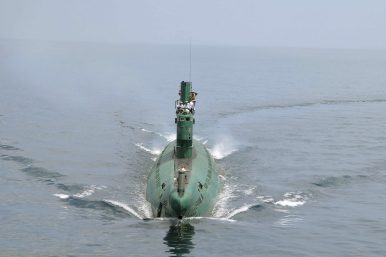
North Korean leader Kim Jong-un (front) stands on the conning tower of a submarine during his inspection of the Korean People’s Army (KPA) Naval Unit 167 in this undated photo released by North Korea’s Korean Central News Agency (KCNA) on June 16, 2014.
Image Credit: KCNA via Reuters

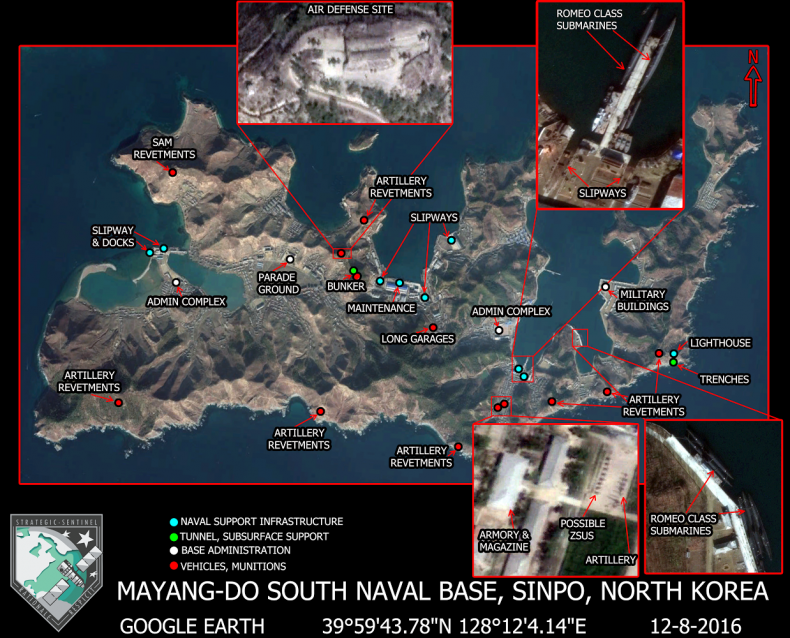
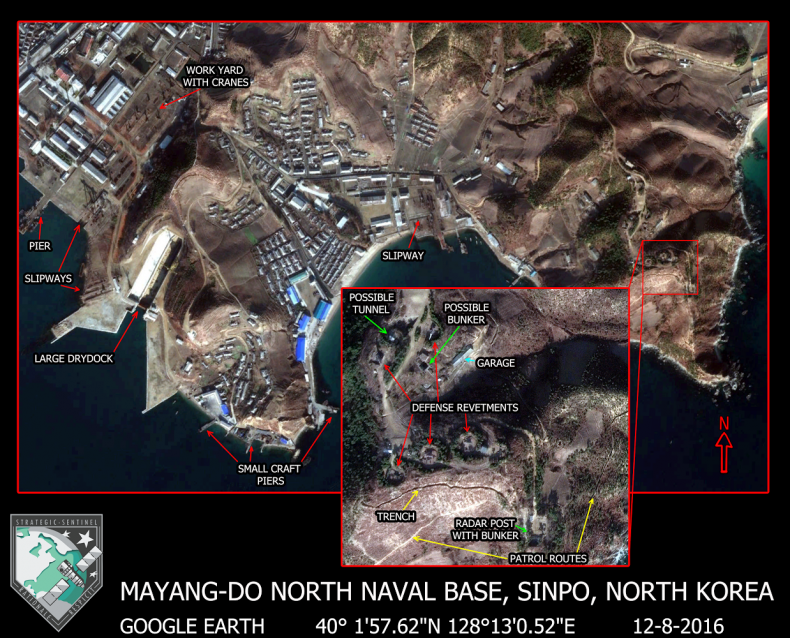
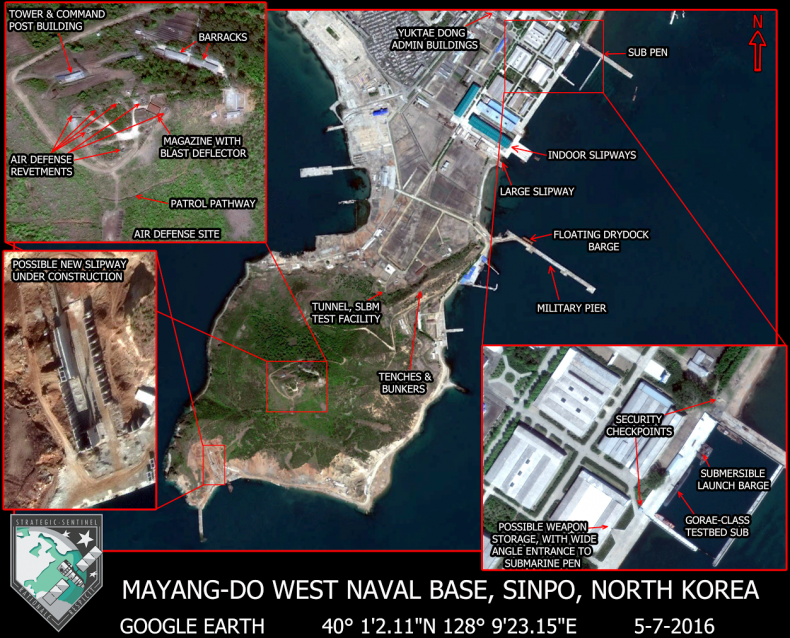
To this effect, the DPRK is building the new Gorae-class submarine (or Sinpo-class) and testing Submarine-Launched Ballistic Missiles (SLBMs) accordingly. Remarkably, most of this activity and materiel are headquartered within a few kilometers of each other in the city of Sinpo and the nearby Mayang-Do Naval Base. Shipyards for the new Gorae-class, SLBM research and development facilities, many or most of the DPRK’s east coast submarines, and the only known ground-based launch platforms for SLBM tests — all are located along the same 35 square kilometer stretch of the North Korean coast. A well-coordinated first strike on this facility would hamstring the North’s submarine fleet, its submarine building capacity, and its hopes of a credible naval nuclear deterrent all in one go.

unnamed (1)

Source: Strategic Sentinel

Significance

Sinpo, a small city bordering the Sea of Japan, has been building North Korean submarines for decades. Sinpo’s shipyards churned out dozens of the aforementioned Shark-class submarines in the 1990s, and are now constructing more of the newest Gorae-class as well. (Nuclear missile submarines are generally larger than their conventional counterparts — Gorae, not incidentally, is Korean for “whale.”) As Joe Bermudez, a renowned expert on North Korean military matters, reportedtwice — this particular vessel may very well undergo more testing and tweaking before more are built. In light of Sinpo’s history with the Shark-class, its current status as headquarters for the Gorae, and the overall prominence of submarines within the DPRK Navy, North Korea undoubtedly regards Sinpo as one of its most valuable shipbuilding sites.

Not content with the prospect of a mobile, surface-launched ICBM capability, North Korea is simultaneously — albeit much more slowly — working toward a sea-based nuclear deterrent. Crafting a reliable SLBM is a long, arduous process, full of tests, setbacks, and incremental improvement. Lamentably, however, North Korean ballistic missile development is progressing much faster than historical precedent would suggest, thanks in large part to newly unemployed Soviet scientists traveling to Pyongyang as the Cold War ended. Still, rigorous testing is necessary for new models to be considered remotely reliable, and the North has yet to come near this threshold in its SLBM program.

Source: Strategic Sentinel

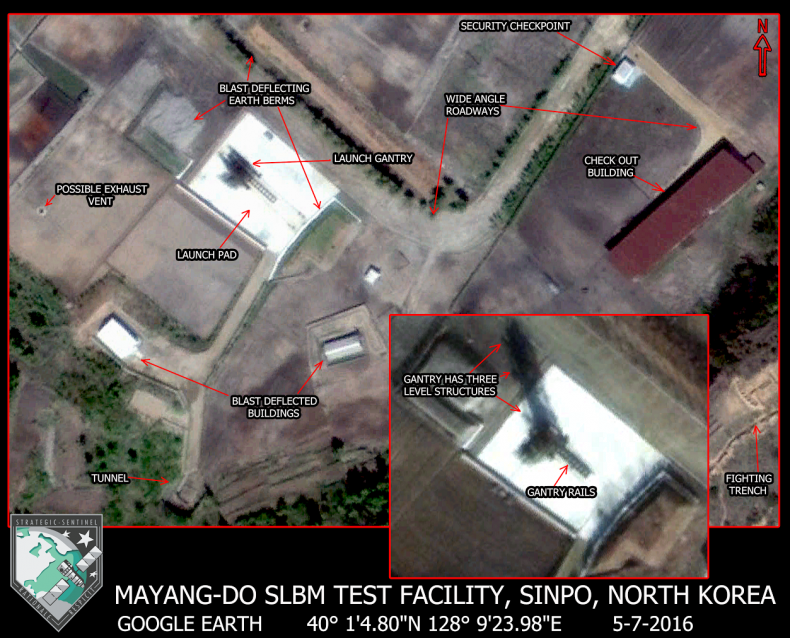
A very poor test of an infant SLBM program could result in substantial damage to the submarine itself. To avoid any such potential and costly destruction, North Korea has constructed a land-based SLBM launch platform at Sinpo, barely a kilometer away from the Gorae’s submarine pen. We believe this to be the only such facility heretofore identified by open-source intelligence. Destroying it — and the Gorae next door — would deliver a crushing body blow to the North’s SLBM program.

0

Source: Strategic Sentinel

Whether North Korea could realistically achieve a working long-range, nuclear SLBM by 2025 remains in serious doubt. Actually producing a functioning naval nuclear deterrent is several other matters entirely. The Gorae-class subs would need to be both quiet and capable of traveling the length of the Pacific Ocean to get into range of the United States, and both of these prospects seem a ways off. Once the vessel design is perfected, North Korea would need to produce at least six such submarines to maintain a continuous, credible deterrent. Then there’s the need for reliable command, control, and communications infrastructure, all of which would need to markedly improve on current conditions. North Korea remains rather far from a sea-based deterrent; one successful strike on Sinpo could set them back many more years.

Scanning a satellite photograph (dated December 2016) of Sinpo’s naval facilities and the Mayang-Do Naval Base not three kilometers off the coast, I personally counted over 25 docked submarines. Satellite imagery from March and May of that year do not reveal quite so many, but still well over a dozen are clearly visible. Most of these were the older, less capable Yono­- and Romeo-class models. Still: the quantity of submarines facing simultaneous destruction is more than high enough to warrant attention; these smaller submarines can be used to traffic North Korean Special Ops into South Korean territory; the brand new Gorae lies within two kilometers of the other clustered submarines; and the research, testing, and naval support facilities add substantially to the base’s strategic value.

0 (1)

Source: Strategic Sentinel

Predictably, a surprise strike would be practically necessary to eliminate all of these assets in one fell swoop. The DPRK would be expected to disperse their submarines during times of heightened tension. (Note that the satellite images from March 2016 — taken during the annual U.S.-South Korea military exercises — show fewer submarines than in December.) A surprise strike could effectively cripple the North Korean East Sea Fleet; recall that submarines are the backbone of the DPRK Navy. Mayang-Do is one of but two east coast submarine bases, and Sinpo is the flagship of the North’s SLBM program.

Vulnerability

Rarely in military strategy do significance and vulnerability pair as smoothly together as they do at Sinpo and Mayang-Do. Generally, a base’s significance bestows upon it a certain vulnerability, for shrewd adversaries tend to strike their opponent’s center of gravity. This can then be ameliorated with physical fortifications, air defense networks, missile defense systems, secrecy, and so on. But truly, little in North Korea is “well defended” by modern military standards.

Sinpo and its related military facilities lie within close range of Toksan and Iwon air bases, both loaded with MiG-21 fighter aircraft. North Korea possesses several sophisticated or pseudo-sophisticated air defense systems, from the ancient SA-2 to the more modern KN-06. The KN-06 is very similar to the Russian S-300 and the Chinese HQ-9, the latter itself also being curiously similar to the S-300. This makes the KN-06 North Korea’s most advanced surface-to-air missile to date and the most plausible threat against American or allied aircraft. The KN-06 is still undergoing testing, however, and it is unclear how many batteries the North plans to produce.

As of right now, MiG-21s and S-200s look to be the most likely defenders of Sinpo and Mayang-Do. These platforms represent no real threat to the U.S., South Korean, or Japanese air forces. In Operation Desert Storm, American F-15s made quick work of Iraqi MiG-21s, 23s, 29s, and Su-25s. North Korea does not currently operate a single aircraft better than those the United States easily defeated over 25 years ago. Perhaps the North Korean Air Force or its SAMs would get lucky and destroy a few U.S. aircraft. Perhaps they get really lucky and slay a few more. Unless they can somehow shoot down most of the planes involved in a first strike — possibly including stealthy F-22s and B-2s or pseudo-stealthy F-35s — and intercept the cruise missiles fired from American and allied ships, the North Koreans would not be able to defend their base from utter destruction.

Conclusion

A strike on Sinpo and the island of Mayang-Do would be a tactician’s dream. One full salvo on the submarines stationed there (and their supportive infrastructure) could constitute the most brutally efficient military operation of the next Korean War. The risk-reward ratio dramatically favors the aggressor. Esteemed professionals — two former secretaries of defense, for example — have called for preventative strikes against North Korean military facilities. That is not what I am doing here. But should an aggressor choose to target Sinpo in such a wave, they could simultaneously cripple much of North Korea’s submarine force and slam its SLBM program to a halt.


From Space, China’s Cyber-Warriors, PLA

Image result for pla china cyber  PLA Unit 61398  Operation Shady Rat

Primer: Xi Jinping to visit president Trump, hum…..will this be a topic?

China’s external strategies in cyberspace – as distinct from its internal social control policies – can be divided into two parts: the first, before late 2015; the second, after that point. The most notable transition, from the U.S. perspective, has been the agreement to foreswear commercial cyberespionage.

Less well noted, but of comparable importance, has been the formation of its Strategic Support Force, which has combined the cyber warriors of the Chinese People’s Liberation Army (PLA), its electronic warriors, and a large chunk of those conducting intelligence, surveillance, and reconnaissance, notably from space.

  FreeBeacon

China Pivots its Hackers from Industrial Spies to Cyber Warriors

Levi Maxey:

China continues to deploy military equipment to contested islands in the South China Sea, raising concerns among regional players and U.S. forces stationed in the Pacific.

A Chinese government strategy document published last month by China’s state-owned news agency Xinhua signals that Beijing is building up its military cyber capabilities. It says that China will “expedite the development of a cyber force and enhance capabilities… to prevent major cyber crisis, safeguard cyberspace security and maintain national security and social stability.”

To be sure, the Chinese document acknowledges that its activities in cyberspace could aggravate tensions with the U.S. and other major powers. It says that “the tendency of militarization and deterrence buildup in cyberspace is not conducive to international security and mutual trust” – seemingly a direct response to the April 2015 Pentagon strategy report strongly emphasizing that the U.S. must build up its offensive capabilities to deter adversaries from engaging in malicious activity in cyberspace.

Given China’s past espionage in cyberspace, its move from economic theft towards militarization in the virtual domain represents a pivot that Washington could regard as threatening. While issues of trade and North Korea are likely to consume much of the discussion during this week’s summit between Chinese President Xi Jinping and President Donald Trump, the growth of cyberspace as a battlefield domain could also be a point of focus. What is China’s history in cyberspace in relation to the United States, and what has led to this change in policy?

Chinese leaders perceive cyberspace as a means of advancing economic growth, preserving the Chinese Communist Party, and maintaining stability and national security. Adam Segal, director of the digital and cyberspace policy program at the Council on Foreign Relations, argues that Chinese state-sponsored hackers seek to steal foreign technology via cyber espionage, weaken domestic opposition to the regime, and offset U.S. conventional military supremacy.

Despite some instances of political and counter-intelligence collection – such as the 2015 breach of the U.S. Office of Personnel Management and the alleged hacking into the 2008 presidential campaigns of former President Barack Obama and Sen. John McCain (R-Az) – Chinese cyber espionage has focused largely on the theft of intellectual property, trade secrets, and other sensitive commercial information. Its chief aim has been to boost Chinese economic competitiveness.

In 2010, Gen. Keith Alexander, then U.S. Cyber Commander and director of the National Security Agency, said that, “our intellectual property here is about $5 trillion. Of that, approximately $300 billion is stolen over the networks per year.” He called this theft “the greatest transfer of wealth in history.” By 2013, U.S. officials had begun publically decrying China’s economic espionage, only to be faced with denial from Beijing. In 2014, the Department of Justice obtained indictments against five members of the Chinese People’s Liberation Army (PLA), charging them with using computer network operations to commit commercial espionage.

Not long after, the U.S. threated China with sanctions and potential cancellation of a planned summit in September 2015 between President Xi and then-President Obama. Negotiators were quickly dispatched and the event went forward. During the summit both countries announced an accord, commonly referred to as the Xi Agreement, in which they agreed that “neither country’s government will conduct or knowingly support cyber-enabled theft of intellectual property, including trade secrets or other confidential business information, with the intent of providing competitive advantages to companies or commercial sectors.”

The Xi Agreement was shocking in that China implicitly acknowledged having conducted economic espionage in the past and agreed to stop doing it. Many observers were skeptical that the Chinese would abide by the pact, but a report by Mandiant, now a branch of the American cyber security firm FireEye, found a notable decline in Chinese hackers targeting U.S. companies – which suggests that the Chinese were taking the accord seriously.

However, according to Chris Porter, manager of FireEye’s Horizons team, “while appearing as a significant diplomatic victory for the Obama administration, in reality China simply agreed to stop doing operations that it didn’t want to continue anyway.” He notes that Chinese hackers were often moonlighting as for-hire-hackers, sometimes even targeting Chinese companies. At the time, President Xi was in the midst of a robust anti-corruption campaign while also centralizing power, including in cyberspace, under his control.

Porter argues that “Chinese leaders are heeding a lesson about the limitations of cyber espionage that stems from the fall of the Soviet Union: you cannot steal your way to innovation.” China hopes eventually to become a world leader in cutting-edge research, he says, so it “wants to live in a world where patents are respected and its own claims are viewed as legitimate and untainted by accusations of intellectual property theft.”

Martin Libicki, the Keyser Chair of cybersecurity studies at the U.S. Naval Academy, says that ultimately, “A combination of declining returns and increasing risks on the one hand and the prospects of U.S. sanctions on the other led Chinese President Xi Jinping to agree to end Chinese commercial cyber espionage against first the United States, then the United Kingdom, and finally the other G-20 nations.” Chinese hackers are still conducting some business-focused espionage and recently have intensified their targeting of Russian officials and institutions. But they seem focused on gleaning intelligence on military capabilities and on government officials who interact with business executives.

Furthermore, the Chinese People’s Liberation Army (PLA) elevated cyber operations under the Strategic Support Force in December 2015, placing the virtual domain on par with other branches of the military. “The best guess,” Libicki says, “is that Chinese cyber warfare will be focused on supporting conventional military operations as opposed to assuming an independent role in strategic warfare, as U.S. Cyber Command seems to be doing, or to bolster information operations, as Russia seems to be doing.”

The U.S. may use its cyber capabilities for “left-of-launch” missile defense against North Korea – meaning, sabotaging planned missile launches before they happen – and to disrupt ISIS communications.

By contrast, China is consumed by fears of a massive U.S. military intervention in Asia. Beijing is building up its anti-access and area-denial (A2/AD) military strategy in the South China Sea by adding cyber and electronic warfare capabilities meshed into what is referred to as “Integrated Network-Electronic Warfare.” A report published by the NATO Cooperative Cyber Defence Centre of Excellence in Tallinn maintains that PLA units responsible for electronic warfare are taking on the role of running computer network operations as well.

China’s “strategy consists of neutralizing the logistics and communications infrastructure that permits U.S. forces to operate so far from home,” Libicki says, and is “pursuing the ability to corrupt U.S. information systems – notably, those for military logistics – and disrupt the information links associated with command and control.”

Such network and electronic attacks could target the U.S. military or regional allies’ early warning radar systems and could cause blind spots in U.S. command and control systems. The PLA could use these blind spots to deploy sorties or launch ballistic missile strikes. It could deliver these capabilities early in hostilities, integrated with technologies that could sabotage U.S. weapons systems, or even U.S. critical infrastructure, so that U.S. forces could not respond in a timely way.

To accomplish effective cyber attacks on U.S. command, control and communications platforms, or any advanced systems, the PLA would have to conduct cyber reconnaissance ahead of time. China has already begun to probe some potential targets, including elements of the U.S. power grid and review the designs of weapons systems such as the F-35 combat aircraft, the Patriot missile defense system, and U.S. Navy littoral combat ships.

“Because China, like other nations, has had far less practice at cyber warfare than cyber espionage, it is harder to anticipate its intentions and plans,” says Libicki. China’s efforts to augment kinetic assaults with cyber and electronic warfare could escalate a conflict by setting up a scenario in which adversaries might view espionage as a step toward war.